

LeadIQ vs Apollo.io: Which One Actually Delivers?
LeadIQ and Apollo.io solve different problems disguised as the same product category. One's a browser-based capture tool built for SDRs who live in their CRM. The other's an all-in-one outbound engine with sequencing, a dialer, and a massive contact database baked in. Pick the wrong one and you're paying for workflows you'll never touch.
30-Second Verdict
Choose Apollo if you want sequencing, a dialer, and a 275M+ contact database in one platform - and you're okay managing credit limits. Choose LeadIQ if your SDRs need fast browser-to-CRM capture and you've already got a sequencing tool in place.
Skip both if your real problem is bounce rates and bad phone numbers. We've watched teams blame their messaging for months when the actual culprit was 30%+ email bounces underneath it all.
Pricing Breakdown
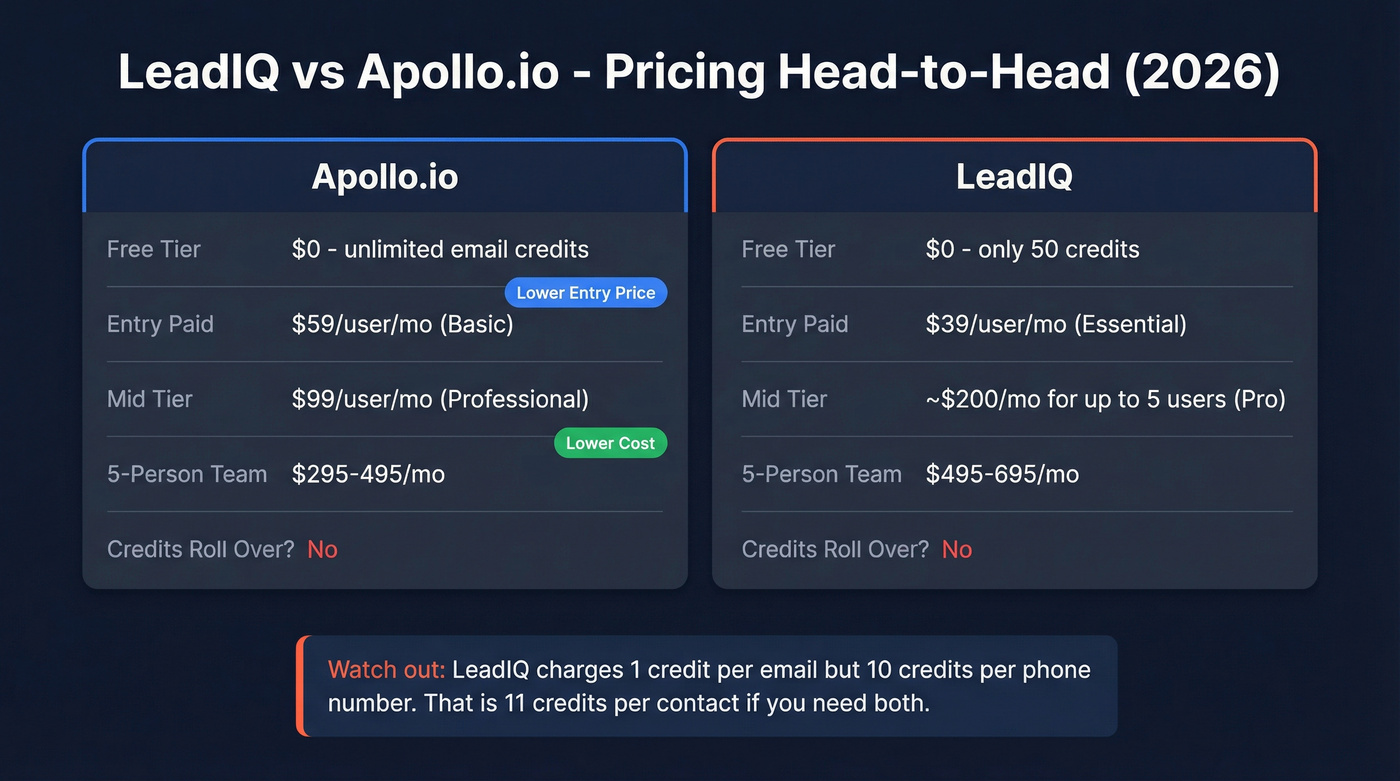
Both tools use per-seat pricing plus usage limits and credits. Unused credits expire each billing cycle - wasted money, full stop.
| Dimension | Apollo.io | LeadIQ |
|---|---|---|
| Free tier | $0 (1 user; unlimited email credits, limited mobile/export) | $0 (1 user, 50 credits) |
| Entry paid | Basic: $59/user/mo | Essential: $39/user/mo |
| Mid tier | Professional: $99/user/mo | Pro: ~$200/mo (up to 5 users) |
| Enterprise | $1,188/yr/user | Custom (annual only) |
| 5-person team | ~$295-495/mo before add-ons | ~$495-695/mo |
| Credits roll over? | No | No |
Starting in late 2025, Apollo users flagged tighter restrictions around uploads and workarounds people used to generate "free" lookups - including blocked uploads for emails, phone numbers, and even profile URLs. If you're budgeting based on older pricing guides, recalculate.
LeadIQ's credit math is sneakier than it looks. One email costs 1 credit, but a phone number costs 10. Need both? That's 11 credits per contact, which drains your allocation fast if you're pulling direct dials for every prospect.
An analysis of 93 actual LeadIQ deals found a median annual cost of $26,400, ranging from $6,096 to $58,240. The average buyer negotiated 21% off list price, so don't pay sticker. For most SMB teams, Apollo is the cheaper option by a wide margin.
Data Quality: Claims vs. Reality
Here's the thing - the industry lacks a controlled accuracy benchmark between these two tools. Every comparison out there is feature-and-pricing-led, not data-led. That's a problem, because data quality is the #1 reason teams switch providers.
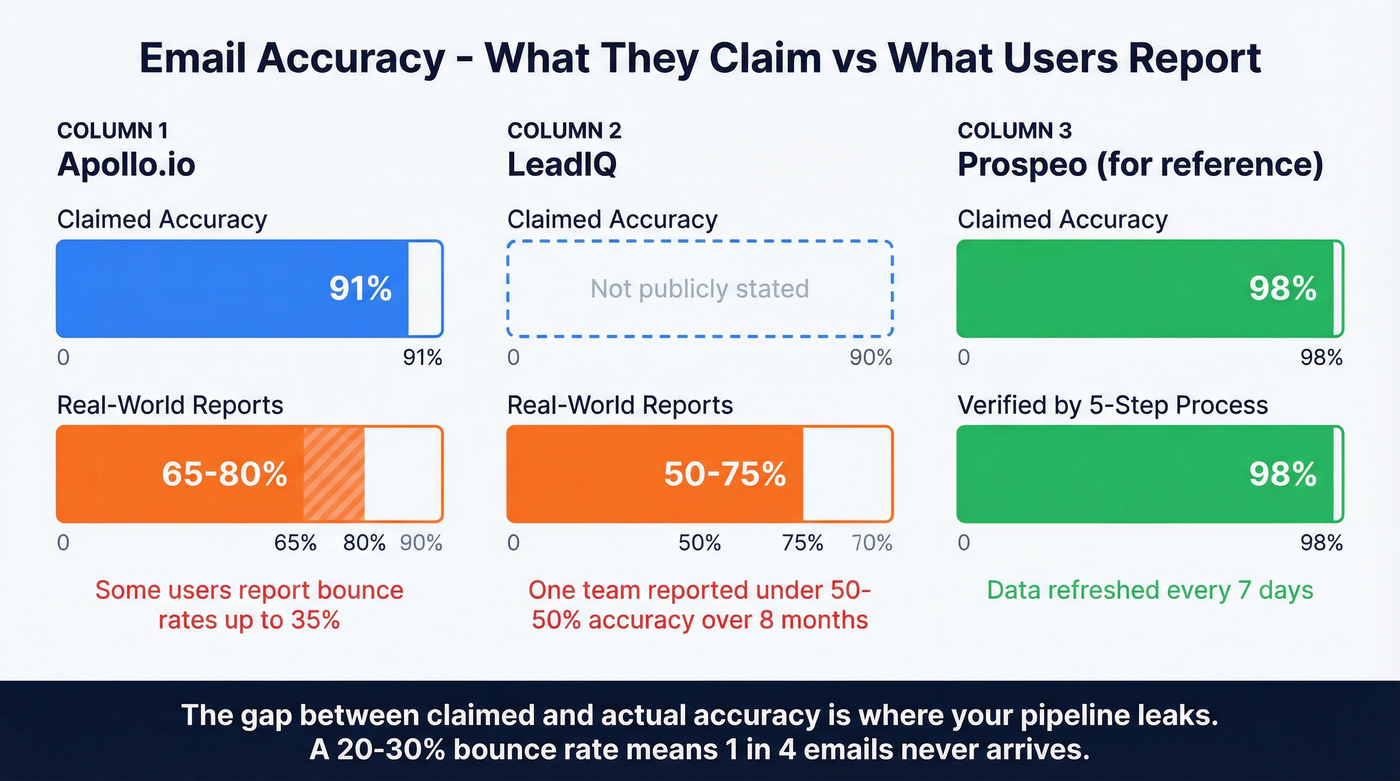
Apollo claims 91% email accuracy through a 7-step verification process. Real-world reports tell a different story. Independent reviews consistently cite 65-80% accuracy, with some Reddit users reporting bounce rates as high as 35%. One r/SaaS thread summarized it bluntly: "Apollo/LeadIQ: 5k leads, 60% bad data, 2% reply rates."
LeadIQ isn't immune. A G2 reviewer - a Sr. Director of BD at a mid-market company - praised the Chrome extension but flagged "lots of bounced emails" and "incorrect direct dial / no direct dial." A separate Reddit thread reported less than 50% email accuracy over 8 months. That's a worst case, not typical, but the pattern is consistent across both tools: the databases are large, the verification is shallow.

Let's be honest: if your average deal size is under $15k, you probably can't afford the pipeline leakage from 65-80% email accuracy. We've seen teams burn entire quarters chasing ghosts.

Both Apollo and LeadIQ users report 65-80% email accuracy in real-world tests. Prospeo's 5-step verification delivers 98% accuracy across 300M+ profiles - refreshed every 7 days, not every 6 weeks. At $0.01/email, you stop paying for contacts that bounce.
Replace bad data before it burns another quarter of pipeline.
Features That Actually Differ
Apollo's edge: It's a full outbound platform. You get a 275M+ contact database, multi-step email sequences with A/B testing, a built-in dialer, and workflow automation - all in one login. The tradeoff is complexity. If you're only using it for enrichment, reviewers flag slow support and CRM duplicate issues that make it overkill for simpler workflows.
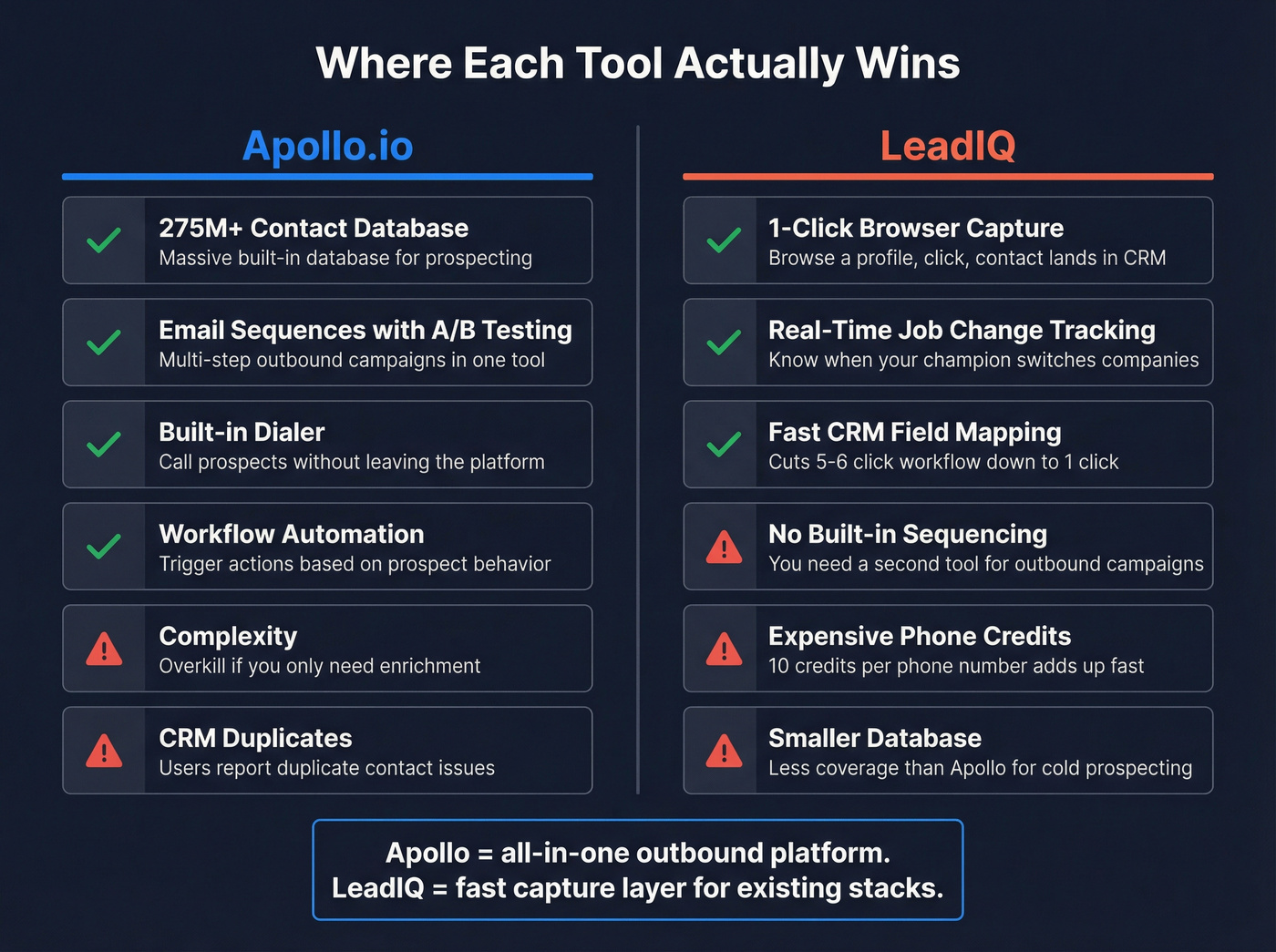
LeadIQ's edge: The Chrome extension workflow is genuinely fast. Browse a professional profile, click capture, and the contact lands in your CRM with fields mapped. LeadIQ claims this cuts the typical 5-6 click prospecting flow down to one. It also tracks job changes in real time, which is gold for champion tracking when your buyer switches companies. But if you need sequencing, you're buying a second tool - and that second tool has its own price tag.
User Reviews at a Glance
| Metric | Apollo.io | LeadIQ | Edge |
|---|---|---|---|
| G2 rating | 4.7/5 (9,514 reviews) | 4.2/5 (1,160 reviews) | Apollo |
| G2 Meets Requirements | 9.1 | 8.2 | Apollo |
| TrustRadius "Buy again" | 93% (171 responses) | 85% (17 responses) | Apollo (larger sample) |
| Primary segment | Small-business (67%) | Mid-market (60%) | Depends on your size |
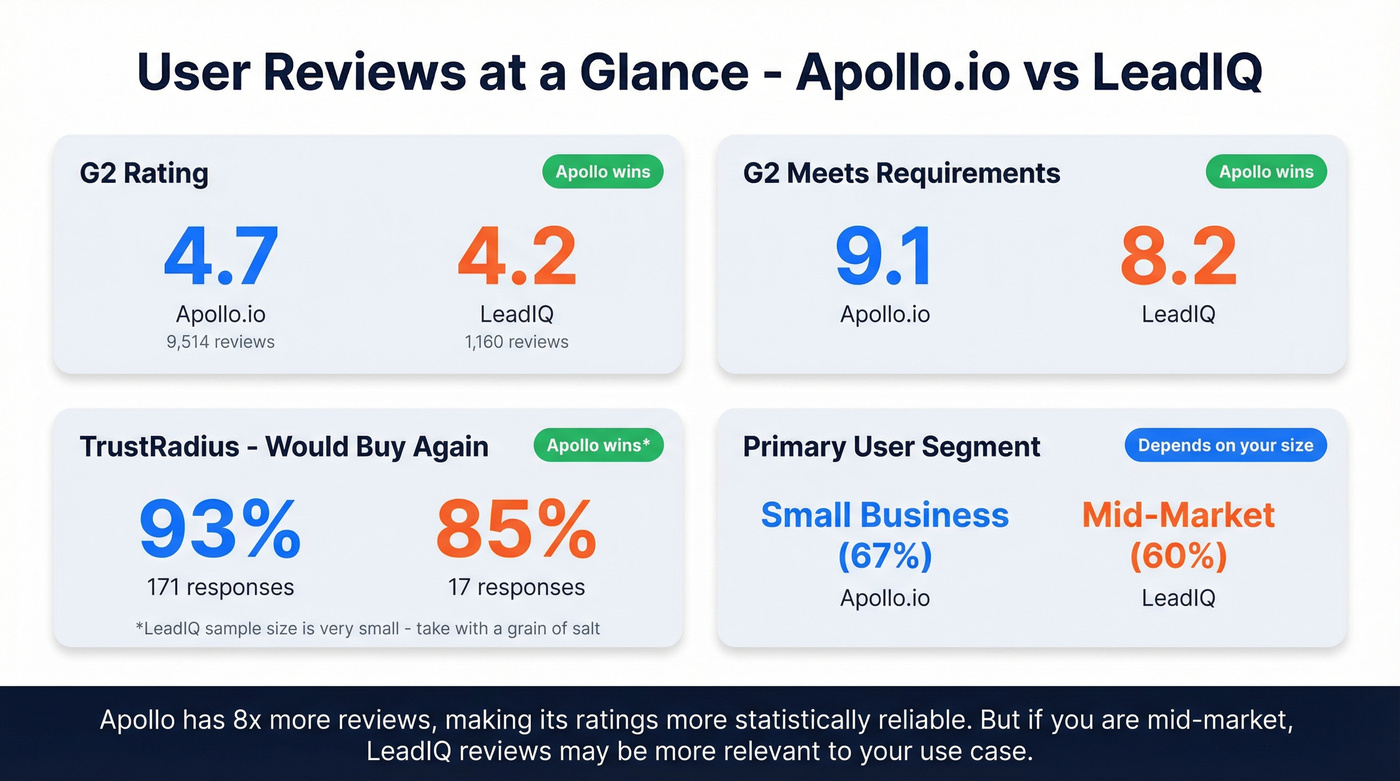
Apollo wins on volume and satisfaction. Its review base is 8x larger, which makes the 4.7 rating more statistically meaningful. LeadIQ's TrustRadius sample is just 17 responses - take that 85% with a grain of salt.
The segment split matters, though. If you're a 200-person company with an established SDR motion, LeadIQ's mid-market reviews are more representative of your use case than Apollo's small-business-heavy sample.
When to Skip Both
The #1 complaint about both Apollo and LeadIQ is the same: bad data. Bounced emails, wrong phone numbers, wasted credits. The consensus on r/sales threads is pretty clear - most teams eventually layer in a verification tool or replace their primary database entirely.
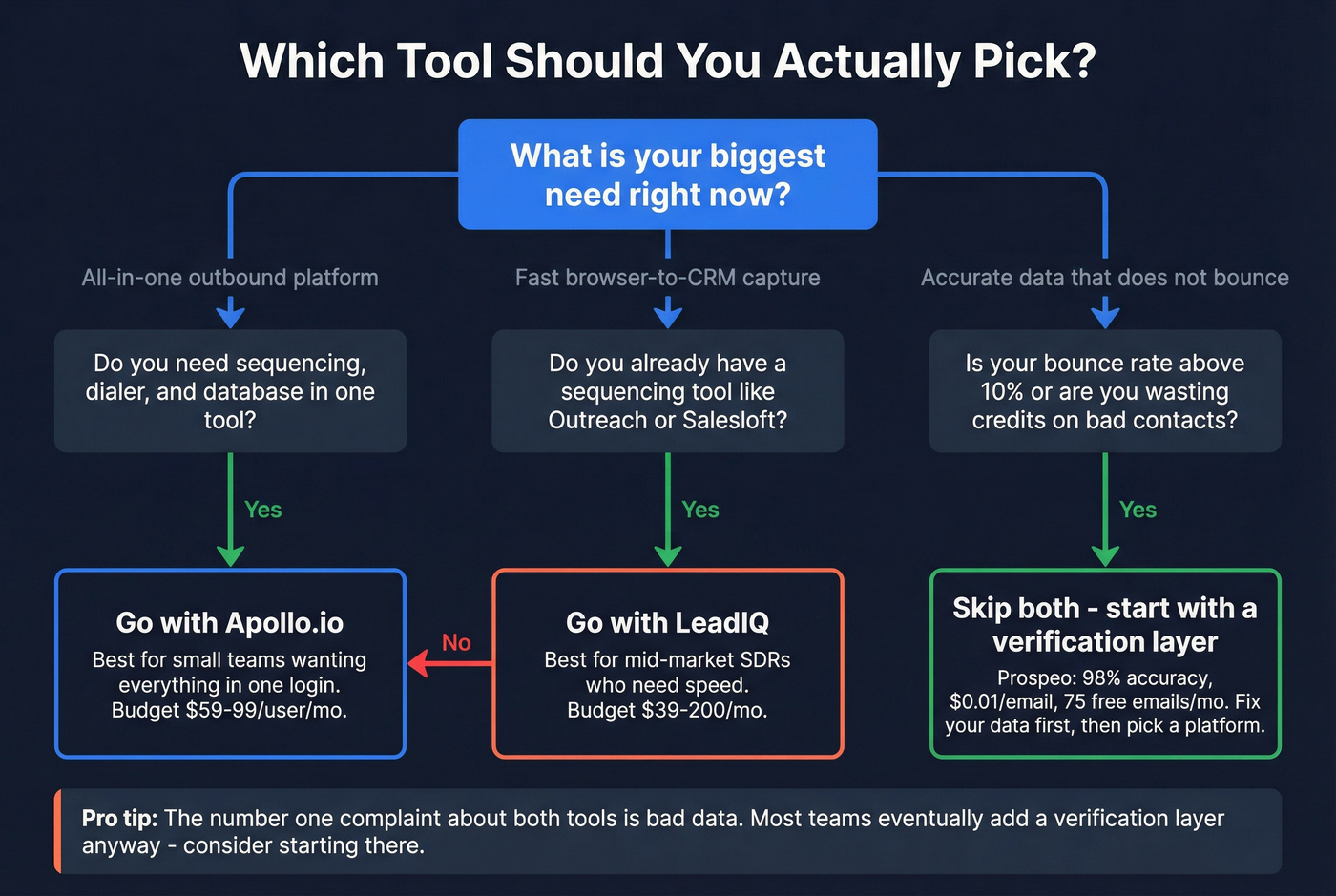
In our testing, the teams that get the best results pair their prospecting tool with a dedicated verification layer. Prospeo covers 300M+ professional profiles with 98% email accuracy and 125M+ verified mobile numbers that hit a 30% pickup rate. Data refreshes every 7 days, not the 4-6 week cycle most providers run. There's a free tier with 75 emails/month, paid plans start at roughly $0.01/email, and there are no contracts.
If you're evaluating other B2B contact databases, it's worth comparing refresh cadence and verification depth, not just record counts.
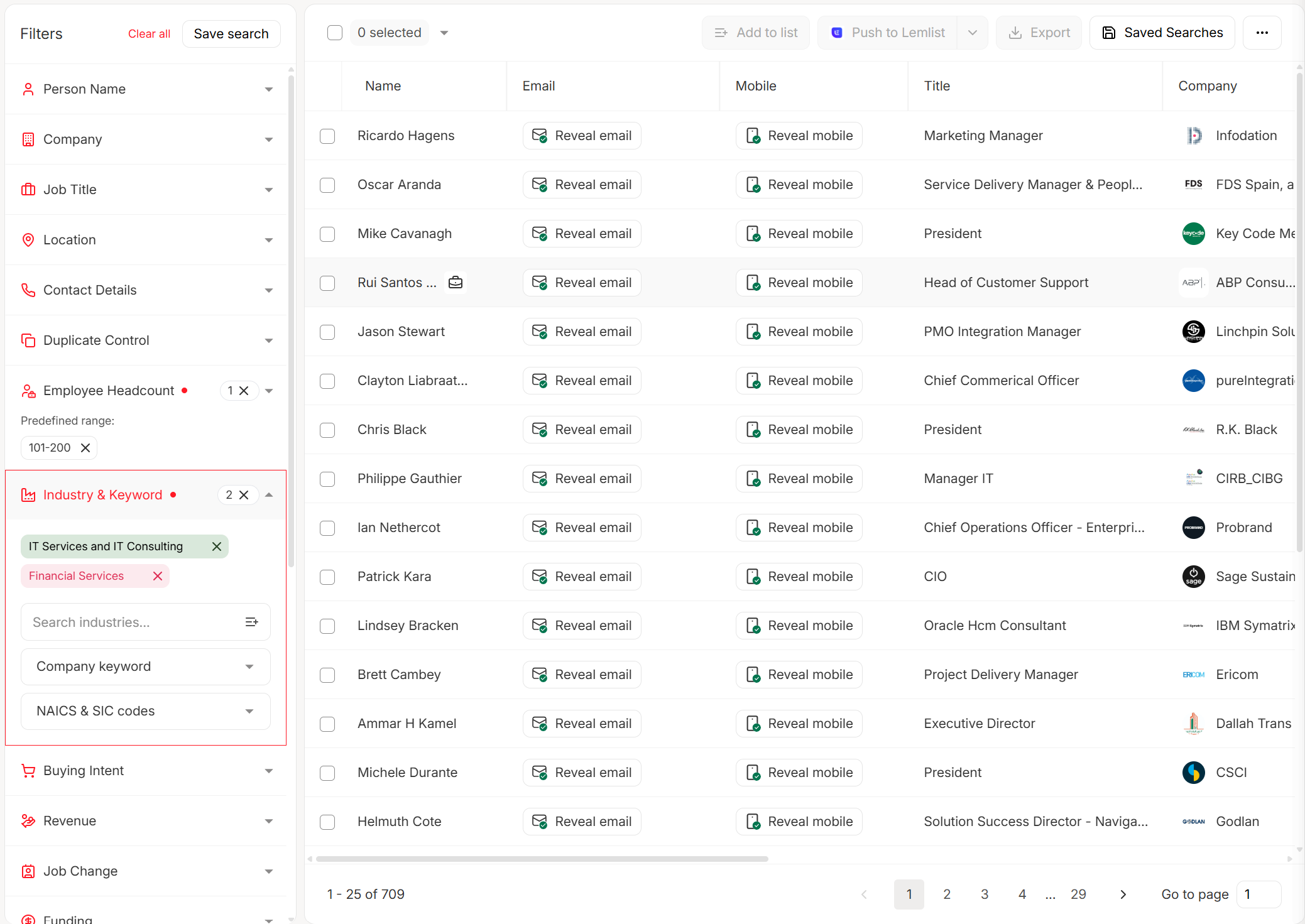
LeadIQ charges 10 credits per phone number. Apollo restricts mobile exports behind higher tiers. Prospeo gives you 125M+ verified mobile numbers with a 30% pickup rate - no tier-gating, no credit tricks.
Get direct dials that actually connect, starting free today.
FAQ
Is Apollo.io better than LeadIQ for small teams?
Generally, yes. Apollo's free tier is far more generous - unlimited email credits vs. 50 - and its all-in-one platform means fewer tools to manage and fewer invoices to justify. LeadIQ's value kicks in at mid-market teams that already have a sequencing tool and need fast browser-to-CRM capture for their SDRs.
Why do both tools have so many data quality complaints?
Neither tool runs real-time verification on every record. Both rely on large databases that decay as people change jobs and companies switch email providers. Pairing either with a dedicated verification tool that refreshes data weekly reduces bounce rates from 20-35% to under 5%.
Can I use Apollo.io and LeadIQ together?
Some teams do - LeadIQ for browser-based capture, Apollo for sequencing. But the overlapping credit costs add up fast, and you're paying for two databases. Most teams we've talked to pick one and add a verification layer instead. That's usually the more cost-effective path.
What's a good alternative if neither fits my budget?
Prospeo offers 75 free verified emails per month with no credit card required, plus a Chrome extension with 100 free credits. Paid plans run about $0.01 per email with native integrations for Salesforce, HubSpot, Instantly, and Lemlist. For teams that need accurate data without enterprise pricing or annual lock-ins, it's worth a look.