

The Best B2B Contact Databases in 2026 - With Pricing Nobody Else Publishes
We've watched teams run three-tool bake-offs where the "biggest" database created 4,000 duplicate contacts in Salesforce within five days. The cheapest tool had better phone connect rates and half the bounce rate. Database size is a vanity metric. What actually matters is how many contacts are usable when your reps hit send.
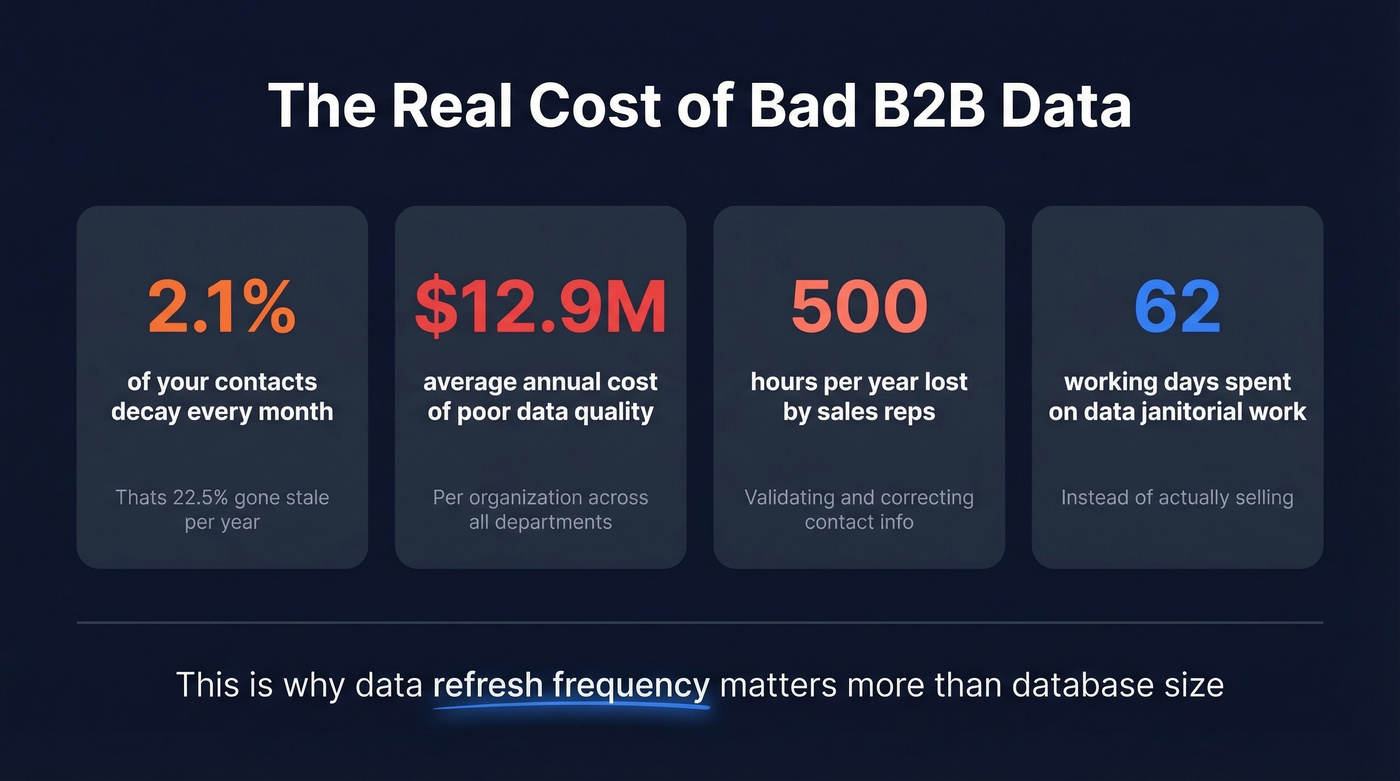
B2B contact and company data decays at roughly 2.1% per month - that's 22.5% of your database going stale every year. Wrong emails, changed titles, departed employees. Poor data quality costs organizations $12.9M annually on average, and sales reps lose about 500 hours per year just validating and correcting contact info. That's 62 working days spent on data janitorial work instead of selling.
Here are the 12 providers worth evaluating right now, with real pricing, accuracy benchmarks, and the credit math that determines what you'll actually pay. (If you want a shorter shortlist, see our guide to the best B2B databases.)
Our Picks (TL;DR)
- Prospeo - Best for email accuracy and data freshness. 98% email accuracy on 143M+ verified emails, a 7-day refresh cycle, and a free tier to test before you commit. If deliverability is your bottleneck, start here.
- Apollo.io - Best free starting point. A generous free tier with built-in email sequences. Great for SMBs that want prospecting and outreach in one tool.
- Cognism - Best for European coverage. Diamond Data phone-verified mobile numbers drive higher connect rates, and the compliance posture is strong. If your ICP is EMEA-heavy, Cognism is the obvious pick.
How We Evaluated
We scored each database across six criteria that actually predict whether a tool works in production:
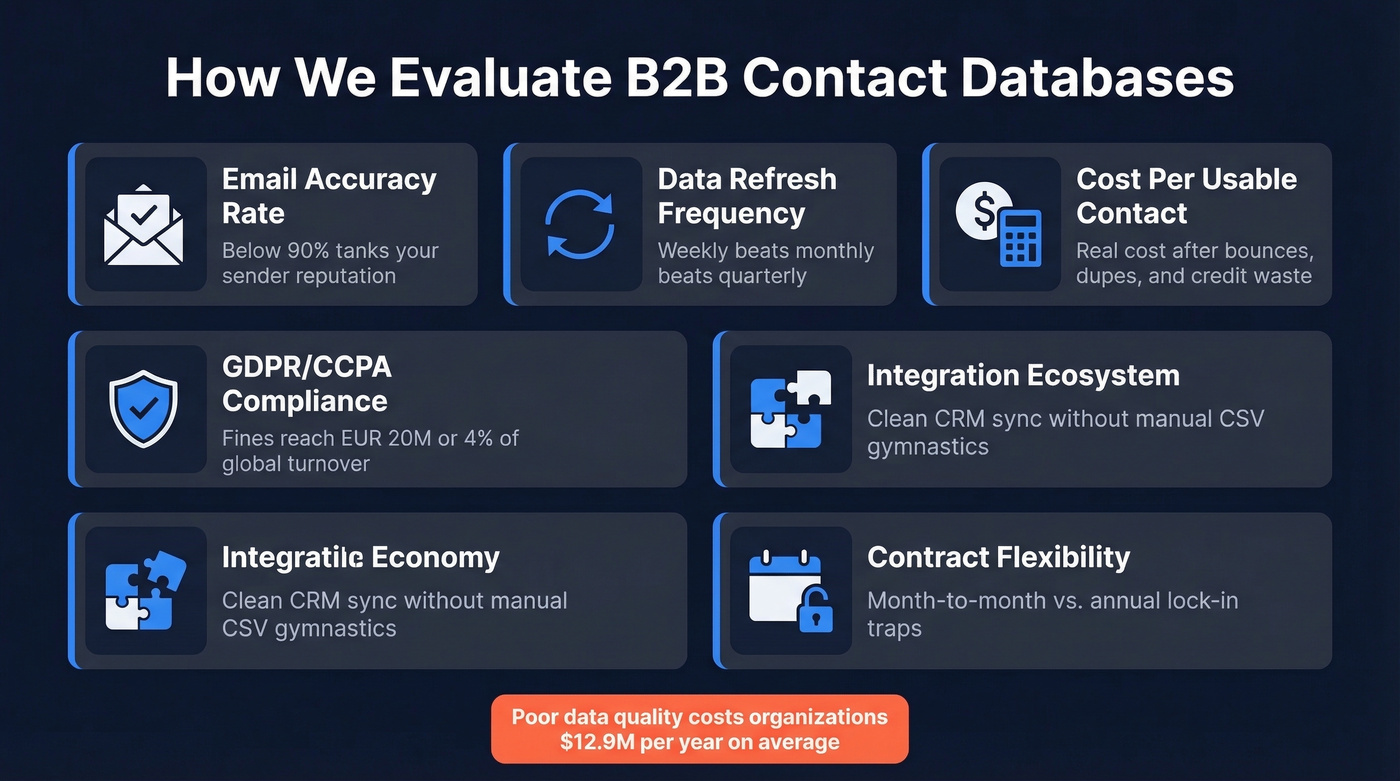
- Email accuracy rate - What percentage of exported emails are deliverable? Anything below 90% tanks your sender reputation (use an email verifier to benchmark vendors).
- Data refresh frequency - Weekly beats monthly. Monthly beats quarterly. Stale data is expensive data.
- Cost per usable contact - Not the sticker price. The real cost after you account for bounces, duplicates, and credit waste.
- GDPR/CCPA compliance - Consent tracking, DSAR fulfillment, opt-out enforcement. GDPR fines reach EUR 20M or 4% of global annual turnover.
- Integration ecosystem - Does it push clean data into your CRM and sequencer without manual CSV gymnastics?
- Contract flexibility - Annual lock-ins with auto-renewal traps vs. month-to-month self-serve.
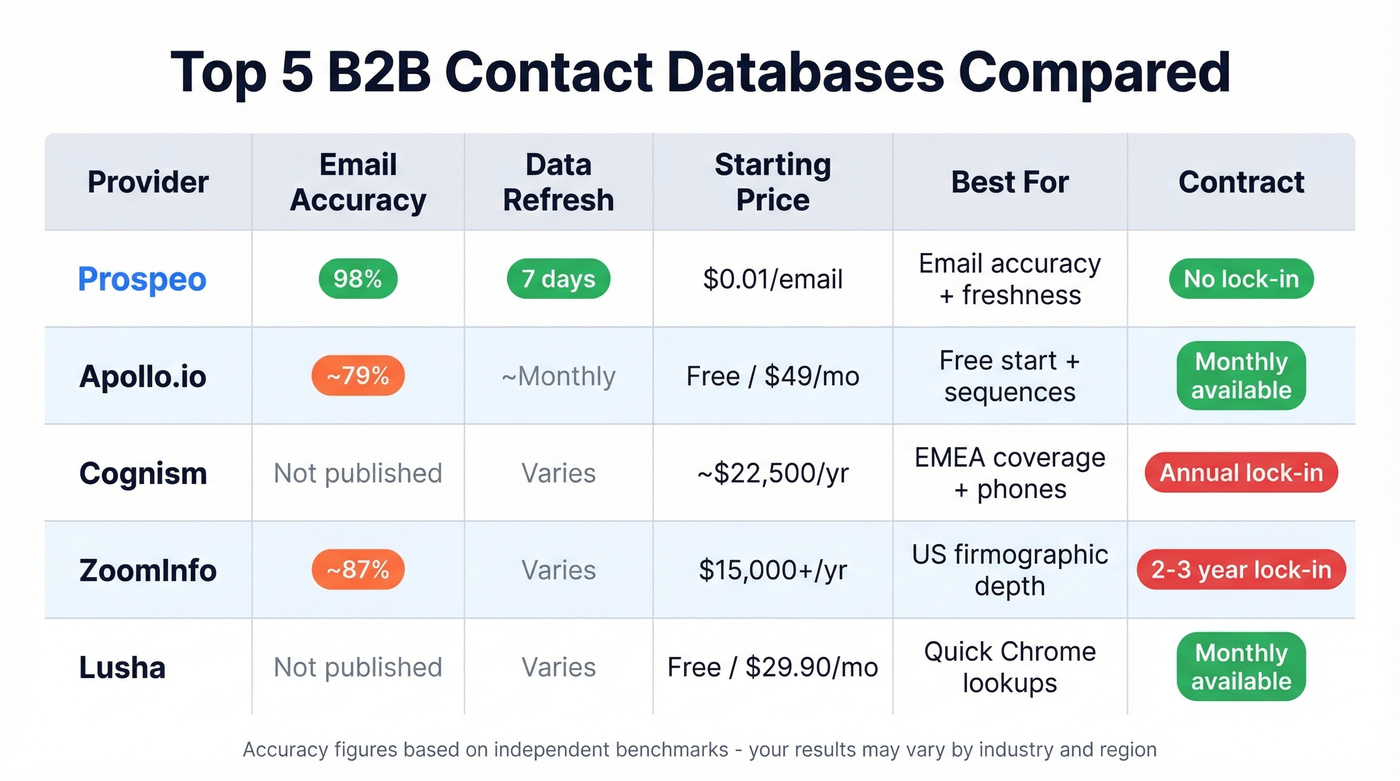
Side-by-Side Comparison
| Tool | Starting Price | Best For |
|---|---|---|
| Prospeo | ~$0.01/email (free tier) | Email accuracy + freshness |
| Apollo.io | Free / $49/mo | Free start + sequences |
| Cognism | ~$22,500/yr | EMEA coverage |
| ZoomInfo | $15,000+/yr | US firmographic depth |
| Lusha | Free / $29.90/mo | Simple Chrome lookups |
| Seamless.AI | ~$100-$300/mo | Targeted real-time search |
| Lead411 | ~$49/user/mo | Predictable prospecting costs |
| RocketReach | Free / from $39/mo | One-off research |
| UpLead | $99/user/mo | Small teams |
| SalesIntel | ~$5,000+/yr | Phone-first outbound |
| Kaspr | From EUR 45/mo | European phone numbers |
| Instantly | ~$30/mo | All-in-one cold email |

You just read that B2B data decays at 2.1% per month. Most databases on this list refresh every 4-6 weeks - by then, thousands of contacts are already stale. Prospeo refreshes every 7 days across 300M+ profiles, delivering 98% email accuracy at ~$0.01 per email. That's why teams like Snyk cut bounce rates from 35% to under 5% and added 200+ new opportunities per month.
Test 75 emails free and see the accuracy difference yourself.
The 12 Best Providers Ranked
Prospeo
Use this if: You need the highest deliverability in the market and don't want to negotiate a contract. Prospeo's 300M+ profiles include 143M+ verified emails and 125M+ verified mobile numbers, all refreshed on a 7-day cycle. The 30+ search filters cover buyer intent powered by Bombora across 15,000 topics, technographics, job changes, headcount growth, and funding signals.

The Chrome extension has 40,000+ users - it pulls verified contact data from any website in one click. CRM enrichment returns 50+ data points per contact at a 92% API match rate. Meritt tripled their pipeline from $100K to $300K per week after switching, with bounce rates dropping from 35% to under 4%. (For more options in this category, compare data enrichment tools.)
Skip this if: You need a built-in dialer or full outreach suite. Pair Prospeo with Smartlead, Instantly, or Lemlist for sequencing - the native integrations handle this cleanly (see our picks for outbound email automation).
Pricing: ~$0.01 per email, 10 credits per mobile number. Free tier includes 75 emails and 100 Chrome extension credits monthly. No contracts, cancel anytime.
Apollo.io
Use this if: You're an SMB that wants prospecting, enrichment, and email sequences in one platform without paying enterprise prices. Apollo's free tier is genuinely generous, and the built-in sequencer means you don't need a separate outreach tool on day one.
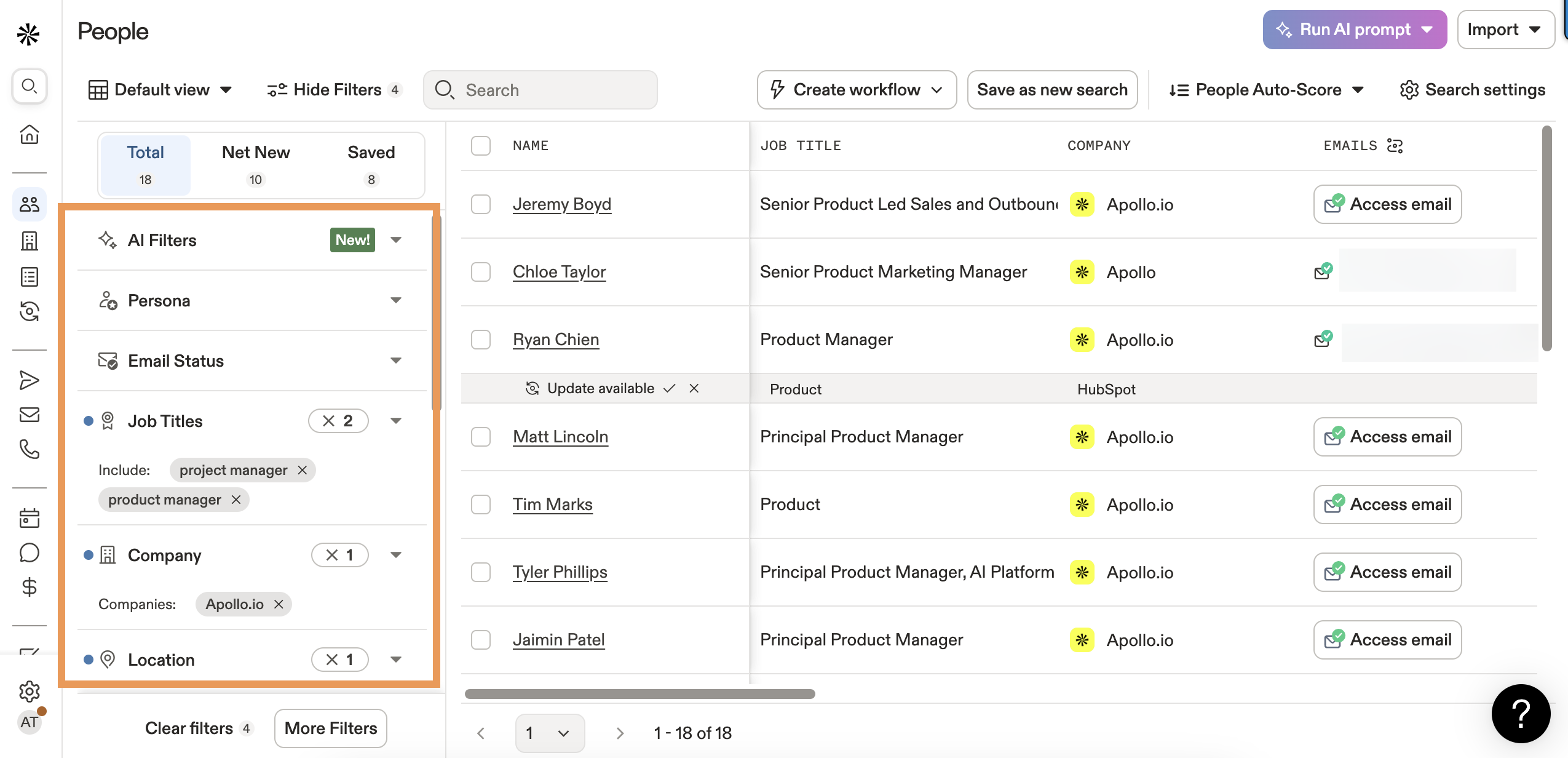
Skip this if: Email accuracy is critical to your domain reputation. In our benchmark, Apollo email accuracy runs around 79% - roughly one in five emails bounces. At scale, that's a deliverability problem (run an email reputation check if bounces spike). Also watch the credit model: credits don't roll over month-to-month, and waterfall enrichment can spike costs unpredictably.
Pricing: Free tier available. Basic $49/mo, Professional $79/mo, Organization $119/mo (minimum 3 seats). Additional credits run ~$0.20 each.
Cognism
Use this if: Your ICP lives in the UK or continental Europe. Cognism's Diamond Data phone-verified mobile numbers are designed to deliver a 3x connect rate. The GDPR compliance infrastructure is genuinely strong - not just a checkbox (use a GDPR compliant database checklist when you evaluate vendors).
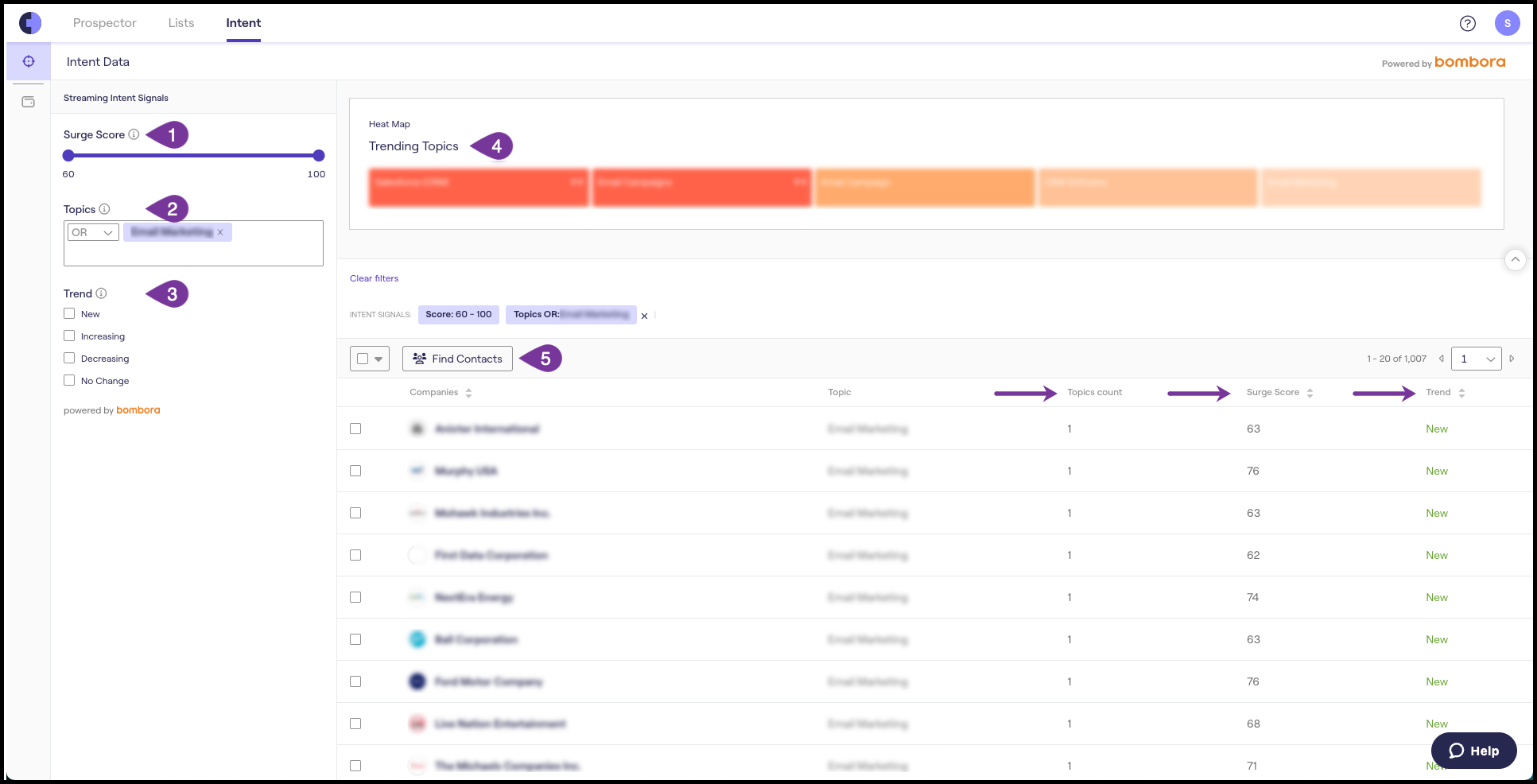
Skip this if: You're selling primarily into North America. Cognism's North American coverage is thinner than the most US-centric databases, and the pricing doesn't justify it for a US-only motion. Budget for hidden costs too: onboarding runs $2,000-$5,000, API/enrichment overages add $5,000-$15,000/year, intent topics run $200-$400 per topic annually (negotiable to $75-$150), and "unlimited" access is governed by fair-use limits of ~2,000 records per user per month.
Pricing: Grow ~$22,500/year for 5 users, Elevate ~$37,500/year. Annual lock-in required.
ZoomInfo
The deepest US firmographic database in the market, full stop. If you need granular company data - technographics, org charts, intent signals - ZoomInfo's breadth is hard to beat. But you'll pay for it.
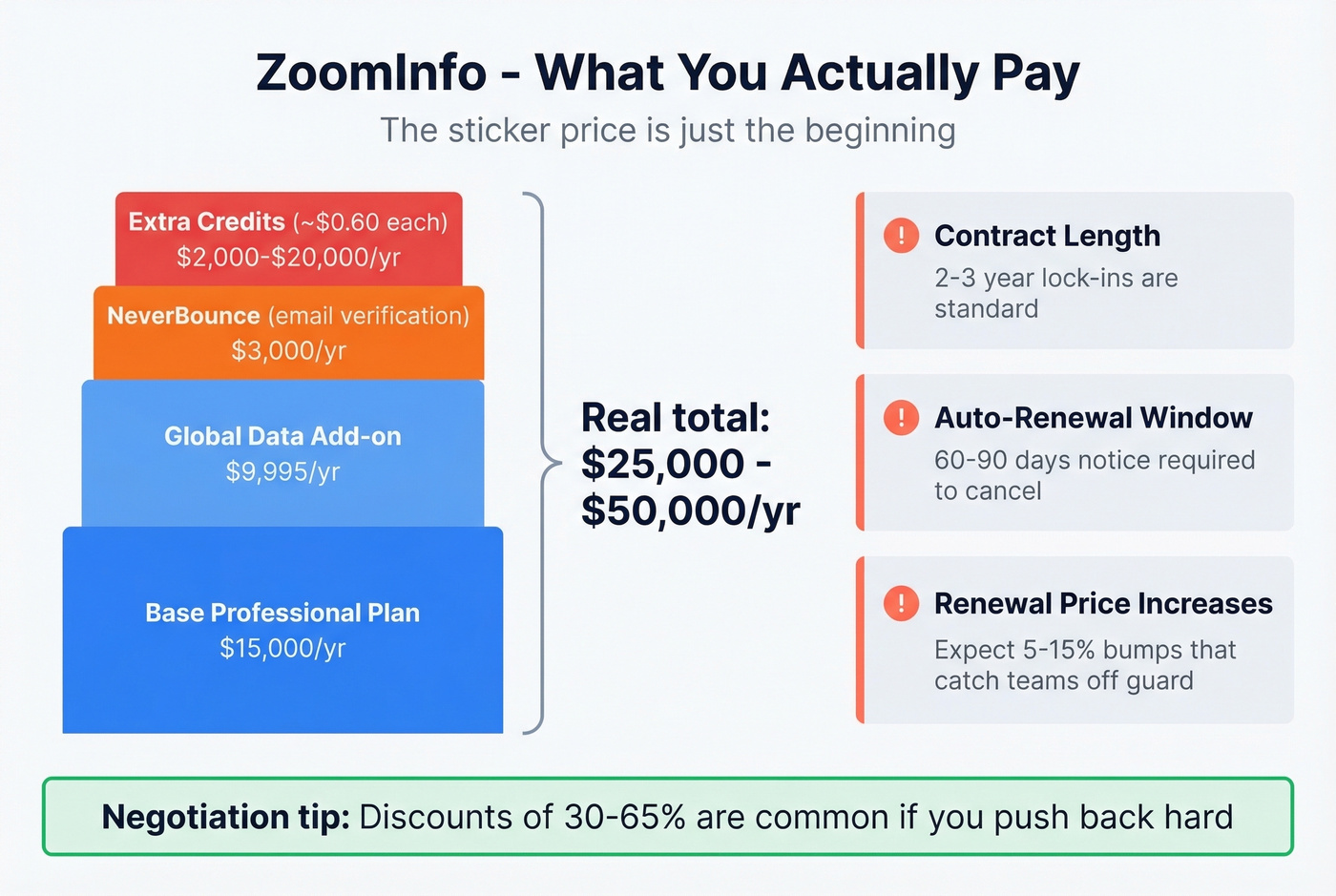
Professional starts at $15,000+/year, but most teams pay $25,000-$50,000 all-in once you add Global Data ($9,995), NeverBounce ($3,000), and extra credits (~$0.60/credit). Contracts run 2-3 years with auto-renewal windows of 60-90 days and renewal increases that catch people off guard. In our benchmark, ZoomInfo email accuracy sits around 87%. Discounts of 30-65% are common if you negotiate hard.
Here's the thing: ZoomInfo is still the best all-in-one platform for large US-focused teams. But the #1 complaint on r/sales isn't the data - it's paying for modules you never turn on. A practitioner there put it bluntly: "Your competitors are emailing the same ZoomInfo contacts you are." The overused-contacts problem is real, and it's one reason smaller, fresher databases often outperform on reply rates.
Lusha
Lusha wins on simplicity. The Chrome extension works, the UI is clean, and you can be pulling contacts within five minutes of signing up. For individual contributors who need quick lookups without a learning curve, it's hard to beat (see more contact extensions).
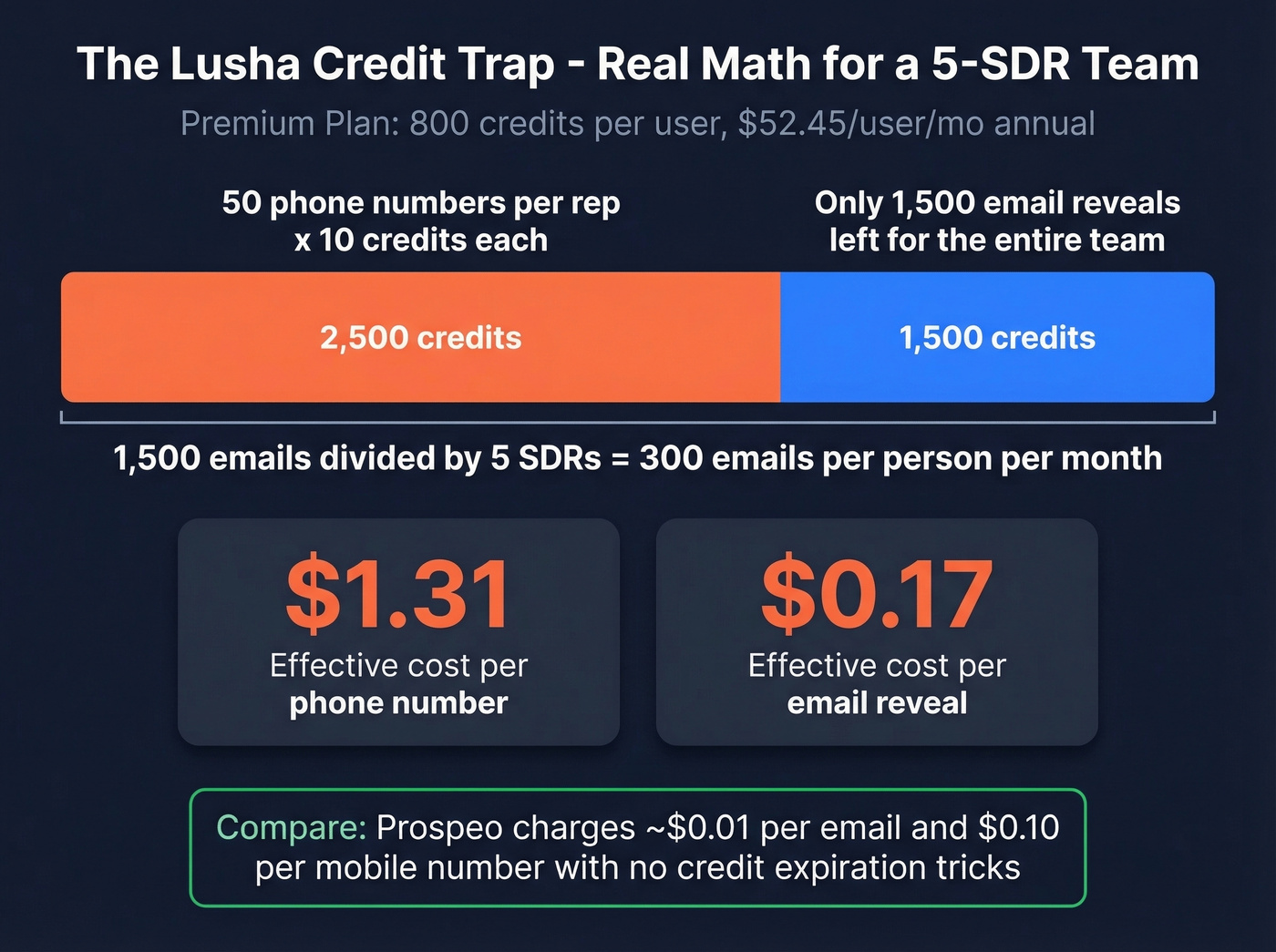
But the credit math gets brutal fast. One email reveal costs 1 credit. One phone number costs 10 credits. Run the numbers: 5 SDRs on Premium (800 credits each, $52.45/user/mo annual) need 50 phone numbers each - that's 2,500 credits burned on phones alone, leaving just 1,500 email reveals across the entire team. For a tool that looks cheap on the pricing page, the per-contact cost scales poorly once you need direct dials at any volume.
Pricing: Free (70 credits/mo), Pro $29.90/user/mo annual (250 credits), Premium $52.45/user/mo annual (800 credits).
Seamless.AI
Seamless.AI takes a fundamentally different approach - it's a real-time search engine that finds contacts on demand rather than pulling from a static database. The upside is that you sometimes get fresher results than any cached database can deliver. The downside is inconsistency. You get a perfect hit one query and garbage the next.
Users on Reddit consistently flag accuracy swings, with one practitioner noting that "70% of phone numbers are wrong" in certain verticals. Best for teams wanting targeted lookups, not bulk list building. Free tier available for testing.
Pricing: Paid plans are custom-priced - expect $100-$300/mo per user depending on volume.
Lead411
Unlimited-style positioning on annual plans is rare in a space obsessed with credit gating. Strong US SMB coverage. The UI feels dated compared to newer tools, and the database is smaller than ZoomInfo or Apollo, but for teams that hate credit math, the model is genuinely refreshing.
Pricing: Around $49/user/mo. Good value for teams that want predictable costs.
RocketReach
Solid for one-off lookups and research, less suited for bulk prospecting workflows. The free tier offers 5 searches/month, which is enough to test whether the data quality holds up for your ICP before committing.
Pricing: Free tier available. Paid plans from $39/month.
UpLead
A straightforward option for small teams that want a simpler B2B contact database without enterprise contracts or complex credit structures. The 95% accuracy guarantee is a nice touch, though we haven't independently verified it at scale.
Pricing: Starts at $99/user/mo with a free trial.
SalesIntel
A strong fit for organizations that prioritize phone-first outbound. SalesIntel's human-verified contacts are re-verified on a 90-day cycle, which is slower than weekly refresh but better than most competitors' quarterly or ad-hoc schedules. The research-on-demand feature lets you request contacts that aren't in the database - useful for niche ICPs.
Pricing: Typically $5,000-$15,000/year for small teams.
Kaspr
A Cognism-owned tool focused on European phone numbers and email data. Kaspr fills a niche for European SDRs who need quick phone lookups without Cognism's enterprise price tag. Paid plans include unlimited B2B email credits, which is a nice differentiator at this price point.
Pricing: Paid plans start at EUR 45/user/month.
Instantly
Lead finder bundled with a full outreach platform - prospecting and sending in one tool. The database is growing but still maturing compared to dedicated providers. Best for teams already using Instantly for cold email who want to consolidate their stack (see our multichannel sales outreach playbook).
Pricing: Plans from ~$30/mo.
What a B2B Contact Database Actually Costs
Sticker price is meaningless. What matters is cost per usable contact - the price you pay for each record that actually results in a delivered email or a connected call. Let's break this down with real numbers.
ZoomInfo's Professional plan runs $15,000/year for 5,000 annual credits - that's $3.00 per credit before waste. With ~87% usable emails, you're looking at roughly 4,350 usable contacts, which works out to about $3.45 per usable contact. Add the NeverBounce verification add-on ($3,000) to clean up more of the remainder, and your effective cost climbs further.
A tool priced at ~$0.01 per email with 98% accuracy means virtually every credit produces a deliverable contact. The cost per usable contact is essentially the sticker price - no waste multiplier. That's a 300x difference in unit economics.
Lusha's credit gating creates a different kind of cost trap. Phone numbers cost 10x what emails cost. A team of 5 SDRs on Premium burns through 4,000 credits monthly, but if they need direct dials, the math collapses fast.
Apollo's credit expiration is another hidden cost. Unused credits vanish at month-end with no rollover. If your team has a slow month, those credits are gone. And the waterfall enrichment behavior can trigger automatic overages that blow up your budget without warning.
The "biggest database" myth needs to die. A 700M-record database refreshed every six weeks is less valuable than a 300M-record database refreshed weekly. By the time you export from the larger database, thousands of those contacts have already changed jobs, switched emails, or left the company entirely. This is why ongoing data management - keeping records clean and current - matters more than raw volume.
This comparison proves that cost per usable contact matters more than sticker price. At ~$0.01 per email with 98% accuracy, Prospeo wastes fewer credits on bounces than tools charging 20x more. No annual lock-ins, no auto-renewal traps, no hidden onboarding fees - just verified data that actually connects you to buyers.
Run your own bake-off. Prospeo's free tier needs zero commitment.
How to Choose the Right Provider
Start with a bake-off. Export 500 contacts from each tool you're evaluating, run a verification pass, and measure bounce rates. This single test tells you more than any feature comparison matrix. We've seen teams reverse their vendor decision entirely after a 500-contact test revealed the "premium" tool had worse deliverability than the budget option.
Next, calculate cost per usable contact by dividing your annual spend by the number of contacts that actually deliver. A $5,000/year tool with 98% accuracy can outperform a $25,000/year tool with 85% accuracy - the math is straightforward once you stop looking at sticker prices. Ask vendors directly how often they re-verify records. If they dodge the question, that's your answer.
Don't overlook compliance. Look for consent tracking, DSAR fulfillment within 30 days, data minimization practices, and DSAR fulfillment, opt-out enforcement. This isn't optional if you're selling into Europe. Test integrations before signing too - push data into your CRM and outreach stack during the trial. Duplicate handling, field mapping, and sync reliability vary wildly between providers.
One important distinction: there's a difference between buying a static contact list and subscribing to a continuously refreshed database. Static lists degrade immediately and carry higher GDPR risk. A database with active refresh cycles, opt-out enforcement, and verification infrastructure is a fundamentally different product. Make sure you're buying the latter.
One pattern we see repeatedly: teams get better results from a waterfall approach - two or three complementary databases layered together - than from one monolithic provider. A dedicated accuracy tool for emails, paired with a broader platform for firmographics, often outperforms a single $40K contract (more B2B prospecting strategies here).
FAQ
What is a B2B contact database?
It's a searchable collection of business professional profiles - emails, phone numbers, job titles, company data - used by sales and marketing teams to find and reach prospects. Accuracy and freshness matter more than raw record count; a 300M-record database refreshed weekly outperforms a 700M-record database refreshed monthly.
How fast does B2B contact data decay?
About 2.1% per month, meaning roughly 22.5% of your records are stale by year-end. Weekly-refresh providers minimize this gap; most competitors refresh every 4-6 weeks, leaving thousands of outdated contacts in every export.
What's the difference between a contact database and a CRM?
A contact database provides net-new prospect data for outreach. A CRM like Salesforce or HubSpot stores and manages existing relationships. Most teams use both - the database feeds the CRM with fresh leads, and the CRM tracks engagement after first contact.
Are B2B contact databases GDPR compliant?
Not automatically. Look for consent tracking, DSAR fulfillment within 30 days, data minimization practices, and opt-out enforcement. GDPR fines reach EUR 20M or 4% of global annual turnover. Always request a Data Processing Agreement before signing.
Do I need a $30K database?
Most teams don't. If you need 500-2,000 verified contacts per month, that's a $50-200/month problem. Enterprise databases make sense for 50+ seat teams with complex ICP requirements and multi-channel orchestration needs. Everyone else is overpaying for features they'll never activate.