

Cold Email Results: What's Normal, What's Broken, and How to Fix It
You sent 500 cold emails last month and got 3 replies. One was "remove me from your list." Those cold email results aren't a messaging problem - they're a math problem, and most teams are solving the wrong equation.
The quick version: average reply rate of 3.43%. Top 10% get above 10%. The #1 lever is data quality (bounce rate under 2%), not better copy. Priority stack: Verified data, then deliverability, then smaller lists, then follow-ups, then copy.
Normal Benchmarks in 2026
Instantly's 2026 benchmark report analyzed billions of cold email interactions and found an average reply rate of 3.43%. The top 10% exceed 10%. And 58% of all replies come from the first email, which means your opener carries most of the weight.
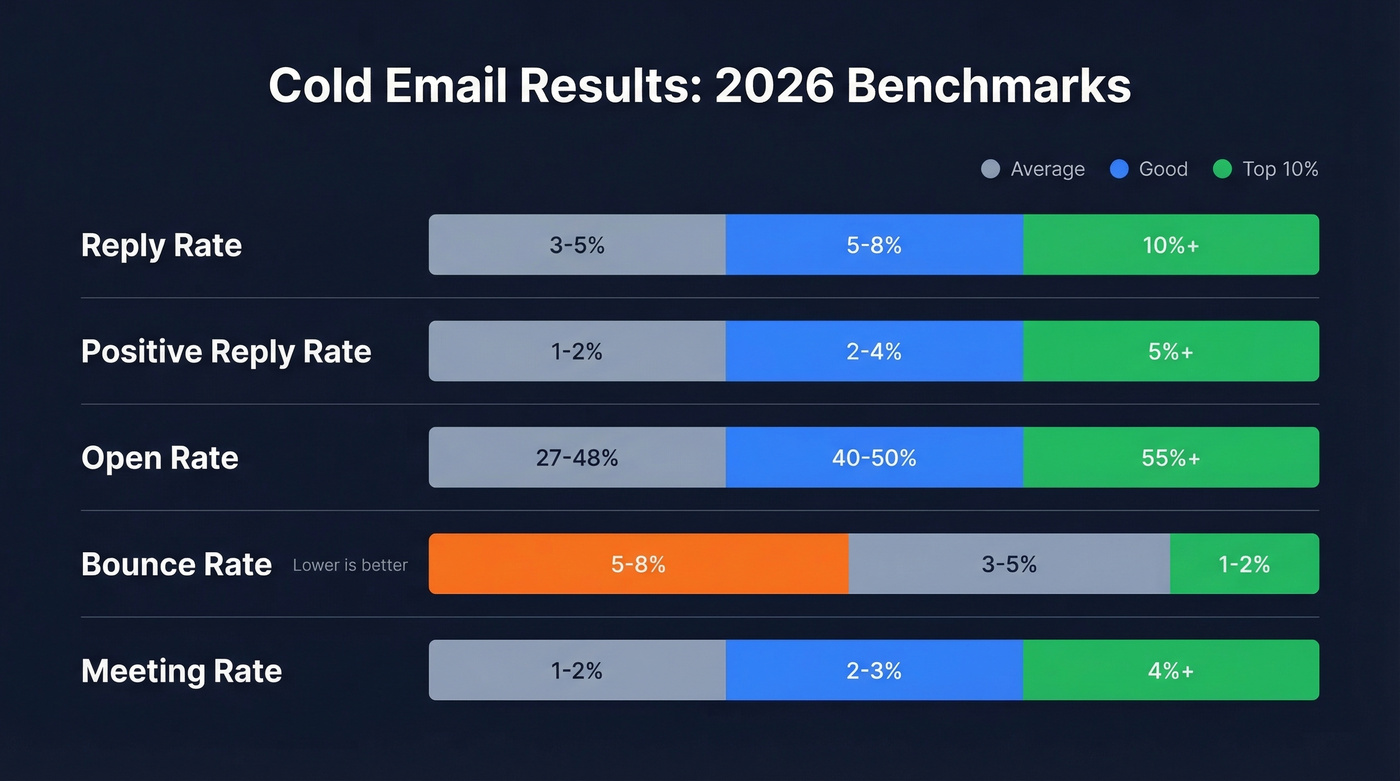
One practitioner on r/b2b_sales shared their numbers: 32% open rate, 7.3% reply rate, 2.5% meeting booking rate. That's genuinely good - well above average - and it still means 97.5% of emails didn't produce a meeting. Let's sit with that for a second, because it recalibrates what "working" actually looks like in cold outbound.
Here's the full funnel at scale: another Reddit poster sent 147,000 cold emails and generated 1,764 positive replies (1.2%) leading to just 40 calls. Scale alone doesn't guarantee outcomes.
| Metric | Average | Good | Top 10% |
|---|---|---|---|
| Reply rate | 3-5% | 5-8% | 10%+ |
| Positive reply | 1-2% | 2-4% | 5%+ |
| Open rate | 27-48% | 40-50% | 55%+ |
| Bounce rate | 5-8% | 3-5% | 1-2% |
| Meeting rate | 1-2% | 2-3% | 4%+ |
Performance by Industry
Not all verticals respond equally. A BuiltForB2B analysis of 10,000+ campaigns found SaaS and tech top performers hitting 10-12% reply rates, professional services reaching 8-11%, manufacturing at 7-10%, healthcare tech at 6-9%, and financial services at 5-8%. These are top-performer numbers. Typical campaigns run 40-60% lower, so a "normal" SaaS outreach lands closer to 5-6%.
If you're in financial services and comparing yourself to SaaS benchmarks, stop. You're measuring against a different sport.

The article says it: bounce rate is the #1 killer of cold email results. Prospeo's 5-step verification delivers 98% email accuracy with a 7-day refresh cycle - so your list never goes stale. Stack Optimize held under 3% bounce across every client campaign and hit $1M ARR on Prospeo data alone.
Stop optimizing copy on a list that bounces. Fix the data first.
Why Reply Rates Keep Declining
Cold email reply rates are falling fast. Across multiple datasets, the direction is unmistakable: Belkins tracked 6.8% in 2023 dropping to 5.8% in 2024 across 16.5M emails. Hunter's 2024 dataset of 11M emails puts average reply rate at 4.1%. Instantly's 2026 report across billions of interactions shows 3.43%. Different methodologies, same trajectory.
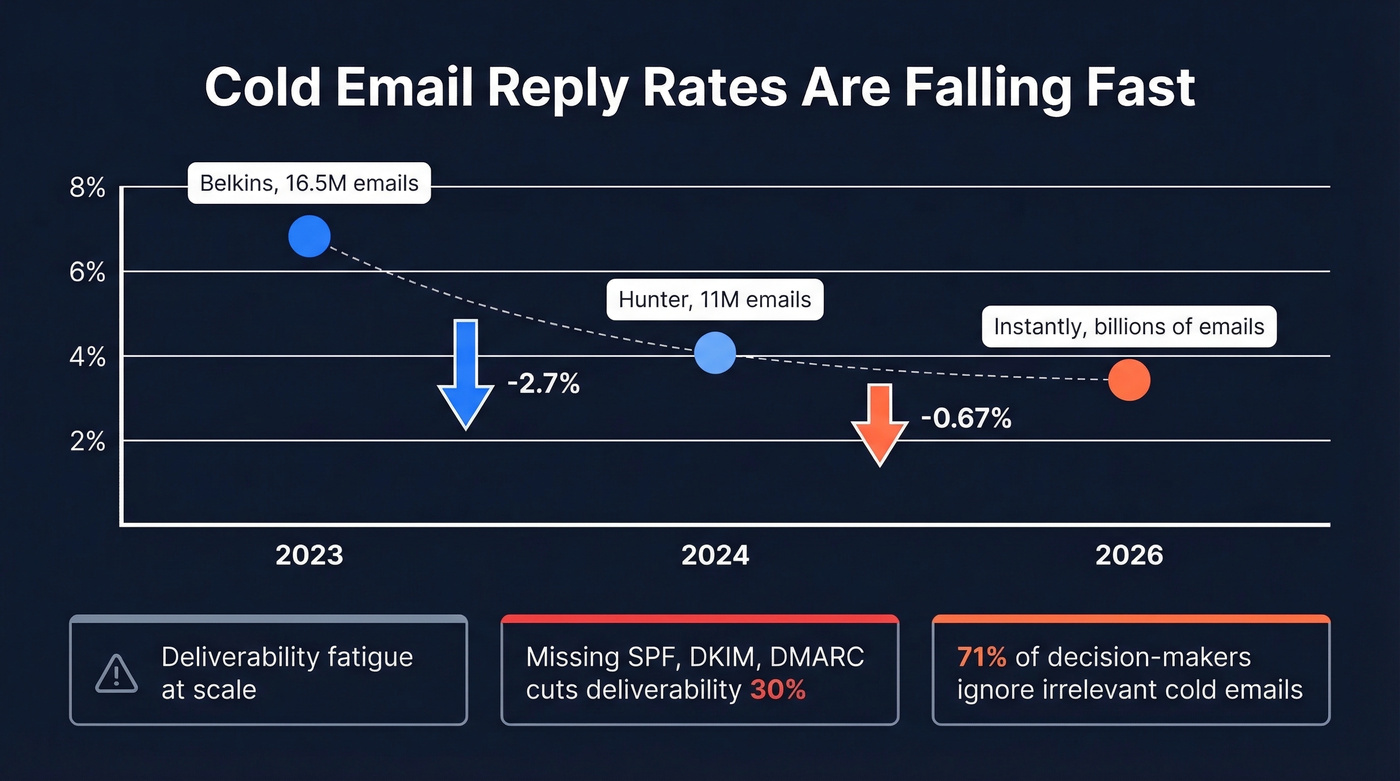
The biggest culprit is email deliverability fatigue at scale. One practitioner on Reddit documented sending 217,000 cold emails and watching their reply rate collapse from 2.1% to 0.7% as domains burned faster than new ones could be warmed. Missing SPF, DKIM, or DMARC authentication can cut deliverability by as much as 30%. In a survey of 217 decision-makers, 71% ignore cold emails due to lack of relevance - bigger lists almost always mean less relevance.
Here's the thing: if your average deal size is under $5k, you probably can't afford the infrastructure burden cold email now demands. The teams winning at outbound in 2026 spend more on data and deliverability than on their sending tools.
How to Improve Cold Email Results
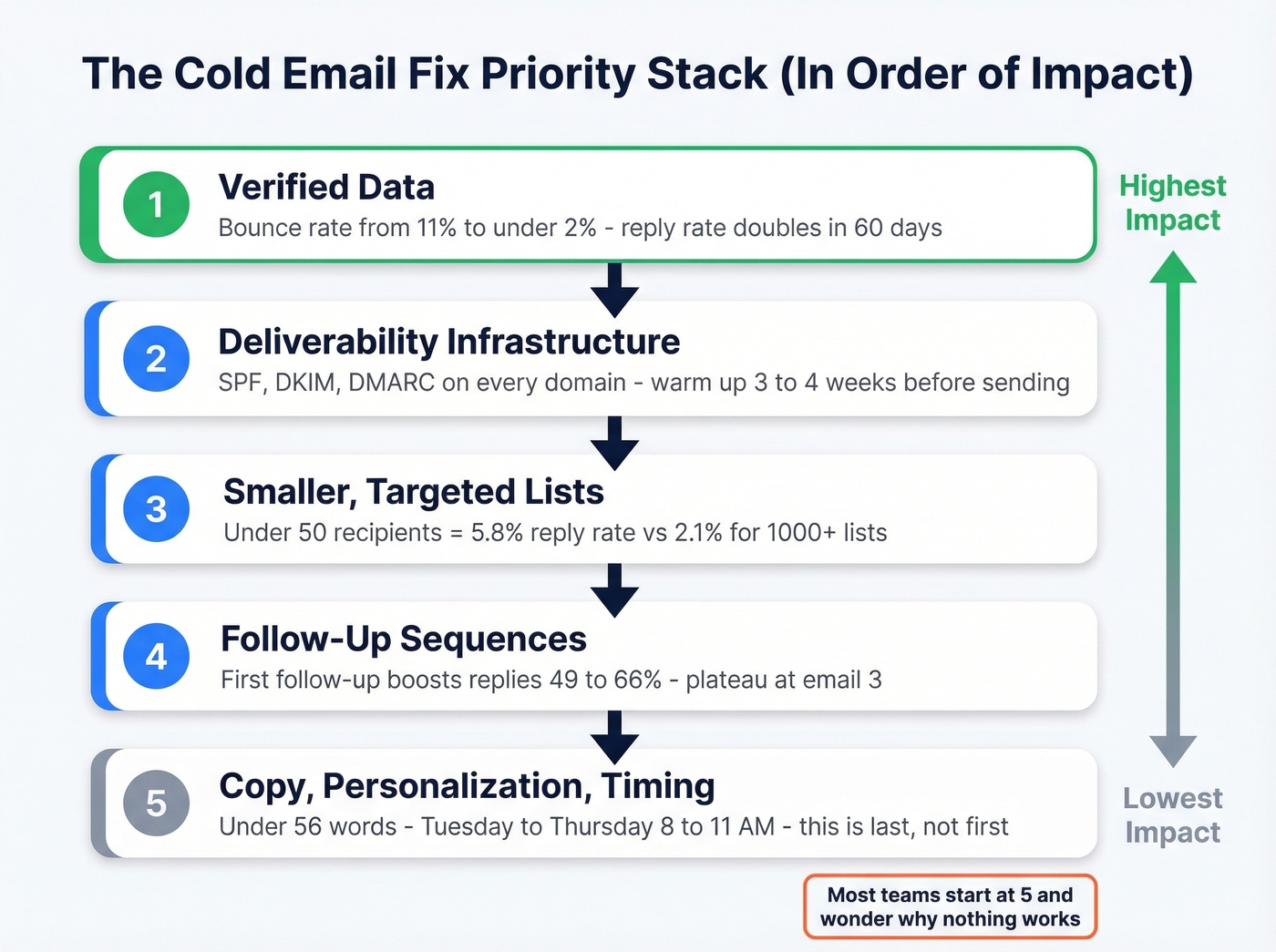
We've seen teams obsess over subject lines while sending to lists with 11% bounce rates. That's like optimizing your golf swing while playing on a highway. Here's the priority stack, in order of impact.
1. Verified Data First
Everything downstream depends on this. One team documented their rebuild: bounce rate went from 11% to under 2%, and reply rate improved from 3% to 6% after 62 days. Stack Optimize built their agency from $0 to $1M ARR using Prospeo's 98% verified email data, holding 94%+ deliverability and bounce rates under 3% across all clients - zero domain flags.
If you're evaluating vendors, start with data enrichment and list hygiene, then work backward into your outbound process.
2. Deliverability Infrastructure
Set up SPF, DKIM, and DMARC on every sending domain. Warm up new inboxes for 3-4 weeks before sending. Keep volume at 20-50 emails per inbox per day and manage 5-10 domains to spread risk. Skip this step and nothing else matters.
If you want a deeper breakdown of safe sending limits, use an email velocity framework instead of guessing.
3. Smaller, Targeted Lists
Campaigns targeting under 50 recipients average 5.8% reply rates - nearly 3x the 2.1% from campaigns over 1,000. The consensus on r/coldemail is consistent: tight lists beat big blasts every time. If you're sending to 5,000 people, you don't know your ICP well enough.
If you're building lists from scratch, these sales prospecting techniques help you narrow targeting without shrinking pipeline.
4. Follow-Up Sequences
| Emails in sequence | Approx. reply rate |
|---|---|
| 1 | ~3% |
| 2 | ~4.8% |
| 3 | ~5.8% (plateau) |
The first follow-up boosts replies 49-66%. Space it at day 3-4, then widen to 7-9 days. Only 5% of senders personalize every email in the sequence - those who do see 2-3x better response rates.
If you need plug-and-play messaging, pull from these cold email follow-up templates and adapt them to your offer.
5. Copy, Personalization, and Timing
Keep emails short. One team cut from 141 words to under 56 as part of a rebuild that took reply rate from 3% to 6%. A Mailshake A/B test went from 9.8% to 18% reply rate - generating 30+ meetings from 206 prospects - by simplifying the email and asking a simpler question.
Subject lines matter less than you think, but "Quick question" pulled 39% opens vs. "Partnership opportunity" at under 19%. If you want a swipe file, use these cold email subject line examples. Send Tuesday through Thursday, 8-11 AM in the recipient's timezone, with Wednesday as the peak day in large benchmark datasets. Great copy sent to a bad list with broken infrastructure still fails. That's why this is fifth on the stack, not first.
Metrics That Actually Matter
Reply rate is a vanity metric. Cost Per Meeting is the number that matters.
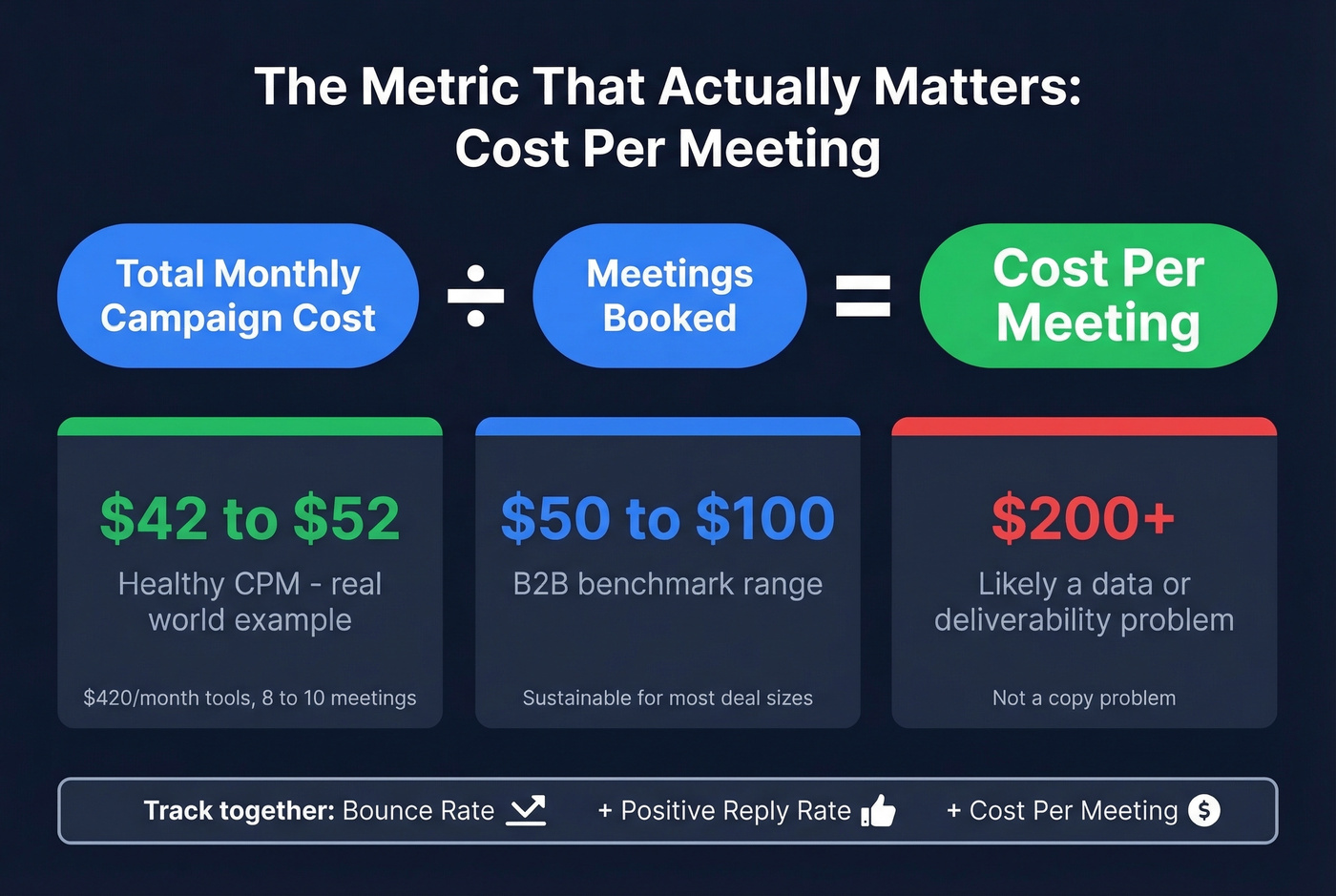
Total monthly campaign cost divided by meetings booked. A healthy B2B benchmark is $50-$100 CPM. Infrastructure runs about $4-$6 per mailbox per month, and one real-world cold email stack example came out to roughly $420/month for tools, verification, and data. If you're booking 8-10 meetings, that's around $42-$52 per meeting. In our experience, teams with CPM above $200 almost always have a data quality or deliverability problem, not a copy problem.
Track bounce rate, positive reply rate, and cost per meeting together. Any single number in isolation will mislead you, and we've watched teams celebrate a 6% reply rate that was 80% "not interested" responses - which is worse than a 3% rate that's mostly positive.
If you want a more complete KPI set, map this to your funnel metrics so you can see where the leak actually is.
Smaller, targeted lists beat big blasts 3-to-1. Prospeo's 30+ filters - buyer intent, technographics, headcount growth, funding - let you build the tight ICP lists that drive 5.8%+ reply rates. At $0.01 per email, sending to 50 perfect-fit prospects costs less than a coffee.
Build the list that replies. 75 free verified emails to start.
FAQ
What's a good cold email reply rate in 2026?
Average is 3.43% according to Instantly's 2026 benchmark. Above 5% is good, and top performers hit 10%+. Focus on positive reply rate (2-4%) - "not interested" responses inflate numbers without filling pipeline.
How many follow-ups should I send?
Three to five emails total works best. The first follow-up boosts replies 49-66%, but after email three returns diminish sharply. Space them 3-4 days apart initially, then widen to 7-9 days.
What's the fastest way to fix poor cold email results?
Clean your data first. Switching to a verified source with 98%+ accuracy typically cuts bounce rates below 3% and lifts reply rates 50-100% within 60 days. No amount of copywriting fixes emails that never reach the inbox.
Is cold email still worth it in 2026?
Yes - if your data is clean and infrastructure is solid. Teams sending to targeted lists under 200 contacts still book meetings at $50-$100 CPM. High-volume blasting is dead, but targeted, verified outreach still works when you monitor performance weekly and adjust list size, sending volume, and follow-up cadence based on what the numbers tell you.