

LeadSquared vs Salesforce: Which CRM Is Actually Right for You?
You got the Salesforce quote back and it's $175/user/month - before add-ons, before the admin you'll need to hire. Meanwhile, a colleague in Mumbai swears by LeadSquared at a fraction of the cost. Here's the thing: these aren't equivalent options. One's a regional specialist built for high-volume B2C in Asia. The other's a global platform that can do almost anything, if you've got the budget and patience to configure it.
30-Second Verdict
Pick LeadSquared if you're running high-volume B2C sales in India or Southeast Asia across education, financial services, or healthcare. It's fast to implement, strong on lead management, and priced for those markets.
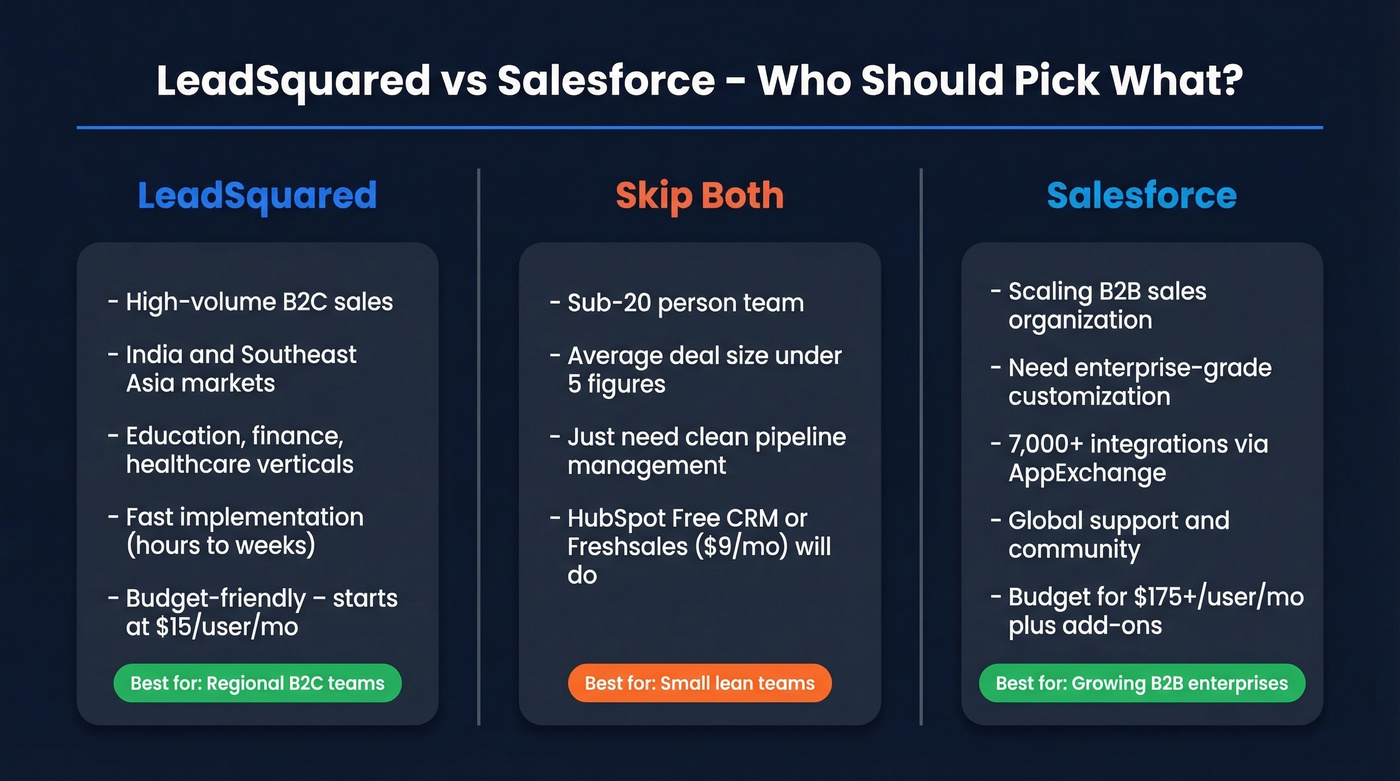
Pick Salesforce if you're a scaling B2B team that needs enterprise customization, a massive integration ecosystem, and global support. You'll pay for it, but the platform grows with you.
Skip both if you're a sub-20-person team that just needs clean pipeline management. HubSpot's free CRM handles that without the overhead, and Freshsales starts at $9/user/month.
Most teams agonizing over this decision don't actually need either platform. If your average deal size stays under five figures and your team is under 15 reps, a lighter CRM plus a solid data layer will outperform an over-configured enterprise system every time.
Pricing Side by Side
LeadSquared doesn't publish USD pricing on its website - you need a sales conversation. The closest public USD numbers come from G2's pricing page. Salesforce publishes its core Sales Cloud tier pricing upfront, though the listed price and the actual cost are very different animals.
LeadSquared Tiers
| Lite | Pro | Super | |
|---|---|---|---|
| $/user/mo | $15 | $50 | $100 |
| Contacts | 10,000 | 100,000 | 200,000 |
| Billing | Annual | Annual | Annual |
LeadSquared's own site lists Sales Pro at ₹2,500/user/mo and Sales Super at ₹5,000/user/mo in INR. The refusal to publish USD pricing openly is frustrating for global buyers trying to compare.
Salesforce Tiers
| Free Suite | Starter Suite | Pro Suite | Enterprise | Unlimited | Agentforce 1 Sales | |
|---|---|---|---|---|---|---|
| $/user/mo | $0 | $25 | $100 | $175 | $350 | $550 |
| Users | 2 max | Unlimited | Unlimited | Unlimited | Unlimited | Unlimited |
| Billing | - | Mo/Annual | Annual | Annual | Annual | Annual |
What Salesforce Actually Costs
The listed tiers are just the starting point. A 5-person SDR team on Enterprise ($175/user/mo) looks like $875/month on paper. In reality, expect $1,250 to $8,000+/month once you factor in Sales Engagement (~$75/user/mo), Conversation Intelligence (~$50/user/mo), Premier Support (~20% of license fees), and implementation ranging from $5k for Starter setups to $75k-$300k+ for Unlimited-tier deployments.
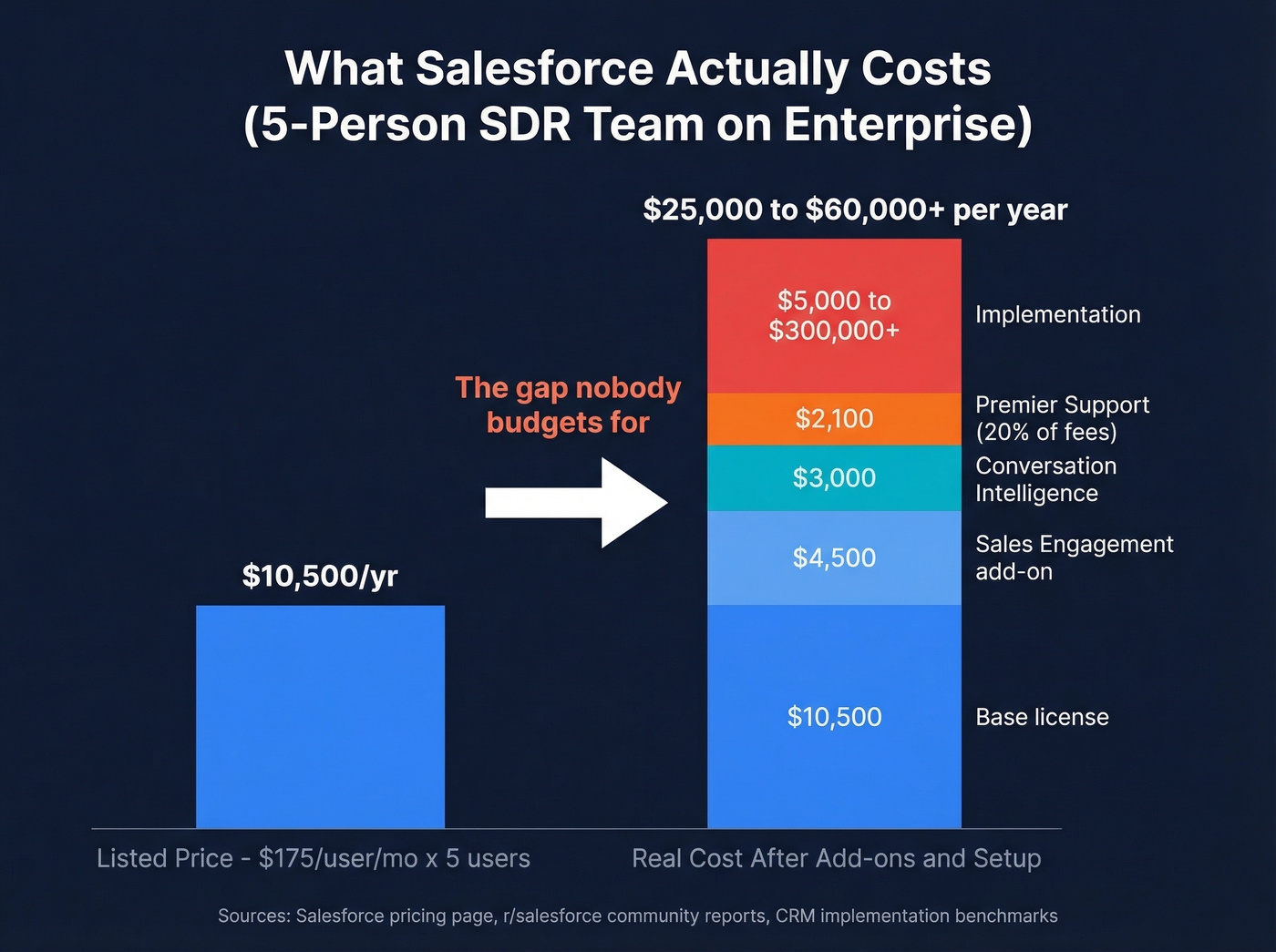
We've seen teams budget $25k/year for Salesforce and end up at $60k+ by the time they're actually using it properly. CRM community forums - especially threads on r/salesforce and r/sales - consistently flag this total cost of ownership as the number-one surprise for new buyers.

Salesforce costs $60K+ when fully configured. LeadSquared saves money upfront but limits your integrations. Neither solves the real problem: stale contact data rotting inside your pipeline. Prospeo enriches your CRM with 50+ data points per contact at 98% email accuracy - for roughly $0.01 per email.
Stop paying enterprise CRM prices to store bad data.
Features That Actually Matter
| Feature | LeadSquared | Salesforce | Edge |
|---|---|---|---|
| Lead management | Core strength | Strong | LeadSquared (for B2C volume) |
| Marketing automation | Built-in | Add-on (Marketing Cloud) | LeadSquared (included) |
| Integrations | 163 (vertical-curated) | 7,000+ (AppExchange) | Salesforce |
| Mobile (iOS) | 4.1 ★ (9 reviews) | 4.7 ★ (298K reviews) | Salesforce |
| Mobile (Android) | 3.2 ★ (7.6K reviews) | 3.8 ★ (47K reviews) | Salesforce |
| Implementation | Hours to weeks | Weeks to quarters | LeadSquared |
| Free trial | 15-day, no CC | Free Suite (2 users) | Tie |
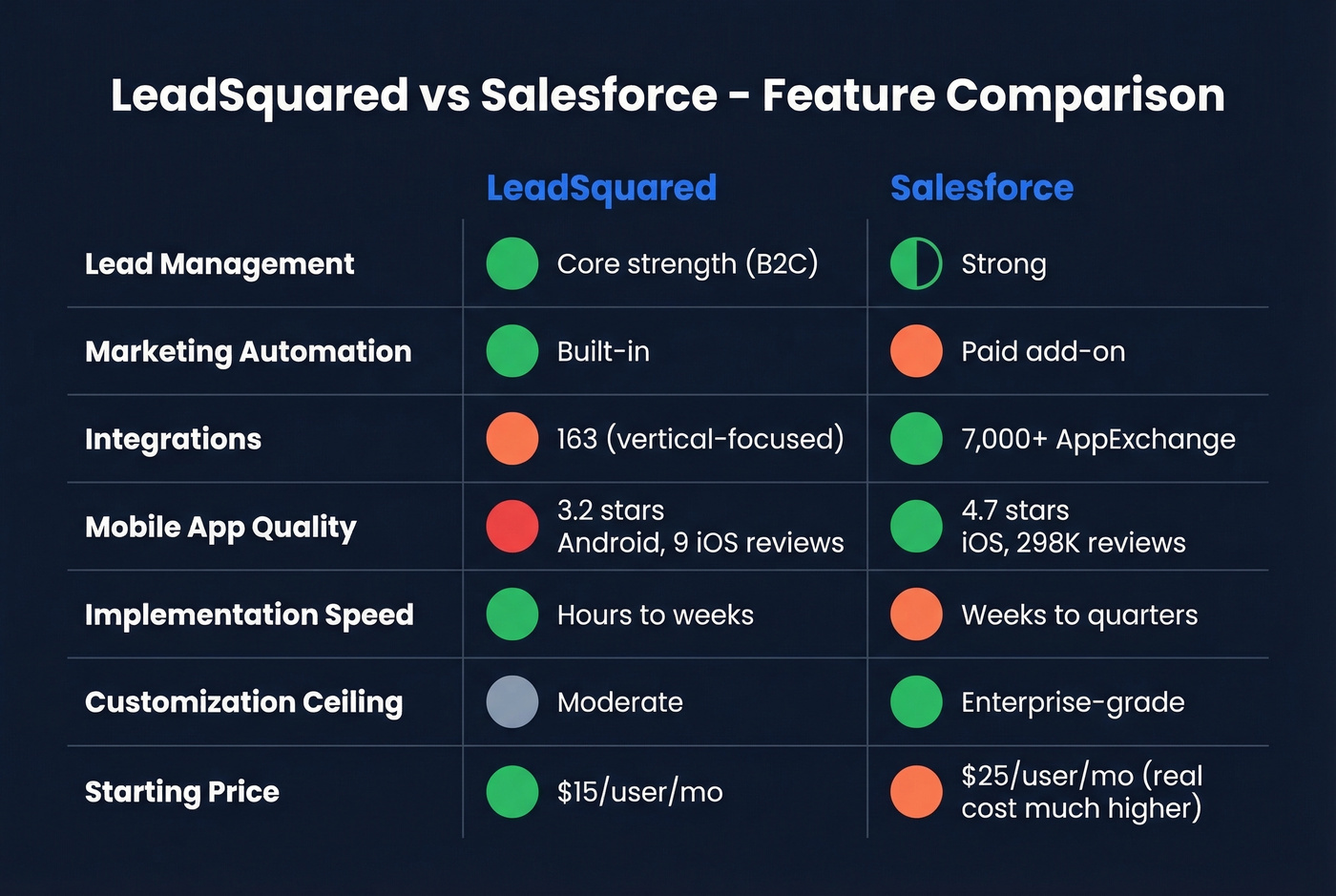
The integration gap tells the real story. LeadSquared's 163 integrations are curated for verticals like education, BFSI, and healthcare - if you're in those spaces in India, the connectors you need are probably there. Salesforce's 7,000+ AppExchange listings cover essentially everything, but you'll spend time and often money configuring them.
Let's be honest about LeadSquared's mobile app ratings, though. Nine iOS reviews versus Salesforce's 298,000 isn't a comparison - it's a rounding error. If mobile CRM matters to your field team, Salesforce wins by a mile.
What Users Actually Say
LeadSquared carries a 4.5/5 on G2 from 284 reviews. Salesforce sits at 4.4/5 from 25,486 reviews. The ratings look comparable until you consider sample sizes - Salesforce's score is battle-tested across nearly 90x more reviews. And 271 of LeadSquared's 284 reviews come from Asia, with only 6 from North America. If you're a US-based buyer looking for peer validation, it's thin.
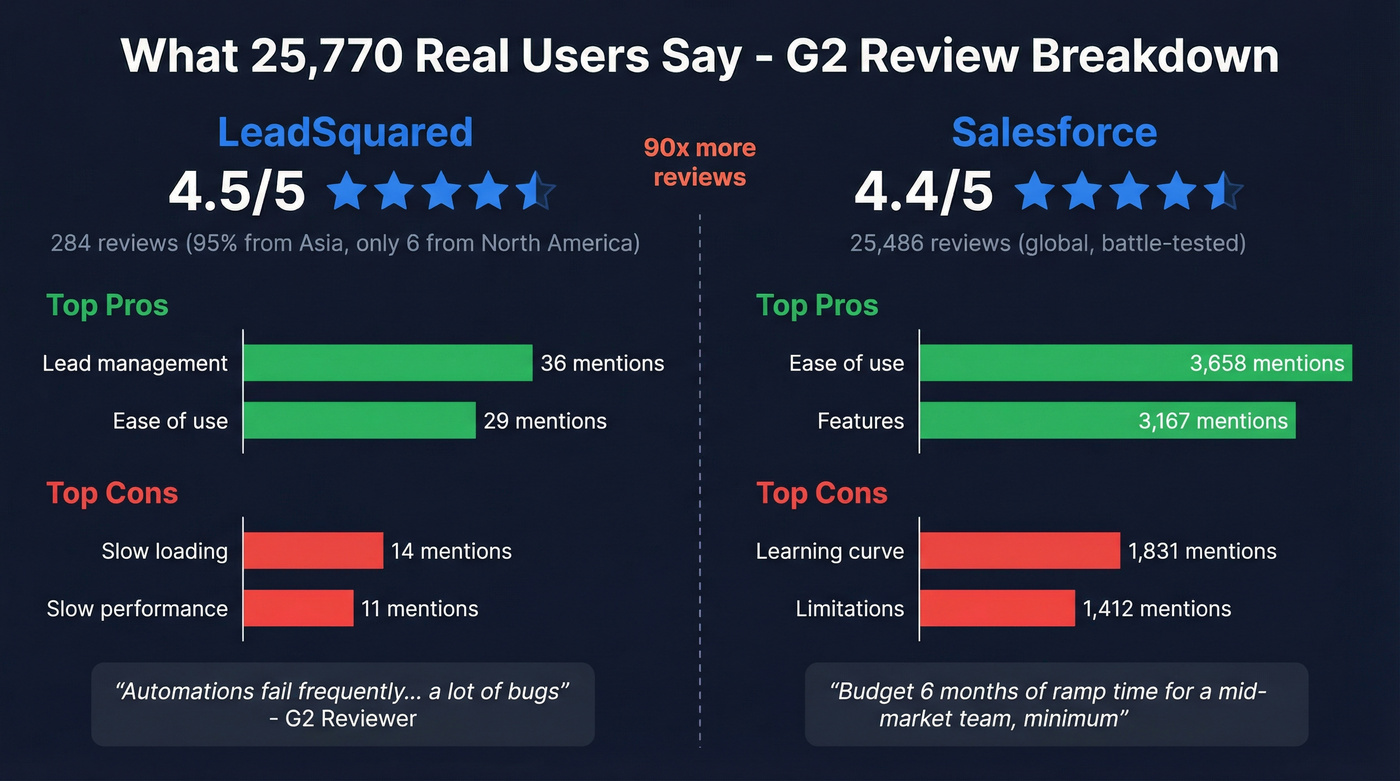
LeadSquared pros: Lead management (36 mentions) and ease of use (29 mentions) dominate. Users genuinely like how quickly they can get leads routed and scored.
LeadSquared cons: Slow loading (14 mentions) and slow performance (11 mentions) recur. One reviewer called it a "complex and old system" where "automations fail frequently" with "a lot of bugs." Software Advice reviews echo the performance issues, with multiple users flagging scenarios where items were automatically deleted or data was lost unexpectedly.
Salesforce pros: Ease of use (3,658 mentions) and features (3,167 mentions) lead - though "ease of use" at this scale likely reflects platform maturity, not simplicity.
Salesforce cons: Learning curve (1,831 mentions) and limitations (1,412 mentions). We've noticed the learning curve complaint is practically universal among Salesforce users - teams love what it can do but consistently underestimate the time and expertise needed to get there. Budget six months of ramp time for a mid-market team, minimum.
The Problem Neither CRM Solves
Your CRM is only as good as the data feeding it. Neither LeadSquared nor Salesforce is a dedicated contact verification tool. Reps chase bounced emails and disconnected numbers while pipeline metrics look healthy - right up until connect rates tell the real story.
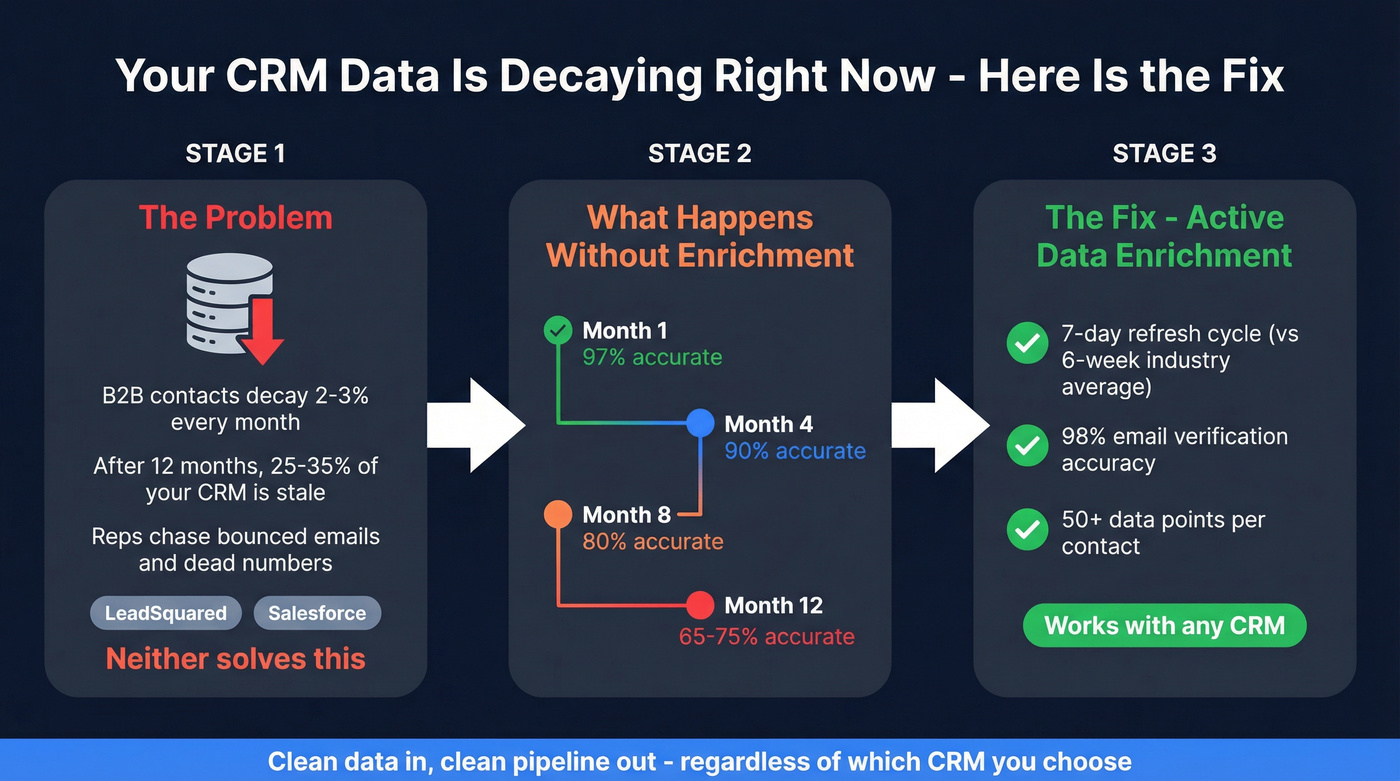
This is where a data layer matters. Prospeo verifies emails at 98% accuracy on a 7-day refresh cycle, compared to the 6-week industry average, and integrates natively with Salesforce and HubSpot to enrich records with 50+ data points per contact. B2B contact lists decay 2-3% monthly without active enrichment, which means roughly a quarter of your CRM goes stale within a year. Clean data in, clean pipeline out - regardless of which CRM you choose.
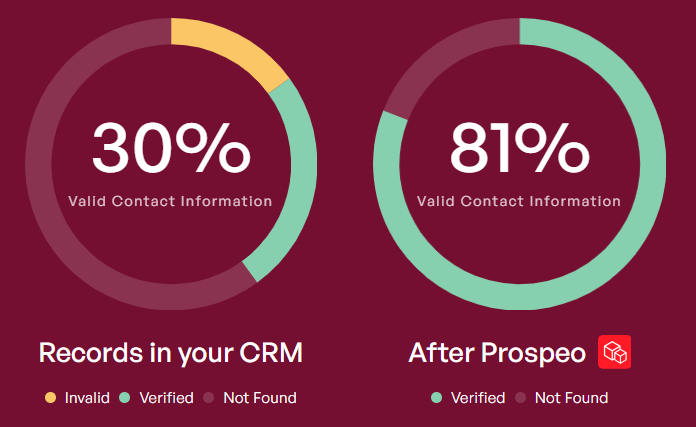
Your CRM decays 2-3% per month without active enrichment. That's a quarter of your pipeline gone stale every year - regardless of whether you chose LeadSquared or Salesforce. Prospeo's 7-day data refresh cycle and native Salesforce integration keep every record current automatically.
Feed your CRM verified data that actually connects reps to buyers.
FAQ
Is LeadSquared good for US-based teams?
LeadSquared's review base is 95%+ Asia-based - only 6 of 284 G2 reviews come from North America. The product functions globally, but peer validation, community support, and local implementation partners for US buyers remain thin compared to Salesforce or HubSpot.
Can I use Salesforce's free plan for a real sales team?
No. It caps at 2 users with basic features, useful only for a solo founder testing workflows. For an active sales team, you'll need Starter Suite ($25/user/mo) at minimum, and most growing teams land on Pro Suite ($100/user/mo) within six months.
How do I keep CRM data accurate after choosing a platform?
Layer in a verification tool that refreshes records regularly and returns rich data points per contact. Without active enrichment, B2B contact lists decay 2-3% monthly - meaning 25-35% of your CRM goes stale within a year.
Which CRM is better for high-volume lead routing?
LeadSquared edges out Salesforce for B2C lead routing in markets like education and financial services, where speed-to-lead matters most. Salesforce requires more configuration to match that out-of-the-box routing speed, though its customization ceiling is significantly higher for complex B2B workflows.