

Lienion Pricing, Reviews, Pros and Cons for 2026
Three different websites list three different prices for Lienion. Capterra says €1.99/month flat rate. SoftwareSuggest says $6 for 10 users in its FAQ, then shows ₹399 for 10 users on the "All App" plan. TechnologyCounter also lists ₹399 for 10 users. The official site? It doesn't publish pricing at all.
If you've been trying to pin down what Lienion actually costs, what real users think of it, and whether it's worth your time - you're not imagining the confusion. The information really is that scattered, and we spent a few hours pulling it together so you don't have to.
30-Second Verdict
Lienion scores a 4.9/5 on Capterra (listed under its Releasion app name), but that's from just 16 reviews, with many dating back to 2020. The rating looks stellar on paper. The sample is too small and too old to draw strong conclusions from. Capterra subscores tell a consistent story: Ease of Use 4.9, Customer Service 5.0, Features 5.0, Likelihood to Recommend 10/10.
Here's the thing: it's a genuinely affordable all-in-one suite for small teams who want to consolidate project management, CRM, timesheets, and QA testing under one roof. The UI won't win design awards, and you won't find a thriving community around it. Worth a free trial if you're under 50 people and starting fresh. If you're already invested in Jira or ClickUp, Lienion won't pull you away.
Pricing Breakdown
Lienion's pricing is a mess to research. The official site mentions a transparent license fee per user and per app, with volume discounts and long-term pricing plans - but no actual numbers. Third-party aggregators fill the gap, and they don't agree with each other.
| Source | Listed Price | Model | Notes |
|---|---|---|---|
| Capterra | €1.99/mo (starting) | Flat rate | As of early 2026 |
| SoftwareWorld | €1.99/mo (Basic) | Flat rate | Free trial listed |
| SoftwareSuggest | ₹399 / 10 users (All App) | Per-team | FAQ also shows $6/10 users |
| TechnologyCounter | ₹399 / 10 users (All App) | Per-team | - |
The €1.99 figure likely represents a single-user or single-app entry point. The per-10-user prices suggest team bundles or regional packaging. In practice, expect the real cost to scale with how many apps you activate and how many users you add.
SoftwareWorld lists both a free version and a free trial.
How It Stacks Up on Price
| Tool | Starting Price | Free Tier |
|---|---|---|
| Lienion | ~€2-6/mo | Free trial |
| Jira | Free (up to 10 users) | Yes |
| ClickUp | $9/user/mo | Yes |
| monday.com | $9/seat/mo | Yes |
| Asana | $10.99/user/mo | Yes |
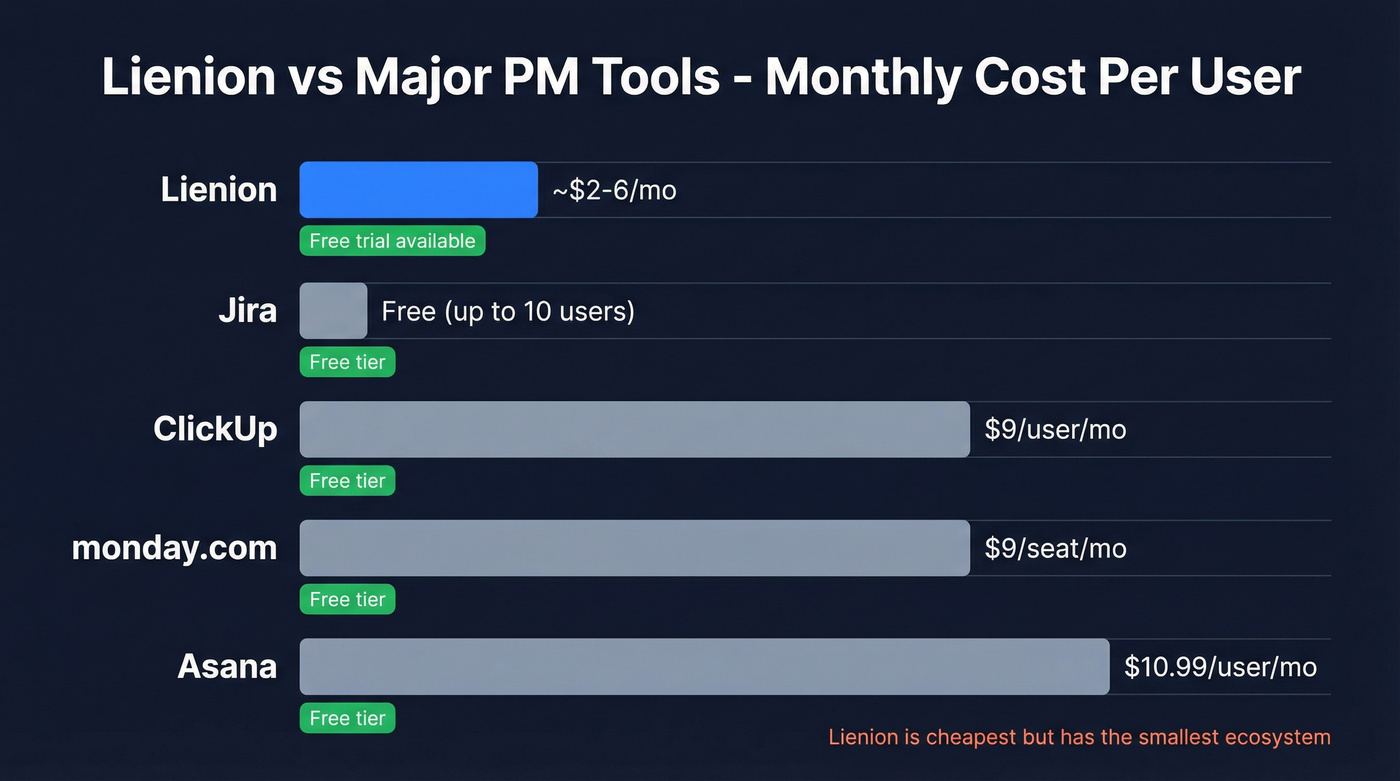
Even at the high end of the range, Lienion undercuts most major PM tools on a per-user basis. The tradeoff is ecosystem maturity.
The 10 Apps Inside Lienion
Lienion's pitch is consolidation. Instead of stitching together half a dozen SaaS tools, you get ten purpose-built apps on a single platform. Each works independently, but the real value comes from connecting them - timesheets linked to projects, CRM tied to tasks, test cases mapped to releases.
| App | What It Does |
|---|---|
| Releasion | Project/sprint/release management with kanban, scrum boards, burndown charts, backlog management (Agile, Waterfall, IPLS) |
| Todosion | Tasks, user stories, support tickets |
| Shoution | Team collaboration, social networking |
| Tempion | Timesheets, holidays, employee well-being (Niko Niko) |
| Trenion | Training, skills, competence management (LMS) |
| Sequencion | Process/workflow automation, checklists |
| Essencion | KPIs, reporting, customer feedback, meeting minutes |
| Inginion | CRM - prospects, leads, sales pipeline |
| Testcasion | Test case and QA management |
| The Core | Central config, user rights, dashboards |
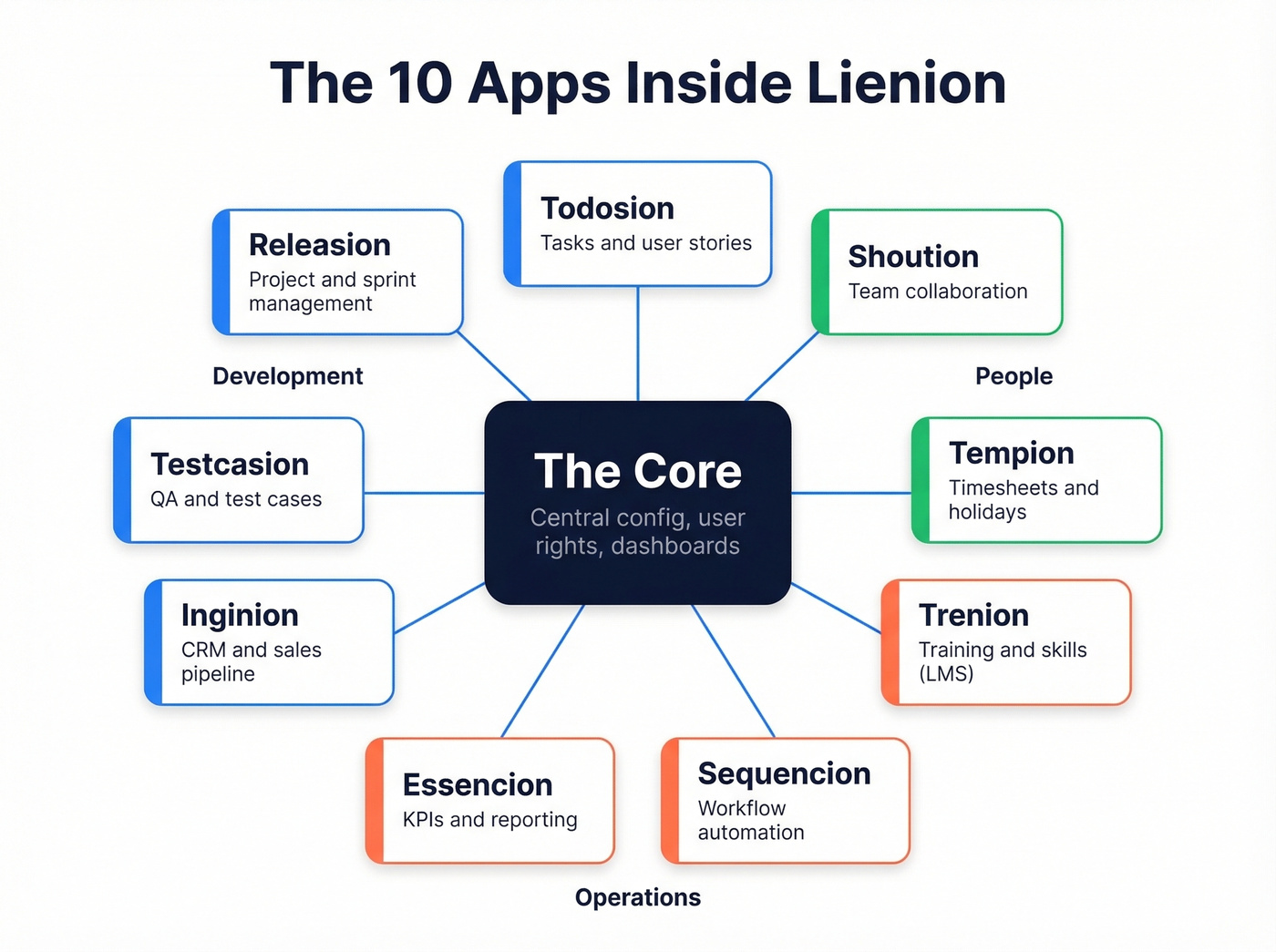
The breadth is impressive for the price. Most SMBs use half a dozen or more tools to cover this ground. Releasion isn't Jira, and Inginion isn't Salesforce. But for a 20-person team that needs competent coverage across the board, one platform at €2/month beats six subscriptions.
Let's be honest: if your average deal size is under $20k and your team is under 30 people, you probably don't need best-of-breed tooling in every category. "Good enough everywhere" beats "perfect in one place, duct-taped everywhere else." That's Lienion's real argument.

Lienion's Inginion CRM helps you manage leads - but where do those leads come from? Prospeo gives you 300M+ professional profiles with 98% email accuracy and 125M+ verified mobile numbers, so your pipeline never runs dry. At $0.01 per email, it costs less than Lienion itself.
Stop managing an empty pipeline. Fill it with verified contacts first.
Pros and Cons
What Works
All-in-one consolidation is the headline benefit. PM, CRM, timesheets, QA testing, training, and collaboration in one platform - that's five or six vendor contracts you don't need. As one reviewer put it, it's "one place with complete package."
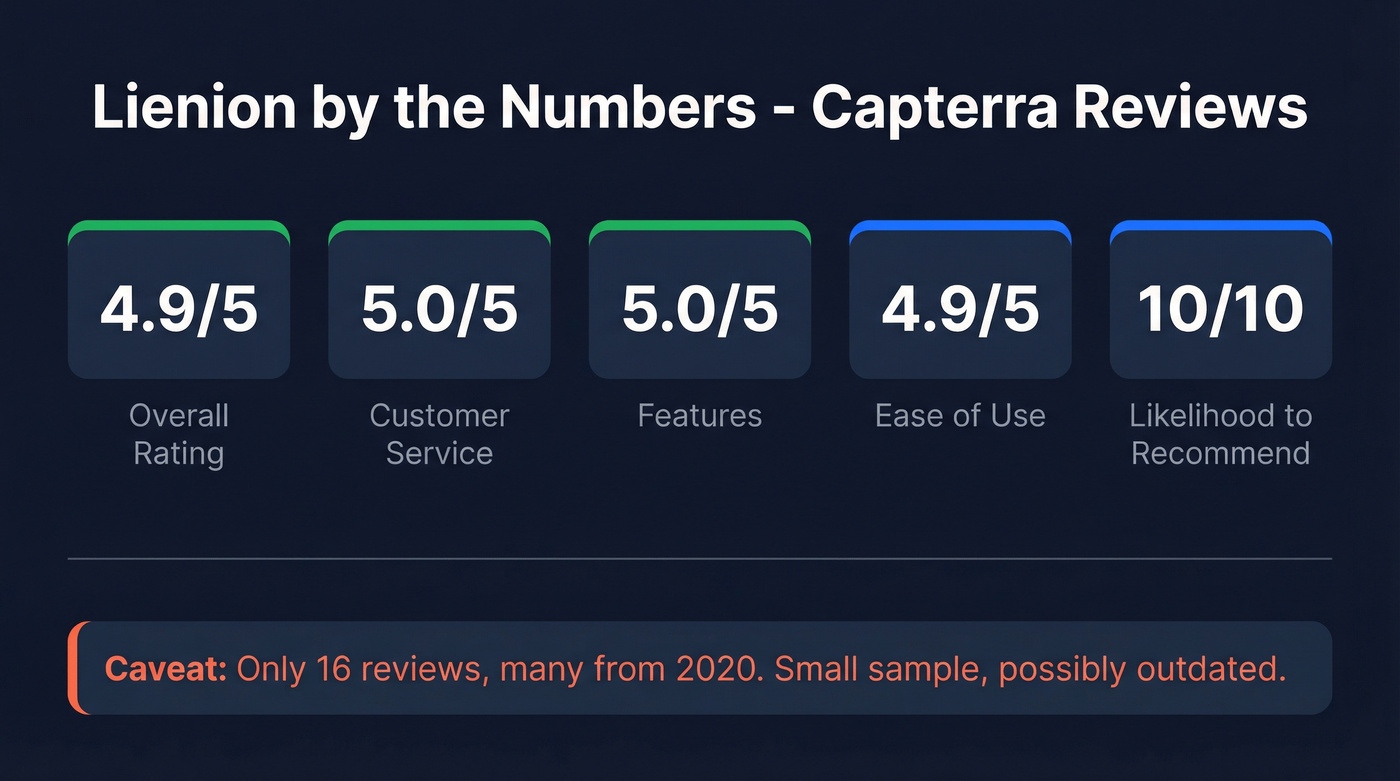
Customer service is exceptional. Reviewers gave it a perfect 5.0/5 for support. With a smaller user base, you're talking to people who built the product, not navigating a ticket queue. That matters more than most buyers realize until something breaks.
Agile and Waterfall in one tool. Releasion supports both methodologies plus IPLS, with scrum/kanban boards, burndown charts, and backlog management. Teams running mixed methodologies across projects don't need to pick sides.
Transparency into work across teams. Reviewers praised the visibility Lienion gives into project progress, making it easier for managers to track what's happening without chasing status updates.
The price-to-feature ratio is hard to beat. At ~€2-6/month, you're getting functionality that would cost $50-100+/user/month assembled from best-of-breed tools. Lienion reports an 85% improvement in customer satisfaction after using Sequencion's validator feature - that's a vendor stat, but the workflow automation capability is real and useful for process-heavy teams.
What Doesn't
The UI feels dated. Reviewers describe it as "traditional" and call for better graphics. If your team cares about modern UX, this will be a constant friction point.
Notifications are weak. One reviewer specifically noted the lack of notification options, comparing it unfavorably to consumer apps. For a collaboration platform, that's a real gap.
Testcasion's workflow is cumbersome. Creating test cases requires too many save-and-load steps. QA teams used to spreadsheet-style entry will find it painfully slow.
Timesheet saving has timeout bugs. Reviewers flagged the Tempion timesheet page timing out when saving at end of day - exactly when you need it to work.
No public API. If you need to integrate Lienion with your existing stack, options are limited. For teams with established automation workflows, this is a dealbreaker.
The review dataset is tiny. Sixteen reviews, many from 2020, isn't enough to confidently assess the product's current state. We couldn't find G2 ratings or active Reddit threads discussing it. You're flying blind on community validation.
Who Should (and Shouldn't) Use It
Use Lienion if you're:
- A small team under 50 people starting fresh without existing tool commitments
- Budget-constrained and want PM, CRM, timesheets, and QA in one platform
- Running both Agile and Waterfall projects and tired of juggling separate tools
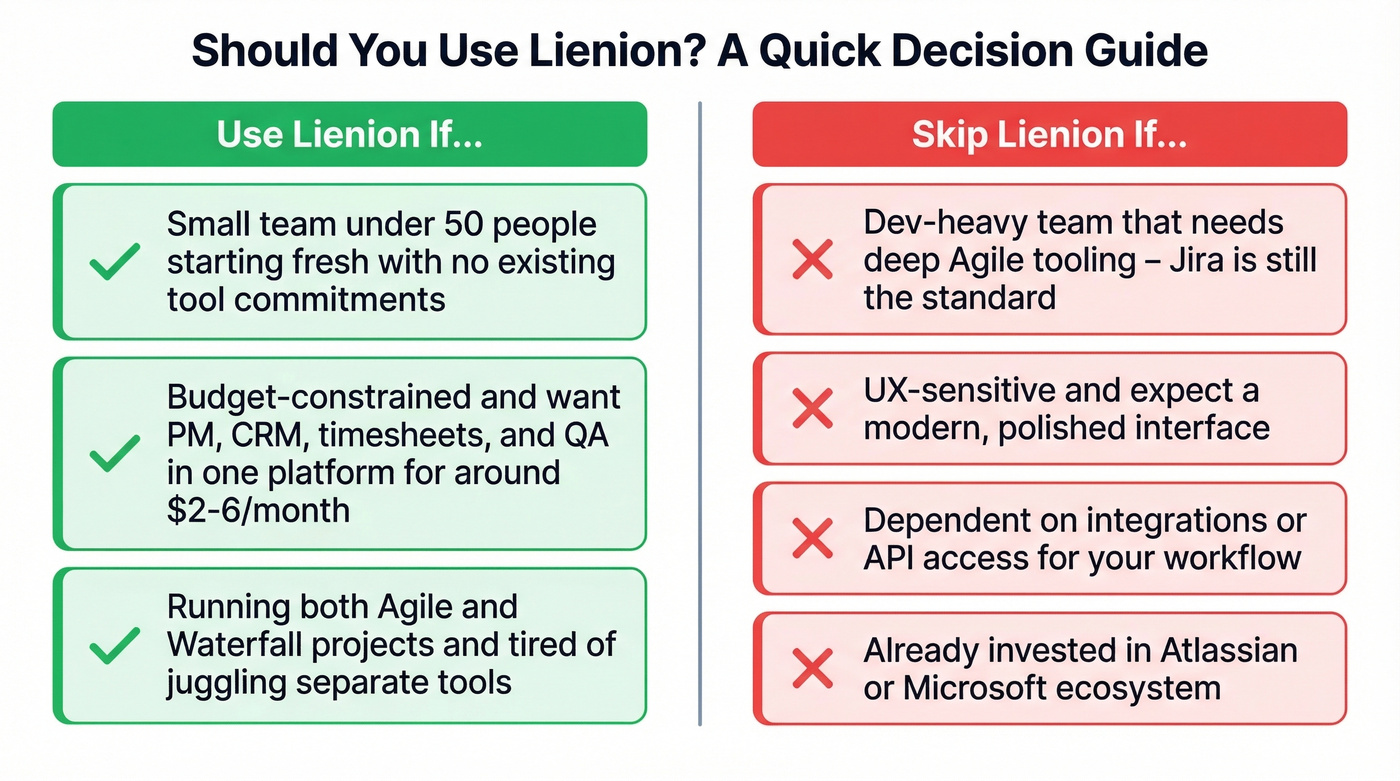
Skip it if you're:
- A dev-heavy team that needs deep Agile tooling - Jira is still the standard
- UX-sensitive and expect a modern, polished interface - ClickUp or monday.com will feel better
- Dependent on integrations or API access
- Already invested in an ecosystem like Atlassian or Microsoft - switching costs won't justify the savings
Alternatives Worth Considering
Jira remains the default for development teams. It's unmatched for Agile workflows, but it doesn't include CRM, timesheets, or training modules. You'll need a stack around it.
ClickUp ($9/user/month) is the pick if Lienion's dated UI is a dealbreaker. Generous free tier, strong customization, and a modern interface that teams actually enjoy using. It's broader than Jira but narrower than Lienion's full suite.
monday.com ($9/seat/month) works best for non-technical teams - marketing, operations, client services. Intuitive visual interface, though it gets expensive fast as you scale past 10 seats.
Asana ($10.99/user/month) is solid for task-centric teams that don't need CRM or QA modules. Less feature-dense than Lienion's full suite but more polished in what it does cover.
One gap we noticed in our testing: Lienion's Inginion module manages your sales pipeline, but it doesn't source contact data. If you're building prospect lists, you'll need a separate tool. Prospeo handles that - it finds verified emails and direct dials across 300M+ professional profiles at about $0.01/lead with 98% email accuracy, and plugs directly into HubSpot, Salesforce, and other CRMs.
If you're building prospect lists, it also helps to understand sales prospecting techniques and how to set up a repeatable lead generation workflow.
No public API is a dealbreaker for many teams evaluating Lienion. Prospeo's Enrich API returns 50+ data points per contact at a 92% match rate - and plugs directly into Salesforce, HubSpot, Clay, Zapier, and Make. Data refreshed every 7 days, not every 6 weeks.
Your all-in-one stack still needs accurate B2B data powering it.
FAQ
Is Lienion free?
A free trial is available with no credit card required, but there's no permanent free plan. Aggregator pricing starts around €1.99/month, though actual cost depends on which apps you activate and how many users you add.
What is Lienion used for?
It's an all-in-one platform covering project management, timesheets, CRM, QA testing, training, and collaboration - built for SMBs that want to consolidate five or six separate tools into a single suite starting at roughly €2/month.
How does Lienion compare to Jira?
Jira goes deeper on Agile development - sprint planning, backlog management, and dev integrations are more mature. Lienion is broader, bundling CRM, timesheets, training, and QA that Jira doesn't include. Pick Jira for dev teams, Lienion for cross-functional consolidation on a tight budget.