


ListKit Pros and Cons (2026): The Credit-Math Review
You just got your first ListKit invoice and the credit math doesn't add up. A "verified mobile" costs 5 credits, intent data adds 2 more, and suddenly that $97/mo plan covers fewer leads than the sales page implied. Here's the real ListKit pros and cons breakdown - what works, what's risky, and whether the economics make sense for your team.
Quick Verdict
Use ListKit if you want a simple, AI-driven list builder with strong onboarding support and you're primarily pulling business emails for cold outreach.
Skip ListKit if you need heavy mobile or intent enrichment, you want frictionless cancellation, or you're prospecting outside the US.
ListKit sits at 4.7/5 on G2 with 388 reviews and 4.2/5 on Trustpilot with 218 reviews. Trustpilot surfaces more billing and onboarding complaints than you'll typically see in the curated G2 feed. They offer a free trial with 50 triple-verified emails and no card required, so you can test before committing.
What ListKit Is
ListKit is a credit-based B2B leads platform built around plain-English AI search and a triple-verification engine. You describe your ICP in natural language, get a targeted contact list verified before export. Their pricing page claims 731M triple-verified email contacts - though their own blog elsewhere cites 626M+, which is a credibility flag worth noting.
Most teams pair ListKit with a sending tool like Instantly or Smartlead and a warmup service. It's a list-building layer, not an all-in-one GTM suite.
Pros That Actually Matter
The support is the standout. Reviewers mention it 64 times on G2 - personalized onboarding calls, strategy sessions, responsive reps. Trustpilot's summary highlights the same pattern: helpful staff, thorough demos, and real strategy conversations rather than canned responses.
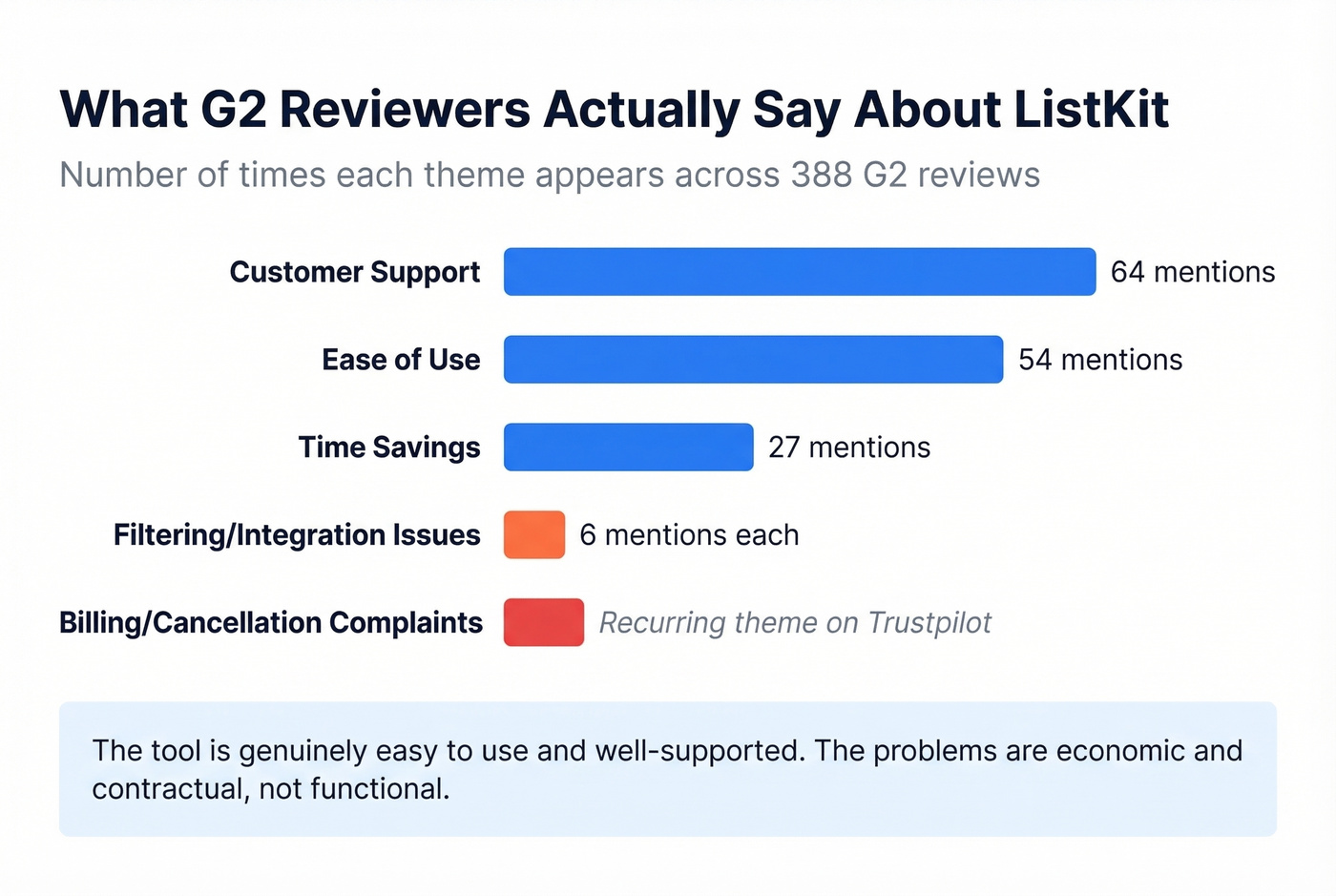
Ease of use gets 54 mentions. The AI search interface is straightforward: type what you're looking for, get a list. No complex boolean required. And time savings are real (27 mentions) - teams build targeted lists in minutes rather than hours of manual prospecting.
One reviewer titled their G2 review "Easy to Use, But Cold Outbound Results Fell Flat," which captures the split personality well. The tool itself is pleasant. The outcomes depend on your enrichment choices and sending infrastructure.
Cons You Can't Ignore
Cancellation and billing friction. This is the big one. A Reddit thread on r/SaaS details a user required to attend an "onboarding meeting" just to cancel. When they couldn't find a convenient time, support stopped replying. After a chargeback, ListKit rebilled repeatedly. The user eventually got it resolved but called the process unacceptable. Another G2 reviewer titled theirs simply "Stay away from this company." Trustpilot complaint themes mirror this pattern - billing issues and sales practices come up consistently. The DFY (done-for-you) service also draws complaints on Trustpilot for unmet expectations.
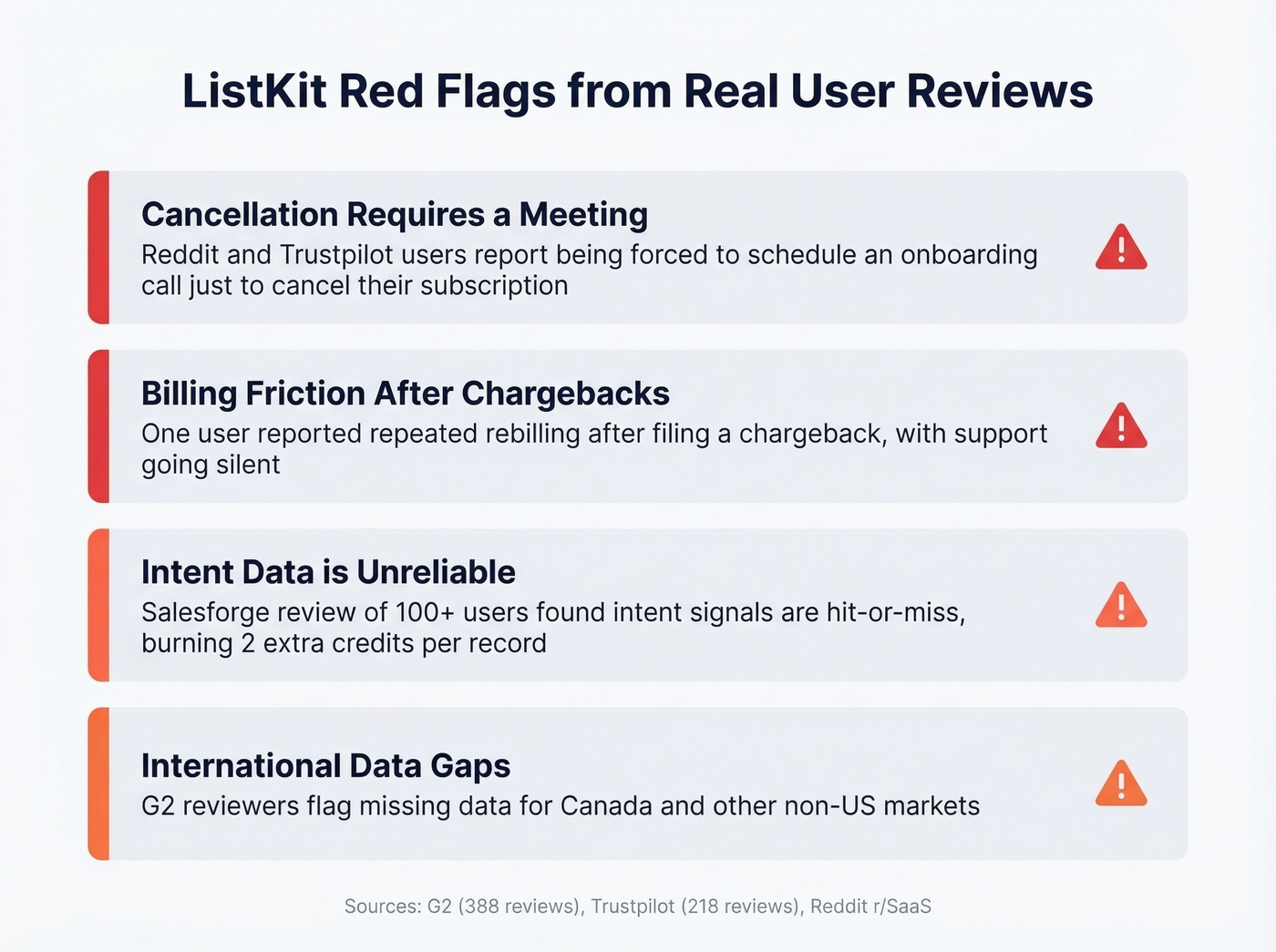
Look, we've seen aggressive retention tactics across the industry, but requiring a meeting to cancel a SaaS subscription is a red flag.
Expensive at scale. Teams often underestimate the real per-lead cost once they start layering mobile numbers and intent signals. More on the math below.
Filtering and integration gaps. For teams running complex ICP criteria or needing tight CRM sync, expect friction - six reviewers flag each issue specifically.
Intent data is hit-or-miss. Salesforge's ListKit review, based on 100+ user reviews, calls intent signals unreliable. For teams buying credits specifically for intent enrichment, that's a problem.

ListKit charges 5 credits per mobile and 2 per intent signal. Prospeo gives you 98% accurate emails at $0.01 each, 125M+ verified mobiles, and intent data across 15,000 topics - all on a 7-day refresh cycle. No credit multipliers, no meetings to cancel.
Stop doing credit math. Start reaching real buyers.
Triple Verification: Reality Check
ListKit's core marketing claim is triple verification - email, domain, and activity checks before export. Sounds bulletproof. It's not.
Even the best verification engines can't eliminate bounces entirely. Verified lists typically still see 1-3% bounce rates depending on niche, list age, and sending infrastructure. That's normal across the industry, but calibrate your expectations if you're coming from ListKit's marketing page expecting perfection. For reference, Prospeo delivers 98% email accuracy with a 7-day data refresh cycle and a 5-step verification process that includes catch-all handling, spam-trap removal, and honeypot filtering - about as rigorous as verification gets in this space.

Pricing and Credit Math
Here's where ListKit gets confusing - and where most buyers get burned.
| Plan | Price | Credits |
|---|---|---|
| Free | $0 | 100 |
| Professional | $83/mo (annual) or $97/mo | ~2,000/mo (24,000/yr) |
| Scale | $253/mo (annual only) | 120,000/yr |
| Ultimate | $508/mo (annual only) | 600,000/yr |
What those credits actually buy:
| Data type | Credits per record |
|---|---|
| Business email | 1 |
| Personal email | 2 |
| Mobile number | 5 |
| Intent signal | 2 |
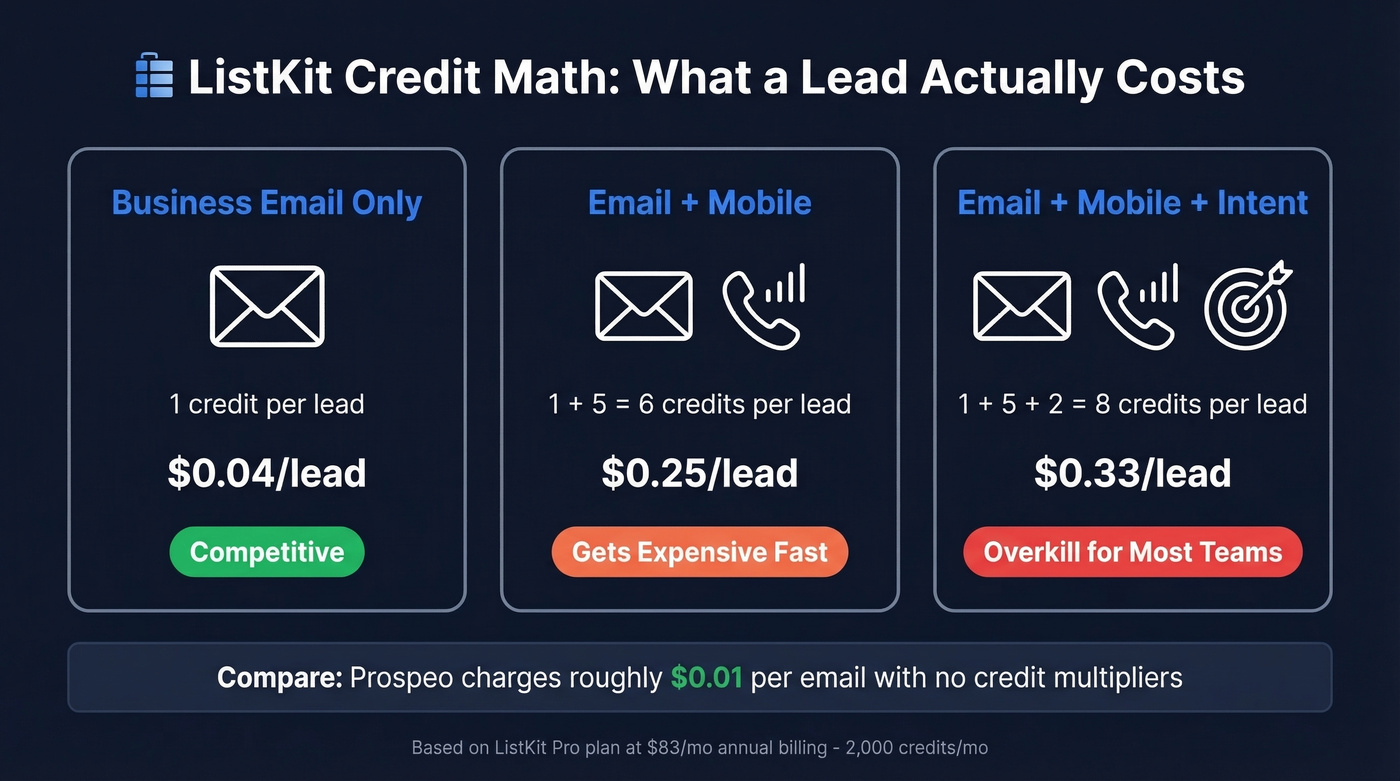
Let's break this down. On the annual Pro plan at $83/mo, a business-email-only lead costs about $0.04. That's competitive. But a fully enriched lead with email plus mobile burns 6 credits, pushing the effective price to roughly $0.25/lead. Add intent data and you're at 8 credits - about $0.33/lead. In our testing, the credit burn on mobile numbers was the single biggest surprise. That math changes the value proposition entirely, especially when you compare it to platforms charging $0.01 per email with no hidden multipliers.
Who Should Use ListKit
Best for: US-focused cold email teams who primarily need business emails, value hands-on onboarding support, and run moderate-volume campaigns under 5,000 leads per month.
Skip it if you prospect internationally - G2 reviews mention gaps like missing Canadian data. Also skip if you need heavy mobile enrichment where the 5-credit cost adds up fast, you're running 10k+ daily API requests (Salesforge flags API rate limits during peak usage), or you want to cancel without scheduling a call.
Hot take: ListKit's AI search is clever, but it's a nice-to-have, not a need-to-have. The real question is always data accuracy and cost per usable lead. A slick search interface means nothing if a big chunk of your mobiles are dead.
Alternatives Worth Testing
Prospeo
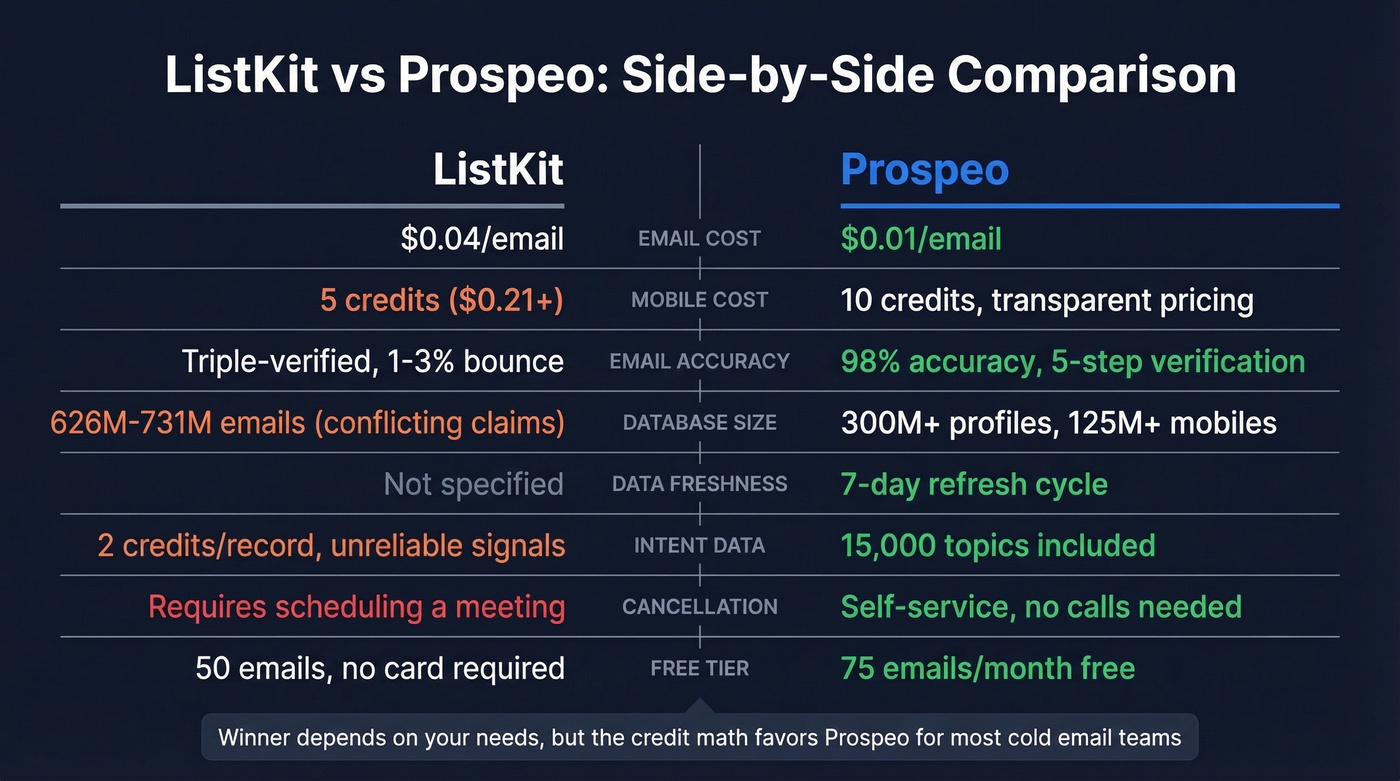
The strongest option if credit economics and data accuracy are your primary concerns. The database covers 300M+ professional profiles with 98% email accuracy and 125M+ verified mobile numbers with a 30% pickup rate, all on a 7-day refresh cycle. Pricing is straightforward - roughly $0.01 per email, 10 credits per mobile, with a free tier of 75 verified emails monthly. No annual contracts, no onboarding calls required to cancel. Native integrations with HubSpot, Salesforce, Instantly, Smartlead, Lemlist, and Clay mean it plugs into existing cold email stacks directly. Real results back this up: Stack Optimize built from $0 to $1M ARR using Prospeo data, maintaining 94%+ deliverability and sub-3% bounce rates across all clients.
Apollo.io
Apollo is the all-in-one play: 210M contacts and 35M companies, bundled with sequencing, a dialer, and basic CRM functionality. Pricing runs $59-$149/user/mo. It beats ListKit on workflow completeness but loses on email accuracy. Best for teams that want one platform instead of a stack.
Lusha
The budget entry point at $22.45/mo for Pro. Solid for small teams pulling a few hundred contacts monthly who don't need intent data or AI search. The tradeoff is coverage depth - Lusha's database is smaller and verification less rigorous. You'll outgrow it, but it's a fine starting point.
ZoomInfo
Enterprise benchmark at $15k-$40k+/year. Not the right tool for anyone reading a ListKit review. Unmatched US database depth and the most mature intent ecosystem, but wildly overkill for teams spending under $500/mo on data.
| Tool | Starting price | Best for | Main tradeoff |
|---|---|---|---|
| Prospeo | Free; ~$0.01/email | Accuracy + simplicity | No built-in sequencing |
| Apollo | $59/user/mo | All-in-one workflows | Lower email accuracy |
| Lusha | $22.45/mo | Budget teams | Smaller database |
| ZoomInfo | ~$15k+/yr | Enterprise orgs | Price and complexity |
Stack Optimize built a $1M agency on Prospeo data with sub-3% bounce rates and zero domain flags. That's what 5-step verification with catch-all handling, spam-trap removal, and honeypot filtering delivers - not marketing claims, but measurable outcomes.
Replace triple verification promises with 98% proven accuracy.
FAQ
Is ListKit worth it for cold email?
ListKit works well for business-email-only cold outreach at low to moderate volume. On the Pro plan, business emails cost ~$0.04 each, which is competitive. But if you need mobile numbers or intent data, credit burn pushes costs to $0.25-$0.33 per lead - at which point alternatives delivering $0.01/email offer better economics.
Can you cancel ListKit easily?
No. Multiple users on Reddit and Trustpilot report being required to schedule an "onboarding meeting" before cancellation is processed. If you can't find a time slot, support may stop responding. Test with the free trial before entering any paid commitment.
How accurate is ListKit's triple verification?
Triple-verified lists still see 1-3% bounce rates in practice. That's standard across the industry - no verification engine eliminates bounces entirely. Salesforge's 2026 review confirms bounce rates aren't zero despite the triple-verification claim.
What's a cheaper alternative to ListKit for verified leads?
Prospeo offers 75 free verified emails monthly with 98% accuracy and charges ~$0.01 per email on paid plans. No annual contracts, no cancellation calls. For teams spending $83+/mo on ListKit, it typically delivers more usable contacts per dollar.
Bottom Line
Weighing ListKit pros and cons comes down to two things: do the credit economics work for your specific enrichment needs, and do you trust the billing process enough to commit? The support is genuinely excellent and the AI search is clever, but the credit burn on mobiles and intent data changes the math fast. If you're spending more than $0.20 per usable lead, you're overpaying for what you're getting.