


LoneScale Pros and Cons: What 62 Reviews Actually Say
You're evaluating LoneScale, which means you're already sold on signal-based selling. The question isn't whether champion tracking matters - it's whether LoneScale is the right $12K+/year commitment for your team. We analyzed all 62 G2 reviews to break down the pros and cons that actually matter.
30-Second Verdict
G2 Rating: 4.8/5 from 62 reviews
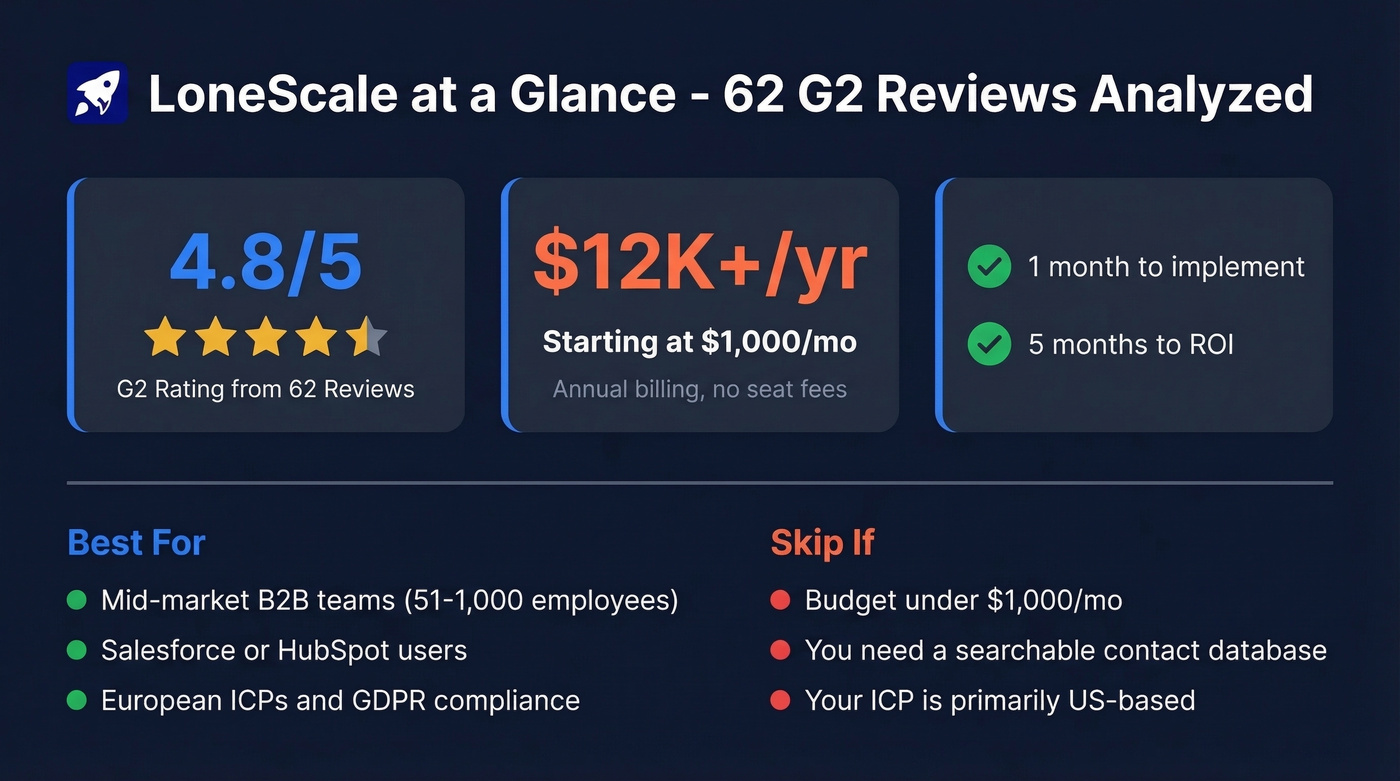
One-liner: A strong signal orchestration tool for European mid-market teams on Salesforce or HubSpot - but narrow by design, and the price floor is steep for what you get.
Best for: Mid-market B2B teams (51-1,000 employees) needing real-time job change and hiring signals pushed into Salesforce or HubSpot, especially with European ICPs. 52 of 62 reviewers are based in Europe, and that skew reflects where coverage runs deepest.
Skip if: You need a searchable contact database, built-in outreach, or you're an SMB that can't commit $1,000/mo minimum on annual billing.
What LoneScale Does
LoneScale monitors buying signals - job changes, new hires, hiring intent - and pushes enriched contacts directly into your CRM. It's the trigger layer, not the database or the sequencer. It sits natively inside Salesforce and HubSpot, runs waterfall enrichment across 25+ data providers, and maps buying committees in one click. With sales cycles stretching 32% longer since 2021, the pitch is straightforward: reach buyers when something changes, not when your cadence says so.
The Pros
In our analysis, reviewer praise clusters around a few clear strengths.
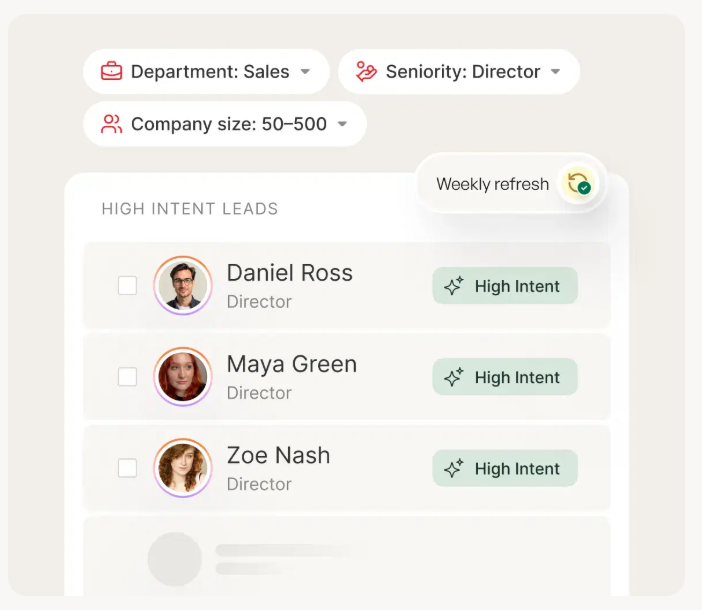
Fast implementation, fast ROI. On G2's "Value at a Glance," LoneScale averages one month to implement and five months to ROI. When you're paying $1K/mo from day one, that speed matters a lot.
Fresh signals with daily CRM refresh. The platform is built around real-time signals and a daily refresh of key fields in your CRM, so reps can act while signals are still warm rather than chasing stale data from last quarter's export.
Reviewers consistently praise ease of setup - 18 mentions across the review base. One user wrote: "Setting up LoneScale was straightforward... comprehensive guides and excellent in-person support." The tool also uses no seat fees, meaning unlimited users with no per-seat math or mid-contract negotiations when you add reps. And if your ICP is EMEA-heavy, the European and GDPR coverage is a genuine differentiator, including specific callouts for German market depth and native GDPR compliance in a detailed G2 review.

LoneScale gives you the signals - but no database and no verified contacts. Prospeo gives you both: 300M+ profiles, 98% email accuracy, and a 7-day data refresh cycle, all without a $12K annual commitment. Start with 75 free verified emails per month, no contract required.
Get the contacts LoneScale can't give you - at $0.01 per email.
The Cons
Here's where the review data tells a clearer story than marketing copy.
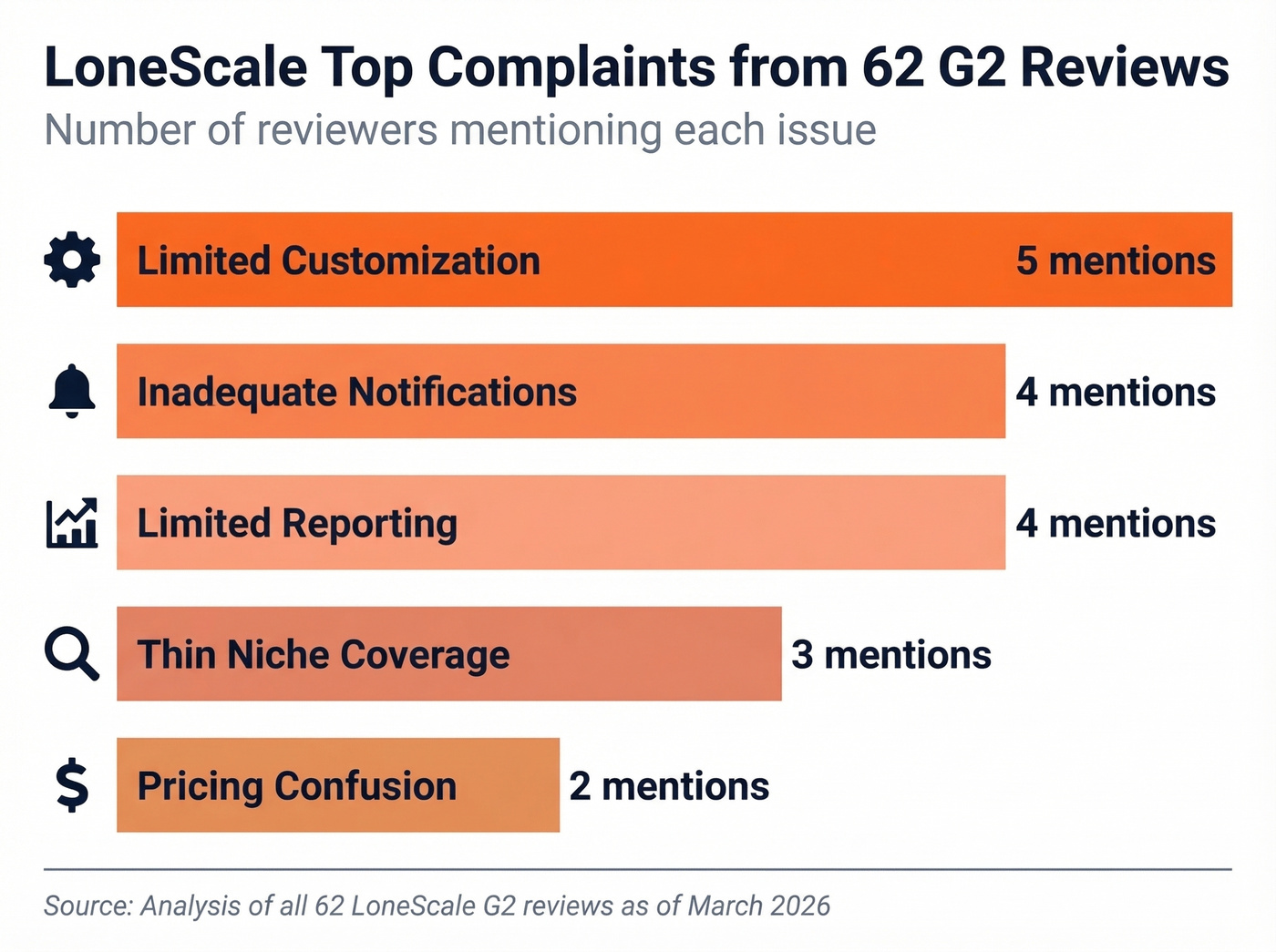
Limited customization (5 mentions). Users want more flexibility in how signals are filtered, formatted, and routed. The tool works well out of the box, but power users hit walls fast.
Inadequate notifications (4 mentions). Alerts are either overwhelming or not configurable enough. One reviewer described needing a "power user" to provide leads rather than being notified directly - that's a workflow bottleneck, not a feature.
Limited reporting (4 mentions). Multiple reviewers request more flexible dashboards. If your RevOps team lives in reports, you'll feel this gap every week.
Thin coverage for niche companies. Waterfall enrichment across 25+ providers sounds impressive, but coverage drops noticeably for smaller or niche verticals.
Pricing confusion. LoneScale's pricing page lists $1,000/mo and $2,500/mo tiers, but directories like Dimmo describe it as "quote-based." Expect annual billing for most teams, with some negotiation depending on usage.
Small team risk. LoneScale has roughly 11-12 employees. For enterprise buyers with strict vendor risk policies, that's worth flagging. The tool also has virtually no Reddit or community discussion - unusual at this price point, and something we noticed when trying to find peer validation outside of G2.
Here's the thing: LoneScale is a genuinely good signal tool trapped inside a pricing model that excludes the teams who'd benefit most. At $12K/year minimum for what is essentially a trigger layer - no database, no outreach, no dialer - you need a large enough team to justify the spend. If your average deal size is under $15K, the math probably doesn't work.
Pricing Breakdown
| Tool | Plan | Monthly Cost | Annual Cost | Contract |
|---|---|---|---|---|
| LoneScale | Core (20K credits) | $1,000 | ~$12,000 | Monthly or annual |
| LoneScale | Team (60K credits) | $2,500 | ~$30,000 | Monthly or annual |
| UserGems | Core | $2,750 | $33,000 + $3K impl. | Annual |
| UserGems | Advanced | $5,750 | $69,000 + $5K impl. | Annual |
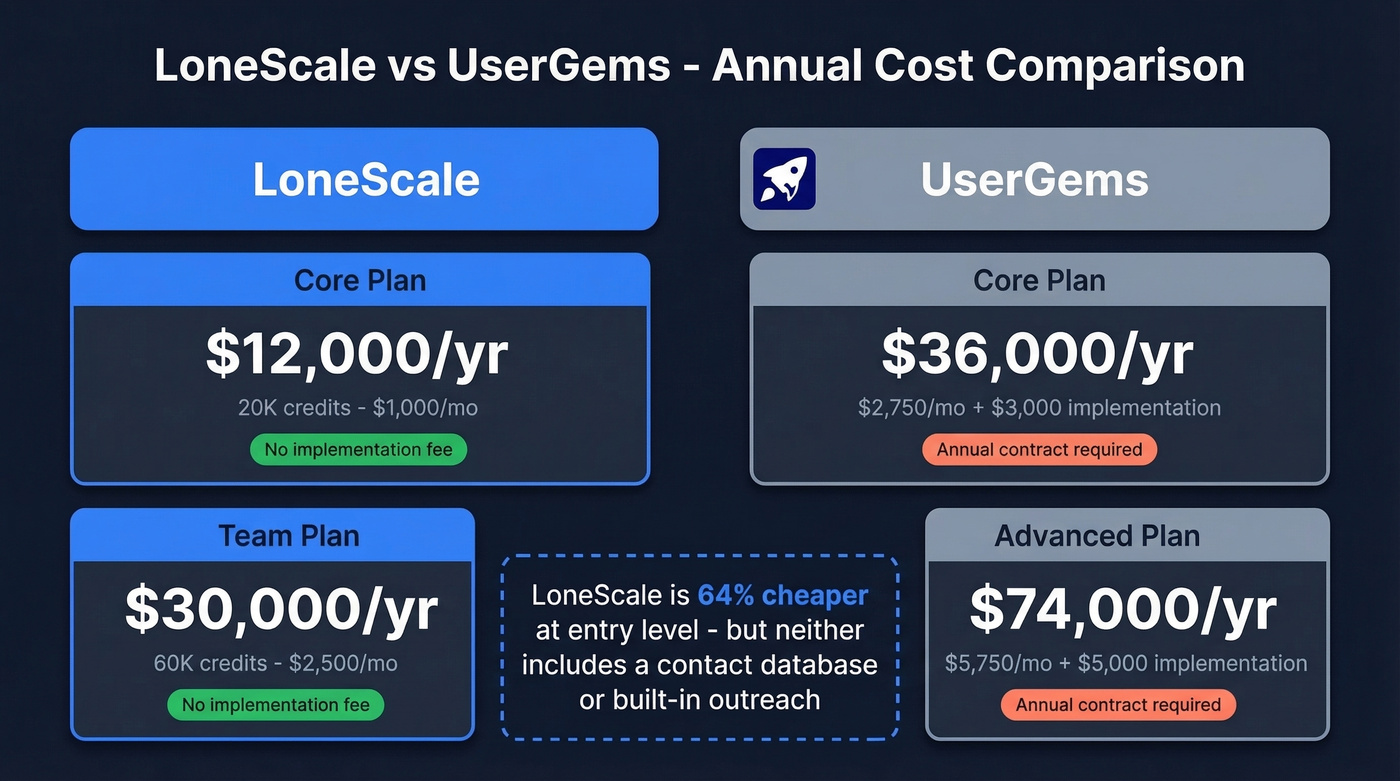
LoneScale runs about 64% cheaper than UserGems at the entry level. UserGems charges a separate implementation fee, and both tools are typically bought on annual budgets. That said, "cheaper than UserGems" is a low bar - both are expensive for what amounts to a signal layer without built-in outreach.
Who Should (and Shouldn't) Use LoneScale
LoneScale fits mid-market European B2B teams on Salesforce or HubSpot that need champion tracking and hiring signals automated into their CRM. It's ideal for orgs with 20+ reps who'll benefit from unlimited users, and companies where GDPR compliance is non-negotiable.
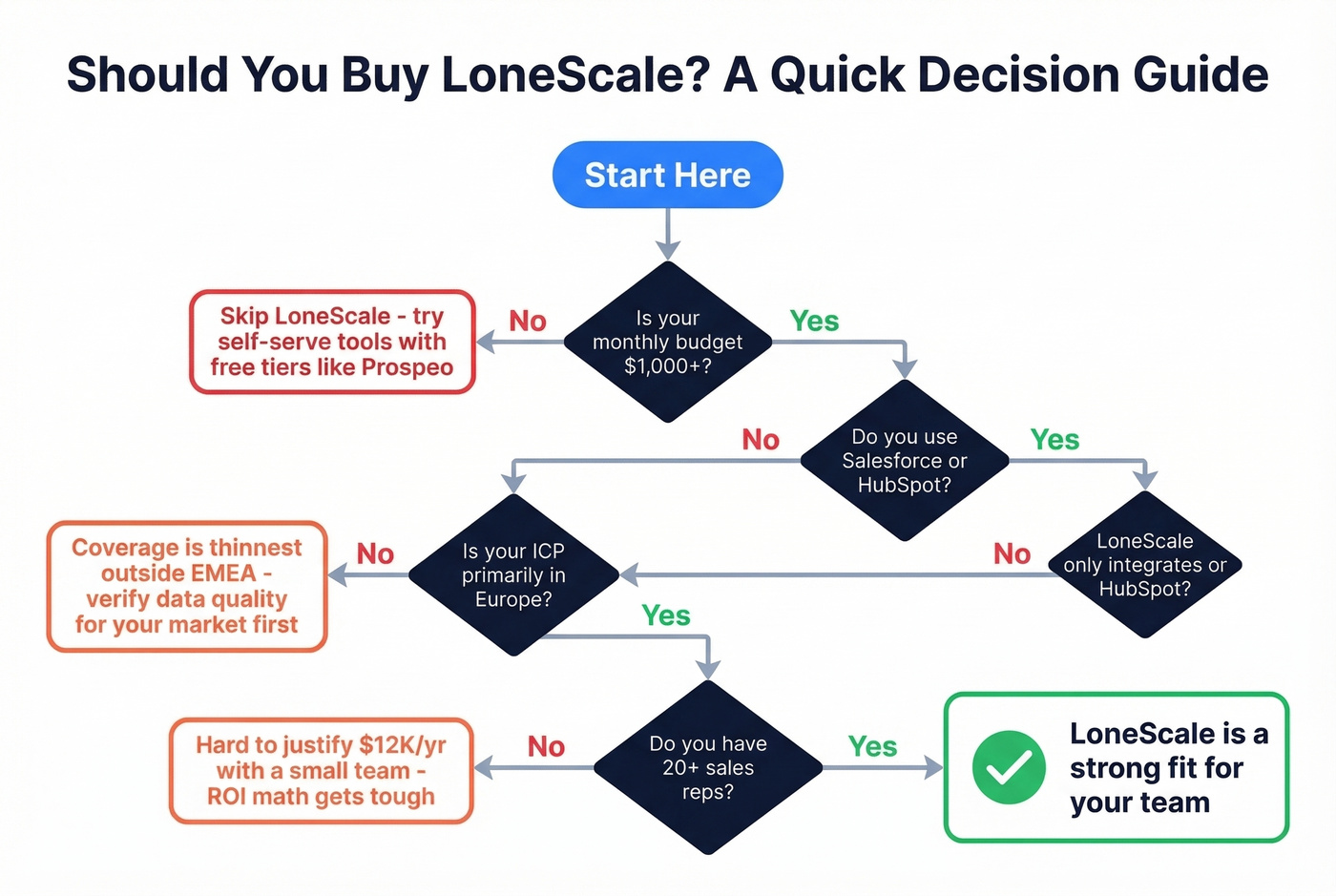
Skip it if your budget is under $1K/mo, you need a searchable contact database or built-in outreach, or your ICP is primarily US-based. With 52 of 62 reviewers being European, that's where coverage runs deepest. Let's be honest - weighing these LoneScale pros and cons against your team's actual workflow and deal size is the only way to make the right call. Don't let the 4.8-star rating do the thinking for you.
Paying $1,000/month for a trigger layer that still needs separate tools for contact data and outreach adds up fast. Prospeo combines a searchable database with 30+ filters, real-time verification, and native integrations with Salesforce, HubSpot, Instantly, and Lemlist - starting at $0.
Skip the $12K floor. Build verified lists in minutes, not months.
FAQ
Is LoneScale worth it for small teams?
No. At $1,000/month minimum on annual billing, smaller teams get better ROI from self-serve tools with free tiers. We've seen early-stage outbound teams do just fine with 75 free verified emails per month and no annual commitment - the $12K floor simply doesn't make sense until your team is large enough to spread that cost across dozens of reps.
How does LoneScale compare to UserGems?
LoneScale is cheaper ($1K/mo vs $2.75K/mo for UserGems Core), easier to set up per reviewers, and emphasizes daily refresh plus real-time signals. UserGems has a larger review base (146 reviews) and broader features but costs about 2.75x more at the entry tier. If budget is the primary constraint, LoneScale wins on price. If you need deeper integrations and a more mature product, UserGems has the edge.
Does LoneScale verify email deliverability?
Yes - LoneScale checks emails and phone numbers for deliverability as part of its enrichment, which helps prevent bounces and protect domain reputation. For high-volume outbound, pairing it with a dedicated verification tool adds an extra safety layer, especially for catch-all domains that trip up most enrichment providers.
What are the biggest drawbacks reviewers mention?
Limited customization, weak notification controls, and sparse reporting are the top three complaints across G2 reviews. Coverage also thins out for niche verticals and smaller companies, even with 25+ waterfall providers feeding the system.