

The Data-Driven Guide to the Sales Cycle Process
Only 43.5% of sales reps hit quota last year. Win rates have dropped 18% compared to 2022, and sales cycles have stretched 22% longer over the same period. The math is brutal: fewer deals closing, each one taking longer to land. Understanding your sales cycle process - and knowing exactly where it's breaking - isn't optional anymore.
What You Need (Quick Version)
If you just want benchmarks, skip to the tables below. If your cycle feels too long, jump to the diagnosis section. Three things move the needle most:
- Multi-thread every deal - engaging 3+ contacts closes deals 2.4x faster
- Send proposals within 24 hours of the demo - 35% faster closes
- Fix your contact data before outreach - bad emails and wrong numbers waste the critical 14-day engagement window before you ever build momentum (see data enrichment options)
The median B2B SaaS sales cycle runs 84 days. If yours is significantly longer than your ACV band suggests, you've got a diagnosable problem - not a market condition.
Sales Cycle vs. Process vs. Methodology
These three terms get swapped around constantly, and it causes real confusion in planning meetings.
| Term | What It Is | Example |
|---|---|---|
| Sales cycle | The timeline from first touch to closed deal | 84-day median for B2B SaaS |
| Sales process | Actionable steps unique to your org | Your 7-stage pipeline in Salesforce |
| Sales methodology | Broader philosophy guiding how you sell | MEDDIC, Challenger, Sandler |
Your sales process is the series of steps your team follows - unique to your organization, your buyer, and your product. A methodology is the philosophy layered on top. Challenger might inform how your reps run discovery calls (use a tighter discovery questions framework), but it doesn't define your pipeline stages.
One more distinction worth internalizing: stages are high-level phases with exit criteria used for forecasting, while steps are the tactical daily actions that move deals through those stages. A stage is "Proposal Sent." A step is "Email the pricing PDF to the VP of Ops by Thursday." Confusing the two is why so many CRM pipelines are a mess (and why sales process optimization matters).
The 7 Stages of the Sales Cycle
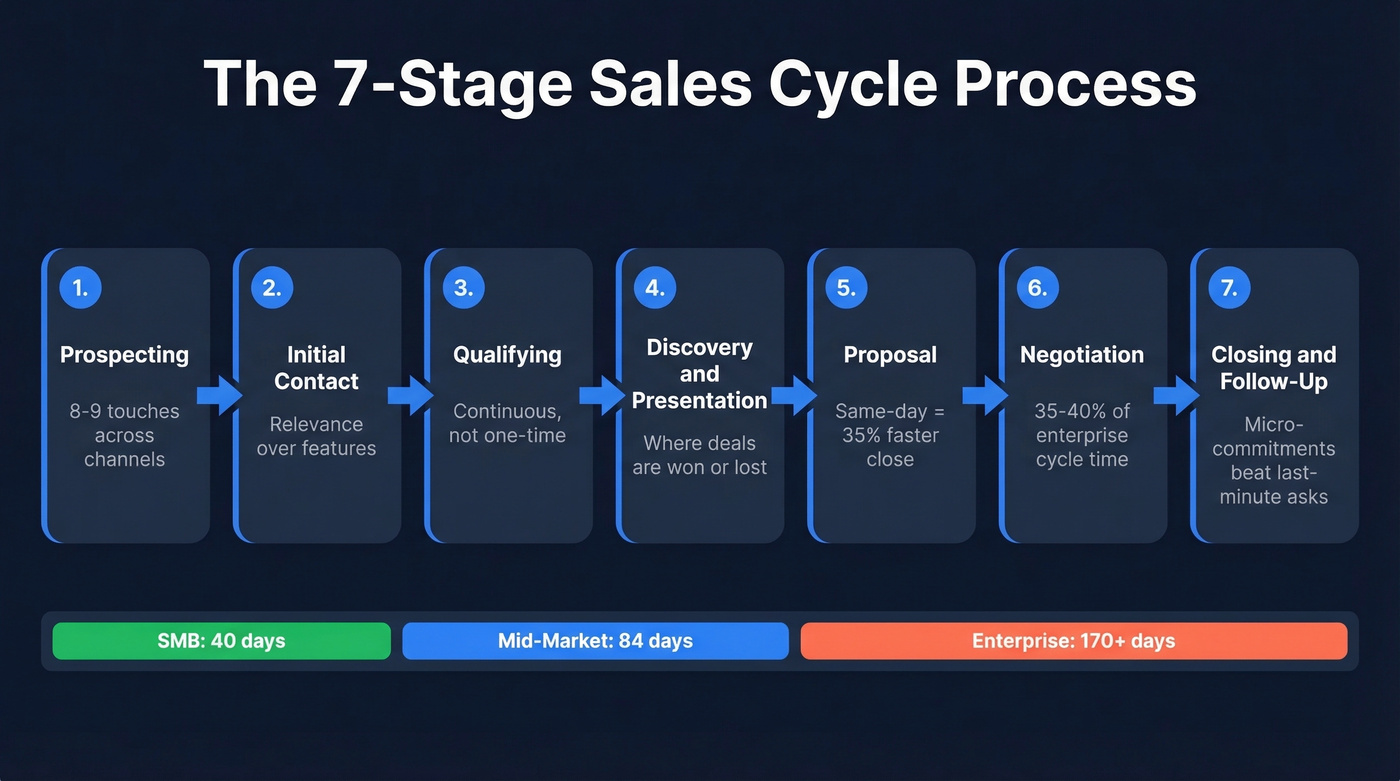
1. Prospecting
Good prospecting isn't blasting 500 emails into the void. It's a focused 14-day engagement window where reps reach out across channels to a well-targeted list. RAIN Group's research shows it takes at least 8 touches to break through, while Outreach data puts the number at 9 across multiple channels (see more sales prospecting techniques).
The quality of your contact data determines whether that window is spent on conversations or chasing bounces. We've seen teams waste the entire first week of a campaign discovering half their list is dead - wrong emails, disconnected numbers, people who left the company six months ago. Tools with 98% email accuracy and a 7-day refresh cycle, like Prospeo, mean reps start with live data instead of burning time on cleanup (and avoid common email bounce rate issues).

Discovery-to-demo typically runs 3-5 days for SMB, 5-10 for mid-market, and 10-20 for enterprise.
2. Initial Contact
71% of buyers want to hear from sellers early in their buying process - but they want relevance, not a feature dump. Good initial contact references something specific about the prospect's situation and offers a clear reason to continue the conversation. Nobody cares about your product in the first touch. They care about their problem (tighten your sales communication here).
3. Qualifying
Qualifying isn't a one-time checkbox. It's a continuous thread running through every interaction. The best reps re-qualify at each stage, confirming that budget, authority, timeline, and need haven't shifted. For SMB deals under $15K, BANT works as quick triage. For enterprise deals with 6.8 stakeholders in the buying committee, you need something heavier - we cover frameworks in detail below (including MEDDIC sales qualification).
4. Discovery & Presentation
This is where most deals are actually won or lost - not at the negotiation table. Great discovery uncovers the prospect's real pain, quantifies the cost of inaction, and builds a business case that survives the internal committee review. The common mistake is treating the demo as a product walkthrough instead of a conversation about the buyer's world, their priorities, and the specific outcomes they need to justify the purchase internally. Demo-to-proposal runs 1-3 days for SMB, 5-15 for mid-market, and 15-30 for enterprise (use a product demo checklist to standardize this).
5. Proposal
Same-day proposal delivery closes deals 35% faster. Yet most teams take a week or more to get a proposal out the door. This is where urgency dies. Build templates in advance, customize 20% instead of 80%, and get it out while the demo is still fresh in the buyer's mind.
6. Negotiation & Objection Handling
For enterprise deals, negotiation-to-close consumes 35-40% of total cycle time. Legal review, procurement processes, security questionnaires - this is where deals go to die slowly. What good looks like: mutual action plans that cut this phase by 20-30%. A shared document with deadlines, owners, and next steps for both sides creates accountability that email threads simply can't match (and pairs well with a clear walk away point).
7. Closing & Follow-Up
44% of sales leaders report that opportunities lost to "no decision" have increased. The biggest threat to your close rate isn't a competitor - it's inertia.
Here's the thing: the best closers don't treat the close as a single event. They've already secured micro-commitments throughout the cycle - introductions to procurement, verbal budget confirmation, technical validation sign-off - so the final signature is a formality. If you're scrambling for buy-in at the contract stage, you lost control of the deal three stages ago (use proven sales follow-up templates to keep momentum).

Bad contact data kills your 14-day prospecting window before it starts. Prospeo's 7-day refresh cycle and 98% email accuracy mean reps spend those 8-9 critical touches talking to real buyers - not chasing bounces. Teams using Prospeo book 35% more meetings than Apollo users.
Stop losing week one to dead emails and disconnected numbers.
Sales Cycle Timeline Benchmarks
These are the numbers everyone's looking for, pulled across four dimensions so you can triangulate where your cycle should land.
By Industry
| Industry | Initial Contact | Proposal | Negotiation | Closing | Total Days |
|---|---|---|---|---|---|
| Retail | 11 | 22 | 20 | 17 | 70 |
| Hospitality | 14 | 27 | 24 | 20 | 85 |
| Software | 14 | 30 | 25 | 21 | 90 |
| Financial Svcs | 16 | 31 | 28 | 23 | 98 |
| Consulting | 17 | 33 | 29 | 24 | 103 |
| Telecom | 17 | 33 | 29 | 24 | 103 |
| Automotive | 17 | 33 | 29 | 25 | 104 |
| Real Estate | 17 | 34 | 29 | 25 | 105 |
| Media/Ent. | 19 | 37 | 32 | 27 | 115 |
| Logistics | 19 | 37 | 33 | 28 | 117 |
| Technology | 20 | 39 | 34 | 28 | 121 |
| Healthcare | 20 | 40 | 35 | 30 | 125 |
| Education | 21 | 40 | 35 | 30 | 126 |
| Insurance | 21 | 41 | 35 | 30 | 127 |
| Manufacturing | 22 | 43 | 36 | 29 | 130 |
| Agriculture | 22 | 43 | 37 | 32 | 134 |
| Construction | 22 | 43 | 37 | 32 | 134 |
| Pharmaceuticals | 25 | 49 | 43 | 36 | 153 |
| Energy | 25 | 50 | 43 | 37 | 155 |
| Non-Profit | 26 | 52 | 46 | 38 | 162 |
Source: Focus Digital
The spread from Retail (70 days) to Non-Profit (162 days) is over 2x. If your industry sits in the 120+ range, your cycle isn't broken - it's structural. The real question is whether you're faster or slower than your industry peers. In our experience, teams that obsess over absolute cycle length when they should be benchmarking against their own vertical waste a lot of energy solving the wrong problem.
By Deal Size (ACV)
| ACV Band | Avg Cycle (Days) |
|---|---|
| < $1K | 25 |
| $1K-$5K | 40 |
| $5K-$10K | 55 |
| $10K-$50K | 75 |
| $50K-$100K | 120 |
| $100K-$250K | 170 |
| $250K-$500K | 220 |
| $500K+ | 270 |
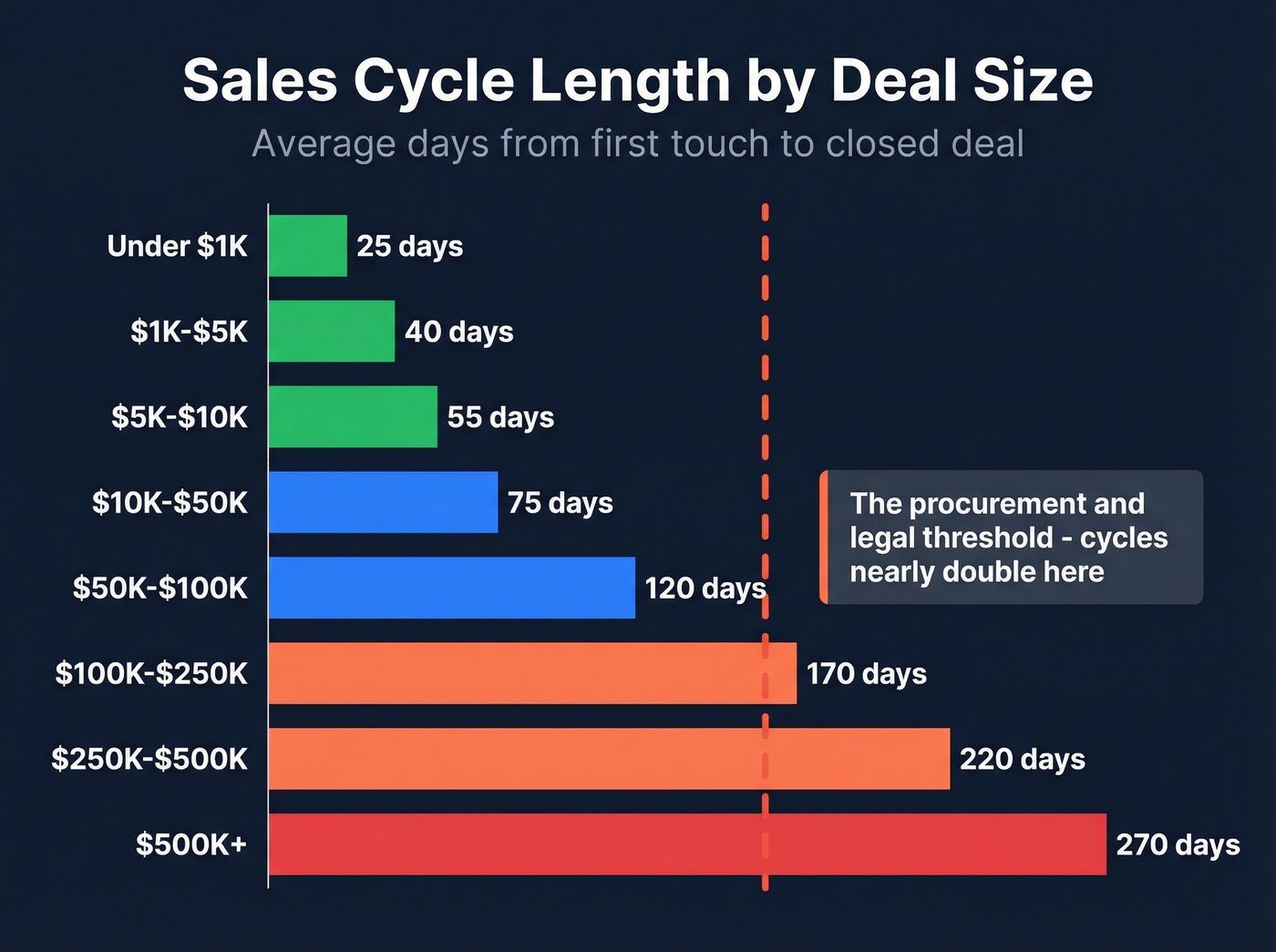
The jump from $50K to $100K ACV is where cycles nearly double. That's the procurement-and-legal threshold - the point where deals stop being a sales conversation and start being an organizational buying process.
By Prospect Company Size
| Company Size | Avg Cycle (Days) |
|---|---|
| 1-10 employees | 38 |
| 11-50 | 57 |
| 51-200 | 77 |
| 201-500 | 95 |
| 501-1,000 | 115 |
| 1,001-5,000 | 135 |
| 5,001-10,000 | 158 |
| 10,001+ | 185 |
By Lead Source Channel
| Channel | Low Complexity | Medium | High Complexity |
|---|---|---|---|
| Referrals | 20 | 35 | 60 |
| SEO / Inbound | 28 | 50 | 75 |
| Events | 35 | 60 | 90 |
| Social Selling | 45 | 70 | 100 |
| Cold Email | 50 | 75 | 105 |
| Cold Calling | 60 | 85 | 110 |
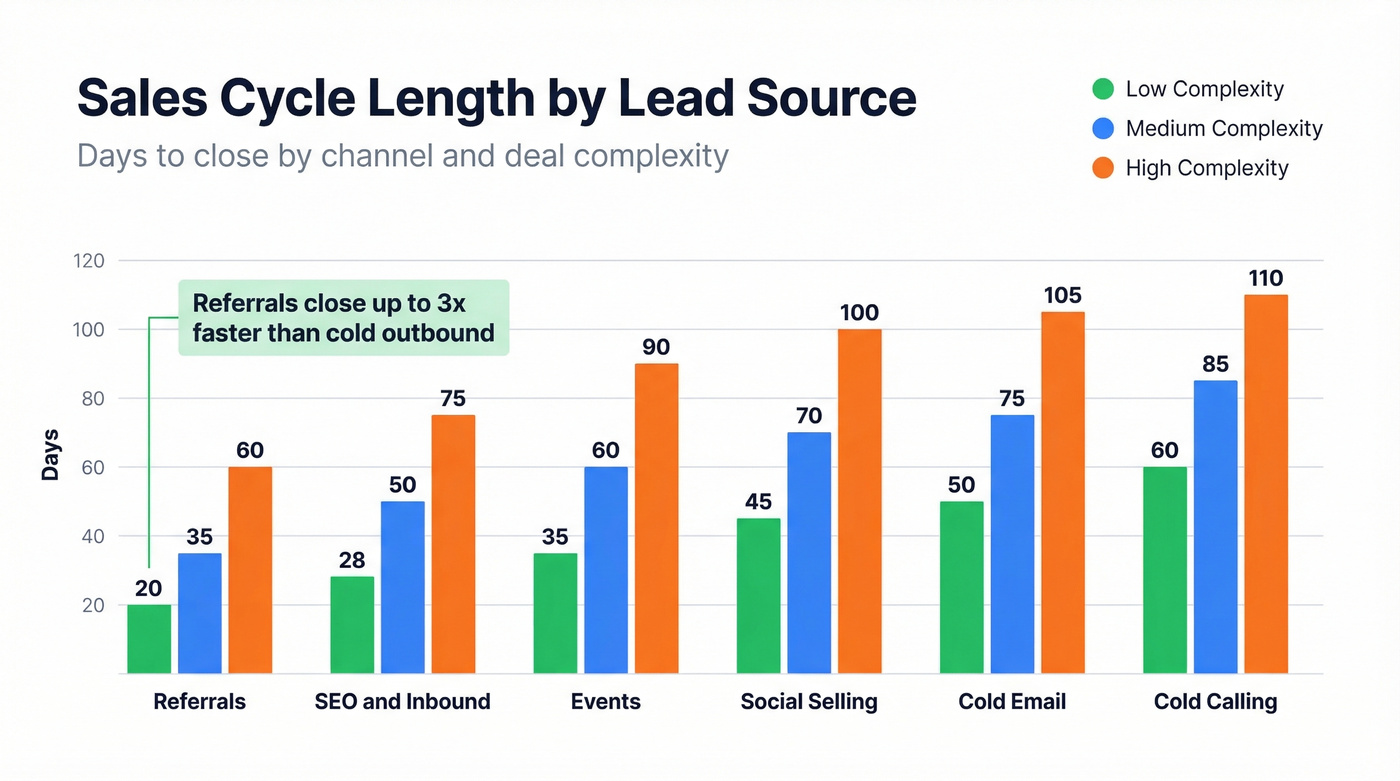
Referrals close up to 3x faster than cold outbound, especially in low-complexity deals. If you're not systematically generating referrals, you're leaving the fastest pipeline source on the table.
Stage Conversion Benchmarks
Knowing your timeline is half the picture. The other half is understanding where volume drops off. Here are stage conversion rates across industries (compare against your own sales pipeline benchmarks):
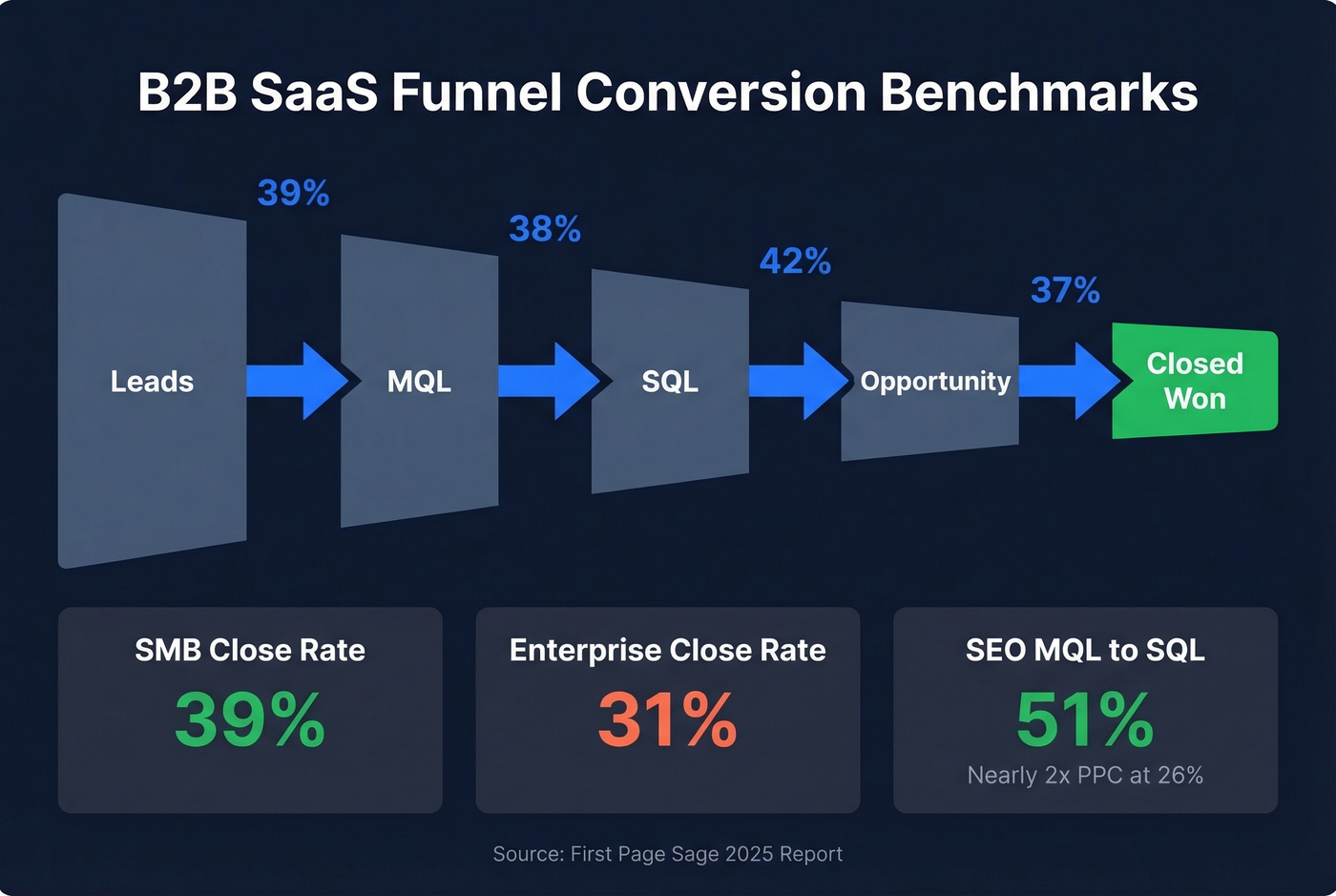
| Industry | Lead-MQL | MQL-SQL | SQL-Opp | SQL-Closed |
|---|---|---|---|---|
| B2B SaaS | 39% | 38% | 42% | 37% |
| Cybersecurity | 24% | 40% | 43% | 46% |
| Financial Svcs | 29% | 38% | 49% | 53% |
| Manufacturing | 26% | 41% | 46% | 51% |
| Higher Education | 45% | 46% | 61% | 66% |
B2B SaaS has the highest lead-to-MQL rate but one of the lowest SQL-to-closed rates - lots of interest, harder to convert. Financial services and manufacturing close at much higher rates once a deal reaches SQL, which makes sense given longer qualification cycles that filter out tire-kickers early.
SMB teams convert opportunities to closed-won at roughly 39%, while enterprise teams run closer to 31% thanks to more stakeholders, longer legal cycles, and higher "no decision" rates.
Channel performance varies dramatically too. SEO-sourced leads convert from MQL to SQL at 51% - nearly double PPC's 26%. Events convert MQL to SQL at just 24%, but opportunity-to-close hits 40%, the highest of any channel. The lesson: events generate fewer qualified leads, but the ones that qualify are serious buyers.
Qualification Frameworks
| Framework | Best For | ACV Range | Core Focus | Weakness |
|---|---|---|---|---|
| BANT | High-volume SDR triage | < $15K | Budget, Authority, Need, Timeline | Breaks with committees |
| CHAMP | Consultative mid-market | $15K-$100K | Challenges first, then budget | Less structured |
| MEDDIC/MEDDPICC | Enterprise, multi-stakeholder | $100K+ | Metrics, Economic Buyer, Decision Process | Heavy overhead |
| GPCTBA/C&I | Executive-level selling | $50K+ | Goals, Plans, Consequences | Requires senior access |
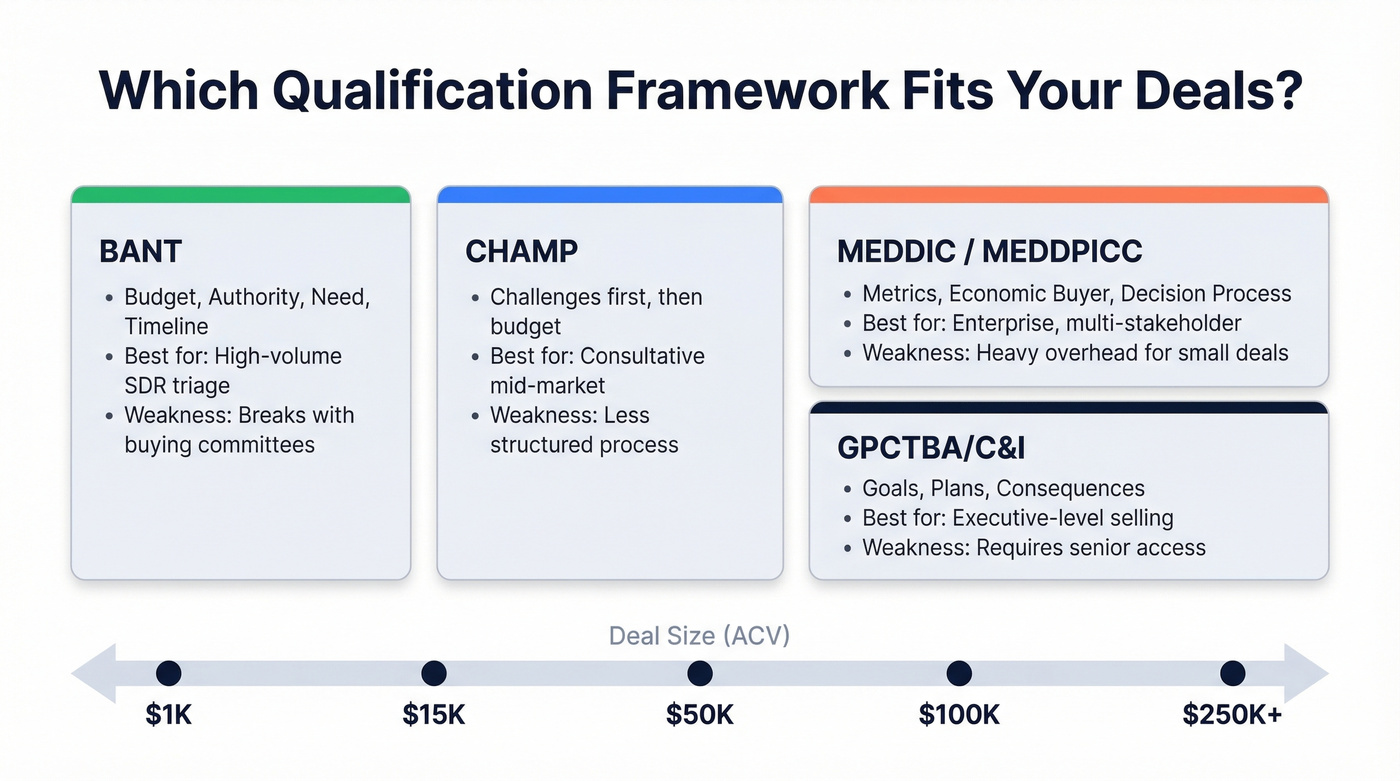
Look, using BANT on six-figure enterprise deals is malpractice. When you've got 6.8 stakeholders in the buying committee, asking "do you have budget?" to one person tells you almost nothing. MEDDIC exists because enterprise deals require you to map the decision process, identify the economic buyer, and build a champion who'll sell internally when you're not in the room (see MEDDPICC economic buyer).
For teams selling sub-$15K deals at volume, BANT is perfectly fine - fast, simple, and it prevents reps from over-investing time in small transactions. Skip MEDDIC if your average deal closes in 30 days and your ACV is under $10K. You'll spend more time filling out qualification fields than actually selling. Match the framework to the deal complexity, not to what sounds most sophisticated on a LinkedIn post.
How to Shorten Your Sales Cycle
Here's the hot take nobody wants to hear: your cycle probably isn't too long because of "market conditions." It's too long because of structural friction you've normalized. Buying committees have grown from 5.4 to 6.8 stakeholders - that's a real headwind. But reps still spend roughly 30% of their time actually selling and 70% on admin, data entry, and internal coordination. That 70% is the part you control (and where data-driven selling pays off).
The consensus on r/sales echoes this constantly: deals that look promising but never move past a certain stage. The fix isn't motivation. It's a measurable process with exit criteria at every stage and the right levers pulled in the right order.
1. Multi-thread every deal. Deals with 3+ contacts engaged close 2.4x faster. With buying committees averaging 6.8 people, single-threading is a recipe for stalled deals. Map the committee early and make sure your champion isn't the only person who knows your name.
2. Send proposals within 24 hours. Same-day proposal delivery correlates with 35% faster closes. Build templates. Pre-approve pricing bands. Remove every internal bottleneck between "great demo" and "here's the proposal."
3. Use mutual action plans. A shared timeline with deadlines and owners for both sides cuts cycle time by 20-30%. It's especially powerful in enterprise deals where the negotiation-to-close phase eats 35-40% of total cycle time.
4. Fix your contact data. This is the unglamorous lever that nobody talks about on conference stages, but it compounds. Snyk's 50-person AE team saw bounce rates drop from 35-40% to under 5% after switching to Prospeo, with AE-sourced pipeline jumping 180% and 200+ new opportunities generated per month. When reps start every day with verified emails and live phone numbers, the 14-day engagement window is spent on conversations - not chasing dead leads.
5. Invest in AI where it saves admin time. 81% of sales teams are investing in AI, and teams using AI tools report 83% revenue growth vs 66% without. The biggest wins aren't AI-generated emails - they're automated CRM updates, call summaries, and deal scoring that give reps back selling hours (see generative AI sales tools).
Let's be honest about what all of this adds up to. 55% of sales leaders say not having a clearly defined sales process has cost them revenue. Shortening your sales cycle process isn't about one magic tactic - it's about systematically removing friction at every stage, starting with the data your reps use to fill the top of the funnel. Use this guide as a diagnostic tool: benchmark your numbers against the tables above, identify the stage where deals stall, and attack that bottleneck first.
Multi-threading 3+ contacts per deal closes 2.4x faster - but only if you can actually reach them. Prospeo gives you 300M+ profiles with verified emails and 125M+ direct dials, so you engage the full buying committee from day one instead of waiting for introductions that never come.
Reach every stakeholder in the deal, not just the one who replied.
FAQ
What's the difference between a sales cycle and a sales funnel?
The sales cycle is the seller's journey through stages - from prospecting to close - measured in time and activities. The sales funnel is a visual model showing how volume narrows at each stage, measured in conversion rates. The cycle tracks one deal's timeline; the funnel tracks aggregate throughput.
How long is the average B2B sales cycle?
The median B2B SaaS sales cycle is 84 days, but that number shifts dramatically by segment. Sub-$1K ACV deals close in about 25 days, while $500K+ deals average 270 days. Use the industry and deal-size tables above to find your specific benchmark.
What's the most common reason deals stall?
"No decision" is the top deal-killer - 44% of sales leaders report it's increasing. The primary drivers are lack of buyer urgency and decision paralysis from too many stakeholders. Mutual action plans and multi-threading across the buying committee are the best countermeasures.
How many touches does it take to close a deal?
Research shows 8-9 touches just to get a first response during prospecting, and the total across a full cycle is significantly higher. Enterprise deals with multiple stakeholders can require dozens of interactions - calls, emails, demos, and champion meetings - before reaching a decision.
Does contact data quality affect sales cycle length?
Bad data wastes the critical 14-day engagement window at the top of the funnel. Bounced emails and wrong numbers mean reps spend days chasing dead ends instead of building pipeline. Starting outreach with verified contacts - 98% email accuracy and a weekly refresh cycle - turns that wasted time into real conversations from day one.