


LoneScale Reviews: Is It Worth $1,000/Month?
Reps spend 68% of their time on non-selling activities. A big chunk of that waste? Manually tracking whether your champion just left their company - and scrambling to find the new stakeholders. LoneScale exists to solve that exact problem, and with a 4.8/5 on G2 across 62 reviews, it's clearly resonating with the teams that use it.
But $1,000/month is real money. We dug into the G2 data, compared pricing tier-by-tier against UserGems, and ran the numbers. Here's what LoneScale reviews actually reveal.
30-Second Verdict
G2 Rating: 4.8/5 (62 reviews - 87% five-star) Best for: Mid-market revenue teams tracking job-change signals Pricing: $1,000/mo (Core) to $2,500/mo (Team) One-line take: Excellent at one specific thing - turning job-change signals into pipeline. If that's your need and you've got the budget, it delivers.
What LoneScale Does
LoneScale is a CRM-native signal platform. It sits inside Salesforce or HubSpot and does three things well: tracks job changes (your champion left, a new VP just started), maps buying committees with verified contact details, and keeps your CRM data fresh by checking it daily against 30+ sources.

The pitch is straightforward - stop wasting time on manual prospecting. LoneScale's homepage touts +30 hours of selling time per rep per month, a 70% increase in contact data quality, and 3X more quality calls per day. Don't take those literally; they're vendor numbers. But the core value prop is sound. If your CRM contacts decay at 30%+ per year and you're losing deals because champions move, automated signals genuinely help.
What Users Actually Say
Ease of Use leads G2's pro tags with 18 mentions, followed by Lead Generation at 16 and Intent Data at 13. Data Accuracy and CRM Integration round out the top five at 10 mentions each. The picture is clear: people find LoneScale intuitive, and it delivers on its core promise.
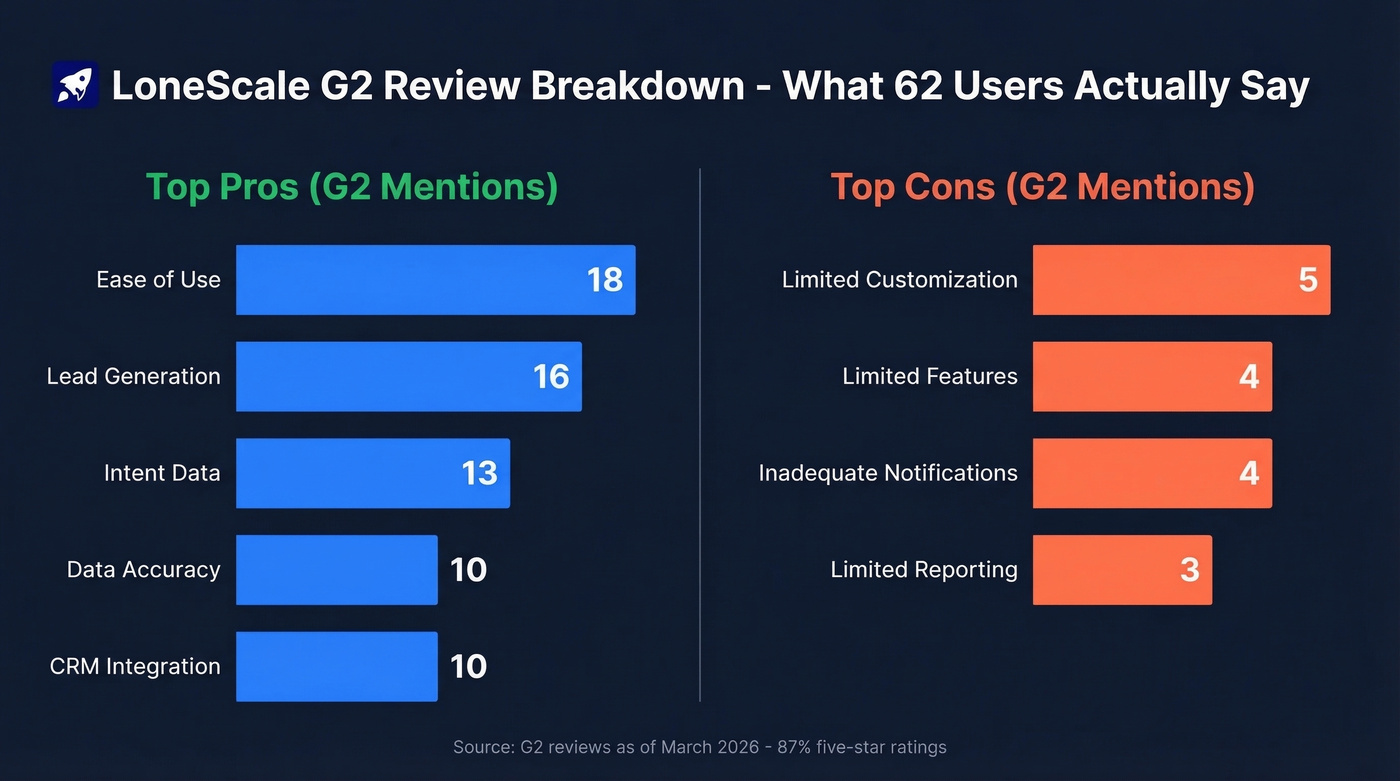
The complaints are more nuanced. Limited Customization leads with 5 mentions, followed by Limited Features (4), Inadequate Notifications (4), and Limited Reporting (3). LoneScale does its core job well, but teams wanting deep dashboards or highly customizable workflows hit walls fast.
One March 2026 reviewer specifically praised European and German coverage alongside native GDPR compliance - a real differentiator if you're selling into EMEA. The same reviewer flagged a need for deeper filtering and more flexible export formatting, which tracks with the customization complaints. LoneScale doesn't have much Reddit or community chatter yet, so most user feedback lives on G2, which is where we focused this analysis.
G2's implementation benchmarks put setup at about 1 month with ROI hitting around the 5-month mark. That's reasonable for a tool at this price point - you're not waiting a year to see results, but it's not plug-and-play overnight either.

LoneScale's Core plan runs $12K/year for 20,000 credits. Prospeo gives you 300M+ profiles with 98% email accuracy, 125M+ verified mobiles, and job-change filters - starting at $0.01 per email with no contracts.
Get the contact data without the $1,000/month price tag.
Pricing Breakdown
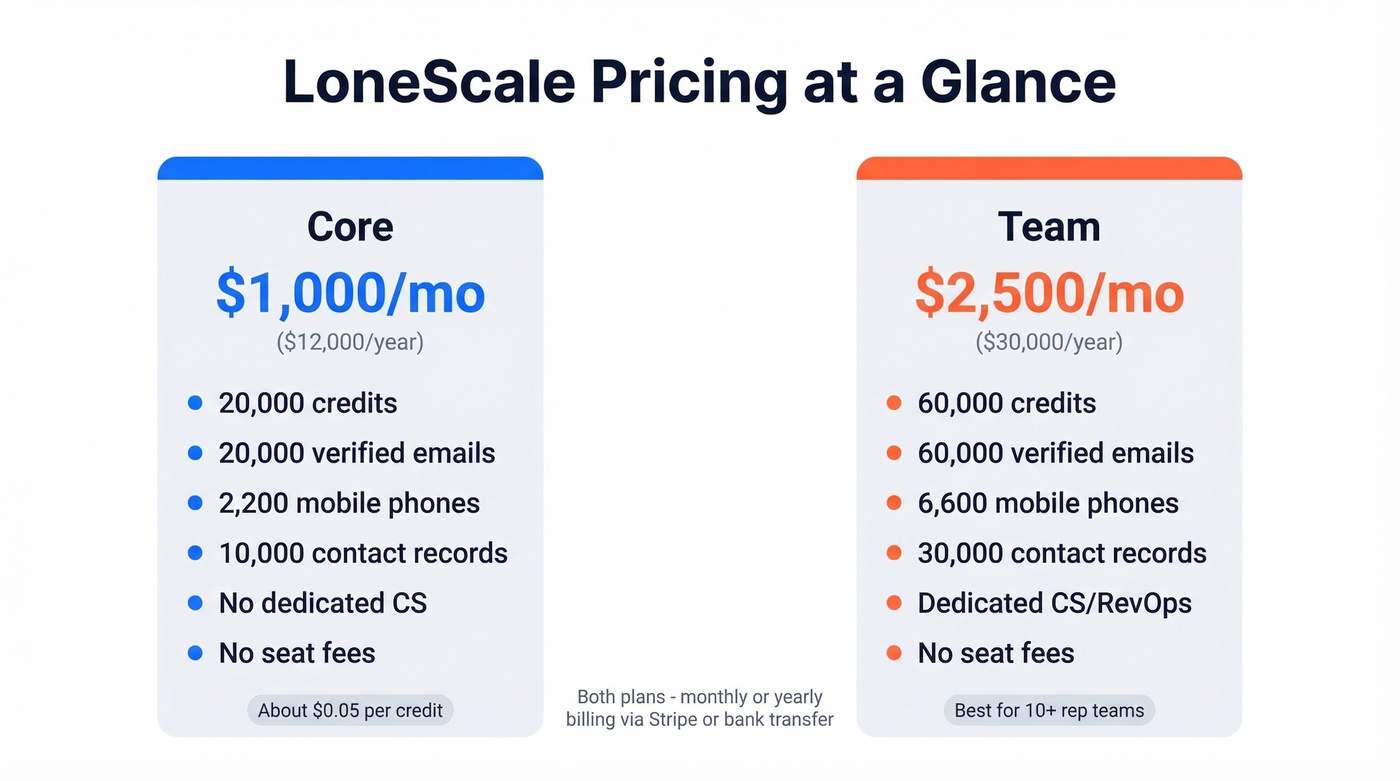
LoneScale keeps pricing simple with two tiers and no seat fees:
| Core | Team | |
|---|---|---|
| Price | $1,000/mo | $2,500/mo |
| Credits | 20,000 | 60,000 |
| Verified emails (example) | 20,000 | 60,000 |
| Mobile phones (example) | 2,200 | 6,600 |
| Contact records (example) | 10,000 | 30,000 |
| Dedicated CS/RevOps | No | Yes |
| Seat fees | None | None |
At Core, you're paying roughly $0.05 per credit. That's not cheap for pure enrichment, but you're paying for the signal layer - job changes, new hires, buying committee mapping - not just contact data. LoneScale also includes waterfall enrichment with up to 98% mobile phone coverage, which is a strong claim for that channel. Billing runs monthly or yearly, and payments go through Stripe or bank transfer.
The no-seat-fee model is genuinely nice. A 15-person sales team pays the same as a 3-person team, which makes LoneScale far more predictable to budget than per-seat tools.
LoneScale vs. UserGems
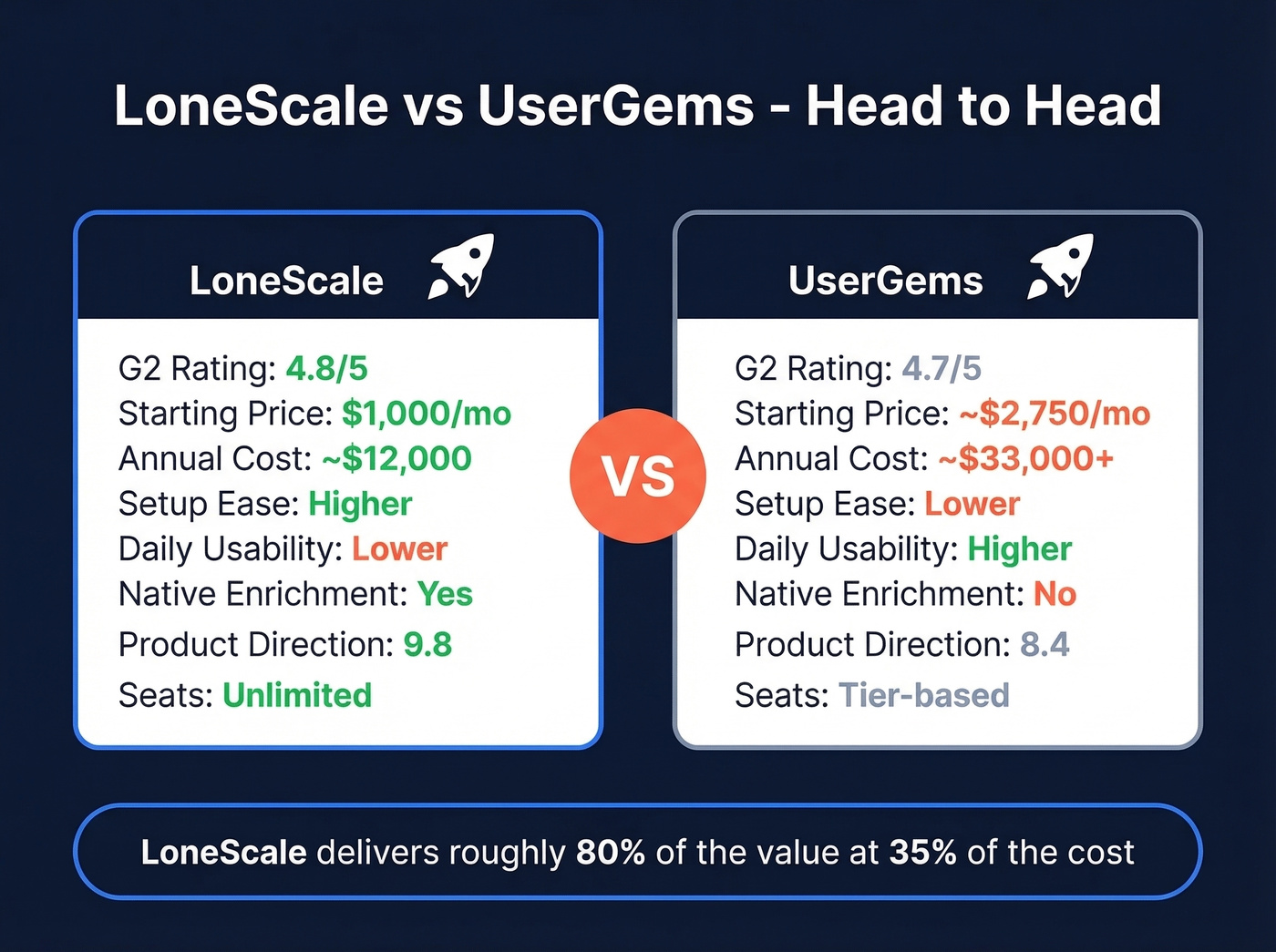
UserGems is the obvious comparison. Both track job changes. Both feed signals into your CRM. We compared the G2 data side-by-side, and the differences come down to price, setup, and scope.
| LoneScale | UserGems | |
|---|---|---|
| G2 Rating | 4.8/5 (62 reviews) | 4.7/5 (146 reviews) |
| Starting Price | $1,000/mo | ~$2,750/mo |
| Annual Cost | ~$12,000 | ~$33,000+ |
| Setup Ease (G2) | Higher | Lower |
| Day-to-Day Usability | Lower | Higher |
| Native Enrichment | Yes | No |
| Product Direction (G2) | 9.8 | 8.4 |
| Seats | Unlimited | Seats included in tier |
The pricing gap is stark. LoneScale starts at $12k/year; UserGems starts around $33k/year, with implementation fees of $3,000-$10,000 on top. Enterprise UserGems contracts can run $70k-$120k/year.
On G2, LoneScale wins on setup, admin, support, and product direction - that 9.8 vs. 8.4 gap on product direction is massive and suggests LoneScale is shipping faster. UserGems wins on day-to-day usability; it's a more polished daily-driver experience. UserGems' recurring cons include Outdated Information and Slow Updates, which is ironic for a signal tool. And because LoneScale includes native contact enrichment while UserGems doesn't, you'll need a separate enrichment tool layered on top of UserGems - adding cost and complexity.
Here's the thing: if you're a mid-market team and job-change signals are your primary use case, LoneScale delivers roughly 80% of UserGems' value at 35% of the cost. Most teams don't need the extra 20%.
Who Should (and Shouldn't) Buy
Buy LoneScale if you:
- Run a mid-market team with 10+ reps and a RevOps function
- Need job-change signals as a primary pipeline driver
- Use Salesforce or HubSpot as your CRM
- Can budget $1,000+/month for a signal-specific tool
- Want faster setup than UserGems without the implementation fees
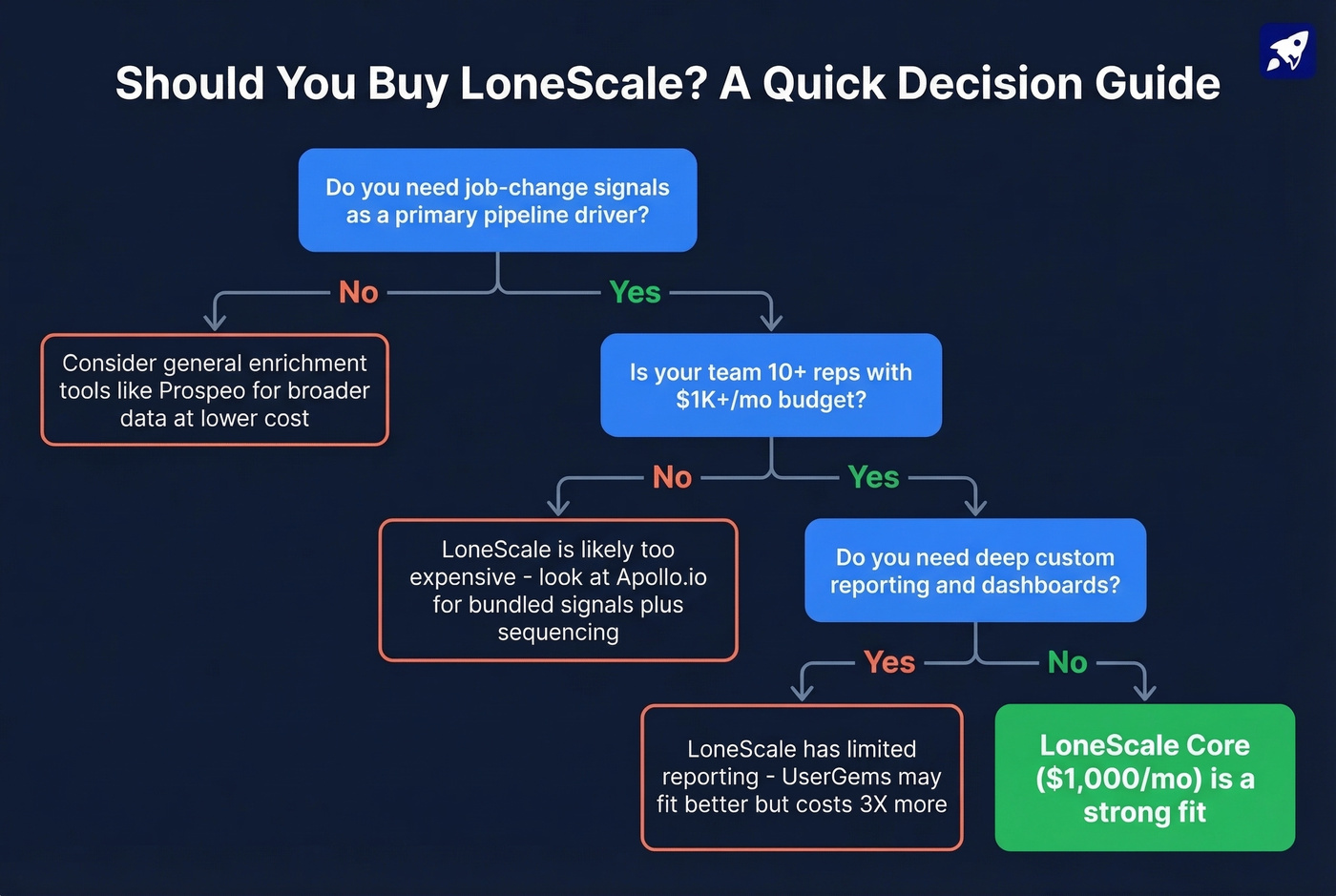
Skip LoneScale if you're:
- A solo founder or small team - $12k/year is steep for signal data alone
- Looking for general-purpose enrichment, not signal-specific workflows
- Dependent on custom reporting and dashboards
- On a tight budget and need broader data coverage per dollar
For teams that want signals and a built-in sequencer, Apollo.io bundles both starting around $49/user/month. The trade-off: Apollo's job-change tracking is shallow compared to LoneScale's dedicated signal engine. You get breadth, not depth.
UserGems needs a separate enrichment tool. LoneScale bundles enrichment but caps you at 20K credits. Prospeo handles enrichment natively - 92% match rate, 50+ data points per contact, 7-day refresh cycle - at a fraction of the cost.
Skip the signal tax and enrich your CRM directly.
FAQ
Does LoneScale offer a free trial?
No. There's no free tier or self-serve trial - the minimum commitment is $1,000/month on the Core plan. Contact their sales team for a demo; most teams get a walkthrough with sample data before committing.
What CRMs does LoneScale integrate with?
Salesforce and HubSpot get native plug-and-play integration with daily syncs. LoneScale also offers a Chrome extension, bulk file enrichment, and API access for piping data into other systems.
What's a good alternative if I only need contact data?
Prospeo covers 300M+ profiles with 98% email accuracy and 125M+ verified mobiles at roughly $0.01/email - about 80% cheaper than LoneScale's credit cost. It includes a free tier (75 emails/month), 30+ search filters, and a 7-day data refresh cycle. Best fit for teams that need enrichment breadth over job-change signal depth.
How long does LoneScale take to show ROI?
G2 benchmarks put implementation at about 1 month and time-to-ROI at roughly 5 months. That's standard for a $12k+/year signal tool - not instant, but faster than most enterprise platforms in the category.