

How Lusha Collects Your Data - And What You Can Do About It
Your personal cell rings. Unknown number. The salesperson on the other end says they found your mobile on Lusha. You've never signed up, never given permission - and now you're wondering how Lusha data collection actually works and what you can do about it.
Here's the short version: Lusha builds profiles from other people's address books, email signatures, and calendar metadata. Your consent isn't required. Regulators in France and Italy have investigated, and California's Delete Act enforcement ramps up this year. You can request removal, but expect friction.
How Lusha Builds Its Database
Lusha's database isn't built from data you hand over. It's built from data other people hand over - often without realizing it.
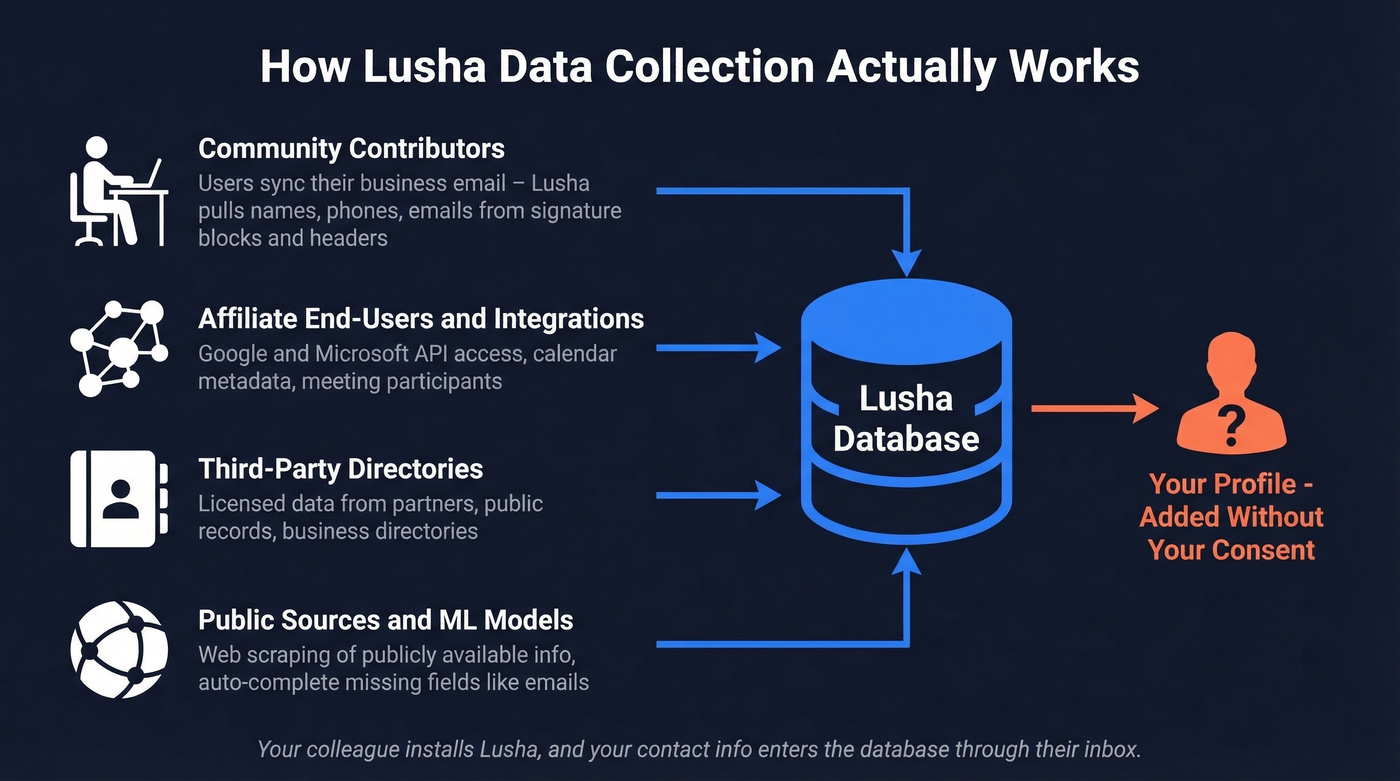
Community contributions. When someone joins Lusha's free membership program, they install a Lusha product and sync their business email with Lusha's database. Lusha pulls business contact details from email headers and signature blocks: names, emails, phone numbers. Your colleague installs Lusha, and your contact info enters the database through what's sitting in their inbox. That's the core mechanic, and it's worth understanding clearly because everything else flows from it.
Affiliate end-users and integrations. Lusha receives contact details from end-users of its affiliates. It also uses Google and Microsoft APIs when users grant access to their email accounts for certain features. Separately, Lusha integrates with calendars and tracks surface information like meeting titles, participants, and their email addresses.
Third-party directories. Lusha licenses data from partners with established directories that collect from public records, publicly available information, and business directories. Standard data broker practice.
Public sources. Lusha's algorithm scans publicly available sources to retrieve business contact information, and its machine-learning models can auto-complete missing fields - like filling in email addresses based on standard corporate naming patterns.
Regarding synced email and calendars specifically, Lusha says it doesn't capture email content beyond signature blocks, doesn't track browsing history, and doesn't access calendar agendas or attachments.
There's also the historical pipeline. Lusha has been linked to the Simpler Caller ID and Simpler Dialer apps, which at the time of security research had 5M+ installs each on Google Play. In a Lusha data-access response referenced in that research, Simpler was mentioned - if a Simpler user consented, basic contact information from the user's contacts could be shared with Lusha. Some of these address-book-based sourcing methods were later restricted in certain regions after regulatory scrutiny.
Is This Legal?
Lusha processes business contact data under GDPR's legitimate interest - a legal basis that says the business value of processing outweighs your privacy rights. Lusha says it conducted a DPIA with first-tier law firms and concluded this balance tips in its favor. It also describes safeguards including two-source authentication for accuracy, requiring a verified business email to sign up, and compliance reviews of customers. Lusha references ISO 27001 certification as well.
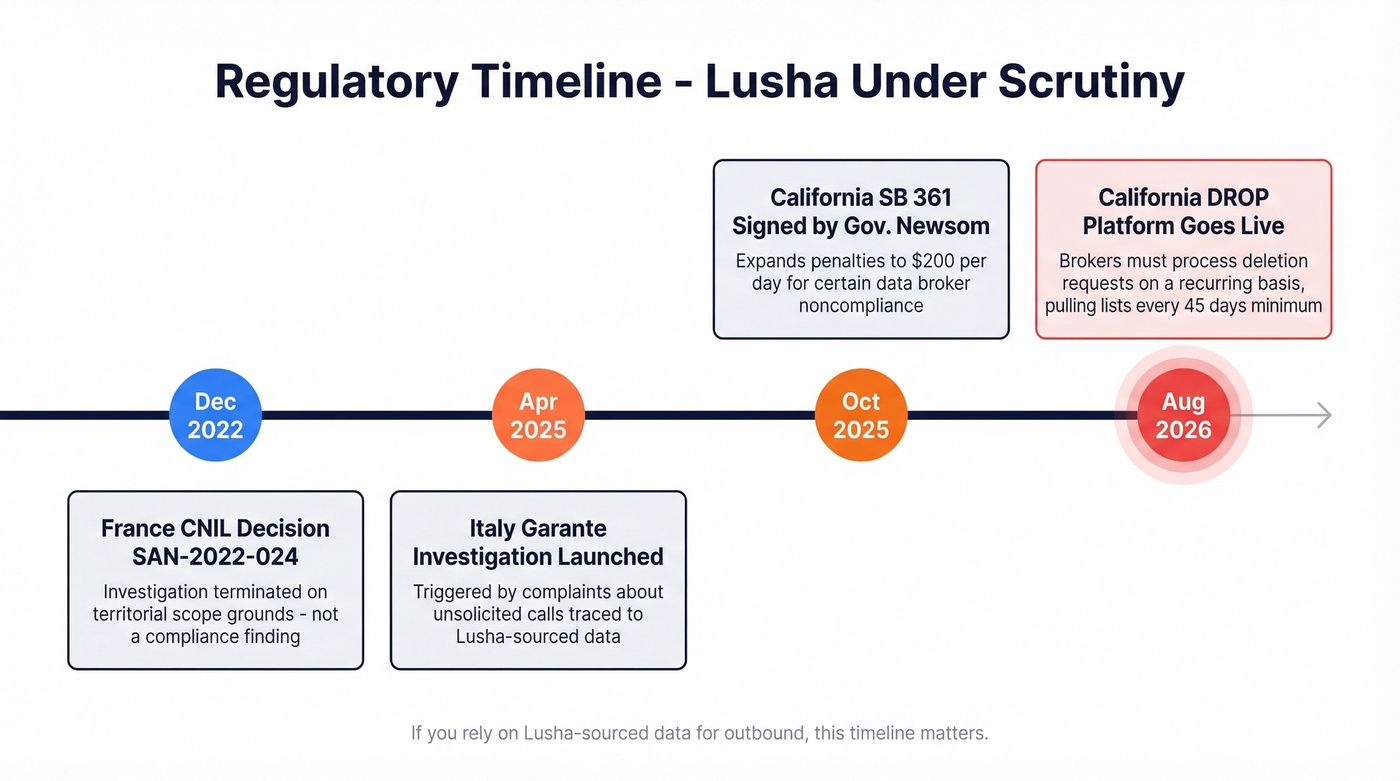
Regulators haven't universally agreed.
France's CNIL investigated and issued Decision SAN-2022-024 in December 2022 - but the investigation was terminated on territorial-scope grounds, finding GDPR didn't apply to Lusha's activities under Article 3 in that case. That's not a finding that the underlying collection was compliant. It's a jurisdiction outcome.
Italy's Garante launched an investigation in April 2025, triggered by complaints from individuals receiving unsolicited calls traced back to Lusha-sourced data.
California is where the real pressure is building. Lusha is a registered data broker in the California Data Broker Registry. Governor Newsom signed SB 361 on October 8, 2025, expanding penalties to $200/day for certain noncompliance. The DROP platform goes live August 1, 2026, requiring brokers to process deletion requests on a recurring basis, including pulling deletion request lists at least once every 45 days. If you're a sales leader relying on Lusha-sourced data for outbound, this timeline matters.

Regulatory pressure on crowdsourced data is accelerating. Prospeo's proprietary email-finding infrastructure doesn't touch address books, email signatures, or calendar metadata - ever. 300M+ profiles, 98% email accuracy, 7-day data refresh, GDPR compliant with global opt-out enforcement.
Stop building pipeline on borrowed data before regulators do it for you.
What Users Actually Report
Lusha holds a 4.0/5 on Capterra from 396 reviews as of March 2026. The praise is straightforward: fast, easy, helps reps identify decision makers in seconds.
The complaints tell a different story. Accuracy is a recurring issue - "data is either inaccurate or not there at all" shows up across multiple reviews. One September 2025 reviewer put it bluntly: Lusha will "re-steal your data and sell it again" after you request deletion. We've seen similar frustration in our own research when testing contact data providers head-to-head.
On r/Luxembourg, users who received Lusha's "Personal Information Notice" email - listing name, company, telephone, email, job title, and social media URL - reacted with consistent frustration at a company they'd never interacted with selling their details under "legitimate interest." The consensus in those threads was pretty clear: people don't buy the legitimate interest argument when they've never heard of the company claiming it.
Let's be honest: if your outbound strategy depends on data sourced from other people's address books, you're building on borrowed time. The regulatory trajectory is clear, and accuracy complaints aren't going away.
How to Remove Your Data
Here's what to expect:
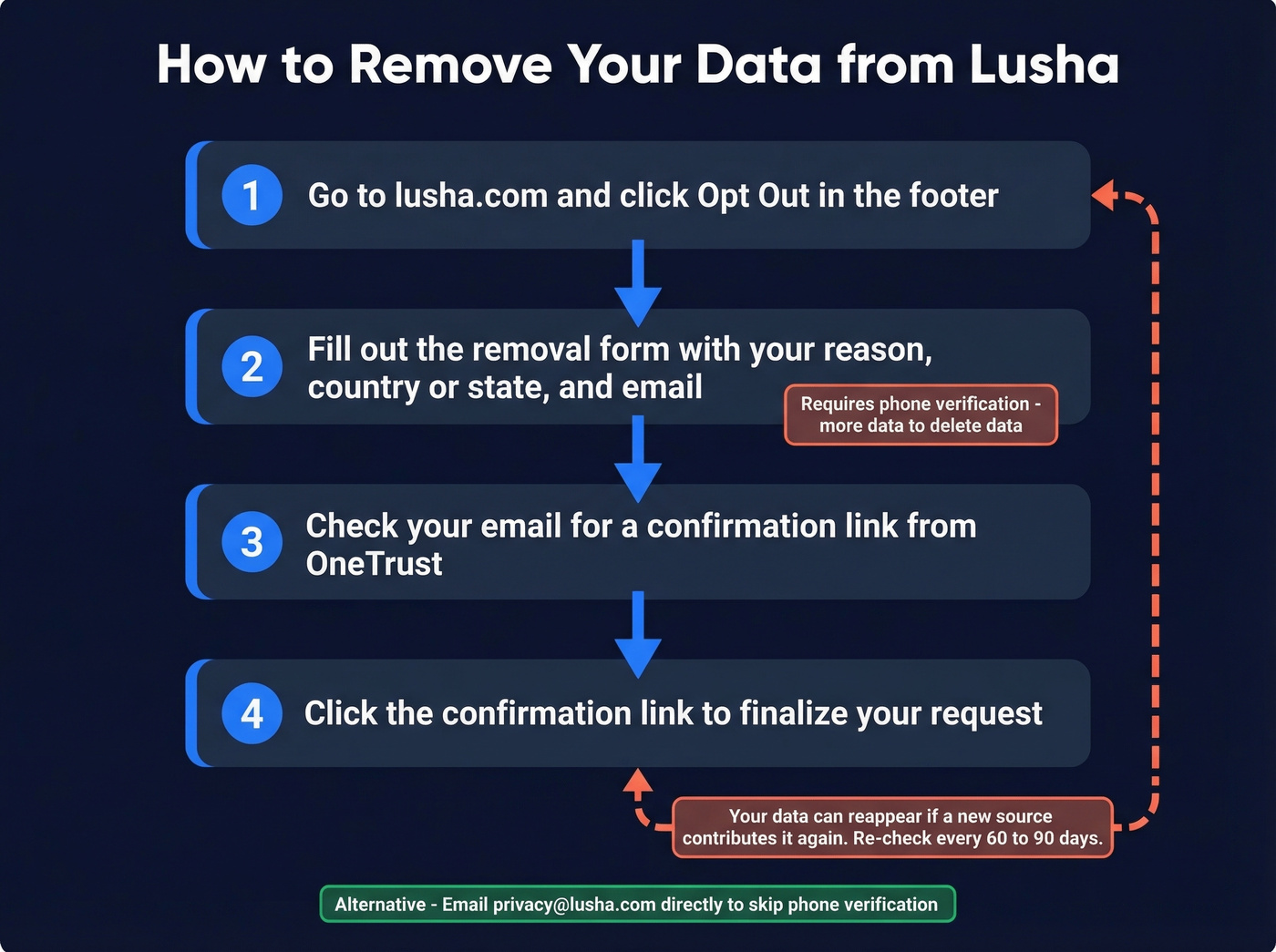
- Go to lusha.com and click "Opt Out" in the footer.
- Fill out the removal form with your reason, country/state, and email.
- Check your email for a confirmation link from OneTrust.
- Click the confirmation link to finalize.
The form asks for phone verification, which creates an absurd catch-22: you have to hand over more personal data to delete the data they already have. If you're uncomfortable with that, email privacy@lusha.com directly. There's no bulk removal option.
Expect the process to take 1-4 weeks. And here's the frustrating part - your data can reappear if a new source contributes it again. We'd recommend monitoring your profile every 60-90 days and re-submitting removal requests as needed. Skip this if you're only in Lusha's database with a generic work email you don't care about; focus your energy on removing direct dials and personal numbers.
A Different Approach to B2B Data
Lusha's model depends on crowdsourcing from other people's address books and email signatures. Prospeo takes the opposite approach: proprietary email-finding infrastructure with zero crowdsourcing and zero address-book harvesting. The database covers 300M+ professional profiles with 98% email accuracy, powered by a 5-step verification process that includes catch-all handling, spam-trap removal, and honeypot filtering. Data refreshes every 7 days - compared to the 4-6 week industry average - and opt-out is enforced globally.

The sourcing method behind your data matters for deliverability, for compliance, and increasingly for legal risk. Understanding how providers like Lusha collect information is the first step toward making a better choice.
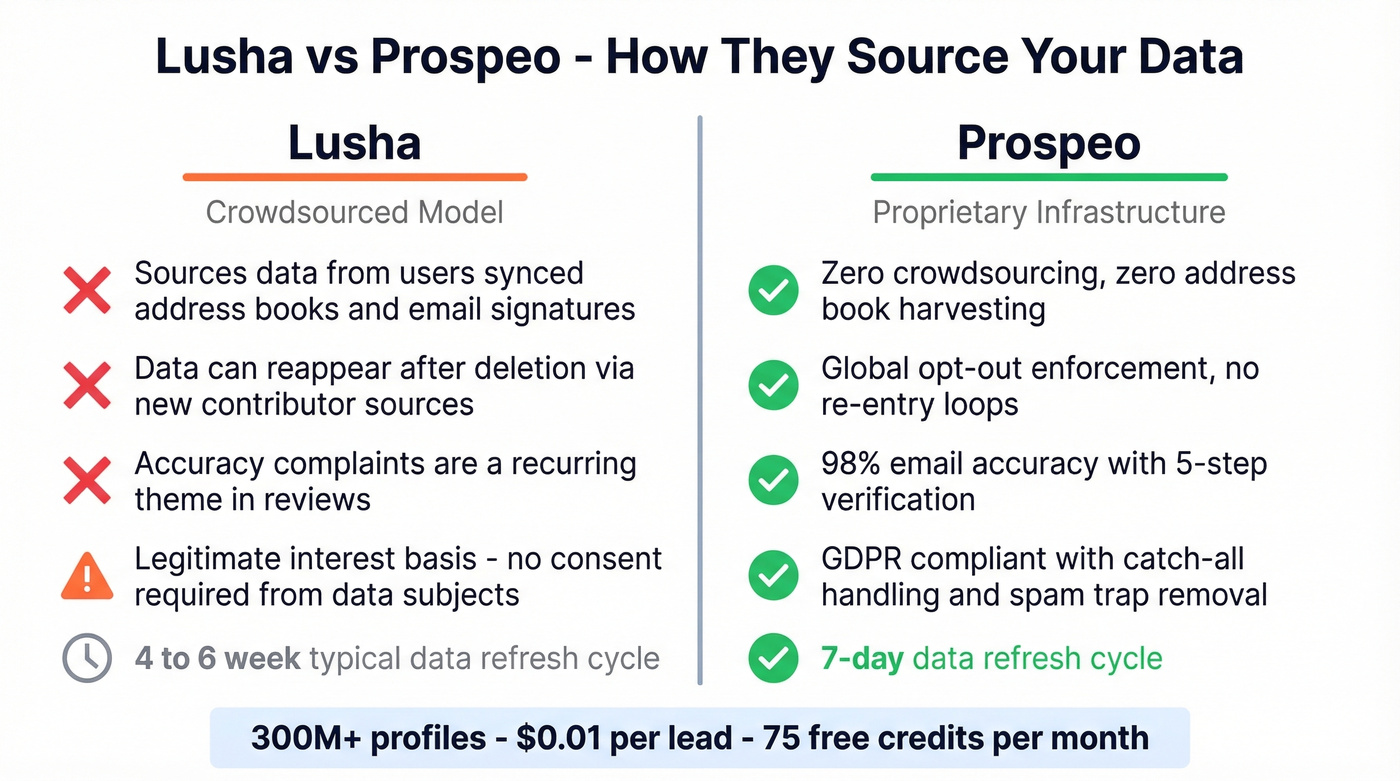
If Lusha's accuracy complaints have you questioning your bounce rates, here's the fix: Prospeo's 5-step verification - including catch-all handling, spam-trap removal, and honeypot filtering - delivers 98% email accuracy at $0.01 per lead. No crowdsourcing. No address-book harvesting. No deletion re-entry loops.
Get data that doesn't come from someone else's inbox.
FAQ
Does Lusha sell my personal data?
Yes. Lusha is a registered California data broker. It collects B2B contact information - names, emails, phone numbers, job titles - and makes it available to paying subscribers under GDPR's "legitimate interest" basis, not your consent.
Can I stop Lusha from recollecting my data after deletion?
There's no guaranteed way. Lusha sources data from multiple channels including other users' synced business email and third-party directories. Even after deletion, your information can reappear if a new source contributes it. Re-submit removal requests every 60-90 days and monitor.
Is there a B2B data provider that doesn't crowdsource contacts?
Prospeo uses proprietary email-finding infrastructure and 5-step verification instead of crowdsourcing. It delivers 98% email accuracy across 300M+ professional profiles (143M+ with verified emails) on a 7-day refresh cycle, with opt-out enforced globally. The free tier includes 75 credits per month - no contracts required.