

The 10 Best Mailbox Checkers in 2026 (Accuracy Data Included)
You verified your list before the campaign. The tool said 99% valid. Then your first sequence bounced 14%, your domain reputation tanked, and your ops team spent a week cleaning up the mess.
Here's the uncomfortable truth: every mailbox checker markets itself as 99%+ accurate, but benchmarks show the average tool lands around 65-70% on real business emails. The industry standard is to keep total bounces below 2% and hard bounces under 1% - and picking the wrong verifier makes that nearly impossible.
We've tested most of these tools on our own prospect lists and dug into every public benchmark we could find. Below are the tools that actually deliver, and the ones coasting on inflated numbers.
Our Top Picks (TL;DR)
| Tool | Best For | Starting Price | Key Stat |
|---|---|---|---|
| Prospeo | Find + verify in one step | Free (75/mo) | 98% accuracy |
| ZeroBounce | Standalone list cleaning | Free (100/mo) | Credits never expire |
| NeverBounce | Budget bulk verification | $0.008/email | 96.9% accuracy |
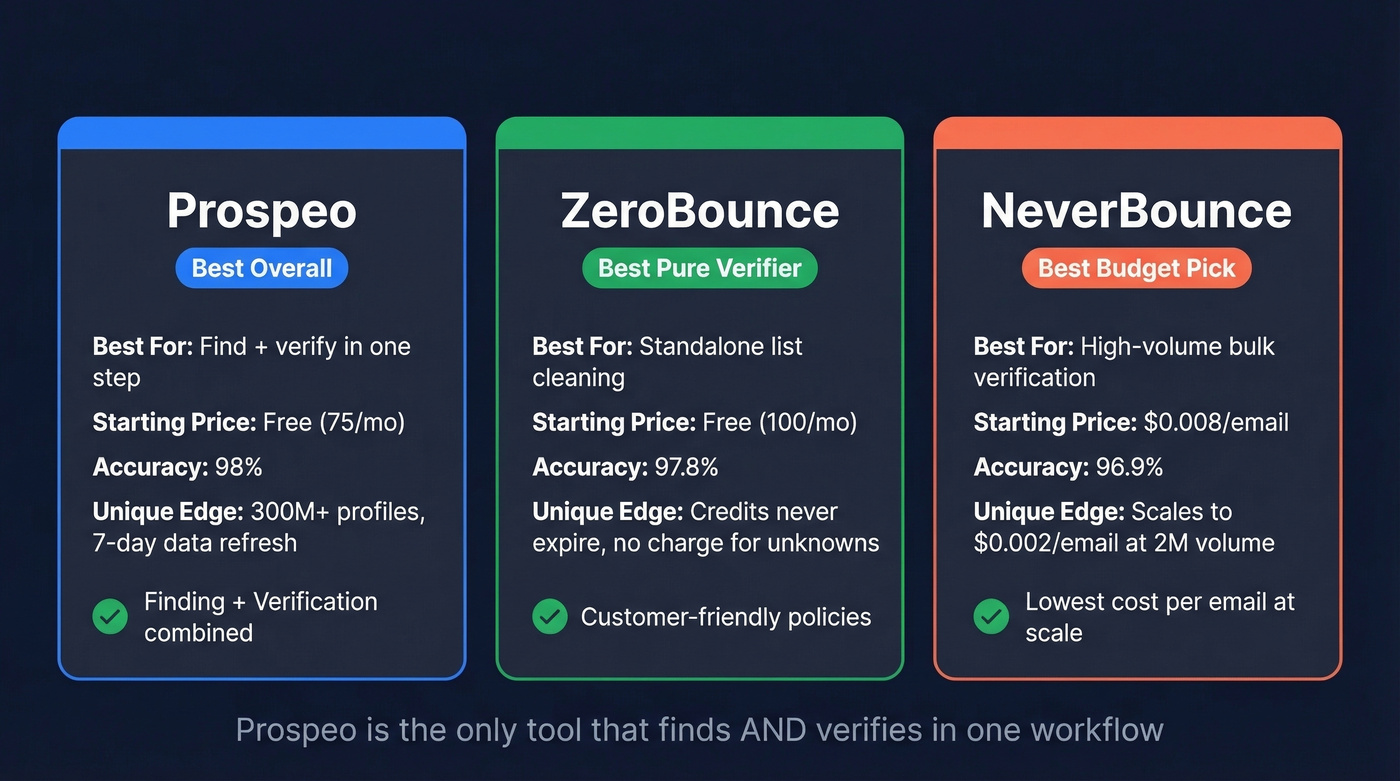
Prospeo takes the top spot because most tools on this list only verify - Prospeo finds and verifies emails in a single workflow, which eliminates the need and cost of a separate finder tool. ZeroBounce is the best pure verifier if you already have your list. NeverBounce wins on price-to-performance for high-volume cleaning.
What a Mailbox Checker Actually Does
A mailbox checker validates whether an email address can receive messages without actually sending one. The process runs through five stages, each filtering out a different type of bad address:
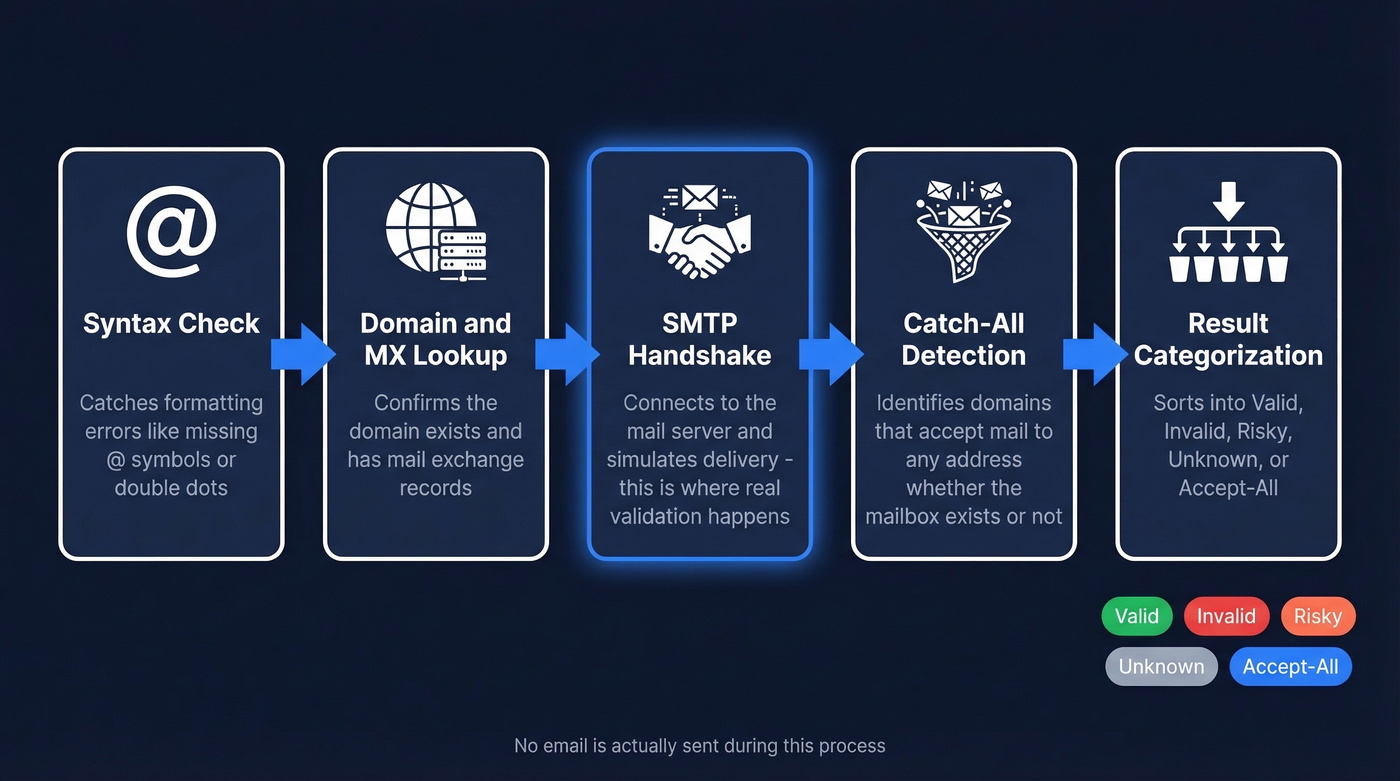
- Syntax check - catches formatting errors like missing @ symbols, double dots, or invalid characters.
- Domain and MX lookup - confirms the domain exists and has mail exchange records configured.
- SMTP handshake - connects to the mail server and simulates a delivery attempt. This is where most real validation happens.
- Catch-all detection - identifies domains that accept mail to any address, whether the mailbox exists or not.
- Result categorization - sorts every address into buckets: valid, invalid, risky, unknown, or accept-all. Better tools also flag disposable emails, role-based addresses, and spam traps.
No email is sent during verification. The tool talks to the mail server, asks "does this mailbox exist?", and interprets the response. That's why accuracy varies so much - different mail servers respond differently, and some actively lie to prevent scraping.
Disposable email detection matters too, especially for sign-up forms. Services like Guerrilla Mail and Mailinator generate throwaway addresses that pass SMTP checks but have zero long-term value. A good verifier maintains databases of known disposable domains and flags them automatically.
The Accuracy Problem
Every email verification tool markets itself as 99%+ accurate. The benchmarks tell a different story.
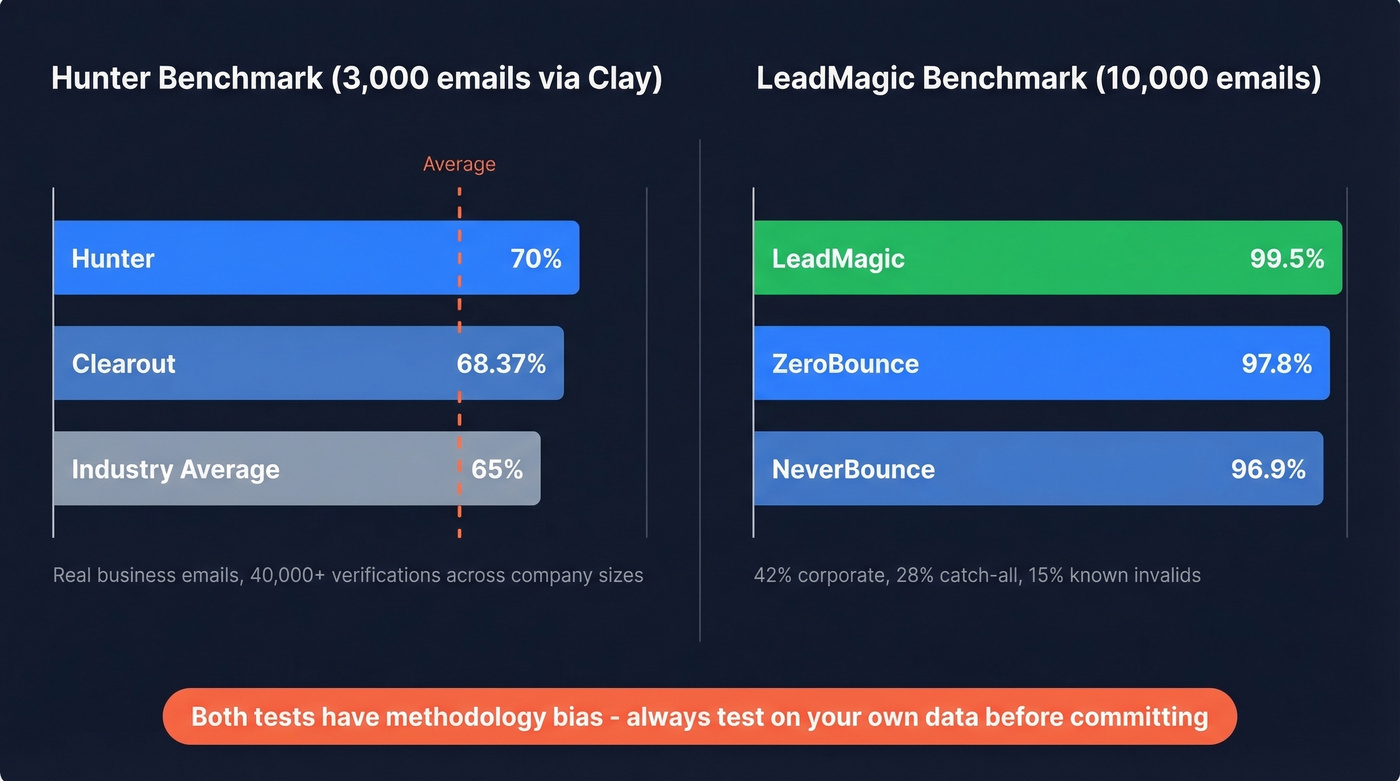
The most methodologically transparent test we've seen comes from Hunter's 3,000-email benchmark - real business emails segmented by company size, all processed in bulk via Clay under identical conditions. The top performer scored 70%. Clearout came second at 68.37%. The average hovered around 65%. These aren't cherry-picked numbers; they're the result of 40,000+ verifications across small, mid-market, and enterprise domains.
On the other end, LeadMagic published a 10,000-email test where their own tool scored 99.5%. The dataset included 42% corporate emails, 28% catch-all, and 15% known invalids. Their results showed ZeroBounce at 97.8% and NeverBounce at 96.9% - dramatically higher than the Clay-run benchmark.
Both tests have methodology bias. Hunter's benchmark labeled data based on email activity recorded in Hunter, which naturally advantages Hunter. LeadMagic's test was run by a vendor who - surprise - ranked themselves first. The truth sits somewhere in between, and accuracy depends heavily on your specific email mix. Enterprise domains with strict mail server configurations consistently produce more unknowns and false results across every tool.
Let's be honest: if a vendor tells you they're 99%+ accurate on all email types, they're either testing on easy datasets or redefining "accuracy" to exclude unknowns. Always run a test on a sample of your own data before committing.
10 Best Email Verification Tools in 2026
1. Prospeo
Best for: Teams that need to find AND verify emails in one platform.
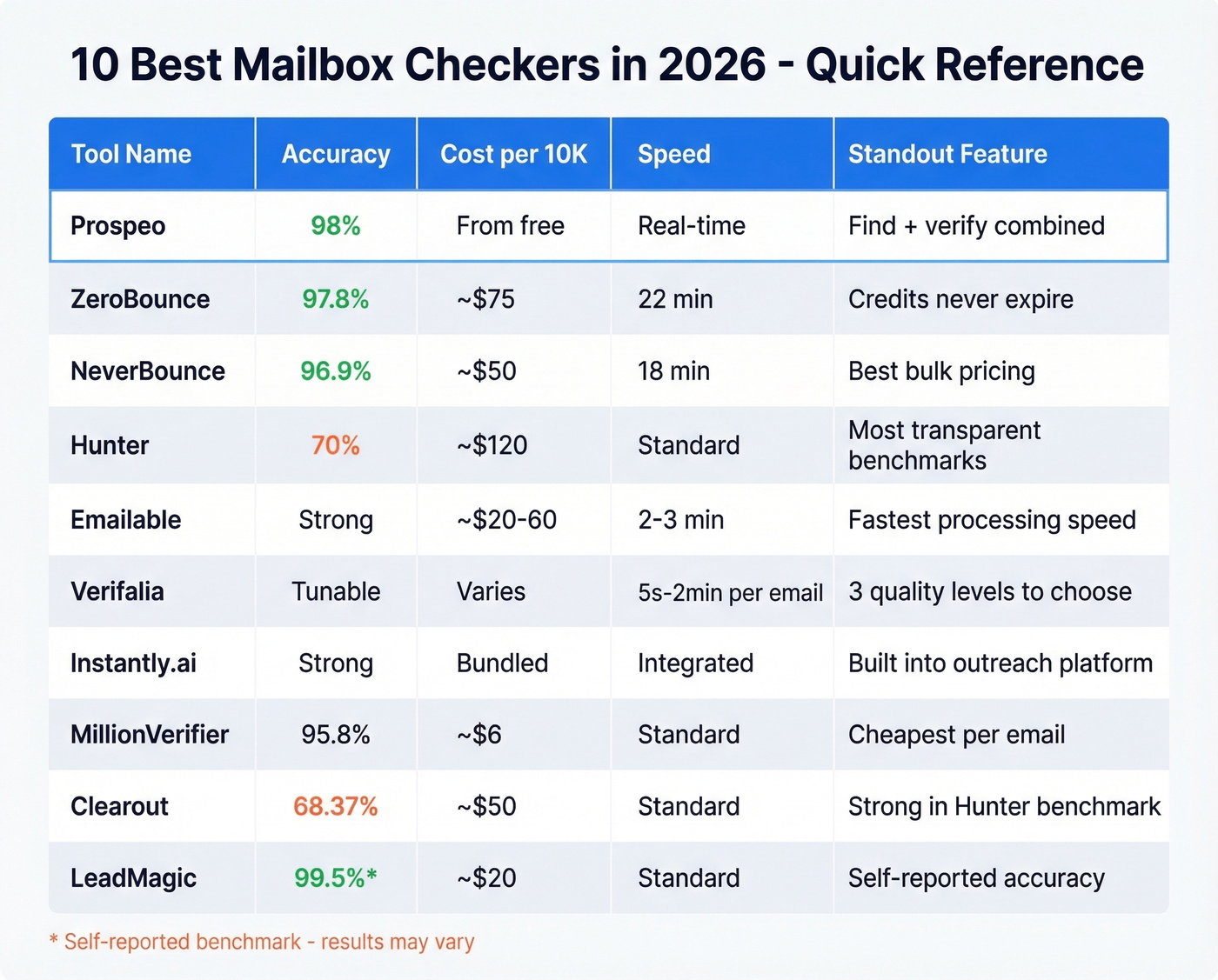
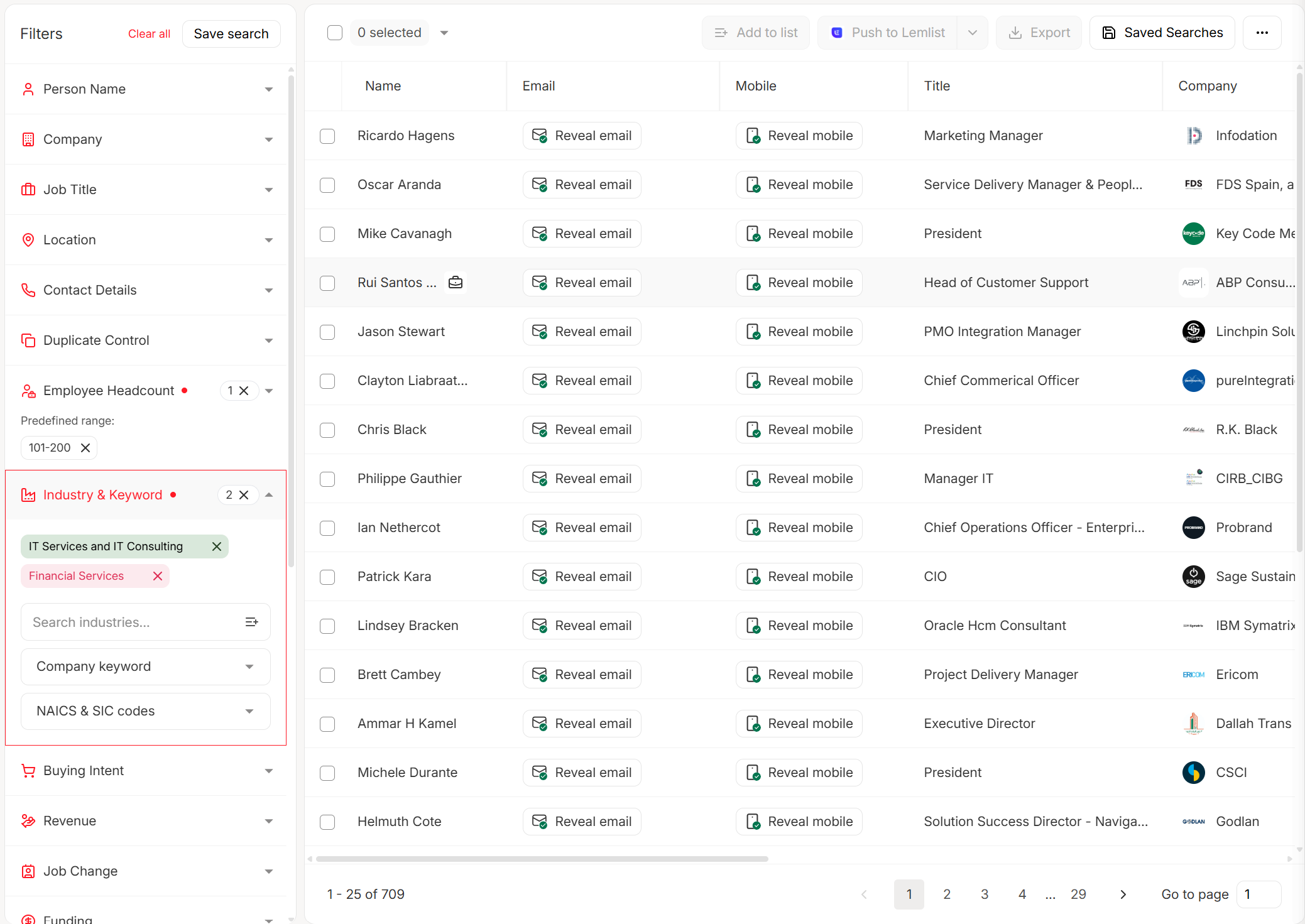
Most tools on this list only verify addresses you already have. Prospeo finds emails from 300M+ professional profiles and verifies them in real time - one workflow, one credit, one tool. The 5-step verification process handles catch-all domains, removes spam traps and honeypots, and delivers 98% email accuracy. Data refreshes every 7 days, compared to the 6-week industry average.
The proof is in production results: Meritt dropped their bounce rate from 35% to under 4% after switching. Stack Optimize runs under 3% bounce with zero domain flags across all clients. Those aren't lab numbers - they're real outbound campaigns at scale.
Use this if: You're building prospect lists from scratch and want finding + verification in a single step. The free tier gives you 75 emails/month to test.
Pricing: Free tier (75 emails/month). Paid plans from ~$39/mo. No contracts.
2. ZeroBounce
Best for: Standalone list cleaning when you already have your contacts.
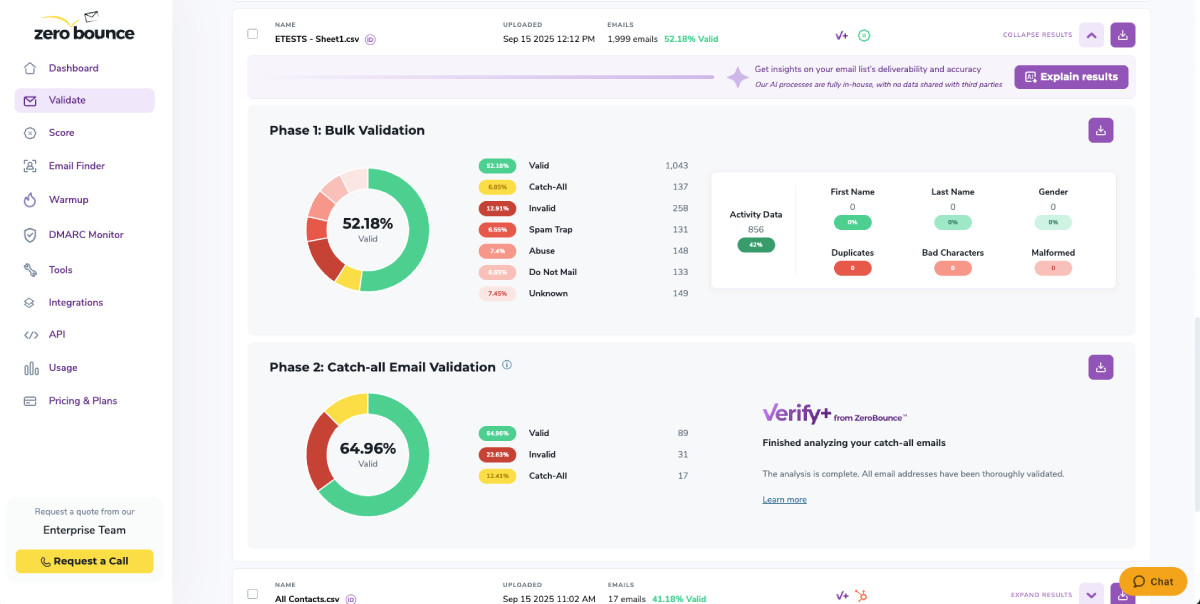
ZeroBounce is the verifier we'd recommend to anyone who says "I have a list, I just need it cleaned." The policies are genuinely customer-friendly: 100 free monthly validations, credits that never expire, and you don't get charged for unknown results. That last point matters more than it sounds - unknowns can be 10-20% of a business email list, and paying for inconclusive results feels like a tax on bad data.
In the LeadMagic benchmark, ZeroBounce hit 97.8% accuracy with a 22-minute processing time for 10,000 emails. Catch-all resolved was only 12%, which is a weakness - but for standard corporate and free-provider emails, it's rock solid. The AI scoring feature adds a confidence layer that helps you decide what to do with borderline results.
Use this if: You need a reliable, no-nonsense verifier with flexible pay-as-you-go pricing and no pressure to use credits before they expire.
Skip this if: You need strong catch-all resolution or you want email finding bundled in.
Pricing: Pay-as-you-go from $0.009/email (2K credits) down to $0.00225/email at 1M. 10,000 verifications run ~$75.
3. NeverBounce
Best for: Budget-friendly bulk verification at scale.
NeverBounce is the workhorse pick. At $0.008/email for small batches scaling down to $0.002/email at 2M, it's one of the cheapest reliable options available. The LeadMagic test showed 96.9% accuracy and 18-minute processing for 10,000 emails - solid numbers for the price point.
In that same dataset, 28% of emails were catch-all, and NeverBounce resolved 8% of them. That's the tradeoff for the price. Over on r/software, one user ranked their experience across tools: Instantly.ai first, NeverBounce second, MillionVerifier third - which tracks with the benchmark data showing NeverBounce as a strong mid-tier performer.
Use this if: You're running high-volume list cleaning and need predictable, low per-email costs. Great for agencies managing multiple client lists.
Skip this if: Your prospect list is heavy on enterprise domains with catch-all configurations. You'll get too many unknowns.
Pricing: $8/1,000 credits, $50/10,000, scaling to $4,000/2,000,000. Pure pay-as-you-go.
4. Hunter
Here's the most interesting thing about Hunter: they ran their own benchmark and published that their accuracy was 70%. That's the highest score in the test - but it's still far below what most vendors claim, and Hunter deserves credit for the transparency. In Clay's catch-all test, Hunter's coverage was 30.62%, meaning it couldn't resolve nearly 70% of catch-all addresses. The quality on what it did resolve was strong at ~93.57%.
The verification lives inside a broader platform, not a standalone tool. The unified credit system means verification costs 0.5 credits per email, so the Starter plan at $49/mo gives you about 4,000 verifications. That works out to roughly $0.012/verification - not cheap for pure verification. The Growth plan at $149/mo brings it down to about $0.0075.
Pricing: Free (50 credits = 100 verifications/mo). Starter $49/mo. Growth $149/mo.
5. Emailable
Emailable's entire pitch comes down to two words: speed and fairness. They process 10,000 emails in 2-3 minutes - significantly faster than the 15-35 minute range most competitors need. The refund policy backs up the fairness claim: unknowns and duplicates get credited back automatically, and credits never expire. The 250 free credits on signup let you test before buying.
This is the tool we'd pick for real-time form validation or any workflow where verification speed is the bottleneck. It doesn't include email finding, but if you need raw verification throughput, nothing else on this list touches it.
Pricing: 250 free credits to start. Pay-as-you-go ~$0.002-$0.006/email depending on volume. Minimum purchase 5,000 credits.
6. Verifalia
Best for: Teams that want granular control over verification depth.
Verifalia is the most technically transparent verifier on this list. You choose between three quality levels - Standard (1 pass, 5 seconds, 1 credit), High (3 passes, 50 seconds, 2 credits), and Extreme (9 passes, 2 minutes, 4 credits). Each level runs progressively more checks against greylisting and anti-tarpit defenses. If you're the type who wants to tune the knobs yourself, this is your tool.
The free tier gives you 25 verifications per day. Paid plans scale from 250/day (Starter) up to 25,000/day (Ultimate), and it handles files up to 100MB - roughly 72 million addresses per upload.
Pricing: Free 25/day. Paid plans scale by daily credits (250/day up to 25,000/day). Purchased credit packs never expire.
7. Instantly.ai
Best for: Teams already running outreach in Instantly's platform.
Instantly earned the top spot in Reddit's r/software verification discussions, and for good reason - the verification is tightly integrated with their outreach tool, so you verify and send from the same platform. The catch: you can't use the verification standalone. It's bundled inside Instantly's outreach plans, which start around $30/mo. If you're already an Instantly user, the verification is essentially free. If you're not, you're buying an entire outreach platform just to verify emails.
Pricing: Bundled with outreach plans starting around $30/mo. No standalone verification option.
8. MillionVerifier
Best for: Maximum volume on minimum budget.
MillionVerifier is the cheapest tool on this list by a wide margin - roughly $6 per 10,000 verifications. The LeadMagic test showed 95.8% accuracy, which is respectable, but catch-all resolved was only 5%. Processing speed was the slowest tested at 35 minutes for 10,000 emails.
In the same Reddit thread where users ranked their favorite verifiers, MillionVerifier placed third behind Instantly and NeverBounce. A fair reflection of its "good enough for the price" positioning.
Pricing: ~$0.0006/email (~$6/10K). Pay-as-you-go.
9. Bouncer
Best for: Catch-all handling in the mid-range price tier.
Bouncer's 15% catch-all resolved beats both NeverBounce (8%) and ZeroBounce (12%), which makes it the standout choice if your list skews toward enterprise domains. The LeadMagic test showed 96.5% accuracy with 25-minute processing for 10K. Nothing flashy, nothing broken - just quietly better than average where it counts.
Pricing: ~$0.005-$0.008/email. Pay-as-you-go.
10. Clearout
Best for: Budget bulk cleaning with competitive accuracy.
Clearout placed second in Hunter's 3,000-email benchmark at 68.37% accuracy - which, while low-sounding, was competitive in that particular test methodology. Worth testing if you're doing bulk list cleaning and want to compare against your current tool. The pricing is aggressive enough to justify running it as a second-pass verifier alongside your primary one.
Pricing: ~$0.004-$0.007/email depending on volume.

Every mailbox checker on this list only verifies emails you already have. Prospeo finds and verifies in a single workflow - 300M+ profiles, 98% accuracy, 7-day data refresh. Real teams run under 4% bounce rates in production, not just benchmarks.
Stop paying twice for finding and verifying. Do both for $0.01/email.
Pricing Comparison
The pricing model matters more than most buyers realize - especially whether a tool charges you for unknown results. Some credit-based tools charge per check no matter what; others, like ZeroBounce and Emailable, make unknowns free. Here's what 10,000 verifications typically costs:
| Tool | Cost/10K | Free Tier | Credits Expire? | Unknowns Charged? |
|---|---|---|---|---|
| ZeroBounce | ~$75 | 100/mo | No | No |
| NeverBounce | ~$50 | None | N/A | N/A |
| Hunter | ~$123 | 100 verifs/mo | Monthly reset | N/A |
| Emailable | ~$20-60 | 250 one-time | No | No |
| Verifalia | ~$50-80 | 25/day | Daily reset* | N/A |
| Instantly.ai | Bundled | N/A | N/A | N/A |
| MillionVerifier | ~$6 | None | N/A | N/A |
| Bouncer | ~$50-80 | None | N/A | N/A |
| Clearout | ~$40-70 | None | N/A | N/A |
Verifalia's daily credits reset, but purchased credit packs never expire.
Catch-All Domains: The Blind Spot
About 28% of B2B emails sit on catch-all domains, and they're the single biggest source of "unknown" results in your verification output. Most comparisons skip this entirely, which is a disservice.
A catch-all domain accepts email sent to any address at that domain - whether the specific mailbox exists or not. When a verifier runs an SMTP handshake against one, the server says "sure, I'll take it" regardless. The verifier can't distinguish between a real inbox and a nonexistent address, so most tools just return "unknown" and move on.
The resolution rates vary wildly:
| Tool | Catch-All Coverage/Resolved | Quality Score | Clay Credits/Lookup |
|---|---|---|---|
| Findymail (via Clay)* | 100% coverage | 94.99% | 0.3 credits |
| Kitt AI (via Clay) | 78% coverage | 91.2% | 2 credits |
| Listmint (via Clay) | 65% coverage | 89.5% | 1 credit |
| Bouncer | 15% resolved | N/A | N/A |
| ZeroBounce | 12% resolved | N/A | N/A |
| NeverBounce | 8% resolved | N/A | N/A |
| MillionVerifier | 5% resolved | N/A | N/A |
Findymail is included from Clay's test data for context - it's not a standalone mailbox checker but a Clay-integrated provider.
If your prospect list skews toward mid-market and enterprise companies, this is the metric that matters most. A tool that's 97% accurate on easy domains but returns "unknown" for a quarter of your list isn't actually saving you from bounces - it's just passing the problem to you.
How to Choose the Right Tool
Different workflows need different tools. Here's a decision framework based on the four most common use cases:
Outbound sales teams - Prospeo. You need to find prospects, get their emails, and verify them before loading into your sequencer. Doing this in one platform eliminates the finder-verifier-CRM shuffle and keeps your data fresh with 7-day refresh cycles.
Sign-up form validation - Emailable or Verifalia. Real-time API speed matters here. Emailable's 2-3 minute bulk processing and Verifalia's configurable quality levels both work well for catching bad addresses at the point of entry. Disposable email detection becomes especially critical for consumer sign-ups.
Bulk list cleaning - ZeroBounce or NeverBounce. You've got a list, you need it cleaned, you want straightforward pay-as-you-go pricing. ZeroBounce if you want credits that never expire and free unknowns. NeverBounce if volume pricing is the priority.
Agency or multi-client work - NeverBounce or Instantly.ai. Volume pricing without contracts matters when you're managing multiple client lists. NeverBounce keeps per-email costs minimal at scale; Instantly bundles verification into its outreach platform if your clients are already there.
Catch-all domains, spam traps, and honeypots wreck campaigns. Prospeo's 5-step verification handles all three - and refreshes every 7 days while competitors wait 6 weeks. Stack Optimize runs under 3% bounce with zero domain flags across all clients.
Test 75 emails free and see why teams ditch their old mailbox checker.
What to Do After Verification
Verification is step one. What you do with the results determines whether your deliverability actually improves.
Valid results - send with confidence. Load them into your sequencer and go.
Risky and unknown results - quarantine them. Re-verify after 7-14 days, since mail server configurations change and temporary issues resolve. If you absolutely must send to unknowns, use a warmed-up secondary domain and keep volume under 50/day until you see bounce data.
Invalid results - delete them. No exceptions. Sending to known invalids is the fastest way to tank your sender reputation.
Keep total bounces below 2% and hard bounces under 1%. If you're above these numbers after verification, your tool isn't doing its job or your list is too old.
One pattern we see constantly: teams verify a list once, then keep sending to it for months without re-verifying. Email addresses decay at roughly 2-3% per month. If you verified in January and you're still sending the same list in April, you've accumulated enough bad addresses to cause problems. Build re-verification into your quarterly workflow - or use a tool with automatic data refresh so you don't have to think about it.
If you want to go deeper on bounce thresholds and what they mean, see our guide to email bounce rate.
FAQ
How accurate are mailbox checkers really?
Benchmarks show 65-70% accuracy on real business emails, despite 99%+ marketing claims. Accuracy drops significantly on enterprise domains with strict server configurations. Always test a sample of your own data before committing to any tool.
What's a catch-all domain and why does it matter?
A catch-all domain accepts email to any address, so verifiers can't confirm whether a specific mailbox exists. About 28% of B2B emails sit on catch-all domains. Most tools return "unknown" for these, meaning a big chunk of your list comes back inconclusive.
Should I send to "unknown" or "risky" results?
Quarantine unknowns and re-verify after 7-14 days - don't send to them immediately. If you must send, use a warmed-up secondary domain and keep volume under 50/day. Addresses categorized as invalid should be deleted permanently.
Is there a free mailbox checker worth using?
ZeroBounce (100/month), Verifalia (25/day), and Prospeo (75 emails/month with finding included) all offer usable free tiers. Run the same sample list through two or three tools to compare results before committing budget - combined, that's enough to benchmark accuracy on your specific data.
Can I find AND verify emails with one tool?
Most verification tools only check addresses you already have. Prospeo finds emails from 300M+ professional profiles and verifies them in real time at 98% accuracy, eliminating the need for a separate finder - a real workflow and cost advantage for outbound teams building lists from scratch.