


7 Best Maildoso Alternatives for Cold Email in 2026
You just pulled up your Maildoso dashboard and half your SMTP mailboxes are flagging. Inbox placement tanked overnight, support's giving you canned responses, and you're staring at a quarterly bill you already paid. That's the moment most cold email operators start searching for Maildoso alternatives - and it's exactly where we'll pick up.
Why People Switch from Maildoso
Maildoso isn't a bad product. It carries a 4.6/5 on G2, setup is genuinely fast - 100 mailboxes connected to Instantly in 2-3 hours - and early deliverability numbers look solid. SMTP inbox placement runs around 85-90%, Google Workspace around 92-95% in the first 5-6 weeks. One 100-mailbox test had users sending 1,500-2,000 emails per day with reply rates around 2.8-3.2%.
The problems start later.
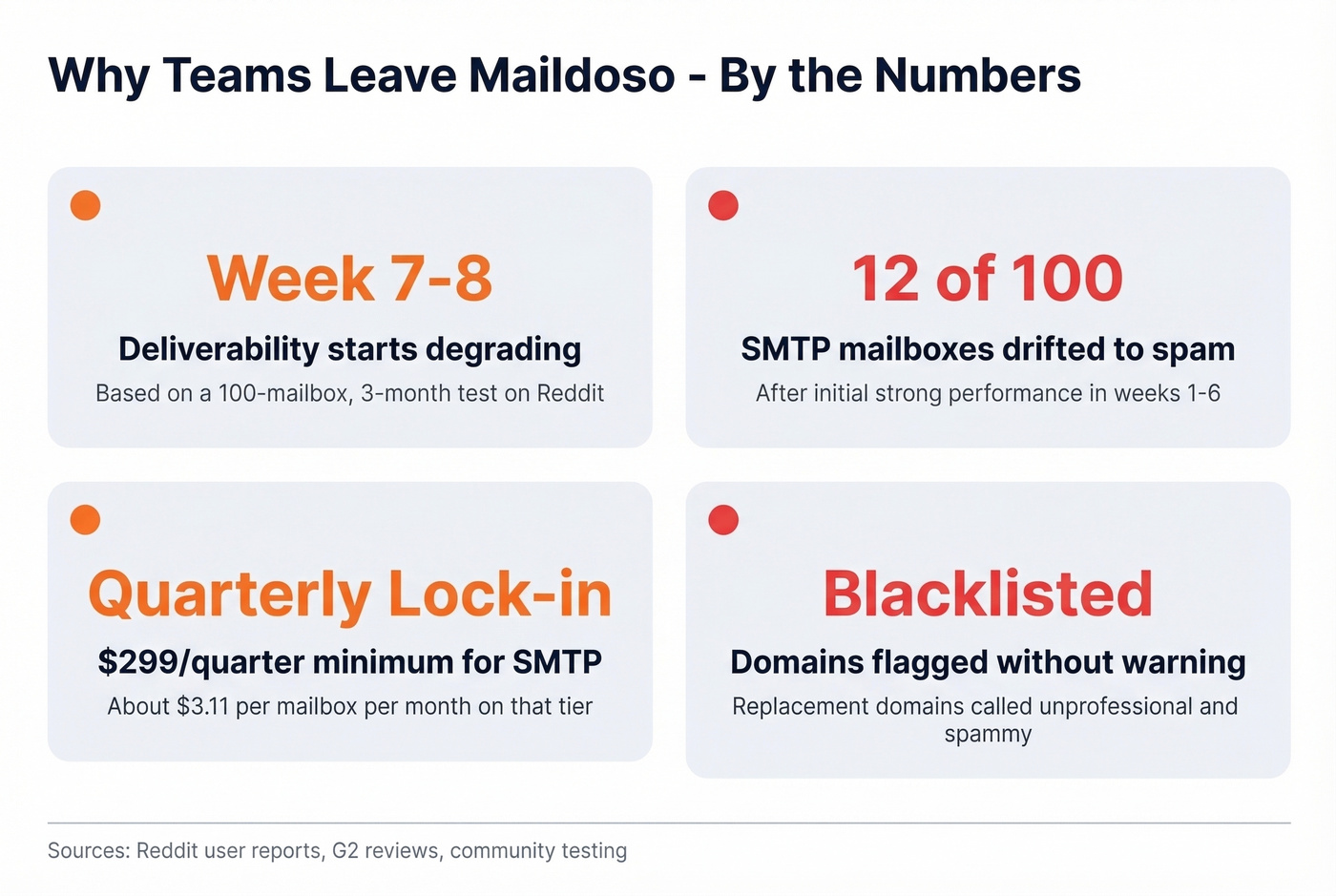
The most talked-about incident on Reddit: users reported Maildoso-provided domains blacklisted without warning, tanking deliverability overnight. Replacement domains looked "unprofessional and spammy." Support during the crisis was described as "largely unresponsive." Maildoso's founder eventually compensated affected users with free domains and inboxes, but the damage to active campaigns was already done - and for teams running revenue-critical outbound sequences, "we'll make it up to you later" doesn't cut it.
Beyond the blacklisting event, a 100-mailbox test over three months showed deliverability degradation around week 7-8, with roughly 12 SMTP mailboxes drifting into spam. Support moved them to different IPs, which helped, but the reviewer noted responses "sometimes felt like AI."
On billing: Maildoso's quarterly SMTP plans start at $299/quarter for 32 mailboxes (about $3.11/mailbox/month on that tier). Monthly SMTP plans are also available - 20 mailboxes for $50/month, 50 for $113/month, 200 for $380/month - but a lot of teams still end up locked into quarterly packages.
Here's something worth knowing: several cold email infrastructure providers appear to run near-identical dashboards, suggesting possible white-labeling or shared underlying infrastructure. Switching providers doesn't always mean switching infrastructure. That's why data quality matters more than which logo sits on your sending dashboard.
Our Picks (TL;DR)
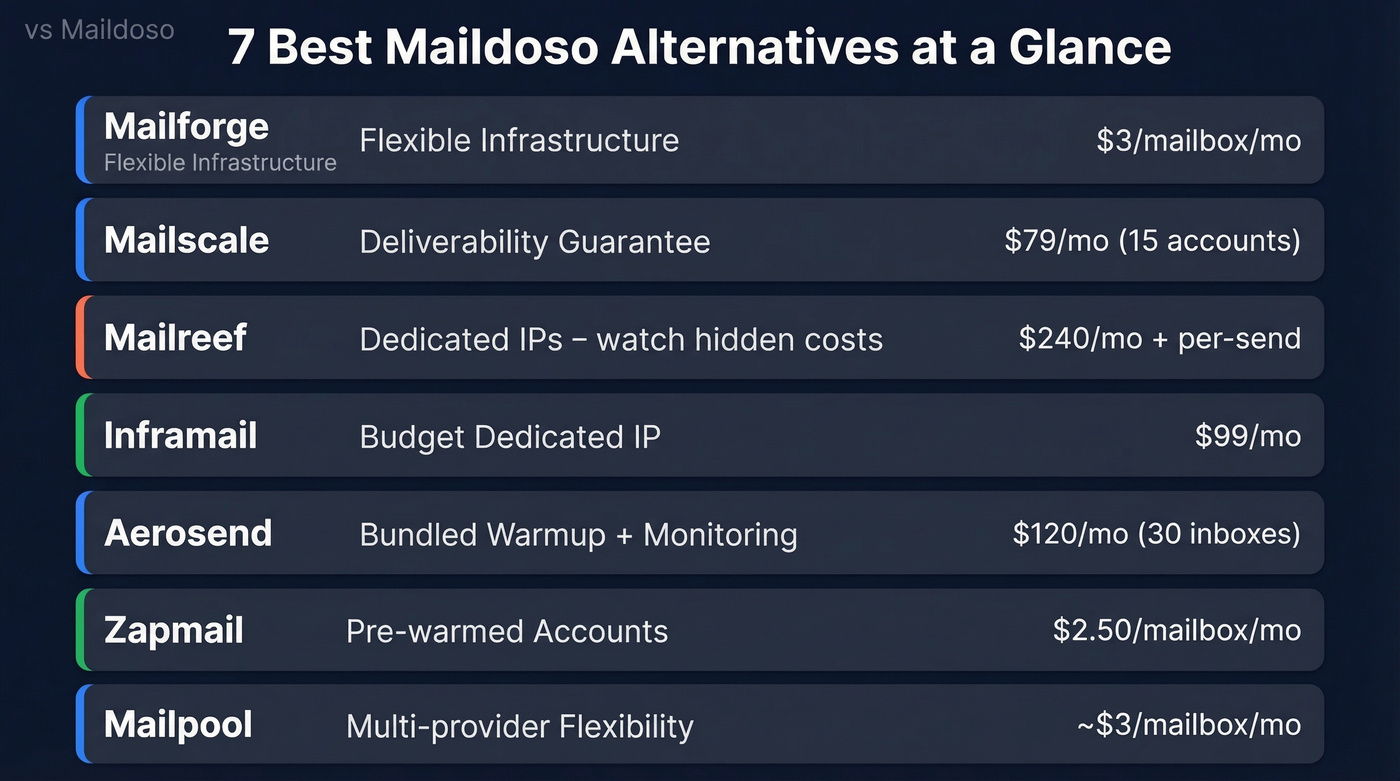
| Tool | Best For | Starting Price |
|---|---|---|
| Mailforge | Flexible infrastructure | $3/mailbox/mo |
| Mailscale | Deliverability guarantee | $79/mo (15 accounts) |
| Mailreef | Dedicated IPs (watch hidden costs) | $240/mo + per-send |
| Inframail | Budget dedicated IP | $99/mo |
| Aerosend | Bundled warmup + monitoring | $120/mo (30 inboxes) |
| Zapmail | Pre-warmed accounts | $2.50/mailbox/mo |
| Mailpool | Multi-provider flexibility | ~$3/mailbox/mo |
Top Maildoso Competitors Reviewed
Mailforge - Flexible Infrastructure
Mailforge sells mailbox "slots" - capacity you can fill and empty as campaigns shift. Minimum purchase is 10 slots at $3/month per slot, with .com domains running $14/year each. SSL and domain masking add $2/domain/month if you need them.
The cancel-anytime model is the real draw. No quarterly lock-in, no annual commitment unless you want the ~20% savings on yearly billing. Shared IPs with rotation and AI-powered warmup come included. There's no free trial, but you can explore the app before buying.
We've seen agencies use Mailforge to spin up 80 mailboxes for a product launch, then scale back to 20 the following month without eating dead costs. That kind of elasticity is rare in this space, and it's the main reason Mailforge keeps showing up in r/coldemail threads as a go-to Maildoso alternative.
Use this if: You want month-to-month flexibility, you're running campaigns that scale up and down seasonally, or you're an agency managing multiple client accounts that need separate infrastructure.
Skip this if: You need dedicated IPs for full reputation control, or you want pre-warmed accounts ready to send on day one.
Mailscale - Deliverability Guarantee
Mailscale leads with a bold promise: 95-100% deliverability during a 14-day warmup period, or your money back. No other tool on this list makes that commitment.
Pricing is straightforward. $79/month gets you up to 15 email accounts. $119/month covers 50 accounts. $249/month handles 200. Annual billing drops those to $63/month, $95/month, and $199/month respectively. If you outgrow your plan, overage is just $1/month per extra account - no surprise jumps. Over 500 customers are already running on it.
Use this if: Deliverability anxiety is your primary reason for leaving Maildoso, and you want a vendor who'll put a refund behind their warmup.
Skip this if: You're running 200+ mailboxes and need enterprise-grade dedicated IP infrastructure. Mailscale's shared model works well at moderate scale but carries the same neighbor-risk as any shared IP setup.
Mailreef - Dedicated IPs
Mailreef markets "unlimited free inboxes," which sounds incredible until you read the pricing page. You're looking at $240-249/month base plus $0.001 per email sent, plus $19 per domain. Each server supports 150+ mailboxes. Need more capacity? That's another server fee - another $240/month on the annual-commit plan or $249/month on the flex plan.
Running 10 domains plus 120,000 emails per month costs roughly $559/month. No built-in warmup, so you'll need a separate tool for that.
True dedicated IPs give you full control over sender reputation with zero shared-IP neighbor risk. API access and monitoring are included. But per-send fees add up fast at volume, and the "unlimited" framing obscures real costs. Budget carefully before committing.
Inframail - Budget Dedicated IP
Inframail's pitch is simple: one dedicated IP with unlimited inboxes for a flat monthly rate, or three dedicated IPs at a higher tier. Pricing sits at $99/month for the 1-IP plan and $249/month for the 3-IP plan, with annual plans saving 20%. Domains run about $16 each.
Inframail automates Microsoft/Outlook inbox and domain setup and auto-configures SPF/DKIM/DMARC, which makes it a solid fit if your prospect lists skew Outlook-heavy. If you want more options in the same category, see our Inframail alternatives.
For teams running 30-50 mailboxes on a tight budget, Inframail is hard to beat on pure cost. You won't get warmup bells and whistles, and the feature set is deliberately lean. But if you just need reliable pipes at a flat rate, this does the job.
Aerosend - Bundled Warmup + Monitoring
Aerosend bundles everything into one price rather than stripping features to a minimum. $120/month gets you 10 domains and 30 inboxes - roughly $4/mailbox - with premium warmup powered by WarmupInbox.com, inbox placement tests, domain burn alerts, and dynamic IP rotation all included.
The pricing model charges by domain slots, where one slot equals three inboxes. Clean and predictable. No free trial, so you're committing based on the feature list alone.
For operators who want monitoring and warmup baked in rather than bolted on, Aerosend saves the hassle of stitching together separate tools. Let's be honest: most cold email stacks end up as a Frankenstein of 4-5 different services. Aerosend tries to collapse that into one.
Zapmail - Pre-Warmed and Ready
Zapmail's differentiator is speed to send. Accounts come pre-warmed at a premium, so you skip the warmup window entirely. Standard pricing runs $2.50/mailbox/month, with a Starter plan at $32.50/month (annual) for 10 accounts.
Best for teams that need to launch campaigns within 24 hours. If your pipeline can't wait two weeks for warmup, Zapmail is the fastest path to inbox.
Mailpool - Multi-Provider Flexibility
Mailpool lets you mix Google Workspace (~$3.40/month), Microsoft 365 (~$4.30/month), and standard inboxes (~$3/month) under one roof. Private servers run about $170-200/month.
The multi-provider approach hedges your bets across email ecosystems. Best for operators who've been burned by single-provider dependency - and the consensus on r/coldemail is that diversification across Google and Microsoft is table stakes in 2026.

New mailboxes won't save campaigns built on bad contact data. Prospeo's 98% verified emails and 7-day refresh cycle mean fewer bounces, cleaner sender reputation, and mailboxes that stay healthy - no matter which infrastructure you pick.
Stop burning fresh domains with stale data. Start with verified contacts.
Cost Comparison at 50 Mailboxes
What 50 mailboxes actually costs per month, with domains amortized monthly and 45,000 emails/month send volume where per-send fees apply:
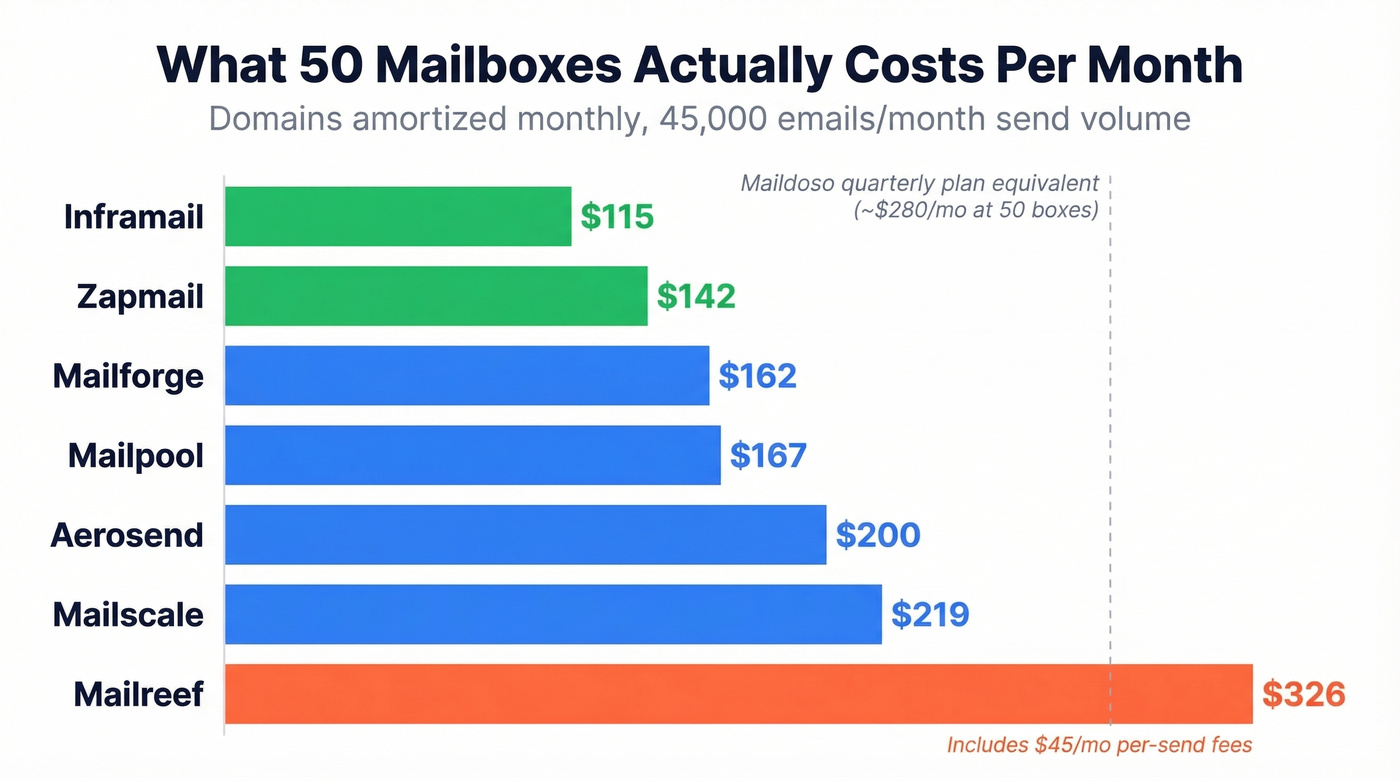
| Tool | Base Plan | Domains (mo.) | Extras | Total/mo |
|---|---|---|---|---|
| Mailforge | $150 (50 slots) | ~$12 (10 domains @ $14/yr) | Warmup included | ~$162 |
| Mailscale | $119 | ~$100 (10 domains @ ~$10 each) | Warmup included | ~$219 |
| Mailreef | $249 | ~$32 | $45 per-send; warmup separate | ~$326 |
| Inframail | $99-249 | ~$16 | Warmup separate | ~$115-265 |
| Aerosend | $200 (17 domain slots x $12) | Included | Warmup + monitoring included | ~$200 |
| Zapmail | $125 | ~$17 | Warmup included (pre-warmed) | ~$142 |
| Mailpool | $150 | ~$17 | Warmup included | ~$167 |
Mailreef is the cleanest "dedicated IP" play here, but it gets expensive fast once per-send fees kick in. For teams that don't need dedicated IP control, Mailforge, Zapmail, and Mailpool are simpler to run and cheaper to maintain.
The Step Most People Skip
Every tool on this list promises better deliverability than Maildoso. None of them can deliver it if you're sending to garbage data.
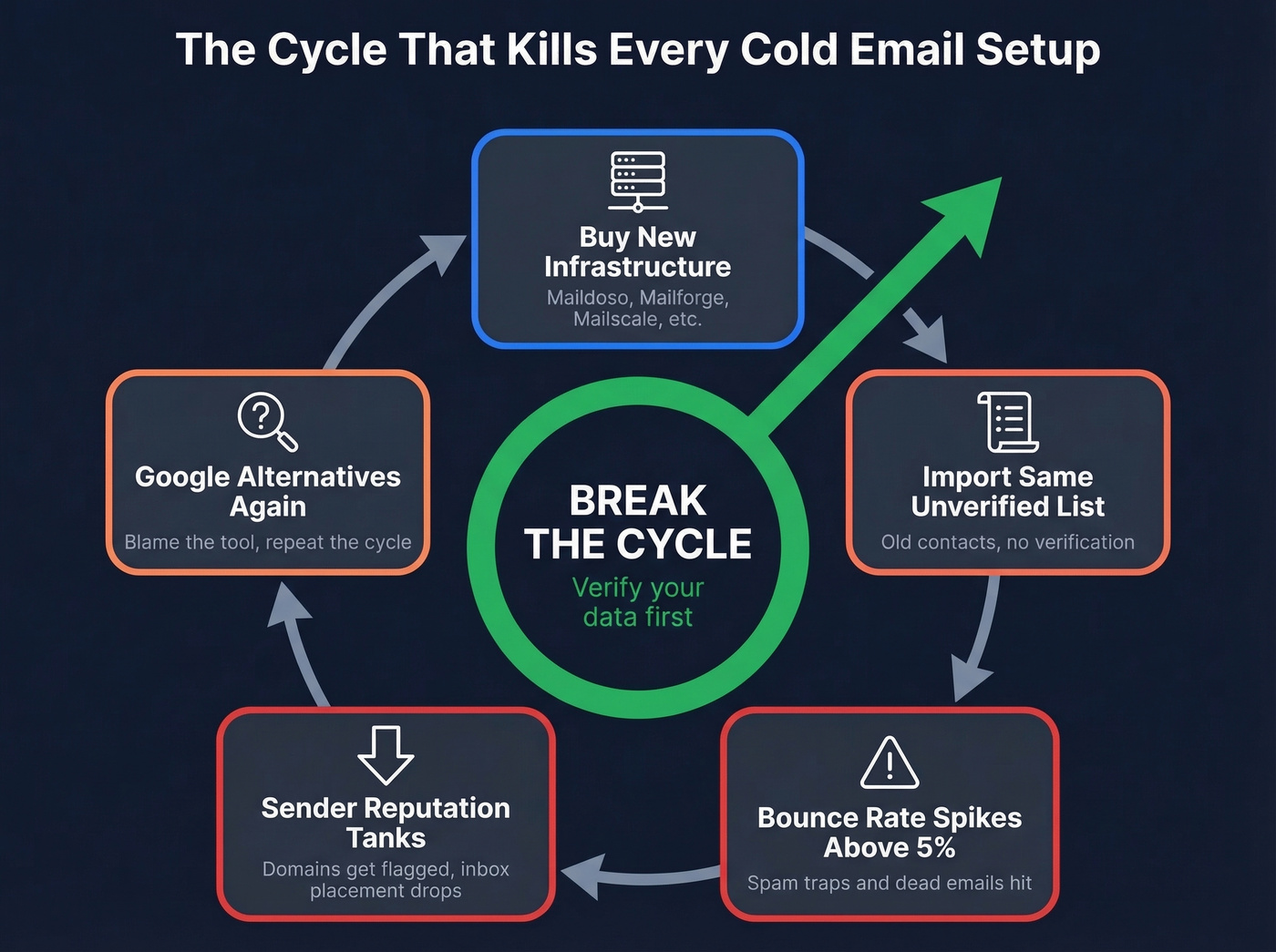
We've watched this cycle play out dozens of times. Team buys new infrastructure, imports the same unverified list they used before, bounce rate spikes above 5%, sender reputation tanks, domains get flagged. Team starts Googling alternatives again.
The infrastructure was never the problem. The data was.
No other guide covering cold email infrastructure mentions this angle because they're all written by infrastructure companies. The best sending setup in the world can't fix a bad list. If you want a deeper benchmark-and-fixes breakdown, start with our guide to email bounce rate.
Every provider on this list shares the same vulnerability: garbage data in, spam folder out. Prospeo's 5-step verification catches spam traps, honeypots, and catch-all domains before they torch your deliverability - at $0.01 per email.
Your infrastructure is only as good as the data you feed it.
Which Alternative Fits You?
For teams that need to launch today, Zapmail's pre-warmed accounts get you sending immediately. When you need to scale up and down without contracts, Mailforge's slot-based model gives you that flexibility at $3/mailbox/month.
Deliverability guarantees matter more than price? Mailscale backs their warmup with a refund - a level of confidence no one else on this list offers. Budget-conscious teams wanting a dedicated IP should look at Inframail's $99/month 1-IP plan. And for those who want everything bundled without stitching tools together, Aerosend handles warmup, monitoring, and burn alerts in one price.
But before you switch infrastructure at all, check your bounce rate. If it's over 3%, fix your data first. New pipes won't save a bad list - and that's the one thing none of these Maildoso alternatives can fix for you. For the infrastructure side, our email deliverability guide and how to improve sender reputation break down the levers that actually move inboxing.
FAQ
Does Maildoso offer a free trial?
No. Maildoso sells quarterly SMTP packages (like $299/quarter for 32 mailboxes) and monthly SMTP and Google Workspace plans, but none include a free trial. You're committing upfront before testing deliverability on your own lists.
What caused the Maildoso blacklisting incident?
Users reported Maildoso-provided domains were blacklisted without warning, causing immediate deliverability drops across active campaigns. Replacement domains were described as "unprofessional and spammy." Maildoso's founder compensated affected users with free domains and inboxes, but campaign disruption had already occurred.
Shared IP vs. dedicated IP - which is better for cold email?
Shared IPs cost less but carry neighbor risk - another sender's bad behavior can tank your deliverability. Dedicated IPs give full reputation control but cost more and require proper warmup. For operations running 50+ mailboxes, dedicated IPs are worth the premium for the control alone.
How many mailboxes do I need for cold outbound?
Plan for one mailbox per 20-30 cold emails per day. Sending 1,000 emails daily requires 35-50 mailboxes spread across multiple domains, with a max of 3 mailboxes per domain. Going heavier per domain accelerates reputation risk and increases the chance of provider-level flags.
Can I improve deliverability without switching providers?
Often, yes. If your bounce rate exceeds 3%, the problem is almost certainly your contact data, not your infrastructure. Verifying emails through a tool like Prospeo - 98% accuracy, 75 free credits/month - eliminates the bounces that damage sender reputation. It's the cheapest fix available and the one most operators skip.