

Best MailMint Alternatives for Catch-All Email Verification in 2026
MailMint the WordPress email marketing plugin and MailMint the email verification service share a name but do completely different things. This article covers MailMint the catch-all verifier - and the alternatives that outperform it.
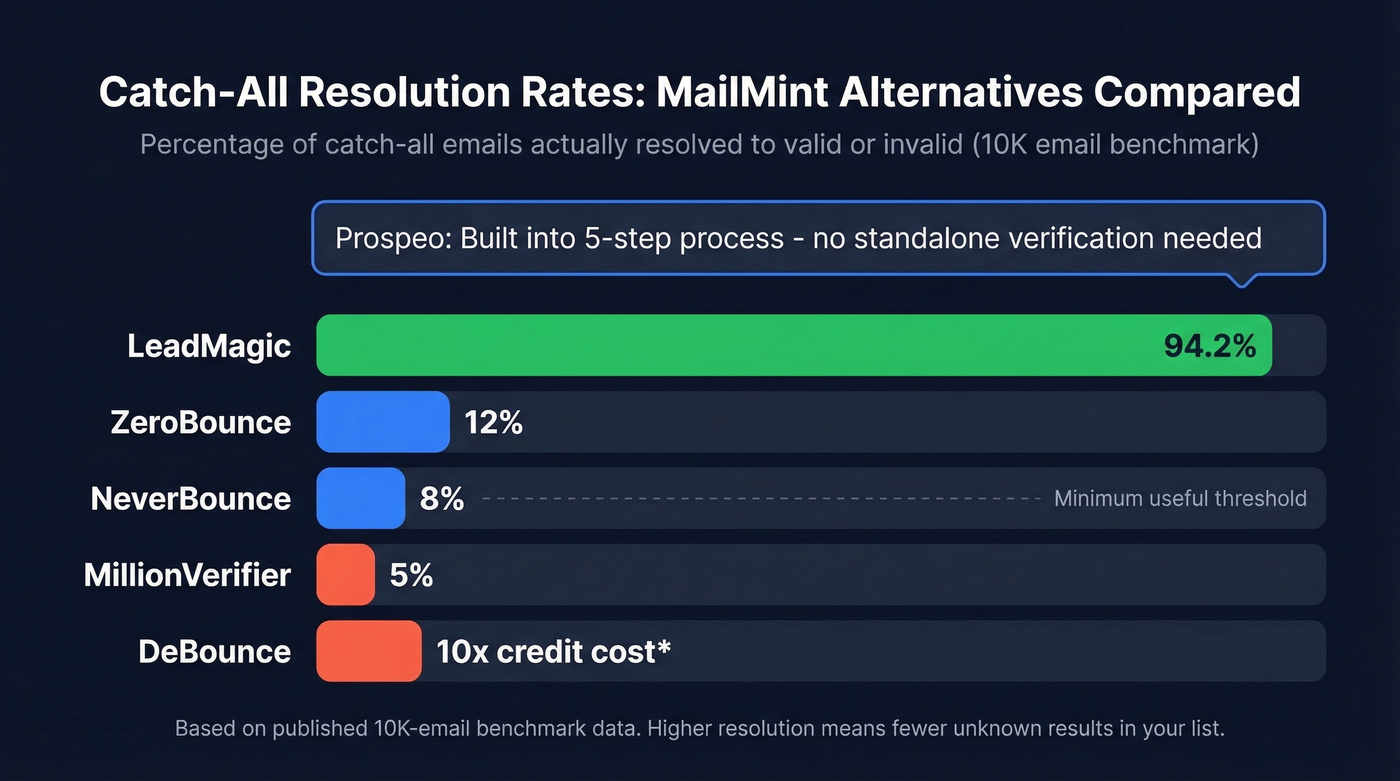
We tested the major catch-all verifiers against published benchmarks on real B2B lists. The differences are bigger than most teams expect.
Our Top Picks
| Tool | Best For | Catch-All Handling | Cost per 1K | Rating |
|---|---|---|---|---|
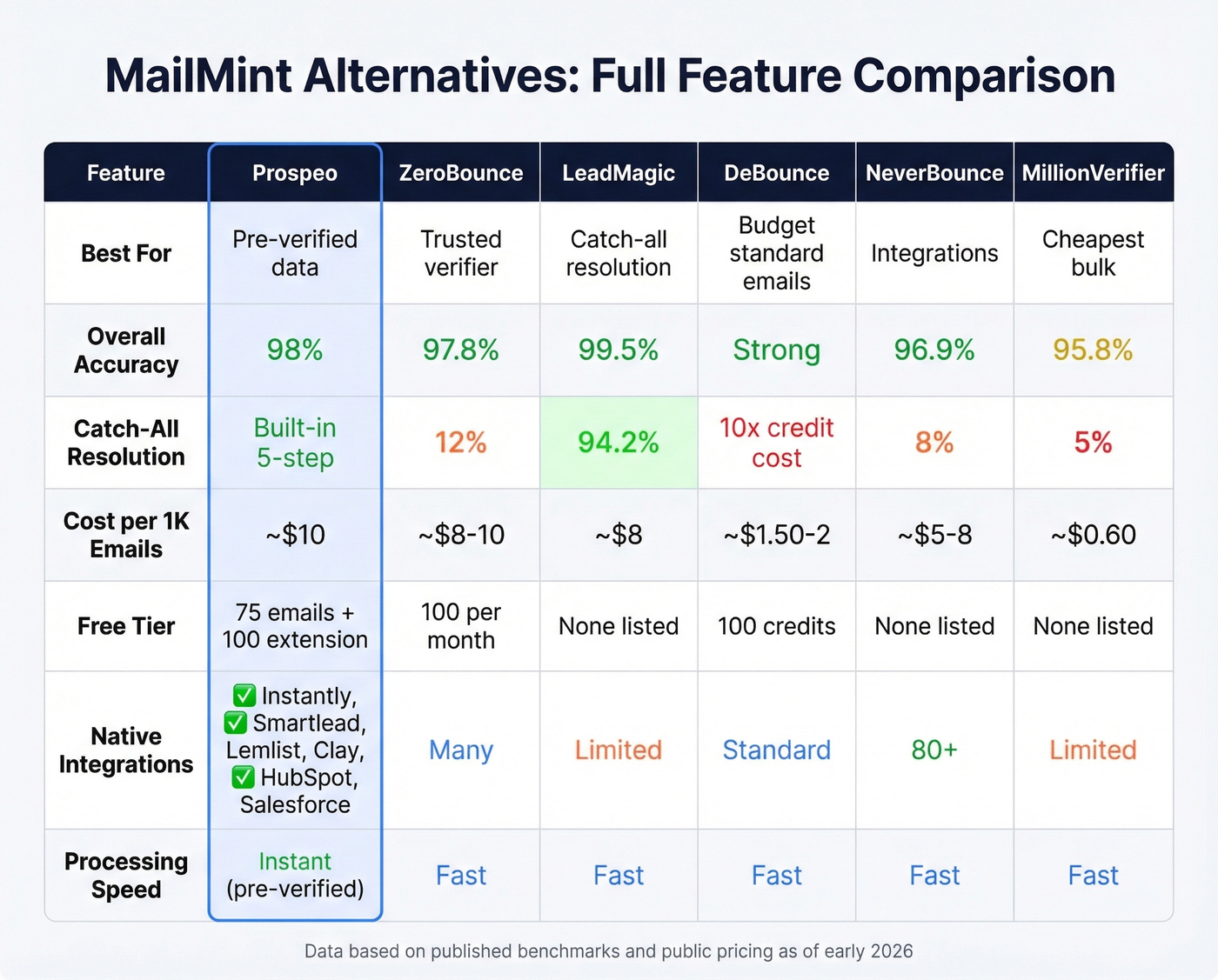
| Prospeo | Pre-verified data | Built into 5-step process | ~$10 | 98% accuracy |
| ZeroBounce | Dedicated verification | Labels catch-all (12% resolved) | ~$8-10 | G2 4.7/5 |
| LeadMagic | Catch-all resolution | 94.2% resolution rate | ~$8 | 99.5% accuracy |
| DeBounce | Budget (standard emails) | 10 credits per check | ~$1.50-2 | Trustpilot 4.8/5 |
| NeverBounce | Integrations (80+) | 8% resolution rate | ~$5-8 | G2 4.2/5 |
| MillionVerifier | Cheapest bulk cleaning | 5% resolution rate | ~$0.60 | 95.8% accuracy |
Our top three: Prospeo if you want to skip standalone verification entirely. ZeroBounce if you need a trusted dedicated verifier with strong G2 reviews. LeadMagic if catch-all resolution is the single thing keeping you up at night.
Why People Switch from MailMint
Three friction points come up repeatedly:
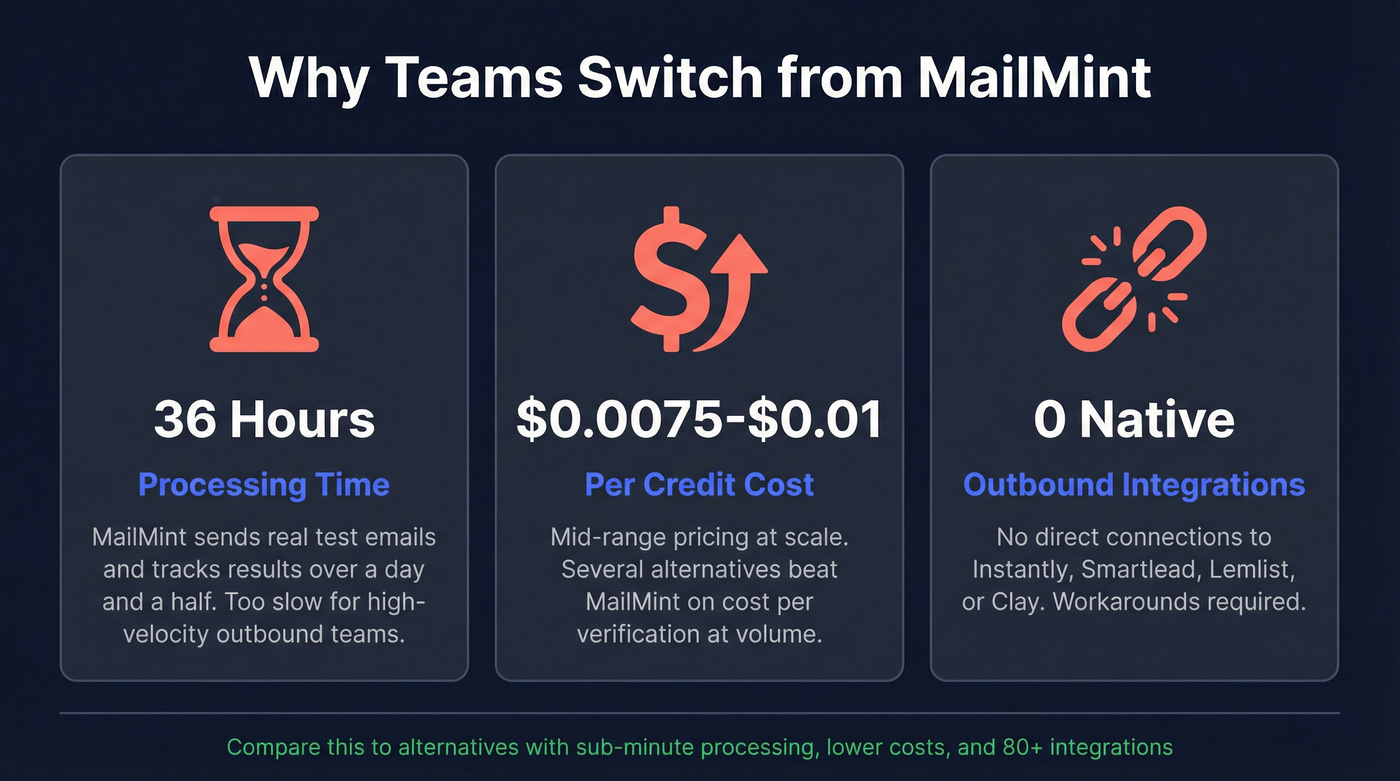
36-hour processing time. MailMint sends real test emails and tracks results over a day and a half. If you're running high-velocity outbound and need a list verified before tomorrow's sequence, that's a bottleneck.
Mid-range pricing at scale. At $0.0075-$0.01 per credit on higher tiers, MailMint isn't expensive - but several alternatives beat it on cost-per-verification at volume.
Limited native integrations. If your stack includes Instantly, Smartlead, Lemlist, or Clay, you'll need workarounds. MailMint doesn't plug directly into the outbound tools most teams actually use.

You're comparing catch-all verifiers because your current data source ships unverified emails. Prospeo's 5-step verification - including catch-all resolution, spam-trap removal, and honeypot filtering - runs before you ever see the contact. 143M+ emails at 98% accuracy, refreshed every 7 days. At ~$0.01/email, it costs less than most standalone verifiers.
Eliminate the verification step entirely. Start with clean data.
Best MailMint Alternatives Compared
Prospeo
Here's the thing: if you're shopping for a better email verifier, you might be solving the wrong problem. Prospeo flips the model. Instead of building a list and then running it through a verification tool, you start with 143M+ emails already verified through a 5-step process that includes catch-all handling, spam-trap removal, and honeypot filtering.
The database refreshes every 7 days - the industry average is closer to 6 weeks - so you're not verifying stale data. Native integrations with Instantly, Smartlead, Lemlist, Clay, HubSpot, and Salesforce mean verified contacts flow straight into your sequencer and CRM. Pricing lands around ~$0.01 per email, with a free tier of 75 emails and 100 Chrome extension credits per month. No contracts.

Use this if: You want to eliminate the verification step from your workflow entirely and start with clean, catch-all-resolved data.
Skip this if: You already have a list from another source and just need to scrub it.
ZeroBounce
ZeroBounce is the safe pick - the verifier your VP of Marketing won't question. A G2 rating of 4.7/5 across 1,361 reviews gives it the strongest social proof in the category. In a 10,000-email benchmark, it hit 97.8% overall accuracy. Pricing sits around $0.008/email (~$8 per 1K) on pay-as-you-go, and the free tier gives you 100 verifications per month.
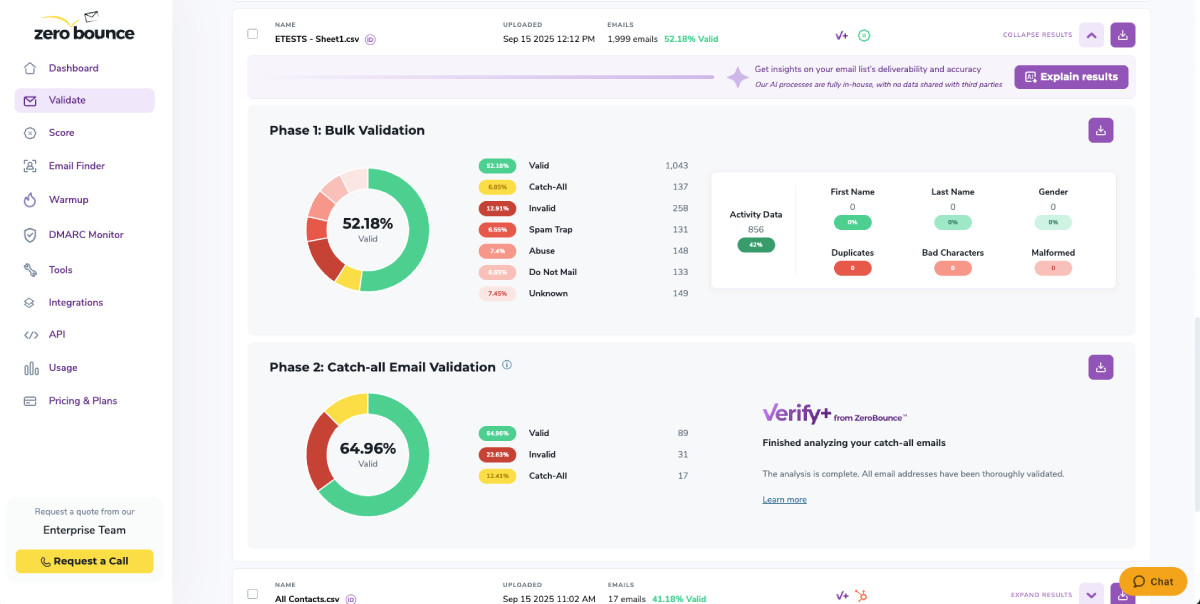
The catch-all story is where it falls short. ZeroBounce mostly labels catch-all addresses as "catch-all" rather than resolving them - only about 12% actually get resolved. In that same 10K test, catch-all emails were 28% of the dataset, which is exactly why this matters: a big chunk of your list ends up stuck in limbo. You know they're catch-all. You still don't know if they're real.
LeadMagic
LeadMagic posted a 94.2% catch-all resolution rate in a 10K-email benchmark - the highest of any tool we've seen tested. Instead of returning "unknown" for tricky accept-all domains, LeadMagic actually tells you whether the mailbox exists. Overall accuracy hit 99.5%.
Pricing is pay-per-result, starting at $59.99/mo for 2,500 credits. A 10K verification run costs roughly $80.
The tradeoff is ecosystem size. Fewer integrations than ZeroBounce or NeverBounce, so you'll likely need Zapier or Make to connect it to your outbound stack. For teams where catch-all resolution is the priority and everything else is secondary, that's a fair trade.
DeBounce
For large lists of standard corporate emails on a tight budget, DeBounce is hard to beat. At $0.00045 per check with credits that never expire, it's absurdly cheap for basic verification. Trustpilot 4.8/5 across 1,340 reviews. 100 free credits to start.
Skip this if catch-all resolution is why you're here. DeBounce charges 10 credits per catch-all check - a 10x multiplier. Your effective cost-per-email jumps from fractions of a penny to something much less competitive for the addresses that matter most. Great tool, wrong use case.
NeverBounce
NeverBounce's 80+ integrations make it the easiest verifier to slot into an existing stack. Processing is fast, accuracy hits 96.9% in benchmark testing, and a 10K verification run costs about $50. G2 reviewers consistently praise the ease of use and quick turnaround.
The problems are real, though. Only 8% catch-all resolution - barely better than returning "unknown" for every catch-all address. G2 sits at 4.2/5 with 141 reviews, noticeably behind ZeroBounce. And the credit expiration policy change caught prepaid customers off guard. One Reddit practitioner ranked their experience across multiple tools as Instantly > NeverBounce > MillionVerifier, noting that stacking providers outperforms any single tool.
MillionVerifier
The pure budget play. In a 10,000-email benchmark, MillionVerifier cost about $6 total and delivered 95.8% accuracy. But catch-all resolution sits at just 5%, which makes it a non-starter for B2B lists heavy on accept-all domains.
If catch-all isn't your primary concern and you need to scrub a massive list cheaply, it does the job. Otherwise, look elsewhere.
Why Catch-All Verification Matters
Between 10-30% of businesses use catch-all email configurations. In a real 10K B2B email test, 28% of addresses were catch-all. That's potentially a third of your list returning "unknown" from most verifiers.
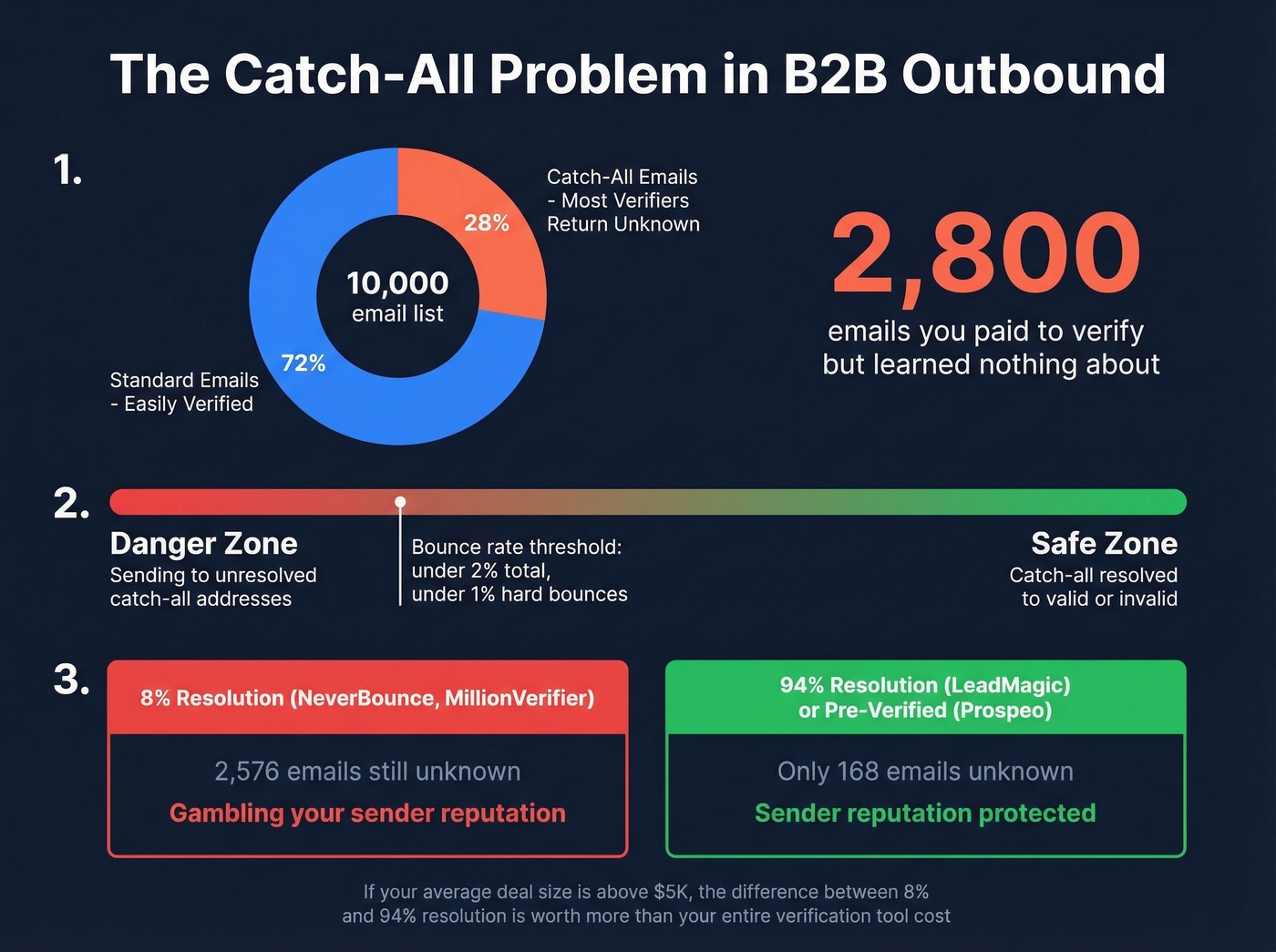
Think about what that means in practice. You paid $75 to verify 10,000 emails, and for 2,800 of them you learned nothing. Deliverability best practices say to keep total bounces under 2% and hard bounces under 1%. Send to unresolved catch-all addresses and you're gambling your sender reputation on a coin flip.
Let's be honest about the math here. If your average deal size is above $5K and you're running outbound at any real volume, the difference between 8% catch-all resolution and 94% catch-all resolution is worth more than the entire cost of your verification tool. A separate 3,000-email benchmark found that verification accuracy drops significantly on mid-market and enterprise domains due to stricter mail server configurations - exactly the domains where catch-all resolution matters most. The tools that actually resolve catch-all to valid/invalid are worth every penny of the premium.
If you're also trying to fix bounce issues at the root, start with email deliverability and a clean email bounce rate baseline.
MailMint takes 36 hours to process a list and doesn't integrate with Instantly, Smartlead, or Lemlist. Prospeo connects natively to all three - plus Clay, HubSpot, and Salesforce - with catch-all handling already done. No workarounds. No waiting. No separate verification bill.
Verified contacts straight into your sequencer. Zero extra steps.
FAQ
What is catch-all email verification?
Catch-all domains accept mail sent to any address, even nonexistent ones. Catch-all verification determines whether a specific mailbox actually exists, returning valid or invalid instead of "unknown." Standard SMTP checks can't make this distinction - specialized resolution is required.
Why do most verifiers fail on catch-all emails?
Standard SMTP verification can't distinguish real inboxes from fake ones on catch-all domains because the server accepts everything. Resolving them requires proprietary methods like behavioral analysis and pattern matching that most verifiers haven't invested in, which is why resolution rates range from 5% to 94%.
Can I skip standalone verification entirely?
Yes - if you source contacts from a pre-verified database with built-in catch-all handling. Prospeo's 143M+ emails go through a 5-step verification process on a 7-day refresh cycle, so you prospect and verify in one motion. That eliminates the separate scrubbing step and its associated cost.
Which free tier is best for testing?
Prospeo offers 75 free emails plus 100 Chrome extension credits monthly - the most generous option for teams running real outbound. ZeroBounce gives 100 free verifications per month, and DeBounce starts you with 100 one-time credits. Test all three on the same list segment to compare results head-to-head.