

Mails.ai vs Apollo.io: You're Comparing Two Different Things
Most teams treat Mails.ai vs Apollo.io like a head-to-head. It's not. Mails.ai is a cold email sending platform; Apollo.io is a B2B database with an engagement suite bolted on. One helps you fire emails at scale. The other helps you find targets and run the whole motion.
Stop trying to pick the "better" tool when they're in different categories. The real question is whether your bottleneck is sending infrastructure or data plus workflow. And if you're honest about it, most outbound programs fail because the data quality upstream is worse than anyone wants to admit.
30-Second Verdict
- Pick Mails.ai if you already have a lead list and need a cheap, unlimited-account sending platform with built-in warm-up. You're a solo operator or small team running high-volume cold email.
- Pick Apollo.io if you need a B2B database to build lists AND want sequences, a dialer, and intent data in one platform. You're a sales team that needs the full stack.
What Each Tool Actually Does
Mails.ai is for sending. Connect unlimited email accounts, rotate inboxes, generate copy with an AI writer, and run warm-up in the background. It's designed for volume without per-inbox pricing games, which is why agencies love it. What it lacks - and what most people assume it has - is a contact database. You bring your own leads via CSV, then Mails.ai handles execution.
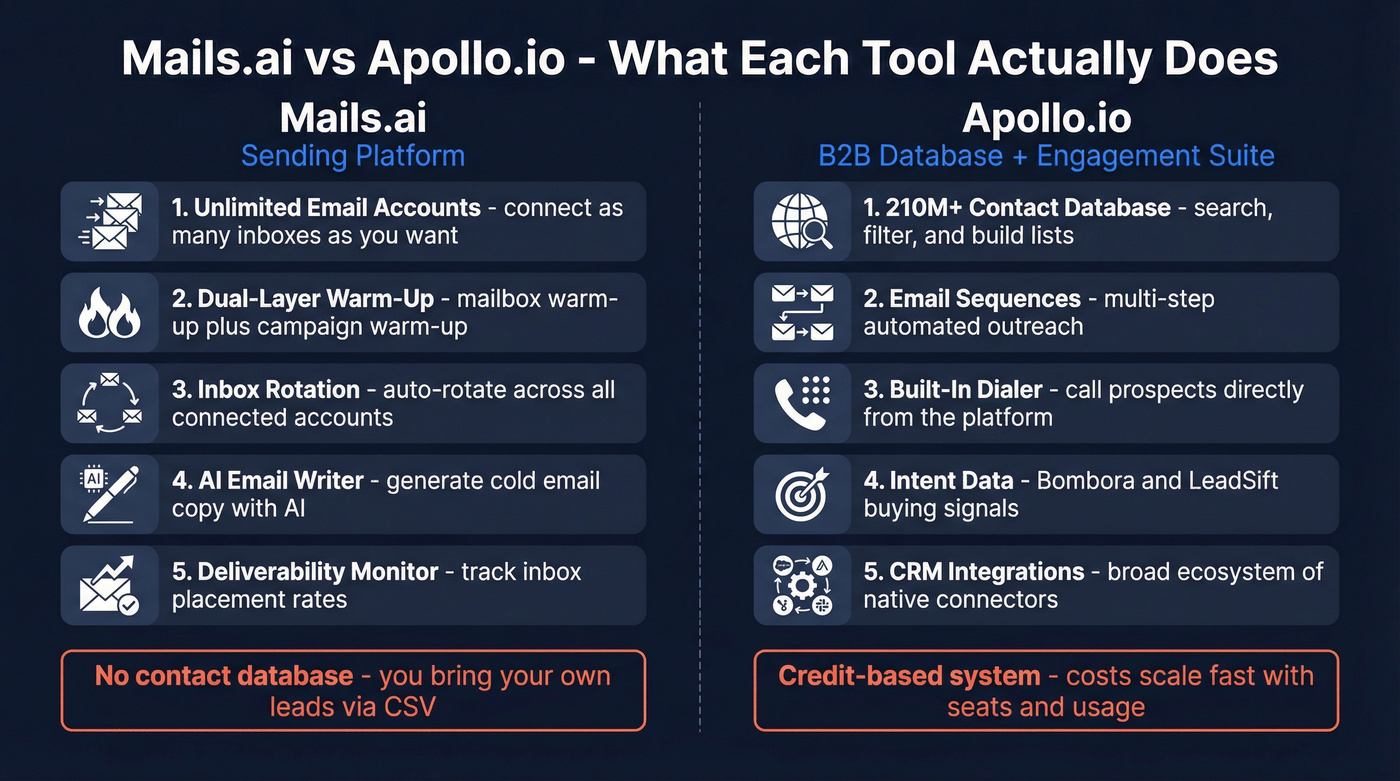
Apollo.io is database-first with engagement layered on top. The database covers 210M+ contacts and 35M+ companies. You build lists, enrich records, and push prospects into sequences. It also bundles a dialer and intent topics via providers like Bombora and LeadSift. Here's the catch: it's credit-based, and the "all-in-one" pitch only works if your team actually adopts the workflow inside Apollo instead of exporting everything out.
Feature Comparison
| Feature | Mails.ai | Apollo.io | Edge |
|---|---|---|---|
| Built-in database | No | Yes | Apollo |
| Email sending | Yes | Yes | Mails.ai (unlimited accounts) |
| Warm-up | Yes (dual-layer) | Inbox ramp-up | Mails.ai |
| AI writer | Yes | Yes | Tie |
| Inbox rotation | Yes | Limited | Mails.ai |
| Multichannel (phone) | No | Yes (dialer) | Apollo |
| Intent data | No | Yes | Apollo |
| Integrations | Basic | Broad | Apollo |
The pattern is clear. Mails.ai wins everything around deliverability and sending throughput. Apollo wins on list building and sales workflow. If you need both, you use both - and that's exactly what a lot of teams do.
Let's be honest: most teams under 5 reps don't need Apollo's full suite. They need a good lead list, a verification layer, and a sending tool. Apollo becomes worth it when you have enough reps to justify the per-seat cost and actually use the dialer.
Pricing Breakdown
Mails.ai Pricing
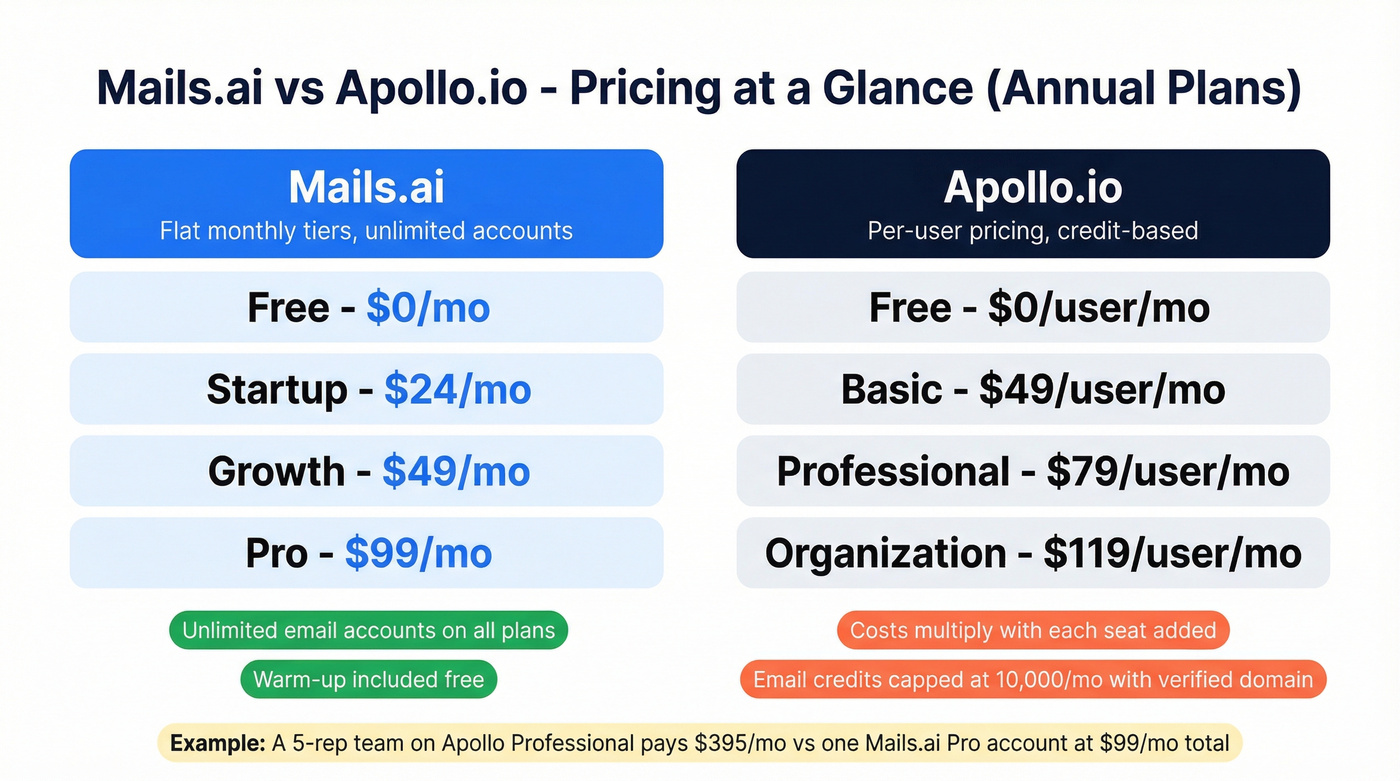
Flat monthly tiers, unlimited accounts, warm-up included.
| Plan | Monthly | Annual (mo equiv.) |
|---|---|---|
| Free | $0 | $0 |
| Startup | $49 | $24 |
| Growth | $99 | $49 |
| Pro | $199 | $99 |
Startup includes 1,000 active contacts/mo and 2,000 email verifications. Growth bumps to 5,000 and 10,000. Pro goes unlimited contacts with 50,000 verifications/mo.
Apollo.io Pricing
Per-user pricing where the real cost scales with seats plus credits.
| Plan | Monthly (user) | Annual (user/mo) |
|---|---|---|
| Free | $0 | $0 |
| Basic | $59 | $49 |
| Professional | $99 | $79 |
| Organization | $149 | $119 |
Apollo's "unlimited email credits" is the gotcha. It's effectively 10,000 credits/month with a verified corporate domain and 100/month without. The free plan is a UI trial, not a real outbound engine. Read the fine print on Apollo's pricing page before you commit.

Apollo gives you lists. Mails.ai gives you sending. Neither guarantees the emails are real. Prospeo's 98% email accuracy and 7-day data refresh mean your sequences hit actual inboxes - not spam traps. At ~$0.01/email, it costs less than a single Apollo bounce destroying your domain.
Verify every lead before it touches your sequencer.
Deliverability and Warm-Up
Mails.ai leads here. It runs dual-layer warm-up (mailbox warm-up plus campaign warm-up), includes a deliverability monitor, and keeps unlimited free email warm-up on all plans. For high-volume senders, that's the whole point.
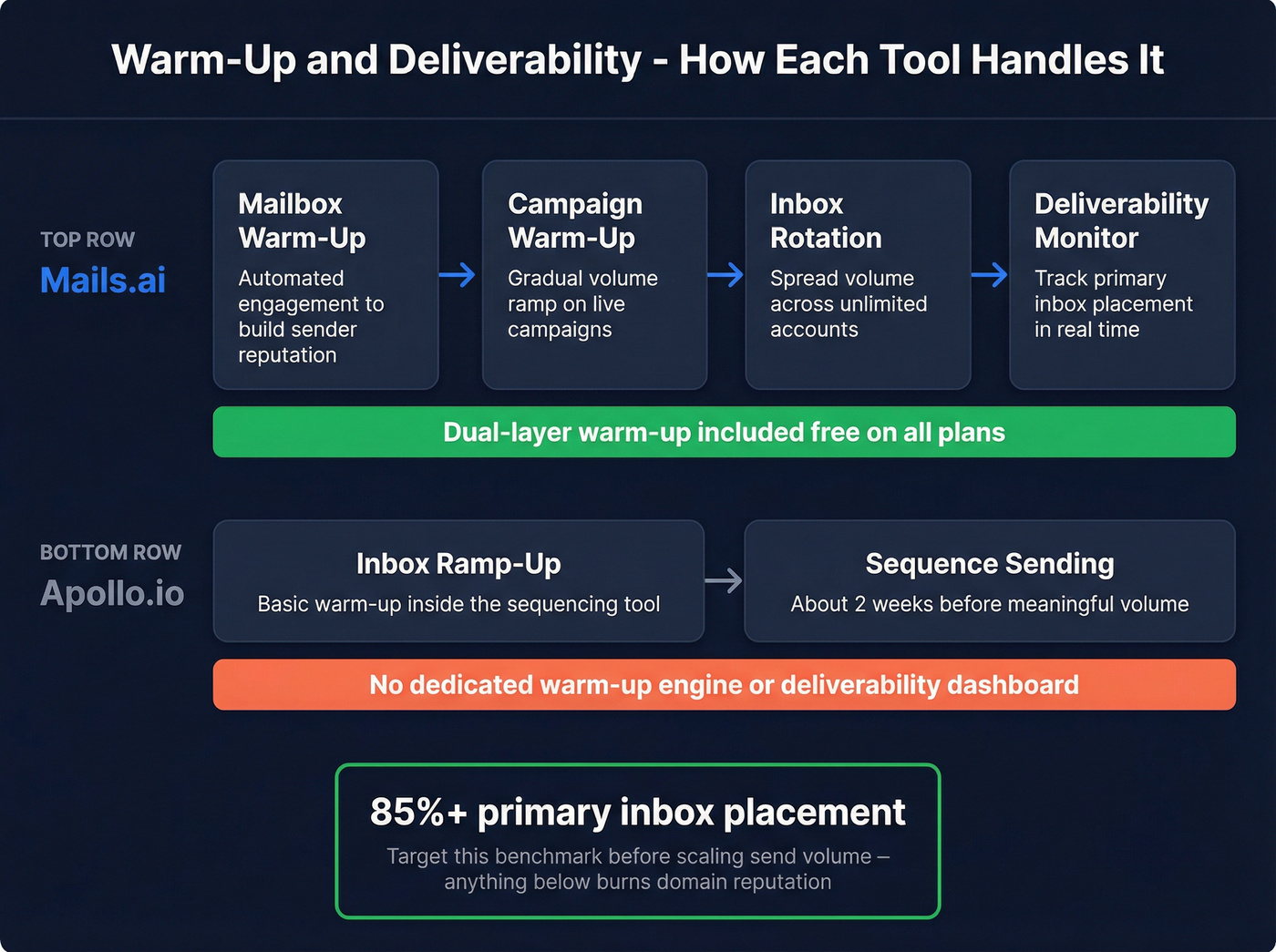
Apollo's approach is more like inbox ramp-up inside a sequencing tool. Expect about two weeks before you're sending at meaningful volume.
A practitioner benchmark worth knowing: target 85%+ primary inbox placement before scaling send volume. Anything below that and you're burning domain reputation faster than warm-up can repair it. Trustpilot feedback questions whether Mails.ai warm-up performs as advertised - warm-up is notoriously hard to validate - so treat it as helpful plumbing, not a magic shield.
User Reviews and Red Flags
Mails.ai sits at 3.7/5 on Trustpilot from 33 reviews, with recurring complaints about support responsiveness and cancellation friction. No self-serve cancel is inexcusable. The fact you may need to email support for a Stripe portal link is a billing red flag. On G2 it shows 4.9/5, but from only 5 reviews. Reddit threads echo the same themes; one honest review thread flags that the free plan lacks a custom tracking domain, creating avoidable spam-filter risk, and the author ended up preferring Lemlist and SmartReach.
Apollo's review base is massive and stable. The consistent knocks are data accuracy, a confusing credit system, and costs that climb fast as you add reps. We've seen bake-offs where Apollo won on speed-to-list, then lost in week two when the CRM filled with duplicates and stale titles. Apollo's scale makes it easy to create a big mess quickly.
The Data Quality Gap
Apollo has breadth, but practitioners report a 30-40% coverage gap once you filter by role, region, and recency. Mails.ai doesn't even try to solve coverage - it has no database.
Neither tool solves the one thing that protects your domain: verification you can trust. Bad emails don't just bounce - they drag down your sender reputation. Prospeo fills that gap with 98% email accuracy, a 7-day refresh cycle, and native integrations with Salesforce, HubSpot, Smartlead, Instantly, Lemlist, and Clay, plus workflow automation via Zapier and Make. Verify and enrich before anything hits your sequencer.

Building lists in Apollo and sending through Mails.ai? The missing layer is verification. Teams using Prospeo cut bounce rates from 35%+ to under 4% - and book 35% more meetings than Apollo users running unverified data. 143M+ verified emails, no contracts, no credit card required.
Fix the data gap between your database and your sending tool.
Who Should Pick What
You already have leads and need sending throughput: pick Mails.ai. Unlimited accounts, warm-up, and rotation without per-seat math.
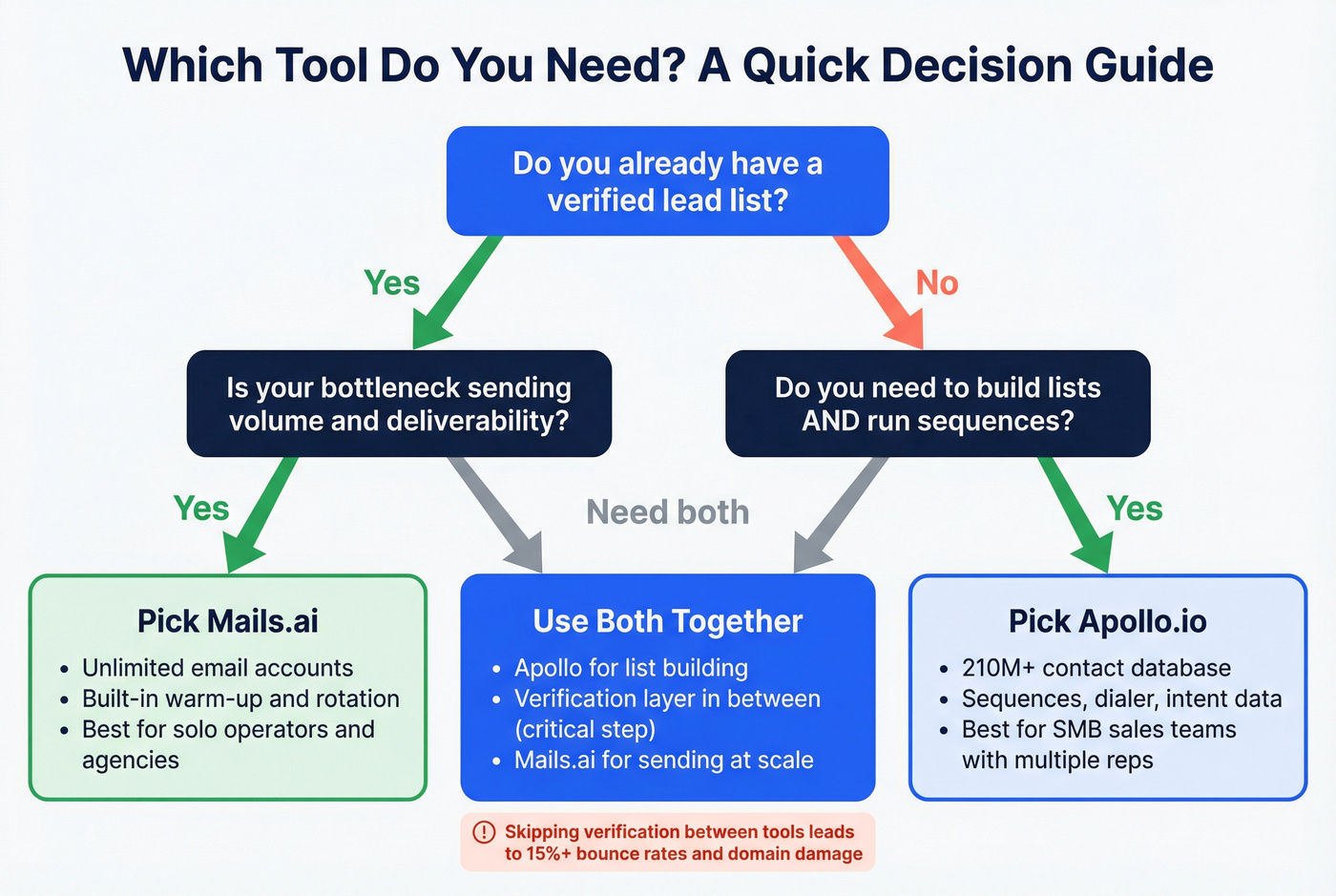
You need a database plus a full engagement suite: pick Apollo.io. It's the obvious starting point for SMB sales teams that want list-building and sequences in one place.
You need both and your deal sizes justify it: use Apollo for list-building, Mails.ai for sending, and a verification layer in between. The scenario we see constantly - download a list from Apollo, load it into Mails.ai, 15% bounces on the first campaign - is a verification problem, not a tool problem. Skip the verification step at your own risk.
For teams where budget is tight and you're running lean, start with Prospeo for data and Mails.ai for sending. You'll spend less than a single Apollo Professional seat and get cleaner data out of the gate.
FAQ
Can I use Mails.ai and Apollo.io together?
Yes, and many teams do. Use Apollo to build lead lists and Mails.ai to send campaigns, especially if you want unlimited inbox rotation. Verify emails between the two steps; Apollo's documented 30-40% coverage gap means unverified lists will damage your sender reputation.
Does Mails.ai have a built-in contact database?
No. Mails.ai is a sending platform only. You need to source leads from a separate database like Apollo or Prospeo and import via CSV. Treat it as outbound infrastructure, not a source of truth for contacts.
Is Apollo.io's free plan useful for real campaigns?
Barely. The "unlimited email credits" are capped at 10,000/month with a verified corporate domain and 100/month without, plus 2 sequences, 5 mobile credits/month, and 10 export credits/month. It's enough to test the UI, not run real outbound.