

Best Mass Email Tools in 2026, Sorted by Use Case
Your list was 2,000 contacts and open rates were 45%. You scaled to 20,000, and suddenly you're at 12%. The subject lines didn't change. The copy didn't change. What changed was the quality of your list and the infrastructure behind your sends.
Picking the right mass email tool matters more than most guides suggest - and most of those guides are lazy. They rank 17 tools alphabetically and call it a day. This one sorts by what you're actually doing: marketing, cold outreach, or developer/transactional sends.
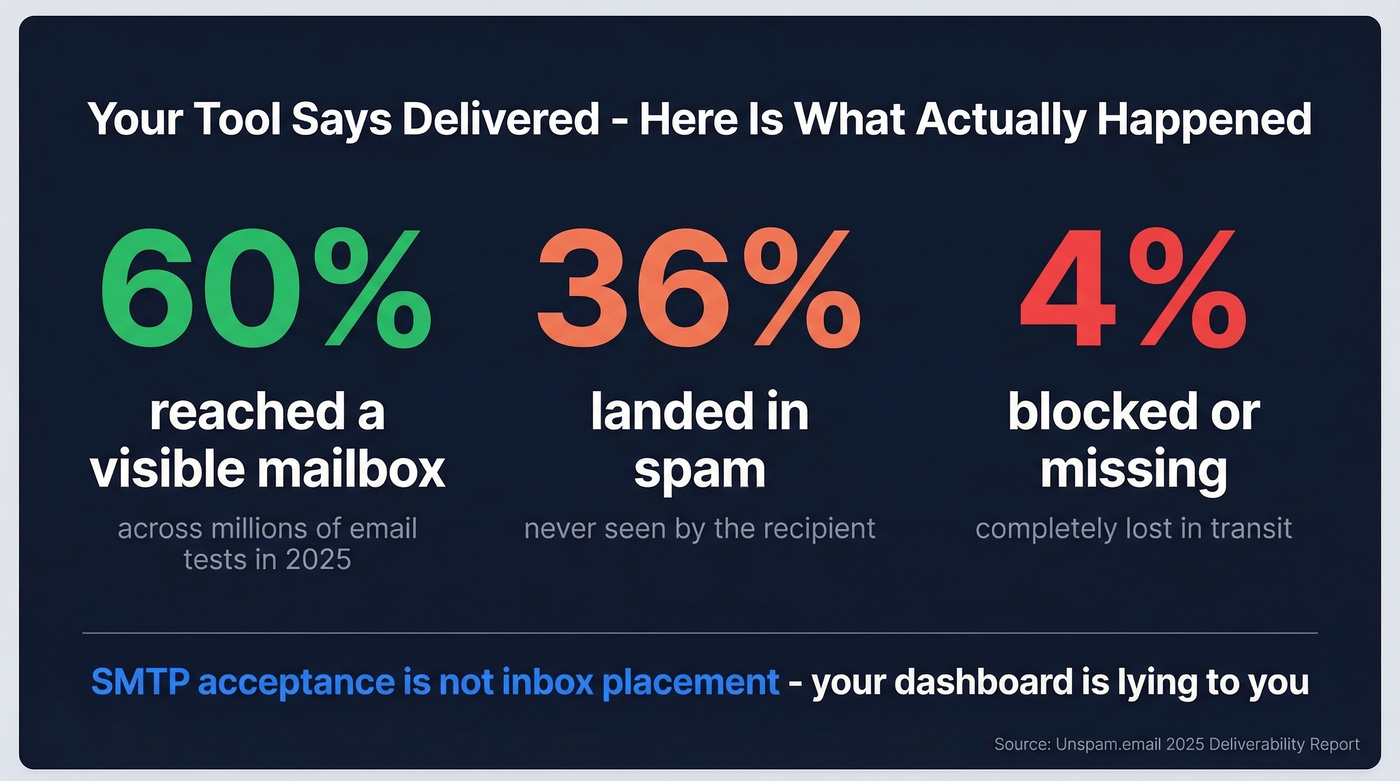
Here's the uncomfortable reality behind those "98% deliverability" claims your current tool is showing you. SMTP acceptance - meaning the receiving server didn't outright reject your email - isn't the same as inbox placement. Across millions of email tests analyzed through 2025, only 60% of emails reached a visible mailbox location. 36% landed in spam. 4% were blocked or went missing entirely. Your tool's dashboard might say "delivered," but a third of your audience may never see your message.
Our Picks (TL;DR)
| Best For | Tool | Starting Price |
|---|---|---|
| Email marketing (free start) | Brevo | Free (300/day) |
| Email marketing (best value) | MailerLite | Free (1,000 subs) |
| Verified contact data | Prospeo | Free (75 emails/mo) |
| Cold outreach at scale | Instantly | ~$30/mo |
| Cold email personalization | Lemlist | ~$39/mo/user |
Your sending platform is only as good as the list you feed it. Instantly and Lemlist send emails brilliantly. Brevo and MailerLite handle marketing campaigns. But none of them verify whether the addresses you're emailing are real, current, and safe to send to. The tools below are split into three categories: email marketing, cold outreach, and developer/API. Pick the section that matches your use case.
Which Type Do You Need?
There are three fundamentally different kinds of bulk email tools, and mixing them up will get you banned.
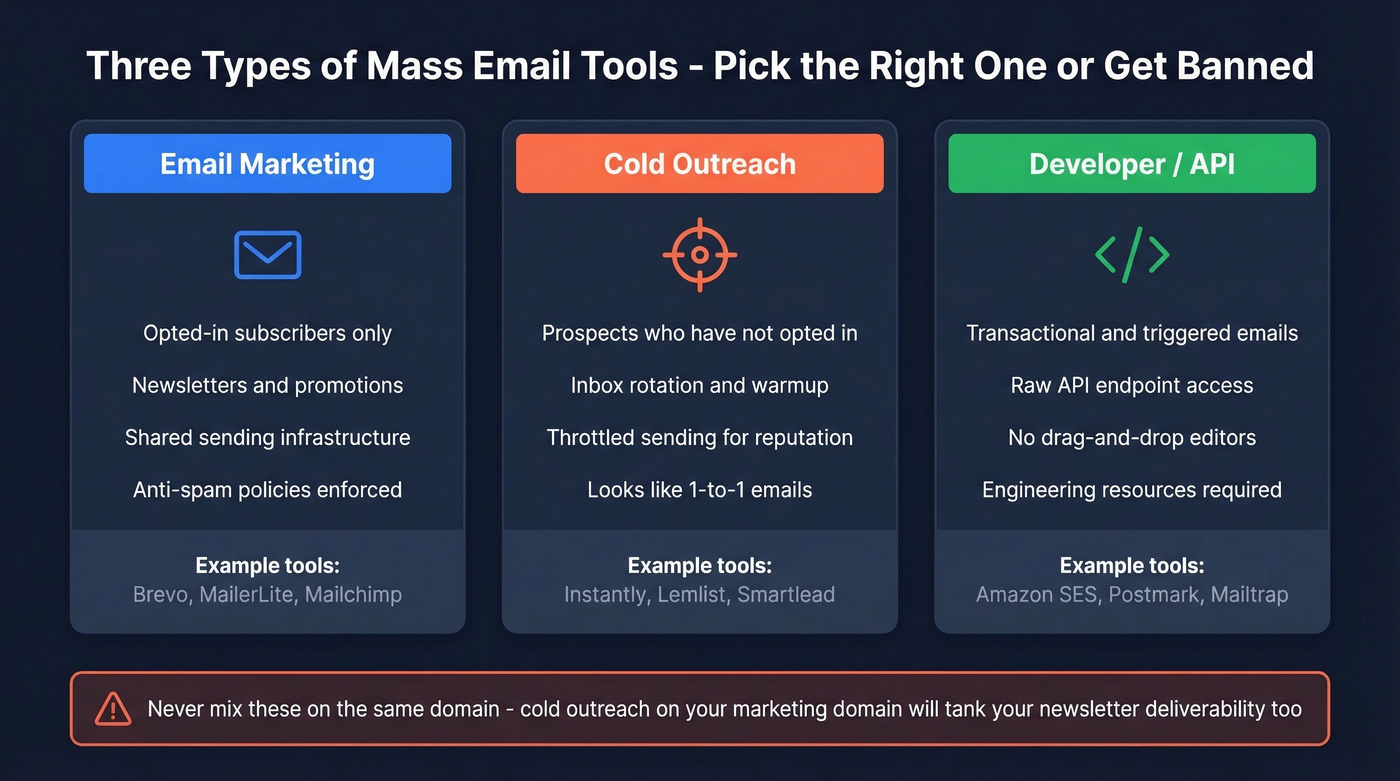
Email marketing platforms like Brevo, MailerLite, and Mailchimp are built for opted-in subscribers. Newsletters, promotions, product updates. They run on shared sending infrastructure with strict anti-spam policies. Send a cold outreach campaign through Mailchimp and your account gets suspended - usually within hours.
Cold email tools like Instantly, Lemlist, and Smartlead are built for outbound prospecting to people who haven't opted in. They use inbox rotation, warmup sequences, and throttled sending to protect your domain reputation. They're designed to look like one-to-one emails, not bulk blasts.
Developer/API tools like Amazon SES, Mailtrap, and Postmark give you raw sending infrastructure. No drag-and-drop editors, no warmup features - just an API endpoint and a price per thousand emails. These are for transactional emails or teams with engineering resources to build their own sending layer. Think of them as bulk email sending software stripped down to the bare metal.
Here's the scenario that kills domains: your marketing team runs Mailchimp on your primary domain, and your sales team starts blasting cold emails through Instantly on the same domain. The cold outreach tanks your domain reputation, and suddenly your marketing newsletters land in spam too. Separate your sending domains. Always.
Deliverability Reality Check
When your sending platform reports 97% deliverability, it's measuring SMTP acceptance - the receiving mail server said "okay, I'll take it." That doesn't mean the email reached the inbox. It might be sitting in spam, in a promotions tab, or silently dropped. The gap between SMTP acceptance and actual inbox placement is enormous.
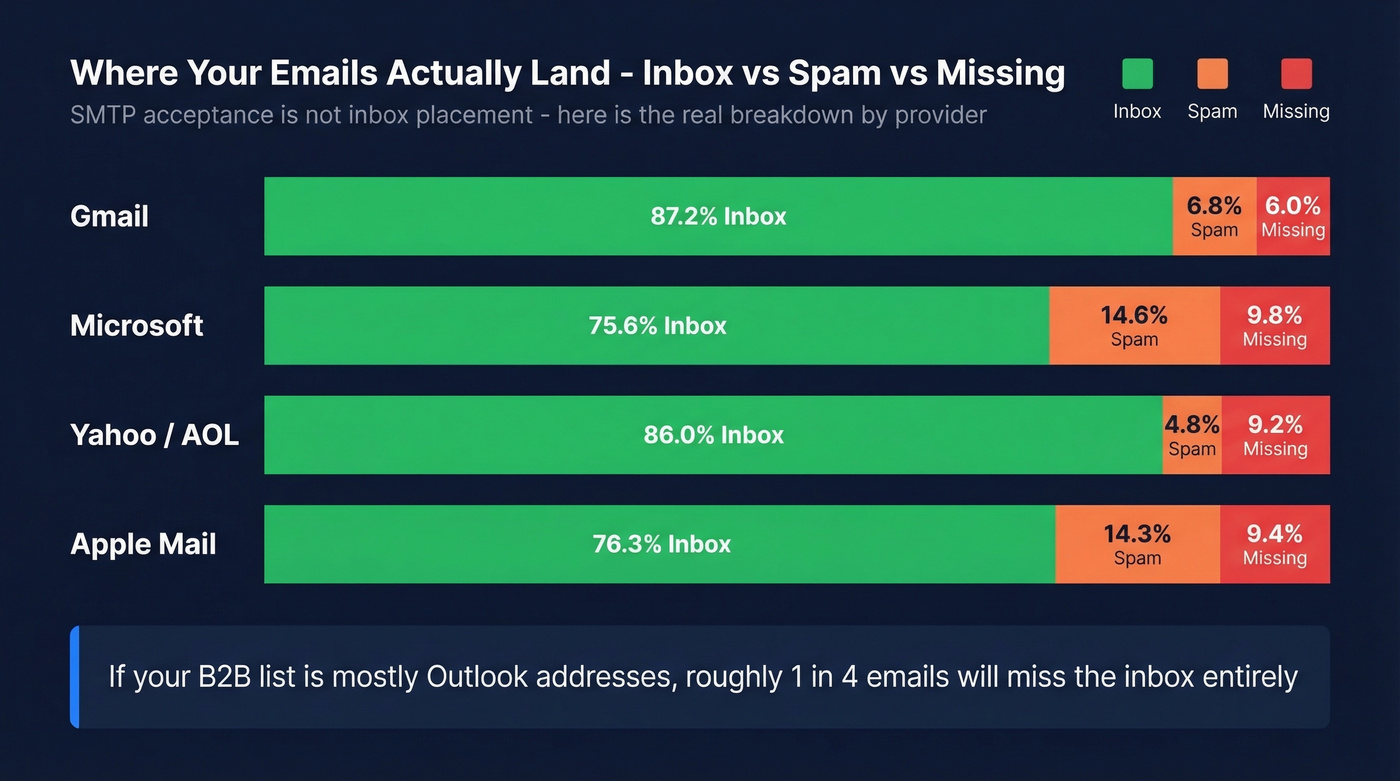
ISP-level benchmarks paint a clearer picture:
| Provider | Inbox % | Spam % | Missing % |
|---|---|---|---|
| Gmail | 87.2% | 6.8% | 6.0% |
| Microsoft | 75.6% | 14.6% | 9.8% |
| Yahoo/AOL | 86.0% | 4.8% | 9.2% |
| Apple Mail | 76.3% | 14.3% | 9.4% |
Microsoft and Apple Mail are the hardest inboxes to reach. If your prospect list skews toward corporate Outlook addresses - which most B2B lists do - expect roughly one in four emails to miss the inbox entirely.
Authentication helps, but it's not a silver bullet. SPF adoption sits at 92%, DKIM at 88%, but DMARC is only at 69%. Even with all three configured correctly, spam placement can still exceed 30% if your list quality is poor or your HTML is broken. Emails with poor HTML structure are 18-25% more likely to land in spam.

2026 Compliance Checklist
Google and Yahoo tightened enforcement in late 2025. Enforcement started in February 2024 and has tightened in stages, with the latest round of temporary and permanent rejections hitting non-compliant senders hard. Here's what you need to pass:
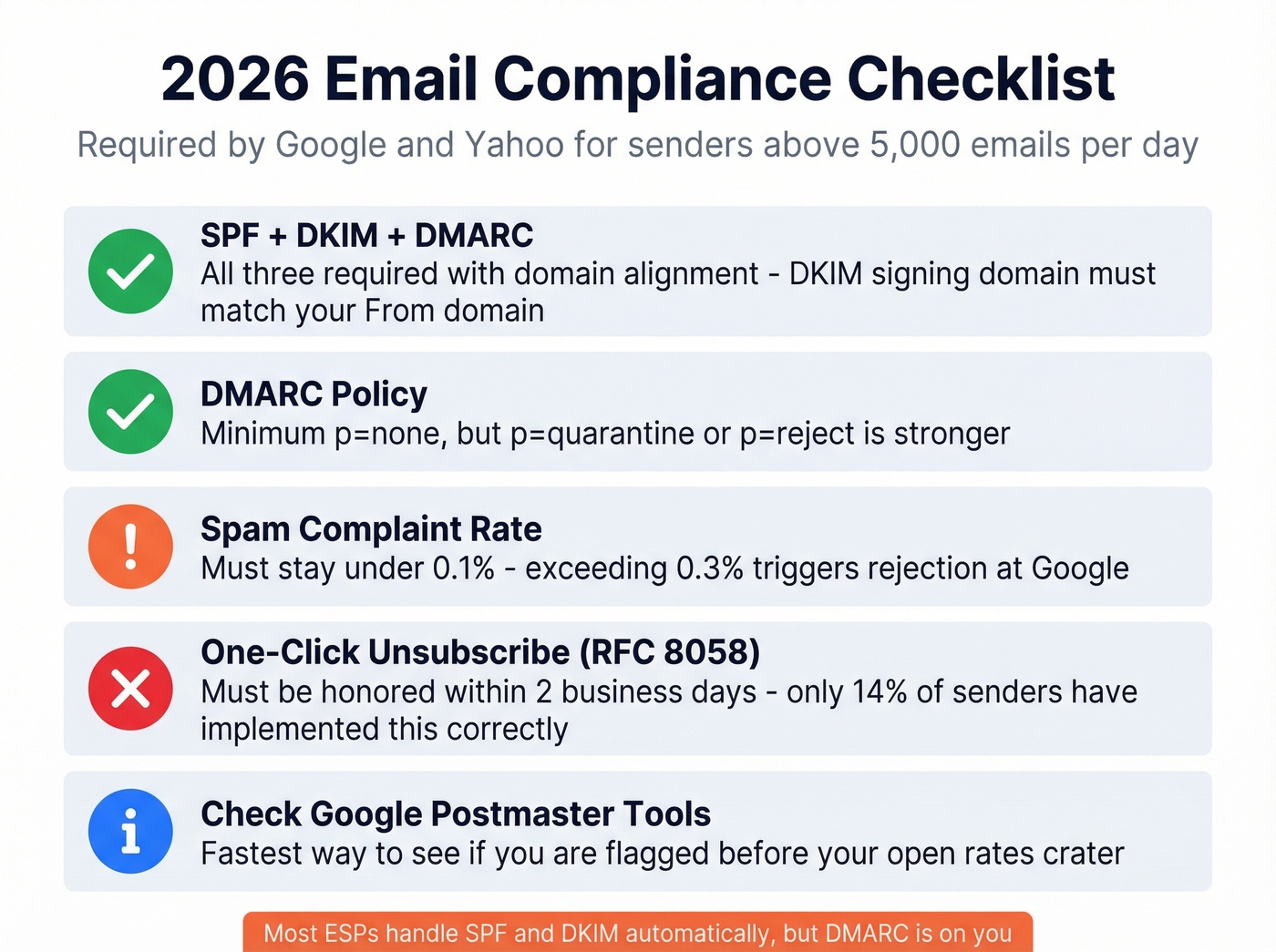
- SPF + DKIM + DMARC: all three required, with domain alignment. Your DKIM signing domain must match your From domain - platform defaults often don't comply
- DMARC policy: minimum p=none, though p=quarantine or p=reject is stronger
- Spam complaint rate: under 0.1% is the target. Regularly exceeding 0.3% triggers rejection at Google
- One-click unsubscribe: must be honored within two business days via the List-Unsubscribe header - only 14% of senders have implemented it correctly
- 5,000+ emails/day threshold: above this, everything listed here becomes mandatory, not optional
The frustrating part? Most ESPs handle SPF and DKIM automatically, but DMARC is on you. And the List-Unsubscribe header - the one Google actually checks - requires your sending platform to support RFC 8058. Not all of them do. Check your compliance status in Google Postmaster Tools. It's the fastest way to see if you're flagged before your open rates crater.
Best Platforms for Email Marketing
Brevo
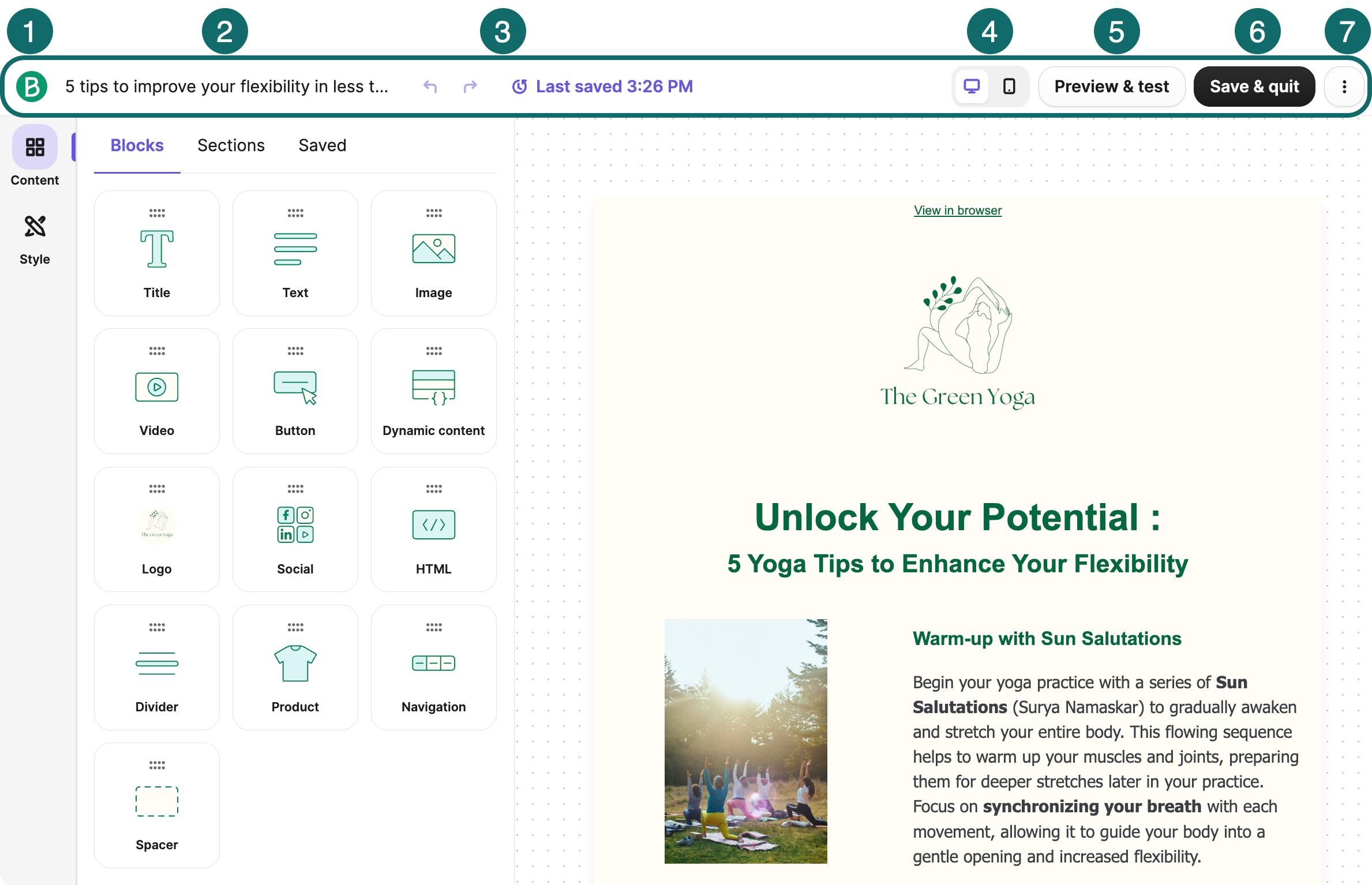
The verdict first: Brevo is the best starting point for small teams that need marketing email without spending a dollar.
The free plan gives you 300 emails per day, which works out to roughly 9,000 emails per month. Paid plans start at $9/mo for 5,000 emails. Transactional email is a separate $15/mo add-on with its own sending stream - this is actually a good thing, because your transactional deliverability doesn't get dragged down by a marketing campaign that underperforms.
Skip Brevo if you need advanced automation workflows - ActiveCampaign does that better.
MailerLite
MailerLite is the tool people switch to after Mailchimp's pricing makes them angry. The free plan covers 1,000 subscribers and 12,000 emails per month. Paid plans start at $10/mo with no sending limits - you pay based on subscriber count, not email volume. As a mass email platform, it punches well above its price point.
One Reddit user summed it up after switching from Mailchimp: "has been awesome so far." That tracks with what we've seen. The editor is clean, the automation builder is intuitive, and deliverability is solid for the price. One gotcha: MailerLite's approval process for new accounts is stricter than most competitors. Some users report getting locked out during review. Have your sending details ready when you sign up.
Use MailerLite if you're a small-to-mid team that wants the best value per subscriber. Skip it if you need deep CRM integration or enterprise-grade segmentation.
Mailchimp
| Pros | Cons |
|---|---|
| Largest template library in the category | Free plan is tightly capped |
| Strong reporting and A/B testing | Pricing scales aggressively - 10K contacts can run $100+/mo |
| Brand recognition = easy team adoption | You're paying a brand premium for mid-tier features |
Let's be honest: Mailchimp is overpriced for what most teams need. Standard plans start around the low teens per month, but costs balloon fast. For teams under 10,000 contacts, MailerLite or Brevo deliver comparable results at a fraction of the cost.
ActiveCampaign
ActiveCampaign starts at $15/mo for 1,000 contacts and doesn't offer a free plan - just a 14-day trial. What you get for the money is the best automation builder in this category. If/then branching, lead scoring, site tracking, and CRM functionality that actually works.
This is the tool for growing teams that have outgrown simple newsletter platforms and need behavior-triggered sequences. It's not cheap at scale, but the automation depth justifies the premium for teams that'll actually use it.
Others Worth Knowing
Moosend starts at $9/mo for 500 contacts with unlimited sends - strong value if volume matters more than features. GetResponse offers a free plan for 500 contacts and 2,500 emails/month, with paid plans from $19/mo that include landing pages and webinar hosting. Omnisend ($16/mo) is purpose-built for e-commerce with SMS and push notification channels baked in. Sender starts at $7/mo with a generous free tier - it's the quiet budget pick that rarely makes these lists.

Every mass email tool on this list sends brilliantly - but none of them verify whether your contacts are real. Prospeo's 5-step verification catches spam traps, honeypots, and catch-all domains before they tank your sender reputation. 98% email accuracy. $0.01 per verified address.
Fix your list before you fix your sending tool.
Best Tools for Cold Outreach
Instantly
Instantly is the Reddit favorite for cold email at scale, and for good reason. The Growth tier runs ~$30/mo and includes warmup, inbox rotation, and enough sending capacity for most outbound teams. It's built to make high-volume cold email look like one-to-one messages. A nice convenience: you can buy domains and inboxes directly inside the tool, which saves the hassle of managing separate registrars.
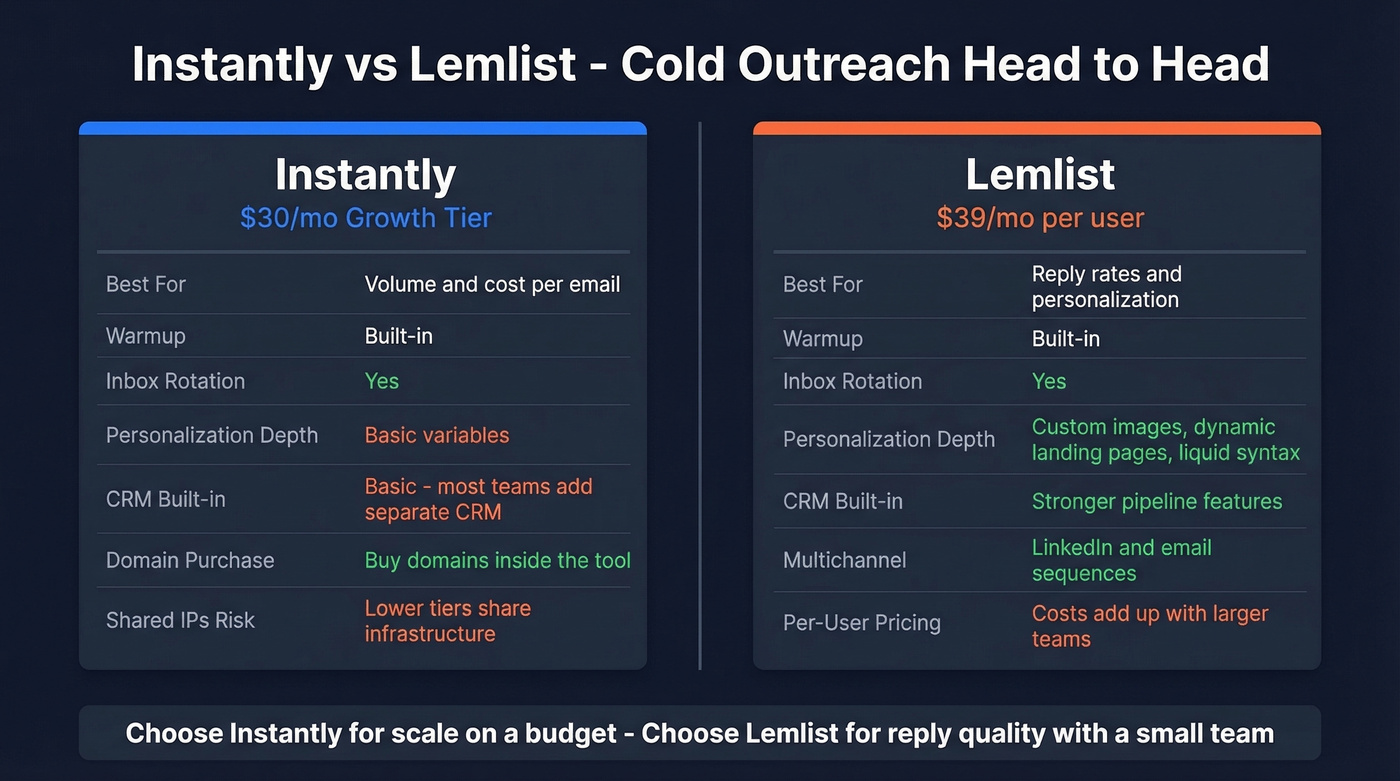
The tradeoff is real, though. Lower-tier plans use shared sending infrastructure, which means your deliverability is partially at the mercy of other users on the same IPs. Integrations and CRM features cost extra - the base plan is lean. We've seen teams start on Instantly for the price, then layer on a separate CRM because the built-in pipeline management is basic.
Use Instantly if you're optimizing for volume and cost per email sent. Skip it if you need multichannel sequences from day one.
Lemlist
Here's who should stop reading and just buy Lemlist: a 2-5 person outbound squad that cares about reply rates over raw volume. Custom images, dynamic landing pages, and liquid syntax variables that go beyond {{first_name}} - the personalization depth is unmatched in this category.
Lemlist starts at ~$39/mo per user. Multichannel sequences are available on higher tiers. The per-user pricing stings for larger teams - a 10-person SDR team is looking at $390/mo before you add any data tools. But for smaller teams where reply quality matters more than send volume, Lemlist consistently outperforms cheaper alternatives in our experience.
GMass
GMass lives inside Gmail, which makes it the simplest cold email tool for individuals and tiny teams. Standard plans run $29.95/mo or $20/mo billed annually. GMass raised prices in January 2026 - Standard jumped from $25 to $29.95 monthly. SMTP usage is free for the first 10,000 emails, then $5 per 10,000 after that.
It's not built for team workflows or complex sequences. But if you're a solo founder or freelancer who lives in Gmail and wants to send 500 personalized emails without learning a new platform, GMass is hard to beat.
Smartlead
Smartlead runs ~$39/mo and is particularly strong for agencies managing multiple client inboxes from one dashboard. The interface isn't as polished as Lemlist, but the infrastructure is solid and the pricing is straightforward.
Others Worth Knowing
Apollo (~$49/mo per user) combines a strong contact database with built-in email sequences, but deliverability is inconsistent - the database is the real value, not the sending engine. Saleshandy (~$25/mo) offers unlimited email accounts on higher tiers, making it a budget play for teams scaling sender infrastructure. Smartreach.io (~$29/mo per user) stands out for timezone-based sending optimization. Reply (~$49/mo) rounds out the category with solid multichannel sequencing if you want email plus calls plus social in one workflow.
The Missing Data Layer
Every tool above sends emails. None of them tell you whether the addresses you're emailing are real.
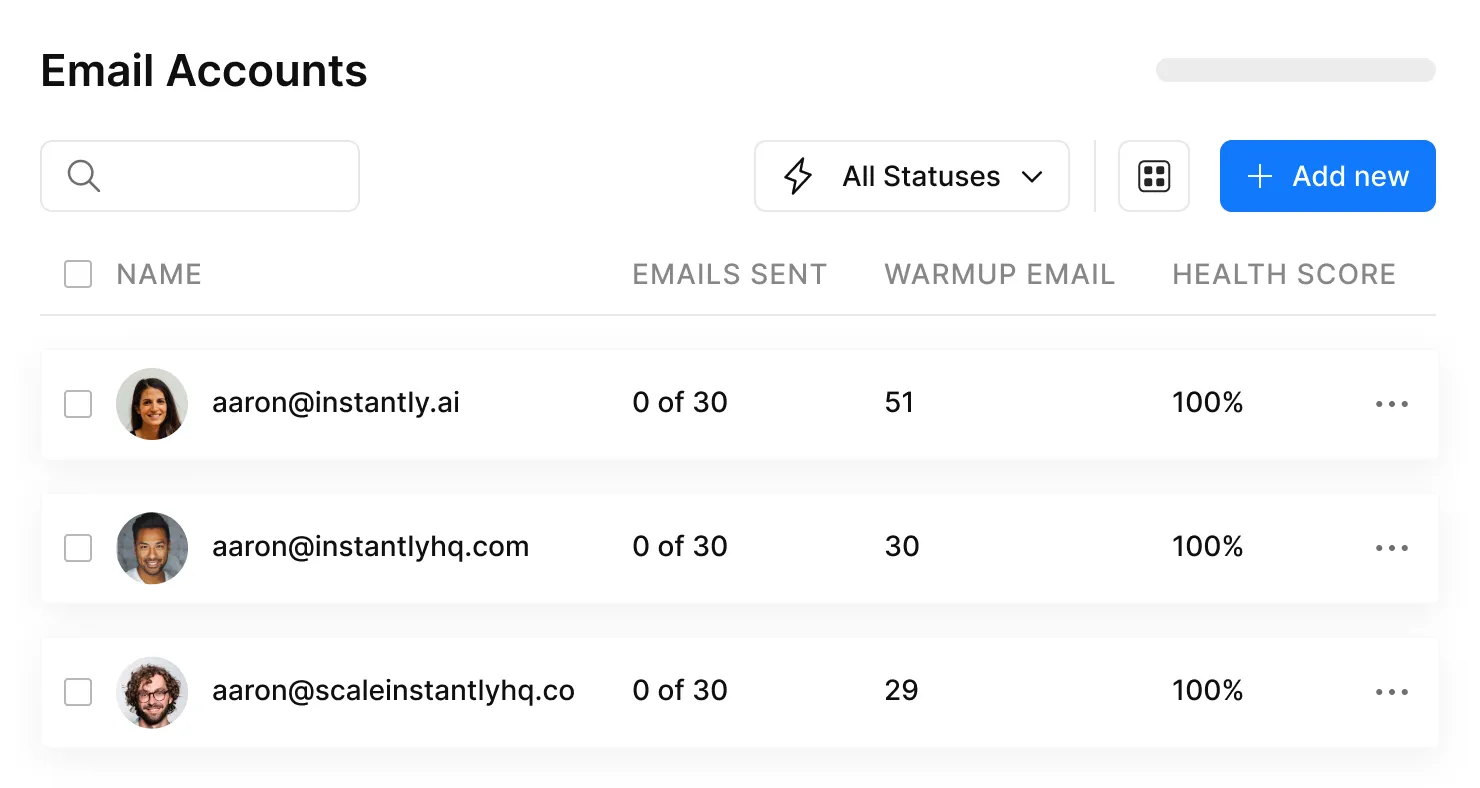
The free tier gives you 75 verified emails and 100 Chrome extension credits per month. Paid plans start at roughly $39/mo with no annual contracts. Native integrations with Instantly, Lemlist, Smartlead, HubSpot, and Salesforce mean verified contacts flow directly into your sending platform without CSV gymnastics.
The proof point: Stack Optimize built to $1M ARR using Prospeo as their data layer, maintaining 94%+ client deliverability, bounce rates under 3%, and zero domain flags across all clients. That's what clean data does for your sending reputation.
Use Prospeo if your bounce rates are above 3% or you're scaling outbound campaigns. Skip it if you're sending to a small, manually curated list you've already verified by hand.
One in four B2B emails misses the inbox on Outlook - and bad addresses make it worse. Prospeo refreshes 300M+ profiles every 7 days, so the contacts you load into Instantly, Lemlist, or Brevo are current, verified, and safe to send to. Bounce rates under 4% across 15,000+ teams.
Stop blaming your sending platform for a data problem.
Developer & Salesforce Tools
Amazon SES
Amazon SES costs $0.10 per 1,000 emails. A dedicated IP adds $15/mo. If you're already running EC2 instances, the first 62,000 emails per month are free. That's the cheapest per-email cost in this entire article - by a wide margin.
The catch: there's no UI. No template editor, no analytics dashboard, no warmup features. You're getting raw SMTP infrastructure and an API. SES is for engineering teams that want to build their own sending layer or plug into an existing application. If you need to ask "how do I design an email in SES," this isn't the right tool.
Mailtrap
Mailtrap offers a free tier at 4,000 emails per month, with paid plans starting at $15/mo (Basic) and $85/mo (Business). The standout feature is separate sending streams, so different types of email don't share the same reputation. Analytics are solid for a developer-focused tool.
Others Worth Knowing
Postmark has paid plans from $15/mo for 10,000 emails - it's laser-focused on transactional email. Mailjet starts at $17/mo for 15,000 emails and includes a collaborative template editor useful for teams where marketing and engineering both touch email templates.
MassMailer (Salesforce-Native)
MassMailer is the tool you consider when you're locked into Salesforce and need to send bulk email without leaving the platform. But the real cost will surprise you.
The volume plan starts at $219/mo for 10,000 emails. Add a Full Access user license at $49.99/mo. Add the required Read Only Access license at $12.49/mo. Add the one-time IP warmup fee of $297. Your true first-month cost for a single user: roughly $578. Tack on the onboarding package (starts at $297) and you're approaching $875.
It carries a 4.6/5 on Capterra from 33 reviews, and the Salesforce integration is genuinely deep. But this is a "hidden costs" cautionary tale - the sticker price and the actual price are very different animals.
Pricing Comparison
| Tool | Category | Free Plan? | Starting Price | Key Limit |
|---|---|---|---|---|
| Brevo | Marketing | Yes (300/day) | $9/mo | Transactional = add-on |
| MailerLite | Marketing | Yes (1K subs) | $10/mo | Feature gates on free |
| Mailchimp | Marketing | Yes | ~$13/mo | Scales aggressively |
| ActiveCampaign | Marketing | No (14-day trial) | $15/mo | Per-contact pricing |
| Instantly | Cold outreach | No | ~$30/mo | CRM costs extra |
| Lemlist | Cold outreach | No | ~$39/mo/user | Per-seat adds up |
| GMass | Cold outreach | No | $29.95/mo | Gmail only |
| Smartlead | Cold outreach | No | ~$39/mo | UI less polished |
| Amazon SES | Developer/API | Yes (62K w/ EC2) | $0.10/1K emails | No UI at all |
| Mailtrap | Developer/API | Yes (4K/mo) | $15/mo | Dev-focused |
| MassMailer | Salesforce | No | ~$578 first month | Multi-part pricing |
Mistakes That Kill Deliverability
If you've ever watched your open rates crater after scaling a campaign, the problem probably isn't your subject line. It's your list quality.
I'll say something that might annoy the data vendors: if your average deal size is under five figures, you probably don't need a $15k/year data platform. But you absolutely need verified emails. A $39/mo verification tool will protect your domain reputation better than an enterprise data suite with 87% accuracy.
Here are the mistakes we see repeatedly:
- Emailing stale lists - addresses go bad at roughly 2-3% per month. A list you haven't cleaned in six months has 15%+ dead addresses dragging your reputation down
- Buying contact lists - purchased lists are loaded with spam traps and honeypots. One bad send can flag your domain for months (and if it happens, you’ll want a spam trap removal plan)
- Unsegmented blasts - sending the same message to your entire database tanks engagement metrics, which ISPs use to decide if you're spam
- Using no-reply addresses - replies are a positive engagement signal. Blocking them tells mailbox providers nobody wants your email
- Skipping deliverability monitoring - if you aren't checking Google Postmaster Tools or your platform's bounce/complaint dashboards weekly, you're flying blind (use email reputation tools to spot issues early)
The cost of bad data compounds. Bounces damage your sender reputation. A damaged reputation routes future emails to spam. Spam placement kills engagement. Low engagement further damages reputation. It's a death spiral, and it starts with a single unverified list. No mass email service can outrun a poisoned contact database.
How to Choose
Four questions will get you to the right answer.
What are you sending? Marketing emails to opted-in subscribers point you toward Brevo or MailerLite. Cold outreach to prospects means Instantly or Lemlist. Transactional emails from your app call for Amazon SES or Postmark. Don't cross the streams.
What's your volume? Under 10,000 emails per month, free tiers from Brevo or MailerLite will cover you. For cold outreach, even 1,000 emails per month justifies a paid tool because deliverability infrastructure matters more than volume (see email velocity limits before you scale).
What's your budget? A solo founder can get started for $0 with Brevo's free plan and a free verification tier. A 5-person SDR team running Lemlist is looking at ~$195/mo. A Salesforce-locked enterprise team on MassMailer could easily spend $500+/mo.
How technical is your team? If nobody on your team can configure DNS records, skip Amazon SES and Mailtrap. Stick with platforms that handle authentication automatically. Regardless of which mass email tool you pick, start with a free tier before committing to an annual contract. Most tools on this list offer one - use it.
FAQ
What's the difference between a mass email tool and a cold email tool?
Marketing platforms like Brevo and Mailchimp are built for opted-in subscribers - newsletters, promotions, transactional emails. Cold email tools like Instantly and Lemlist are built for outbound prospecting to people who haven't opted in, with inbox rotation, warmup, and throttled sending to protect deliverability. Using a marketing platform for cold outreach will get your account banned.
How many emails can I send for free?
Brevo offers 300 emails per day free (~9,000/month). MailerLite gives 12,000 emails per month to 1,000 subscribers. Mailtrap provides 4,000 per month. Amazon SES includes 62,000 free with EC2.
What's a good inbox placement rate?
SMTP delivery rates above 95% are standard, but that metric is misleading. Actual inbox placement - emails landing in the primary inbox, not spam - averages only 60% across all senders. Aim for 85%+ by maintaining authentication (SPF, DKIM, DMARC), verifying your list before sending, and keeping spam complaints under 0.1%.
Do I need a dedicated IP for bulk sends?
Only if you send 50,000+ emails per month consistently. Below that volume, a shared IP from a reputable provider performs fine. Dedicated IPs require warmup - expect 4-6 weeks before reaching full sending capacity. Jumping to full volume on a cold dedicated IP is worse than staying on shared infrastructure.
How do I avoid the spam folder when sending mass emails?
Authenticate your domain (SPF, DKIM, DMARC), verify your contact list before sending, keep spam complaints under 0.1%, include a one-click unsubscribe header, segment your audience, and never use purchased lists. Verifying emails at 98% accuracy before they enter your sending platform eliminates the bounces and spam traps that destroy sender reputation. This single step matters more than any feature your bulk email sending software offers.