

MEDDIC Qualification: The Playbook Your Pipeline Actually Needs
It's week three of the quarter. You're in the pipeline review, and a rep is walking through a "qualified" deal. The MEDDIC fields in Salesforce are filled in - technically. Metrics says "ROI." Champion says "VP of Ops." Economic Buyer says "TBD." Everyone in the room knows this deal isn't qualified. Nobody says it out loud.
This is what happens when MEDDIC qualification becomes what one r/sales thread called it: "a CRM exercise disguised as a sales methodology." Reps fill fields to survive pipeline reviews. Managers check boxes to survive QBRs. The framework that was supposed to create deal clarity creates paperwork instead.
The fix isn't abandoning the framework. It's implementing it with teeth.
The Short Version
MEDDIC works for complex B2B deals over $50K with 90+ day cycles and multiple stakeholders. The framework is free - the ROI comes from scoring deals (not just defining fields), stage-gating your pipeline, and holding reps accountable to qualification criteria. Below: the scorecard, CRM blueprint, question bank, and failure modes that turn MEDDIC from a checkbox exercise into a deal-closing system.
What Is MEDDIC and Where Did It Come From?
MEDDIC was created at PTC in 1996, credited to Dick Dunkel, and later documented and scaled internally with leaders like Jack Napoli. It helped PTC grow from about $300M to $1B in revenue. The methodology survived because it maps to how enterprise deals actually get bought - not how sellers wish they'd get bought.
| Element | What It Means | Why It Matters |
|---|---|---|
| Metrics | Quantifiable outcomes the buyer expects | No metrics = no business case = no urgency |
| Economic Buyer | The person who can say yes and write the check | Miss the EB and your close probability drops below 50% |
| Decision Criteria | How the buyer will evaluate solutions | Miss these and you're pitching blind |
| Decision Process | Steps, timeline, and approvals to close | Deals die in processes you didn't map |
| Identify Pain | The business problem driving the initiative | No pain = no change = no deal |
| Champion | Your internal advocate who'll spend political capital | Not someone who likes your product - someone who'll fight for it |
Here's the insight most people miss: these elements aren't a checklist you complete once. They're continuously validated throughout the deal. Your champion can go quiet. The economic buyer can change after a reorg. Decision criteria shift after a board meeting nobody told you about. This is a living qualification process, not a snapshot.
Teams using structured frameworks like MEDDIC see 20-30% higher close rates compared to unstructured approaches. Not surprising - the process forces you to confront what you don't know about a deal instead of hoping it'll work out.
MEDDIC vs MEDDICC vs MEDDPICC
The alphabet soup gets confusing. Let's simplify it.
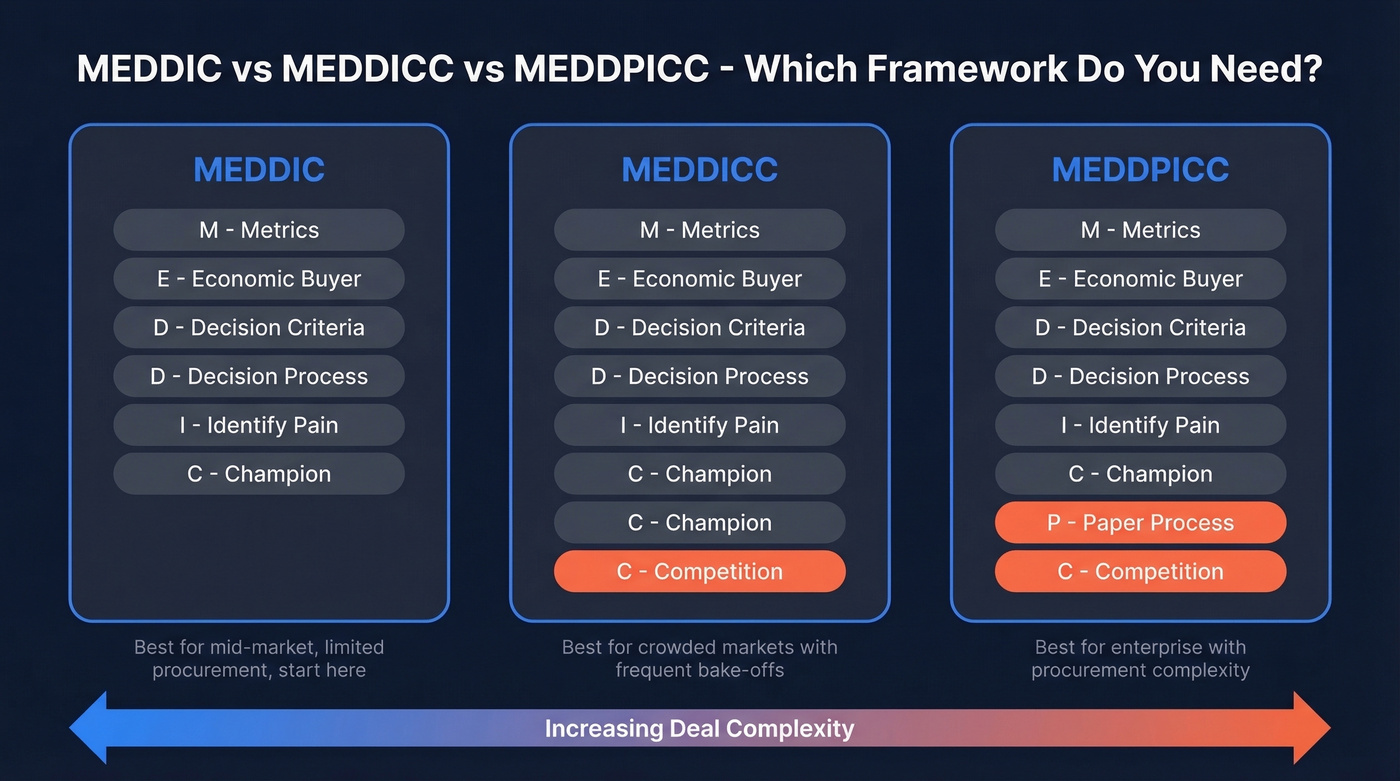
| Variant | Components | Best For | When to Upgrade |
|---|---|---|---|
| MEDDIC | 6 elements (original) | Mid-market, limited procurement | Start here |
| MEDDICC | + Competition | Crowded markets, frequent bake-offs | You're losing deals to competitors you didn't see coming |
| MEDDPICC | + Paper Process + Competition | Enterprise with procurement complexity | Legal/procurement kills your timeline |
73% of SaaS companies selling above $100K ARR use some version of the MEDDICC framework, and organizations that fully adopt it report 18% higher win rates and 24% larger deal sizes. Adoption doubled from 11% to 21% between 2021 and 2022, and it's kept climbing since.
Don't over-engineer this on day one. Start with the original six elements. Add Competition when you're consistently losing deals to vendors you didn't know were in the evaluation. Add Paper Process when procurement delays start killing your quarter - like the $200K deal that dies because the CFO has a three-bid policy nobody mentioned until week 11.
Building a MEDDIC Scorecard
This section separates real implementation from checkbox theater. A MEDDIC field without a scoring rubric is just a text box.
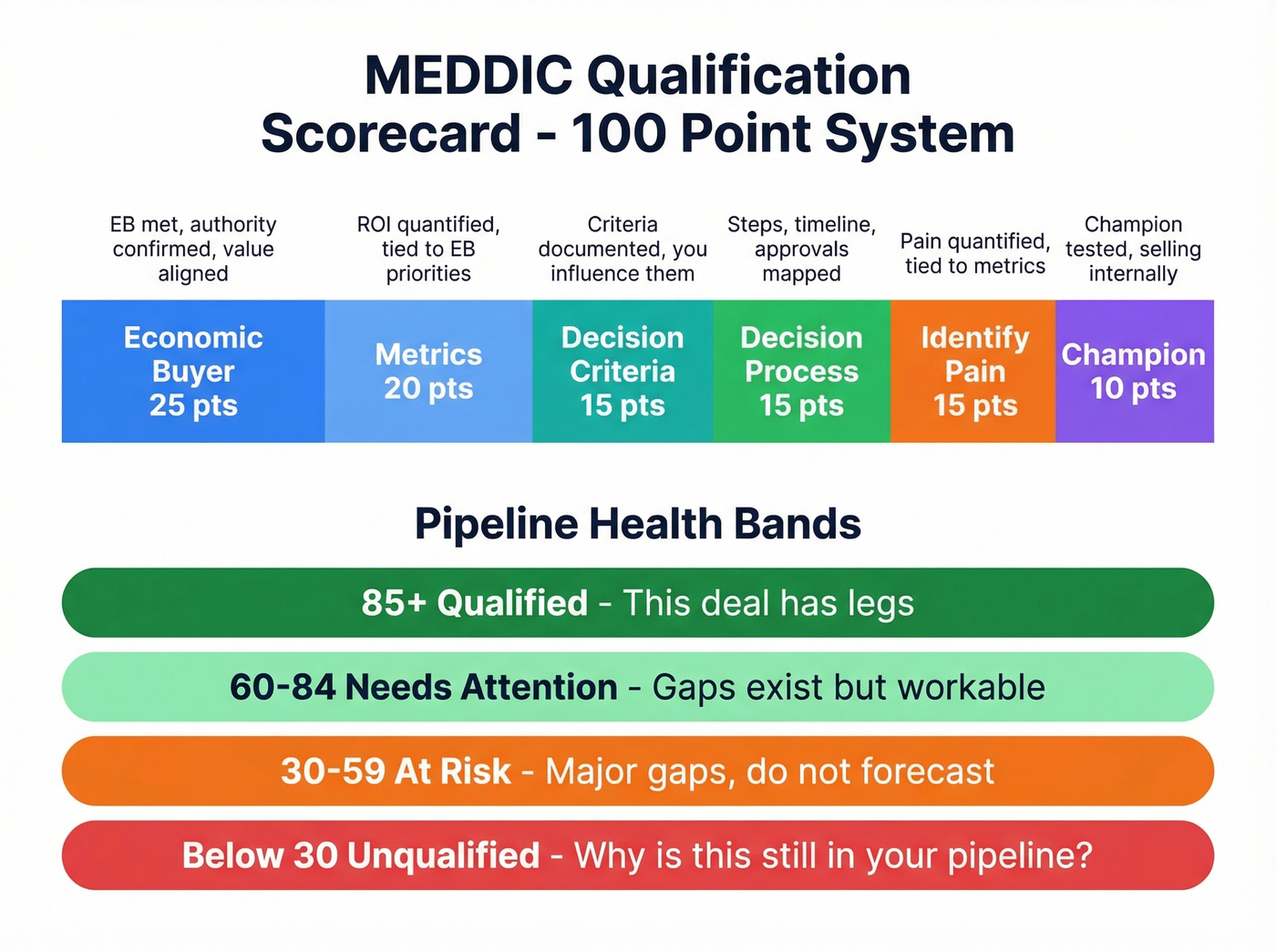
The DemandFarm model uses a 100-point weighted system that we've found works well in practice:
| Element | Weight | Score Range | Full Marks |
|---|---|---|---|
| Economic Buyer | 25 pts | 0-25 | EB met, authority confirmed, value aligned |
| Metrics | 20 pts | 0-20 | ROI quantified, tied to EB priorities |
| Decision Criteria | 15 pts | 0-15 | Criteria documented, you influence them |
| Decision Process | 15 pts | 0-15 | Steps, timeline, approvals mapped |
| Identify Pain | 15 pts | 0-15 | Pain quantified, tied to metrics |
| Champion | 10 pts | 0-10 | Champion tested, selling internally |
Layer on health bands so every deal gets a color in your pipeline:
- 85+ (Dark Green) - Qualified. This deal has legs.
- 60-84 (Light Green) - Needs attention. Gaps exist but they're workable.
- 30-59 (Orange) - At risk. Major qualification gaps. Don't forecast this.
- Below 30 (Red) - Unqualified. Why is this still in your pipeline?
Ebsta uses a 1-10 scoring model with similar color bands across MEDDPICC's eight criteria, giving reps a visual at-a-glance view inside Salesforce.
The stage gates are what make this enforceable. Don't advance a deal to Proposal without 60% completion. Don't let it reach Negotiation without 80%. These aren't suggestions - they're hard gates in your CRM. Without them, reps will push unqualified deals forward because optimism is a hell of a drug.

A perfect MEDDIC score means nothing if you can't reach the Economic Buyer. Prospeo gives you 98% accurate emails and 125M+ verified mobile numbers so your champion mapping turns into actual conversations - not bounced emails that tank your domain.
Stop qualifying deals you can't even contact. Start with real data.
Discovery Questions That Drive Qualification
The scorecard tells you what to measure. These questions tell you how to uncover the answers. Qualifying leads with MEDDIC means asking the right questions at the right time - not running through a script like a deposition.
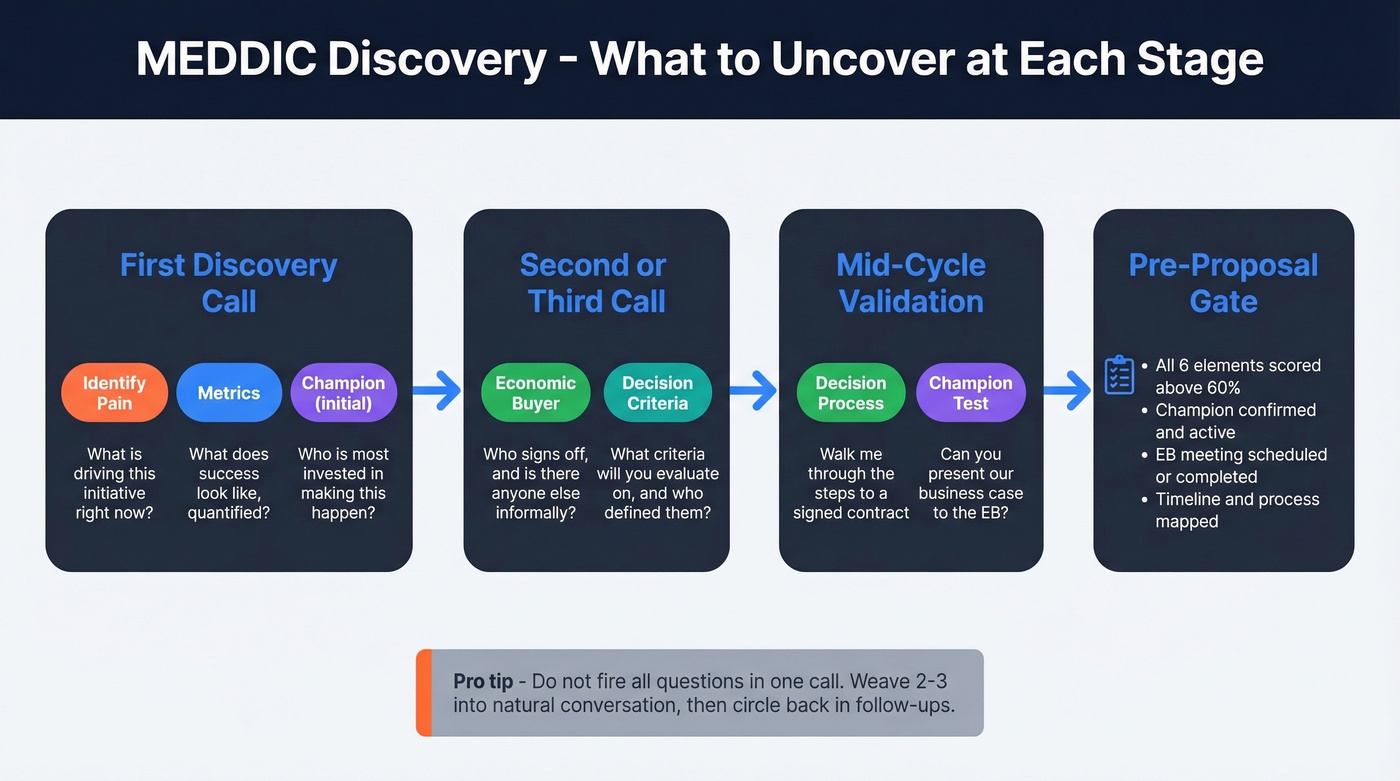
Metrics
- What does success look like for this initiative, quantified?
- Which KPIs do you use to measure the health of this department or process?
- How much are you currently spending trying to solve this problem?
- What's the cost of doing nothing for another 6 months?
Segment your metrics discovery into "below the line" (cost savings, efficiency gains) and "above the line" (revenue growth, time-to-market, customer satisfaction). Economic buyers care about above-the-line metrics. Managers care about below-the-line. You need both.
Economic Buyer
- Who's responsible for the final sign-off on this investment?
- If you and I come to an agreement, is there anybody else - formally or informally - who'd need to approve?
- What's their biggest priority this quarter, and how does this initiative connect?
- Have they killed similar initiatives before? What was the reason?
That second question is the single most important validation question in the entire MEDDIC process. It surfaces hidden stakeholders before they surface themselves at the worst possible moment - like the procurement VP who shows up in week 10 asking for a competitive bid you didn't plan for.
Decision Criteria
- What criteria will you use to evaluate solutions, and how are they weighted?
- Who defined these criteria, and are they final?
- Are there technical requirements that would disqualify a vendor?
- How does your team typically evaluate build vs. buy?
Decision Process
- Walk me through the steps from "we like this" to signed contract.
- Is there a procurement or legal review? How long does that typically take?
- Have you purchased anything in this price range recently? What did that process look like?
- What could delay or derail this timeline?
Identify Pain
- What's driving this initiative right now - why not six months ago?
- What happens to your team if this problem doesn't get solved?
- Have you tried to solve this before? What happened?
- If you could fix one thing about your current process tomorrow, what would it be?
Champion
- Who on your team is most invested in making this happen?
- Would they be willing to present our business case to the economic buyer?
- What do they personally gain if this initiative succeeds?
- Can they get us access to the people we haven't met yet?
A good discovery call doesn't fire these questions in sequence. The best reps weave two or three into a natural conversation, then circle back in follow-up calls. If you're asking all 24 questions in a single meeting, you're interrogating, not qualifying.
And a reminder that keeps coming up on r/sales: a champion isn't someone who likes your product. It's someone who'll spend political capital to get it bought. If your "champion" won't make an introduction to the economic buyer, they're a coach at best and a friendly dead end at worst. Test them. Ask for something small - an internal introduction, a copy of the evaluation criteria, a meeting with procurement. Their response tells you everything.
CRM Implementation Blueprint
The framework lives or dies in your CRM. Here's the Salesforce field schema that works:
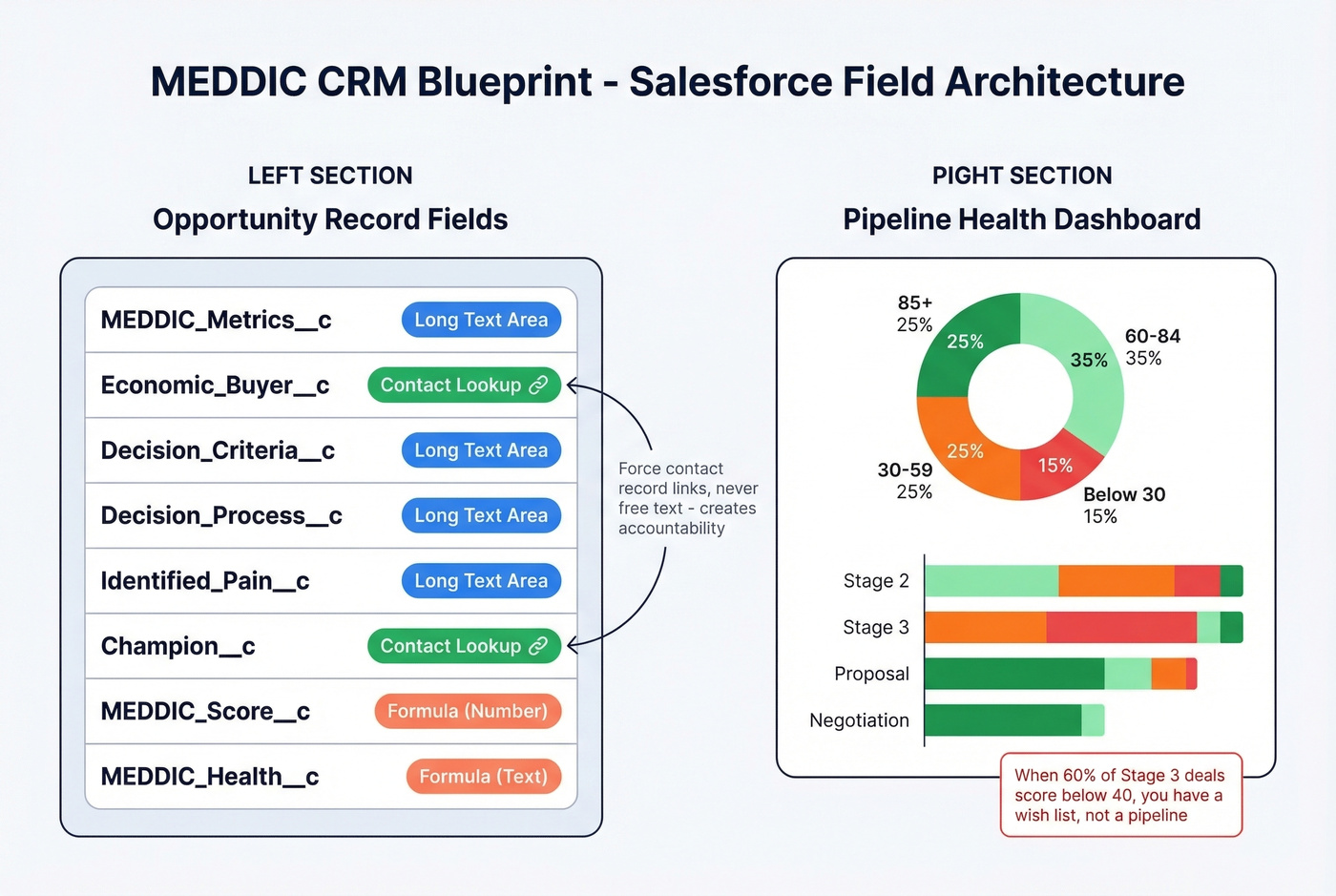
MEDDIC_Metrics__c          → Long Text Area
Economic_Buyer__c          → Contact Lookup
Decision_Criteria__c       → Long Text Area
Decision_Process__c        → Long Text Area
Identified_Pain__c         → Long Text Area
Champion__c                → Contact Lookup
MEDDIC_Score__c            → Formula (Number)   -   auto-calculated
MEDDIC_Health__c           → Formula (Text)   -   returns health band
The Contact Lookup fields for Economic Buyer and Champion are critical. Don't let reps type a name into a text field - force them to link an actual contact record. This creates accountability and makes your multi-threading reports useful. Before running deals through your scorecard, enrich your opportunity contacts with Prospeo's CRM enrichment, which returns 50+ data points per contact and brings back data for 83% of leads - so your Economic Buyer and Champion fields link to complete, current records instead of stale placeholders.
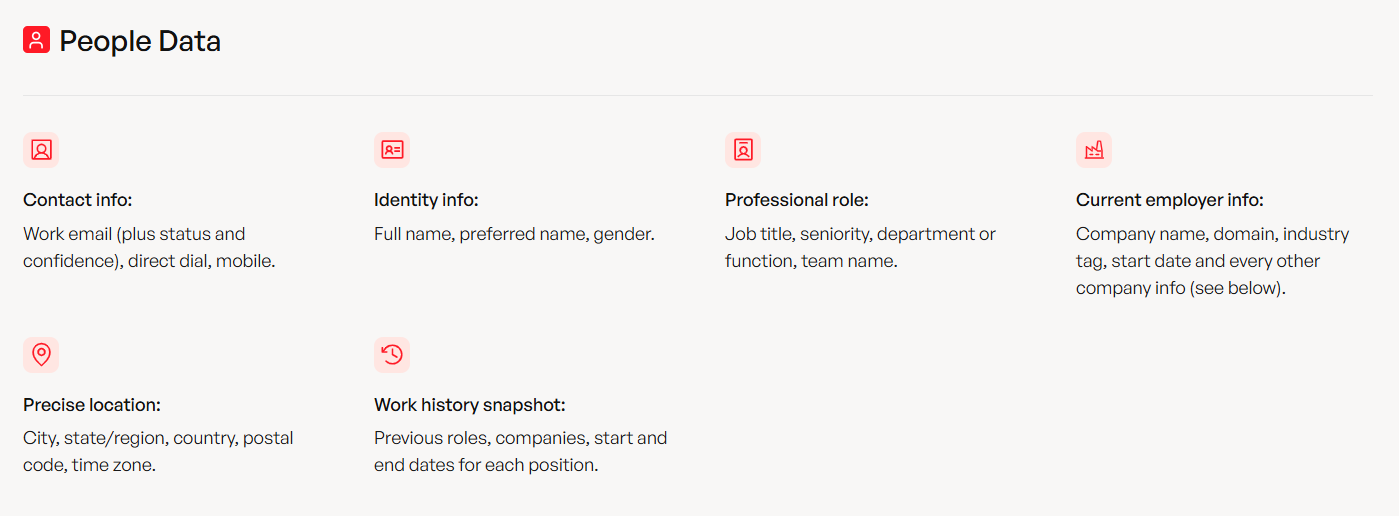
Build a dashboard that shows score distribution across your pipeline. When 60% of deals in Stage 3 are scoring below 40, you don't have a pipeline - you have a wish list.
Now the failure timeline we've watched play out repeatedly. Month 3, completion rates are low and managers start nagging. Month 6, reps game the system with "TBD" and "In Progress" in every field. Month 12, leadership quietly stops enforcing it. The antidote is coaching, not compliance. Weekly deal reviews where managers ask "tell me about your champion" instead of "did you fill in the champion field" are what keep the process alive.
When to Use MEDDIC (and When Not To)
Skip this framework entirely if your deals are small and fast.
| Framework | Best For | Deal Size | Cycle Length |
|---|---|---|---|
| BANT | SMB, transactional | Under $10K | Under 30 days |
| SPICED | SaaS, PLG motions | $10K-$50K | 30-90 days |
| MEDDIC | Enterprise, complex | $50K+ | 90+ days |
| SPIN | Consultative selling | Varies | Varies |
If your deal is under $10K with a single decision-maker, MEDDIC is overkill. You'll spend more time qualifying than closing. BANT gets you there faster.
Here's our honest take: if your average contract value is under $25K, you probably don't need this level of rigor at all. The framework's ROI comes from preventing six-figure deals from dying in the dark. On smaller deals, the qualification overhead eats into the very efficiency you're trying to create. For SaaS companies with product-led growth motions, SPICED maps better to how those buyers move - they've already used the product and don't need you to "identify pain" because they've felt it firsthand.
For enterprise deals, we'd rank it: MEDDIC > Challenger > SPIN > BANT.
Common Failure Modes
The framework itself is sound. Implementation is where things break.
Checkbox syndrome. Reps fill fields instead of thinking about deals. The qualification section becomes a compliance exercise - "I wrote something in every box, so I'm qualified." If your reps can fill in MEDDIC fields in under two minutes, they're not qualifying. They're typing. One r/sales commenter nailed it: "My team treats MEDDIC like a tax they pay to keep deals in the pipeline."
No scoring rubric. "VP of Finance" in the Economic Buyer field tells you nothing about whether you've met them, confirmed their authority, or aligned on value. The 100-point model above exists for exactly this reason.
No stage gates. A deal in Negotiation with a score of 35 is a deal that's about to slip - or worse, close-lose after you've invested weeks of solution engineering time.
Universal application. Forcing MEDDIC on $5K transactional deals is how you make reps hate the framework. Training programs often run $100K-$500K for enterprise rollouts, but the framework itself is free. The cost is in the discipline, not the methodology.
No reinforcement. A two-day training followed by zero coaching cadence produces the Month 3 decay timeline every time. Training without weekly deal coaching is a donation to your enablement vendor. The consensus across sales communities is that champion testing is the most underused skill - and it's the first thing that atrophies without reinforcement.
The Upstream Data Problem
Nobody covers this failure mode in training: you've identified the Economic Buyer, you know exactly who needs to approve the deal, and you can't reach them because their email bounces. They changed roles six months ago and your database hasn't caught up.
MEDDIC qualification requires reaching specific people - the Economic Buyer, the Champion, the three to five stakeholders you need to multi-thread across the account. If one in five outreach attempts bounces, qualification fails before it starts. Prospeo's email finder covers 300M+ professional profiles with 98% email accuracy and a 7-day data refresh cycle, so when you need the direct email for a CFO who just moved companies last quarter, your outreach actually lands.
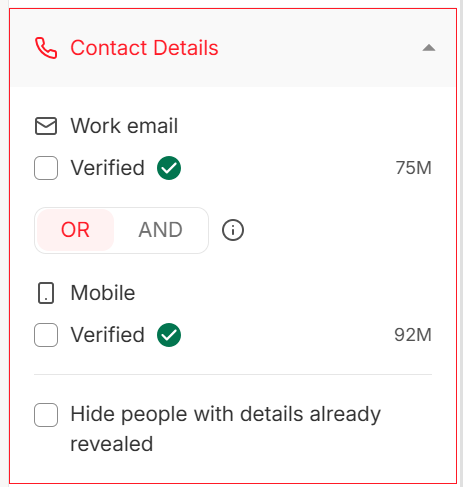
Multi-threading is the other angle. You're not just reaching one person per deal - you need verified contact data for every stakeholder in the decision process. That's the difference between a qualified deal and a single-threaded one that dies when your champion goes on vacation.
Stage gates enforce qualification rigor - but only if your CRM data is current. Prospeo refreshes 300M+ profiles every 7 days, so the decision-makers and champions in your pipeline are always reachable, not stale records from last quarter's org chart.
Deals die when contacts go dark. Keep your pipeline data alive.
FAQ
What does MEDDIC stand for?
Metrics, Economic Buyer, Decision Criteria, Decision Process, Identify Pain, and Champion. Created at PTC in 1996 by Dick Dunkel and scaled with leaders like Jack Napoli, it's credited with growing PTC's revenue from ~$300M to $1B and remains the most widely adopted enterprise sales qualification methodology.
What's the difference between MEDDIC, MEDDICC, and MEDDPICC?
MEDDICC adds Competition to the original six elements; MEDDPICC adds both Paper Process and Competition. Start with MEDDIC for most enterprise deals. Upgrade to MEDDICC when you're losing to vendors you didn't anticipate, and to MEDDPICC when procurement delays - typically in deals above $100K with formal bid processes - start killing your forecast.
Is MEDDIC qualification still relevant in 2026?
More relevant than ever. 73% of SaaS companies selling above $100K ARR use a MEDDIC variant. Adoption keeps growing as buying committees expand, deal complexity increases, and CFOs scrutinize every purchase more closely.
How do I score a MEDDIC-qualified deal?
Use a 100-point weighted model: Economic Buyer (25 pts), Metrics (20), Decision Criteria (15), Decision Process (15), Pain (15), Champion (10). Deals at 85+ are fully qualified. 60-84 needs attention. 30-59 is at risk. Below 30 shouldn't be in your forecast.
What tools help with MEDDIC execution?
Your CRM handles scoring and stage gates - Salesforce custom fields and validation rules cover the framework itself. For the upstream data dependency - reaching the Economic Buyer and Champion with accurate contact info - tools like Prospeo ensure your outreach lands with 98% email accuracy and a 7-day refresh cycle, so qualification doesn't stall because of stale data.