

MEDDPICC: The Enterprise Sales Framework That Actually Closes Deals
It's week 3 of the quarter. Your VP asks you to defend your forecast. You pull up your top 10 deals and realize you can't name the Economic Buyer on half of them - and you haven't mapped the procurement process on any of them. That's the moment MEDDPICC stops being a theoretical framework and starts being the thing that saves your pipeline.
54% of sales professionals say closing is harder than it was five years ago. Buying committees have ballooned, procurement cycles have stretched, and the status quo wins more deals than any competitor. This eight-letter qualification framework exists to fight all three problems at once.
The Short Version
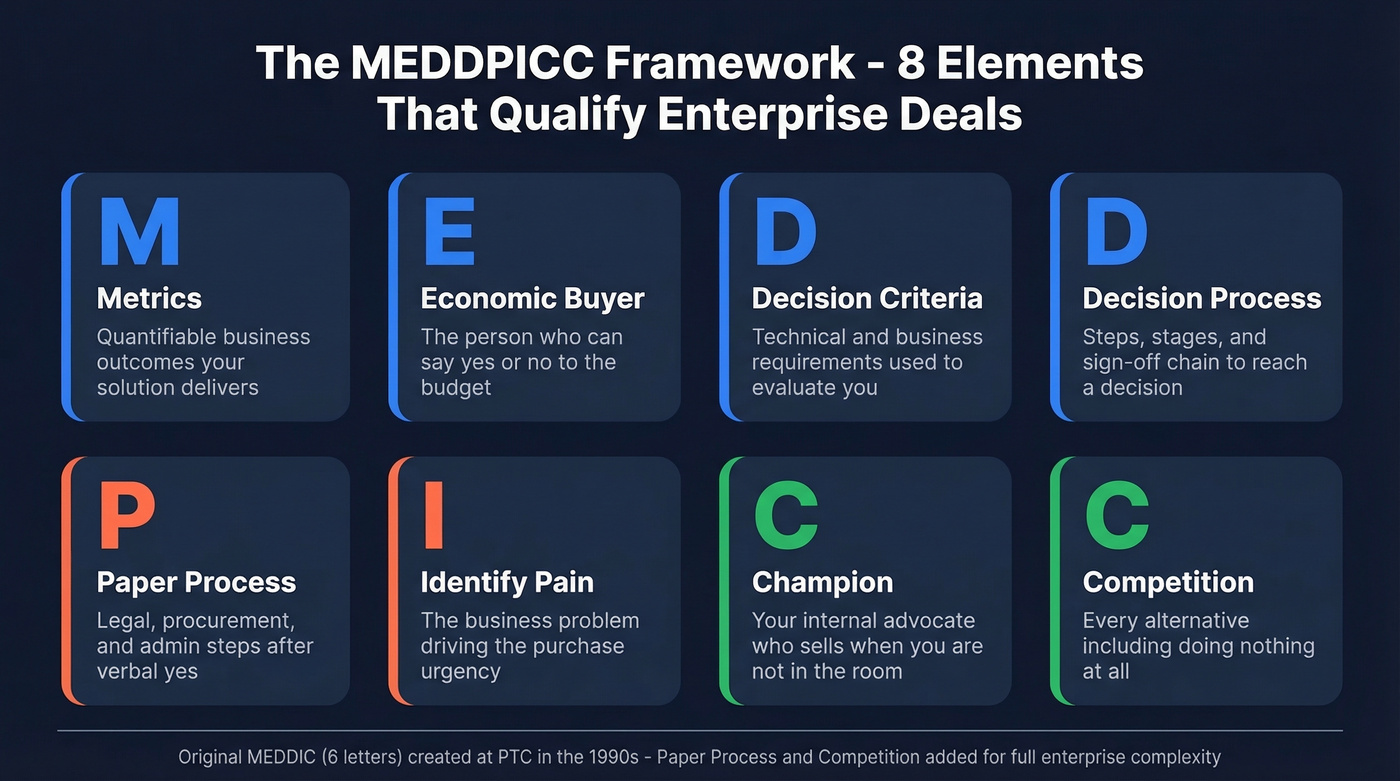
MEDDPICC stands for Metrics, Economic Buyer, Decision Criteria, Decision Process, Paper Process, Identify Pain, Champion, Competition. It's a deal qualification framework, not a selling methodology.
If your deals close in under 60 days with one decision-maker, skip it - use BANT. Most teams only need the full eight-letter version if they sell $50K+ ACV deals with procurement and legal complexity. Simpler deals? MEDDIC (six letters) works fine.
The #1 reason this framework fails isn't the framework itself - it's treating it as a CRM checkbox exercise instead of a diagnostic lens.
What Is MEDDPICC?
Let's clear up the alphabet soup. MEDDPICC is a sales qualification framework that forces you to answer eight critical questions about every deal in your pipeline. If you can't answer them, you shouldn't be forecasting the deal. Often called the MEDDPIC sales methodology in shorthand, it's technically a qualification and forecasting tool - not a methodology that prescribes how to run a sales conversation.
| Letter | Stands For | One-Sentence Definition |
|---|---|---|
| M | Metrics | The quantifiable outcomes your solution delivers |
| E | Economic Buyer | The person who can say yes or no to the budget |
| D | Decision Criteria | What the buyer uses to evaluate solutions |
| D | Decision Process | The steps and timeline to reach a decision |
| P | Paper Process | Legal, procurement, and admin steps to close |
| I | Identify Pain | The business problem driving the purchase |
| C | Champion | Your internal advocate who sells when you're gone |
| C | Competition | Every alternative, including doing nothing |
MEDDIC originated inside Parametric Technology Corporation (PTC) in the 1990s and is widely credited to Dick Dunkel. The goal was simple: create a systematic way to qualify and forecast complex enterprise deals. It worked - PTC grew from $300M to $1B in revenue over four years, becoming one of the most cited enterprise sales execution stories of that era. Darius Lahoutifard later popularized the framework through MEDDIC Academy, bringing it to a much wider audience. (MEDDPICC is also a federally registered trademark of Lahoutifard.)
Now, about the spelling. You'll see MEDDIC, MEDDICC, MEDDPIC, MEDDPICC, and even MEDDPPIC floating around. They're the same core idea with different elements added depending on deal complexity. The original was MEDDIC (six letters). The eight-element version adds Paper Process and Competition. If you Googled "MEDDPPIC" or "MEDPIC sales" to get here, you're in the right place. Everyone misspells it.
This framework doesn't tell you how to sell. It tells you whether a deal is real, whether you can win it, and whether it'll close when you say it will. Think of it as a diagnostic tool, not a playbook.
Why It Matters in 2026
Enterprise selling has gotten objectively harder. Buying committees have expanded from 3-5 stakeholders to 8-12. Sales cycles that used to run three months now stretch to six or nine - especially in cybersecurity, cloud infrastructure, and martech, where procurement and security reviews add weeks to every deal.
And buyers complete roughly 80% of their research before they ever talk to a rep. That stat is the killer. By the time a prospect takes your discovery call, they've already built a mental shortlist, read the G2 reviews, compared pricing pages, and asked their network. You're not educating them - you're being evaluated.
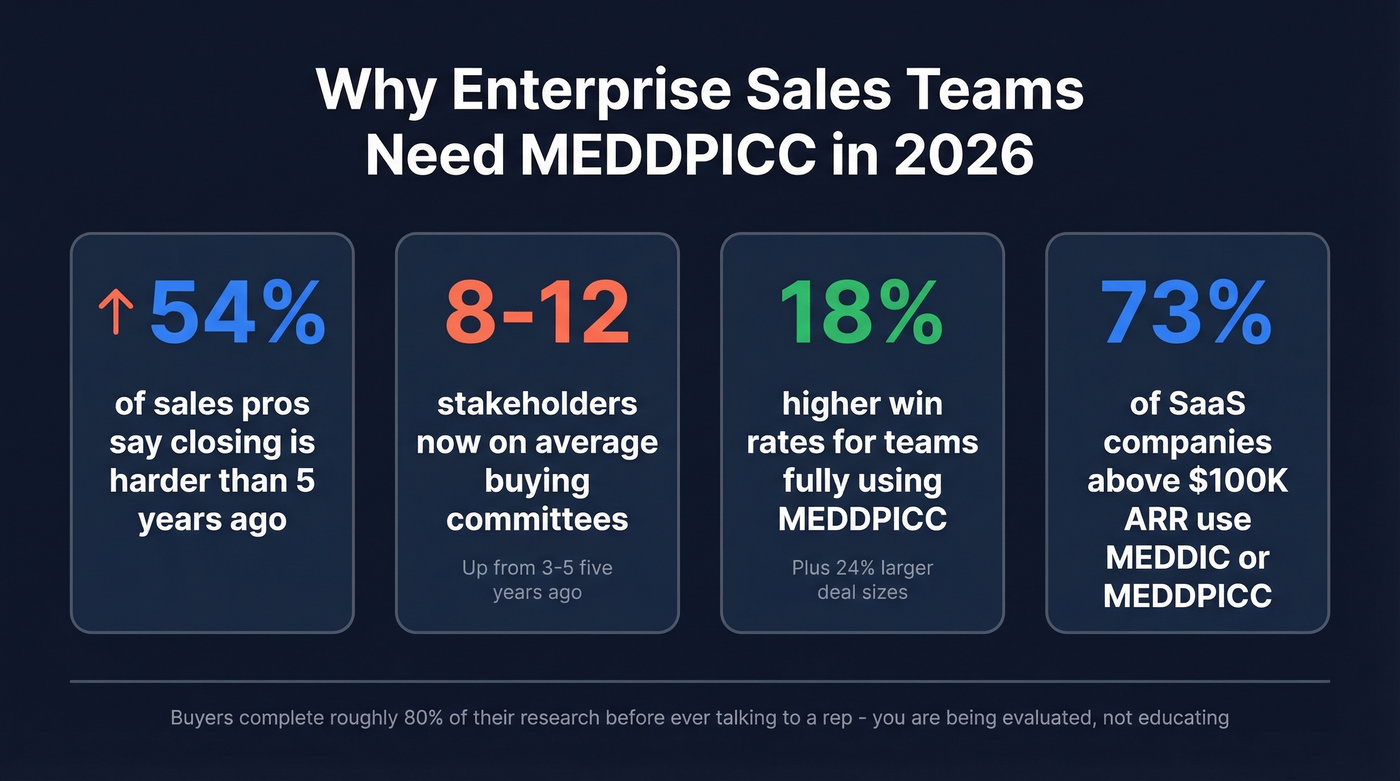
73% of SaaS companies selling above $100K ARR use some version of MEDDIC or MEDDPICC. Teams that fully adopt the framework see 18% higher win rates and 24% larger deal sizes compared to teams using simpler approaches. Those numbers aren't surprising when you think about what the framework actually does: it forces you to confront the gaps in your deal knowledge before the forecast call, not during it.
Here's the thing: this is the best qualification framework for enterprise sales. But if your average deal is under $25K, you probably don't need it - and forcing it on a transactional sales team will actively make them worse. The framework's power comes from matching the complexity of the deal. No complexity, no need.
MEDDIC vs MEDDICC vs MEDDPIC vs MEDDPICC
The variant question comes up constantly. Here's the decision tree.
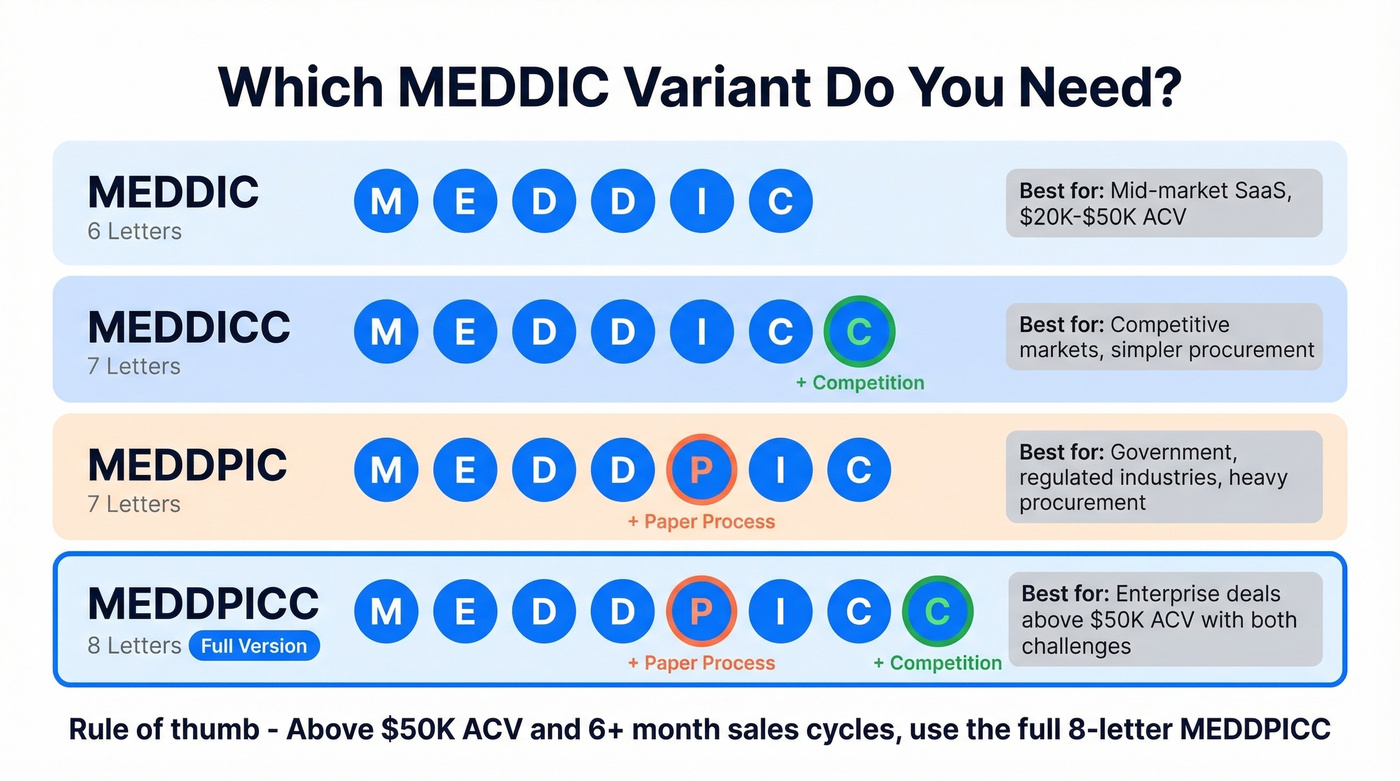
| Variant | Letters | What's Added | Best For |
|---|---|---|---|
| MEDDIC | 6 | Original | Mid-market SaaS, $20K-$50K ACV |
| MEDDICC | 7 | + Competition | Competitive markets, fewer legal hurdles |
| MEDDPIC | 7 | + Paper Process | Government, regulated industries, heavy procurement |
| MEDDPICC | 8 | + Paper Process + Competition | Full enterprise with both challenges |
If your deals regularly involve procurement teams, legal redlines, security questionnaires, or vendor onboarding processes, you need Paper Process. If you're consistently going head-to-head with named competitors or losing to "do nothing," you need Competition.
A reasonable rule of thumb: above $50K ACV and sales cycles longer than six months, go with the full eight-letter version. Below that, MEDDIC gives you 80% of the value with less overhead. Above it, the complete framework pays for itself by catching deal risks you'd otherwise miss in week 11 of a 14-week cycle.
We've seen teams try to skip Paper Process and regret it every time. If your deals involve procurement, legal redlines, or security questionnaires, use the full version. You'll thank yourself when a deal doesn't stall for 60 days because nobody asked about the vendor onboarding process.

MEDDPICC tells you who the Economic Buyer is. Prospeo gets you their verified contact data. Search 300M+ profiles with 30+ filters - including job title, seniority, department headcount, and buyer intent - so you can multi-thread every enterprise deal with 98% accurate emails and direct dials.
Stop qualifying deals you can't actually reach. Start connecting.
The Framework - Letter by Letter
Metrics
Metrics are the quantifiable measures of value your solution delivers. Not features. Not capabilities. The actual business outcomes your buyer cares about - revenue gained, costs reduced, time saved, risk mitigated.
If you can't tie your solution to a number, the Economic Buyer has no reason to prioritize your deal over the 15 other budget requests on their desk. Metrics are the language of executive buy-in.
Smart teams tier their metrics. Company-level metrics like revenue impact and market share resonate with the C-suite. Team-level metrics such as hours saved and error rates reduced matter to the evaluation committee. Leading indicators like pipeline velocity and response time prove early value. Map each metric to the stakeholder who cares about it, and you'll never walk into a meeting speaking the wrong language.
Example calculation: If your prospect's sales team spends 6 hours/week on manual data entry, and you eliminate 4 of those hours across 50 reps, that's 200 hours/week - roughly $520K/year in recovered selling time at a fully loaded cost of $50/hour. That number gets an EB's attention. "We make your team more efficient" does not.
Red flags: The prospect can't quantify the impact. Success metrics are vague. No one's done the math on the cost of inaction.
Economic Buyer
The Economic Buyer is the person who can say no when everyone else says yes - and yes when everyone else says no. They control the budget, and they have the authority to kill or greenlight the deal regardless of what the evaluation committee recommends.
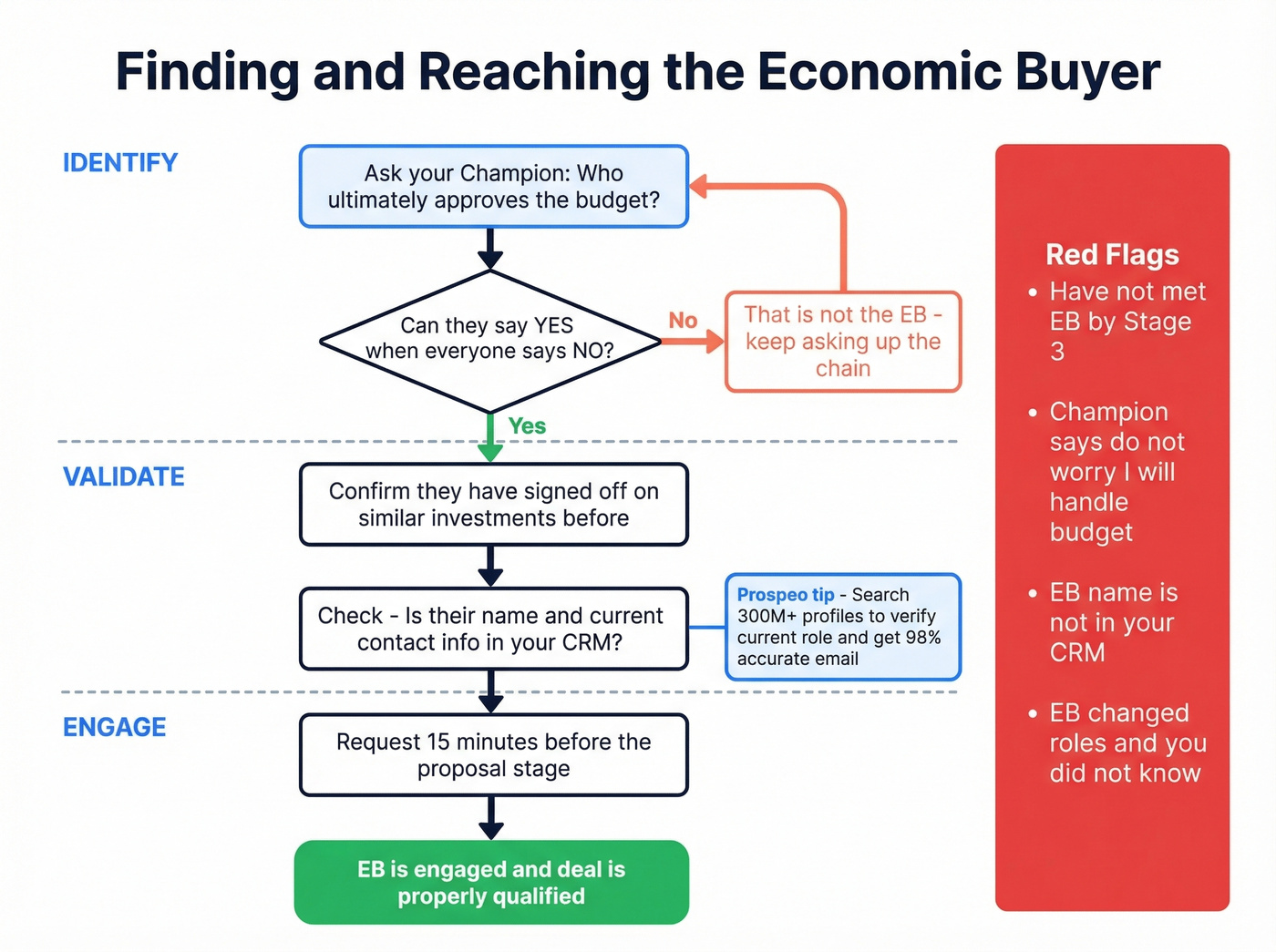
You can win every technical evaluation, impress every end user, and still lose the deal because the EB had different priorities. Identifying the EB is step one. Reaching them is step two.
If your CRM data is stale - contacts who've changed roles, emails that bounce, phone numbers that ring out - you can't get to the people who matter. Prospeo covers 300M+ professional profiles with 98% email accuracy and a 7-day refresh cycle, so you're reaching stakeholders at their current company, not the one they left last quarter.
Discovery questions:
- Who ultimately approves the budget for this initiative?
- Has this person signed off on similar investments before?
- What does the Economic Buyer care about that's different from what your team cares about?
- Can we get 15 minutes with them before the proposal stage?
Red flags: You haven't met the EB by Stage 3. Your Champion says "don't worry, I'll handle the budget conversation." The EB's name isn't in your CRM.
Decision Criteria
Decision Criteria are the specific requirements - technical and business - that the buyer uses to evaluate solutions. These aren't just feature checklists. They include integration requirements, compliance standards, ROI thresholds, implementation timelines, and vendor stability.
If you don't know the criteria, you can't shape them. And if a competitor shaped the criteria before you arrived, you're playing their game.
Discovery questions:
- What are the must-have requirements vs nice-to-haves?
- How are you weighting technical fit vs business outcomes vs price?
- Who defined these criteria, and when were they last updated?
Red flags: The criteria feel like they were written by a competitor. The prospect can't distinguish between must-haves and nice-to-haves. Criteria keep shifting mid-evaluation.
Decision Process
Decision Process maps the timeline, stages, and sign-off chain from "we're evaluating" to "the contract is signed." It's the deal's roadmap - and most reps never ask for it.
You can't forecast a close date if you don't know the buyer's internal process. A deal that "should close this quarter" can slip 90 days because nobody mentioned the board approval step.
Discovery questions:
- Walk me through the steps from today to a signed contract.
- Who needs to sign off at each stage?
- Have you bought software at this price point before? What did that process look like?
- What could delay this timeline?
Red flags: The prospect can't articulate their own buying process. There's no defined timeline. "We'll figure it out as we go" is a yellow flag the size of a billboard.
Paper Process
Paper Process covers everything that happens between "verbal yes" and "signed contract." Legal redlines. Security questionnaires. Vendor onboarding forms. Procurement reviews. MSA negotiations. These steps can add 30-90 days to your deal if you don't front-load them.
This is where enterprise deals go to die. The champion is excited, the EB approved the budget, and then legal sits on the redlines for six weeks. In our experience, Paper Process is the most underrated letter in the entire framework. Start the security questionnaire in week two, not week twelve.
Discovery questions:
- What does your procurement process look like for a purchase at this price point?
- Will legal need to review our terms? How long does that typically take?
- Are there security or compliance questionnaires we should start now?
- Who manages the contracting process on your side?
Red flags: "We'll figure out procurement later." No one can name the procurement contact. The prospect has never bought from a vendor your size before.
Identify Pain
Pain is the business problem driving the purchase - not the technical annoyance, but the problem that costs money, loses customers, or creates risk. Technical pain gets you a meeting. Business pain gets you a budget.
If the pain is aspirational rather than urgent, the deal will stall. "It'd be nice to improve this someday" loses to every other budget request on the EB's desk. "We're bleeding customers and the board is asking questions" gets funded. The distinction sounds obvious, but we've watched experienced reps confuse the two for entire deal cycles.
Discovery questions:
- What happens if you don't solve this problem in the next 6 months?
- How is this impacting revenue, retention, or team productivity today?
- Who else in the organization feels this pain?
Red flags: Pain is aspirational, not urgent. The prospect describes the problem in technical terms but can't connect it to business outcomes. Only one person feels the pain.
Champion
Your Champion is the internal advocate who sells your solution when you're not in the room. They have influence, access to the Economic Buyer, and a personal stake in solving the problem. A Champion isn't just someone who likes you - they're someone who'll spend political capital to get your deal done.
The Champion litmus test - all three must be true:
- Influence. They can change opinions in internal meetings. If they recommend a vendor, people listen.
- Access. They can get you a meeting with the Economic Buyer. Not "maybe eventually" - within a reasonable timeframe.
- Personal stake. Solving this problem makes their career better. They're not helping you out of kindness; they're helping because your win is their win.
If your "champion" fails any of these three tests, you have a coach - someone who gives you information but can't drive action. Coaches are useful. Champions are essential. Know the difference.
Red flags: Your "champion" has no organizational power. They're enthusiastic but junior. They won't make introductions to the EB. They agree with everything you say - that's a coach, not a champion.
Competition
The status quo wins more enterprise deals than any named competitor.
That's the uncomfortable truth most reps ignore when they fill out the Competition field in their CRM. Competition includes every alternative the buyer is considering: named vendors, internal builds, and doing nothing. A thread on r/sales put it well - reps obsess over the competitor they can see and ignore the one they can't, which is the prospect deciding this isn't worth the effort.
Discovery questions:
- What other solutions are you evaluating?
- Have you tried to solve this internally? What happened?
- What would it take for you to decide to do nothing and keep the current process?
Red flags: The prospect says "we're not looking at anyone else." They are. The evaluation criteria suspiciously match a competitor's feature set. The prospect is comparing you on price alone.
MEDDPICC Scorecard Template
Remember that forecast defense scenario from the intro? Here's how the scorecard makes it painless. Score each letter 0-3 for every deal in your pipeline.
| Score | Meaning | Description |
|---|---|---|
| 0 | Unknown | Haven't gathered this info yet |
| 1 | Partially identified | Some data, not confirmed |
| 2 | Confirmed | Validated with the prospect |
| 3 | Validated/tested | Verified through multiple sources |
Now map total scores to deal health:
| Total Score | Health | Forecast Action |
|---|---|---|
| 0-11 | Red | Exclude from commit |
| 12-18 | Yellow | Best case only |
| 19-24 | Green | Include in commit |
The power of this scorecard isn't the numbers - it's the conversation it forces. When your VP asks "why is this deal in commit?", you don't say "the champion told me it's looking good." You say "we've scored 21/24. The only gap is Paper Process - we haven't confirmed the legal review timeline, and I'm scheduling that call Thursday." That's a fundamentally different conversation, and it changes how leadership trusts your pipeline.
Teams that run this exercise on their top 10 deals every week transform their forecast accuracy. The deals that score Red don't magically become Green - but they stop polluting your commit number. That alone is worth the effort.
A half-filled scorecard with genuine insight beats a fully-completed one with guesses. Don't optimize for completion - optimize for accuracy.
Why the Framework Fails (And How to Fix It)
The #1 criticism on r/sales is blunt: it's a CRM exercise disguised as a sales methodology. Reps fill out fields to make managers happy. Managers check boxes to survive pipeline reviews. Nobody actually uses it to sell better.
That criticism is valid when the framework is implemented badly. And most implementations are bad.
MEDDPICC is designed to solve three specific problems: forecast uncertainty, slow rep ramp time, and stalled up-market expansion. When it fails, it's because the implementation targets CRM compliance instead of these outcomes. Here are the three failure modes we see repeatedly:
Checkbox compliance without coaching. Leadership adds eight fields to Salesforce and tells reps to fill them out. No training on why each letter matters. No coaching on how to uncover the information naturally in conversation. Just fields and deadlines.
Memorization without internalization. Reps can recite what each letter stands for but don't use the framework as a diagnostic lens. They treat it as an internal compass in theory and a robotic checklist in practice.
Manager audits instead of coaching conversations. The weekly deal review becomes "did you fill out the Champion field?" instead of "tell me about your Champion - do they have the organizational power to push this through procurement?"
The fix isn't complicated, but it requires discipline:
- Coach to the framework weekly. Every deal review should reference qualification elements, not CRM fields. Ask "who's the Economic Buyer and have you met them?" not "is the EB field populated?"
- Tie scoring to deal reviews, not CRM audits. The scorecard is a coaching tool, not a compliance tool.
- Start with three letters. Don't roll out all eight at once. Start with Pain, Economic Buyer, and Champion for 30 days. Those three alone will improve pipeline quality. Add the rest once the team has internalized the diagnostic mindset.
MEDDPICC vs BANT vs SPIN vs Challenger
| Framework | Best For | Deal Size | Cycle Length | Stakeholders |
|---|---|---|---|---|
| MEDDPICC | Enterprise, complex | $50K+ ACV | 6+ months | 5-12 |
| BANT | Transactional | <$20K | <60 days | 1-3 |
| SPIN Selling | Discovery-heavy | Any | Any | Any |
| Challenger | Commoditized markets | Mid-market+ | 3-6 months | 3-8 |
BANT (Budget, Authority, Need, Timeline) is the right framework when deals are straightforward. One decision-maker, a clear budget, and a short cycle. If your average deal is under $20K and closes in 60 days, an eight-letter qualification framework is overkill.
SPIN Selling (Situation, Problem, Implication, Need-Payoff) is a discovery methodology, not a qualification framework. MEDDIC is rooted in SPIN's principles. You can and should use SPIN inside your qualification process. They're complementary, not competing.
Challenger Sale works best when you're selling into commoditized markets where the buyer thinks all solutions are the same. It's about teaching, tailoring, and taking control of the conversation. Powerful approach, but it doesn't give you the deal qualification rigor that MEDDPICC provides.
For deals involving 5+ stakeholders, $50K+ ACV, and 6+ month cycles, MEDDPICC is the right choice. Everything else is either too simple or too narrow.
How to Implement the Framework
Don't try to roll out all eight letters on day one. That creates exactly the CRM-checkbox problem everyone complains about.
Phase 1 (Days 1-30): Pain + Economic Buyer + Champion. These three letters have the highest impact on deal qualification. Train the team on what good looks like for each one. Run weekly deal reviews focused only on these elements.
Phase 2 (Days 31-60): Add Decision Criteria + Decision Process. Once reps are naturally uncovering Pain, EB, and Champion in their discovery calls, layer in the two D's. This is where deal timelines start getting more accurate.
Phase 3 (Days 61-90): Full rollout. Add Metrics, Paper Process, and Competition. By now, the team understands the diagnostic mindset. The last three letters feel like natural extensions, not additional bureaucracy.
Expect roughly 3.6 months to reach proficiency across the team.
Your tool stack needs three layers: a CRM (Salesforce or HubSpot) to track qualification data, a conversation intelligence tool (Gong, tl;dv) to capture discovery insights, and a data platform to verify stakeholder contacts. When your scorecard says "Economic Buyer: identified but not contacted," the bottleneck is usually bad contact data - you've found the right person but your email bounces or their phone number is dead. Prospeo's 7-day refresh cycle and 98% email accuracy at ~$0.01 per email, with no annual contract required, means you're not emailing someone who left the company two months ago.

One 2026-specific tip: use your conversation intelligence tool and AI prompts to extract qualification insights from call transcripts and turn them into clean CRM notes. This cuts the "CRM busywork" complaint in half because reps aren't manually filling fields - the data flows from conversations they're already having.
On certification: MEDDIC/MEDDPICC training typically runs $500-$2,000 per individual rep, with team programs ranging from $10K-$50K+ depending on cohort size and whether you're getting live coaching or self-paced modules. Certification is worth it for individual reps breaking into enterprise sales. For teams, pair it with ongoing coaching or you're wasting the investment. A one-time training without weekly reinforcement decays within 90 days.
If you want a tighter discovery layer for this framework, use these MEDDIC discovery questions as your baseline.
Your Champion can't sell for you if you never reached them. Prospeo's 125M+ verified mobile numbers deliver a 30% pickup rate - 3x the industry average. Map every stakeholder in MEDDPICC, then pull their direct dials and verified emails at $0.01 per contact.
Build multi-threaded deal maps with contact data that actually connects.
FAQ
What does MEDDPICC stand for?
MEDDPICC stands for Metrics, Economic Buyer, Decision Criteria, Decision Process, Paper Process, Identify Pain, Champion, and Competition. Each letter represents a critical qualification element for complex enterprise deals. Whether you searched MEDDPPIC, MEDPIC, or MEDDPIC, the framework is the same - it helps sales teams systematically assess whether a deal is real, winnable, and forecastable.
What's the difference between MEDDIC and MEDDPICC?
MEDDPICC adds two letters to the original MEDDIC: Paper Process (legal, procurement, and admin steps to finalize a contract) and Competition (all alternatives including the status quo). Use the full eight-letter version when deals involve procurement complexity and competitive evaluations - typically $50K+ ACV with 6+ month cycles.
When is MEDDPICC overkill?
For deals under $50K ACV with sales cycles under 60 days and 1-3 stakeholders, the full framework adds unnecessary overhead. Use BANT instead. The value comes from navigating complexity - multiple stakeholders, long timelines, and procurement hurdles. Without those, it becomes a bureaucratic exercise.
How long does it take to implement?
Expect roughly 3.6 months to reach team-wide proficiency. Start with three letters (Pain, Economic Buyer, Champion) for the first 30 days, add Decision Criteria and Decision Process in month two, then roll out the remaining elements in month three. Weekly deal reviews using the scorecard accelerate adoption significantly.
How do you find and reach the Economic Buyer?
Map the org chart through your Champion, ask directly who controls the budget, and verify contact data before outreach. Stale CRM data is the silent killer - you identify the right person but your email bounces. Tools like Prospeo, with 300M+ profiles on a 7-day refresh cycle and 98% email accuracy, ensure you're reaching people at their current roles instead of contacts who left last quarter.