

The Miller Heiman Sales Methodology: A 2026 Practitioner's Guide
You're three months into an enterprise deal. The demo went great, the champion's excited, procurement is engaged. Then the CFO - someone you've never spoken to - kills it in a budget review you didn't know was happening.
The Miller Heiman sales methodology exists to make sure that CFO never blindsides you again.
What You Need (Quick Version)
- What it is: A deal-strategy methodology for mapping every stakeholder who can approve, block, or influence a complex B2B sale.
- Who it's for: Teams running deals worth $50K+, involving 3+ stakeholders, with sales cycles of 2+ months.
- The core deliverable: The Blue Sheet - a living document that maps buying influences, competitive position, red flags, and next actions for a single opportunity.
- Skip this if: You're selling transactional or SMB deals with short cycles. Look at MEDDIC for qualification rigor or SPIN for discovery conversations instead.
Origins of Strategic Selling
Robert B. Miller and Stephen E. Heiman published Strategic Selling in 1985, codifying a framework they'd been teaching since the late 1970s. The Blue Sheet - the methodology's signature artifact - got its name in 1978 when a printer ran out of white paper and used blue stock instead. By the time the book hit shelves, the name had stuck. What began as a workshop exercise evolved into the structured deal-planning approach that thousands of enterprise teams still rely on.
Miller Heiman Group was eventually acquired by Korn Ferry, and the CRM enablement tool Scout is now Korn Ferry Sell. The training programs - Strategic Selling with Perspective, Conceptual Selling with Perspective, and LAMP - live in Korn Ferry's sales training catalog.
Why does it still matter? Korn Ferry's own research shows the percentage of reps making quota has dropped 10% over the last five years, and only 16% of organizations believe they have the sales talent needed to succeed. Buying committees are getting larger. A structured approach to stakeholder mapping isn't optional anymore.
Here's the thing: most teams don't need a $50K methodology rollout. They need the discipline this framework teaches - rigorous stakeholder mapping and honest red-flag assessment. You can get 80% of the value from the book and a spreadsheet. The training accelerates adoption, but the thinking is what wins deals.
The Four Buying Roles
The methodology centers on four roles that exist in every complex deal. These aren't job titles - they're functions. One person can hold multiple roles, and one role can be shared across several people.
Economic Buyer
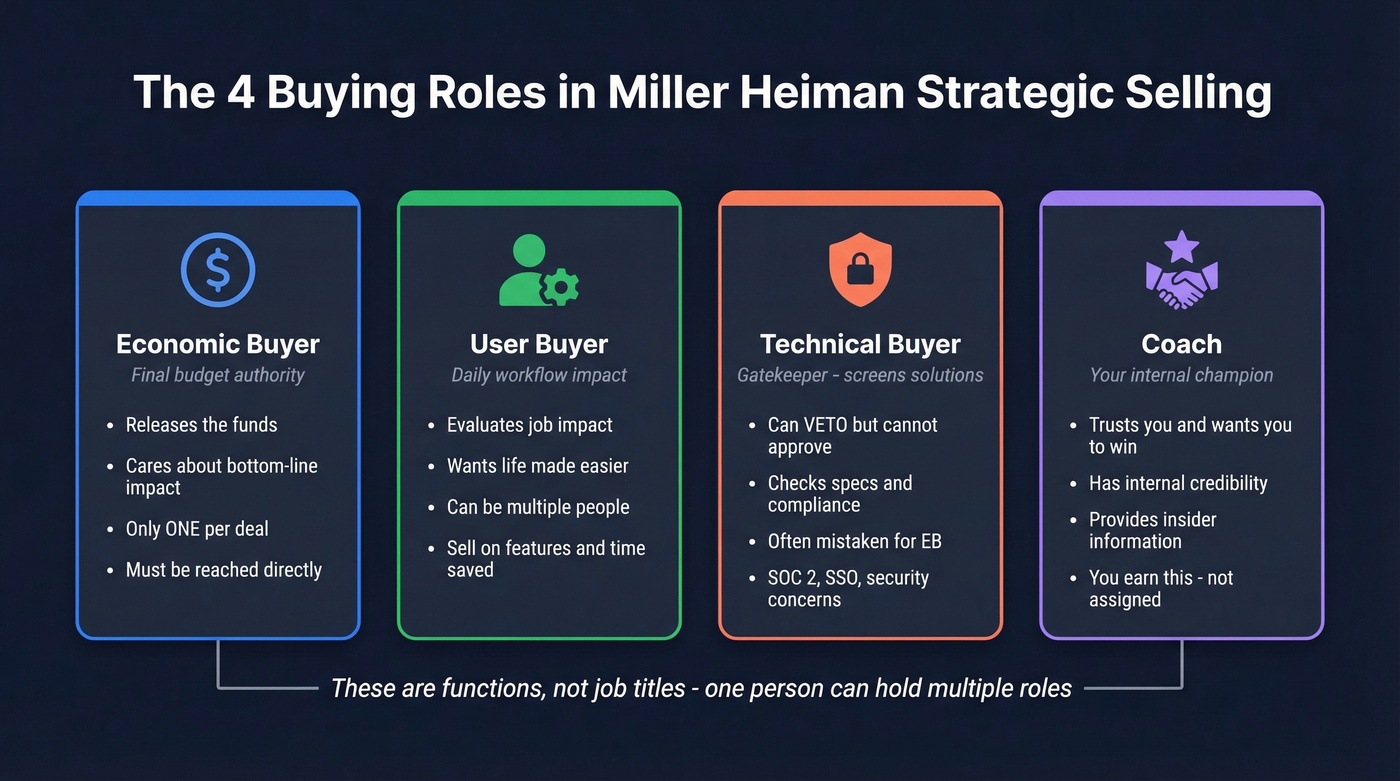
The one person with final budget authority who releases the funds. In a $200K enterprise software deal, this is the VP of Finance who signs off on anything above $100K. They care about bottom-line impact, price-performance, and organizational stability. Reach this person directly - never rely on intermediaries who claim to speak for them.
User Buyer
The people whose daily work changes if the deal closes. They evaluate based on job impact. In our scenario, that's the 15-person operations team who'll use the software every day. Sell them on features - they want to know if this thing actually makes their lives easier. "Saves me 5 hours weekly" is the win-result that matters here.
Technical Buyer
The gatekeeper who screens your solution against specs, compliance, and technical standards. They can veto but can't approve. In our deal, this is the IT security lead who needs SOC 2 compliance and SSO integration.
Critical warning: don't let a Technical Buyer convince you they're the Economic Buyer. It happens constantly, and it's how deals stall for months without anyone understanding why.
Coach
Your internal champion - someone who trusts you, has credibility within the organization, desires your success, and has access to information you can't get on your own. You don't assign someone as Coach. You earn it. The best-case scenario is when the Economic Buyer also serves as your Coach.
The Four Buying Modes
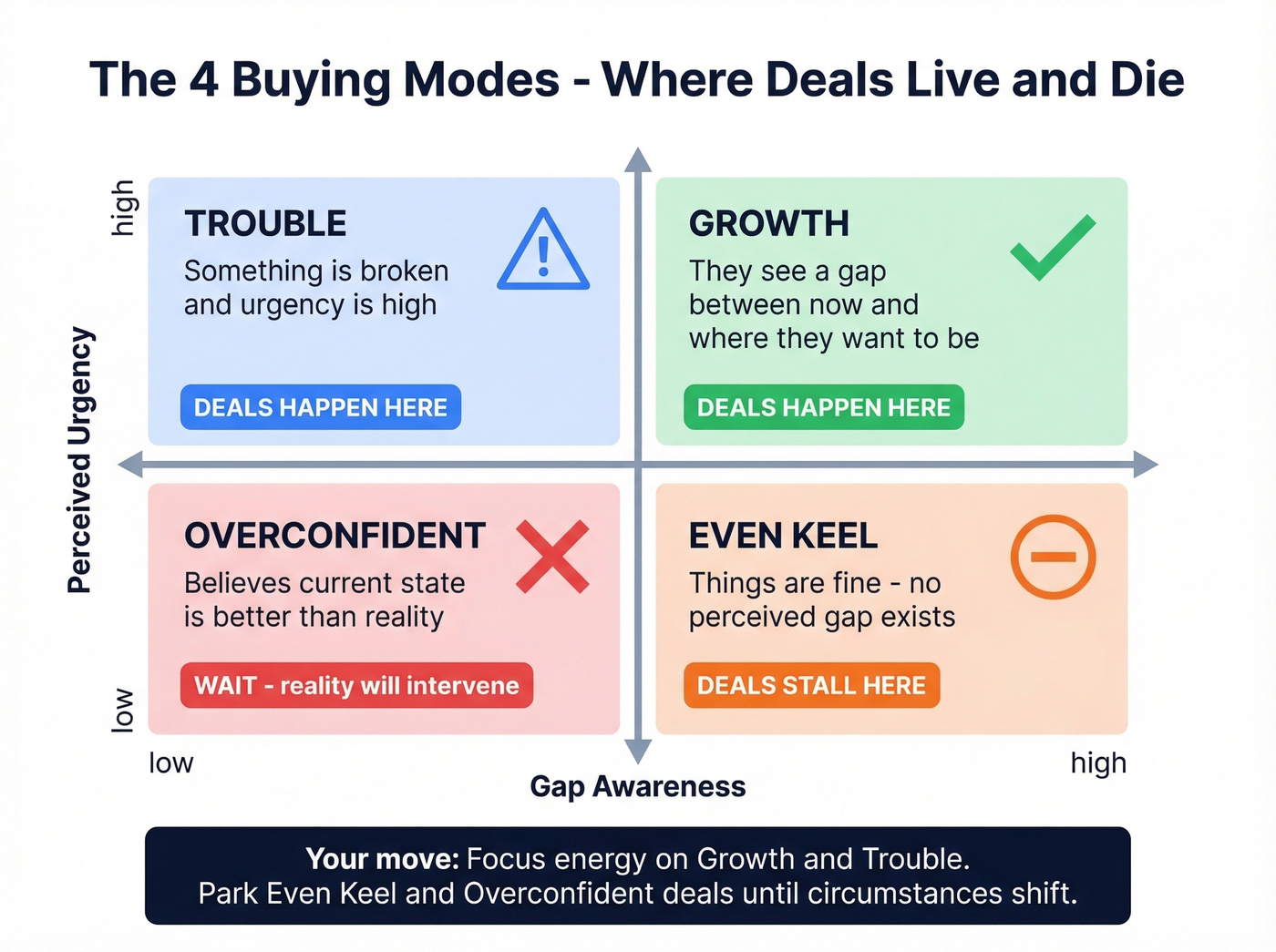
Every stakeholder sits in one of four modes at any given time. Your job is to identify the mode and adjust.
| Mode | Definition | Your Move |
|---|---|---|
| Growth | Gap between current and desired state | Align to their growth vision |
| Trouble | Something's broken; urgency is high | Show how you fix the pain fast |
| Even Keel | Things are fine; no perceived gap | Build awareness of unseen risks |
| Overconfident | Believes current state is better than reality | Wait. Reality will intervene. |
Growth and Trouble are where deals happen. Even Keel and Overconfident are where deals go to die. If your Economic Buyer is in Overconfident mode, you've got a timing problem, not a selling problem. Park the deal and revisit when circumstances shift.

Identifying Economic Buyers and Technical Buyers is only half the battle - you still need to reach them. Prospeo gives you 98% accurate emails and 125M+ verified mobile numbers so you can contact every buying influence directly, not through intermediaries who claim to speak for them.
Map the stakeholders. Then reach every single one.
Red Flags and Win-Results
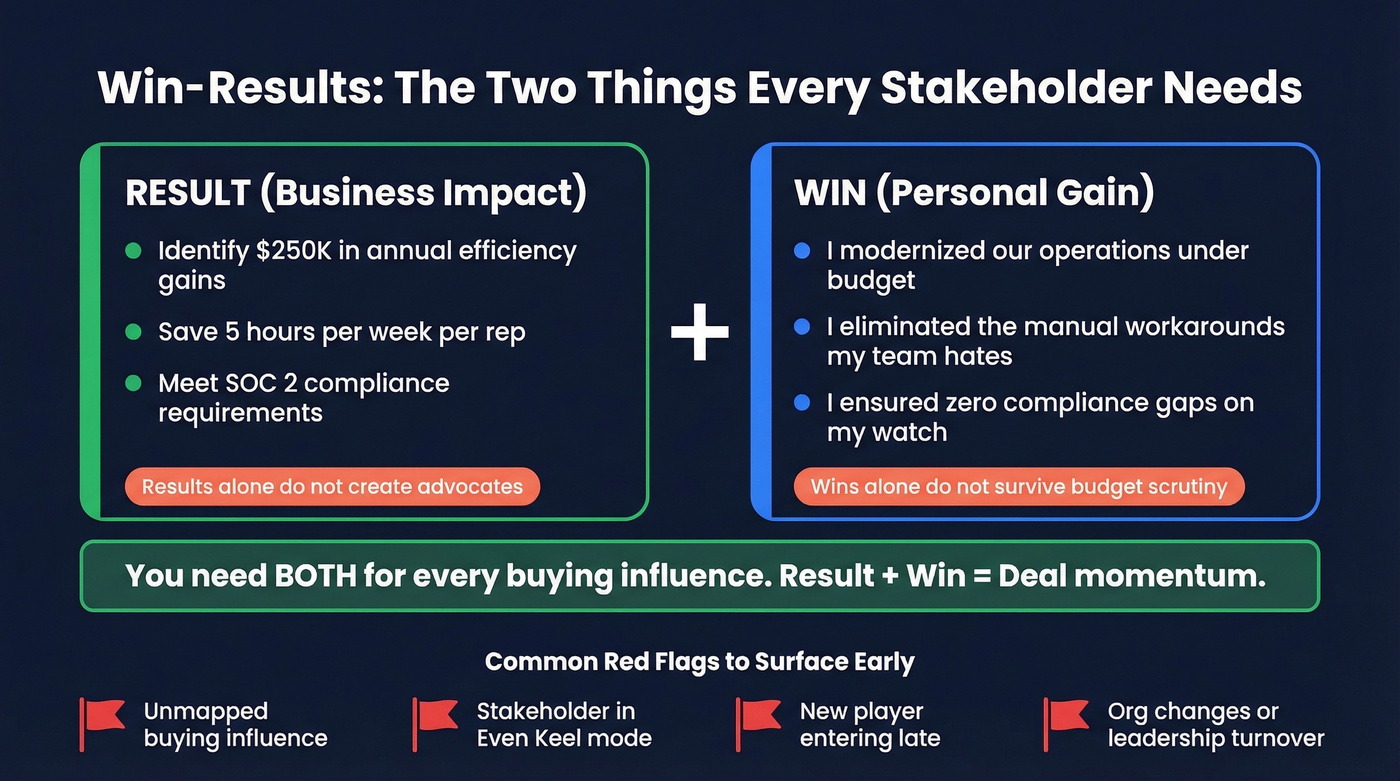
Red flags are the uncertainties that jeopardize your sale: any buying influence you've ignored, stakeholders in Even Keel or Overconfident mode, new players entering the decision process, and organizational changes like mergers or leadership turnover.
"Not finding Red Flags is a major Red Flag."
That line is worth internalizing. If your Blue Sheet shows zero red flags, you're not being thorough - you're being naive. Every complex deal has risks. The discipline is surfacing them early enough to act.
Win-Results connect your solution to what each stakeholder cares about. A "Result" is the measurable business impact - "identify inefficiencies worth $250K annually" for the Economic Buyer. A "Win" is the personal gain - "I look like the person who modernized our operations." You need both for every buying influence. Results without wins don't create advocates. Wins without results don't survive budget scrutiny.
How the Blue Sheet Works
The Blue Sheet is what separates this methodology from frameworks that live in a slide deck and die in a CRM. It's a multi-page deal planner that forces structured thinking about every dimension of a complex sale.
| Section | What Goes Here |
|---|---|
| Opportunity Details | Account, deal size, objective, target close |
| Competitive Info | Competitors, status, customer perception |
| Buying Influences | EB/UB/TB/Coach with Win, Results, Mode, Rating |
| Strengths vs Red Flags | What's working, what's at risk |
| Action Plan | Actions, owners, priority, due dates |
The rating scale runs from +5 (Enthusiastic Advocate) to -5 (Antagonistic Anti-Sponsor), with no zero - you have to commit to a direction.
Worked Example
Here's the Buying Influences section for our $200K enterprise software deal:
| Role | Name | Win / Results | Mode | Rating |
|---|---|---|---|---|
| EB | VP Finance, Sarah | "Modernize ops under budget" / $250K efficiency gains/yr | Growth | +3 |
| UB | Ops Lead, James | "Stop manual workarounds" / 5 hrs/week saved per rep | Trouble | +4 |
| TB | IT Security, Priya | "No compliance gaps" / SOC 2 + SSO met | Even Keel | -1 |
| Coach | Dir. of Ops, Marcus | "Career win - I brought this in" / Operational transformation | Growth | +5 |
Priya has high influence, Even Keel mode, and a -1 rating. She can veto the deal. The action plan needs a specific play to move her - a technical deep-dive addressing compliance concerns directly. Without the Blue Sheet, you'd keep talking to Marcus and James because they're enthusiastic, and that's exactly the trap this deal-planning discipline prevents.
We've walked through hundreds of Blue Sheets in deal reviews, and the most common gap is an unmapped Technical Buyer. The initial Blue Sheet takes 3-5 hours to complete properly. That's why the methodology only makes sense for deals with real complexity.
Miller Heiman vs Other Methodologies
| Dimension | Miller Heiman | MEDDIC | Challenger | SPIN |
|---|---|---|---|---|
| Origin | Miller & Heiman, 1985 | PTC/Parametric, 1990s | CEB, 6,000+ reps | Huthwaite, 35K+ calls, 12 yrs |
| Best For | Multi-stakeholder deals | Enterprise qualification | Rep behavior change | Discovery calls |
| Core Mechanism | Stakeholder mapping | Qualification checklist | Teach, tailor, take control | Situation-Problem-Implication-Need-Payoff |
| Documentation | Heavy (Blue Sheet) | Medium (scorecard) | Light (behavioral) | Light (call framework) |
| Ramp Time | 90-120 days | 30-60 days | 60-90 days | 30-45 days |
| Best Pick | Stakeholder-heavy enterprise | Qualify in/out fast | Changing seller behavior | Discovery-heavy sales |
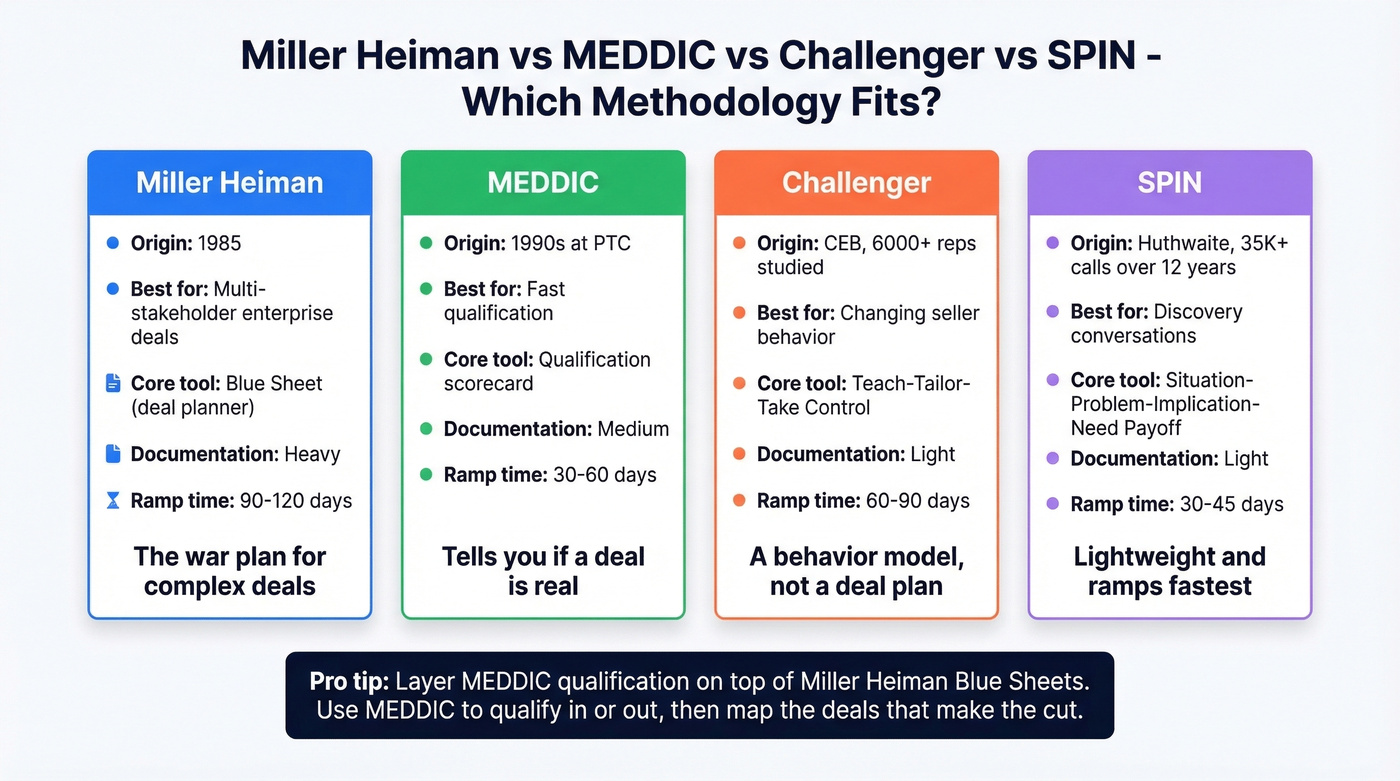
MEDDIC is a qualification checklist. Miller Heiman is a war plan. They solve different problems. MEDDIC tells you whether a deal is real. Strategic Selling tells you how to win it. In our experience, the best enterprise teams layer MEDDIC qualification on top of Blue Sheet deal strategy - use MEDDIC to qualify in or out, then map the deals that make the cut.
Challenger has impressive research behind it - Xerox reported a 17% increase in sales and $65M in contract value after implementation. But Challenger is a selling behavior model, not a deal-planning framework. You can be a Challenger-style seller and still use Blue Sheets. They're complementary, not competing.
SPIN is the lightest-weight option and ramps fastest. For deals with 6+ stakeholders and political complexity, SPIN alone won't cut it.
What Implementation Actually Takes
If you're new to this approach, start small. Here's the checklist we recommend before spending a dollar on formal training:
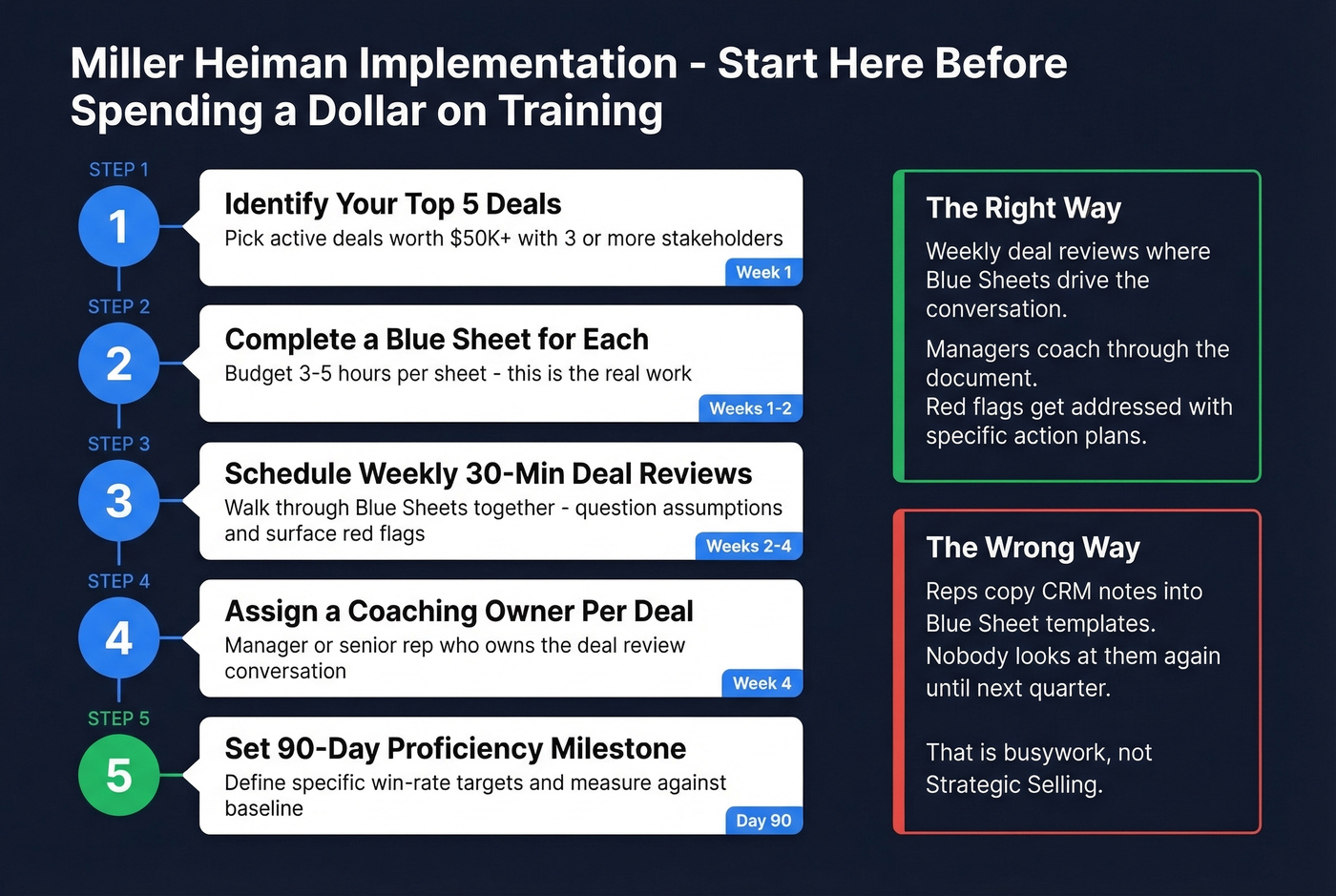
- Identify your top 5 active deals worth $50K+ with 3+ stakeholders
- Complete a Blue Sheet for each (budget 3-5 hours per sheet)
- Schedule weekly 30-minute deal reviews around Blue Sheets
- Assign a coaching owner for each deal
- Set a 90-day proficiency milestone with specific win-rate targets
We've seen teams adopt this methodology two ways: the right way and the way that wastes $50K in training budget.
The right way is weekly deal reviews where managers and reps walk through Blue Sheets together, questioning assumptions, identifying red flags, and assigning next actions. The Blue Sheet becomes the coaching artifact - the thing you actually look at in pipeline review, not a form you fill out to check a box.
The wrong way? Your manager asks you to fill out Blue Sheets for your top 5 deals. You spend 45 minutes copying CRM notes into the template. Nobody looks at it again until next quarter. That's not Strategic Selling - that's busywork, and the consensus on r/sales is that this is exactly where most rollouts fail.
The Blue Sheet feels "heavy" only when it's treated like a form. When it's used as a living strategy document in weekly coaching reviews, it surfaces blockers early and keeps complex deals from drifting.
Expect 90-120 days before reps are genuinely proficient. Teams that enforce Blue Sheet discipline through weekly coaching reviews typically see 5-20% win-rate improvement on complex deals.
Korn Ferry's training catalog includes Strategic Selling with Perspective, Conceptual Selling with Perspective, and combined programs. Public workshops run $1,000-$5,000 per seat. Full team rollouts with custom delivery land between $30,000 and $80,000+. Korn Ferry Sell - the CRM-native tool that embeds Blue, Green, and Gold Sheets into Salesforce and Microsoft Dynamics - typically runs $50,000-$150,000+ annually depending on seat count and modules. Korn Ferry claims combining methodology with their CRM integration yields a 4X increase in win rates.
Keeping Your Stakeholder Map Accurate
The Blue Sheet is only as good as the contact data behind it. Champions leave. Org charts shift mid-deal. The VP of Finance you mapped as Economic Buyer three months ago may have moved to a different division entirely.
After you've mapped your buying roles, you'll inevitably identify stakeholders you haven't met - especially the Economic Buyer and Technical Buyers outside your champion's circle. Tools like Prospeo can help here: upload your stakeholder list and get verified emails and direct dials back, so your Blue Sheet identifies who matters and you can actually reach them.
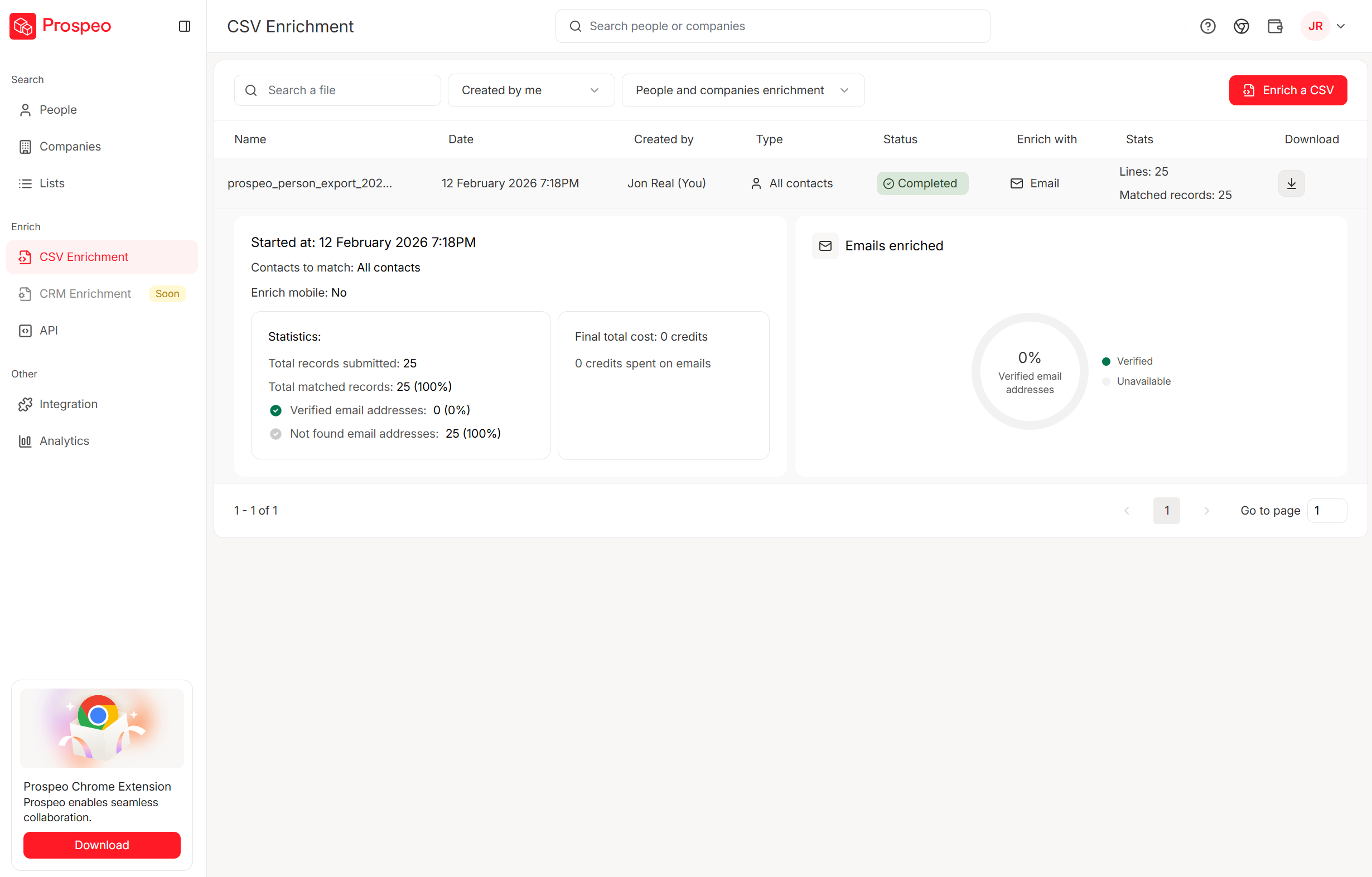
Your Blue Sheet shows four buying roles, red flags, and win-results. But none of it matters if you can't get the CFO's direct line before the budget review kills your deal. Prospeo's 30+ search filters let you find decision-makers by title, department, and company - with data refreshed every 7 days, not 6 weeks.
Stop getting blindsided. Start with accurate buyer data.
FAQ
What is the Miller Heiman Blue Sheet?
A deal-planning worksheet that maps every buying influence, their mode, rating (-5 to +5), win-results, competitive position, red flags, and next actions. It typically takes 3-5 hours to complete properly for a single opportunity and functions as a living strategy document updated through weekly deal reviews.
What are the four buying roles in Miller Heiman?
Economic Buyer (final budget authority), User Buyer (daily job impact), Technical Buyer (screens against specs and can veto but can't approve), and Coach (internal champion with trust, credibility, and access to information you can't get otherwise).
Is Miller Heiman the same as Strategic Selling?
Strategic Selling is one pillar of the broader framework. The full methodology also includes Conceptual Selling (meeting-level planning via the Green Sheet) and LAMP (strategic account planning via the Gold Sheet). Korn Ferry now owns and delivers all three programs.
How much does Miller Heiman training cost?
Public workshops run $1,000-$5,000 per seat. Custom team rollouts land between $30,000 and $80,000+. Korn Ferry Sell, the CRM-native tool, typically runs $50,000-$150,000+ annually depending on seat count. Many teams start with the book and a spreadsheet before investing in formal training - and honestly, that's a smart move.
How do I find contact data for unmapped stakeholders?
Use a B2B data platform after completing your Blue Sheet. Prospeo covers 300M+ professional profiles with 98% email accuracy and a 7-day data refresh cycle, which matters when org charts shift mid-deal. The free tier includes 75 email credits per month - enough to cover a handful of active enterprise opportunities.