

MillionVerifier Pricing, Reviews, Pros & Cons (2026)
$3.70 per thousand emails at the 10K-credit tier. That's MillionVerifier's pitch, and it makes them one of the cheapest bulk verifiers worth talking about. But "works" and "works at 99% accuracy" are two very different claims, and the gap between marketing copy and real-world performance is where your sender reputation lives.
We've dug through public benchmarks, G2 reviews, Reddit threads, and our own experience cleaning B2B lists to give you the full picture - pricing, accuracy data, real pros and cons, and when you should look elsewhere.
30-Second Verdict
Rating: 7/10 - Cheapest credible bulk verifier on the market, but the "99% accuracy" claim is marketing. A large public benchmark by LeadMagic puts it closer to 95.8%.
Best for: High-volume list cleaning on a tight budget - newsletters, marketing lists, large-batch hygiene where a 2-3% bounce rate is acceptable (see email bounce rate benchmarks).
Skip if: You're running cold outbound and need sub-1% hard bounces, your lists are heavy on catch-all domains, or you'd rather source verified emails than clean dirty ones after the fact.
What Does MillionVerifier Cost?
MillionVerifier runs on a one-time credit model. You buy credits, use them whenever, and they never expire. That alone sets it apart from competitors where credits vanish after 30-90 days.
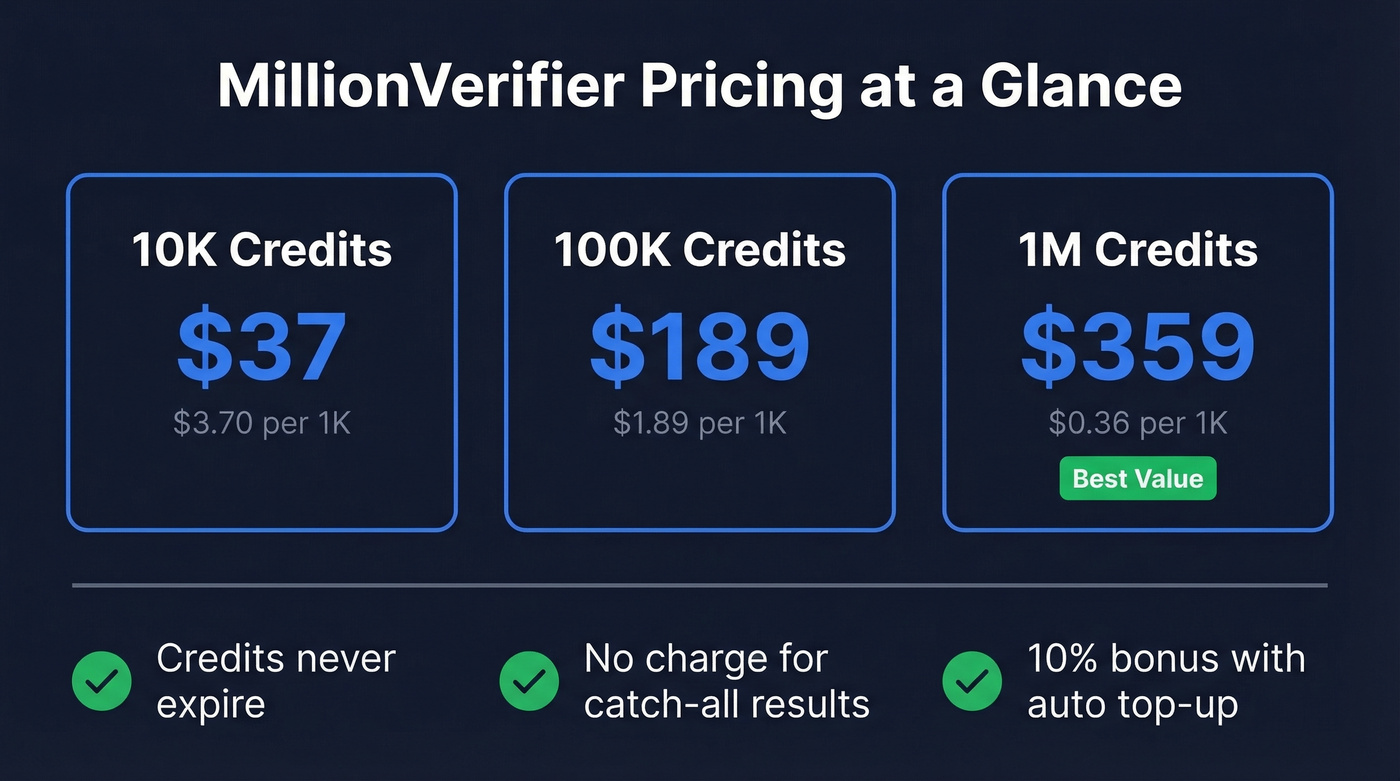
| Volume | Price | Cost per 1K |
|---|---|---|
| 10,000 | $37 | $3.70 |
| 100,000 | $189 | $1.89 |
| 1,000,000 | $359 | ~$0.36 |
You're only charged for emails classified as Good or Bad. Catch-all and unknown results aren't charged - MillionVerifier markets this as unique in the space, and it does meaningfully reduce your effective cost on B2B lists where 20-30% of addresses sit on catch-all domains.
A few other pricing details worth knowing: the "Million Ever Green" promo gives you 1M extra credits when you hit 5M purchased (past payments count toward the threshold), enabling auto top-up earns a 10% credit bonus on every payment, and there's a money-back guarantee if your hard bounce rate exceeds 4% after verification.
EverClean, their automated daily verification product, runs on a separate monthly subscription - roughly $15-99/mo depending on list size. New accounts typically get 100-500 free credits depending on the promo, no credit card required.
Pros: What Users Actually Like
Across 28 G2 reviews, affordability and ease of use are the two most-cited strengths.
Price is genuinely hard to beat at scale. At roughly $0.36 per thousand on the 1M tier, MillionVerifier is around 8-11x cheaper than ZeroBounce or NeverBounce at the same volume. The 10K LeadMagic benchmark test cost about $6 total - a testament to the pricing even where accuracy isn't perfect.
Simple bulk workflow. Upload a CSV, wait about 35 minutes for 10K emails, download results. No complexity, no learning curve. The free credits let you test before committing real money.
Credits never expire. This matters more than it sounds. Stock up during promos without worrying about a ticking clock - something ZeroBounce and NeverBounce don't offer.
Catch-all credit policy. In the LeadMagic benchmark dataset, 28% of emails were on catch-all domains. Not paying for those inconclusive results can cut your effective cost by a quarter on typical B2B lists.

MillionVerifier charges you to clean bad data. Prospeo gives you clean data from the source - 98% email accuracy across 300M+ profiles, verified through a 5-step process with catch-all handling built in. At ~$0.01 per email, you pay less than verification and never worry about bounce rates again.
Stop paying to verify bad emails. Start with good ones.
Cons: Where It Falls Short
Here's the thing - MillionVerifier's weaknesses are predictable for a tool at this price point, but they're still worth spelling out clearly.
Accuracy isn't 99%. The LeadMagic 10,000-email benchmark measured MillionVerifier at 95.8% accuracy, with a 1.8% false positive rate and 2.4% false negative rate. Decent for the price. Not what the marketing says.
Catch-all handling is basic. In that same test, MillionVerifier resolved only 5% of catch-all addresses. Given how common catch-all domains are in B2B, that's a lot of "risky" results you can't confidently act on.
Bulk and single API return different results. The same email can come back as unknown via the bulk API and ok via the single API - they run on separate base URLs, and support has attributed discrepancies to connection issues during verification. That's a bug, not a feature, and it erodes trust in the results.
Misses obvious invalids. Reddit users on r/coldoutreach have flagged MillionVerifier failing to mark unregistered domains and invalid TLDs as bad - errors that more expensive tools routinely catch.
Support can be slow. Expect responses that take up to 72 hours, sometimes longer. During a live campaign where bounces are climbing, that's not fast enough.
Does the 99% Accuracy Claim Hold Up?
No. Let's be honest about this.
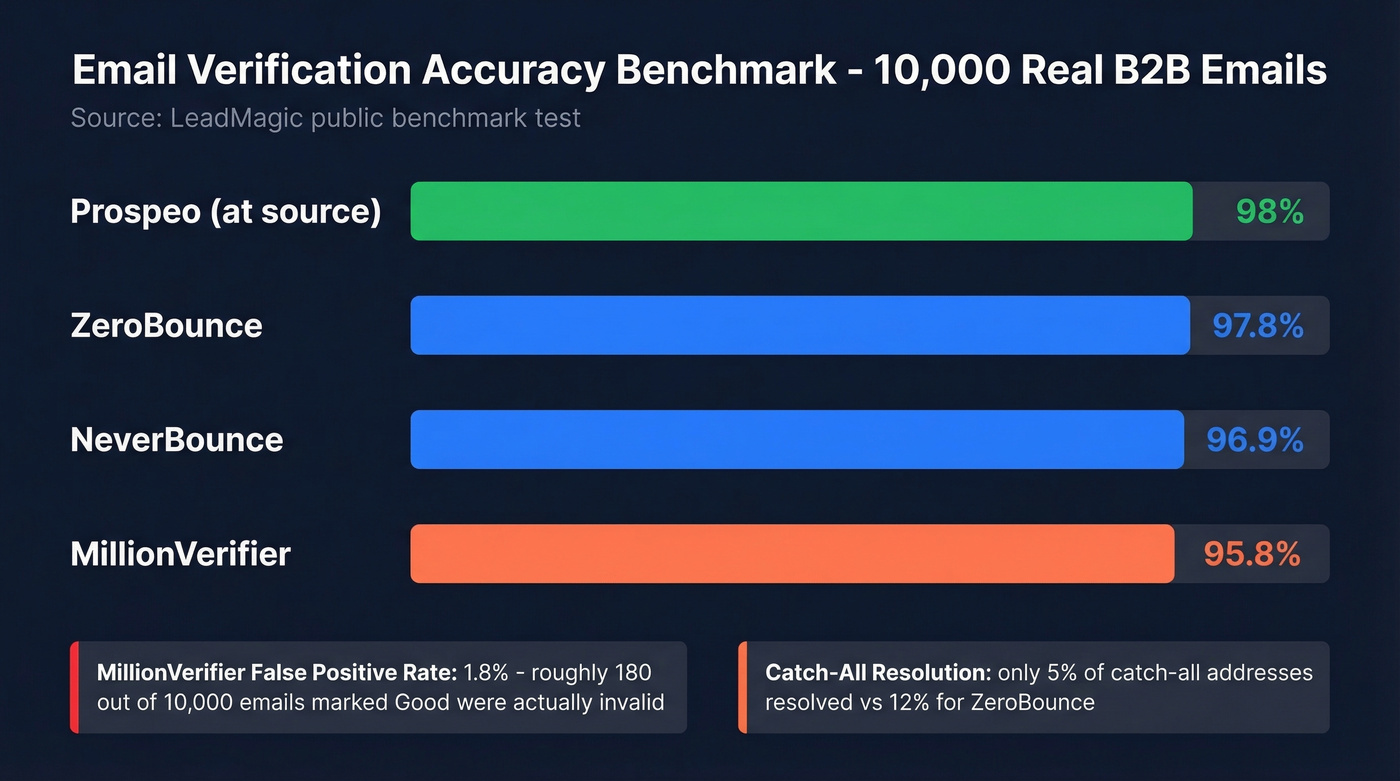
One of the most detailed public tests comes from LeadMagic's verification benchmark, which ran 10,000 real B2B emails from recent outbound campaigns - including 2,800 catch-all domains and 1,500 known invalids - through multiple verifiers simultaneously.
MillionVerifier scored 95.8% overall accuracy. ZeroBounce hit 97.8%. NeverBounce landed at 96.9%. The 1.8% false positive rate means roughly 180 out of 10,000 emails that MillionVerifier marked "Good" were actually invalid - and those are the ones that bounce and damage your domain.
For a newsletter with 50K subscribers, 180 extra bounces per 10K is manageable. For cold outbound where hard bounces above 1% trigger ESP throttling, it's a real problem.
MillionVerifier has introduced a Catch-All Email Verifier in beta that runs automatically in accounts. They report 70-80% improvement in reducing catch-all and "business unknown" results and the ability to correctly identify 98% of valid catch-all addresses. Promising numbers, but still vendor-reported with no independent verification we've seen.
Our take: For teams verifying under 50K emails a month, the accuracy difference between MillionVerifier and ZeroBounce won't matter much. Above that volume, the gap compounds into hundreds of wasted sends and unnecessary bounces. Know your threshold.
Who Should (and Shouldn't) Use It
Use MillionVerifier if you're cleaning large marketing or newsletter lists on a budget, your bounce tolerance is above 2%, and you don't need real-time support. The economics genuinely are hard to beat for high-volume batch verification.
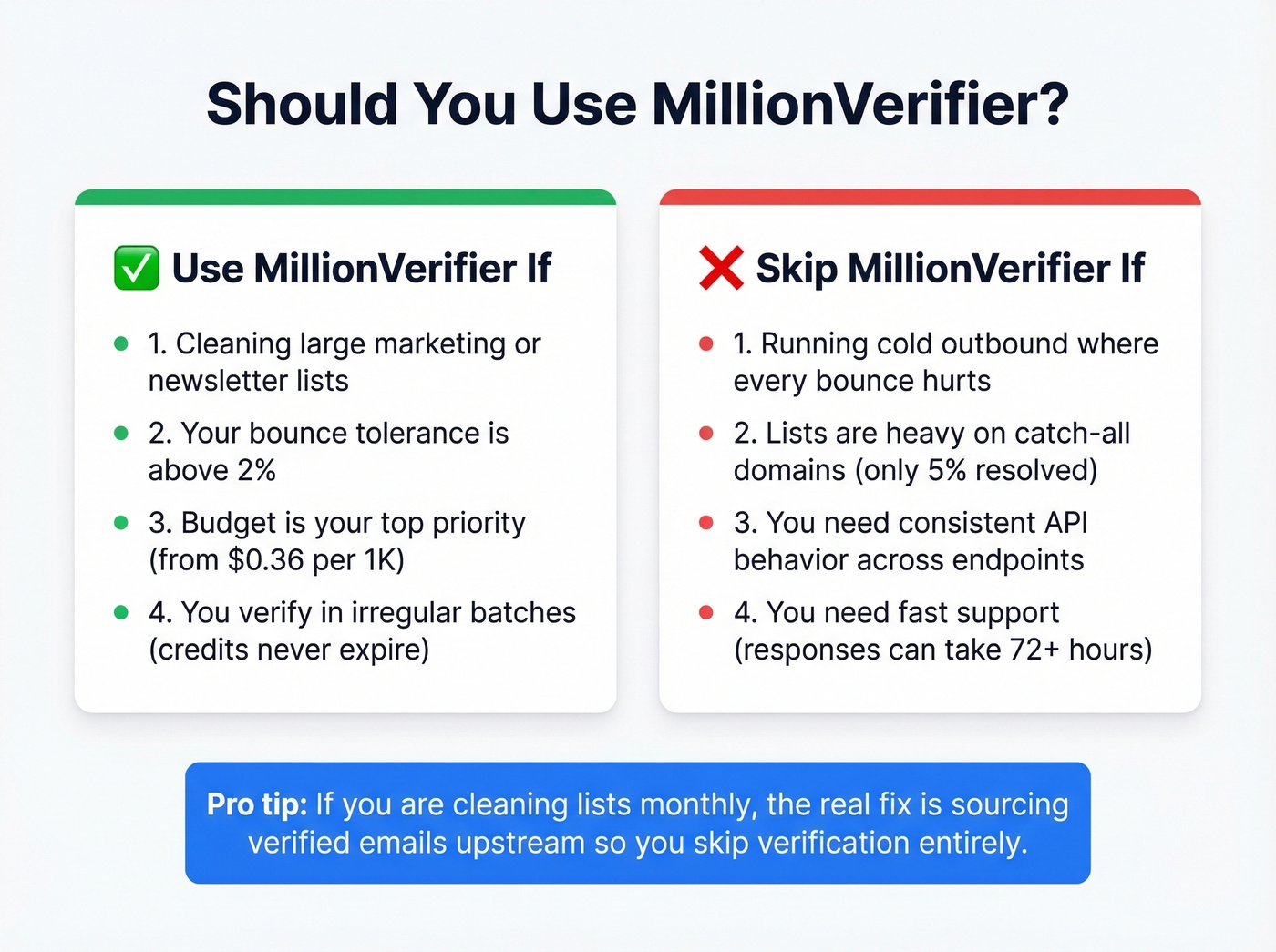
Skip it if you're running cold outbound sequences where every bounce hurts your sender reputation, your lists are heavy on catch-all domains, or you need consistent API behavior across endpoints. If you must use MillionVerifier for cold outbound, a common approach is pairing it with a second verifier for catch-all/unknown handling.
For outbound teams, the smarter move is sourcing clean data upstream. Prospeo's 98% email accuracy across 300M+ profiles means you skip the cleanup step entirely - no monthly verification ritual, no bounced-email anxiety.
Alternatives Worth Considering
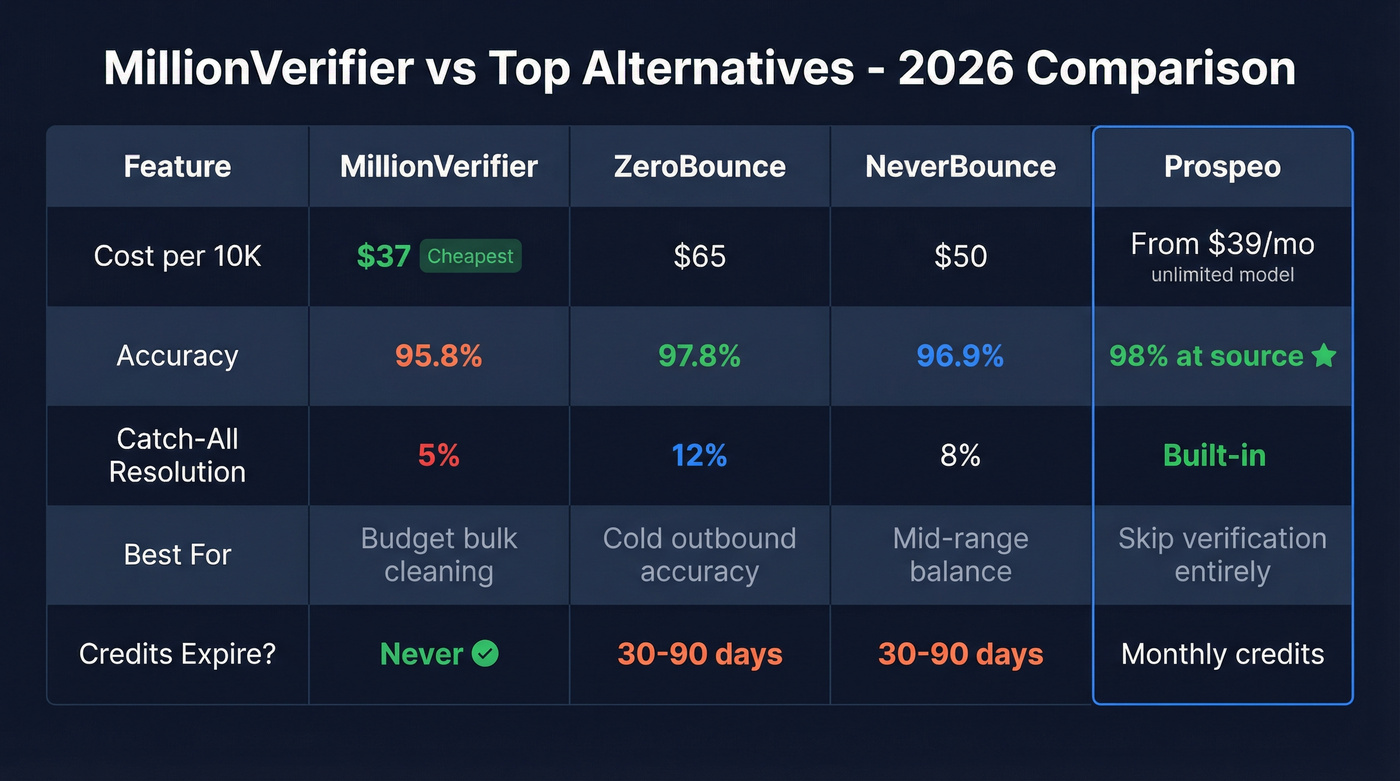
| Tool | Cost per 10K | Accuracy | Catch-All Resolution | Best For |
|---|---|---|---|---|
| Prospeo | From ~$39/mo | 98% at source | Built-in | Skip verification entirely |
| ZeroBounce | ~$65 | 97.8% | 12% | Cold outbound accuracy |
| NeverBounce | ~$50 | 96.9% | 8% | Mid-range balance |
| MillionVerifier | ~$37 | 95.8% | 5% | Budget bulk cleaning |
Prospeo
Different job entirely. Instead of verifying emails after collection, Prospeo gives you verified emails from the start - 98% accuracy across 300M+ professional profiles, refreshed every 7 days. Its proprietary 5-step verification handles catch-all domains, spam traps, and honeypots before an address ever reaches your list. Free tier available (75 emails/month), paid plans from ~$39/mo with no contracts. If you're running a monthly list-cleaning ritual, the problem isn't your verifier - it's your data source. Teams like Stack Optimize have maintained 94%+ deliverability and sub-3% bounce rates across all clients using this approach.
ZeroBounce
The premium option. 97.8% accuracy in the same 10K benchmark, with 12% catch-all resolution - more than double MillionVerifier's rate. At ~$65 per 10K you're paying roughly 75% more, but for cold outbound where sub-1% hard bounces matter, ZeroBounce earns that premium. Skip it if you're verifying 500K+ emails monthly and the budget math breaks down.
NeverBounce
The middle ground at 96.9% accuracy and ~$50 per 10K. NeverBounce is a solid pick for teams that want better accuracy than MillionVerifier without ZeroBounce's price tag. Nothing flashy, just reliable.
Catch-all domains eat 28% of your verification budget and still leave you guessing. Prospeo's proprietary email infrastructure resolves catch-all addresses before they ever reach your list - no second verifier needed, no "unknown" results piling up.
Source verified emails at 98% accuracy and skip the cleanup step entirely.
FAQ
Do MillionVerifier credits expire?
No. Credits never expire regardless of when you purchased them. Most competitors expire unused credits after 30-90 days, which pressures you into verifying on their timeline. MillionVerifier's no-expiry policy is one of its strongest selling points for teams that verify in irregular batches.
Does MillionVerifier charge for catch-all emails?
No. You're only charged for emails classified as Good or Bad. Catch-all and unknown results are effectively refunded, which meaningfully reduces your effective cost on B2B lists where 20-30% of addresses sit on catch-all domains.
What if my bounce rate is still high after verification?
MillionVerifier offers a money-back guarantee if your hard bounce rate exceeds 4% after cleaning. For tighter control, pair it with a second verifier for catch-all/unknown handling. Teams that want to eliminate the verification step altogether can source pre-verified contacts through a platform with built-in verification - Stack Optimize, for example, keeps bounce rates under 3% across all clients by sourcing clean data upstream.
Is MillionVerifier accurate enough for cold outbound?
At 95.8% accuracy with only 5% catch-all resolution, it's risky for cold outbound where hard bounces above 1% damage sender reputation. For newsletter and marketing list hygiene, it's fine. For outbound sequences, consider ZeroBounce at 97.8% accuracy or source pre-verified contacts so you don't need a separate verification step at all.