

Mobile Sales Enablement: The 2026 Practitioner's Guide
A RevOps lead we know ran a pilot last quarter with a $140K enablement platform. Six months in, reps used exactly two features: the content search bar and the PDF viewer. The coaching module? Untouched. That's not a technology failure - it's a buying failure, and mobile sales enablement investments go wrong like this at company after company.
The sales enablement market hit $6.13B in 2025 and is growing at 17.2% CAGR toward $25.65B by 2034. Two mega-mergers - Seismic and Highspot announcing a combination in February 2026, and Showpad merging with Bigtincan in October 2025 - have reshuffled the enterprise tier completely. Let's figure out what actually works for your team size and budget.
What You Need (Quick Version)
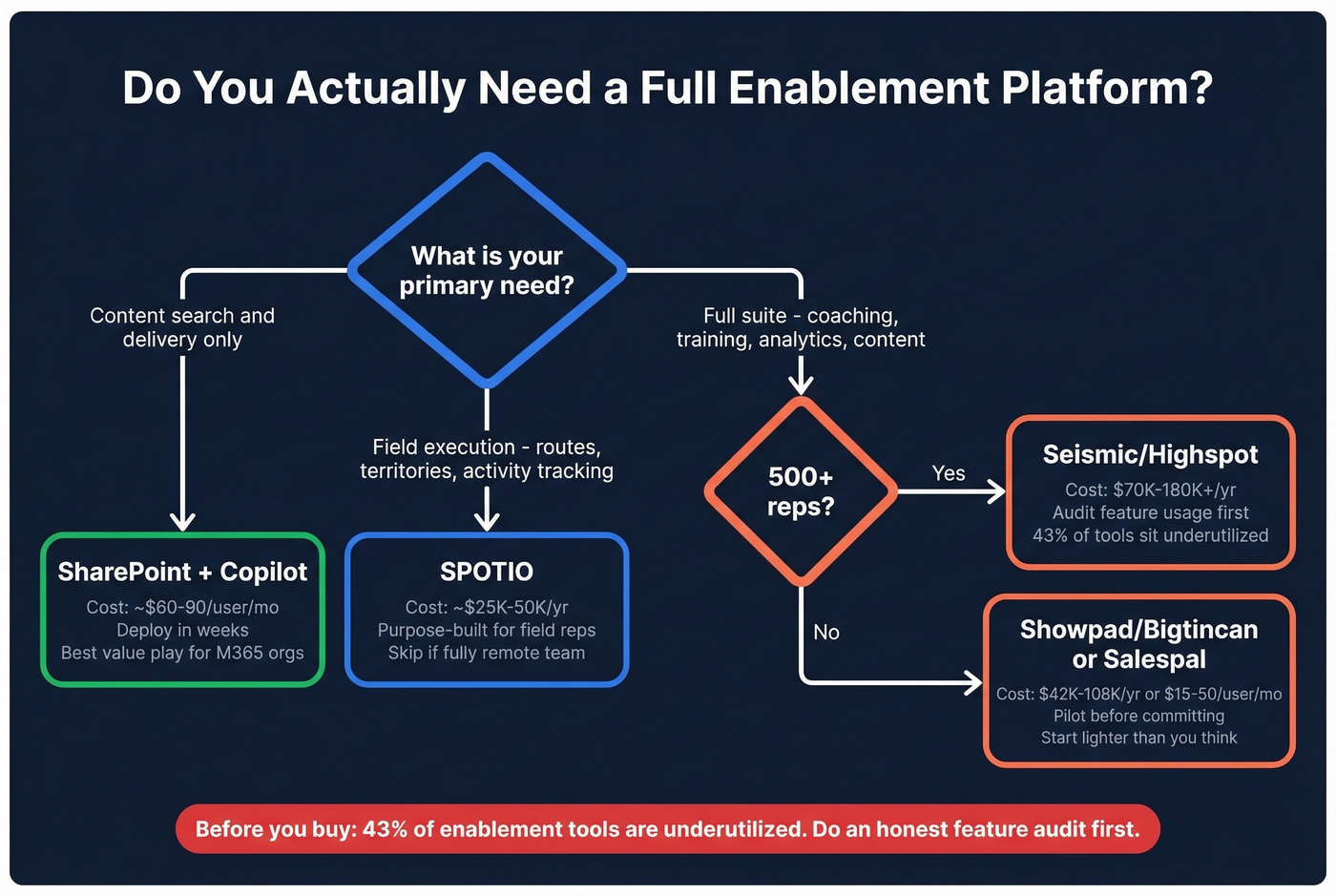
- Enterprise (500+ reps): Seismic/Highspot or Showpad/Bigtincan - but audit your feature usage first. If you're only using content management, you're overpaying.
- Mid-market (50-500 reps): SPOTIO for field execution, Salespal or Crescendoapp for content delivery. Mix and match.
- SMBs or content-only needs: SharePoint + Copilot. Don't spend $70K on a platform when a modern M365 stack handles content search just fine.
43% of enablement tools are underutilized, with adoption below 50%. Before you buy a platform, make sure you're buying what you'll actually use.
What Is Mobile Sales Enablement?
Mobile sales enablement gives reps access to content, CRM data, coaching, and analytics on their phones and tablets - so they can sell from anywhere, not just their desk. It's the difference between a field rep pulling up a case study in a parking lot before a meeting and that same rep walking in empty-handed because the content lives on a SharePoint nobody can access offline.
The category looks fundamentally different in 2026. The Seismic/Highspot merger created one of the largest enablement platforms in the market. Showpad/Bigtincan doubled down on field sales with offline mobile access, 3D/AR content, and video coaching. AI capabilities - dynamic content surfacing, real-time coaching prompts, lead scoring - have moved from nice-to-have to table stakes.
Here's the number that tells you where things are headed: 76% of organizations now have a dedicated enablement function, up from 32% five years ago. High performers are nearly 4x as likely to use a mobile sales app as underperformers. This isn't a niche anymore.
Why It Matters for Revenue Teams
Teams with structured enablement programs hit a 49% win rate versus 42.5% without. Best-in-class programs drive 84% quota attainment compared to 60% for teams without structured enablement. Sellers using AI-powered sales tools are 3.7x more likely to meet quota.
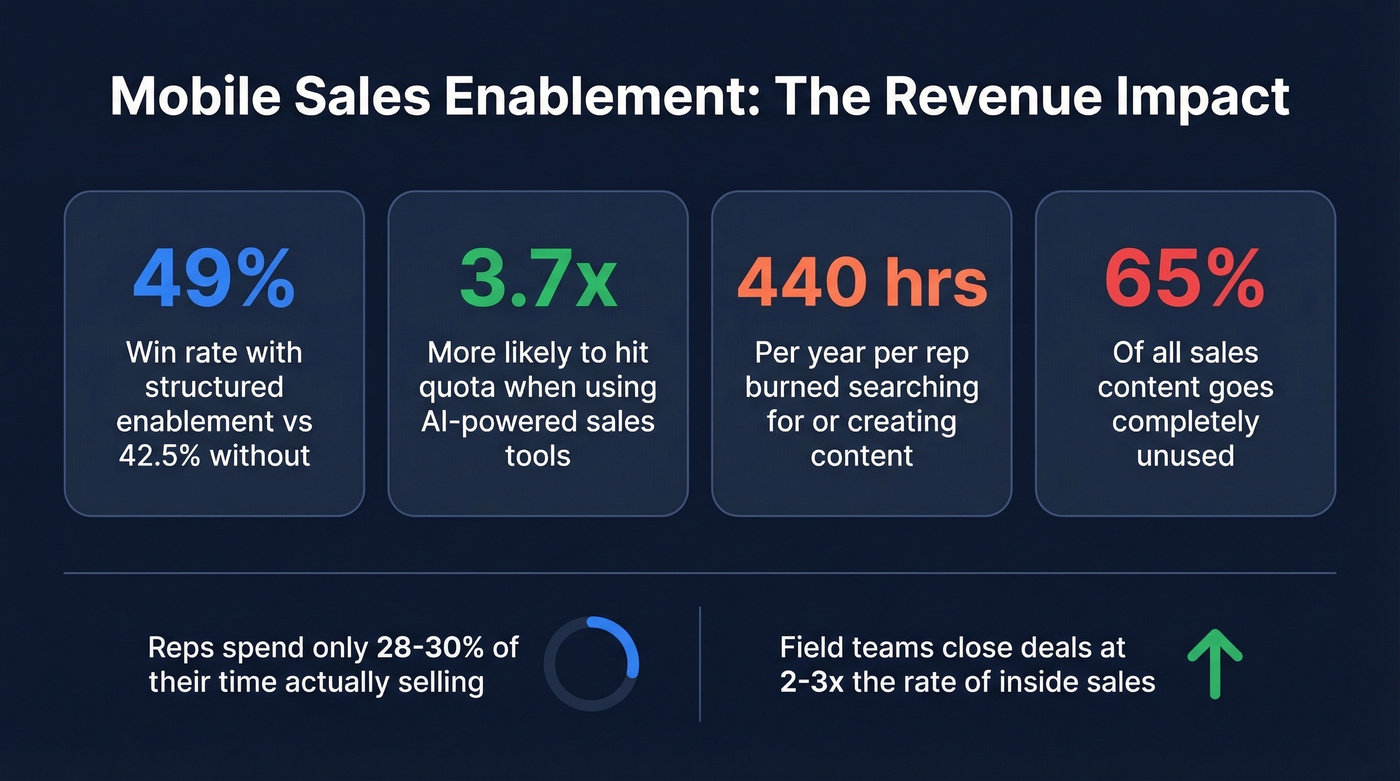
Reps spend just 28-30% of their time actually selling. The rest disappears into admin, content searching, and data entry - 440 hours per year burned searching for or creating content, while 65% of all sales content goes unused anyway. Half of all prospect engagement comes from just 10% of content assets. That's a staggering amount of wasted effort on both sides.
For field sales, the math gets even more compelling. Field teams close deals at 2-3x the rate of inside sales, but the average B2B field rep spends only 33% of their week in front of customers. Saving 30 minutes of drive time or admin per day equals 12 extra selling days per year per rep. Across a 100-person field team, that's 1,200 recovered selling days annually. Structured enablement also cuts onboarding time by 40-50%, getting new reps productive weeks faster.
Yet only 19% of B2B organizations have achieved what SPOTIO calls "sustainable success" - high quota attainment paired with low rep turnover. The other 81% are either burning reps out or leaving revenue on the table.
Here's the thing: most teams don't need a $100K enablement platform. They need clean data, a searchable content library, and a CRM that works on a phone. Everything else is optimization.
The 2026 Vendor Landscape
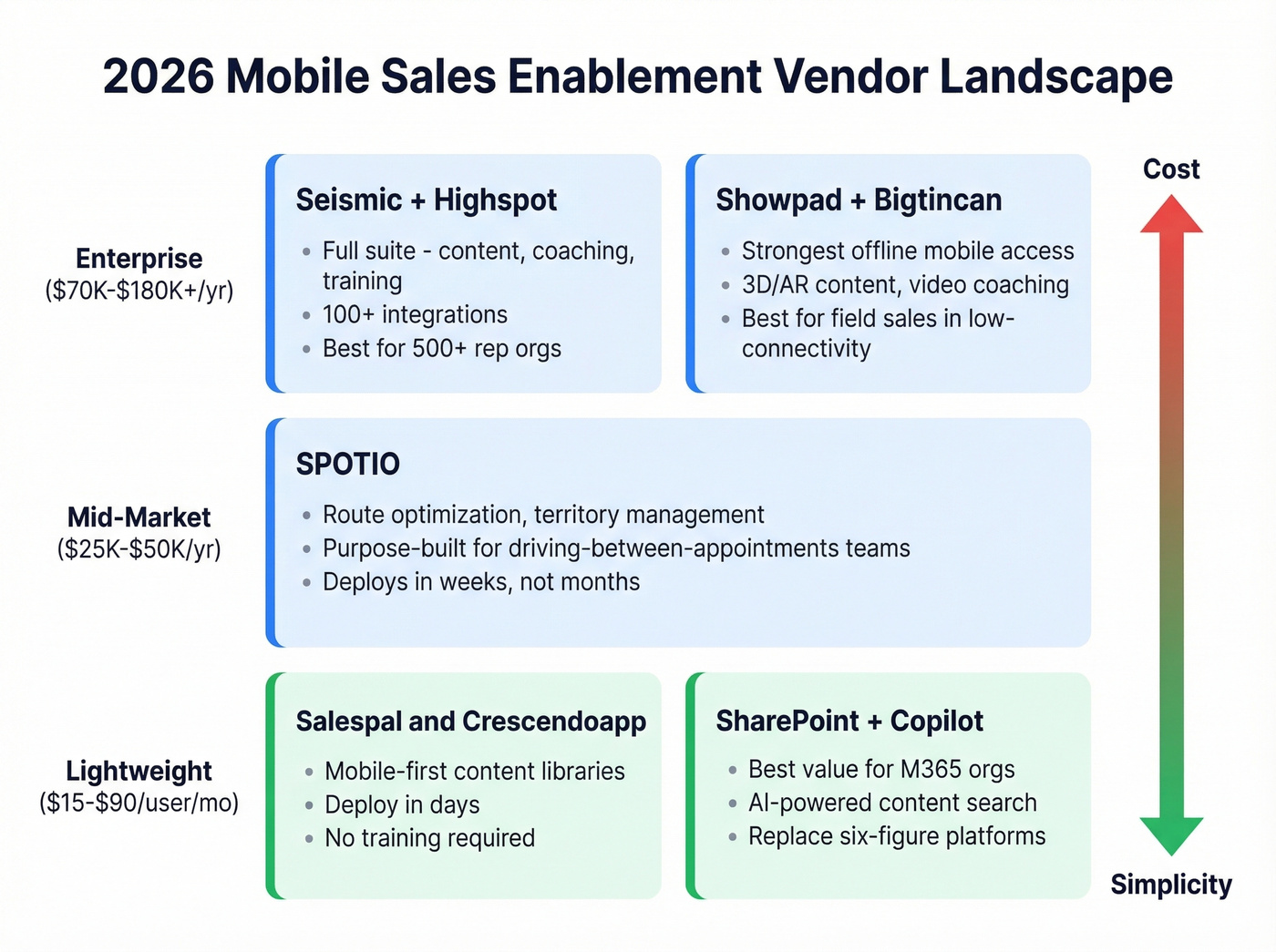
Two mergers compressed the enterprise tier, while lighter tools emerged for teams that don't need - or want - a full platform.
Enterprise Platforms (Post-Merger)
Seismic/Highspot is one of the largest enablement platforms in the market. Seismic brings deep content management and training, bolstered by its Lessonly acquisition; Highspot adds coaching, playbook adherence tracking, and content analytics. Seismic offers 100+ integrations while Highspot lists 70. Users praise the "single source of truth" experience, though some complain the UI is "more complicated than it needs to be." Expect $70K-$180K+/year with $15K-$50K+ in implementation.
Showpad/Bigtincan took a different path, doubling down on field sales. It offers one of the strongest offline mobile experiences in the category, plus 3D/AR content and MeetingIQ for video coaching. If your reps work in warehouses, showrooms, or hospital systems where Wi-Fi is spotty, offline access is the reason to buy. Pricing runs $42K-$108K+/year with implementation starting at $2K+.
Mid-Market and Lightweight Tools
SPOTIO is a leading field sales execution platform - route optimization, territory management, activity tracking - purpose-built for reps who spend their days driving between appointments. Skip this if your team is fully remote or inside sales. Pricing is custom but expect $25K-$50K/year for a mid-market team, well below Showpad's floor.
Salespal and Crescendoapp take a different approach entirely. Salespal is a mobile-first content library with solid offline access. Crescendoapp is an iOS/iPad content app that keeps things dead simple - no training required, no six-week implementation. Expect pricing around $15-$50/user/month depending on seats and packaging. Both deploy in days, not months. If your only problem is "reps can't find the right deck," either one solves it without the enterprise overhead.
The SharePoint + Copilot play deserves serious consideration. For organizations already on Microsoft 365 (typically $30-$60/user/month depending on plan), adding Copilot at roughly $30/user/month gives you AI-powered content search across your existing repository. We've seen teams replace six-figure platforms with this stack and not miss a beat.
Platform Comparison
| Platform | Best For | Mobile Offline | Pricing Range | Implementation |
|---|---|---|---|---|
| Seismic/Highspot | Enterprise 500+, full suite | Yes | $70K-$180K+/yr | $15K-$50K+, 3-4 mo |
| Showpad/Bigtincan | Field sales, 3D/AR (best offline) | Yes (strongest) | $42K-$108K+/yr | $2K+, 2-4 mo |
| SPOTIO | Field execution, route-heavy teams | Yes | ~$25K-$50K/yr | Weeks |
| Salespal | Mobile content delivery | Yes | ~$15-$50/user/mo | Days-weeks |
| Crescendoapp | iOS content, simplicity | Yes | ~$15-$50/user/mo | Days |
| SharePoint + Copilot | M365 orgs, content search (best value) | Via app | ~$60-$90/user/mo | Weeks |
Our picks: For most mid-market field teams, SPOTIO is the best value. Enterprise teams should pilot Showpad/Bigtincan before committing to Seismic/Highspot's price tag - unless you'll genuinely use the coaching and training modules. For teams where content search is the primary need, SharePoint + Copilot wins on cost.

Reps spend 440 hours a year searching for content - and even more chasing bad contact data. Prospeo gives your mobile sales team 125M+ verified direct dials with a 30% pickup rate, so every field visit starts with a real conversation, not a gatekeeper.
Stop enabling reps with dead numbers. Start with data that connects.
Do You Actually Need a Full Platform?
A product marketing team of 17 supporting ~1,500 sales reps recently posted on Reddit about replacing Highspot - a tool they had roughly 1,000 licenses for - with SharePoint. They were using it mainly for content management and occasional external pitch links. They'd started building a Copilot agent POC in Teams to search and surface SharePoint content instead.
We've seen this pattern repeatedly. Another buyer on r/techsales described paying for Showpad and using "maybe 10% of its features" - then worrying the Bigtincan merger would make it even more expensive.
The data backs this up: 91% of sales orgs use at least three enablement tools, with the average stack running 10+ tools, and 43% of those tools sit underutilized. Before you sign a $100K contract, do an honest audit. Are you buying an enablement platform, or are you buying a content repository with a $70K price tag?
How to Choose the Right Tool
When comparing platforms, a few capabilities separate useful tools from expensive shelfware.
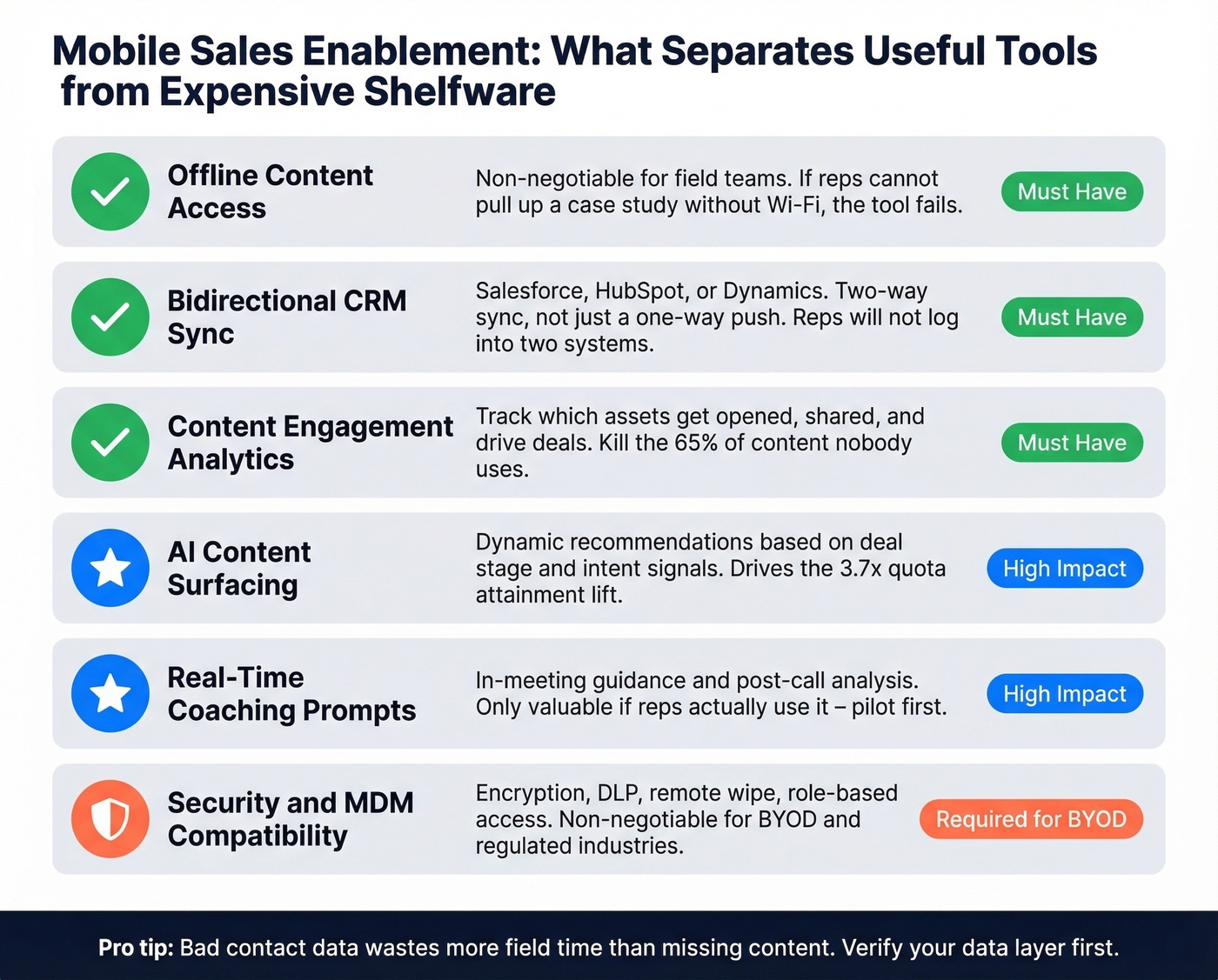
Mobile content with offline access is non-negotiable for field teams. If your reps can't pull up a case study without Wi-Fi, the tool fails its primary job. Closely related is CRM integration - Salesforce, HubSpot, or Dynamics with bidirectional sync, not just a one-way push. Reps won't log into two systems. Don't ask them to.
Content engagement analytics tell you which assets get opened, shared, and drive deals forward. Without this, you can't kill the 65% of content nobody uses. AI capabilities have crossed the threshold from optional to essential - dynamic content surfacing based on deal stage, intent signal tracking that routes hot leads to reps via Slack or CRM alerts, and real-time coaching prompts all contribute to that 3.7x quota attainment lift.
For regulated industries, security and MDM compatibility - encryption, DLP, remote wipe - are non-negotiable in BYOD environments. And none of this matters if your reps are working off stale contact records. In our experience, bad contact data wastes more field time than missing content does. A tool like Prospeo verifies emails at 98% accuracy on a 7-day refresh cycle, so reps aren't emailing dead addresses or dialing disconnected numbers from the parking lot.
Security and Compliance Checklist
51% of sales professionals say data security concerns halt AI initiatives. Start by choosing your device model - BYOD, COPE, or COBO - then ensure your baseline covers encryption at rest and in transit, DLP policies, role-based access control, remote wipe, and automated device enrollment through Apple Business Manager or Android Zero-Touch.
Run a 2-4 week pilot across device types before full rollout. Validate that your MDM plays nicely with the enablement platform's mobile app. This step catches more issues than any vendor demo ever will.
The Data Quality Problem
Your field rep is sitting in a parking lot, 10 minutes before a meeting. They pull up the prospect's contact record. The mobile number is disconnected. The email bounces. The decision-maker listed left the company in January.
That wasted visit costs more than any missing case study.
74% of AI-ready sales teams prioritize data hygiene for exactly this reason. Your enablement stack can surface the perfect content, but if the rep can't reach the right person, none of it matters. Prospeo refreshes data every 7 days and covers 300M+ professional profiles with 125M+ verified mobile numbers at a 30% pickup rate across all regions. That data freshness is the foundation every other enablement investment sits on.
You just read that 65% of sales content goes unused. Bad prospect data has the same problem - most of it never converts. Prospeo's 7-day data refresh and 98% email accuracy mean your reps aren't wasting recovered selling days on bounced emails and disconnected numbers.
Clean data is the enablement tool your stack is missing.
Implementation Roadmap
Don't start with the platform. Start with the data.
Step 1: Audit and verify contact data. Run your CRM through an data enrichment pass before any mobile rollout. Clean data first, then build on it. This single step prevents the most common field failure - reps losing trust in the system because the first record they pull up is wrong.
Step 2: Inventory your content. What stays, what needs updating, what's missing? Build mobile-optimized resources - short videos, interactive modules, bite-sized one-pagers. Kill the 40-page PDFs nobody opens on a phone.
Step 3: Choose your tier. Enterprise platform, mid-market stack, or SharePoint + Copilot. Match the tool to your actual usage patterns, not your aspirational ones. If you're debating build-vs-buy, remember: building only makes sense if you have dedicated engineering resources and your needs are genuinely unique.
Step 4: Run a staged pilot. Two to four weeks with a representative cohort. Test offline access, CRM sync, and content discoverability on actual mobile devices in actual field conditions. Pay close attention to whether reps actually open the app daily or revert to old habits - early adoption signals predict long-term usage far better than feature checklists do.
Step 5: Measure what matters. Track usage first, then engagement, then revenue impact. Only 25% of organizations can measure enablement effectiveness - be in that 25% from day one.
FAQ
What is mobile sales enablement?
Mobile sales enablement gives reps access to sales content, CRM data, coaching, and analytics on phones and tablets - anywhere, including offline. It typically includes content libraries, AI-powered content surfacing, real-time coaching prompts, and engagement analytics synced back to your CRM.
How much do enablement platforms cost?
Lightweight tools run $15-$50/user/month; enterprise platforms cost $42K-$180K+/year plus $2K-$50K+ implementation. SharePoint + Copilot lands around $60-$90/user/month for M365 organizations - the best value if content search is your primary need.
What's the ROI of field sales enablement?
Teams with enablement programs hit a 49% win rate versus 42.5% without. For field teams specifically, saving 30 minutes of admin per day equals 12 extra selling days per rep per year - 1,200 recovered days across a 100-person team.
Do I need a dedicated platform or is SharePoint enough?
SharePoint + Copilot handles content search and surfacing well for most teams. Invest in a dedicated platform only if you need coaching analytics, strong offline mobile access for field reps, or 3D/AR content delivery that SharePoint can't replicate.
How do I keep contact data accurate for mobile reps?
Use a verification tool with a weekly refresh cycle to enrich your CRM before syncing to mobile devices. Stale contacts waste field selling time and undermine every other enablement investment you've made.