

Mock Calls Script Templates That Actually Prepare You (With a Scoring Rubric)
You've got a mock call tomorrow and you need a script that doesn't sound like it was written in 2011. The problem? Most resources are broken SlideShare links, poorly formatted PDFs, or scripts so robotic they'd fail the very assessment they're supposed to prepare you for.
Below: copy-paste scripts for customer service, tech support, and sales cold calls. A scoring rubric so you know exactly how you're being graded. And the seven mistakes that fail people most often.
What Is a Mock Call?
A mock call is a simulated phone conversation where one person plays the agent and another plays the customer or prospect. It's used in three contexts: interview assessments (call centers use them to screen candidates), team training (managers run weekly sessions to sharpen skills), and QA calibration (supervisors align on what "good" sounds like before scoring real calls).
One distinction worth nailing down early: a script is what to say - the actual words. A call flow is the steps to follow - greeting, verification, issue identification, resolution, close. You need both. Scripts without a flow feel robotic. Flows without scripts leave agents fumbling for words.
What You Need (Quick Version)
- For interview prep: Practice the billing inquiry, irate customer, and cold call scripts below - they cover the most common scenarios hiring managers test.
- For team training: Use the scoring rubric in the next section to grade every session. If you're not scoring, you're just having conversations.
- For real outbound after practice: Build your prospect list with verified data. Prospeo's free tier gives you 75 emails/month at 98% accuracy - enough to run your first real campaign.
How Mock Calls Are Scored
Not all parts of a mock call carry equal weight. Effective listening is worth 4x the greeting points. You can nail the opening and still fail if you're not demonstrating active listening throughout the call.
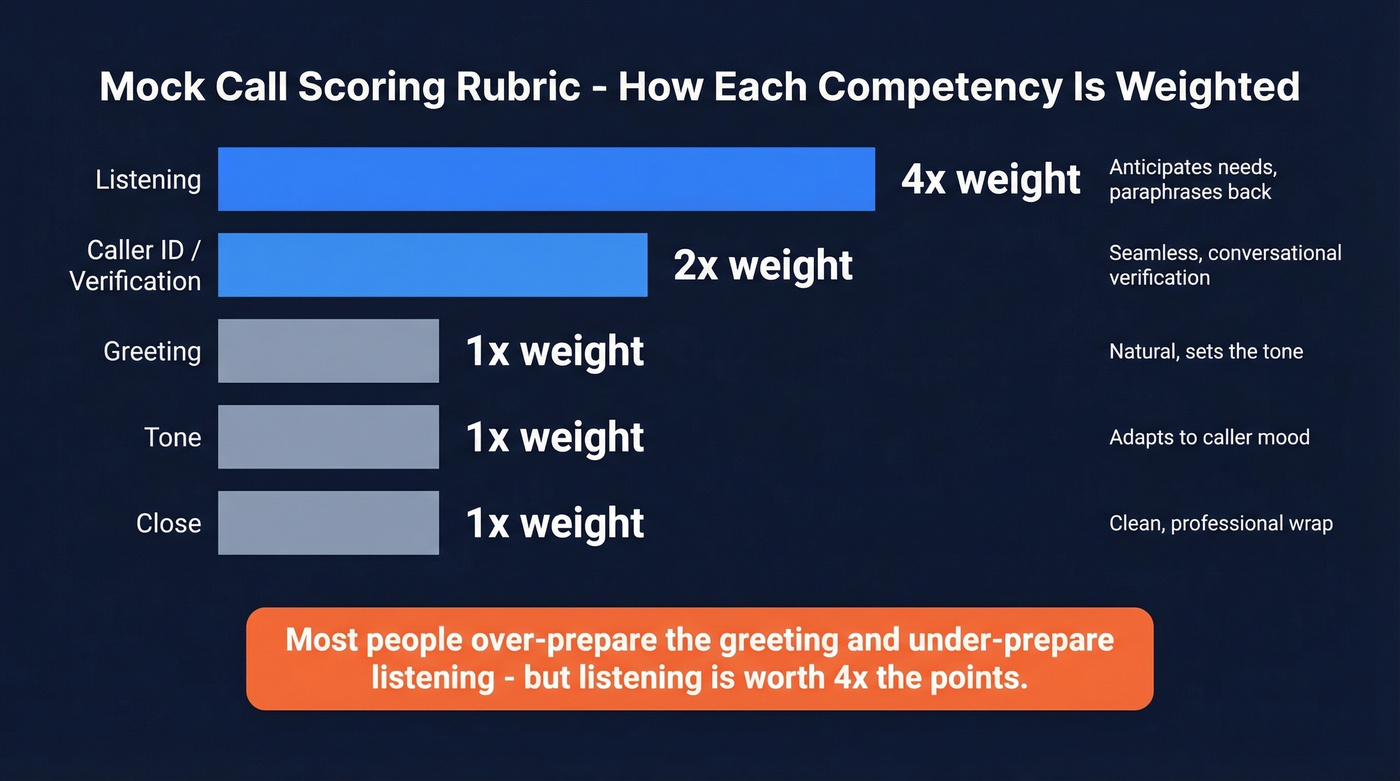
Copy this rubric directly. It covers five competency areas across four rating levels:
| Competency (Weight) | Poor (0) | Fair (1) | Good (2) | Above & Beyond (3) |
|---|---|---|---|---|
| Greeting (1 pt) | No greeting or mumbled | Basic but rushed | Warm, professional | Natural, sets tone |
| Caller ID (2 pts) | Skips verification | Gets 1 of 3 criteria | Follows all 3 ID criteria | Seamless, conversational |
| Tone (1 pt) | Flat or defensive | Adequate but stiff | Friendly, consistent | Adapts to caller's mood |
| Listening (4 pts) | Interrupts, no recap | Listens but misses cues | Paraphrases, confirms | Anticipates needs |
| Close (1 pt) | Trails off, no recap | Basic close | Confirms resolution | Clean, professional wrap |
The "three ID criteria" for caller identification usually means verifying the customer's name, an account identifier like an account number, and one security check - ZIP code, last four digits on file, or a security question. Poor means you skip it. Above and beyond means the verification feels like a conversation, not an interrogation.
Most call centers blend two scoring methods. Pass/fail works for compliance items - did the agent read the recording disclosure? Yes or no. Weighted scoring (0-5 per category) works for softer skills like empathy and problem-solving. The best QA scorecards combine both.
The seven standard categories on a modern QA scorecard are greeting and introduction, communication skills, process and compliance, product knowledge, problem-solving, closing, and customer experience factors.
If you're building a training program, score every session against these. If you're prepping for an interview, know that your evaluator is probably using something very close to this rubric - and they're weighting listening and resolution far more than your opening line.
Customer Service Script Templates
Billing Inquiry Script
This is one of the most common mock call scenarios in interviews. It tests whether you can follow a standard call flow without sounding like a robot.
[Agent]: "Thank you for calling [Company], this is [Name]. This call may be recorded for training and quality purposes. How can I help you today?"
[Customer]: "Hi, I'm looking at my bill and there's a charge I don't recognize - $14.99 for something called 'Premium Support.'"
[Agent]: "I'd be happy to look into that for you. Can I get your account number and the name on the account?"
[Customer]: "Sure - account 4481992, under Sarah Mitchell."
[Agent]: "Thank you, Sarah. And for security, can you confirm the last four digits of the phone number on file?"
[Customer]: "7734."
[Agent]: "Perfect. I can see the $14.99 charge - it looks like Premium Support was added earlier this month. Would you like me to remove that and issue a credit for this billing cycle?"
[Customer]: "Yes, please."
[Agent]: "Done. You'll see the $14.99 credit on your next statement. Is there anything else I can help with today?"
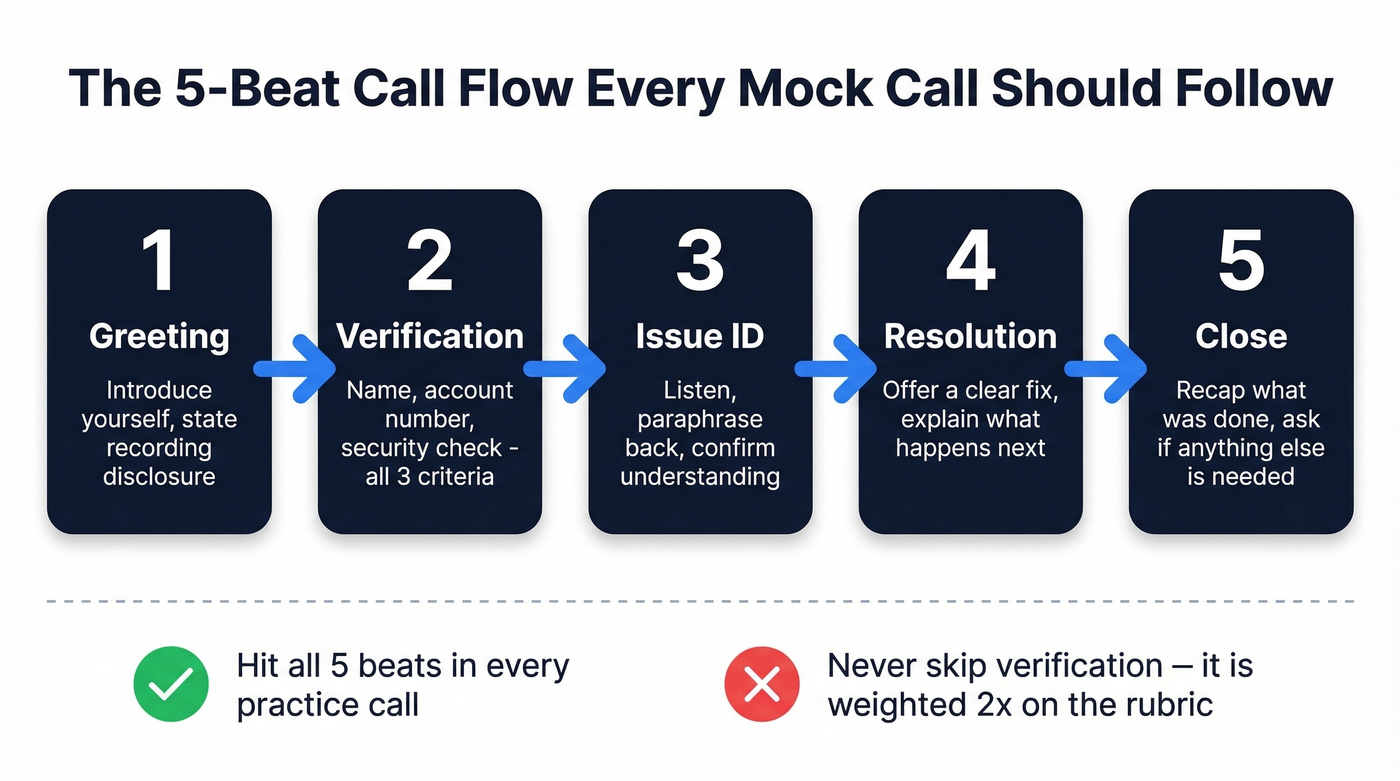
Notice the flow: greeting with recording disclosure, verification (three criteria), issue identification, resolution, and close. Every practice call should hit these five beats.
Irate Customer Script
This is where most people fail. The instinct is to jump to a solution, but the rubric rewards de-escalation first. Before you touch the dialogue, internalize this eight-step sequence:
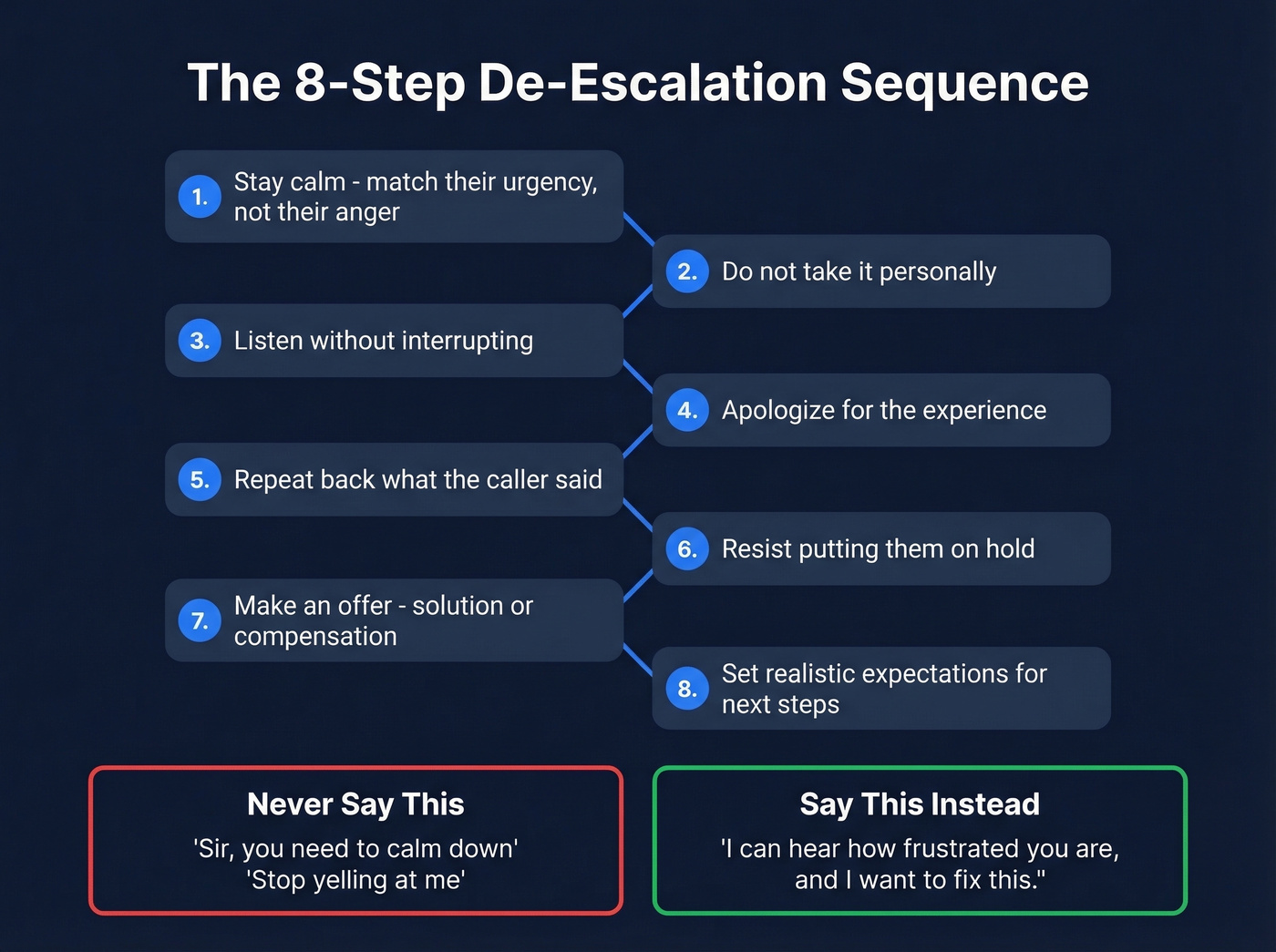
- Remain calm - match their urgency, not their anger
- Don't take it personally
- Listen without interrupting
- Apologize for the experience, not necessarily the company's fault
- Repeat back what the caller said
- Resist putting them on hold (it escalates frustration)
- Make an offer - a solution or compensation
- Set realistic expectations for next steps
Now the script:
[Customer]: "I've been on hold for 45 minutes! This is ridiculous. My internet has been down for three days and nobody can fix it!"
[Agent]: "I completely understand how frustrating that is, and I'm sorry you've had to wait. You've been dealing with this for three days - that's not acceptable, and I want to get this resolved for you right now."
[Customer]: "You better, because I'm about to cancel everything."
[Agent]: "I hear you, and I don't want that to happen. Let me pull up your account so I can see exactly what's been going on. Can I get your account number?"
[Customer]: "It's 5529103. And my name is David Torres."
[Agent]: "Thank you, David. So what I'm seeing is that a technician was scheduled but the appointment was missed - is that right?"
[Customer]: "Yes! Nobody showed up."
[Agent]: "That's unacceptable, and I apologize. Here's what I can do right now: I'm going to escalate this to our priority dispatch team and get a technician to you by tomorrow morning. I'm also going to credit your account for the three days of downtime. Does that work for you?"
What NOT to Say
"Sir, you need to calm down" or "Stop yelling at me." These phrases show up in outdated training scripts and they'll cost you heavily on empathy and de-escalation scoring.
What to Say Instead
"I can hear how frustrated you are, and I want to fix this." Acknowledge the emotion, then redirect to the solution.
Retention & Cancellation Script
Retention calls test whether you can save a customer without making promises you can't keep.
[Customer]: "I want to cancel my service. My modem died and I can't afford to replace it."
[Agent]: "I'm sorry to hear that. Before we process anything, can I take a look at your account? There might be options we can explore."
[Customer]: "Fine, but I'm not paying for a new modem."
[Agent]: "Completely understood. I can see you've been with us for over five years - thank you for that. Here's what I can offer: a free modem replacement with overnight shipping, so you'd be back online by tomorrow. I can also add a six-month trial of our faster speed tier - 6 Mbps instead of 3 - at no extra cost during the trial. After the six months, it's $5/month if you decide to keep the faster speed; if not, we'll switch you back."
[Customer]: "Really? No charge?"
[Agent]: "No charge for the modem, and no charge for the speed upgrade during the trial. Your order number is FX893-7873 - keep that for your records. And if you need help setting up the new modem, our tech support line is available 24/7."
The progression matters: acknowledge, verify tenure, offer a tangible save (free hardware), then sweeten with a speed upgrade trial. Never promise something you can't deliver. If you don't have authority to offer a free modem, say "Let me check what I can do" - not "Absolutely, no problem."
Technical Support Script
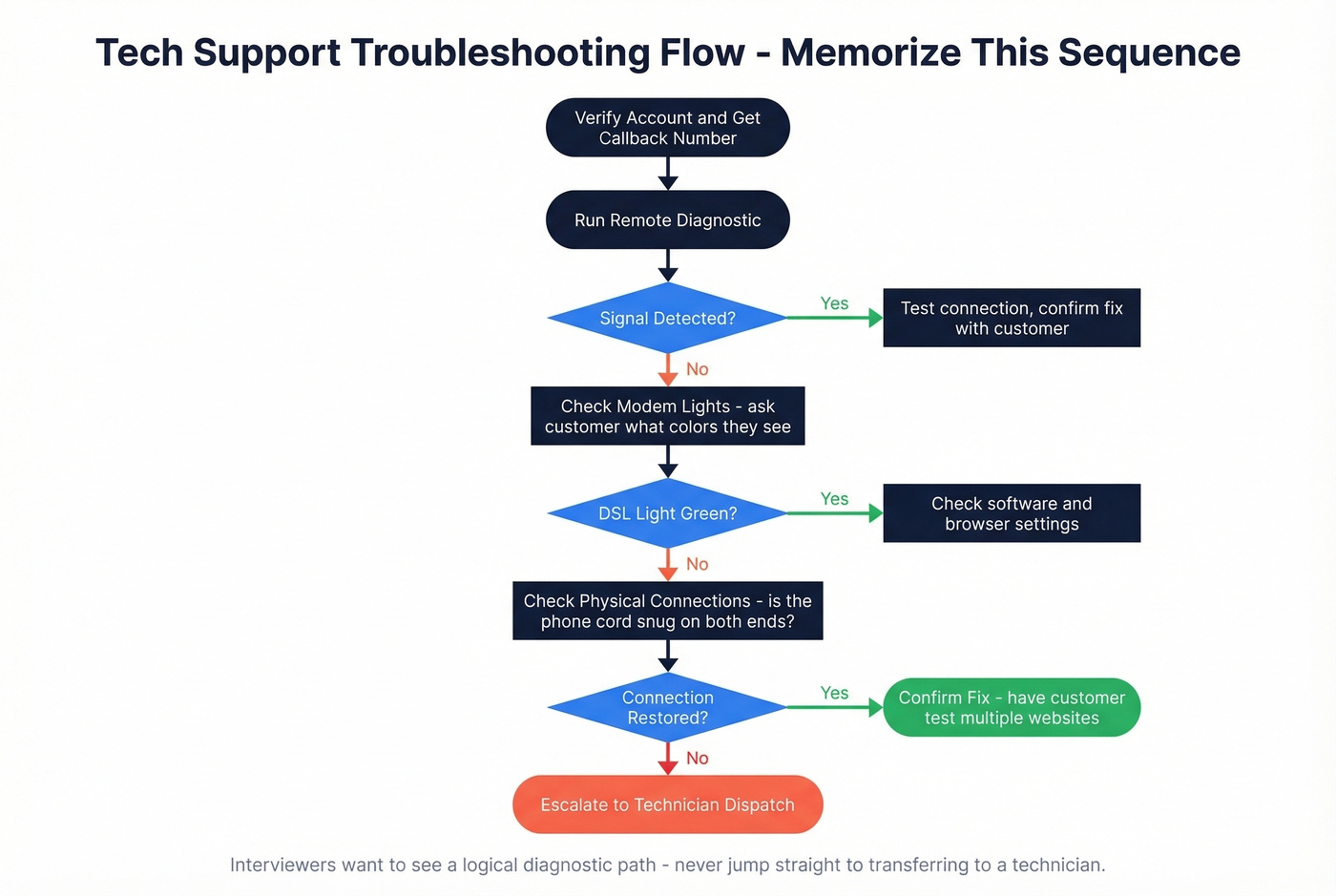
Tech support scripts test your ability to walk a customer through a diagnostic flow without losing them. The key is translating technical steps into plain language.
[Agent]: "Thank you for calling [Company] technical support, this is [Name]. How can I help you today?"
[Customer]: "My internet's been down for over a week. I've called twice already and nothing's been fixed."
[Agent]: "I'm sorry you're still dealing with this. Let me pull up your account and we'll work through this together. Can I get your account number and a good callback number in case we get disconnected?"
[Customer]: "Account 7720415. Callback is 555-0183."
[Agent]: "Thank you. I'm running a diagnostic on your line now, and I'm not seeing a DSL signal reaching your modem. Let's check a few things on your end. Can you look at the front of your modem and tell me which lights are on?"
[Customer]: "The power light is green, the Ethernet light is green, but the DSL light is flashing red."
[Agent]: "That tells me the modem isn't getting a signal from the wall. Can you follow the gray phone cord from the back of the modem to where it plugs into the wall jack? Is it snug on both ends?"
[Customer]: "Hold on... actually, it's loose on the modem side. Let me push it in. ...Okay, the DSL light just turned green."
[Agent]: "Excellent. Let's make sure everything's working. Can you open a browser and try loading a couple of different websites?"
[Customer]: "Yeah, it's working now. I can't believe it was that simple."
[Agent]: "It happens more often than you'd think. I'm glad we got it sorted. Just so you know - if a technician had come out and found a loose connection, there could've been a dispatch charge. So it's always worth checking the physical connections first. Is there anything else I can help with?"
The troubleshooting flow to memorize: Verify account, get callback number, run remote diagnostic, check modem lights, check physical connections, confirm fix by testing. Interviewers are looking for whether you follow a logical diagnostic path rather than jumping straight to "let me transfer you to a technician."
Mock Sales Call Script: Cold Outreach
Sales mock calls are a different animal. You're not resolving a problem - you're creating interest where none existed. Before your team runs cold call practice sessions, pull a real prospect list so scenarios match actual targets. Practicing with fictional companies builds generic skills; practicing with real company names, real titles, and real pain points builds muscle memory that transfers to live calls.
B2B Cold Call Script
One stat should shape your opener: an analysis of 90,000 cold calls found that reps who opened with a friendly greeting saw response rates 6.6x higher than those who led with a pitch. "How have you been?" crushed "I'm calling because..." by a massive margin.
And 49% of buyers still prefer phone as the first outreach channel. Cold calling isn't dead - it's just done badly most of the time.
Five frameworks that work for B2B openers:
- Friendly opener - lead with warmth, not product
- Common ground - reference a shared connection or event
- Problem-Agitate-Solution (PAS) - name the pain, twist it, offer relief
- Question-led - open with a question that implies the problem
- Referral mention - drop a name (with permission)
Full SDR-to-prospect dialogue using the friendly opener:
[SDR]: "Hey Sarah, this is Mike from [Company]. How's your week going?"
[Prospect]: "Uh, fine. Who is this again?"
[SDR]: "Mike from [Company]. I'll be quick - I noticed your team just opened a new office in Austin, and we've been helping companies in your space solve [specific problem] during expansion. Is [specific pain point] something you're running into?"
[Prospect]: "Actually, yeah. We've been struggling with that."
[SDR]: "That's exactly why I called. We helped [similar company] cut that problem by 40% in about two months. Would it make sense to grab 20 minutes next Tuesday so I can show you what that looked like?"
[Prospect]: "Sure, Tuesday works."
[SDR]: "Great. I'll send a calendar invite right now. Thanks, Sarah - talk Tuesday."
The whole call is under two minutes. That's intentional. Cold calls aren't for selling - they're for earning the next conversation.
Gatekeeper Script
Gatekeepers aren't obstacles - they're people doing their job. Confidence and brevity win here, not tricks.
[SDR]: "Hi, this is Mike from [Company]. I'm trying to reach Sarah Chen in marketing - is she available?"
[Gatekeeper]: "Can I ask what this is regarding?"
[SDR]: "Sure - we work with a few companies in your space on [specific area], and I wanted to see if it's relevant for her team. If she's in a meeting, I'm happy to try back - what's a better time?"
[Gatekeeper]: "She's usually free after 2 PM."
[SDR]: "Perfect, I'll call back at 2:15. Could I also grab her direct line or email so I can send a quick note first?"
Notice the tone - confident, not pushy. You're not trying to sneak past anyone. You're asking for help, which is what gatekeepers respond to. The Zendesk cold calling guide has additional gatekeeper variations worth reviewing.
"I Don't Have Time" Objection
This is the most common objection in cold calling. The worst response is to apologize and hang up.
[Prospect]: "Look, I really don't have time for this."
[SDR]: "Totally fair - I know I'm calling out of the blue. In three minutes, I can explain how we helped [similar company] solve [specific problem]. If it's not relevant, I'll never call again. Sound fair?"
[Prospect]: "Fine, three minutes."
If they still say no:
[SDR]: "No problem at all. When's a better time this week? I can call back Thursday afternoon - would that work?"
The "three minutes" framing works because it's specific and low-commitment. "Can I have a moment of your time?" is vague and easy to dismiss. Three minutes is concrete.

Mock calls build the skill. Real calls build the pipeline. Once your cold call script is sharp, Prospeo gives you 125M+ verified mobile numbers with a 30% pickup rate - so your first live dials actually connect.
Stop practicing on fake prospects. Start reaching real ones.
Plug-and-Play Phrases for Any Script
These are modular lines you can drop into any scenario - building blocks you mix and match based on the situation.
| Situation | Say This | Not This |
|---|---|---|
| Opening | "Thanks for calling, this is [Name]." | "Yeah, hello?" |
| Recording | "This call may be recorded for quality." | Skip it entirely |
| Hold request | "Mind if I put you on a brief hold?" | "Hold on." |
| Back from hold | "Thanks for waiting. Here's what I found." | "Okay, so..." |
| Transfer | "I'll transfer you and brief them so you won't repeat yourself." | "Let me transfer you." |
| Empathy | "I understand how frustrating that is." | "I get it." |
| Can't answer | "Let me find the right answer rather than guess." | "I don't know." |
| Closing | "Anything else I can help with today?" | "Okay, bye." |
These phrases are script elements - what to say. Your call flow determines when to use them. A great phrase in the wrong moment still sounds off.
15 Mock Call Scenarios to Practice
If you're running a training program, rotate through these. For interview prep, focus on the intermediate and advanced scenarios - those are what hiring managers use to separate candidates.
| Scenario | Difficulty | Description |
|---|---|---|
| Billing question | Beginner | Unfamiliar charge on bill |
| Password reset | Beginner | Account recovery walkthrough |
| Feature request | Beginner | Wants something you don't offer |
| Order status | Beginner | Track a package or delivery |
| Missing item | Intermediate | Part of order didn't arrive |
| Shipping delay | Intermediate | Late order, no update |
| Transfer to manager | Intermediate | Demands a supervisor |
| Can't answer | Intermediate | You genuinely don't know |
| Refund request | Intermediate | Refund outside policy |
| Saying no | Intermediate | Can't give what they want |
| Retention/cancellation | Advanced | Wants to cancel service |
| Abusive customer | Advanced | Crosses the line |
| Irate + technical | Advanced | Angry with complex problem |
| Hearing-impaired caller | Advanced | Accessibility accommodation |
| False promise recovery | Advanced | Previous agent over-promised |
Three scenarios worth scripting out in detail:
Refund request: Acknowledge the request, check policy, and offer alternatives if a full refund isn't possible. "I understand you'd like a refund. Let me review the order... I can offer a full credit to your account or a replacement - which would you prefer?"
Saying no: This is the hardest skill in customer service. "I wish I could do that, but here's what I can do..." Always pivot from what you can't do to what you can. Never just say no and stop talking.
Verbally abusive customer: You have the right to set a boundary. "I want to help you, and I need us to work together to do that. If we can't continue respectfully, I may need to end the call and have a supervisor follow up." Dashly's scenario library covers additional edge cases worth practicing.
7 Mistakes That Fail You
These map directly to the rubric. Every mistake here costs you points in a specific competency area.
1. Over-reliance on scripts. The irony of an article full of scripts telling you not to rely on scripts isn't lost on us. Here's the thing - word-for-word delivery sounds cold and mechanical. Use scripts to prepare, not to perform. The rubric scores conversational agility, not recitation. Interviewers can tell when you're reading.
2. Not actively listening. This is the single highest-weighted competency on the rubric (4 pts). Interrupting, multitasking, or formulating your response while the customer is still talking will tank your score. Use verbal affirmations ("I see," "go on") and paraphrase back what you heard.
3. Providing incorrect information. Guessing is worse than not knowing. "I'm not sure, but let me find the right answer" scores higher than a confident wrong answer every time. This ties directly to First Call Resolution - meaning the customer's issue is fully solved on the first call with no callbacks needed. Wrong info means callbacks, which means failed resolution.
4. Poor call control. Letting the customer ramble for five minutes without redirecting isn't empathy - it's poor time management. Use bridging phrases: "I want to make sure we address that. Let's focus on the main issue first so I can get you a solution."
5. Failing to show empathy. Jumping straight to the fix without acknowledging the customer's frustration is the most common mistake we see in training sessions. "I can understand how frustrating that must be" takes three seconds and completely changes the tone of the call.
6. Skipping verification. It feels awkward to ask for an account number in a roleplay, but skipping it signals to the evaluator that you'll skip it on real calls too. Compliance items are pass/fail - there's no partial credit.
7. No clear close. Trailing off with "so, yeah..." instead of a clean close ("Is there anything else I can help with today?") leaves points on the table. The close is your last impression. Make it count.
How to Practice (Even Alone)
A common question on r/callcentres is how to practice when you don't have a senior rep to roleplay with. Here are solo methods that actually work:
Record yourself. Read both parts of any script above, play it back, and listen for tone, pacing, and filler words. You'll catch things you'd never notice in the moment - the "ums," the rushed transitions, the spots where your energy drops.
Mirror practice. Watch your facial expressions while you talk. Smiling changes your vocal tone - customers can hear it, and so can interviewers.
Self-score with the rubric. After every practice session, grade yourself using the rubric from Section 2. Track your scores over time. If you're not scoring, you're just having conversations.
Set up properly. Find a quiet room, use a headset, and record every session. Background noise and poor audio quality distract from the skills you're trying to build.
Use AI roleplay tools. Several platforms now offer AI-powered call simulations. They're not perfect, but they're better than reading scripts silently. For sales teams, pairing AI roleplay with practice against real prospect profiles accelerates ramp time significantly.
Practice weekly, not monthly. Twenty minutes a week beats two hours once a month. Consistency wins.
From Practice to Real Calls
Mock calls build the skill. But when you transition to real outbound, bad contact data will destroy the confidence you just built.
Look - nothing kills momentum faster than three bounced emails and two disconnected numbers in a row. We've watched it happen with teams that practiced for weeks and then hit a wall because half their numbers were dead. The biggest gap between mock call practice and real-world performance isn't skill. It's data quality. Prospeo closes that gap with 98% email accuracy and 125M+ verified mobile numbers hitting a 30% pickup rate, so your first real dials actually connect.
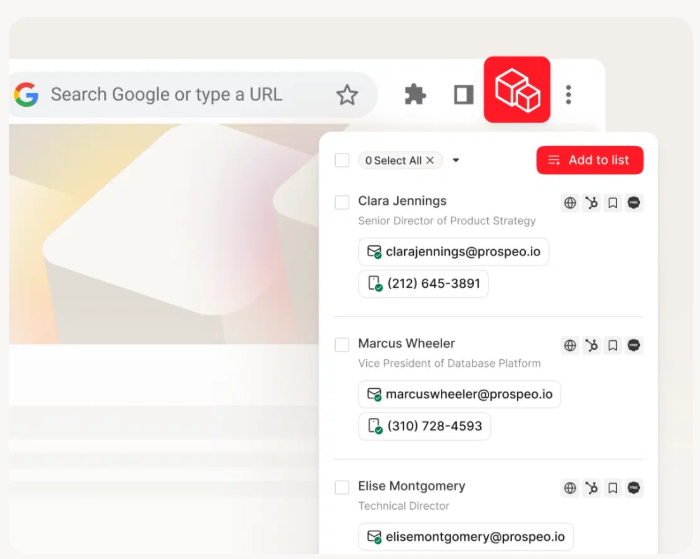
You've rehearsed the script, nailed the rubric, and mastered de-escalation. Now you need a list worth calling. Prospeo's 98% email accuracy and 7-day data refresh mean zero bounces burning your domain on day one.
Turn mock call confidence into booked meetings - free tier, no contract.
FAQ
How long should a mock call last?
Customer service mock calls run 5-10 minutes - long enough to cover the full call flow from greeting through resolution and close. Cold call roleplays should be 2-3 minutes, since real cold calls rarely go longer. A tight three-minute call scores higher than a rambling seven-minute one.
Can I use a mock calls script during an interview?
No. Interviewers test whether you've internalized the call flow, not whether you can read. Use scripts to prepare - practice until the structure feels natural - but don't bring notes into the actual assessment. Reading from a script is one of the fastest ways to fail a call center interview.
What score do I need to pass?
Most programs set pass thresholds around 75-85% on their rubric. Focus prep on Effective Listening (4 pts) and Tone (1 pt), which carry the most weight. A perfect greeting with poor listening still fails. Hit the high-weight categories first, then polish the rest.
How do I practice mock calls alone?
Record yourself reading both parts of a script, then play it back and score yourself against the rubric above. Mirror practice helps too - smiling changes your vocal tone, and customers can hear the difference. AI roleplay tools are another option; they're improving fast and beat silent script reading every time.
Where can I find more mock call examples for sales?
The B2B cold call, gatekeeper, and objection-handling scripts in this article are solid starting points. For more, listen to real recorded sales calls on platforms like Gong - hearing how top reps handle live objections gives you patterns you can fold into practice.