

Stop Motivating Your Sales Team. Start Removing What Demotivates Them.
It's Tuesday morning. Your top AE is quietly browsing job listings between calls. Down the hall, the sales manager types "Let's crush it this week" into Slack and genuinely believes they're helping.
Here's the gap nobody talks about: 89% of managers think their team is thriving, but only 24% of employees agree. That's not a motivation problem - it's a perception chasm, and it explains why most advice on motivating sales teams misses the mark entirely.
The Quick Version
Audit your comp plan for fairness before you try anything else. No amount of recognition fixes a broken pay structure. Replace performative recognition with specific, timely praise - "Great job on the Acme deal, your objection handling on the procurement call was sharp" beats "Way to go team!" every time. And give your reps data and tools they can actually trust. A rep who spends half their day chasing disconnected numbers isn't unmotivated. They're demoralized.
The Cost of Getting Motivation Wrong
Replacing a single sales rep now costs an average of $45,236. For a 20-person sales org with even modest turnover, that's a six-figure line item before you factor in ramp time, lost pipeline, and the morale hit to the reps who stayed. 50% of U.S. companies are bracing for higher turnover in 2026, up from 33% just two years ago.
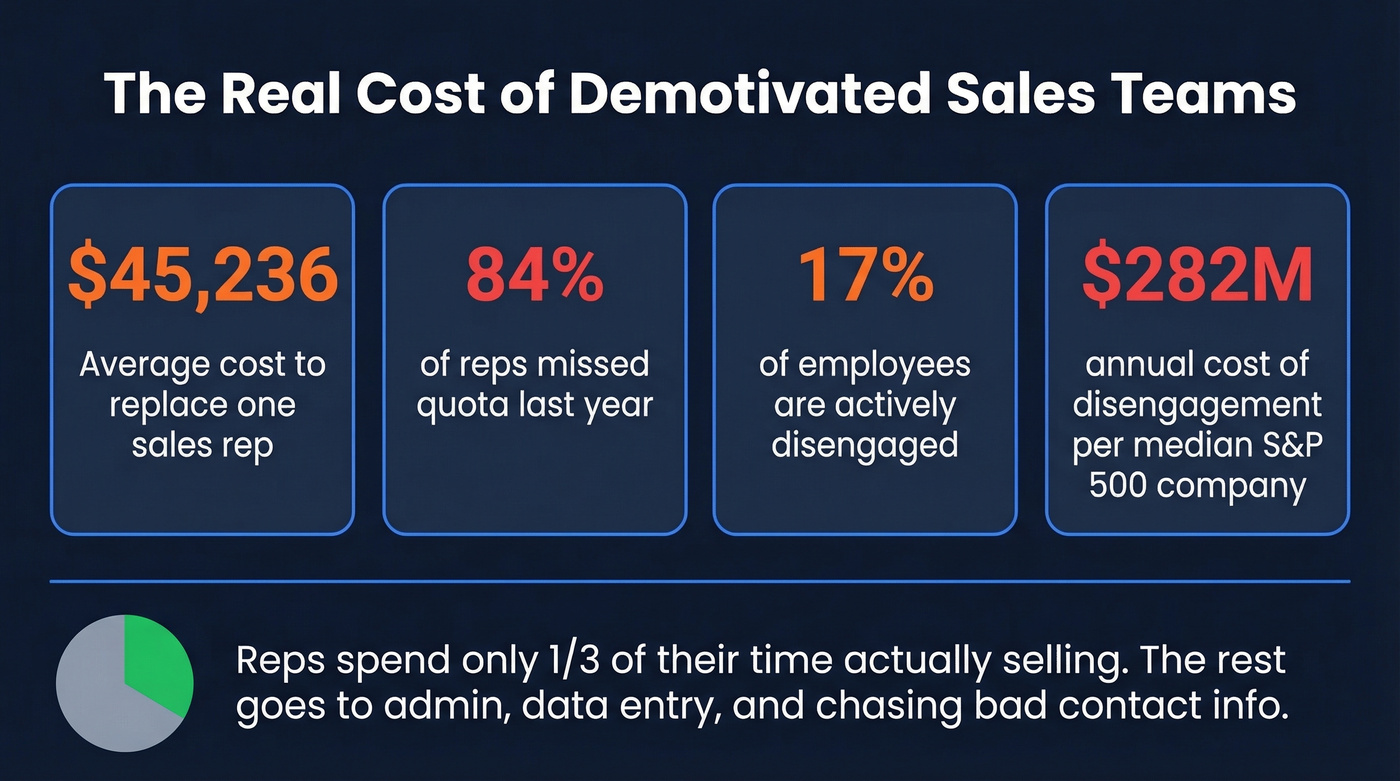
Across sales teams, quota attainment is brutal: 84% of reps missed quota last year. U.S. employee engagement sits at just 31%, with 17% actively disengaged. In sales specifically, 52% of leaders rate their team's engagement as "very low", and 70% say burnout is the primary barrier. Meanwhile, 90% of organizations cite retention as a top concern, with learning and development as a key lever.
A McKinsey estimate puts the cost of disengagement and attrition at $282M annually for the median S&P 500 company. Reps spend only a third of their time actually selling - the rest goes to admin, data entry, searching for contact information, and updating CRM fields. When your highest-paid revenue generators spend most of their day on tasks that don't generate revenue, motivation isn't the problem. The system is.
The Psychology Behind Sales Motivation
Abraham Maslow's hierarchy is a management cliche at this point. A more actionable framework comes from Edward Deci and Richard Ryan's Self-Determination Theory (SDT), which identifies three core psychological needs that drive sustained motivation: autonomy, competence, and relatedness.
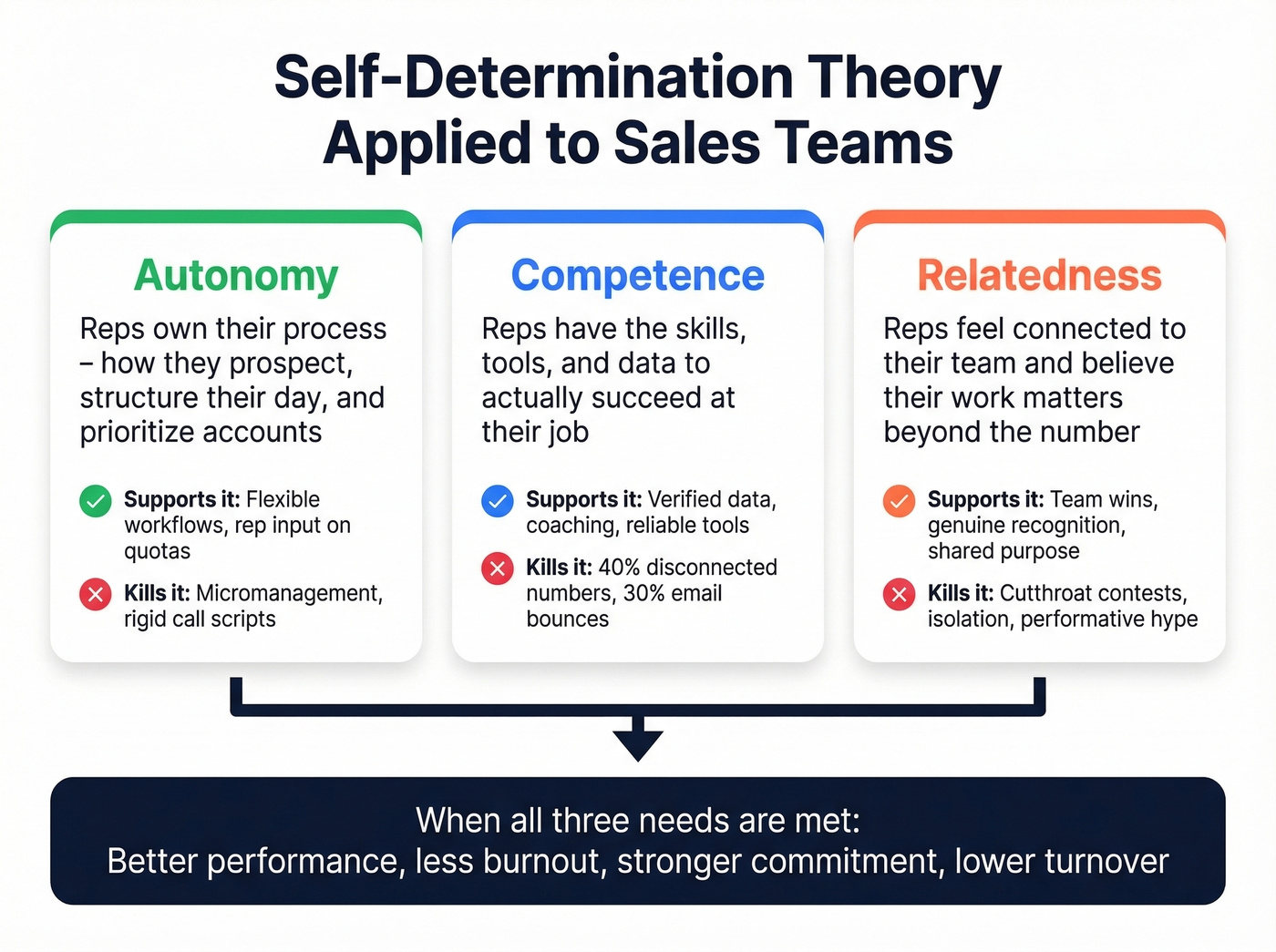
Autonomy means reps own their process - how they prospect, how they structure their day, which accounts they prioritize. Competence means they have the skills, tools, and data to actually succeed. Relatedness means they feel connected to their team and believe their work matters beyond the number.
Meta-analytic evidence shows that satisfying these three needs is associated with better performance, reduced burnout, stronger organizational commitment, and lower turnover intentions - a pattern replicated across dozens of studies and work contexts, including remote and hybrid environments. Every "motivation tactic" you deploy either supports or undermines one of these three needs. Contests can boost competence signals short-term but erode relatedness if they pit teammates against each other. Micromanagement destroys autonomy. Bad data undermines competence. Once you see motivation through this lens, the playbook gets much clearer.

You just read it: reps spend two-thirds of their day on tasks that don't generate revenue. Bad numbers, bounced emails, and manual data entry destroy the competence your team needs to stay motivated. Prospeo gives your reps 98% verified emails and 125M+ direct dials - so they spend time selling, not chasing dead leads.
Stop demotivating your team with bad data. Give them Prospeo.
What Actively Demotivates Reps
Most articles about how to motivate a sales team skip the part that matters most: what's actively killing motivation right now.
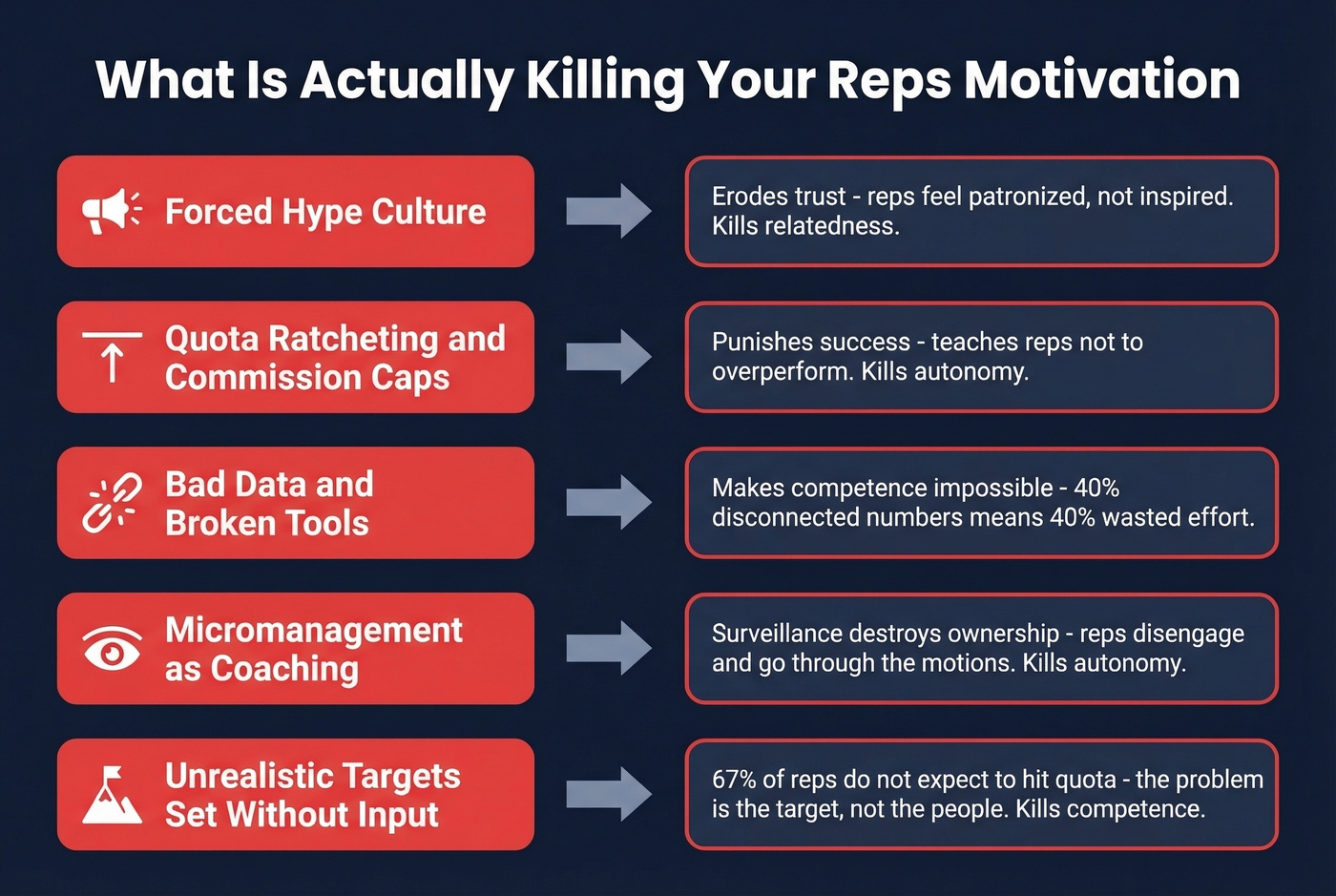
Forced Hype Culture
One rep on r/sales described daily "motivational" Teams messages - the "let's crush it" memes, the pump-up GIFs - as making them "feel ill." Another stated flatly:
"Your plan, contest, presidents club has zero influence on my performance."
When recognition feels performative, it doesn't just fail - it actively erodes trust.
Quota Ratcheting and Commission Caps
Nothing tells a rep "don't overperform" faster than capping their upside. Raising quotas every time someone hits target teaches the team that success gets punished. It's one of the most widely cited drivers of rep churn.
Bad Data and Broken Tools
Picture an SDR team making 200 calls a day. If 40% of the numbers are disconnected and 30% of their emails bounce, that rep isn't lazy - they're trapped in a system that makes competence impossible. This is the SDT violation nobody talks about in motivational sales articles.
Micromanagement Disguised as Coaching
"Let me listen to your calls" can be developmental or surveillance. Reps know the difference instantly. When every activity is tracked and scrutinized without context, autonomy evaporates.
Unrealistic Targets Set Without Input
If 67% of reps don't expect to hit quota this year, the problem isn't 67% of your reps. The problem is the quota.
Here's how common motivation approaches actually stack up:
| Approach | Short-Term Impact | Long-Term Impact | Risk |
|---|---|---|---|
| Contests / SPIFs | High (2-4 weeks) | Low | Entitlement creep |
| Comp redesign | Medium (1 quarter) | Very high | Needs leadership buy-in |
| Recognition programs | Medium | Medium-high | Performative if not genuine |
| Removing friction (data, tools) | High | Very high | ROI not immediately visible |
| Coaching / development | Low (slow ramp) | Very high | Requires skilled managers |
Strategies That Actually Work
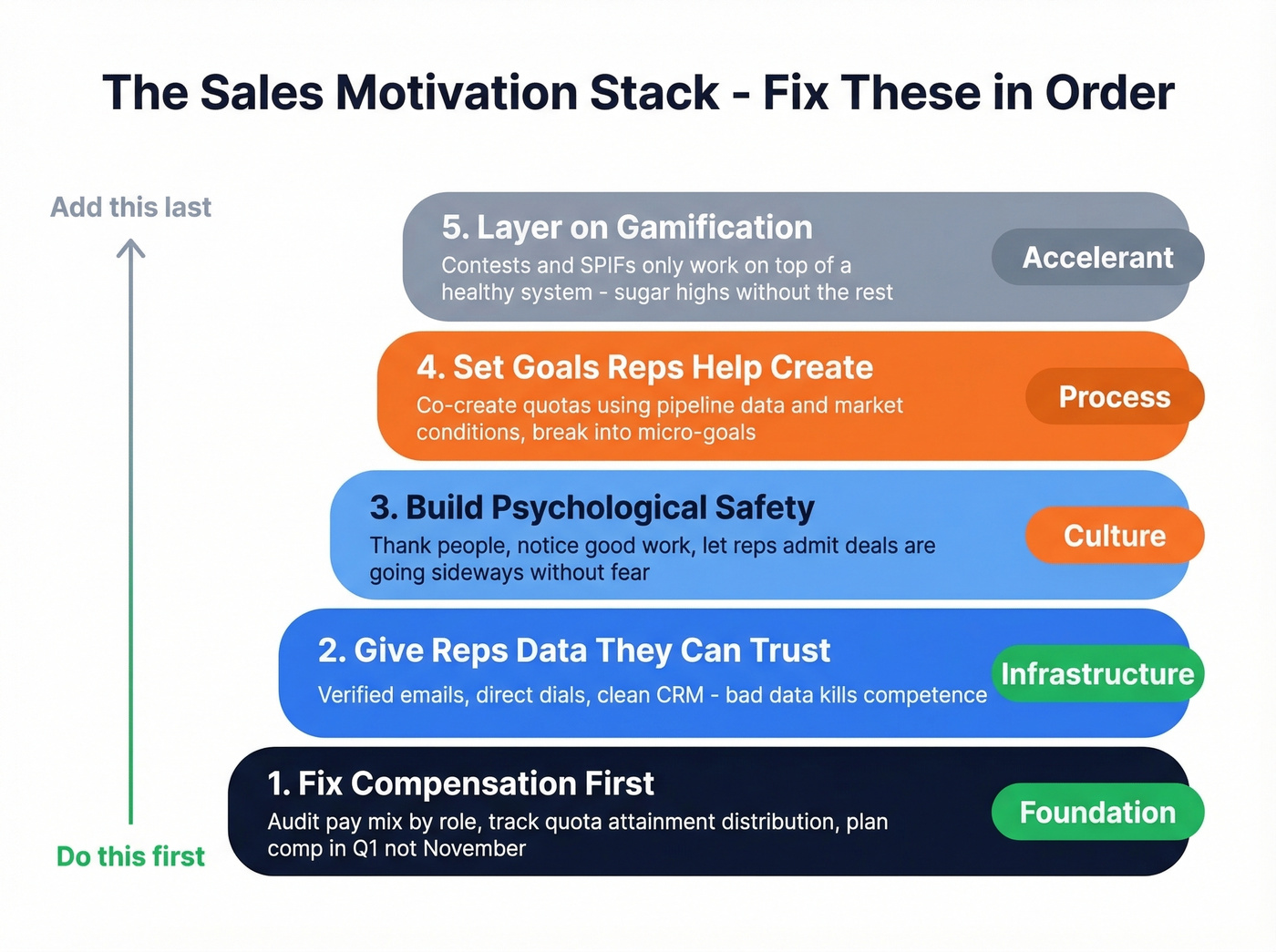
Fix Compensation First
Use this if: reps are underpaid with narrow commission structures, or more than 40% of the team is missing quota. One Reddit manager described exactly this - underpaid reps with commission tied only to a single product line, creating a "high barrier of entry" that made earning feel impossible.
Skip this if: your comp plan is already competitive and the real issue is tooling, culture, or management. Throwing money at a broken system just makes the system more expensive.
Pay mix should differ by role - more aggressive variable compensation for hunters, more base-weighted for customer success roles. Track quota attainment distribution quarter over quarter as your North Star metric. If the distribution is skewed left, your quotas are wrong, not your reps. And 31% of reps cite lack of bonuses as a key reason for quitting, while 43% cite insufficient benefits. Start comp planning in Q1 for the next fiscal year - not in November when it's too late.
Build Trust and Psychological Safety
Google's Project Aristotle study found that the single strongest predictor of high-performing teams wasn't talent, experience, or incentive structure. It was psychological safety - the belief that you won't be punished for making a mistake.
70% of workers say their motivation would improve if managers "just said thank you more and noticed good work." That's not a complicated intervention. A bottle of champagne on someone's desk when they close a big deal. A #kudos Slack channel where wins get called out with detail. Gold balloons tied to a chair after a milestone quarter. These aren't expensive - they're just intentional.
Let's be honest: most sales leaders overcomplicate motivation. If your reps feel safe enough to admit a deal is going sideways without fear of being publicly grilled, you've already won half the battle. Psychological safety isn't soft - it's the foundation everything else is built on.
Set Goals Reps Help Create
When reps participate in setting their own targets, you're directly feeding the autonomy need from SDT. This doesn't mean letting reps sandbag - it means using pipeline data, historical performance, and market conditions to co-create quotas that are ambitious but achievable. Break annual targets into micro-goals that create momentum. If 67% of your reps don't expect to hit quota, the target-setting process is broken. Fix the process before blaming the people.
Adapt Leadership to the Situation
In our experience, the best sales managers aren't consistently one type of leader - they shift gears. During a crisis quarter, decisive top-down direction works. When a rep is underperforming, a coaching approach beats a disciplinary one. When the team is hitting stride, step back and let autonomy do its work.
One r/sales thread captured this perfectly - a rep described being motivated "out of spite and ego" for years, then losing that drive entirely after outperforming peers and becoming financially secure. The motivation shifted, but the coaching didn't. Early-career reps often run on money and competition. Mid-career reps need mastery. Senior reps want purpose and impact. Coaching that treats a 10-year veteran like a first-year SDR doesn't just miss - it insults.
Use Gamification as Accelerant, Not Foundation
Gamification works when it's layered on top of a healthy system. Caixa Bank targeted a 5% increase in product sales through gamification and hit a 49% increase in six months. Published roundups associate gamification with roughly 48% higher engagement.
Here's the thing: contests without underlying systems are sugar highs. A two-week SPIF creates a two-week boost. Fair comp, realistic quotas, and reliable data create a two-year infrastructure. If your reps are already demoralized by bad tools or unfair pay, a leaderboard just makes the dysfunction more visible.
Give Reps Data They Can Trust
This is the motivation lever nobody talks about, and it's the most important one. Bad data directly violates the competence need from SDT. When a rep sends 100 emails and 35 bounce, they don't feel like a skilled professional - they feel like they're wasting their time. That's not a data problem. That's a motivation problem wearing a data costume.
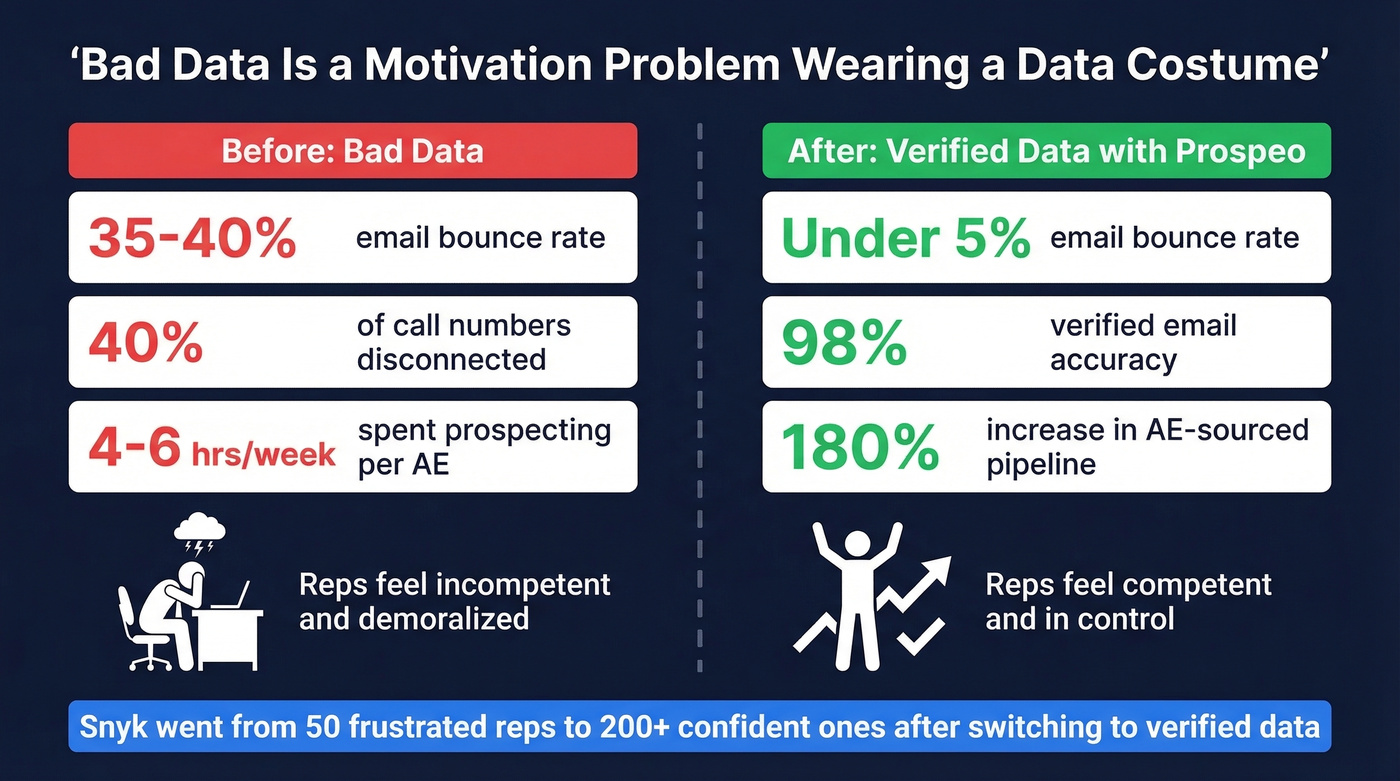
We've seen this play out at companies like Snyk. Fifty AEs were prospecting 4-6 hours per week with bounce rates running 35-40%. After switching to Prospeo, bounce rates dropped to under 5%, AE-sourced pipeline jumped 180%, and they went from 50 frustrated reps to 200+ new opportunities per month. That's the difference reliable data makes - 98% email accuracy, data refreshed every 7 days. Competence stops being a question and the pipeline follows.

Motivating Remote and Hybrid Teams
80% of B2B sales interactions now happen through digital channels, and 92% of B2B buyers prefer digital engagement. Remote selling isn't a pandemic holdover - it's the default. And it creates specific motivation failure modes that map directly to SDT: isolation erodes relatedness, delayed feedback undermines competence, and limited visibility into wins weakens autonomy.
The fixes require consistency more than creativity. Regular async recognition - a weekly wins thread, a recorded shoutout during all-hands - replaces the hallway high-five. Real-time feedback drives 12% higher productivity compared to delayed quarterly reviews. Virtual team rituals like Friday pipeline reviews, monthly skill-shares, or even a casual video chat with no agenda rebuild the relatedness that remote work erodes. 76% of leaders say team activities are the most effective tactic for retaining top sales reps. The investment is time, not money.
How to Measure Sales Motivation
If you can't measure it, you're guessing. Track quota attainment distribution quarterly - if the curve shifts left, your system is failing, not your people. Voluntary attrition rate is the ultimate lagging indicator; by the time it spikes, you're already behind. Run engagement surveys quarterly, not annually. Annual surveys capture resentment, not insight. 76% of sales leaders already use them.
Beyond those core metrics, watch ramp time for new hires - if it's getting longer, your onboarding or tooling has a problem. Track pipeline generated per rep, because uneven distribution signals coaching gaps or territory problems. Monitor activity-to-outcome ratios like calls-to-meetings and emails-to-replies. When those ratios degrade, the issue is usually data quality or targeting, not effort.
The pattern we see repeatedly: teams invest in motivation programs but never instrument the feedback loop. You wouldn't run a marketing campaign without tracking conversion. Don't run a motivation strategy without tracking outcomes.
If 40% of your SDRs' calls hit disconnected numbers, that's not a motivation problem - it's a data problem. Prospeo's 7-day refresh cycle and 30% mobile pickup rate mean your reps actually reach real buyers. At $0.01 per email, fixing this costs less than one week of wasted rep time.
Reps who connect with buyers don't need motivational Slack messages.
FAQ
How do you motivate a struggling sales team?
Start by diagnosing the root cause - comp, quotas, tooling, or culture. If 84% of reps missed quota industry-wide, the problem is likely structural. Audit comp fairness, check quota attainment distribution, and ask reps directly what's blocking them before layering on incentives.
What motivates salespeople the most?
Autonomy, competence, and belonging outperform extrinsic drivers long-term, according to Self-Determination Theory research. But compensation is the floor - 31% of reps cite lack of bonuses as a key reason for quitting. Get comp right first, then invest in psychological needs.
Do sales contests actually work?
Short-term, yes - gamification can boost engagement by roughly 48%. But contests without fair comp, realistic quotas, and reliable data are sugar highs that fade in 2-4 weeks. Pair them with systemic fixes like better tooling and co-created goals for lasting impact.
How does bad data affect sales team morale?
Directly and severely. When bounce rates hit 30-40%, reps feel incompetent despite doing everything right - a core SDT violation. Snyk cut bounce rates from 35-40% to under 5% and saw AE-sourced pipeline jump 180%, proving data quality is a motivation lever most leaders overlook.