

Negative Replies: What They Mean, How to Handle Them, and How to Get Fewer
You open your inbox to five angry replies before 9 AM. "Remove me from your list." "I have no idea who you are." "This is completely irrelevant." It stings - but in most cold email campaigns, a large share of responses are some version of "not interested." Negative replies aren't the exception. They're the norm.
The question isn't how to eliminate them. It's how to get fewer hostile ones and handle the rest without burning time or your domain.
Here's the thing most people get wrong: hostile responses usually aren't a messaging problem. They're a data problem. Fix the data, and a big chunk of your angry inbox disappears overnight.
What Counts as a Negative Reply
A negative reply is any response to cold outreach that isn't moving toward a conversation. They fall into four categories, and each one tells you something different about what went wrong.
"Not interested." The classic brush-off. Most common, least useful - it tells you almost nothing about why.
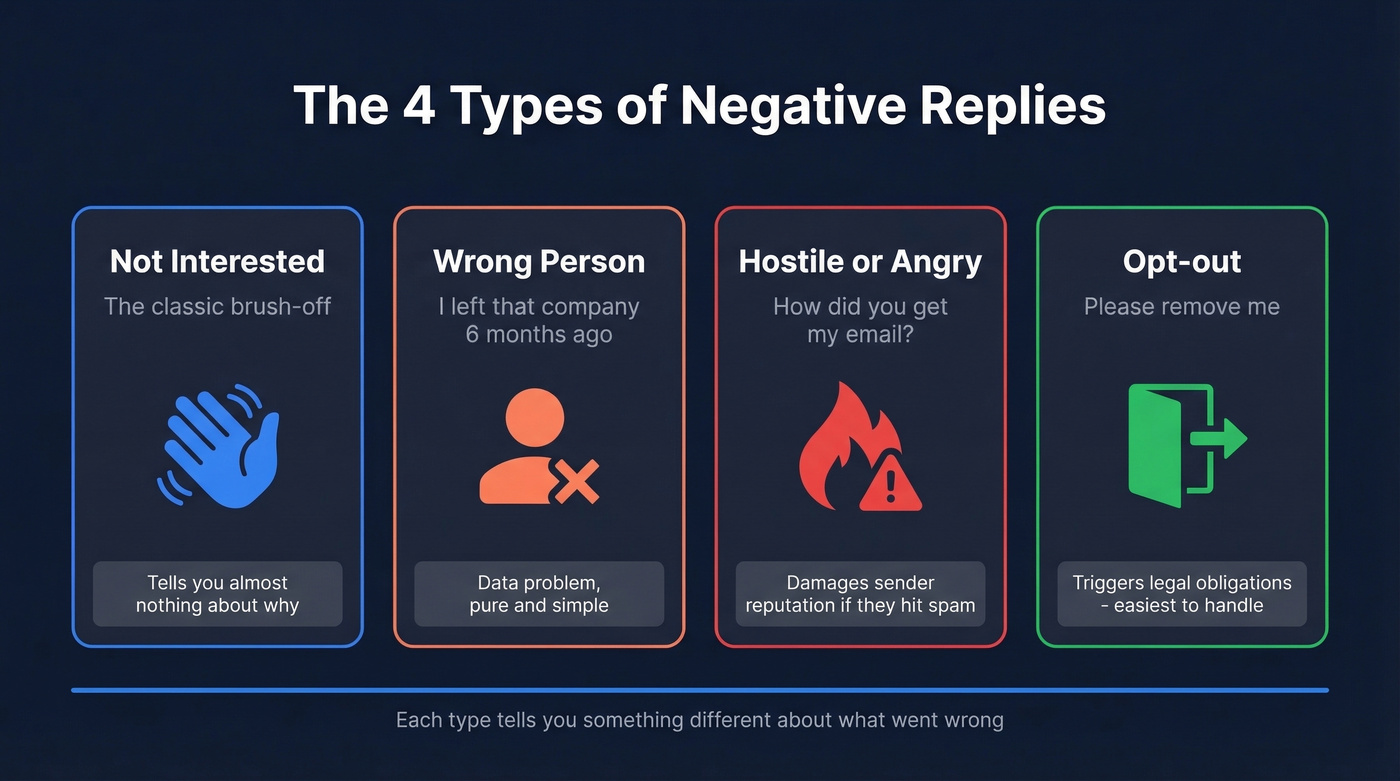
"Wrong person." "I left that company six months ago" or "I don't handle procurement." This is a data problem, pure and simple.
Hostile or angry. "How did you get my email?" or "This is spam." These rattle reps and damage your sender reputation if the recipient hits the spam button.
Opt-out. "Please remove me." Straightforward, triggers legal obligations, easiest to handle.
With cold email reply rates often in the low single digits, every reply carries weight. Knowing which type you're dealing with determines whether you respond, learn, or just move on.
Why Prospects Send Hostile Responses
Most guides obsess over subject lines and opening hooks. That's the last thing to fix. Here are the actual causes, ranked by impact from our experience running and auditing hundreds of outbound campaigns.
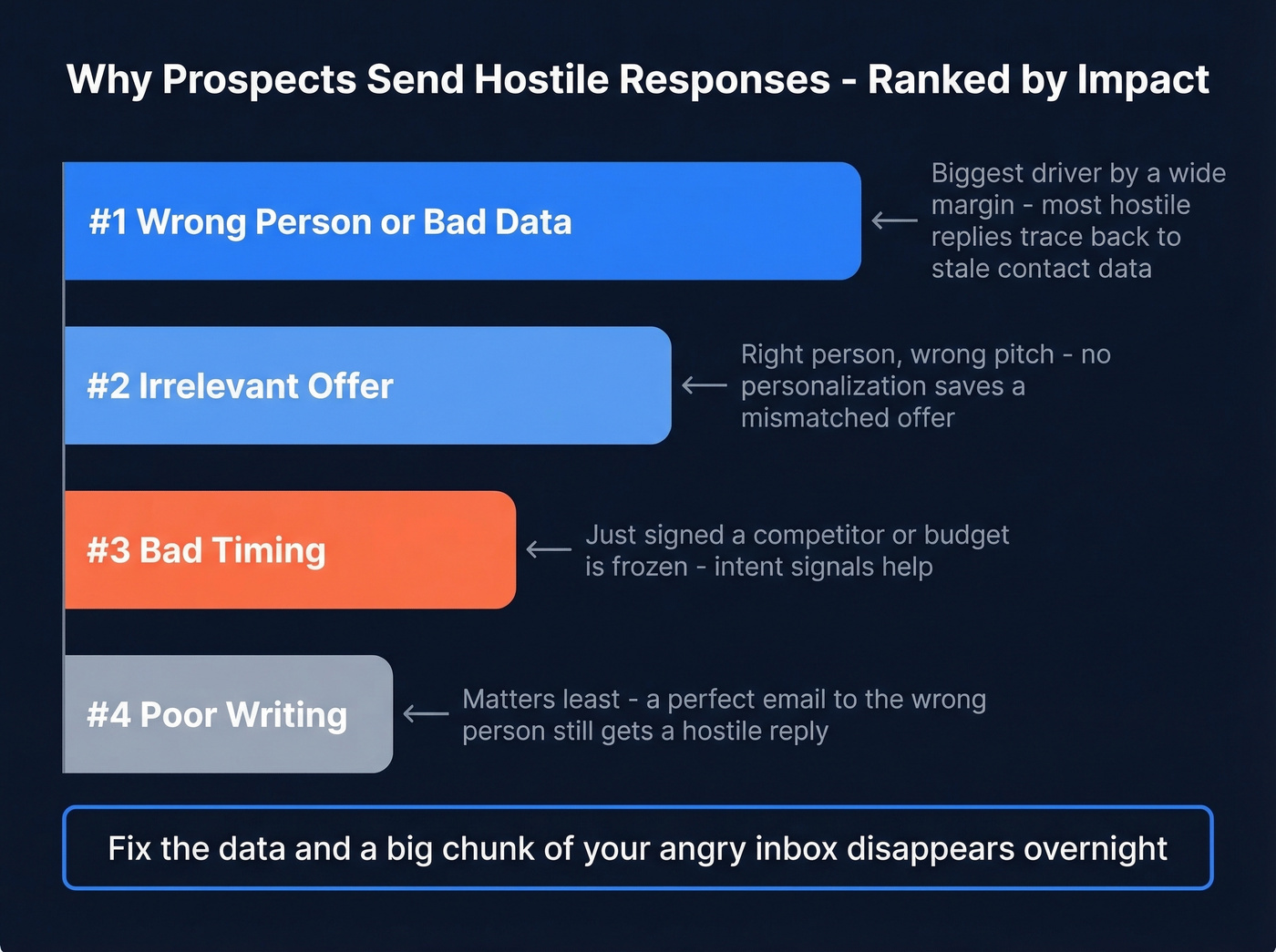
#1: Wrong person or bad data. This is the biggest driver by a wide margin. You're emailing someone who left the company, changed roles, or was never the right contact. We've seen it over and over - most hostile responses trace back to stale contact data. When your email reaches someone who actually holds the role you're targeting, at the company they still work for, the "who are you?" reply drops fast. Snyk's team saw bounce rates fall from 35-40% to under 5% after switching to verified data, and the downstream effect on negative replies was immediate.
#2: Irrelevant offer. Right person, wrong pitch. A VP of Engineering doesn't care about your marketing automation tool. No amount of personalization saves a fundamentally mismatched offer.
#3: Bad timing. They just signed a competitor. Budget's frozen. You can't control this, but intent signals reduce its frequency.
#4: Poor writing. A perfectly written email to the wrong person still gets a hostile response. Copy matters, but it matters least.

Stale data is the #1 cause of hostile replies. Prospeo's 5-step verification with catch-all handling and spam-trap removal ensures 98% email accuracy - so you stop emailing people who left the company six months ago.
Clean data means fewer angry inboxes and more real conversations.
Why Negative Replies Actually Matter
A negative reply is engagement data. It's infinitely better than silence or landing in spam.
"Not interested" tells you the email arrived, got opened, and prompted action - the timing was off, or the persona needs adjusting, but your deliverability is working. That's useful information.
But too many complaint-type responses damage your domain reputation. If recipients hit "report spam," your future emails land in junk - even for prospects who'd genuinely want to hear from you. Under CAN-SPAM, you must honor opt-outs within 10 business days. GDPR requires handling erasure requests without undue delay. Ignoring either isn't just rude; it's a legal risk that can cost you real money.
How to Respond to Each Type
Let's break this down by reply type, because the wrong response to a hostile email can do more damage than the original send.
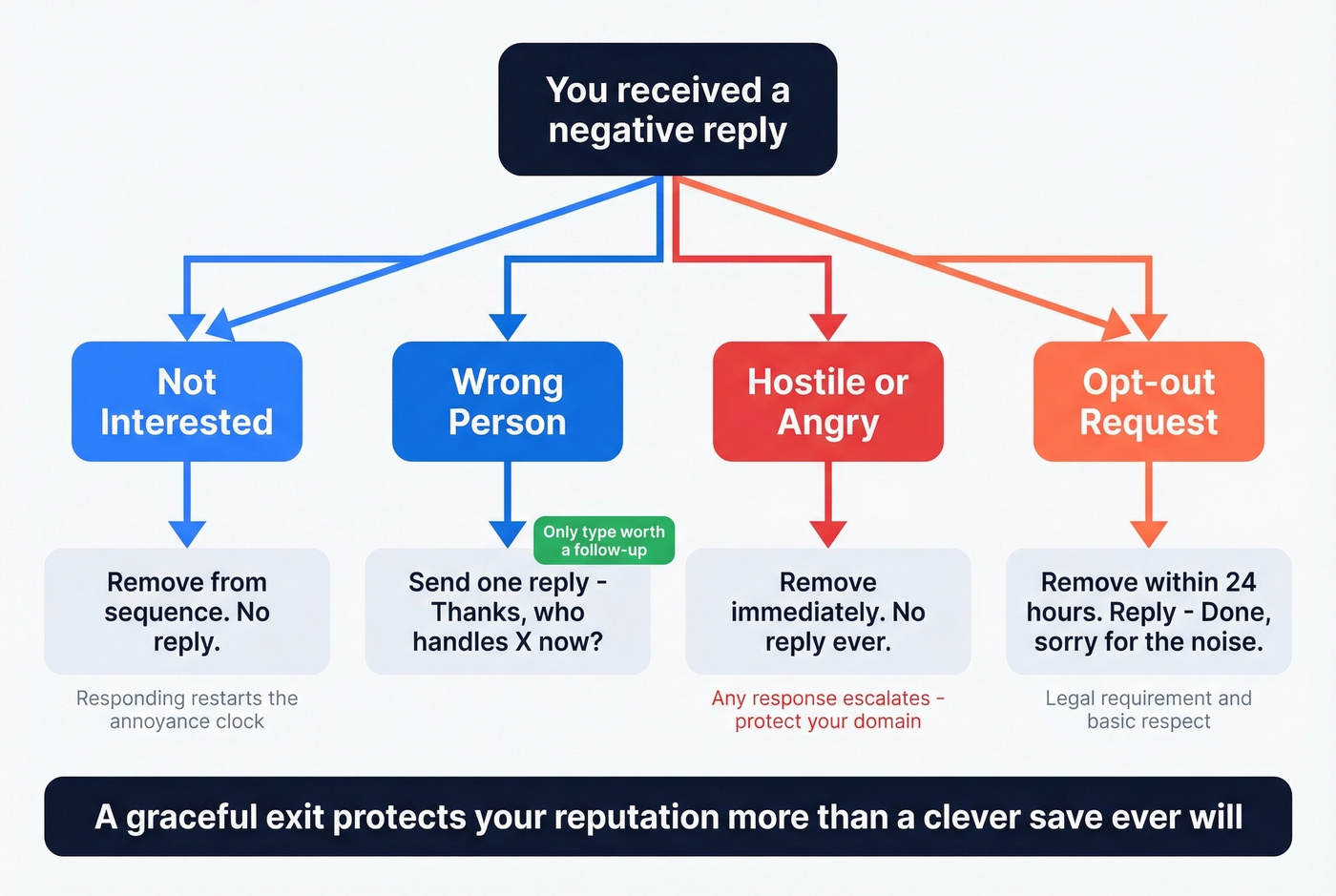
| Reply Type | Action | Why |
|---|---|---|
| Not interested | Remove from sequence. No reply. | Responding restarts the annoyance clock. |
| Wrong person | One-sentence redirect: "Thanks - who handles X now?" | The only negative reply worth a follow-up. |
| Hostile/angry | Remove immediately. No reply. | Any response escalates. Protect your domain. |
| Opt-out | Remove within 24 hours. Reply: "Done - sorry for the noise." | Legal requirement and basic respect. |
A graceful exit protects your reputation more than a clever save ever will. Skip the urge to "handle the objection" on hostile replies - there's no objection to handle, just someone who wants you gone.
How to Reduce Negative Replies
We've tested this across hundreds of campaigns, and data verification moves the needle more than any subject line tweak, template rewrite, or send-time optimization. Here's the priority list.
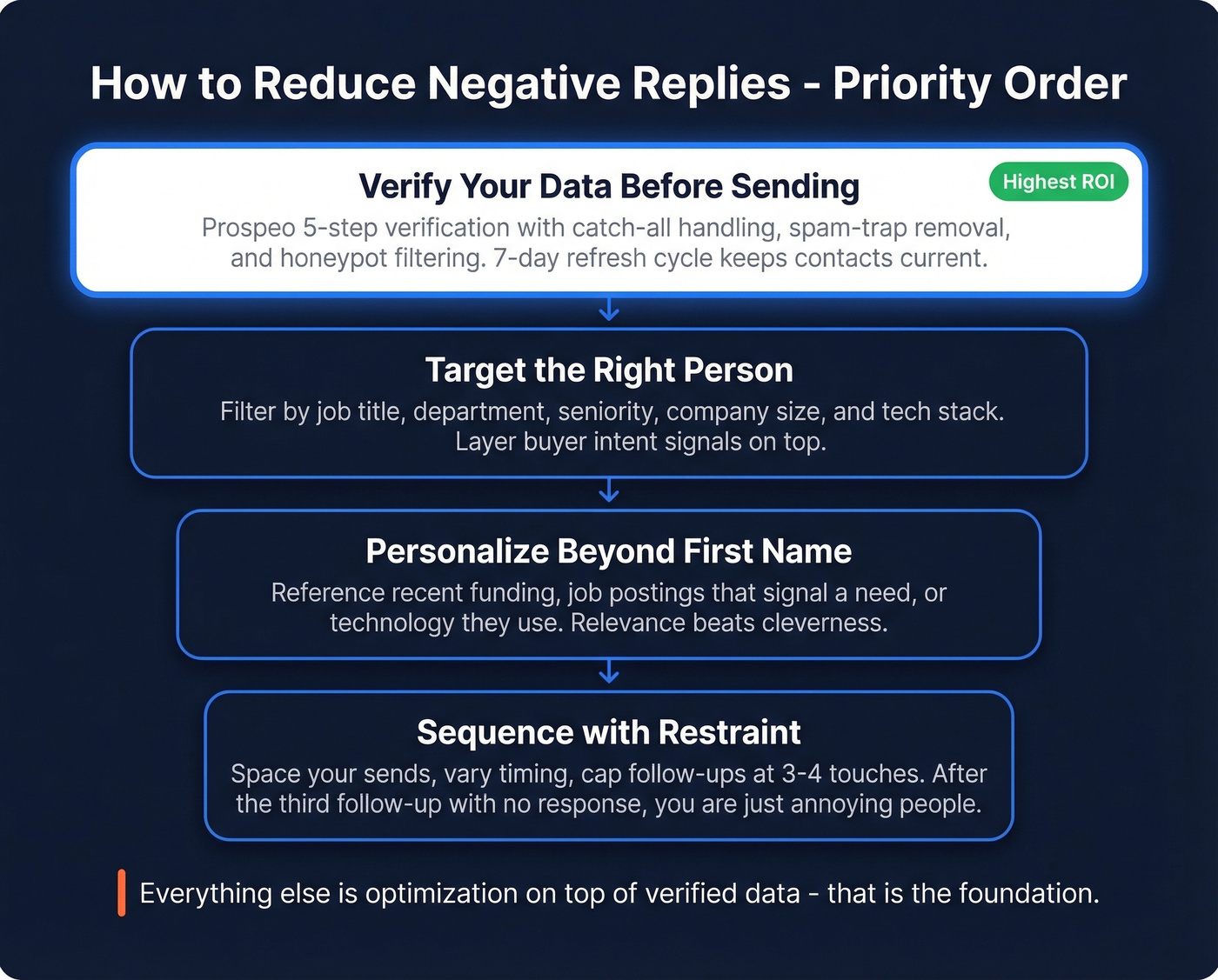
Verify your data before sending. Not after. Prospeo's 5-step verification process with catch-all handling, spam-trap removal, and honeypot filtering catches the garbage before it hits anyone's inbox. With a 7-day data refresh cycle - about 6x more frequent than the industry average - contacts stay current instead of decaying into angry strangers.
Target the right person. Use filters for job title, department, seniority, company size, and tech stack to narrow your list to people who'd actually care. Layering buyer intent signals on top means you're reaching people who are actively researching solutions like yours, not just people who match a job title.
Personalize beyond {first_name}. Reference their company's recent funding round, a job posting that signals a need, or a technology they're using. Generic templates generate generic rejections. Relevance beats cleverness every time.
Sequence with restraint. Space your sends, vary timing, and cap follow-ups at 3-4 touches. Hammering someone's inbox is the fastest way to turn indifference into anger. The consensus on r/sales is pretty clear: after the third follow-up with no response, you're just annoying people.
The single highest-ROI action? Verify your data before you send. Everything else is optimization on top of that foundation.
FAQ
How many negative replies are normal in cold email?
Expect 30-60% of all replies to be some form of rejection. If hostile or angry responses exceed 10% of total replies, your list quality or targeting needs immediate attention - the issue is almost always bad data, not bad copy.
Should I reply to a "not interested" email?
No. Remove the prospect from your sequence and move on. Replying to a "not interested" message restarts the annoyance cycle and increases the chance they report you as spam, which hurts deliverability for your entire domain.
What's the fastest way to reduce angry prospect replies?
Verify every email address before sending and confirm contacts still hold the role you're targeting. A 7-day data refresh cycle keeps records current, while 5-step verification removes spam traps and invalid addresses - the two biggest triggers for hostile responses.
Are negative replies worse than no reply at all?
Not necessarily. A "not interested" confirms deliverability and inbox placement. Silence might mean your email landed in spam. The exception: complaint-type responses where recipients mark you as spam directly damage sender reputation and are genuinely worse than silence.
Wrong person, wrong company, wrong role - that's what triggers the "How did you get my email?" replies. Prospeo refreshes 300M+ profiles every 7 days and layers 30+ filters including buyer intent, so every send reaches someone who still holds the title and actually cares.
Stop generating rejection. Start generating pipeline at $0.01 per verified email.