

Nonverbal Buying Signals: Read Buyers Right in 2026
The prospect nodded through your entire demo. Asked sharp questions about implementation timelines. Leaned forward when you showed the ROI slide. Then ghosted you for three weeks and chose a competitor.
If that sounds familiar, you've learned the hard lesson: nonverbal buying signals are prompts, not proof. Individual cues are invitations to ask better questions - not green lights to skip discovery. Here's what actually works in person, on calls, and on video.
Why Most Body Language Advice Is Wrong
You've seen the stat: "55% of communication is body language." It's a popular simplification of Mehrabian's work, and it's widely misapplied outside the narrow emotional-expression context it came from. A 2023 paper in Perspectives on Psychological Science identified "decodable body language" as a persistent misconception - one of those "zombie ideas" that survive despite disconfirming evidence. Microexpression-style "emotion decoding" has faced similar scrutiny. A frown can mean anger, concentration, remembering, or physical exertion.
This doesn't make nonverbal cues useless. It makes them starting points.
Buying Signals That Matter: In Person, On Calls, and On Video
In Person: Clusters Over Single Cues
Forget isolated gestures. Nodding alone is politeness. Nodding combined with leaning forward, sustained eye contact, and operational questions like "How would implementation work?" - that's a genuine signal worth acting on.
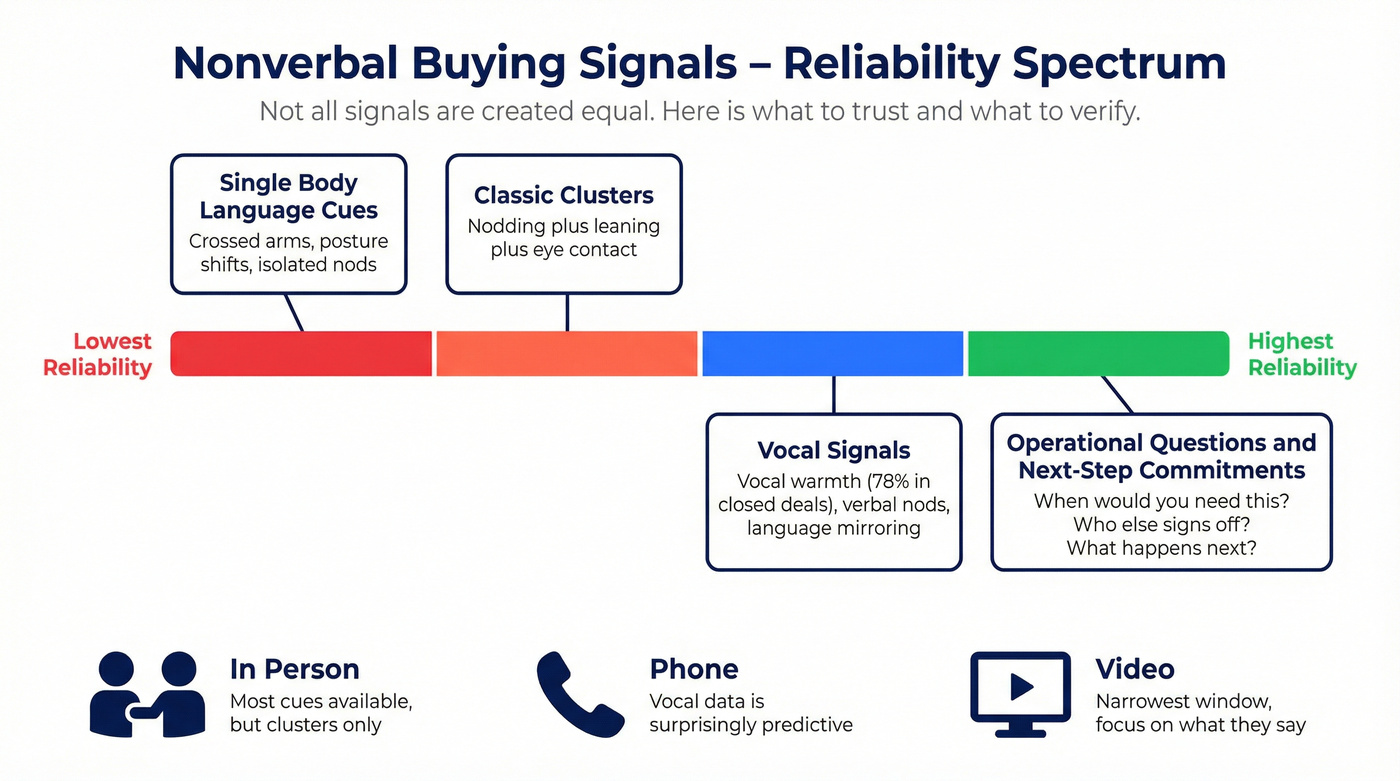
The strongest in-person cue we've observed is physical product interaction. At trade shows, picking up a product and flipping the price tag is self-qualifying behavior. The prospect is mentally pricing the purchase before you've pitched. Watch for stress indicators too: normal blink rate runs 15-22 times per minute, and a spike means stress. Stress means you need to ask more questions, not push harder.
Here's the thing: when someone says "great" while their head shakes "no," surface it directly. Try something like, "I hear you, but I'm sensing something else going on."
On the Phone: The Data Is Surprisingly Clear
In one practitioner analysis of 5,427 sales calls shared on r/SaaS, vocal warmth appeared in 78% of closed deals versus 29% of lost ones. "Verbal nodding" - those mm-hmms and yeahs - averaged 12.4 per call among top closers versus 2.1 among bottom performers. Mirroring the prospect's language correlated with a 1.8x close rate.
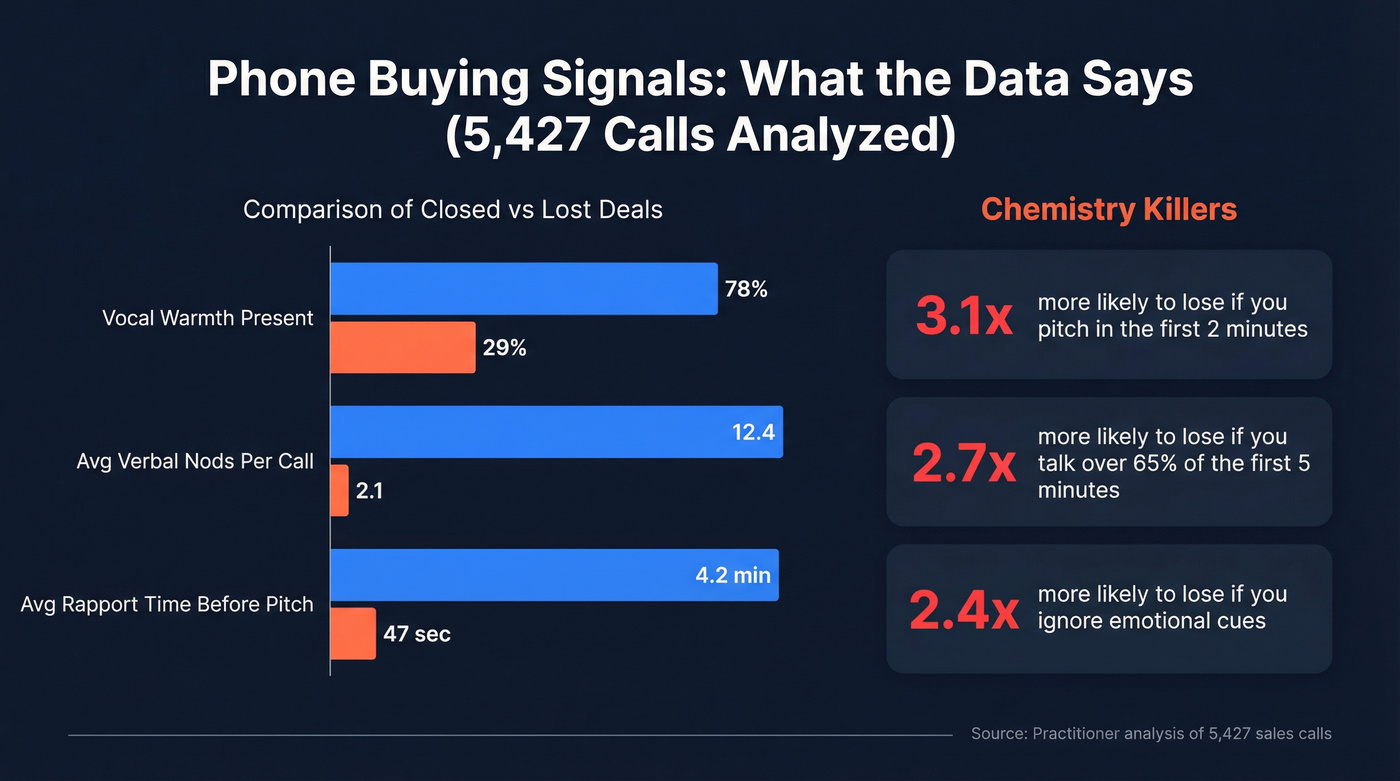
Rapport timing was equally striking. Closed deals averaged 4.2 minutes of rapport-building before product discussion. Lost deals? Forty-seven seconds.
The chemistry killers nobody talks about: Pitching within the first 2 minutes makes you 3.1x more likely to lose the deal. Talking more than 65% of the first 5 minutes? That's 2.7x more likely to lose. Ignoring emotional cues entirely? 2.4x.
Let's be honest - if your close rate is below 20%, the problem probably isn't your pitch deck or your pricing. It's that you're talking too much in the first five minutes.
On Video: Less Data, Higher Stakes
Video narrows the cue window. You lose lower body, peripheral gestures, and spatial context. Prospects form judgments in under seven seconds on camera, so your setup matters more than you think.
Look into the camera lens, not the on-screen face. Move your meeting window near the lens to make this feel natural. Higher vocal pitch reads as nervous, not energetic - aim for steady and warm.
Crossed arms on video are often perceived as closed off, but context matters: temperature, posture, whether they're taking notes. Camera off is usually neutral. Don't assume it's negative.
Two signals most reps miss: rushed pacing (a sign you're losing them) and silence. When a prospect goes quiet after a key point, don't fill it. That silence can mean they're processing, and processing is exactly what you want. The strongest video buying signal isn't visual at all - it's whether the prospect asks what happens next.

Nonverbal cues only work when you're in the room. For the 47% of buyers consuming content before they ever talk to sales, you need digital buying signals. Prospeo tracks 15,000 intent topics via Bombora and pairs them with 98%-accurate verified emails and 125M+ direct dials - so you reach prospects while they're still in-market.
Stop guessing who's interested. Start seeing who's actually researching your category.
Cross-Cultural Traps
Before you universalize any cue, consider where your buyer sits.
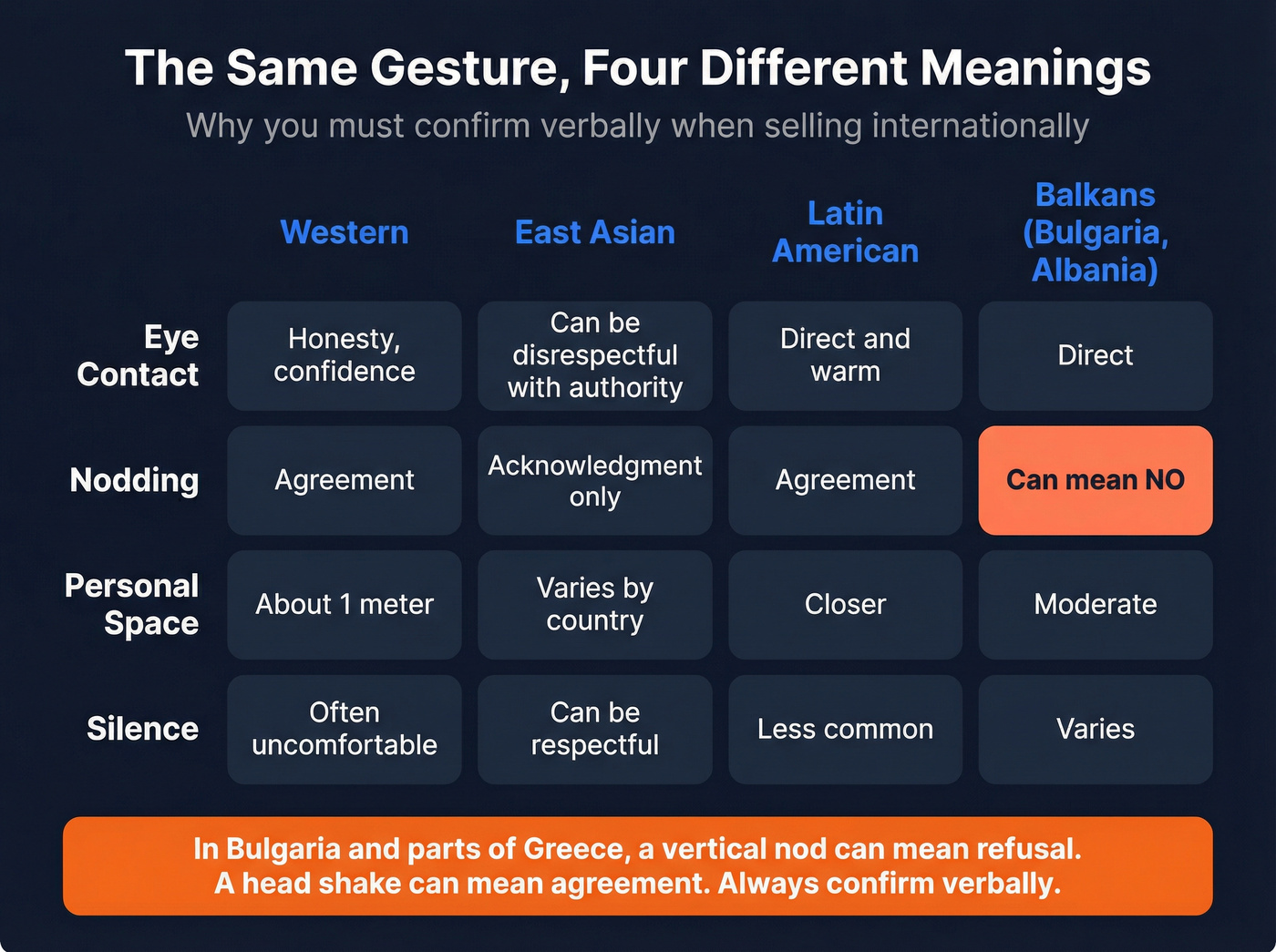
| Cue | Western | East Asian | Latin American | Parts of the Balkans |
|---|---|---|---|---|
| Eye contact | Honesty, confidence | Can be disrespectful with authority | Direct, warm | Direct |
| Nodding | Agreement | Acknowledgment | Agreement | Can invert (Bulgaria/Albania) |
| Personal space | ~1 meter | Varies by country | Closer | Moderate |
| Silence | Often uncomfortable | Can be respectful | Less common | Varies |
In Bulgaria, Greece, and Albania, a vertical nod can signal refusal while a head shake means agreement. When selling internationally, always seek explicit verbal confirmation. We learned this the hard way on a deal with a Sofia-based team - three "yes" nods that turned out to mean "I hear you," not "I agree."
The 5-Step Confirmation Framework
Every nonverbal cue should funnel into this process:
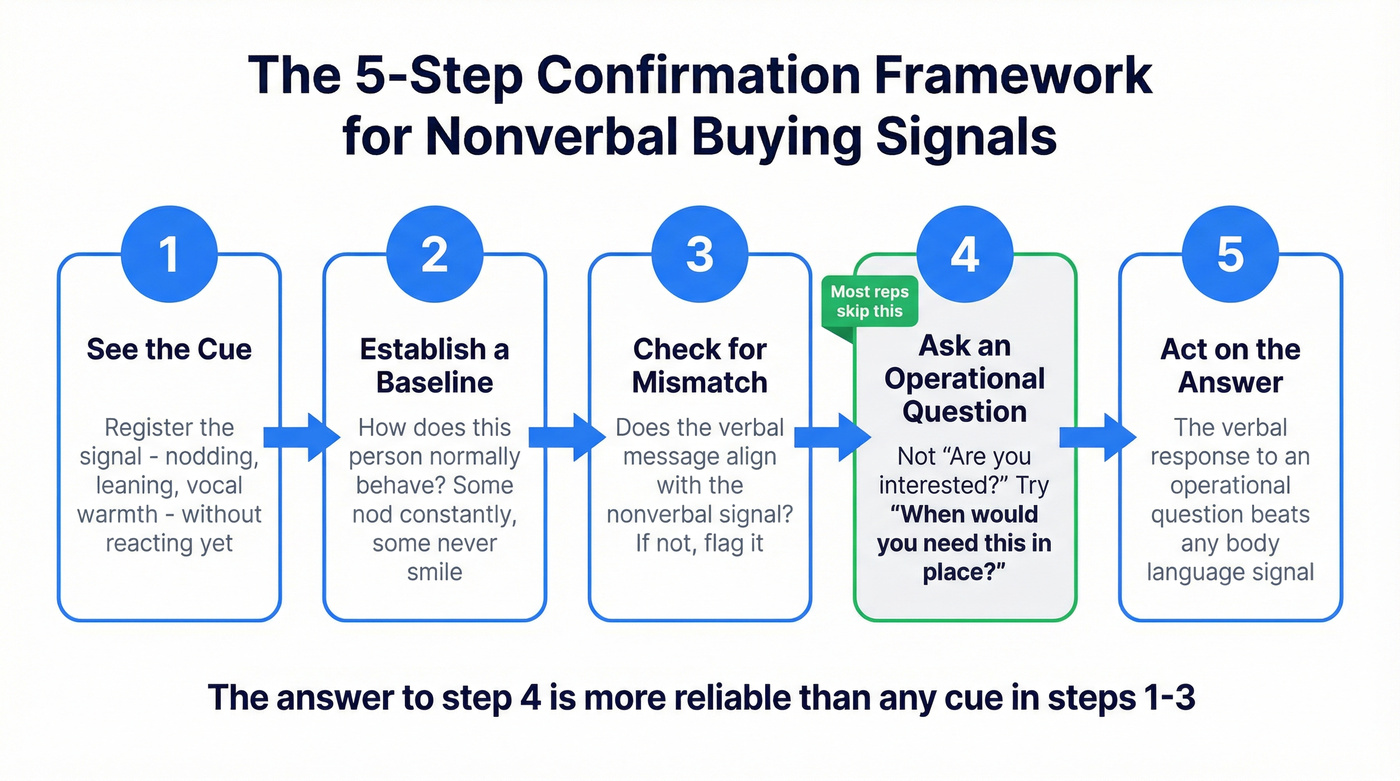
- See the cue. Nodding, leaning, vocal warmth - register it without reacting.
- Establish a baseline. How does this person normally behave? Some people nod constantly. Some never smile.
- Check for mismatch. Does the verbal message align with the nonverbal signal?
- Ask an operational question. Not "Are you interested?" Try "When would you need this in place?" or "Who else needs to sign off?" These presuppose purchase and force a real answer. In our experience, this is where most reps skip ahead and lose deals they thought they'd won.
- Act on the answer, not the cue. The verbal response to an operational question is more reliable than any body language signal. Full stop.
| Signal Type | Reliability |
|---|---|
| Operational questions and next-step commitments | Highest |
| Product handling and price checking | High |
| Vocal warmth and verbal acknowledgments | Medium-High |
| Classic body language cues (arms, posture) | Lowest alone |
When You Can't See the Buyer at All
For cold outreach and account prioritization, you need digital buying signals instead. 47% of buyers consume 3-5 pieces of content before ever talking to sales. Companies researching your category throw off intent signals - pricing page visits, content downloads, topic surges - that function like watching a prospect flip a price tag at a trade show. According to InsideSales research, you're 7x more likely to have a meaningful conversation if you reach out within an hour of detecting a signal.
Skip this section if your team only sells in person at events. But for anyone running outbound, intent data is the digital equivalent of reading a room. Prospeo tracks 15,000 intent topics via Bombora and pairs that data with 98%-accurate verified emails and 125M+ verified mobile numbers, so you know who's in-market and can reach them while they're still warm.
The best buying signal isn't a nod or a lean - it's a prospect actively researching your category right now. Prospeo surfaces those signals across 15,000 topics, then gives you verified contact data (98% email accuracy, 125M+ mobiles) to act within the hour. At $0.01 per email, no contracts, no sales calls required.
Reach in-market buyers before they ghost you for a competitor.
FAQ
What are the strongest nonverbal buying signals?
Clusters of cues beat any single gesture. Nodding combined with leaning forward, sustained eye contact, and operational questions like "When would you need this?" is the most reliable pattern. On calls, vocal warmth and verbal acknowledgments predict closed deals at 78% versus 29% for lost ones.
How do nonverbal cues differ on video calls?
You lose lower body and spatial context, so focus on vocal tone, silence after key points, and whether the prospect asks follow-up questions. Camera-off is usually neutral - don't read it as disengagement. The strongest video signal is the prospect asking what happens next.
Can you detect buying signals in digital channels?
Yes - through intent data rather than body language. Content consumption patterns, pricing page visits, and topic surges all indicate purchase readiness before a call ever happens. Tools that track intent topics and pair signals with verified contact data let you reach in-market buyers within the hour, before a competitor does.
Why do single body language cues mislead salespeople?
Because context changes meaning. Crossed arms can signal cold temperature, not resistance. Nodding can be cultural politeness, not agreement. Without baselining a prospect's normal behavior and confirming with an operational question, you're guessing - and guessing costs deals.