

Objection Handling Techniques: Scripts, Data, and Frameworks From 300M+ Calls
A rep on your team just heard "not interested" for the ninth time today. They're tweaking their script again, adding another paragraph to the email template, searching for "how to overcome price objections." They're solving the wrong problem.
The best objection handling techniques aren't about memorizing more scripts - they're about mastering fewer, better ones. Gong's analysis of 300M+ cold calls reveals that 74% of all objections come from just five types. Most reps are memorizing responses to objections they'll rarely hear. Let's fix that.
The Short Version
- Master 5 scripts, not 15. The top five objections cover nearly three-quarters of all pushback. Get those right and you've handled the vast majority of calls.
- Use the Voss method over acronym frameworks. Labels and mirrors outperform Feel-Felt-Found and every other acronym-based system because they uncover what the prospect actually means, not what they said.
- Fix your data first. If you're calling someone who left the company six months ago, no script saves you. Verify contacts before you dial.
Why This Matters More in 2026
Buyers are harder to reach and harder to convince than they were even two years ago. 96% of prospects research before engaging a rep, and 71% prefer doing their own research over talking to you at all. When they do pick up, 81% of revenue leaders say deals are more complex than ever.
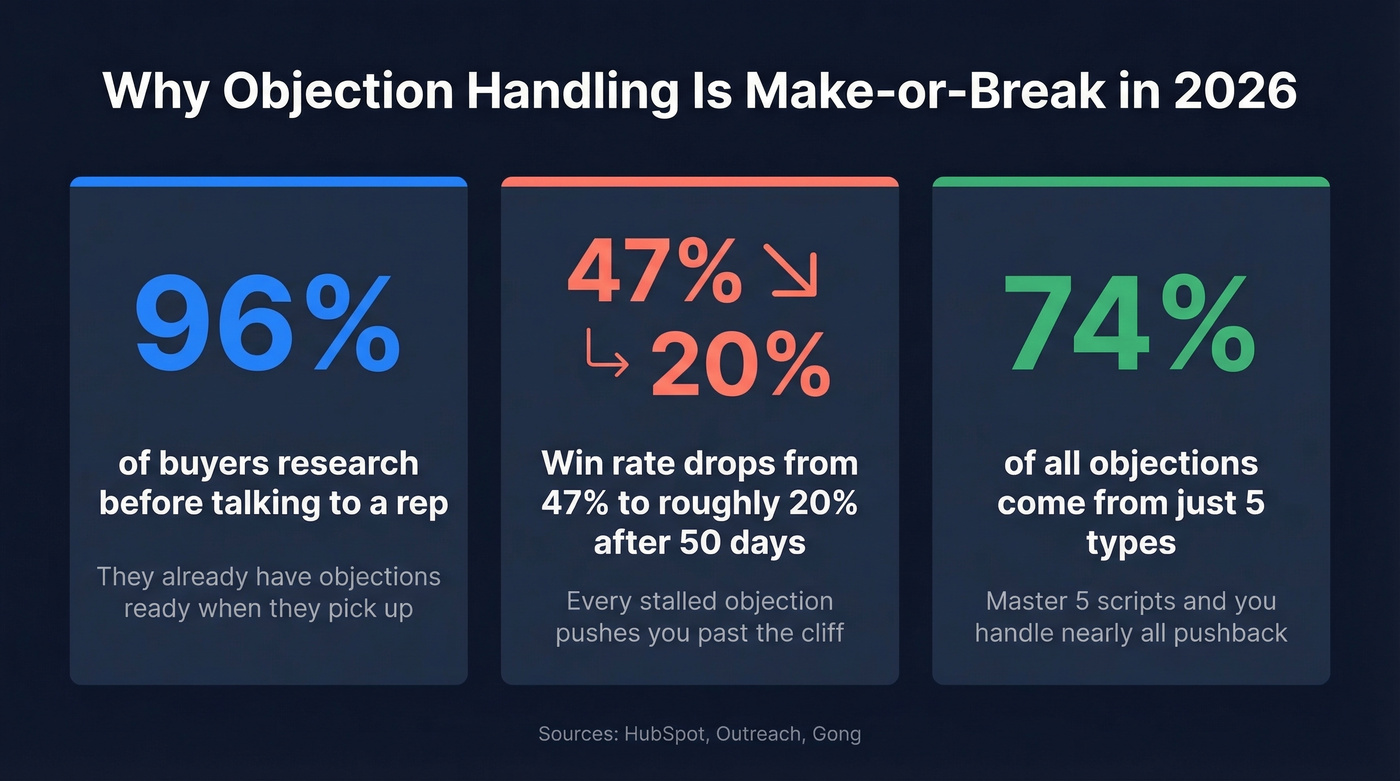
Here's the number that should scare you: Outreach's analysis found that opportunities closed within 50 days carry a 47% win rate - but after that window, win rates crater to roughly 20%. Every unresolved objection that stalls a deal pushes you past that cliff. Strong objection handling isn't a soft skill anymore. It's the mechanism that keeps pipeline velocity inside the window where deals actually close, and the difference between a team that hits quota and one that spends Q4 making excuses.
Three Types of Sales Objections
Most reps think about objections by topic - price, timing, authority, need. That's the wrong lens. Gong's data breaks objections into three behavioral types, and the type determines your response more than the specific words do.
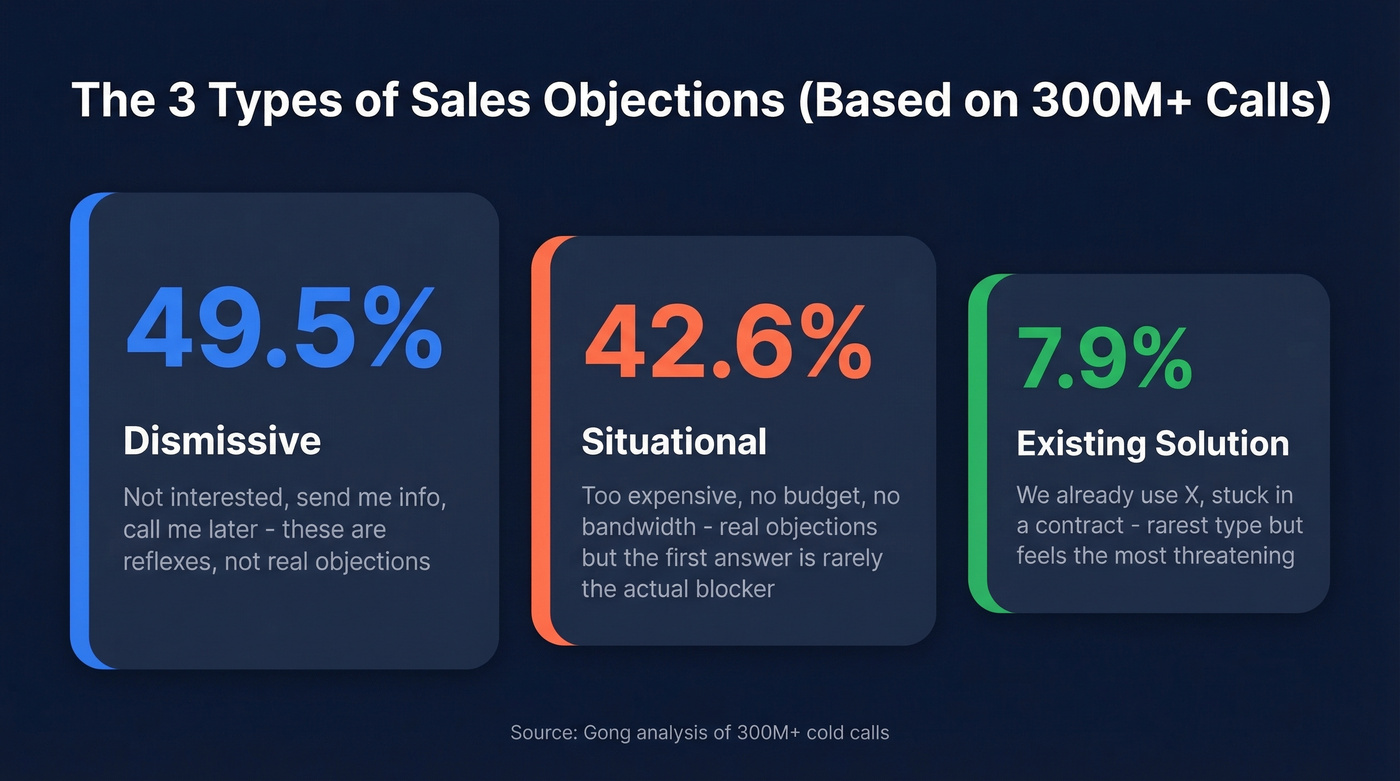
Dismissive objections make up 49.5% of all objections. "Not interested," "send me info," "call me in 6 months," "is this a cold call?" These aren't real objections. They're reflexes. The prospect is trying to end the conversation, not evaluate your product.
Situational objections account for 42.6%. "Too expensive," "no budget," "no bandwidth," "not sure it fits." These are real but often layered - the first thing they say isn't the actual blocker. Your job is to diagnose, not defend.
Existing solution objections are just 7.9%. "We already use X," "stuck in a contract," "we handle it in-house." These are the rarest but feel the most threatening. The instinct to attack the competitor is strong here - and it's almost always wrong.
7 Proven Techniques With Copy-Paste Scripts
1. The Disarmingly Blunt Response
The objection: "Not interested" / "Is this a cold call?"
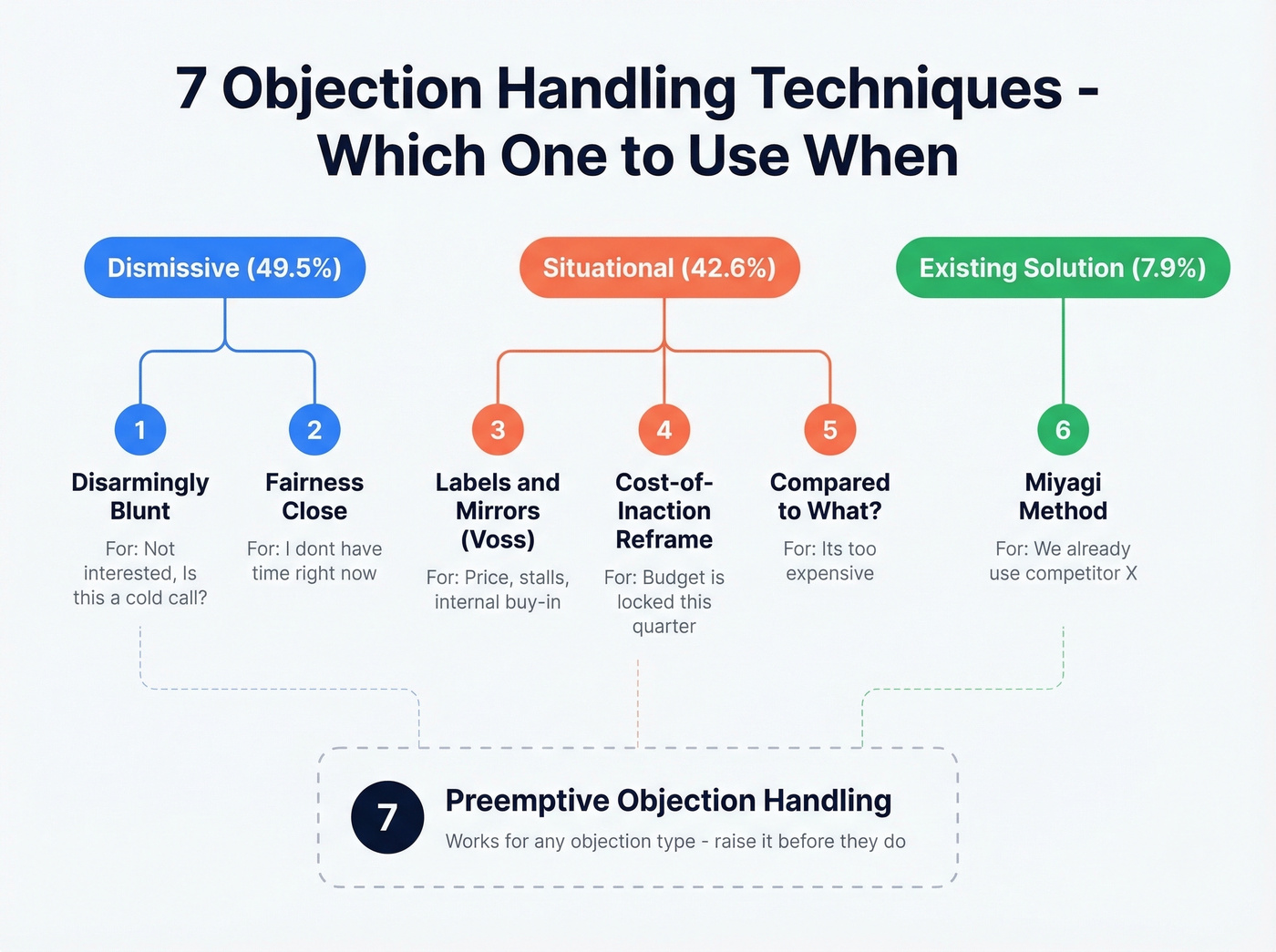
What to say: "Yeah, it is - I figured I'd be honest about that. I'm calling because [one-sentence reason tied to their role]. If that's not relevant, I'll let you go."
Dismissive objections are reflexes, not decisions. Gong's cold-call research shows that the "Disarmingly Blunt" approach - transparency plus a little humor - reduces tension enough to get past the reflex and into an actual conversation. The prospect expects you to dodge. When you don't, they pause. That pause is your opening.
2. The Fairness Close
The objection: "I don't have time right now."
What to say: "Totally get it - all I'm asking for is 30 seconds. If what I share is relevant, we can put time on the calendar. If not, you can hang up on me." Pause. "Does that sound fair?"
Morgan Ingram's script uses a simple psychological trigger - most people don't want to appear unfair. The "does that sound fair?" question almost always gets a yes. Once you have 30 seconds, the 70/30 talk-time rule kicks in: let the prospect talk 70% of the time after your pitch.
Don't cram a full pitch into those 30 seconds. You're not selling - you're earning the next five minutes.
3. Labels and Mirrors - The Voss Method
This one works differently because you're not responding to the objection at all. You're reflecting it back until the prospect reveals what's actually going on.
For price objections: "It sounds like the value just isn't there for you." For stalls: "Some time to think about it?" For internal buy-in: "What specifically are you going to tell them about our conversation?"
Chris Voss's labels and mirrors make the prospect correct you - and in correcting you, they reveal the real objection. When you say "the value isn't there," most prospects will say "no, the value is fine, it's just that..." and hand you the actual blocker. The calibrated question on champion building forces them to rehearse your pitch internally, which dramatically increases the odds they'll sell it for you.
This is one of the strongest objection handling techniques for reps who are comfortable reading conversational cues in real time. It's also the hardest to teach, which is why we recommend starting newer reps on simpler frameworks first.
4. Cost-of-Inaction Reframe
When NOT to use this: If the prospect has genuinely zero budget authority, this reframe will feel tone-deaf. Save it for prospects who have influence but are stalling.
The objection: "Budget is locked this quarter - maybe next year."
What to say: "Jordan, just so I'm clear - if this backlog compounds like it has, we're talking about 300+ hours lost by next fiscal. Is there usually a process for surfacing that kind of operational risk to leadership now, or would it make sense for us to map out the cost together so you're ready when it comes up?"
This script, pulled from a practitioner thread on r/sales, reframes the conversation from "can we afford this?" to "can we afford not to?" It quantifies the cost of delay in terms the prospect's leadership cares about, and it offers to co-create the internal business case rather than pushing for an immediate close. Loss framing is consistently more motivating than gain framing - but personalizing the reframe with the prospect's specific data is what separates a good response from a generic one.
5. "Compared to What?"
The objection: "It's too expensive."
What to say: "Compared to what?"
Three words. That's it. They separate price objections from value objections instantly. If the prospect compares you to a competitor, it's a positioning conversation. If they compare you to doing nothing, it's a budget conversation. If they can't answer, the objection isn't real - they're testing you. This diagnostic question, highlighted across expert consensus on Featured.com, prevents the most common mistake in sales: discounting before you understand the problem.
6. The Miyagi Method
The objection: "We already use [competitor]."
What to say: "That makes sense - [competitor] is solid. Out of curiosity, if you could change one thing about how it works for your team, what would it be?"
Gong's research is clear: never attack the current solution. The prospect chose it, and attacking it means attacking their judgment. The agree-then-question flow lets them voice frustrations on their own terms. We've seen reps blow deals by leading with "well, unlike [competitor], we..." - the prospect shuts down immediately.
Let them sit with the frustration before you pitch. Ask a follow-up. Then, and only then, connect their gap to your solution.
7. Preemptive Objection Handling
The objection: Any - before the prospect raises it.
What to say: "Before we go further - most teams I talk to at this stage are worried about [specific concern]. Is that on your mind too, or is there something else?"
Bringing up the objection yourself removes the adversarial dynamic entirely. The prospect doesn't have to "confront" you with bad news during a discovery call. It builds trust, signals that you've done this before, and lets you control the framing. The key is specificity - don't say "any concerns?" Say the actual concern you know they're thinking about.

Every unresolved objection stalls your deal past the 50-day cliff. But the objection you can't script around? Calling someone who left the company. Prospeo's 7-day data refresh and 98% email accuracy mean your reps reach real decision-makers - so their objection handling skills actually get used.
Fix your data before you fix your scripts.
Framework Comparison
| Framework | Best For | Weakness | Verdict |
|---|---|---|---|
| 4 Ps (Pause, Probe, Provide, Prove) | New reps needing structure | Mechanical in practice | Best starter framework |
| 3 Fs (Feel, Felt, Found) | Empathy-heavy conversations | Prospects see through it | Outdated - skip it |
| LAER (Listen, Acknowledge, Explore, Respond) | Complex enterprise deals | Most reps skip Explore | Good if fully executed |
| Voss Method (Labels, Mirrors, Calibrated Qs) | Experienced reps, any stage | Requires real practice | Most effective overall |
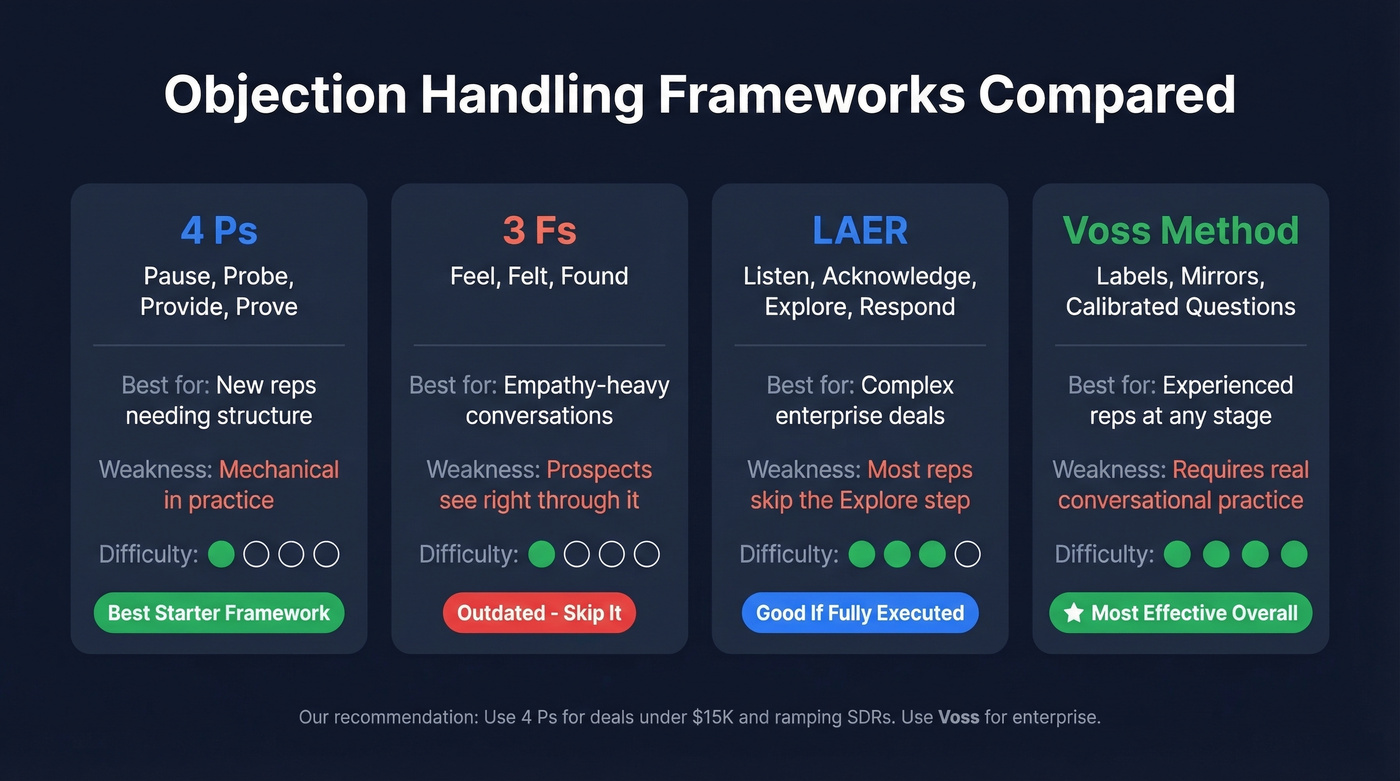
Let's be honest: Feel, Felt, Found sounds scripted the moment it leaves your mouth. Prospects have heard it a thousand times. The Voss method is the most effective system for experienced reps who can read a conversation in real time. But for ramping new SDRs, start them on the 4 Ps framework - we've tested all four with ramping SDR teams, and the 4 Ps produce the fastest improvement because the forced pause alone fixes the biggest rookie mistake.
Our take: If your deals typically close under $15K, you probably don't need the Voss method. The 4 Ps with solid buying signal data will outperform a sophisticated negotiation framework on short-cycle deals every time. Save Voss for enterprise.
Enterprise vs. SMB Playbooks
The objections your reps face depend heavily on who they're selling to, and most training glosses over this entirely.
Enterprise deals skew toward compliance, security, risk mitigation, and multi-stakeholder alignment. Highspot's research confirms that regulated industries generate objections around data governance and vendor risk that simply don't exist in SMB sales. Team-selling involvement has surged in complex deals, which means your champion needs to handle objections internally without you in the room - and that's exactly why the calibrated question from Technique #3 matters so much at this level.
SMB deals are a different animal. The prospect is often the decision-maker and the implementer. They're not worried about compliance reviews - they're worried about whether they'll actually use the tool after buying it. Your scripts need to address "will this be worth my time?" more than "will this pass procurement?"
6 Mistakes That Kill Your Win Rate
1. Discounting too fast. The moment a prospect says "too expensive," most reps reach for a discount. This trains buyers to object on price every time and erodes your margins permanently. Diagnose first. Discount last - or never.
2. Treating the first objection as real. The expert consensus is overwhelming: the first objection is usually a smoke screen. "No budget" often means "I don't see the value." "Bad timing" often means "I'm not the decision-maker." Probe before you respond.
3. Defending instead of diagnosing. When a prospect pushes back, the instinct is to explain why they're wrong. That instinct is the enemy. Ask a question instead. Every time.
4. Talking too much after the objection. The 70/30 rule is the single easiest improvement most SDR teams can make. After you respond to an objection, stop talking. The silence is uncomfortable - and it's supposed to be.
5. Ignoring data quality. Look, if you're calling someone who left the company, reaching a non-decision-maker, or dialing a dead number, you're generating "not interested" objections that have nothing to do with your pitch. Tools like Prospeo with a 7-day data refresh cycle catch job changes and number updates that most databases miss for weeks - the industry average refresh cycle is six weeks. Fix the inputs before you blame the script. If you're building a repeatable outbound motion, start with a cold calling system and a clean list from data enrichment services.
6. Not knowing when to walk away. Not every objection is worth handling. If you're getting the same circular pushback after multiple attempts, the prospect is genuinely a bad fit. Walk away and spend that energy on accounts that can actually close.
Fix Your Data Before Your Talk Track
Half the "not interested" responses your team hears aren't objections - they're the result of calling the wrong person at a dead number. In our experience, cleaning up contact data before launching a new sequence reduces false objections by 30-40% on its own, before you change a single word of your script.
Prospeo verifies emails at 98% accuracy and delivers mobile numbers with a 30% pickup rate. Upload a CSV, run verification, and push clean contacts to your sequencer via HubSpot, Salesforce, Outreach, or Lemlist. The free tier gives you 75 verified emails per month to test it - enough to see whether cleaner data actually moves your connect rate. If you're troubleshooting deliverability, use our email bounce rate benchmarks and the email deliverability guide before scaling volume.
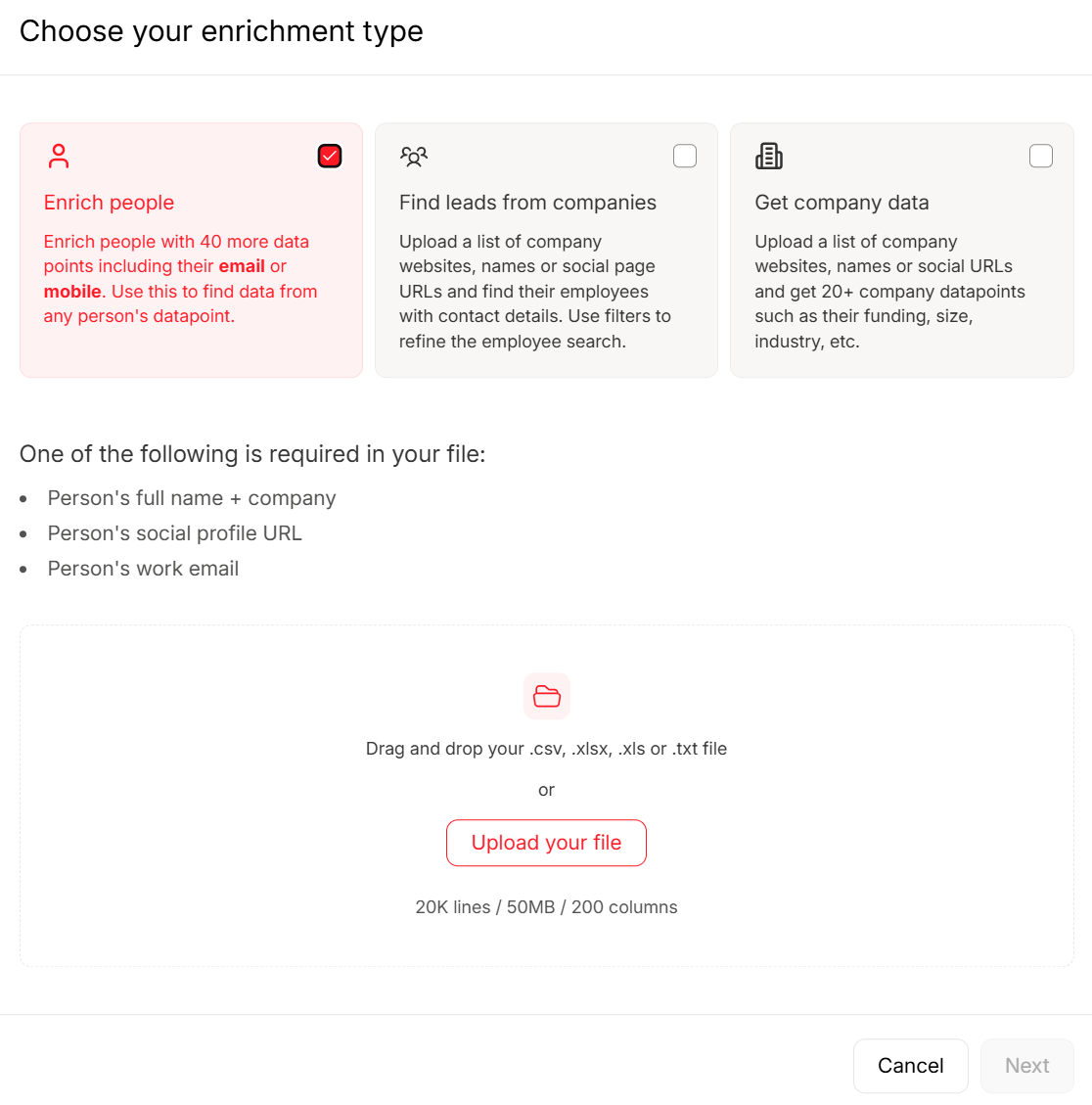
Your reps can master every Voss label and mirror technique - but if 35% of their calls bounce, they never get the chance. Teams using Prospeo cut bounce rates below 4% and connect with 125M+ verified mobile numbers at a 30% pickup rate. More live conversations means more objections handled, more deals closed.
Stop rehearsing scripts for voicemails that never land.
FAQ
What are the 4 Ps of objection handling?
Pause (don't react emotionally), Probe (ask clarifying questions to find the real objection), Provide (offer relevant information that addresses the actual concern), and Prove (back it up with evidence - case studies, data, ROI calculations). It's the best starter framework for newer reps who need a repeatable structure on calls.
How do you handle "it's too expensive" without discounting?
Ask "compared to what?" to isolate whether it's a price or value issue. Then use a Voss label: "It sounds like the value just isn't there for you." Let the prospect correct you - they'll reveal the real constraint, which is rarely the number itself. Discount only after you've exhausted every other lever.
What is the LAER method?
Listen, Acknowledge, Explore, Respond - a four-step framework from Carew International. Its strength is the Explore step, which forces reps to clarify objections with questions before jumping to a response. Most reps skip straight from Acknowledge to Respond, which defeats the entire purpose.
How many objection scripts do I actually need?
Five. Gong's data shows the top five objections account for 74% of all pushback on cold calls. Master those before memorizing 15 responses you'll rarely use. Once those five are second nature, add scripts for industry-specific or deal-stage-specific objections.
What's the best free tool for reducing bad-data objections?
Prospeo's free tier gives you 75 verified emails and 100 Chrome extension credits per month - enough to test whether cleaner data reduces your "not interested" rate. Other free options include Hunter (25 searches/mo) and Snov.io (50 credits/mo), though neither matches the same email accuracy or refresh frequency.