

The One Call Close Playbook: Framework, Scripts, and Data That Work
It's Monday morning. Your manager's circling deals older than seven days on the pipeline report, asking why they're still open. You know the answer - half of them shouldn't have been multi-call deals in the first place. The other half needed more discovery before anyone picked up the phone.
The one call close sits right at that intersection: a technique that works beautifully when the conditions are right and blows up in your face when they're not.
What a Single-Call Close Actually Requires
Closing a deal in one call means qualifying, presenting, handling objections, and securing commitment in a single conversation. No follow-up sequence. No "let me send you a proposal." One call, one decision.
Three things have to be true before you attempt it:
- Right deal profile. Low price point, simple product, single decision-maker, sales cycle under a month.
- Pre-call intelligence. You know who you're calling, what they care about, and whether they can actually buy.
- Structured framework. Not winging it. A stage-by-stage call flow with time allocations and scripted transitions.
This approach works for transactional sales with a single decision-maker. It fails catastrophically on complex, multi-stakeholder deals. 73% of buyers already say most sales interactions feel transactional - so when the deal profile fits, lean into that speed. When it doesn't, you're just creating pressure that kills trust.
Should You Even Attempt It?
Here's the thing: most sales training skips qualification entirely. In our experience, this step determines about 80% of outcomes. Not every deal deserves a single-call attempt, and forcing it on the wrong deal is worse than not trying at all.
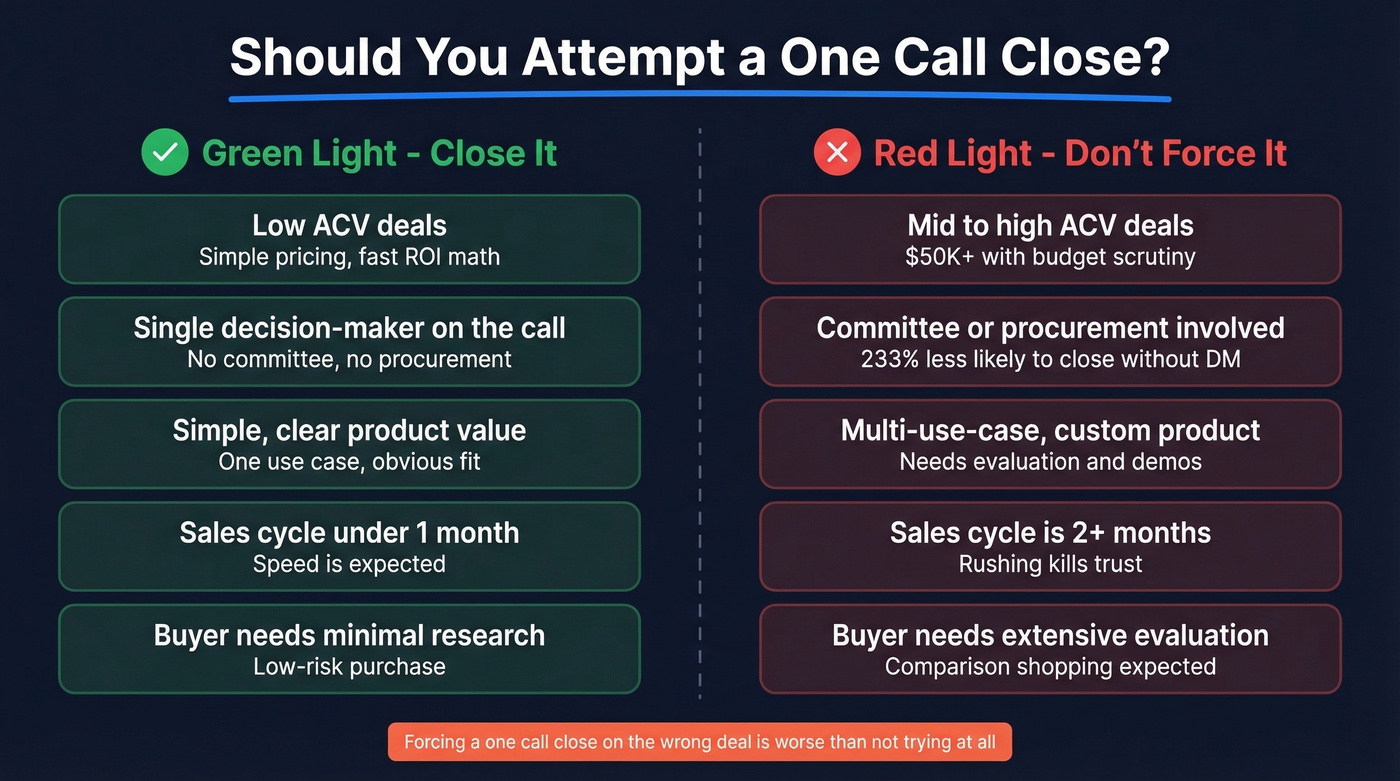
| Factor | Green Light | Red Light |
|---|---|---|
| Deal size | Low ACV | Mid-high ACV |
| Decision-maker | Single buyer on call | Committee / procurement |
| Product complexity | Simple, clear value | Multi-use-case, custom |
| Sales cycle norm | Under 1 month | 2+ months |
| Buyer research | Minimal needed | Extensive evaluation |
The data backs this up. When the decision-maker isn't involved, enterprise deals are 233% less likely to close. No amount of closing technique saves you from that. Remember that 73% transactional stat - buyers already expect speed on simple purchases. Match the expectation.
Sales coach Greg Faxon reports that 50% of his clients had more than one call before enrolling - and that's for a coaching service, not enterprise software. The takeaway isn't that closing in one call doesn't work. It's that it works about half the time even in ideal conditions, so you'd better know which half you're in.
Let's kill a myth here. This approach isn't inherently high-pressure. It's high-pressure only when forced on the wrong deal profile. Hyperbound identifies four ways forcing it kills deals: it breeds distrust through pressure tactics, it ignores modern buying complexity, it causes cognitive overload that leads to mistakes, and it destroys rep conviction when the approach doesn't match their style. If your manager wants you to close a $50K enterprise deal with a procurement committee in one conversation, the problem is your manager, not your skills.
Most sales teams would close more revenue by attempting fewer single-call closes on better-qualified prospects than by attempting more of them on everyone who picks up the phone.
The 6-Stage Framework
You've probably sat through "sales training" where someone told you to "build rapport and handle objections" without giving you a single word of actual script. That's not training. That's a motivational speech. What follows is a stage-by-stage framework with time allocations and the exact words to use at each transition.
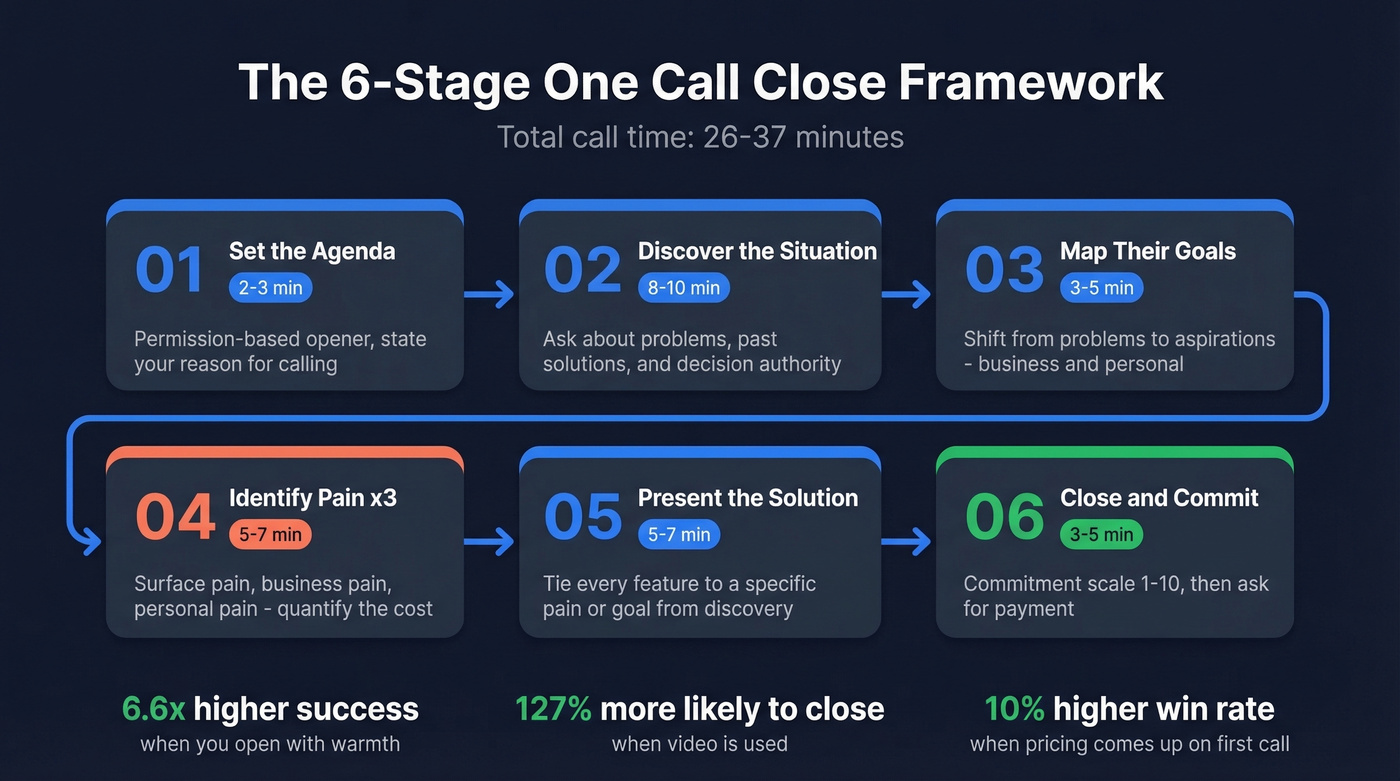
Stage 1 - Set the Agenda (2-3 min)
Your opening line matters more than you think. Gong's call analysis data is unambiguous: opening with "Did I catch you at a bad time?" drops your success rate by 40%, landing you at a dismal 0.9% booking rate. Opening with "How have you been?" produces a 6.6x higher success rate - those calls had over a 10% meeting-booking rate. Stating your reason for calling increases success by 2.1x.
We've watched reps blow deals in the first 30 seconds with a bad opener. So start with warmth, then set a permission-based agenda:
"Hey [name], thanks for taking the time. Here's what I was thinking - I'll ask a few questions to understand your situation, share how we've helped similar companies, and if it makes sense, we'll talk next steps. If it doesn't fit, I'll tell you. Fair enough?"
That last question gives the prospect control, which paradoxically makes them more likely to stay engaged.
Stage 2 - Discover the Situation (8-10 min)
This is where most reps blow it. They rush through discovery to get to the pitch. Don't.
Eight to ten minutes of genuine curiosity is what separates closing on the first call from a first-call hang-up. Cover these: "How long have you been dealing with [problem]?" "What have you tried so far?" "What exactly are you looking for?"
And the one that matters most: "If we find something that works today, are you the person who makes this decision?" That's your purchasing power qualification. If the answer is no, you're not closing in one conversation - adjust accordingly.
Stage 3 - Map Their Goals (3-5 min)
Shift from problems to aspirations. "Where do you see yourself with this in six months?" "What would solving this mean for the business financially?" Then go personal: "How would fixing this impact your day-to-day?"
The personal question is where deals accelerate. Business goals are rational. Personal impact is emotional. Closing in a single conversation runs on emotional momentum paired with rational justification - and you can't manufacture that momentum if you skip this stage.
Stage 4 - Identify Pain at Three Levels (5-7 min)
No pain, no sale. You need to uncover it at three levels: surface pain (the symptom they called about), business pain (what it's costing the company), and personal pain (how it affects them individually).
The question that does the heavy lifting: "How much is this costing you in money, time, and energy?" Let them quantify it. Once a prospect puts a dollar figure on their pain, your price becomes a comparison, not an expense.
Stage 5 - Present the Solution (5-7 min)
Now - and only now - you present. Tie every feature directly to a pain or goal from stages 2-4. "You mentioned [specific pain]. Here's exactly how we solve that."
If you're on a video call, even better - deals are 127% more likely to close when video is used at any point in the sales process. Win rates are also 10% higher when pricing comes up on the first call. Top performers bring up price after the value prop, not before. Frame the investment against the cost of inaction you uncovered in stage 4.
Stage 6 - Close and Commit (3-5 min)
Two questions close the deal. First: "On a scale of 1-10, how committed are you to making this happen?" Anything below a 7 means you've got more discovery to do. At 7+, move to the second question: "Great - how would you like to handle payment?"
If they hesitate, deploy the "your loss" principle - not as pressure, but as genuine concern: "What happens if you don't solve this now? Based on what you told me, that's costing you [their number] every month." Then be quiet. Let the silence work.

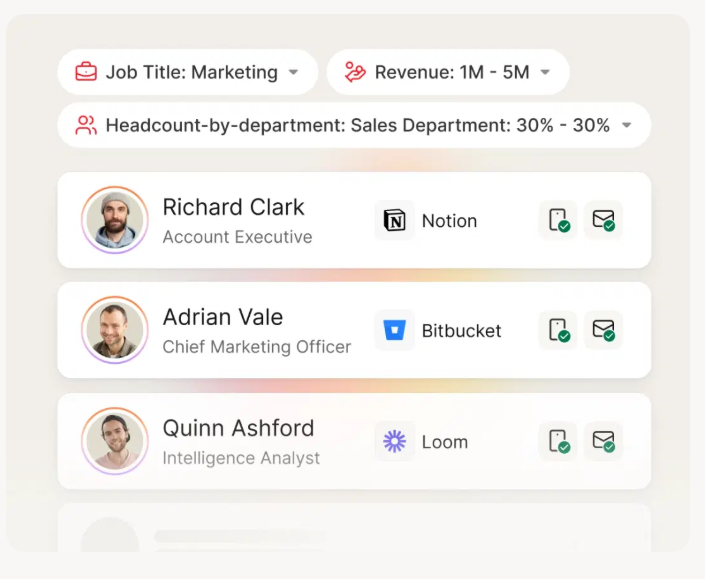
Stage 2 says it all: discovery makes or breaks your one call close. Prospeo gives you 50+ data points per contact - job title, company revenue, tech stack, funding status - before you ever pick up the phone. Walk into every call with the pre-call intelligence this framework demands.
Stop winging discovery. Start closing on the first call.
Objection Handling With the AAA Method
The Acknowledge-Ask-Advise framework is the cleanest objection-handling method for single-call closes because it keeps the conversation collaborative instead of adversarial. Acknowledge the concern without dismissing it. Ask a follow-up question to understand the real objection behind the stated one. Advise with a specific response that addresses what they actually said.
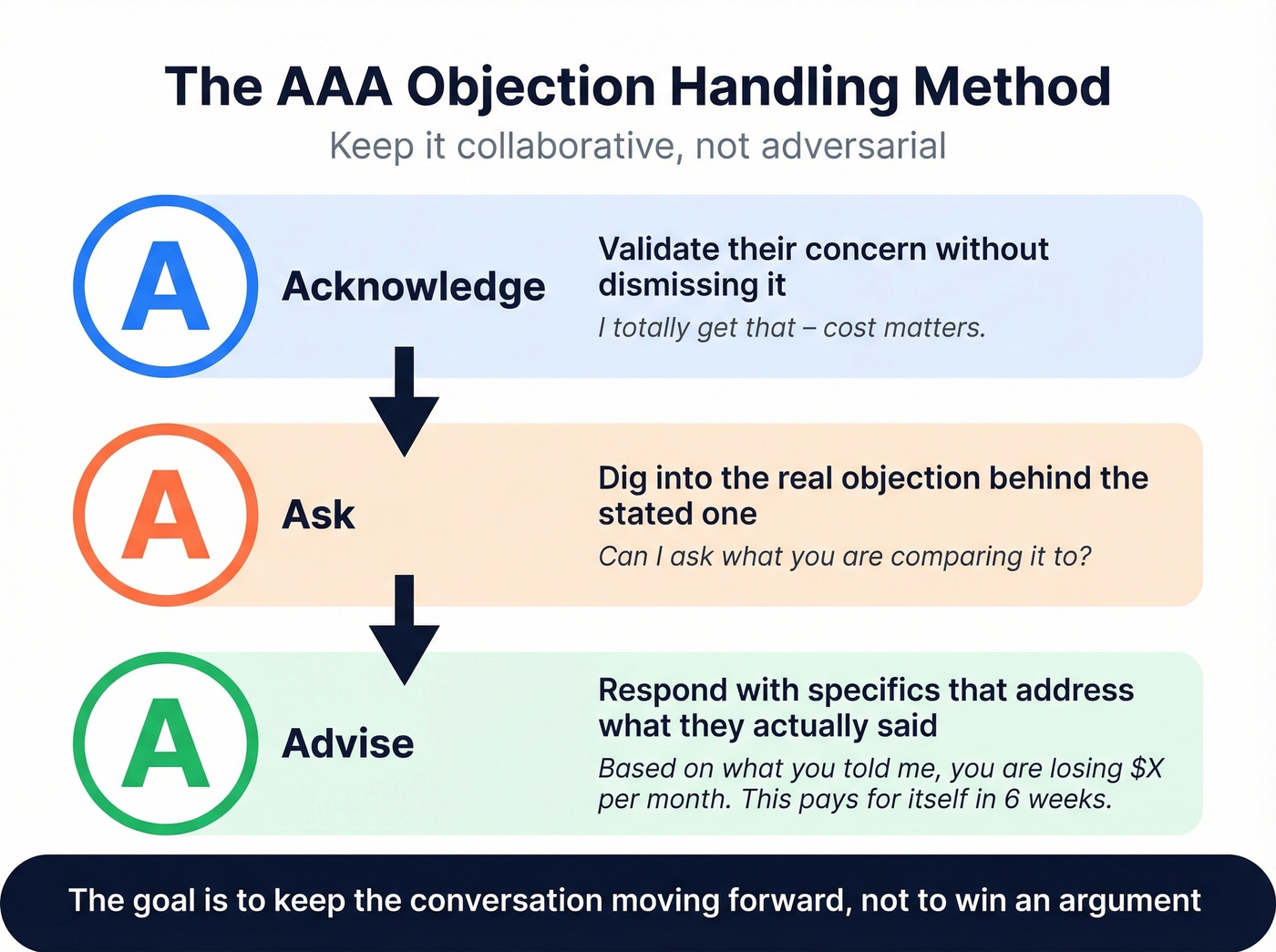
Worked example for price objections: "I totally get that - cost matters. Can I ask what you're comparing it to?" Then, once they answer: "So the real question is whether the ROI justifies the difference. Based on what you told me about [their pain], you're losing $X per month. This pays for itself in [timeframe]."
The 5 Most Common Objections, Scripted
"I need to think about it." "That makes total sense - it's a real decision. What specifically do you want to think through? Is it the price, the timing, or something about the solution itself?" Then address whatever they name. Most "think about it" objections mask a price or authority concern you can resolve on the spot.
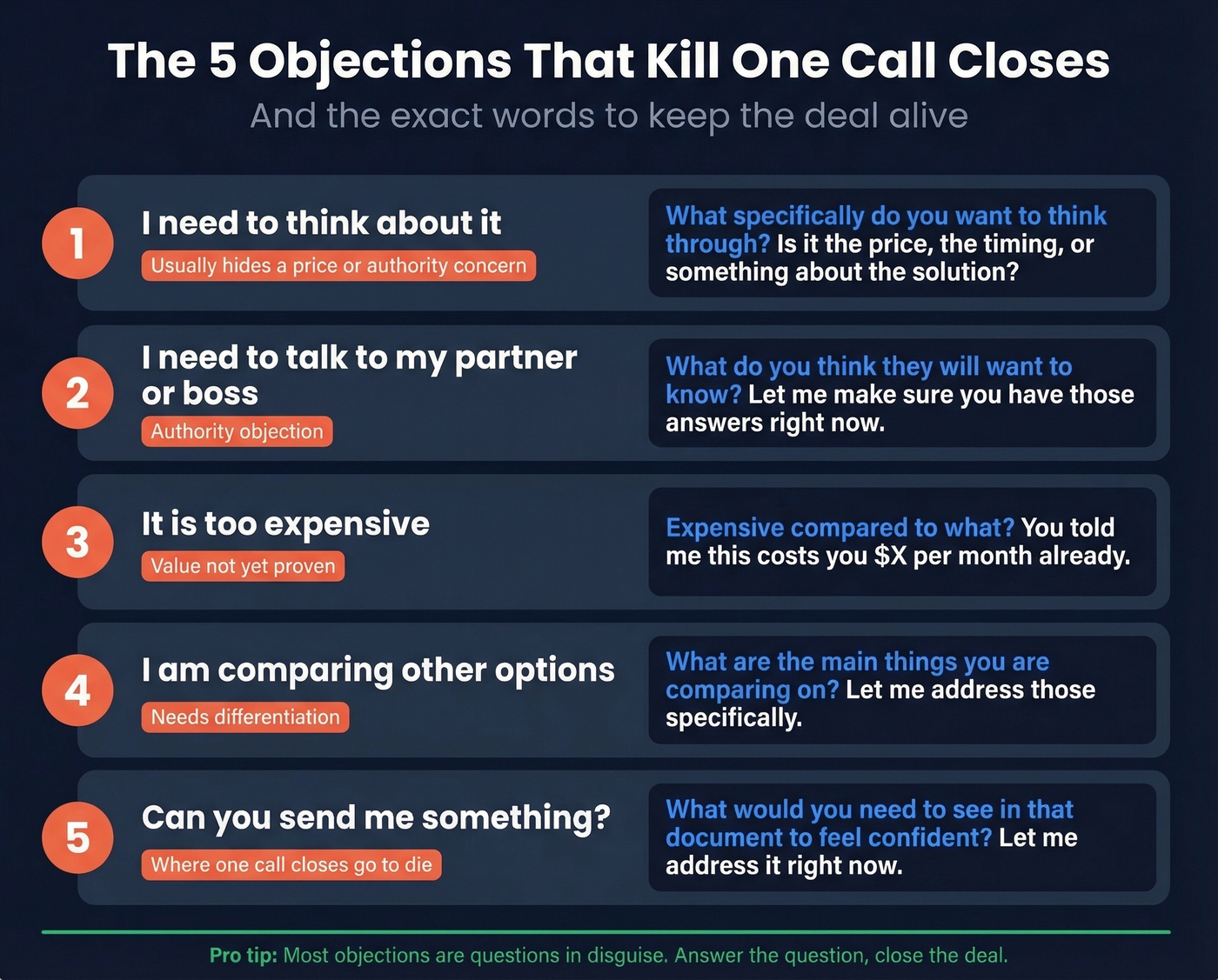
"I need to talk to my spouse/partner/boss." "Of course - I'd do the same thing. What do you think they'll want to know? Let's make sure you have those answers." Offer to schedule a brief three-way call or provide a one-page summary they can share.
"It's too expensive." "I hear you - nobody wants to overpay. Expensive compared to what?" Then reframe against the cost of inaction they already quantified in discovery.
"I'm comparing other options." "Smart move - you should compare. What are the main things you're comparing on?" Position your differentiators against their specific criteria, not a generic feature list.
"Can you send me something?" This is where single-call closes go to die. Respond with: "Absolutely, I can send you details. Before I do - what would you need to see in that document to feel confident moving forward?" If they can articulate it, address it right now on the call.
Closing by Industry
Home Services
This is the natural habitat of closing in one conversation. You're sitting in someone's kitchen, the roof is leaking, and they want it fixed. Insurance deductibles typically run 1%-5% of a home's insured value, which creates sticker shock you need to preempt.
A roof replacement takes 3-5 days and delivers 60-70% ROI - those are your value-framing numbers. Face-to-face with the homeowner, urgent need, local credibility? Close it. But if there's an HOA approval process or the market's saturated with storm chasers, the trust barrier is too high for a single visit. Skip it and build the relationship instead.
Lead Gen Services
One r/sales thread includes an example of a rep selling lead gen to construction companies where top producers closed around 30 deals per month versus 6-10 for average reps. Pricing ranged from $600-$8K depending on scope. The gap between top and average wasn't talent - it was qualification. Top producers only attempted first-call closes on prospects who fit the profile.
SaaS and Transactional Software
The sweet spot is narrow but lucrative: $50-200/month tools where one person makes the buying decision. Think single-user productivity tools, not platform software.
The danger zone is anything that touches enterprise. Procurement committees, security reviews, and multi-stakeholder sign-offs make single-call closes impossible. Don't even try. Selling as a team with multiple contacts engaged can make you 258% more likely to close - that's the opposite of a single-call strategy. For SaaS, a free trial works as a fallback close: "Let's get you started on the trial today, and I'll check in Thursday to make sure you're seeing value."
Pre-Call Intelligence Changes Everything
The secret to closing a deal in one call isn't what happens on the call. It's what happens before it.
A rep with solid data and a mediocre script outcloses a rep with a perfect script and bad data every single time. Before you dial, you need their title and authority level, company size and industry, pain signals like hiring patterns, tech stack changes, and funding events, plus a realistic budget range. We've seen reps spend 15 minutes on a call only to discover they're talking to someone three levels below the decision-maker - that's a pre-call research failure, not a closing failure.
Tools like Prospeo make this prep work fast. With 300M+ professional profiles, 98% email accuracy, and a 7-day data refresh cycle, you walk into the call knowing who you're reaching and whether they can actually buy. Layer in intent data tracking 15,000 topics, and you know not just who they are but what they're actively researching.
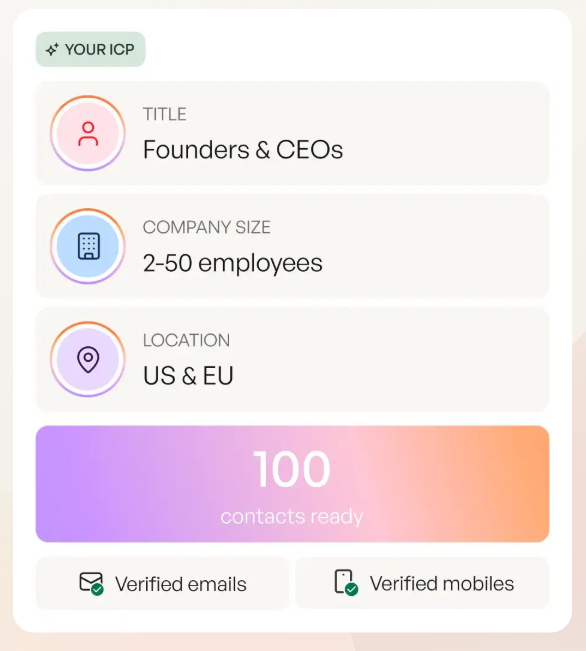
The framework above requires one thing above all else: the right decision-maker on the line. Prospeo's 125M+ verified mobile numbers hit a 30% pickup rate - 3x the industry average. Combine that with 30+ filters including buyer intent and job changes to find single-buyer deals primed for a one call close.
Reach the decision-maker directly. Skip the gatekeeper entirely.
Mistakes That Kill Your Close Rate
Forcing it on complex deals. If there are multiple stakeholders, a procurement process, or an ACV above $30K, a single-call attempt doesn't just fail - it damages the relationship. You're 258% more likely to close with team selling multiple contacts engaged. Single-call pressure is the opposite of that.
Bad openers. "Did I catch you at a bad time?" is a 0.9% success rate. Stop using it.
Skipping discovery. Jumping straight to the pitch is the fastest way to hear "send me something." Stages 2-4 of the framework exist for a reason - they build the emotional momentum that makes the close feel natural instead of forced.
Fake urgency. "This price is only good today" works once. Then you've lost the customer forever. Real urgency comes from the prospect's own pain, not your discount deadline.
Calling the wrong person. You can't close a deal with someone who can't sign the contract. Stale data means you reach gatekeepers instead of decision-makers - and when you're working with data that refreshes weekly instead of every six weeks, the direct dial you're calling actually connects.
FAQ
What is a one call close?
A one call close qualifies, presents, handles objections, and secures commitment in a single conversation - no follow-up emails or second meetings. It works best for transactional deals under $5K with a single decision-maker and a product that doesn't require extensive evaluation.
Does closing in one call work for B2B?
Yes, but only for low-ACV deals with one decision-maker on the line. Enterprise deals with procurement committees close 233% less often without the decision-maker involved. Multi-threaded outreach wins at higher price points - reserve single-call attempts for simple, transactional products.
How do you handle "I need to think about it"?
Acknowledge the decision's weight, then ask what specifically they want to think through - price, timing, or the solution itself. Most "think about it" responses mask a price or authority concern. Name it, address it on the spot, and 40-60% of these objections resolve without a callback.
What's the best opening line?
"How have you been?" produces a 6.6x higher success rate than baseline, per Gong's analysis. Stating your reason for calling increases success by 2.1x. Never open with "Did I catch you at a bad time?" - it drops your chances by 40%.
What tools help with pre-call research?
A B2B data platform with verified emails, direct dials, and intent signals lets you build a prospect dossier before you dial. Pair that with your CRM activity history and public pain signals like job postings or funding announcements, and you'll know whether the person you're calling can actually make a buying decision.