

One on One Sales Coaching: What It Costs, Who's Good, and Whether It's Worth It
We watched a rep bomb a $200K discovery call last year. Not because he didn't know the methodology - he'd been through Sandler, MEDDIC, the whole alphabet. He bombed it because nobody had sat across from him in six months and said, "You're talking past the economic buyer. Let's fix that." He didn't need another training. He needed one on one sales coaching.
What follows is everything the coaching vendors' websites won't tell you: real pricing, who's actually worth hiring, and how to stop lighting money on fire.
Quick Decision Framework
Individual AE paying out of pocket: budget $1,000-$3,000/month for a focused 3-month engagement. If your numbers don't move after 90 days, the problem isn't coaching.
Company is paying: push for individualized coaching over group training. Reps with an effective coach hit 19% more of their sales goal.
Session rates range from $200 to $2,500 depending on the coach's experience and format.
What Is 1:1 Sales Coaching?
Most people conflate coaching with training. They're different interventions that solve different problems, and confusing them is the fastest way to waste budget.
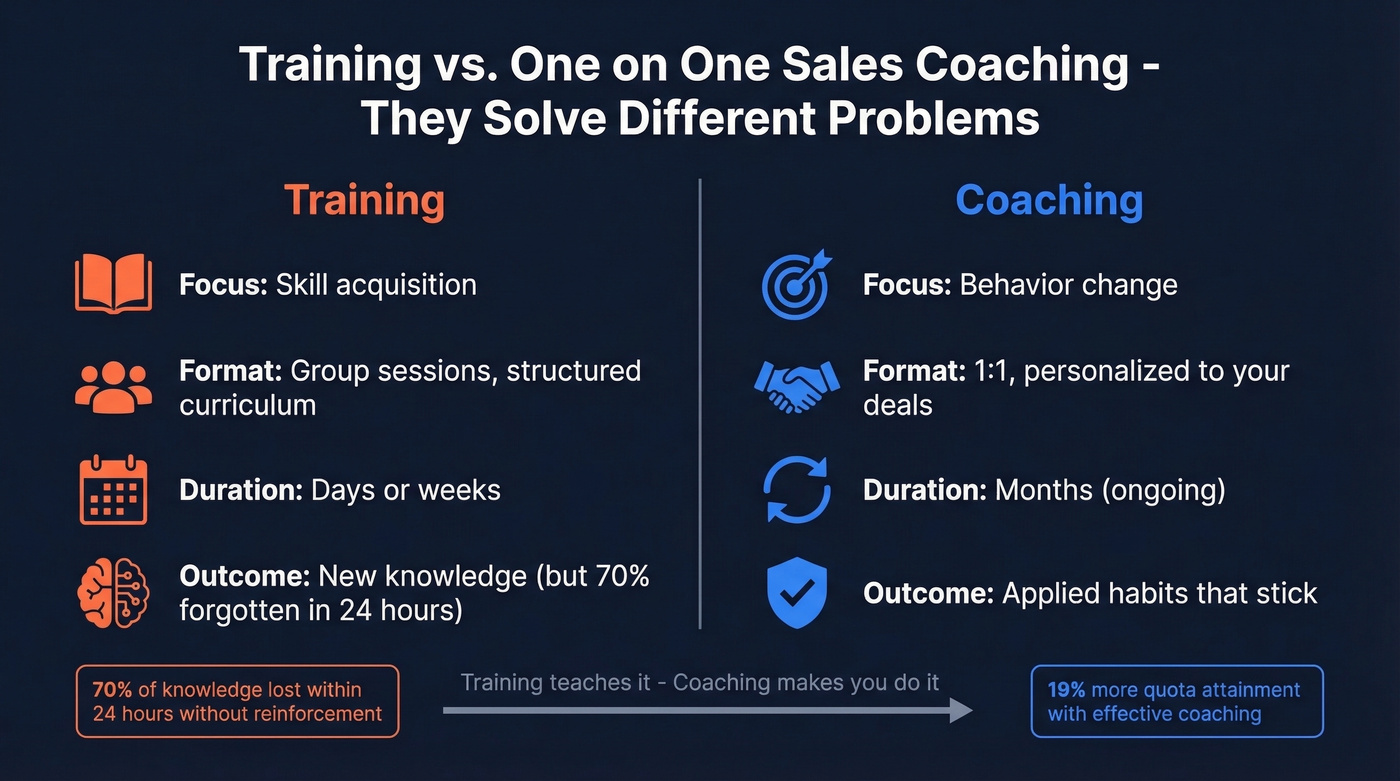
Training builds skills - frameworks, methodologies, objection-handling scripts. You sit in a room, absorb content, and walk away with new knowledge. Coaching turns those skills into behavior. It's the ongoing, personalized work of applying what you learned to your actual deals, your actual pipeline, your actual blind spots.
Sandler's framework breaks coaching into three dimensions: Behavior (what you do daily), Attitude (what you believe about selling), and Technique (how you execute). Training leans heavily on technique. Coaching hits all three. And here's the financial gut punch: 70% of knowledge is forgotten within 24 hours without reinforcement. That $5,000 workshop your company sent you to? Most of it evaporated by Monday.
| Training | Coaching | |
|---|---|---|
| Focus | Skill acquisition | Behavior change |
| Format | Group, structured | 1:1, personalized |
| Duration | Days or weeks | Months (ongoing) |
| Outcome | New knowledge | Applied habits |
Coaching is expensive accountability. That's not a criticism - it's the entire value proposition. You already know you should prep better for discovery calls. You already know you should multi-thread. A coach makes you actually do it.
Does Personalized Coaching Work?
The Corporate Executive Board found that sellers with a "highly effective coach" achieve roughly 19% more sales toward their goal than those without one. On a $1M quota, that's $190K in incremental revenue from one intervention.
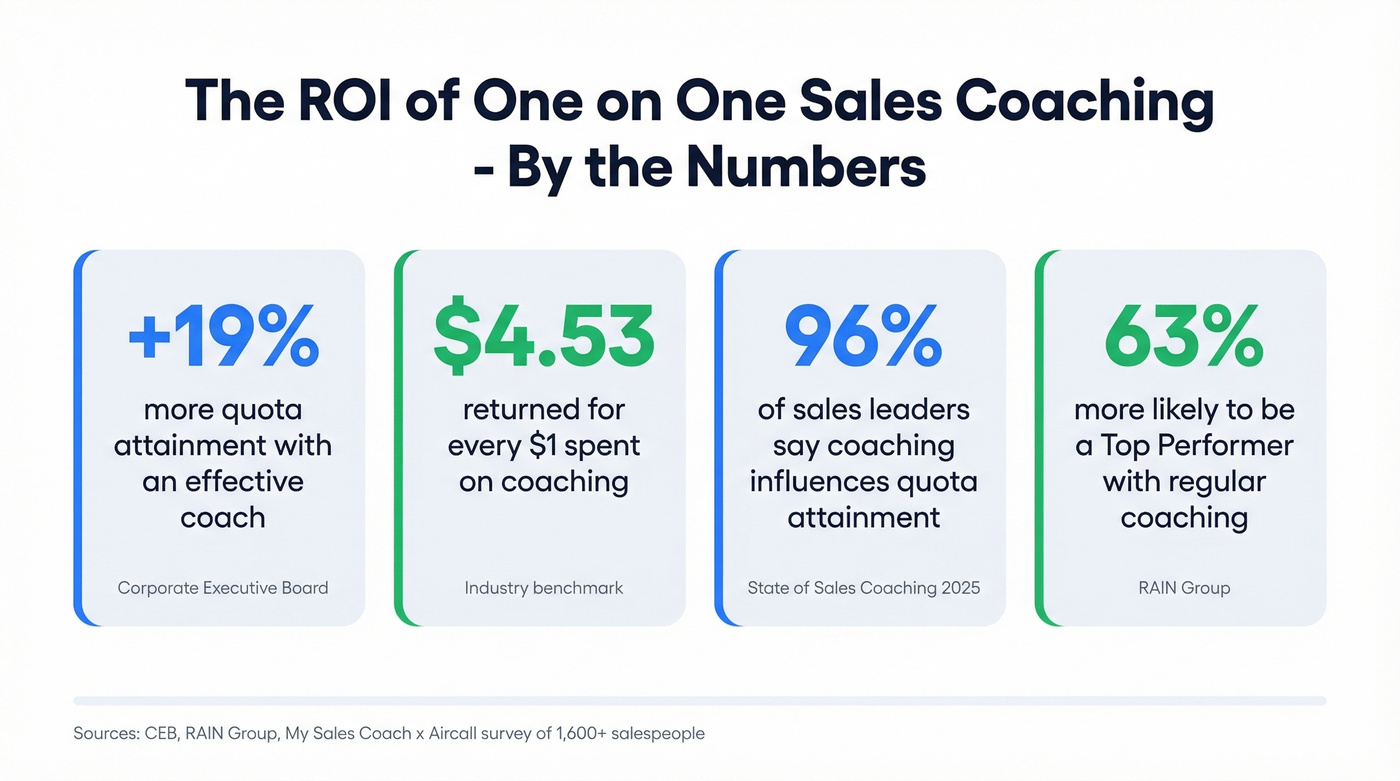
The State of Sales Coaching 2025 survey - conducted by My Sales Coach and Aircall across 1,600+ salespeople - paints an even clearer picture. 96% of sales leaders said coaching influenced quota attainment, with 42% calling the impact "significant." On the rep side, 94% said coaching improved their performance, and 92% said it was important to job satisfaction. RAIN Group's data reinforces this: sellers are 63% more likely to be a Top Performer when they have effective management, regular coaching, and solid training working together. And 65% of the highest-performing sales orgs spend at least 20% more time coaching than lower-performing teams.
The commonly cited ROI benchmark is $4.53 returned for every $1 spent on sales training and coaching. The market is voting with its wallet - the global sales training market hit $10.32B in 2024 and is projected to reach roughly $19B by 2032.
The data isn't ambiguous. The question is whether you're buying the right kind, at the right price, at the right time.
What Does It Actually Cost?
Coaching pricing falls into four models: per-session, monthly retainer, fixed-term packages, and enterprise custom programs.
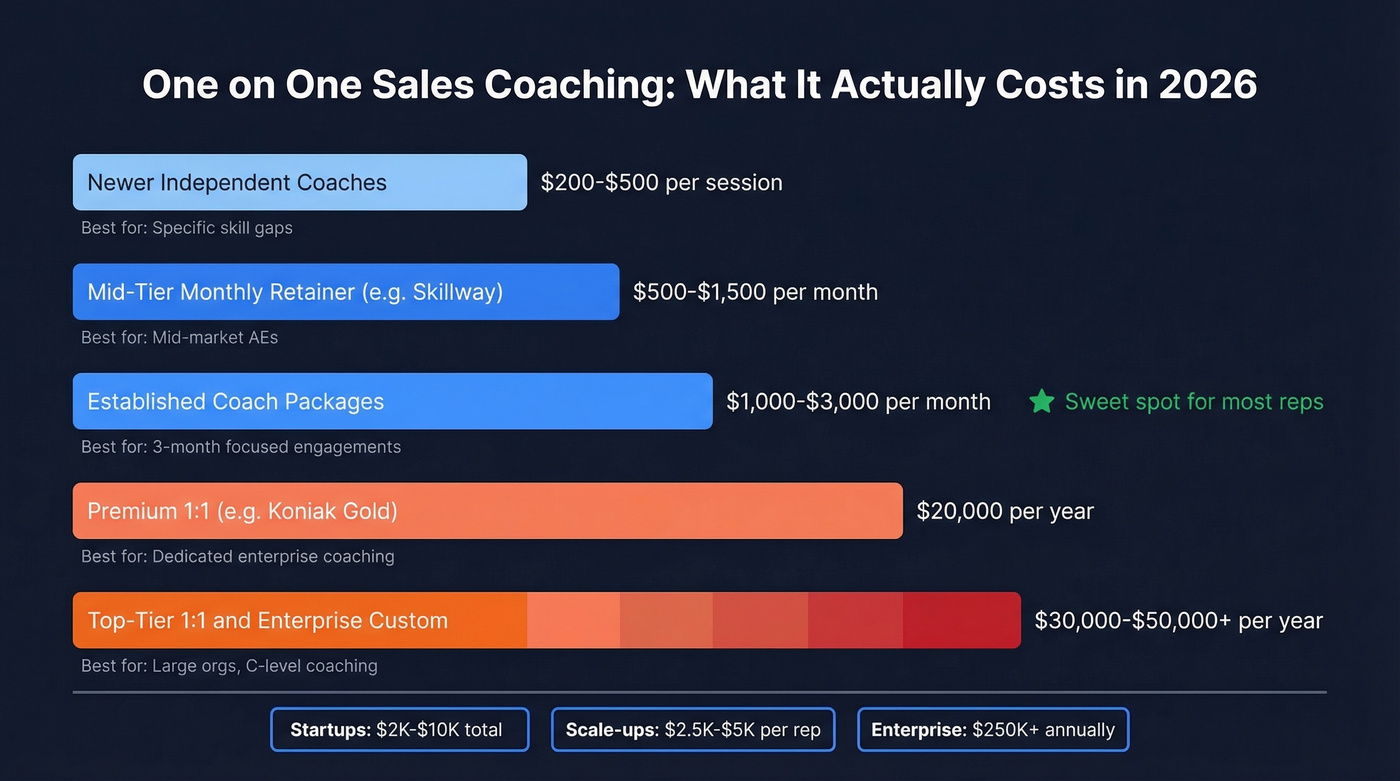
For newer independent coaches - people with 5-10 years of sales experience who've hung a shingle - expect $200-$500 per session. Monthly retainers in this tier run $500-$1,500. This is the "testing the waters" range, perfectly fine for addressing specific skill gaps like discovery technique or negotiation.
Mid-tier coaches with established methodologies charge $1,000-$3,000 per month. Skillway, for example, runs $990/month for a relationship-selling focused program. This is the sweet spot for most individual AEs investing in themselves.
At the top end, Ian Koniak's Untap Your Sales Potential is one of the few coaches who publishes transparent pricing:
| Provider / Tier | Format | Price | Best For |
|---|---|---|---|
| Newer coaches | Per session | $200-$500/session | Specific skill gaps |
| Skillway | Monthly retainer | $990/mo | Mid-market AEs |
| Established coaches | Monthly package | $1K-$3K/mo | 3-month engagements |
| Koniak - Bronze | Online course | $2,997/yr | Self-paced learning |
| Koniak - Silver | Group coaching | $10,000/yr | Weekly group sessions |
| Koniak - Gold | 1:1 (certified coach) | $20,000/yr | Dedicated 1:1 coaching |
| Koniak - Platinum | 1:1 (with Koniak) | $30,000/yr | Top-tier 1:1 |
| Richardson / RAIN | Enterprise custom | $5K-$50K+ | Large sales orgs |
Koniak's Platinum tier works out to $2,500 per session (12 private sessions in the year), which is one of the highest published price points you'll see from an individual coach.
For companies budgeting at scale: startups typically spend $2K-$10K total, scale-ups budget $2.5K-$5K per rep, and enterprise orgs allocate $250K+ annually across their teams.
Hidden Costs
Opportunity cost. Every hour in a coaching session is an hour not selling.
The productivity dip. When you change how you sell, expect a 10-15% temporary productivity dip while new habits take hold. It passes, but nobody warns you about it upfront.
The reinforcement void. If you don't practice between sessions, you're paying for expensive conversations, not behavior change.

A great coach helps you nail discovery calls. But you still need the right people to call. Prospeo gives you 300M+ verified contacts with 30+ filters - buyer intent, job changes, headcount growth - so every coached rep spends sessions reviewing real conversations, not lamenting an empty pipeline.
Stop coaching reps on how to find leads. Give them leads worth coaching on.
A Typical Engagement
Most engagements follow a three-phase arc over 3-6 months.
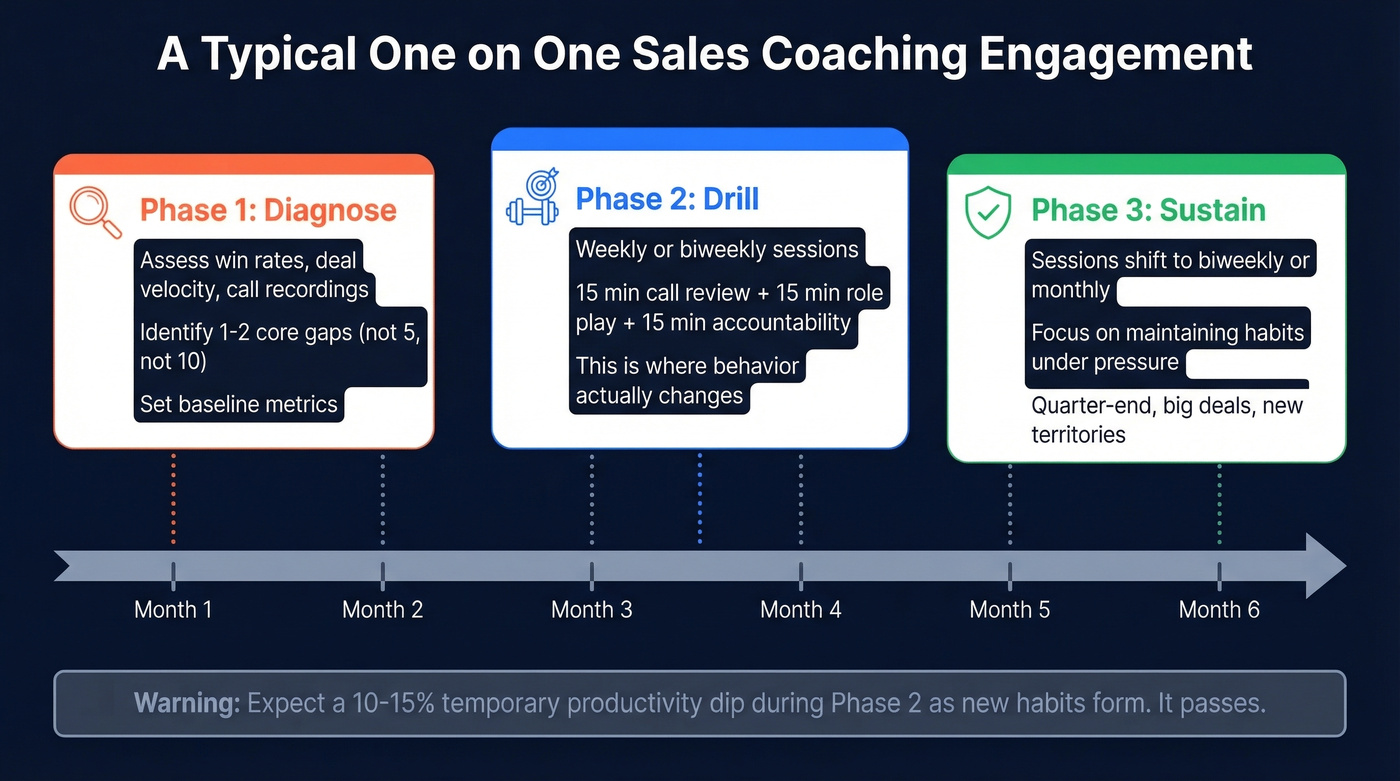
Month 1: Diagnose. The coach assesses your current performance - win rates, deal velocity, call recordings, pipeline health. You identify one or two core gaps. Not five. Not ten. One or two things that, if fixed, move the needle most.
Months 2-3: Drill. Weekly or biweekly sessions built around call reviews, role plays, and accountability checks. A typical session runs 45-60 minutes: 15 minutes reviewing a specific call recording, 15 minutes of role play on the identified gap, 15 minutes of accountability review and next-week commitments.
Months 4+: Sustain. Sessions shift to biweekly or monthly. The focus moves from building new habits to maintaining them under pressure - quarter-end, big deals, new territories.
CSO Insights data shows sales leaders spend less than 20% of their time coaching. Many managers meet reps once a month and call it coaching. That's not enough. Biweekly is the minimum for behavior change, and weekly is ideal during the drill phase. Effective coaching during one-on-ones requires structured agendas, not casual check-ins disguised as development.
Who Needs a Coach (And Who Doesn't Yet)
Get a coach if you're:
A mid-career AE who's hit a plateau. You know the basics, you're making quota or close, but you can't break through to President's Club. Dedicated 1:1 coaching helps you find the 10% improvements that compound.
A new sales manager who's never coached reps before. Managing is a completely different skill than selling, and most companies provide zero training for the transition.
An enterprise rep navigating complex, multi-stakeholder deals where pressure-testing your account strategy is worth its weight in gold.
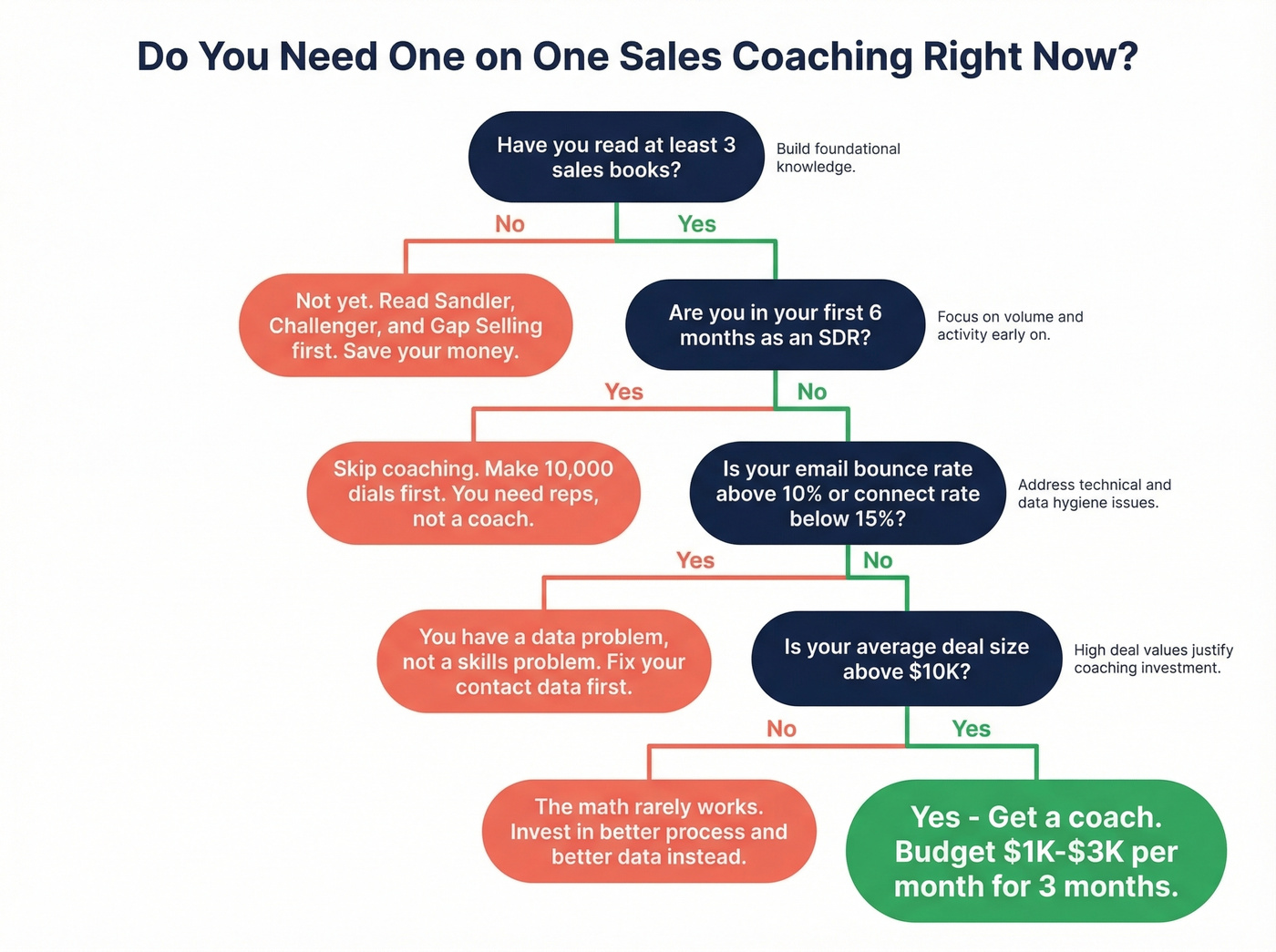
Skip coaching for now if:
You haven't read three sales books. Start with Sandler, Challenger, and Gap Selling. If you haven't absorbed the fundamentals, coaching is premature - you're paying someone $300/hour to teach you what a $20 book covers.
Your data is the problem, not your skills. If your email bounce rate is above 10% or your connect rate is below 15%, you don't have a coaching problem. You have a data problem. Fixing bad contact data is a list-quality issue, not a $3,000/month issue.
You're an SDR in your first six months. You need reps, not coaching. Make 10,000 dials, send 5,000 emails, and learn what rejection feels like. Then get a coach.
Here's the thing: if your average deal size is under $10K, you probably don't need one on one sales coaching at all. At that price point, the math rarely works - a $2,000/month coaching engagement needs to generate two extra closed deals per month just to break even. Invest in better sales process and better data instead.
How to Choose the Right Coach
The coaching industry has a credibility problem. There's no licensing body, no standardized certification that means anything, and the barrier to entry is "make a website." Here's how to vet.
Methodology transparency. A good coach can explain their framework in two minutes. Sandler, Challenger, MEDDIC, SPIN - the specific methodology matters less than having one. If they can't articulate what they do beyond "I help you sell more," keep looking.
Industry relevance. A coach who spent 15 years selling SaaS to mid-market isn't the right fit if you're selling medical devices to hospitals. Domain experience compounds the value of every session.
Published pricing. If a coach won't publish their pricing, that's a yellow flag. It usually means they're pricing based on what they think you can afford. Koniak publishes his. Skillway publishes theirs. The good ones aren't afraid of transparency.
Session structure. Ask what a typical session looks like. If the answer is "we just talk about your deals," that's not coaching - that's a paid conversation. You want call reviews, role plays, and accountability mechanisms.
References from people at your level. Not testimonials on their website. Actual references you can call. Ask specifically: "What changed in your numbers after 90 days?"
Coaches Worth Researching
Rather than trusting a listicle, match the coach to your gap:
- Jill Konrath - Enterprise selling and the SNAP framework. Best for navigating complex buying committees and simplifying your message for overwhelmed executives.
- Mike Weinberg - Prospecting and new business development. His New Sales. Simplified. approach is blunt and effective. Best when pipeline generation is the bottleneck.
- Mark Hunter - Value-based selling and pricing confidence. Best for reps who discount too much or struggle to sell on value instead of features.
- Art Sobczak - Inside sales and phone-based selling. His Smart Calling methodology is the gold standard for reps who live on the phone.
- Ian Koniak - Enterprise SaaS and mindset. The most transparent pricing in the industry, and his content gives you a clear preview of his coaching style before you commit.
Red Flags
The r/sales community has a recurring critique worth heeding: a lot of sales training feels like "theater" - roleplay and frameworks that miss fundamentals like response speed, follow-up discipline, and active listening. There's also real skepticism toward "sales influencers" who built their brand on content rather than actual quota-carrying experience. If a coach's primary credential is their follower count, dig deeper into their selling background before signing a check.
Mistakes That Kill Coaching ROI
SBI Growth identified five coaching mistakes that apply whether the coach is your manager or an external hire.
Telling instead of asking. Good coaching is Socratic. "What did you notice about the buyer's response when you mentioned pricing?" beats "You should've waited to discuss pricing."
Focusing only on what went wrong. In one study, 82% of manager feedback comments were negative when managers were asked to comment on both strengths and weaknesses. A good coach reinforces what's working, not just what's broken.
Too many priorities at once. If your coach gives you seven things to fix after one session, fire them. Behavior change happens one habit at a time.
Sugarcoating feedback. If everything is "great job, keep it up," you're paying for a cheerleader. You need someone who'll tell you your discovery calls are shallow.
Taking over on joint calls. If your coach jumps in to "save" every deal, you're not learning - they're selling for you.
The biggest ROI from personalized coaching isn't new techniques. It's having someone hold you accountable to the basics you already know but aren't executing consistently.
How to Maximize Your Investment
Every coaching session should start with something specific: a call recording you want dissected, a deal you're stuck on, a question you've been wrestling with. "I don't know what to work on" is the most expensive sentence in coaching - it means you just burned $500 on an unstructured conversation.
Before every session, prep three things. A specific recording - the discovery call from Tuesday, not "my calls in general." A specific deal - the $150K opportunity stalled at procurement. A specific question - "How do I get the CFO to engage without going around my champion?"

But let's be honest: coaching without good data is teaching someone to fish in an empty pond. You can perfect your discovery framework and build a flawless multi-threading strategy - none of it matters if a third of your emails bounce and you can't get a decision-maker on the phone. We've seen teams triple their pipeline just by fixing data quality before investing in coaching. One customer, Meritt, was running a 35% email bounce rate; after switching to Prospeo, that dropped to under 4%, and their pipeline tripled from $100K to $300K per week.
Before you write a check to any coach, run your prospect list through a verification tool. If your bounce rate drops significantly, you just solved half your problem for a fraction of the cost.
You're investing $1K-$3K/month in coaching to close the gap. Don't let bad data erase those gains - 35%+ bounce rates destroy the habits your coach is building. Prospeo delivers 98% email accuracy with a 7-day refresh cycle, so every prospecting rep puts their new skills to work on real buyers.
Protect your coaching ROI with data that actually connects.
FAQ
How long should a coaching engagement last?
Three months minimum to change behavior; six to twelve months for sustained transformation. Set clear metrics at the start - close rate, deal size, pipeline velocity - and evaluate at 90 days. If nothing's moved, either the coach isn't right or coaching isn't your bottleneck.
Is virtual coaching as effective as in-person?
Yes. Most top coaches work virtually, and the format has real advantages. Screen-shared call recordings and real-time CRM walkthroughs make remote sessions highly effective. Convenience means fewer cancellations, which matters more than being in the same room.
Should my company pay or should I?
Push for company sponsorship - frame it as a pipeline investment with measurable ROI. If you're self-funding, start with a 3-month package under $3K/month and track your close rate before and after. The data makes the case for renewal.
How do I measure if coaching is working?
Baseline your metrics before session one: close rate, average deal size, pipeline velocity, discovery-to-proposal conversion. If those don't move meaningfully in 90 days, reassess. Don't rely on "I feel more confident" - feelings don't show up in the forecast.
What's the difference between group and individualized coaching?
Group programs cost less and build shared language across a team, but they can't address your specific deals or blind spots. Individualized coaching tailors every session to your numbers and gaps - that's why it drives faster behavior change. The strongest results come from combining both: group sessions for methodology, 1:1 for application.