

One-Party Recording States: The Complete 2026 Guide
You're an SDR sitting in Florida, auto-recording every outbound call because your dialer defaults to it. What you don't realize is that Florida is an all-party consent state - and that "feature" just created felony exposure on every single dial. Understanding which states are one-party recording states and which aren't is the difference between a normal Tuesday and a criminal charge.
The 12 all-party consent states cover roughly 35% of the U.S. population. Get this wrong and you're looking at potential prison time and five-figure fines.
Quick Version
- 38 states + D.C. follow one-party consent - you can record if you're a participant.
- 12 states are commonly treated as all-party consent for phone recording in practice, with a few "mixed" edge cases explained below.
- 6 states are nuanced/mixed: 4 split rules by phone vs. in-person, and 2 add "particularly private place" exceptions.
- The safest universal rule: announce "this call may be recorded" on every call, regardless of where you or the other party are located.
- If you're calling across state lines, follow the stricter state's law.
- "Two-party consent" is a misnomer. It's actually all-party consent - if five people are on a call, all five must agree.
What One-Party Consent Means
The federal baseline comes from the Omnibus Crime Control and Safe Streets Act of 1968 (18 U.S.C. SS 2511). Under federal law, recording a conversation is legal as long as at least one party to the conversation consents. If you're on the call and you decide to hit record, you are the consenting party. No announcement required, no permission from the other side.
The critical concept is "reasonable expectation of privacy." Recording laws protect private conversations. A shouted argument in a crowded restaurant doesn't carry the same expectation of privacy as a whispered phone call from a home office - courts weigh factors like location, volume, subject matter, and whether the parties took steps to keep the conversation private.
One-party consent means you can record any conversation you're actively participating in. You can't plant a recorder in a room and leave. That's eavesdropping, and it's illegal everywhere. The "one party" has to be present and participating.
Full List of One-Party Consent States
These 38 states plus D.C. allow you to record a conversation as long as you're a participant. Vermont is a special case - it has no state recording statute, so the federal one-party consent rule applies by default.
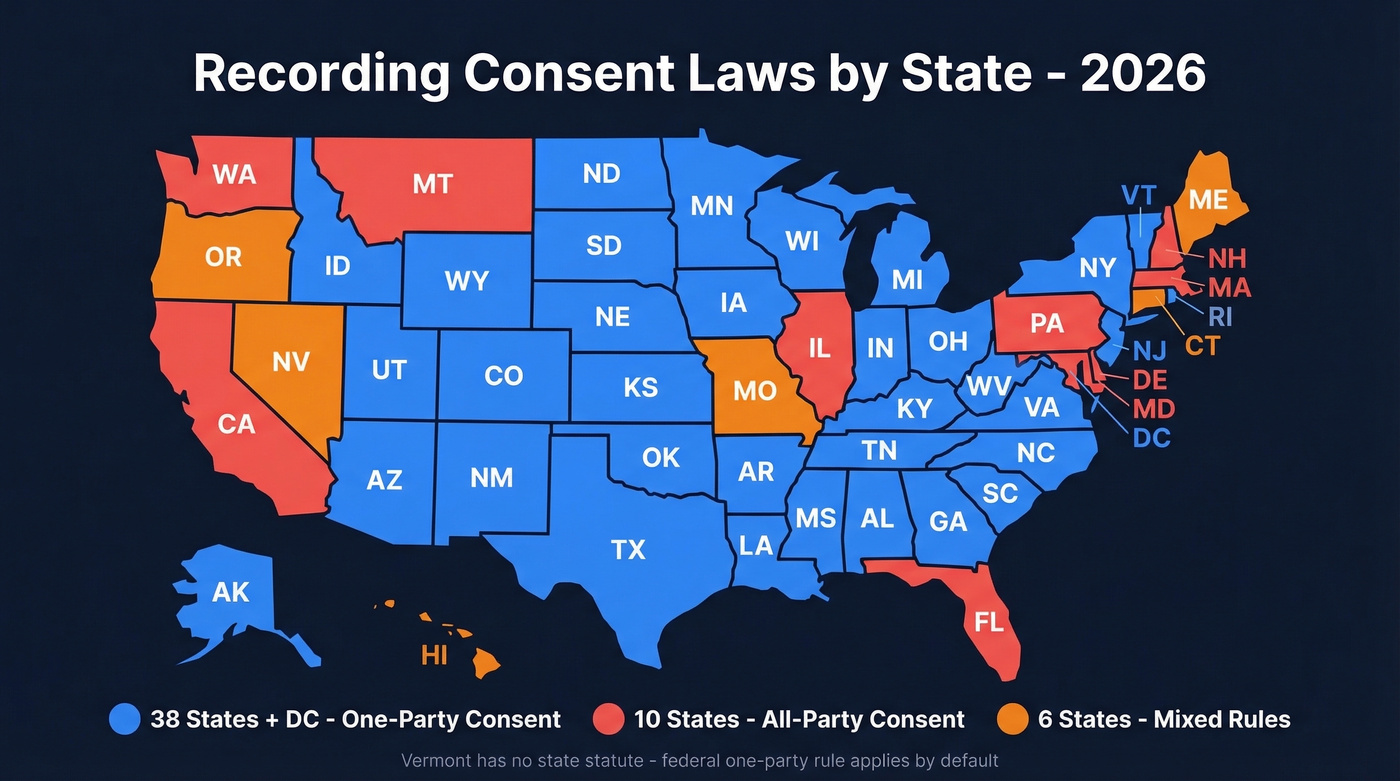
Alabama, Alaska, Arizona, Arkansas, Colorado, District of Columbia, Georgia, Idaho, Indiana, Iowa, Kansas, Kentucky, Louisiana, Maine, Minnesota, Mississippi, Nebraska, New Jersey, New Mexico, New York, North Carolina, North Dakota, Ohio, Oklahoma, Rhode Island, South Carolina, South Dakota, Tennessee, Texas, Utah, Vermont, Virginia, West Virginia, Wisconsin, Wyoming.
A handful of states that often get shoved into "one-party" lists have context-specific rules covered in the Mixed-Consent States section below. These include Michigan, Hawaii, Oregon, Missouri, Connecticut, Nevada, and sometimes Maine depending on how a source classifies "particularly private places."
All-Party (Dual) Consent States
These states require every participant in a phone call to consent before recording. The "two-party consent" label you'll see everywhere is misleading - if there are six people on a conference call in California, all six need to agree.
California deserves a special note: Penal Code SS 632.7 extends all-party consent specifically to cellular and cordless telephone communications, regardless of whether the conversation would otherwise be considered confidential. Even casual cell phone calls in California require consent from all parties.
Primary all-party consent states for phone calls:
- California
- Delaware
- Florida
- Illinois
- Maryland
- Massachusetts
- Montana
- New Hampshire
- Pennsylvania
- Washington
Often treated as all-party for phone calls, but mixed overall:
- Nevada - all-party for phone/electronic communications, more permissive rules for in-person conversations
For a quick-reference list of dual consent states, those twelve jurisdictions above are the ones your compliance team needs to flag in your dialer settings (and in your sales call recording policy).
Mixed-Consent States
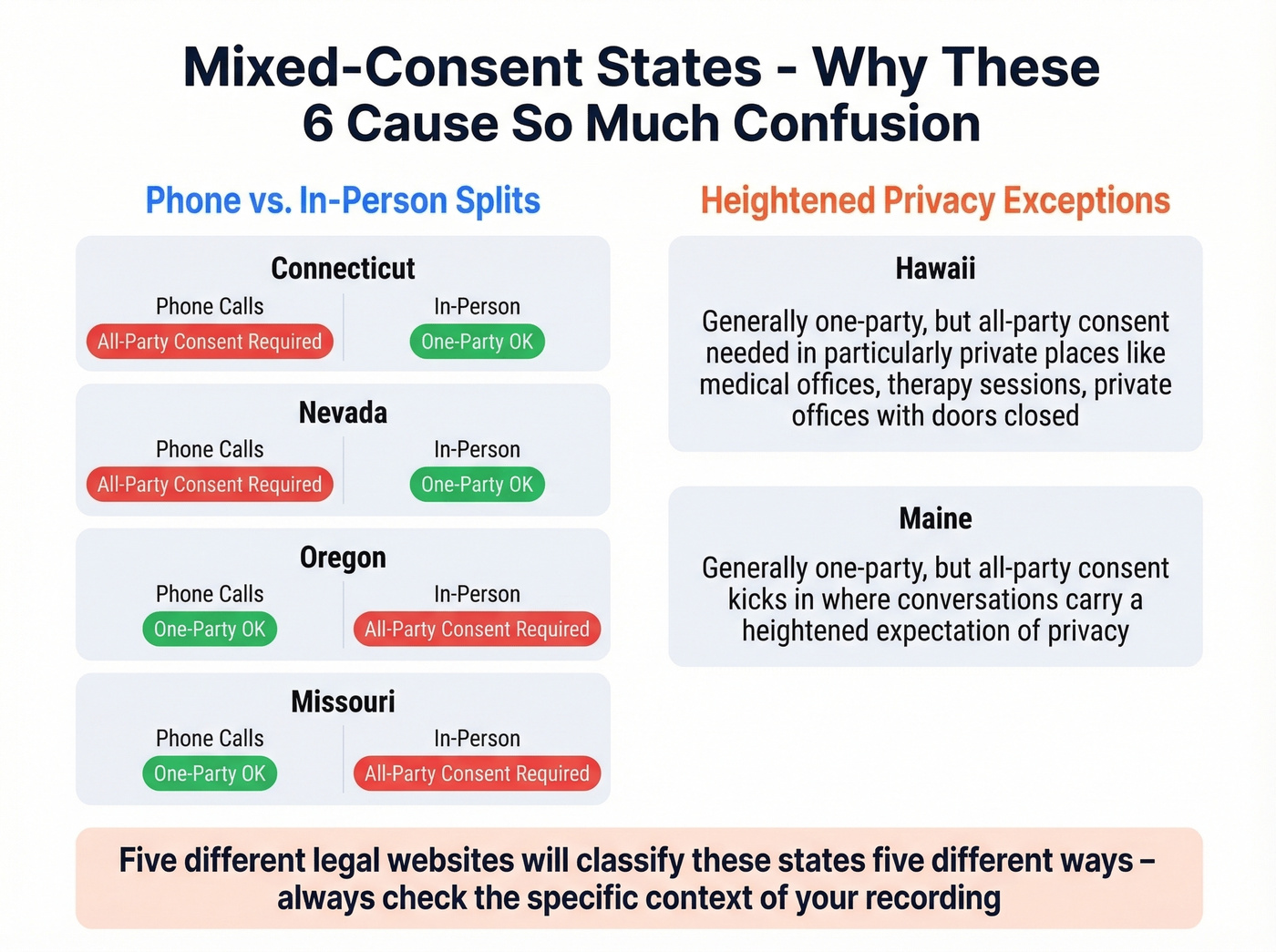
This is why recording-law lists disagree across the internet. Some states don't fit neatly into either category because their rules change depending on whether the conversation happens over the phone or in person, or because they add "particularly private place" exceptions. The Reporters Committee for Freedom of the Press provides the clearest framework for understanding these splits.
Phone vs. In-Person Splits
Connecticut and Nevada require all-party consent for phone calls but only one-party consent for in-person conversations. These states trip up teams that only checked a simplified compliance chart.
Oregon and Missouri flip this - they require all-party consent for in-person conversations but only one-party consent for phone calls.
Heightened Privacy Exceptions
Hawaii and Maine are generally one-party consent states, but they require all-party consent in places where conversations carry a heightened expectation of privacy - a private office with the door closed, a medical consultation, a therapy session. The line between "regular private" and "particularly private" isn't always clear, which makes these two states a compliance headache.
Here's the thing: if you look at five different "recording law" websites, you'll get five different classifications for these states. WorldPopulationReview labels some of them differently than RCFP, which classifies them differently than Justia. The mixed-consent framework above, drawn from RCFP's analysis, is the most legally defensible way to think about them.

Recording laws turn every cold call into a compliance minefield. Prospeo gives you 143M+ verified emails at 98% accuracy - so you can reach decision-makers without worrying about felony exposure from a misrouted dial.
Reach more prospects without the recording-law risk.
Penalties for Illegal Recording
These aren't theoretical. Recording someone without proper consent in an all-party state can be a felony.
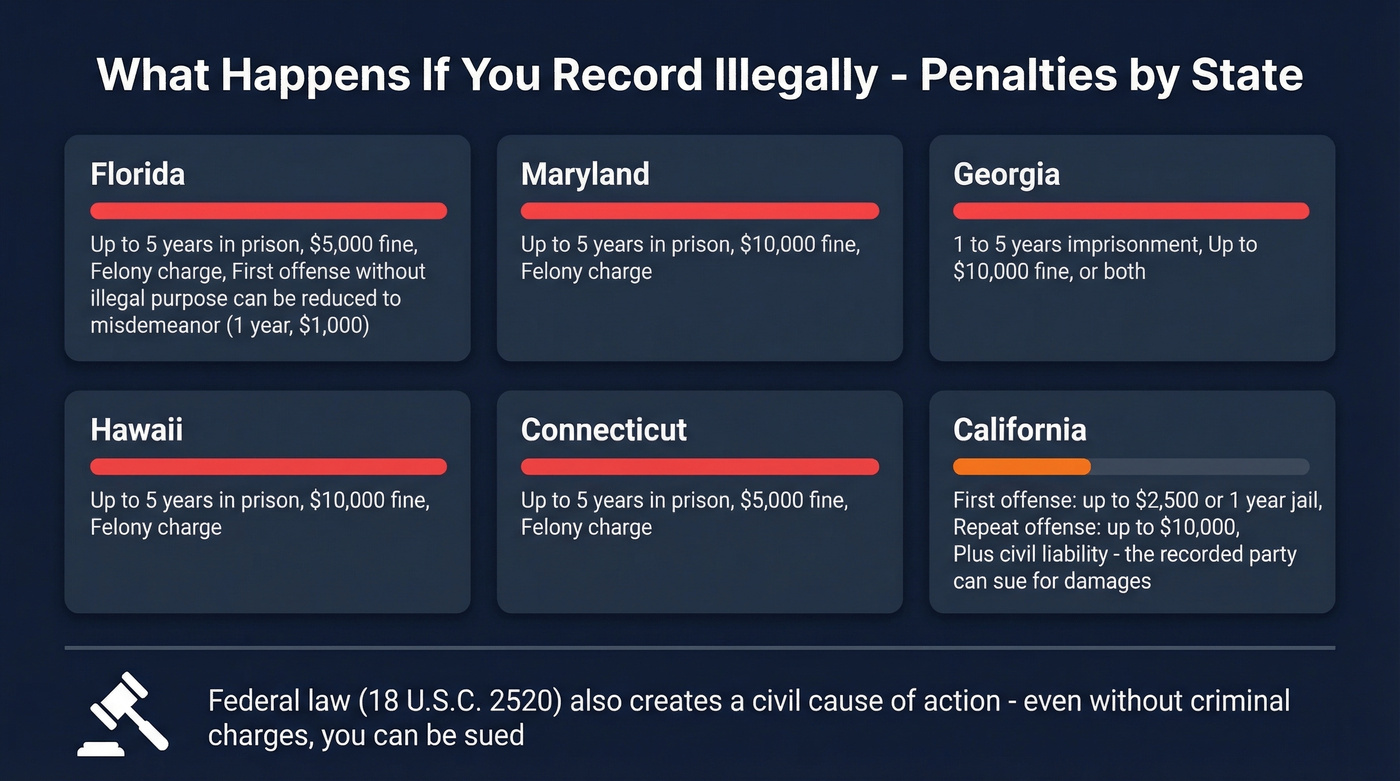
Florida is the harshest - violations carry up to 5 years in prison and a $5,000 fine. A first offense without illegal purpose can be reduced to a misdemeanor (up to 1 year and $1,000), but that's cold comfort if you're an SDR who didn't know the law. Maryland is also severe: felony, up to 5 years or $10,000. Georgia sits in the same range - 1 to 5 years imprisonment or up to $10,000, or both.
Hawaii classifies violations as a felony carrying up to 5 years and $10,000 in fines. Connecticut follows suit: felony, up to 5 years and $5,000. These two are often overlooked because they're mixed-consent states, but their penalties for phone recording violations are just as severe as Florida's.
California is slightly lighter on the criminal side - a first offense carries up to $2,500 or 1 year in jail, with subsequent offenses jumping to $10,000. But California's real teeth are in civil liability: the recorded party can sue for damages. At the federal level, 18 U.S.C. SS 2520 creates a civil cause of action for illegal interception. Even if a prosecutor doesn't charge you, the person you recorded can take you to court.
We've seen teams treat recording compliance as a "nice to have" until someone actually files suit. By then, the damage is done.
Interstate Calls - Which Law Applies?
This is where it gets genuinely complicated. You're in Texas (one-party) calling someone in California (all-party). Which state's law controls?
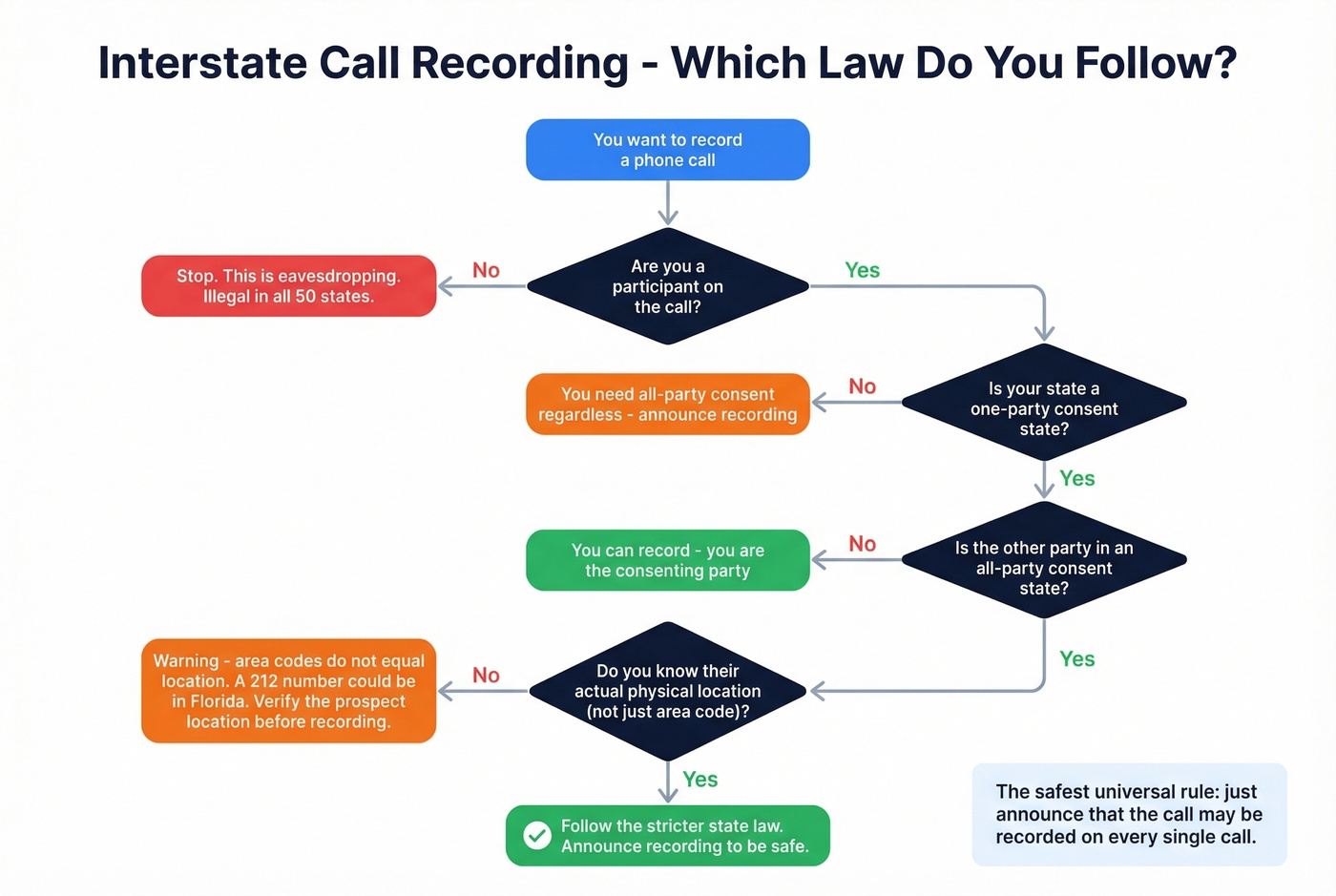
Courts disagree. The landmark case is Kearney v. Salomon Smith Barney, where the California Supreme Court held that California's all-party consent rule applied to calls originating from a one-party state. The logic: California has a strong interest in protecting its residents' privacy, regardless of where the caller sits. Not every jurisdiction follows Kearney, but the bottom line is straightforward - comply with the stricter state's law. If either party is in an all-party consent state, treat the call as requiring all-party consent.
A Reddit thread on cross-state recording between California and Utah drew dozens of responses, and even the armchair lawyers agreed on this point.
The Area Code Problem
There's a wrinkle that catches outbound teams constantly: area codes don't equal physical location. Someone with a 212 (New York) number might be sitting in their home office in Boca Raton, Florida. Ported numbers make it impossible to rely on area codes for compliance - you need to know where the prospect actually is, not where their phone number was originally registered.
In our experience, the area code problem trips up more outbound teams than any other compliance gap. B2B data platforms like Prospeo include verified prospect locations refreshed on a 7-day cycle, so your team knows the actual state before dialing.
Common Recording Scenarios
Recording at Work
Your manager pulls you into a conference room for a performance review. Can you hit record on your phone? In a one-party consent state, yes - you're a participant, and that's all the law requires.
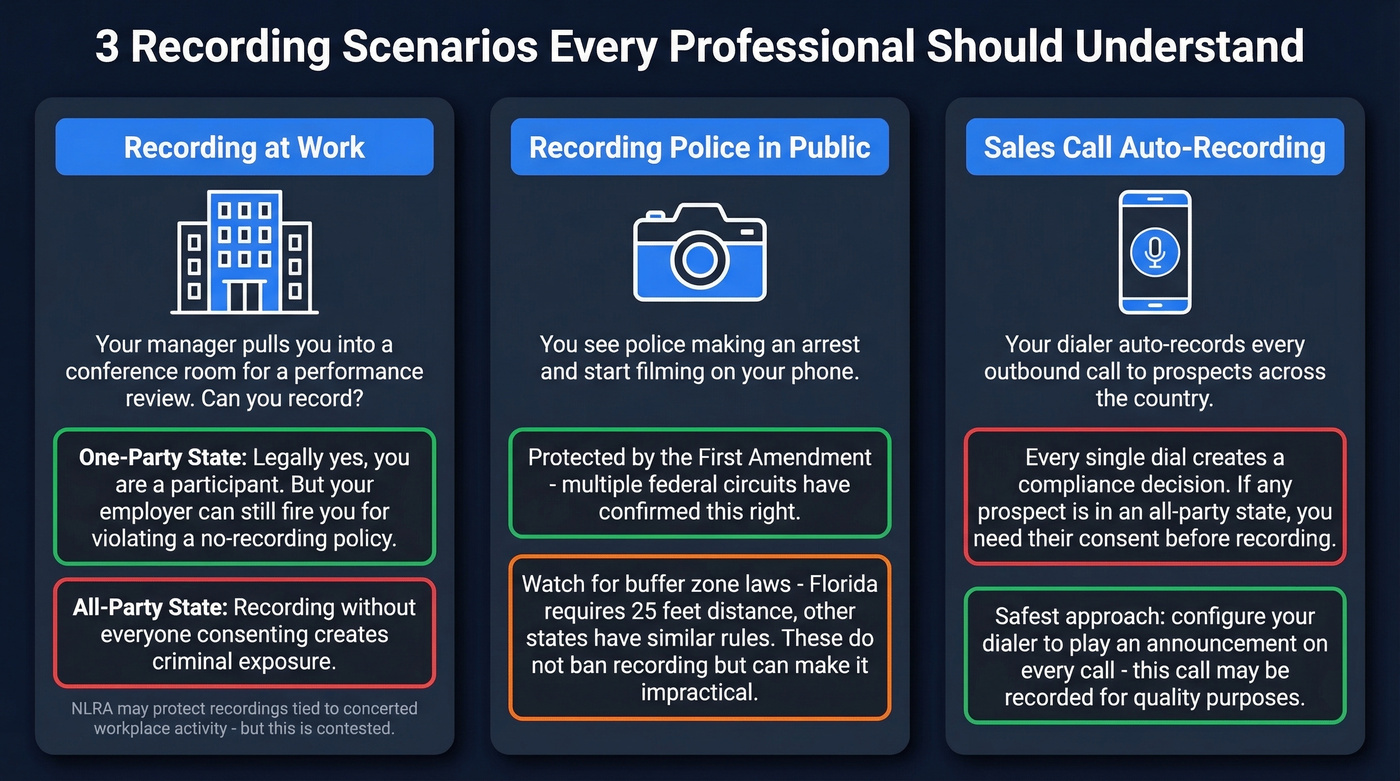
But "legal" and "consequence-free" aren't the same thing. Employers can enforce no-recording policies regardless of state law. Violating that policy won't land you in jail, but it can get you fired. The Seyfarth Shaw analysis highlights an important nuance: the NLRA may protect recordings made as part of "concerted activity" - employees acting together to address workplace conditions. The NLRB has taken an aggressive stance that NLRA protections can preempt state recording laws in these situations, though this remains contested.
In a one-party state, you can legally record. Your employer can still fire you for it. In a dual consent state, recording without consent from everyone in the room creates criminal exposure.
Recording Police in Public
Recording police officers performing their duties in public is protected by the First Amendment. Multiple federal circuits have affirmed this: Glik v. Cunniffe (1st Cir. 2011), ACLU v. Alvarez (7th Cir. 2012), Turner v. Lt. Driver (5th Cir. 2017), and Fields v. City of Philadelphia (3rd Cir. 2017).
The catch is "buffer zone" laws. Florida enacted a 25-foot minimum distance requirement. Arizona passed an 8-foot law in 2022 that was partly overturned on First Amendment grounds. Indiana and Louisiana have similar distance restrictions. These laws don't ban recording outright, but they can make it impractical during fast-moving encounters.
Sales Call Recording Compliance
If your sales team auto-records calls through a dialer, every single dial creates a compliance decision. At scale - hundreds or thousands of calls per day - one wrong setting can generate massive liability.
The universal safe practice: announce "this call may be recorded" at the start of every outbound call. Period. It doesn't matter if you're in a one-party state. The announcement costs you nothing and eliminates the risk. We've tested this across thousands of outbound campaigns, and the announcement adds maybe three seconds while eliminating the risk entirely. Building recording compliance into your dialer workflow - rather than treating it as an afterthought - is the only approach that scales (especially if you're using predictive dialer software or a power dialer).
One additional wrinkle: FCC rules can impose separate requirements if you intend to broadcast or publish a recorded call. Those consent requirements are distinct from state wiretapping statutes, so teams producing podcasts, webinars, or marketing content from recorded calls should verify FCC compliance separately.
Dialing across state lines means juggling 50 different consent laws. Or you could skip the legal maze entirely - Prospeo's 125M+ verified mobile numbers come with 30% pickup rates, and our email database lets you lead with outbound that doesn't require consent disclosures at all.
Replace risky recordings with emails that land - starting at $0.01 each.
How Implied Consent Works
You've heard the phrase a thousand times: "This call may be recorded for quality assurance purposes." That announcement, combined with the other party staying on the line, creates implied consent. The 8th Circuit affirmed this framework in Alexander v. Pathfinder, Inc. (189 F.3d 735, 8th Cir. 1999) - if a party is warned about recording and continues the conversation, they've implicitly consented.
A question that comes up constantly on Reddit: "If a company tells me 'this call may be recorded,' can I record them back?" Yes. The company's announcement constitutes their consent. In a one-party state, you already had the right. In an all-party state, their announcement plus your continued participation creates mutual implied consent. All-party consent requirements are effectively satisfied the moment both sides acknowledge the recording and stay on the line. It's one of the few areas of recording law where the answer is actually straightforward.
What's Changing in 2026
Maryland lawmakers considered legislation in 2025 to chip away at the state's strict all-party consent statute, expanding exemptions for fair housing investigations and certain admissibility scenarios. None of the bills passed, but the debate signals that 2026 could bring real changes to one of the strictest recording states in the country.
Arizona's 8-foot buffer zone law for recording police was partly overturned on First Amendment grounds, and similar challenges are pending against distance laws in other states. The trend is clear: courts are skeptical of laws that restrict the practical ability to record public officials.
Let's be honest about something: most of the "recording law confusion" online isn't about ambiguous statutes. It's about lazy list-making. The nuanced states have clear rules if you read the actual statutes. The problem is that content creators slap states into binary "one-party" or "two-party" buckets because nuance doesn't fit a simple table. Don't trust any list that doesn't address the phone-vs-in-person split.
A Note on International Recording Laws
This guide covers U.S. law exclusively. If your team operates internationally, the EU's GDPR imposes its own consent requirements for call recording - generally requiring explicit, informed consent with a documented legal basis. The UK, Canada, and Australia each have distinct frameworks as well. Don't assume U.S. one-party consent principles translate abroad (see GDPR cold calling for the sales-side implications).
FAQ
Can I record back when a company says "this call may be recorded"?
Yes. The company's announcement constitutes their consent to being recorded. In one-party recording states, you already have the right as a participant. In all-party consent states, their announcement plus your continued participation creates mutual implied consent - both sides have effectively agreed.
Which state's law applies on a cross-state call?
There's no single nationwide rule. The Kearney v. Salomon Smith Barney case held that California's all-party rule applied to a caller in a one-party state. Always comply with the stricter state's law - if either party is in an all-party consent jurisdiction, treat the entire call as requiring everyone's permission.
How often are people actually prosecuted?
Criminal prosecutions are less common than civil lawsuits, but penalties are severe when enforced. Florida, Maryland, Hawaii, and Connecticut classify violations as felonies carrying up to 5 years in prison. Civil suits under 18 U.S.C. SS 2520 are more frequent and can result in significant damages.
Can my employer fire me for recording at work?
In most states, yes - even where one-party consent makes the recording legal. Employers can enforce no-recording policies and terminate employees who violate them. The NLRA may protect recordings tied to concerted workplace activity, but this protection is narrow and contested.
How do outbound teams stay compliant at scale?
Announce "this call may be recorded" on every call - no exceptions. Use a B2B data tool with verified prospect locations so your team knows which state's law applies before dialing, not after a compliance incident surfaces.