

Sales Call Recording: Laws, Tools, Pricing, and Coaching Playbooks for 2026
The average cold call lasts 93 seconds. That's a minute and a half of signal - objections, tone shifts, buying cues - that vanishes the moment a rep hangs up. With a 6.7% call-to-meeting rate and a 16.6% connect rate, every live conversation is rare. Sales call recording turns those fleeting moments into a coaching library, a deal-intelligence engine, and a compliance record all at once.
Most teams know they should record calls. Fewer know how to do it legally across state lines, what the software actually costs once you're past the demo, or how to build a coaching cadence that reps don't resent. Let's fix all three.
What You Need (Quick Version)
Legal baseline. Disclose recording on every call. Fourteen US states require all-party consent - we list them below with penalties. Universal disclosure is the only safe default.
Tool pick by budget. Free: Fathom. Mid-market: Modjo ($15/user/mo) or Fireflies (around $18/user/mo). Enterprise: Gong ($105K-$180K Year 1 for 50 users).
The step most teams skip. If 83.4% of your dials don't connect, you're recording voicemails and wrong numbers. Verify your prospect data first - Prospeo's verified mobiles hit a 30% pickup rate, so reps actually reach humans worth recording.
Consent Laws by State
Federal law makes this straightforward. The Electronic Communications Privacy Act (ECPA) allows one-party consent - meaning you, the person on the call, can be the consenting party. States can and do override that baseline.
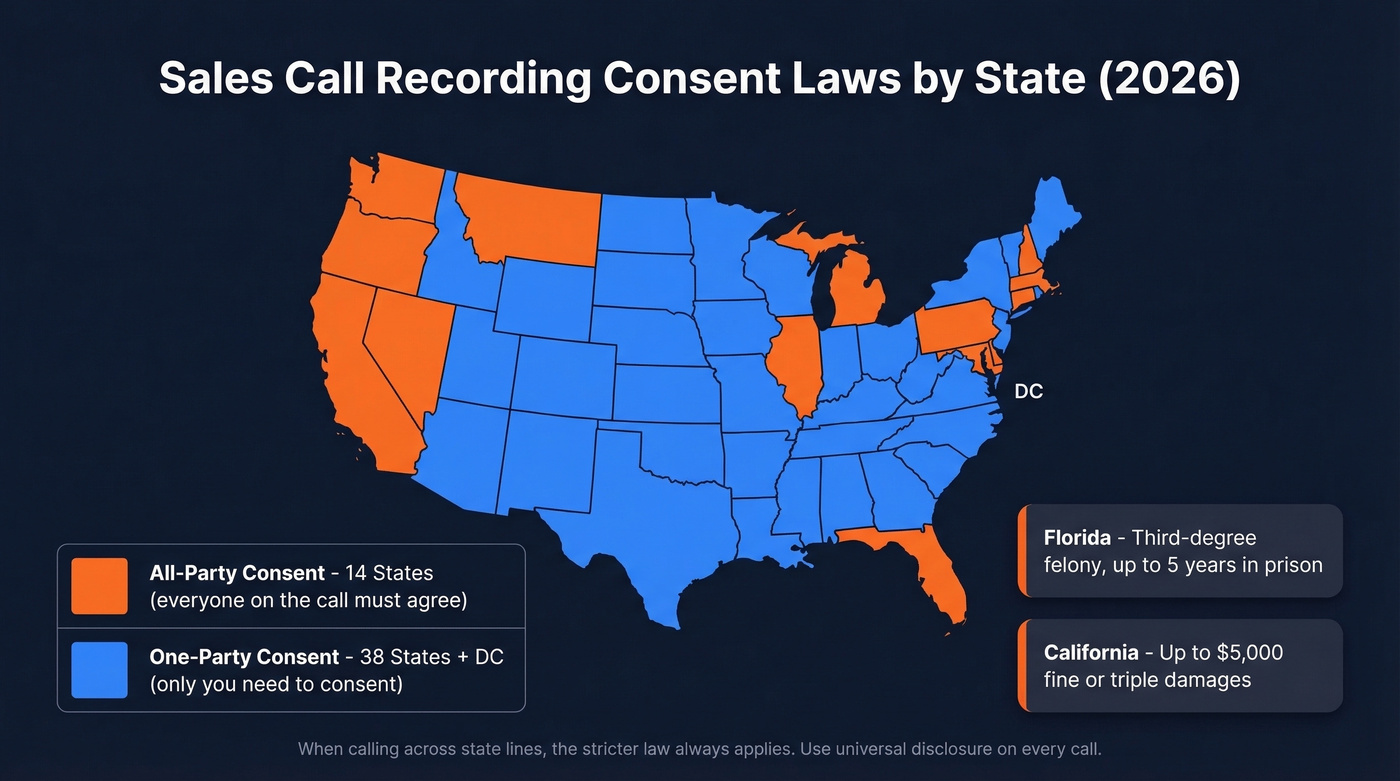
One-Party vs. All-Party Consent
Thirty-eight states plus DC follow the federal one-party rule. Fourteen states require all-party consent, meaning every person on the call must know about and agree to the recording. Some carry situational caveats, but treat all fourteen as requiring disclosure:
| State | Notes |
|---|---|
| California | Up to $5,000 or triple damages |
| Connecticut | Certain circumstances |
| Delaware | |
| Florida | Third-degree felony, up to 5 years |
| Illinois | |
| Maryland | |
| Massachusetts | |
| Michigan | Situation-dependent |
| Montana | |
| Nevada | |
| New Hampshire | |
| Oregon | Electronic communications |
| Pennsylvania | |
| Washington |
California's penalty - $5,000 or triple damages - gets the headlines. Florida's is worse: a third-degree felony carrying up to five years. A single recorded call with a prospect in Tallahassee, without disclosure, is technically a felony.
International teams face additional requirements under GDPR and local privacy laws - consult legal counsel for cross-border recording.
The Interstate Rule
When you're in a one-party state calling a prospect in an all-party state, the stricter law applies. Since your SDR team is probably dialing across dozens of states daily, universal disclosure on every call is the only operationally sane approach.
Disclosure Script You Can Steal
"Just so you know, this call is being recorded for quality and training purposes. Is that okay with you?"
If the prospect stays on the line, that typically counts as implied consent. Some teams bake this into their cold calling system auto-dialer greeting so reps don't have to remember. Simple, but it saves you from a Florida felony charge.
Why Recording Calls Changes Everything
Teams that implement conversation intelligence programs see a 5-15% win-rate lift and faster ramp times for new hires. On a team of 20 reps, a 10-point win-rate improvement on deals over $50K changes your quarter.
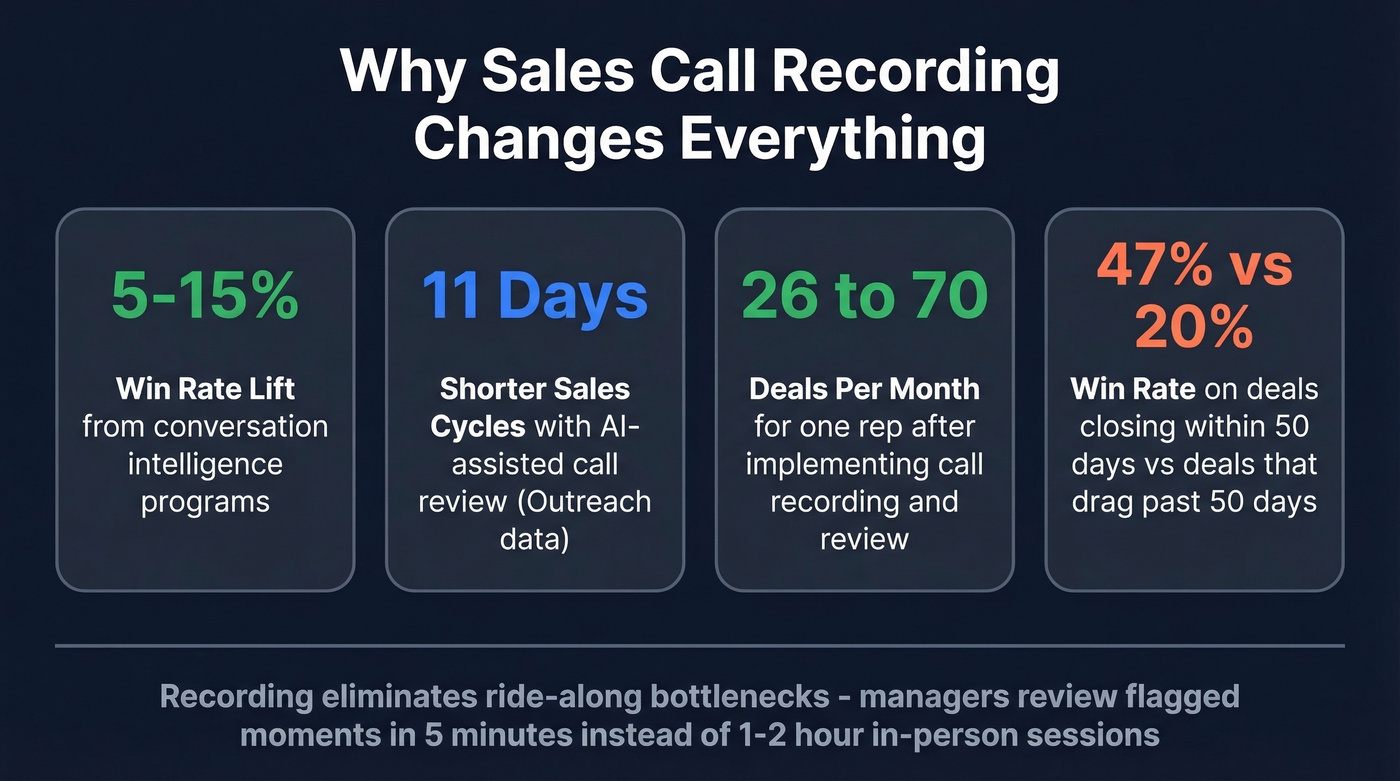
Outreach's data on their Kaia product shows it shaves 11 days off sales cycles and boosts win rates by up to 10 percentage points on deals over $50K. Opportunities that close within 50 days carry a 47% win rate; past that threshold, it drops to 20% or lower. Recording helps managers spot stalled deals faster and intervene before they drift past the window.
The field sales numbers are even more dramatic. unWired Broadband had a rep jump from 26 deals per month to 70 after implementing call recording and review - a pattern that held for two consecutive months. Recording also eliminates the ride-along bottleneck: managers who used to spend 1-2 hours per rep on in-person coaching can now review flagged moments in about 5 minutes.
Recording Modes
Most platforms offer three core recording modes, plus two that matter for specific workflows.
Automatic recording captures every call without rep intervention. This is the default for most sales teams - it removes human error and ensures nothing slips through. Use this for cold calling, discovery, and any high-volume dialing motion.
On-demand recording lets the rep start and stop mid-call. Useful when you need to pause capture during payment or personal information exchanges. Some compliance frameworks require this flexibility.
Supervisor-initiated recording allows managers to silently record or listen in on live calls. Common in call centers and BDR bullpens. In all-party states, the customer still needs to know - which circles back to universal disclosure.
Conference call recording captures multi-party calls and is standard on platforms like Gong and Clari Copilot. Video meeting recording extends the same logic to Zoom, Teams, and Google Meet - most CI tools now handle both audio and video natively.

Recording software is worthless if reps spend 83% of dials reaching voicemails and wrong numbers. Prospeo's 125M+ verified mobile numbers deliver a 30% pickup rate - so every recording captures an actual prospect conversation, not dead air.
Stop recording voicemails. Start recording deals.
What Call Recording Tools Cost
Full Pricing Comparison
| Tool | Starting Price | Free Plan | Best For | G2 Rating |
|---|---|---|---|---|
| Fathom | Free | Unlimited free tier | Solo reps, startups | ~4.9/5 |
| tl;dv | Free | Unlimited free tier | Free transcription | ~4.7/5 |
| Fireflies | ~$18/user/mo | Free tier available | SMB teams (5-30 reps) | ~4.5/5 |
| Modjo | $15/user/mo | Demo | Mid-market coaching | - |
| Allo | $18/user/mo | Demo | Small sales teams | - |
| Claap | $20/user/mo | Free trial | Async video teams | - |
| Dialpad | $15/user/mo | 14-day trial | Phone system + AI notes | - |
| CloudTalk | $19/mo | 14-day trial | Call center + outbound | - |
| Aircall | $30/user/mo | 7-day trial | Phone-first teams | ~4.3/5 |
| Fellow.ai | ~$7/user/mo | Free tier | Meeting management | - |
| Otter | ~$17/user/mo | Free tier | Transcription-heavy orgs | - |
| Talkdesk | $85/user/mo | Demo | Enterprise contact center | - |
| NICE CXone | $110/user/mo | Demo | Large call centers (500+) | - |
| Gong | $1,600/user/year | Demo | Enterprise CI | ~4.8/5 |
| Clari Copilot | $1,080/user/year | Free trial (no CC) | Enterprise CI (budget) | - |
If you're evaluating a phone system + AI notes bundle, it's worth comparing Dialpad options before you commit.
What Gong Actually Costs
Gong doesn't publish pricing, which frustrates anyone building a business case. The three-part model is well-documented at this point.
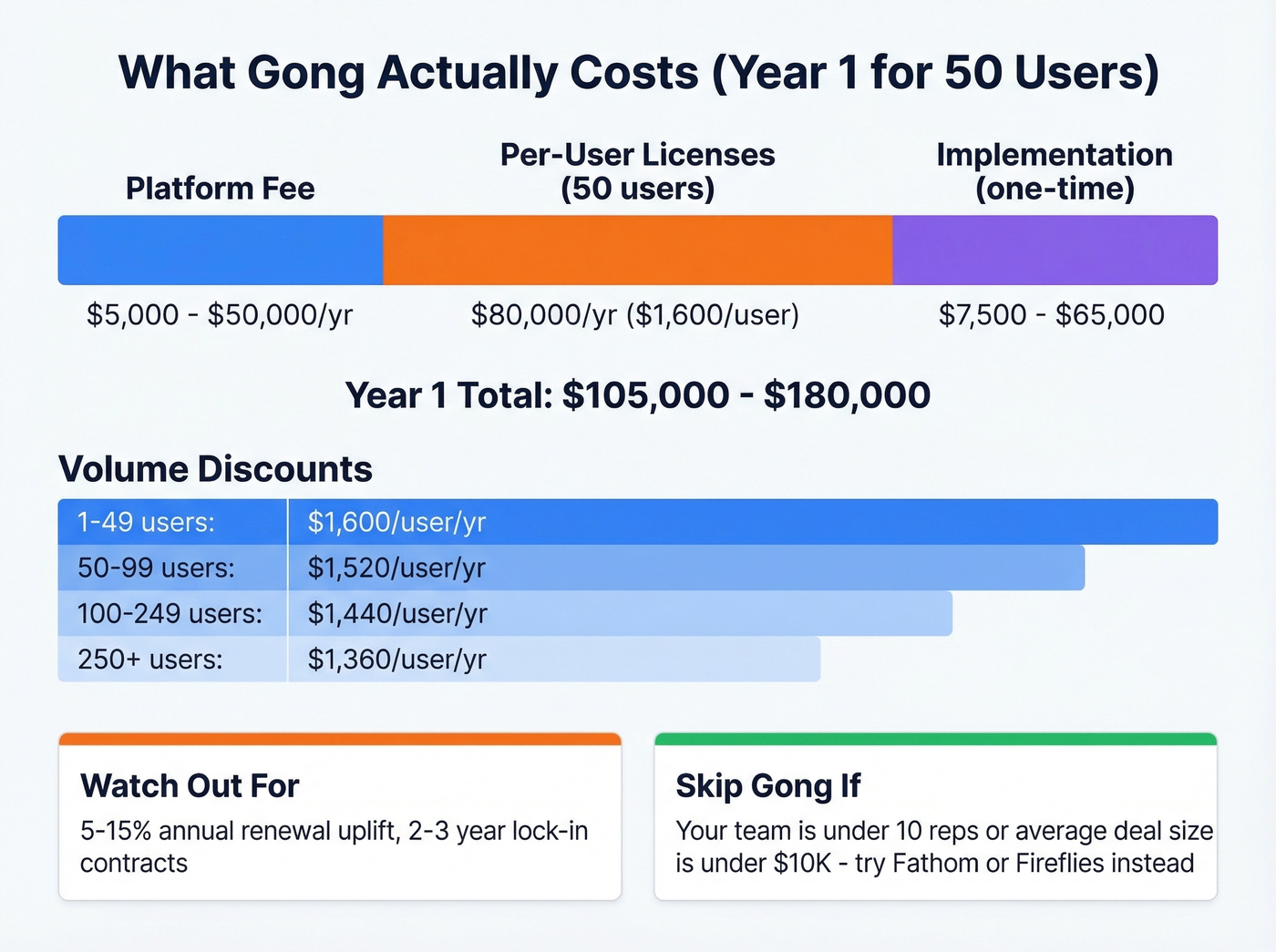
Platform fee: $5,000-$50,000/year depending on company size and modules. That's the base cost before a single user logs in.
Per-user licenses: $1,600/user/year for teams under 50. Drops to $1,520 at 50-99 users, $1,440 at 100-249, and $1,360 at 250+. Annual, prepaid.
Implementation: $7,500-$65,000 one-time, depending on CRM complexity and integrations.
For a 50-user deployment, Year 1 total runs $105,000-$180,000. Renewal uplift is 5-15% annually, and contracts lock you in for 2-3 years.
Here's the thing: Gong is the best all-in-one CI platform on the market. But most teams don't need all-in-one. A 10-person SDR team that just needs transcription and call review is massively overpaying at Gong prices. If your average deal size is under $10K, skip Gong and start with Fathom or Fireflies.
Clari Copilot
Clari Copilot runs two tiers: Accelerator at $1,080/user/year and Enterprise at $1,320/user/year. Cheaper per seat than Gong, but the same annual-prepay, multi-year contract structure applies. Discounts of up to 45% kick in at 150+ users.
The common complaints center on transcription accuracy with accents, speaker attribution in multi-person calls, and a UI that feels clunkier than Gong's. For teams selling internationally, test transcription quality before committing.
Free Plans Worth Trying
| Tool | Recording Limit | Storage | Key Limits | Upgrade Trigger |
|---|---|---|---|---|
| Fathom | Unlimited | Unlimited | 5 AI summaries/mo, no CRM sync | CRM integration |
| tl;dv | Unlimited | Unlimited | Basic AI, limited CRM | Multi-meeting intel |
| Fireflies | Unlimited | 800 min/seat | 20 AI credits/mo, limited CRM | Storage + AI caps |
| Otter | 300 min/mo | Limited | Basic AI, 30-min cap/call | Call length |
| Krisp | 60 min/day | 7-day history | 2 summaries/day, English only | Language + history |
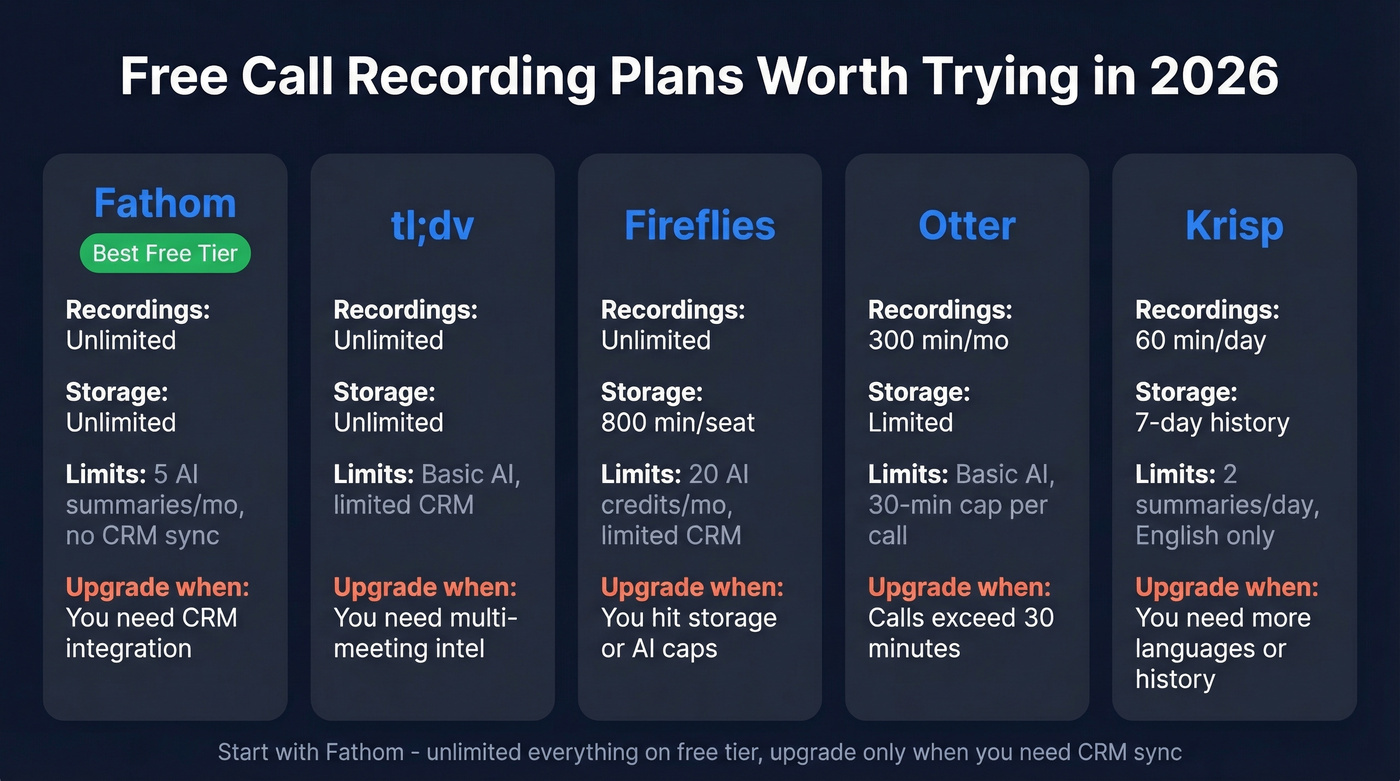
Fathom is the obvious starting point - unlimited recordings, unlimited storage, solid transcription. The consensus on r/NoteTaking is that Fathom's free tier is the go-to before spending a dollar. tl;dv offers a similar unlimited free tier with the paywall at multi-meeting intelligence features.
How to Coach Reps Using Recorded Calls
Recording calls without a coaching system is just surveillance with extra steps.
Set a weekly rhythm. Block one hour per rep, per week. Review three cold calls and one demo or discovery call. The rep picks one call they're proud of; the manager picks the rest. This balance keeps the session from feeling like a tribunal. If you need a structured onboarding ramp, pair this with a 30-60-90 day plan for sales reps.
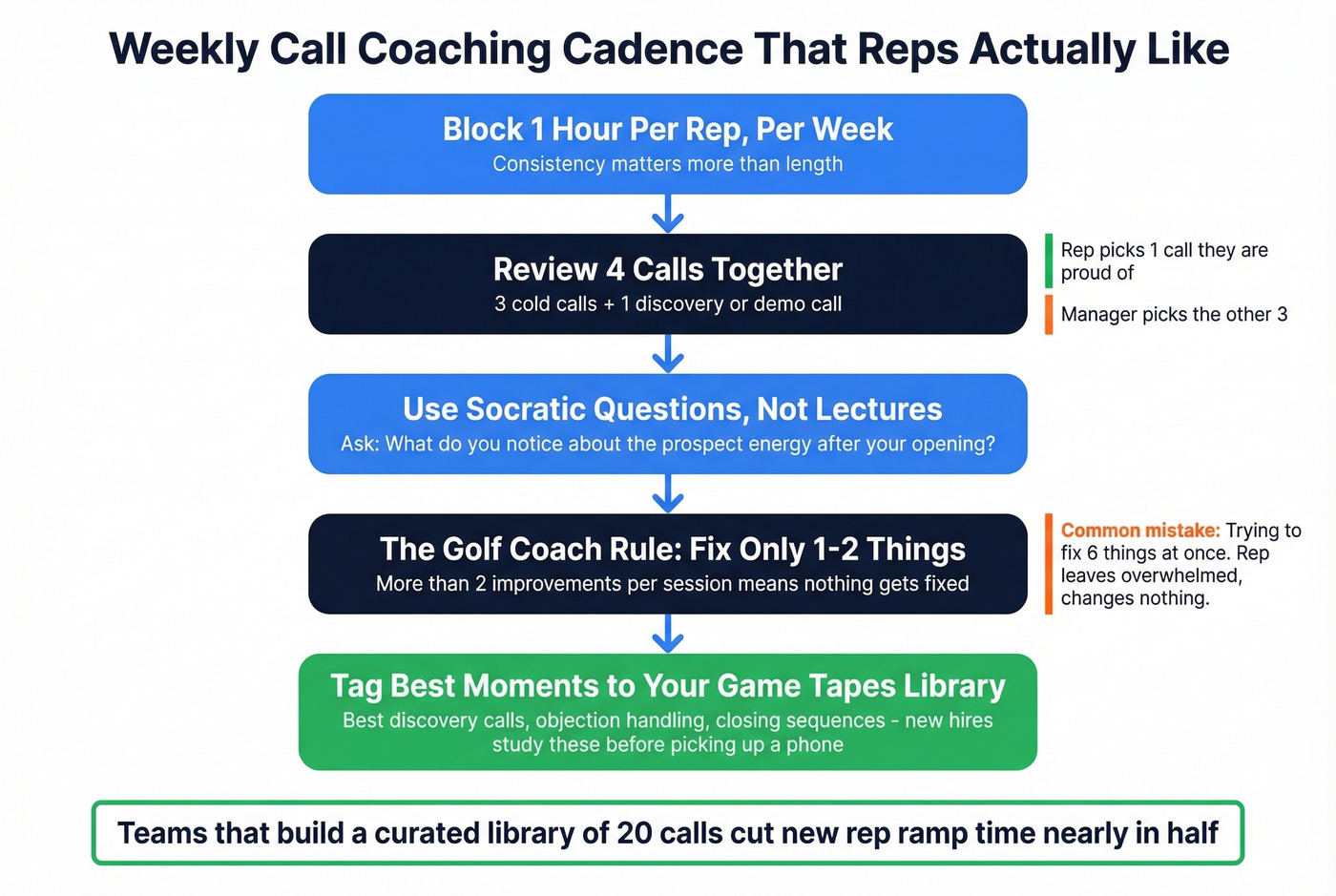
Use Socratic questioning, not directives. Instead of "you talked too much in the first two minutes," try "what do you notice about the prospect's energy after your opening?" Reps who discover their own patterns fix them faster than reps who get lectured.
The golf coaching principle. A golf coach doesn't fix your grip, stance, backswing, and follow-through in one lesson. Pick 1-2 improvements per session, maximum. We've seen managers try to address six things at once - the rep leaves overwhelmed and changes nothing.
Build a "game tapes" library. Tag your best discovery calls, objection-handling moments, and closing sequences. New hires should watch these before they ever pick up a phone. A well-organized library of recorded conversations is the fastest onboarding asset you can build - we've watched teams cut new-rep ramp time nearly in half just by giving them 20 curated calls to study in their first week.
Rolling Out Recording Without Backlash
The #1 reason recording programs fail isn't technology. It's rep resistance.
If your team thinks recordings exist to catch mistakes, they'll game the system or push back hard. Start with positive reinforcement for the first two weeks. Share only highlights - great objection handling, smooth closes, clever pivots. Let reps submit their own best moments.
Teams that position recording as "we're building a library of what great looks like" get buy-in fast. Teams that lead with "we need to identify coaching opportunities" get resistance. The framing has to be genuine, not just messaging.
On the practical side, your recording platform should reduce admin, not add it. One enterprise AE on r/techsales described spending 30+ minutes after each call updating notes and next steps. After integrating Salesforce + Outreach + Gong + Dooly and using post-call dictation, that dropped to under 5 minutes. When reps see recording as a tool that eliminates busywork, adoption follows naturally. Pair your recording tool with your CRM and sequencer so data flows automatically - no manual entry, no duplicate work. (If you're standardizing your stack, start with a clear sales process optimization plan.)
The Upstream Problem
Here's a question nobody in the conversation intelligence space wants to address: what's the point of recording calls that never connect?
With a 16.6% connect rate as the industry benchmark, 83.4% of dials go to voicemail, wrong numbers, or dead lines. If your team makes 200 dials a day, that's 167 useless recordings clogging your system. Recording voicemails teaches you nothing. Recording a confused stranger who hasn't worked at the target company in two years teaches you less than nothing.
The fix is upstream. Before calls hit your dialer, verify the list. Prospeo covers 125M+ verified mobile numbers with a 30% pickup rate - compared to 12.5% for ZoomInfo and 11% for Apollo. That's the difference between 3 live conversations per 10 dials and roughly 1. More live conversations means more calls worth recording, more coaching material, and more pipeline. The email finder delivers 98% accuracy on a 7-day refresh cycle, so your multi-channel sequences actually land. If you're building a repeatable outbound motion, combine this with proven sales prospecting techniques and a tight lead generation workflow.
You're paying $1,600/user/year for Gong to record calls. But if your prospect data bounces or rings out, you're coaching reps on silence. Prospeo gives you verified direct dials at $0.01/lead - 90% cheaper than ZoomInfo - so your CI investment actually pays off.
Fix the data before you fix the pitch.
FAQ
Is it legal to record sales calls?
Federal law (ECPA) allows one-party consent, but 14 states require all-party consent - California, Florida, Illinois, Pennsylvania, and 10 others. Disclose on every call regardless of location. Florida violations are third-degree felonies carrying up to five years.
How much does Gong cost?
Expect $105K-$180K in Year 1 for a 50-user deployment, broken into a platform fee ($5K-$50K/year), per-user licenses ($1,360-$1,600/user/year), and implementation ($7.5K-$65K one-time). Contracts lock you in for 2-3 years with 5-15% annual renewal increases.
What's the best free call recording app?
Fathom offers unlimited free recordings, unlimited storage, and solid transcription - the clear winner for small teams. AI summaries cap at 5/month and CRM sync requires a paid plan. tl;dv is the runner-up with a similar unlimited free tier.
Do I need conversation intelligence or just a recorder?
Teams under 10 reps need a recorder with transcription - Fathom or Fireflies at $0-$18/user/mo. Teams over 20 benefit from full CI platforms like Gong for deal intelligence, coaching scorecards, and pipeline analytics. Match the tool to your team size and deal complexity.
How can I improve connect rates before recording?
Verify your prospect data so you're recording real conversations, not voicemails. Verified mobile numbers with a 30% pickup rate mean three times more live conversations per dial session than unverified lists. Pair verified data with optimal call timing - Tuesday through Thursday, 10-11 AM local time.