

Open-Ended Questions for Sales: What 519,000 Calls Reveal About Asking (and Listening)
Five minutes into the discovery call, you're getting one-word answers. "Yep." "Nope." "We're fine." You've got a list of open-ended questions in your notes - and none of them are working.
The problem isn't your questions. It's that you don't have a system for when to ask them, how to sequence them, and what to do with the silence after.
The Quick Version
An analysis of 519,000+ B2B sales calls found that 11-14 questions is the sweet spot for discovery. More than that and success rates drop to average. Use the SPIN sequence - Situation, Problem, Implication, Need-Payoff - instead of firing questions at random. And the skill that separates top reps from everyone else isn't the questions themselves. It's the 3-second pause after asking them.
What the Data Actually Shows
That dataset - published in 2017 and still one of the most-cited public studies on discovery call questioning - found a direct link between question count and deal outcomes. The magic range: 11-14 targeted questions per discovery call. Below that, you're not digging deep enough. Above it, diminishing returns flatten your success rate.
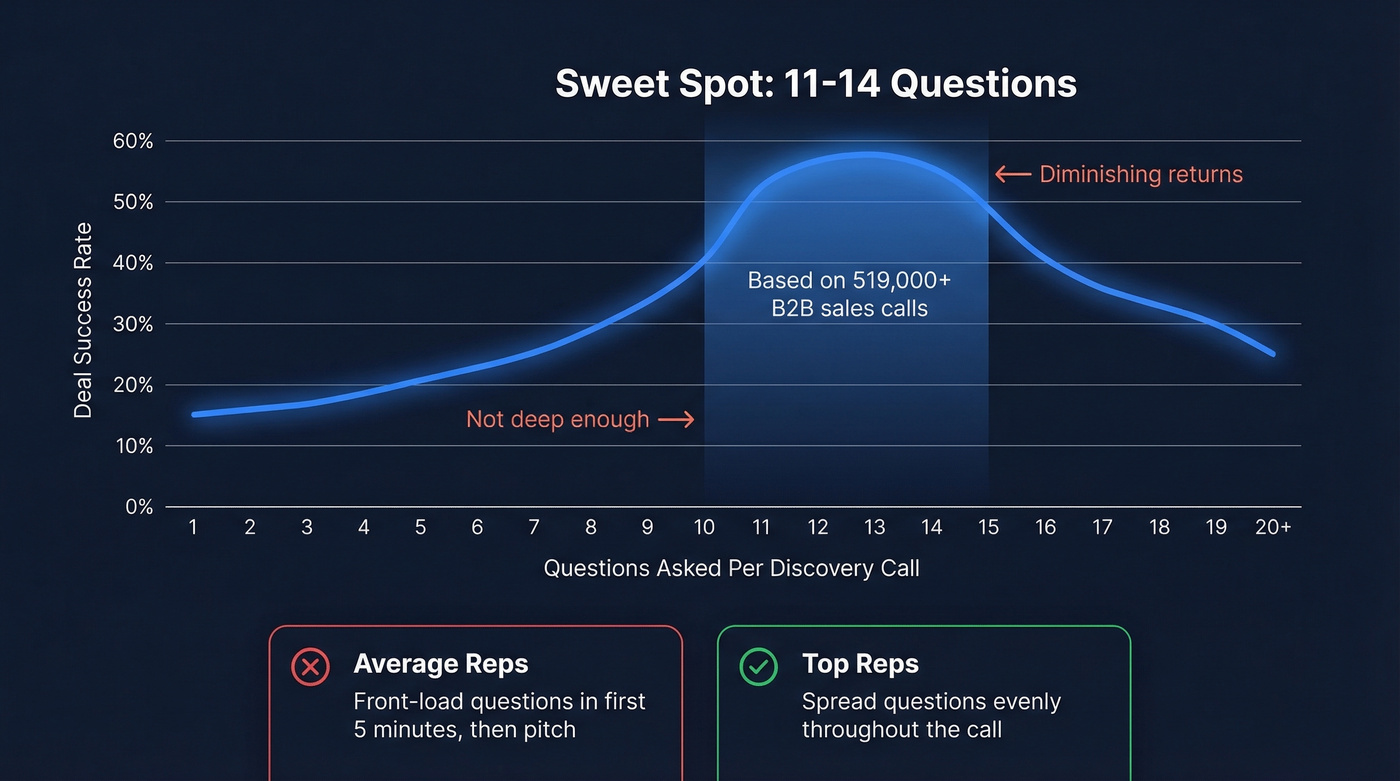
The number alone isn't the insight. It's the distribution. Top-performing reps spread questions evenly throughout the call, weaving them into natural conversation. Average reps front-load questions in the first five minutes like they're running through a checklist, then pivot to pitching. That front-loading pattern is exactly what makes prospects shut down - it feels like an interrogation, not a dialogue.
The quality filter matters too. Questions about business challenges, goals, and consequences correlate with winning. Generic "tell me about your role" questions don't move the needle.
Open-Ended vs. Closed-Ended Questions
Closed-ended questions aren't bad. They're bad at the wrong time.
A well-placed "Is this project funded?" is a perfectly good qualifying question. The mistake is opening discovery with a string of yes/no questions that kill momentum before it starts. The NNGroup funnel technique applies directly: start broad with open-ended questions, then narrow with specific follow-ups. Open-ended prompts surface unexpected insights. Closed questions confirm details. You need both - in the right order.
| Dead-End (Closed) | Keeps Talking (Open-Ended) |
|---|---|
| "Do you have questions?" | "What questions can I answer?" |
| "Are you happy with your current tool?" | "Walk me through how you're handling this today." |
| "Is budget approved?" | "How does your team typically fund projects like this?" |
| "Did that cause problems?" | "What happened as a result?" |
The SPIN Framework for Discovery
If you learn one questioning framework, make it SPIN. Neil Rackham's original research - 35,000+ sales calls studied over 12 years - produced a sequence that still outperforms random question lists in complex B2B sales. Other frameworks like Sandler, Gap Selling, and NEPQ have their merits, but SPIN has the largest research base and the clearest sequencing logic.
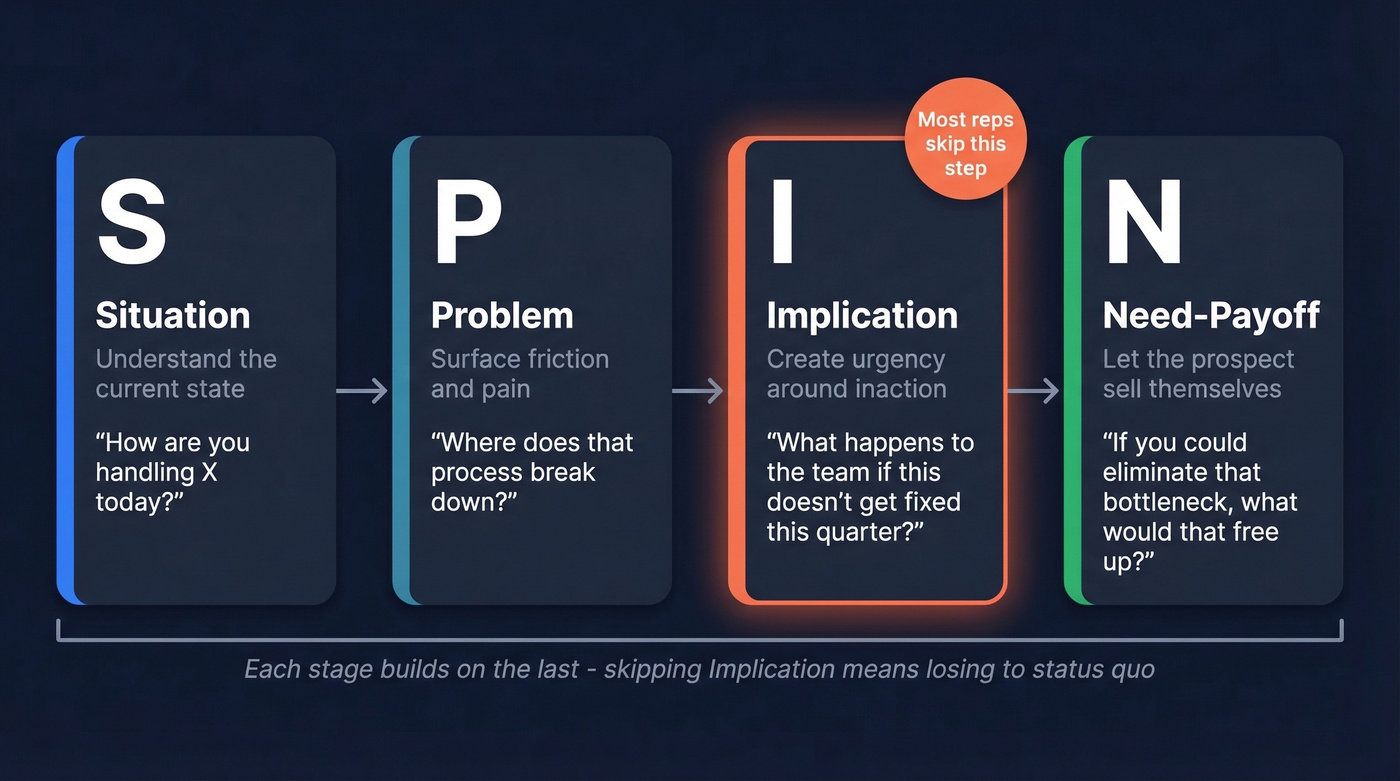
The four stages build on each other:
- Situation - Understand the current state. "How are you handling X today?"
- Problem - Surface friction. "Where does that process break down?"
- Implication - Create urgency. "What happens to the team if that doesn't get fixed this quarter?"
- Need-Payoff - Let the prospect sell themselves. "If you could eliminate that bottleneck, what would that free up?"
Here's the thing: most reps skip Implication questions entirely. They go from Problem straight to pitching. And those reps lose to status quo more than anything else, because they never made the prospect feel the cost of doing nothing. Implication questions are the engine that turns a nice conversation into a deal with urgency.

Your SPIN questions won't matter if you're asking the wrong people. Prospeo's 30+ search filters - including buyer intent, job changes, and department headcount - help you build lists of prospects who actually have the pain you're diagnosing. 300M+ profiles. 98% email accuracy. Start every discovery call with the right buyer.
Stop wasting perfect questions on the wrong prospects.
40+ Questions Organized by Call Phase
One note from the Brooks Group: adapt your style to the buyer. A driver personality wants you to get to the point. A socializer wants to connect first. Read the room before you pick your opening.
Rapport and Opening
- What's going on in your world that made you decide to talk to me?
- What were you hoping to get out of this conversation?
- How's your team structured around [relevant function]?
- What's changed in your business since [recent event/trigger]?
Discovery and Pain
- Walk me through how you're currently handling this today.
- Where does that process break down most often?
- What prompted you to start looking at solutions now?
- Why now - what made this a priority this quarter?
- Have you tried to solve this before? What happened?
- Who on the team feels this pain most directly?
- What could you be doing that you aren't able to do today because of this issue?
- If you didn't solve it, could you live with it?
The consensus on r/sales is that questions 5, 8, 9, 11, and 12 are among the strongest discovery openers. They're simple, non-threatening, and they get prospects talking. We've found the same in our own outbound - question 8 ("Why now?") consistently unlocks the real story behind the inquiry.
Implication and Consequence
- What happens if nothing changes in the next 6-12 months?
- How much does this problem currently cost your company - in time, money, or both?
- What non-monetary costs are associated with this? Morale? Turnover?
- How does this affect your ability to hit your targets?
- If this doesn't get solved, what does that mean for your team's roadmap?
- What's the ripple effect when this breaks down?
Don't only dig into pain. The best discovery balances afflictions (what's broken) with aspirations (what they want to achieve). After asking "What happens if nothing changes?" follow with "What does the ideal state look like for your team?" Prospects who articulate a vision are more motivated buyers than those who only acknowledge problems.
Qualification
- Who else should be involved in this decision?
- Is this project funded, or are we building a case for budget?
- What does your evaluation process typically look like?
- What's your timeline for making a decision?
- What would make you say no to moving forward?
Closing
- What's the main reason you'd hesitate to go ahead with this?
- What needs to happen between now and a signed contract?
- On a scale of 1-10, how confident are you that this solves your problem - and what would make it a 10?
Post-Sale and Expansion
- What's working well since we launched?
- Where are you still seeing friction?
- What would make this a no-brainer to expand to other teams?
Read the Room
A driver wants questions 5, 8, 19, and 23 - fast, direct, no fluff. A socializer needs questions 1, 3, and 27 to build trust before you dig into pain. Skip the rapport section entirely for C-suite buyers who opened the call with "I've got 15 minutes." Adjust your sequence based on who's across the table.
A Real Discovery Conversation
Notice how each question builds on the previous answer - this isn't a checklist, it's a funnel. This is why asking open-ended questions in sales matters more than which specific questions you pick.
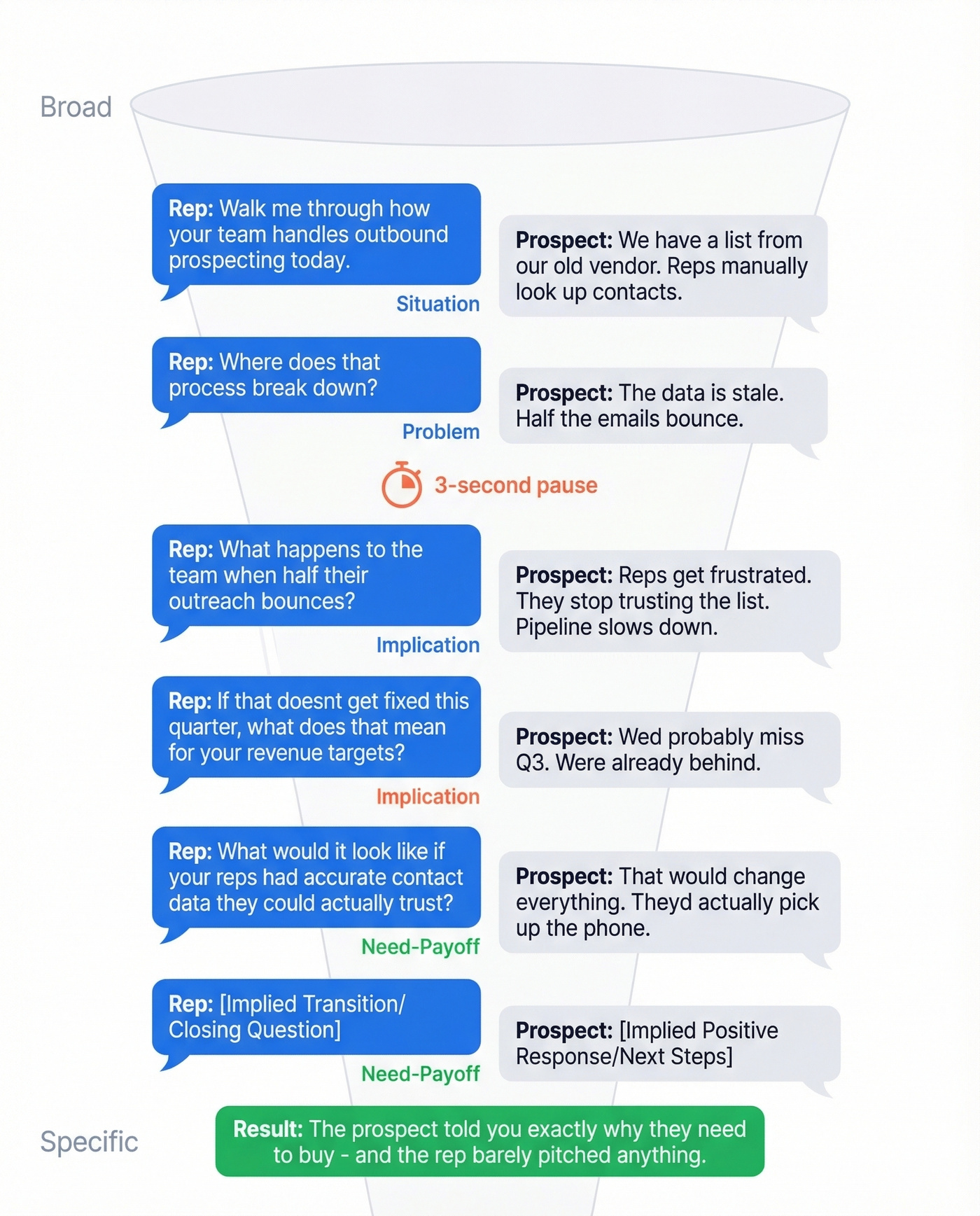
Rep: "I'd love to learn about your current situation and see if there's a fit. Sound good?"
Prospect: "Sure, go ahead."
Rep: "Walk me through how your team handles outbound prospecting today."
Prospect: "We've got a list from our old vendor. Reps manually look up contacts and add them to sequences."
Rep: "Where does that process break down?"
Prospect: "The data's stale. Half the emails bounce."
[3-second pause]
Rep: "What happens to the team when half their outreach bounces?"
Prospect: "Reps get frustrated. They stop trusting the list. Pipeline slows down."
Rep: "If that doesn't get fixed this quarter, what does that mean for your revenue targets?"
Prospect: "We'd probably miss Q3. We're already behind."
Rep: "What would it look like if your reps had accurate contact data they could actually trust?"
Prospect: "That would change everything. They'd actually pick up the phone."
Six questions. Broad to specific. Situation to Implication to Need-Payoff. The prospect just told you exactly why they need to buy - and the rep barely pitched anything.
Active Listening Makes the Questions Work
The best question in the world is useless if you talk over the answer.
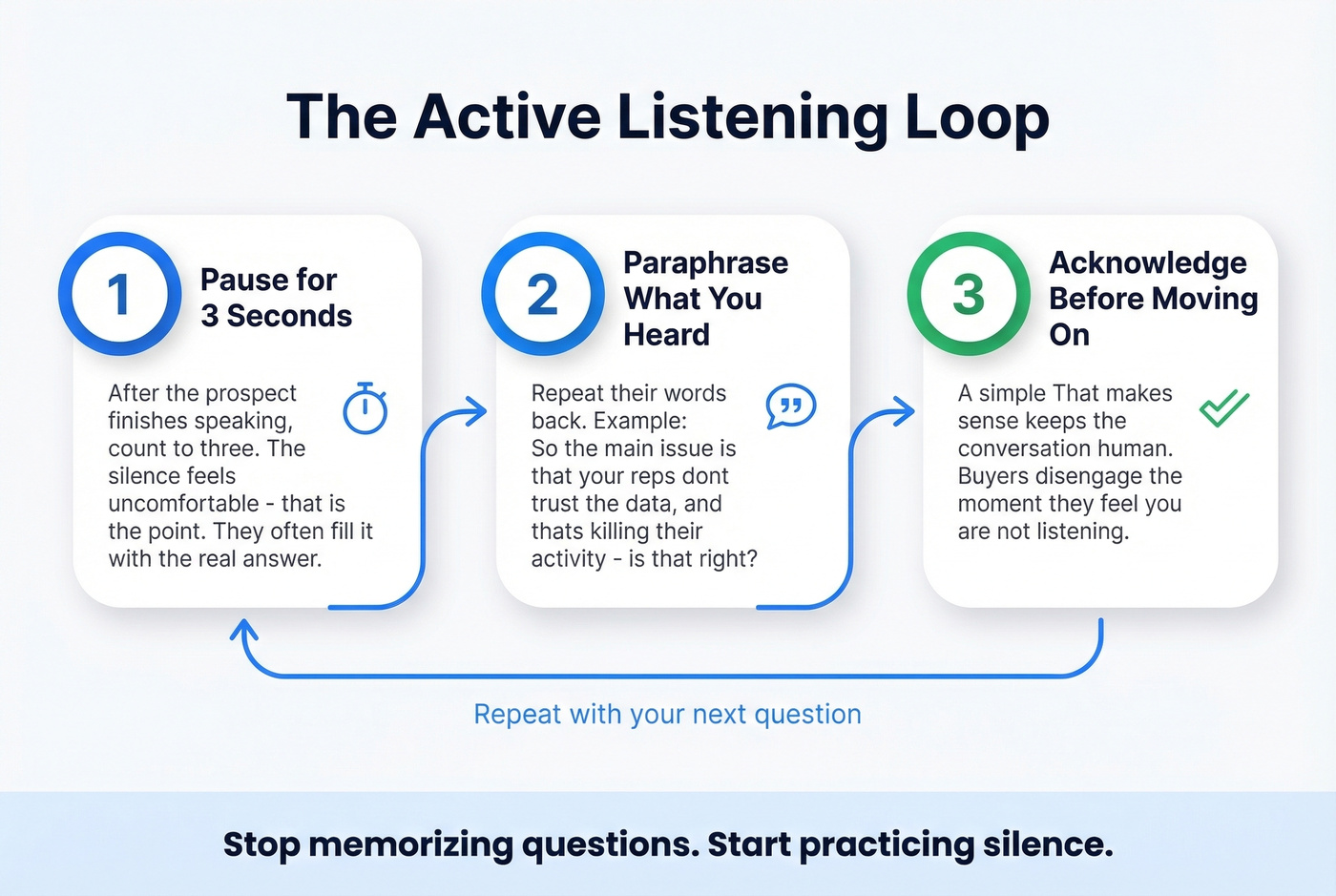
After the prospect finishes speaking, count to three before responding. The silence feels uncomfortable - that's the point. Prospects often fill it with the real answer they were holding back. In our experience, reps who master the 3-second pause see immediate improvement in discovery quality, sometimes within a single call.
After the pause, paraphrase what you heard. "So the main issue is that your reps don't trust the data, and that's killing their activity - is that right?" This proves you listened and gives the prospect a chance to correct or expand. Then, before your next question, acknowledge their answer. A common theme on r/sales is clear: buyers disengage the moment they feel you're not listening. A simple "That makes sense" keeps the conversation human.
Stop memorizing questions. Start practicing silence.
7 Mistakes That Kill Discovery
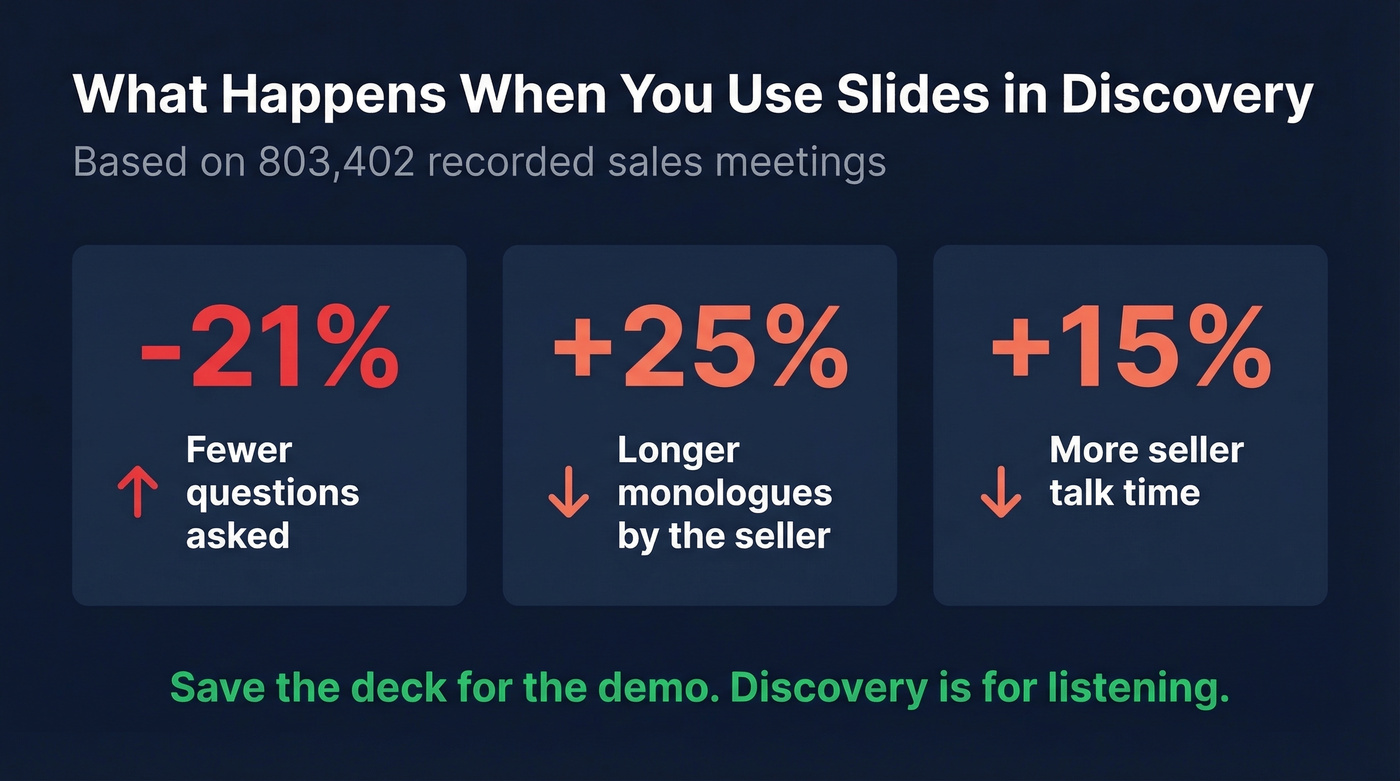
1. Using slides in discovery. An analysis of 803,402 recorded sales meetings found that slides reduce questions asked by 21%, increase monologue length by 25%, and bump seller talk time by 15%. Save the deck for the demo.
2. Front-loading questions like a checklist. Eight questions in the first three minutes, then pitch mode. We've all done it. Spread them out.
3. Interrogation mode. Rapid-fire questions without acknowledging answers. If the prospect feels like they're being deposed, they'll shut down.
4. Not verifying contact data before the call. If half your dials bounce, your questioning skills are irrelevant. Tools like Prospeo verify emails and direct dials on a 7-day refresh cycle so every discovery call actually connects instead of ending at voicemail.
5. Using accusatory "why" questions. "Why did you choose that vendor?" sounds judgmental. Reframe as "What led you to choose that vendor?" One word changes the entire tone.
6. Talking more than listening. A solid benchmark is the 70/30 rule: prospects talk about 70% of the time and the rep talks about 30%. (If you're rebuilding your process end-to-end, map this to your B2B sales funnel.)
7. Skipping Implication questions. Going from "What's the problem?" straight to "Here's our solution" leaves urgency on the table. Make the prospect feel the cost of inaction before you offer the fix.
Post-Call Question Audit
After every discovery call, run through these four checks. If you can't answer yes to at least three, the call needed more work.
- Did I ask at least one Implication question that made the prospect quantify the cost of inaction?
- Did I pause for 3 seconds at least twice after a prospect's answer?
- Was my talk time under 50%?
- Did I balance pain questions with at least one aspiration question about their ideal outcome?
Let's be honest about something: you don't need 14 discovery questions for every deal. Shorter, sharper calls with 6-8 well-sequenced questions can close faster than an over-engineered interrogation. The 11-14 range is built for complex, multi-stakeholder deals. Match your discovery depth to your deal complexity, and you'll close more without exhausting your prospects.
You just nailed discovery - 11-14 questions, perfect SPIN sequence, real urgency uncovered. Now multiply that across every account in your pipeline. Prospeo gives you verified direct emails and mobile numbers so your reps spend time asking great questions, not hunting for contact data. 125M+ verified mobiles with a 30% pickup rate.
Spend your time on discovery calls, not data hunting.
FAQ
How many open-ended questions should I ask per discovery call?
For complex B2B deals, 11-14 targeted questions is the sweet spot based on the 519,000-call analysis. Distribute them evenly throughout the conversation - front-loading kills engagement. Simpler deals with a single decision-maker often close with 6-8 well-sequenced questions.
What's the difference between open-ended and closed-ended sales questions?
Open-ended questions start with "what," "how," or "walk me through" and invite detailed responses. Closed-ended questions get a yes or no. Use open-ended for discovery and closed for confirmation - in that order. Reversing the sequence kills momentum.
What's the best framework for structuring discovery questions?
SPIN Selling - Situation, Problem, Implication, Need-Payoff - backed by 35,000+ calls of research over 12 years. The Implication stage is where most reps fall short, yet it's the step that creates buying urgency.
How do I avoid sounding scripted when asking discovery questions?
Practice the 3-second pause and paraphrase the prospect's answer before asking your next question. Scripted reps ask question #4 regardless of the answer to #3. The best reps treat each response as a branching point, not a checkbox.