

Operational CRM vs Analytical CRM: Which Do You Actually Need?
The CRM market is projected to hit $126B in 2026, and 91% of companies with 10+ employees already use one. Yet 55% of CRM implementations fail. The operational CRM vs analytical CRM decision is often where those failures start. Teams invest in forecasting dashboards when they don't even have consistent data entry, or they automate workflows on top of a database that's half garbage.
This distinction sounds academic, but it's the most practical decision you'll make before swiping a credit card.
If your team struggles with manual data entry, missed follow-ups, or pipeline visibility - prioritize operational CRM. If you've got clean data and need segmentation, forecasting, or churn prediction - prioritize analytical CRM. If your CRM data is a mess - and statistically, it is - fix the data layer first before investing in analytics.
What Is Operational CRM?
An operational CRM automates the daily customer-facing work your team does: logging contacts, moving deals through stages, triggering follow-up emails, routing support tickets. It's the engine that keeps reps from drowning in admin.
The three pillars are sales automation, marketing automation, and service automation. Think pipeline management in Pipedrive, drip campaigns in HubSpot Marketing Hub, or ticket routing in Freshsales. Companies using CRM report a 29% increase in sales and 34% improvement in productivity. HubSpot offers a free tier, Pipedrive starts at $14/user/month, and Freshsales starts at $9/user/month - so the barrier to entry is low.
The limitation is real, though. Operational systems aren't built for long-term forecasting or deep data analysis. They capture data well; they just don't do much with it beyond surface-level reporting.
What Is Analytical CRM?
If 76% of companies admit less than half their CRM data is accurate and complete, why would you invest in analytics? Because when the data is clean, the payoff is massive. Teams using analytical CRM capabilities see a 42% boost in forecast accuracy, and 93% of companies that exceed lead and revenue goals segment their database by persona. That's analytical intelligence at work.
An analytical CRM takes the data your operational system captures and turns it into insight: data mining, data warehousing, customer segmentation, and predictive analytics. Think CLV calculations, CAC tracking, churn risk scoring, and employee performance attribution - capabilities that tell you why deals close and which customers are about to leave. Some analytical platforms also integrate with invoicing tools to surface cash flow patterns alongside customer behavior data, giving finance and sales a shared view of the business.
Segmentation campaigns powered by these insights drive 40% higher email open rates compared to batch-and-blast sends. Tools like Salesforce Einstein (starting at $50/user/month for analytics add-ons) and Zoho Analytics ($25-$100+/user/month) are go-to options, with HubSpot reporting add-ons filling the gap for teams already on that ecosystem.
Here's the catch: analytical capabilities require clean, accurate data and are more complex to implement. If your input data is wrong, your dashboards will confidently display the wrong answers.

76% of companies say their CRM data is incomplete. Analytical dashboards built on bad data just display confident wrong answers. Prospeo enriches your CRM with 50+ data points per contact at a 92% match rate - emails verified to 98% accuracy, refreshed every 7 days, not every 6 weeks.
Clean data first, analytics second. Enrich your CRM for $0.01 per email.
Side-by-Side Comparison
| Dimension | Operational CRM | Analytical CRM | Edge |
|---|---|---|---|
| Focus | Daily workflow automation | Data-driven insights | Operational (immediate ROI) |
| Core features | Pipeline, email, ticketing | CLV, forecasting, segmentation | Analytical (depth) |
| Data usage | Captures and organizes | Mines and analyzes | Analytical (insight) |
| Best for | Teams with no CRM or under 50 contacts/day | Teams with 6+ months of clean data needing forecasting | Depends on stage |
| Limitations | Weak on deep analysis | Needs clean data to work | Operational (lower risk) |
| Example tools | HubSpot, Pipedrive, Freshsales | Salesforce Einstein, Zoho Analytics | Tie |
| Typical cost | ~$9-$60/user/mo | $25-$300+/user/mo | Operational (cost) |
| Implementation | 1-2 weeks (SMB) | 3-6 months (enterprise) | Operational (speed) |
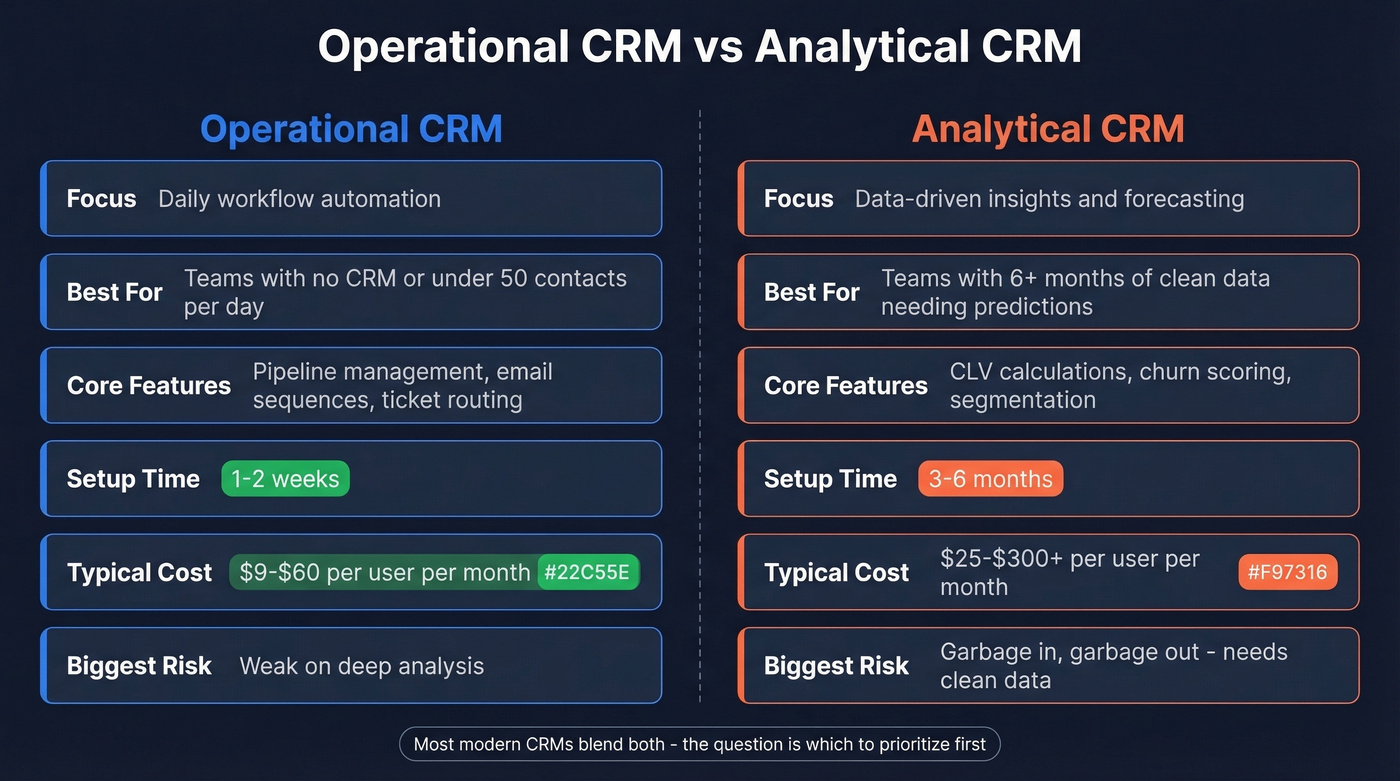
Most modern CRMs - HubSpot, Salesforce, Zoho - blend both types. The real question isn't which product to buy but which capabilities to prioritize and configure first.
How to Choose the Right Type
CRM returns $8.71 per $1 spent on average, but only when you match capabilities to your actual stage. Here's a simple maturity framework.
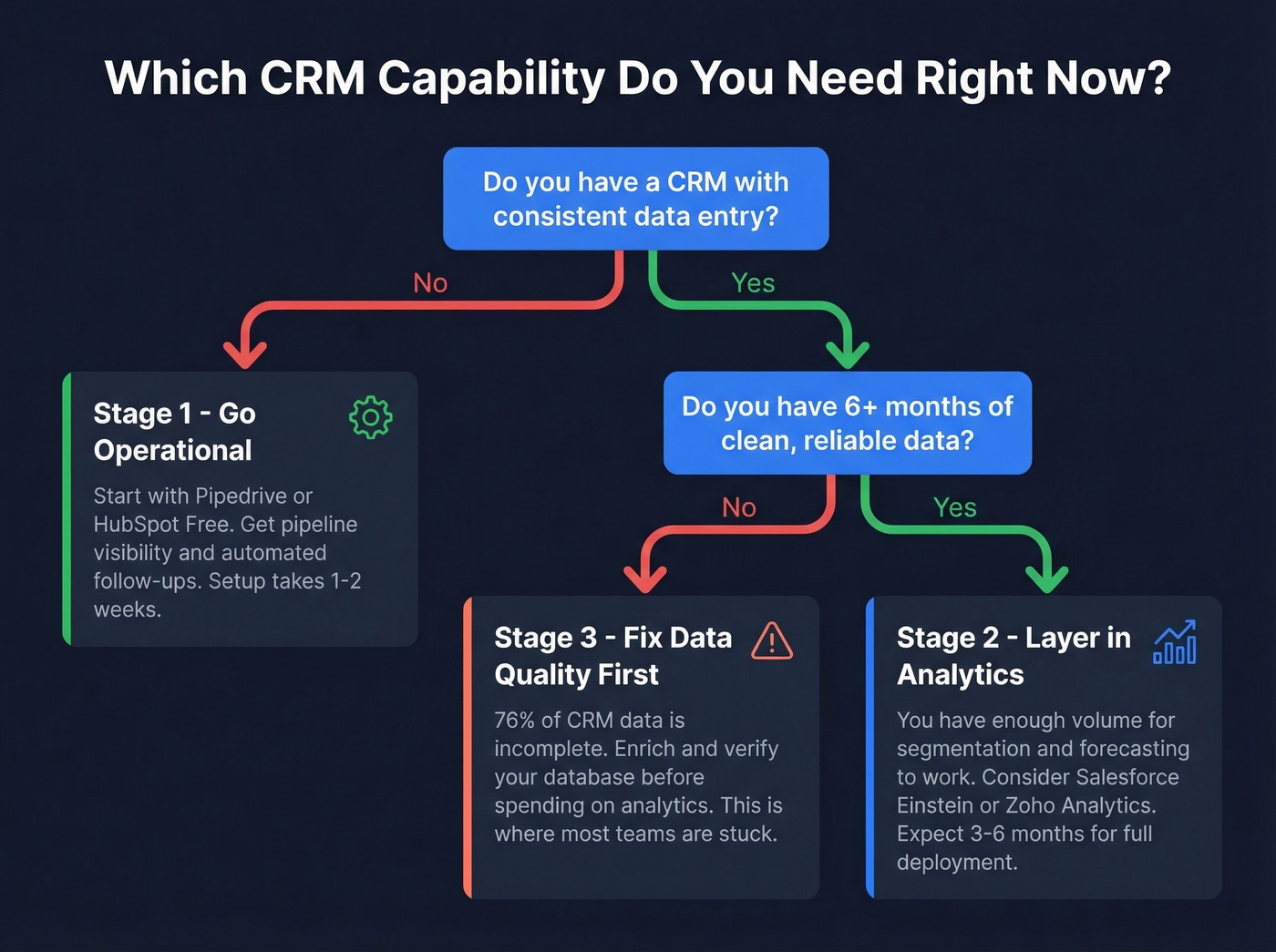
Stage 1: No CRM or under 50 contacts/day. Start operational. You need pipeline visibility and automated follow-ups before anything else. Pipedrive or HubSpot Free will get you moving in a week.
Let's be honest about the biggest CRM mistake we see: buying Salesforce Enterprise when you need Pipedrive. If your average deal size is under $15k and your team is under ten reps, you don't need AI-powered forecasting. You need a system your reps will actually use. That's it.
Stage 2: 6+ months of clean CRM data, growing team. Layer in analytical capabilities. You've got enough volume for segmentation and forecasting to actually mean something. This is where Salesforce Einstein or Zoho Analytics starts earning its cost. Expect 3-6 months for a full enterprise analytical deployment with custom dashboards, versus the 1-2 weeks it took to roll out your operational system.
Stage 3: You have both, but reports feel unreliable. Fix data quality. No amount of analytical tooling will save a database where half the records are stale or incomplete. Skip ahead to the next section - this is where most teams are stuck.
A recurring question in r/CRM is where operational workflows end and revenue intelligence begins, which signals that the categories are merging in practice. And they're right: 83% of CRM deployments now include AI features. Operational and analytical capabilities are increasingly built into the same platforms. The line between the two is blurring fast, which makes getting the foundation right even more important.
The Data Quality Problem
This is where most analytical CRM investments quietly die. 76% of companies admit less than half their CRM data is accurate and complete, and 37% report direct revenue loss from bad data. That 55% failure rate from the intro? Data quality is the common denominator.
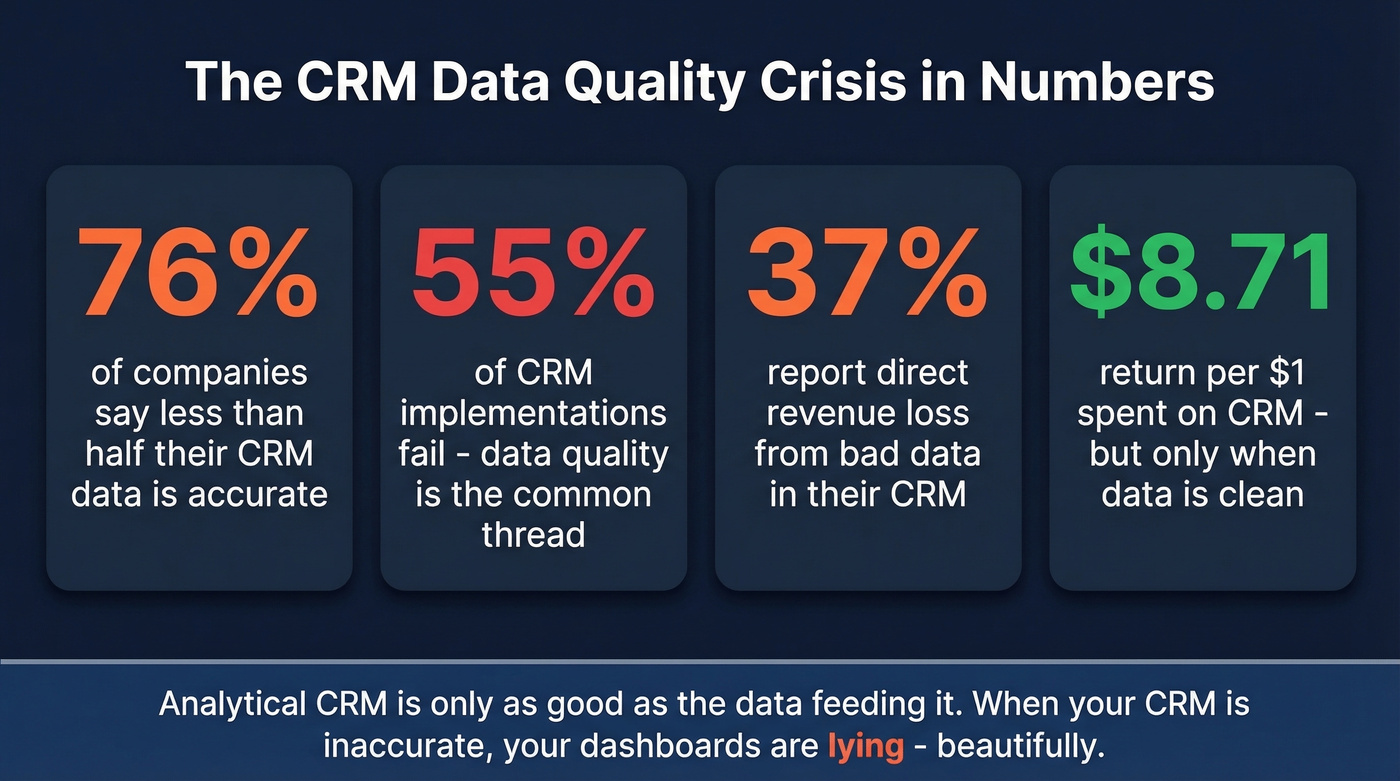
Analytical CRM is only as good as the data feeding it. When your CRM is inaccurate, your analytics dashboards are lying - beautifully.
The fix is the input layer. Before you invest in forecasting models or segmentation engines, enrich what's already in your CRM. Prospeo does this with native Salesforce and HubSpot integrations, returning 50+ data points per contact at a 98% email accuracy rate. Records refresh every 7 days, so your analytical layer works with data that's actually current - not a snapshot from six weeks ago. In our experience, teams that enrich their CRM data before layering analytics see reliable dashboards within the first quarter. It's the step most teams skip, and it's the reason their forecasts don't match reality.
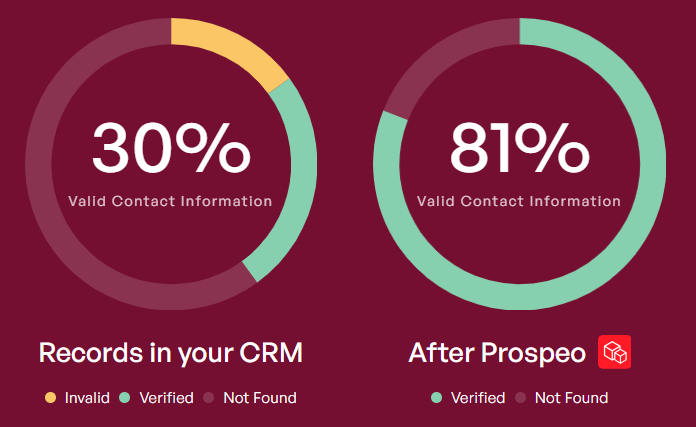
Before you layer on forecasting and segmentation, fix the foundation. Prospeo's CRM enrichment fills gaps across your entire database - 143M+ verified emails, 125M+ mobile numbers, and native integrations with Salesforce and HubSpot. No contracts, no sales calls.
Stop building analytics on a broken database. Start with data you can trust.
FAQ
Can a CRM be both operational and analytical?
Yes. Most modern platforms like HubSpot, Salesforce, and Zoho bundle both operational workflows and analytical reporting in a single product. The distinction is about which features you prioritize first, not which vendor you pick. Start with the capability that solves your biggest bottleneck today.
What about collaborative CRM?
Collaborative CRM focuses on cross-team data sharing: interaction management, channel management, and document sharing across departments. It's the third major type, but most mid-market CRMs include collaborative features by default. You rarely need a separate tool for it.
How do I fix CRM data before adding analytics?
Run a CRM enrichment pass to fill gaps and verify stale contacts - this is the prerequisite that makes forecasting and segmentation trustworthy. With 76% of CRM data reported as inaccurate, enrichment isn't optional. Prospeo's CRM enrichment returns 50+ data points per contact with an 83% match rate and refreshes records on a 7-day cycle, while competitors average 6 weeks.