

Opportunity Qualification: Frameworks, Scorecard, and Process Top Teams Use
It's Thursday afternoon. You're staring at the pipeline review, and there it is again - that $85K deal sitting in "Proposal Sent" for six weeks. No champion identified, no decision process mapped, no compelling event. Just hope.
Hope isn't a qualification methodology.
Most sales teams don't actually qualify deals. They advance them because the rep had a good conversation and the prospect said "this looks interesting." That's not qualification - that's confirmation bias with a CRM record attached, and it's the single biggest reason forecasts miss by 30% or more quarter after quarter.
What You Need (Quick Version)
- A framework selection rule based on deal size. BANT for deals under $10K with short cycles. MEDDIC/MEDDPICC for enterprise deals over $50K. SPICED for SaaS and product-led growth.
- A three-layer qualification model - firmographic, contextual, and opportunity-level - that most teams skip entirely.
- A 100-point opportunity scorecard you can implement today: 10 categories, scored 0-10, with clear thresholds for advancing or killing deals.
- A "default qualify out" mindset. Unless you have positive evidence that a deal is real, it's not real. Clean your pipeline by assuming deals are dead until proven alive.
What Is Opportunity Qualification?
It's the structured process of evaluating whether a specific deal - not a lead, not a name on a list - has a realistic path to closing. It's the difference between a full pipeline and an accurate one.
Most teams conflate this with lead qualification. They're different stages of the same funnel:
| Term | Definition | Funnel Stage |
|---|---|---|
| Lead | Unqualified contact | Top of funnel |
| Prospect | Lead that fits ICP | Mid-funnel |
| Opportunity | Prospect with validated pain, budget path, and authority | Bottom of funnel |
Lead qualification asks "should we talk to this person?" Deal qualification asks "should we invest resources in winning this?" Best-in-class companies close 30% of sales qualified leads. If your close rate on "qualified" pipeline is under 15%, you don't have a closing problem - you have a qualification problem.
Why Qualification Matters
Teams using frameworks like MEDDIC or SPICED see a 37% increase in win rates compared to teams winging it. And 82% of high-performing sales teams cite methodology adoption as a critical success factor.
Speed matters too. Opportunities closed within 50 days carry a 47% win rate. After 50 days, that drops to roughly 20% or lower. Every week a poorly qualified deal lingers in your pipeline, it's dragging down forecast accuracy and stealing attention from deals that could actually close. Add to this: modern B2B buying groups include 6-10+ stakeholders. You're not qualifying a single person's intent anymore - you're qualifying an organization's readiness to buy. That requires structure, not instinct.
Three Layers of Qualifying Deals
One of the best practitioner frameworks we've seen breaks qualification into three distinct layers. Each one filters differently, and skipping any of them creates pipeline bloat.
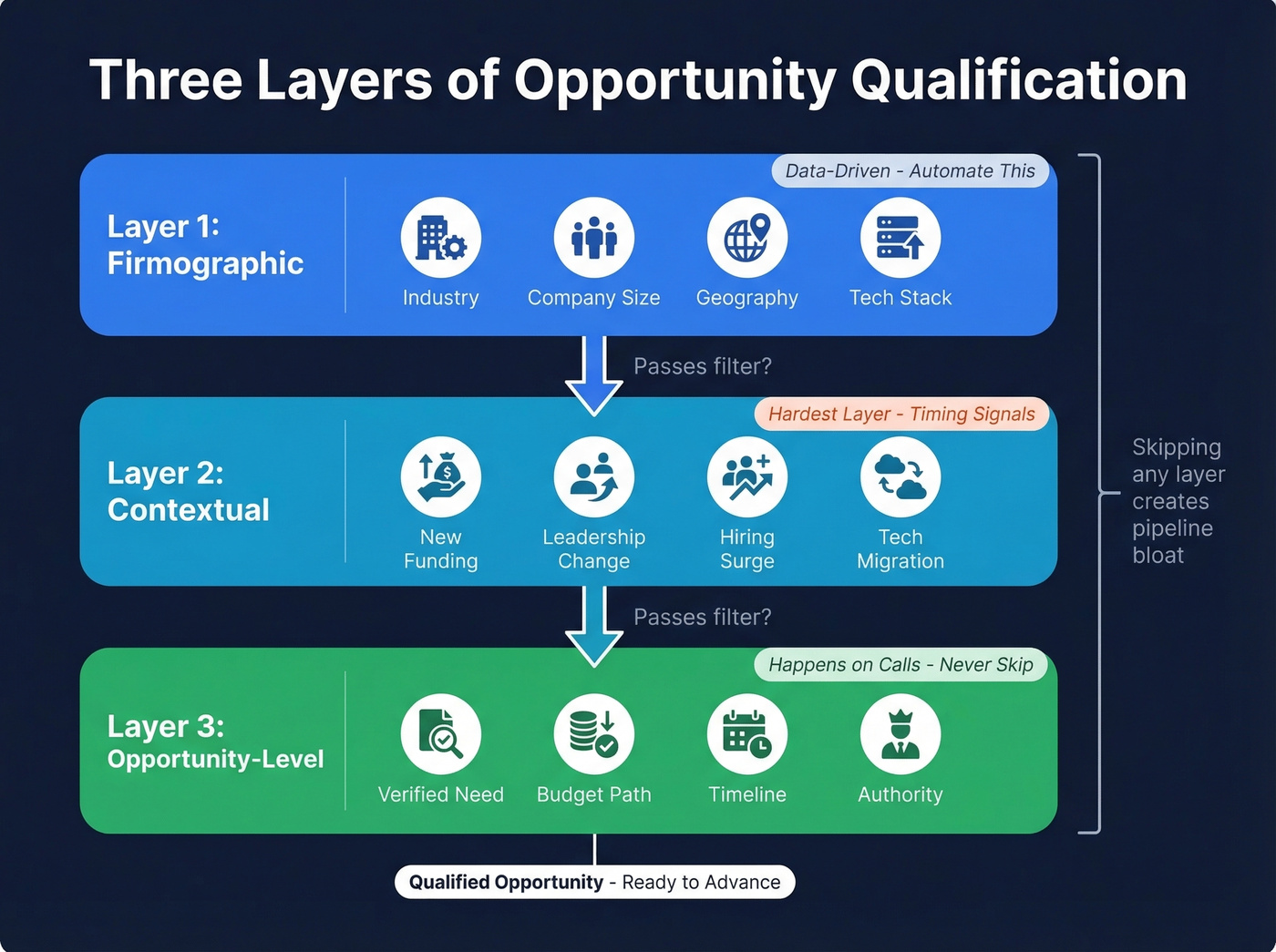
Firmographic qualification is the foundation. Does this company match your ICP? Right industry, right size, right geography, right tech stack. This is the layer most teams handle reasonably well because it's data-driven and objective. To qualify at the firmographic level, you need accurate company and contact data - and this layer should be automated, not manual. Prospeo's 30+ search filters covering technographics, funding signals, and headcount growth let you filter 300M+ professional profiles before a single call is made.

Contextual qualification is where it gets hard. Is this a good prospect right now? New funding round, leadership change, tech stack migration, recent hiring surge - these are the secondary signals that separate "fits our ICP" from "might actually buy this quarter." The consensus on r/sales is that contextual qualification is the hardest step because "buy-now" intent is rarely explicit. You're reading tea leaves, and most reps skip this entirely.
Opportunity-level qualification is the final layer - the one that happens on calls. Verify need, budget, timeline, authority, and competitive position. Even inbound leads and warm referrals need this step. We've seen teams skip this on inbound deals because "they came to us," only to discover three months later that the prospect was just benchmarking pricing for their incumbent vendor.

Firmographic qualification should be automated, not manual. Prospeo's 30+ search filters - including buyer intent, technographics, funding signals, and headcount growth - let you disqualify bad-fit accounts before they ever enter your pipeline. 300M+ profiles, 98% email accuracy, refreshed every 7 days.
Stop qualifying dead deals. Start with data that's already verified.
Which Framework Should You Use?
Framework Selection Matrix
| Framework | Best For | Deal Size | Cycle Length | Complexity |
|---|---|---|---|---|
| BANT | SMB, inbound triage | Under $10K | Under 30 days | Low |
| MEDDIC/MEDDPICC | Enterprise, complex | Over $50K | Over 90 days | High |
| SPICED | SaaS, subscription | Varies | Varies | Medium |
| CHAMP | Buyer-centric orgs | Mid-market | 30-90 days | Medium |
| FAINT | No set budget | Varies | Varies | Medium |
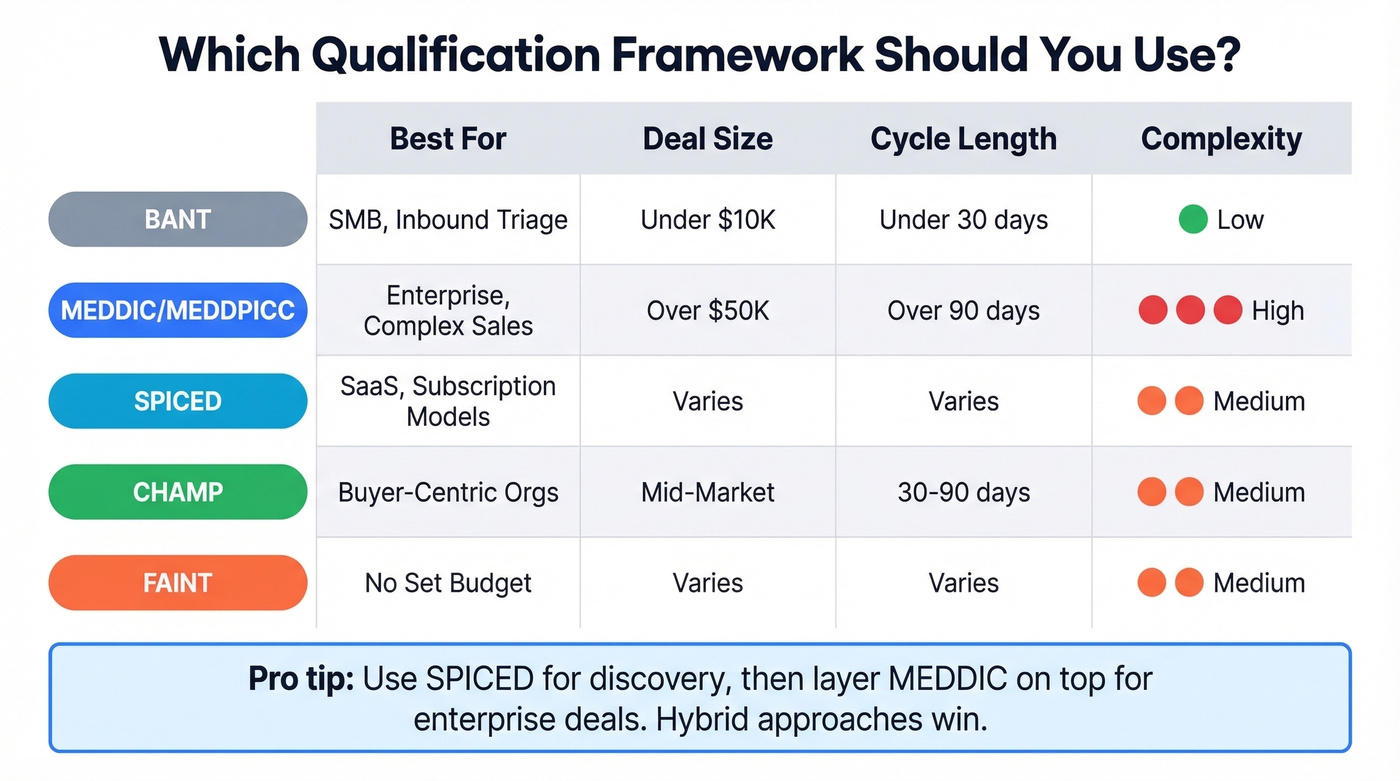
These thresholds come from RevWiser's framework comparison, and they hold up well in practice. The hybrid approach - SPICED for discovery, MEDDIC layered on for enterprise - is what we see working best in teams selling across segments.
BANT - A Pre-Filter, Not a Framework
BANT dates to the 1950s. Budget, Authority, Need, Timeline. It's fine as a fast triage tool for inbound leads and transactional deals. But if you're using BANT as your primary methodology for six-figure enterprise deals, you're bringing a checklist to a chess match. Use it to decide if a conversation is worth having. Use something else to decide if a deal is worth pursuing.
MEDDIC / MEDDPICC - The Enterprise Standard
Metrics, Economic Buyer, Decision Criteria, Decision Process, Identify Pain, Champion. MEDDPICC adds Paper Process and Competition. This is the heavyweight framework, and it earns that label.
The champion definition from SPOTIO's methodology guide is the best litmus test: if your contact isn't putting their reputation on the line - sharing internal decks, mapping the org chart, pulling procurement into conversations - they're a fan, not a champion. For complex sales with multiple stakeholders, nothing else comes close.
Here's the thing: deals also stall when the prospect perceives implementation risk or can't differentiate you from the incumbent. These aren't MEDDIC fields, but they kill deals just as fast. Build them into your discovery.
SPICED - Built for SaaS
Situation, Pain, Impact, Critical Event, Decision. SPICED is customer-centric and flexible, which makes it a natural fit for product-led growth and subscription models. The tradeoff is that it can underweight budget conversations, which means deals advance further before you discover there's no money. Layer budget validation in explicitly if you're using SPICED for deals above $25K.
CHAMP & FAINT
CHAMP starts with Challenges rather than Budget - a more buyer-centric entry point that works well for consultative sales. FAINT (Funds, Authority, Interest, Need, Timing) is designed for prospects without established budgets, common in emerging categories. Both are worth knowing but less widely adopted.
Step-by-Step Qualification Process
Here's a five-stage process with clear exit criteria. The key principle: don't advance a deal unless the exit criterion is met.
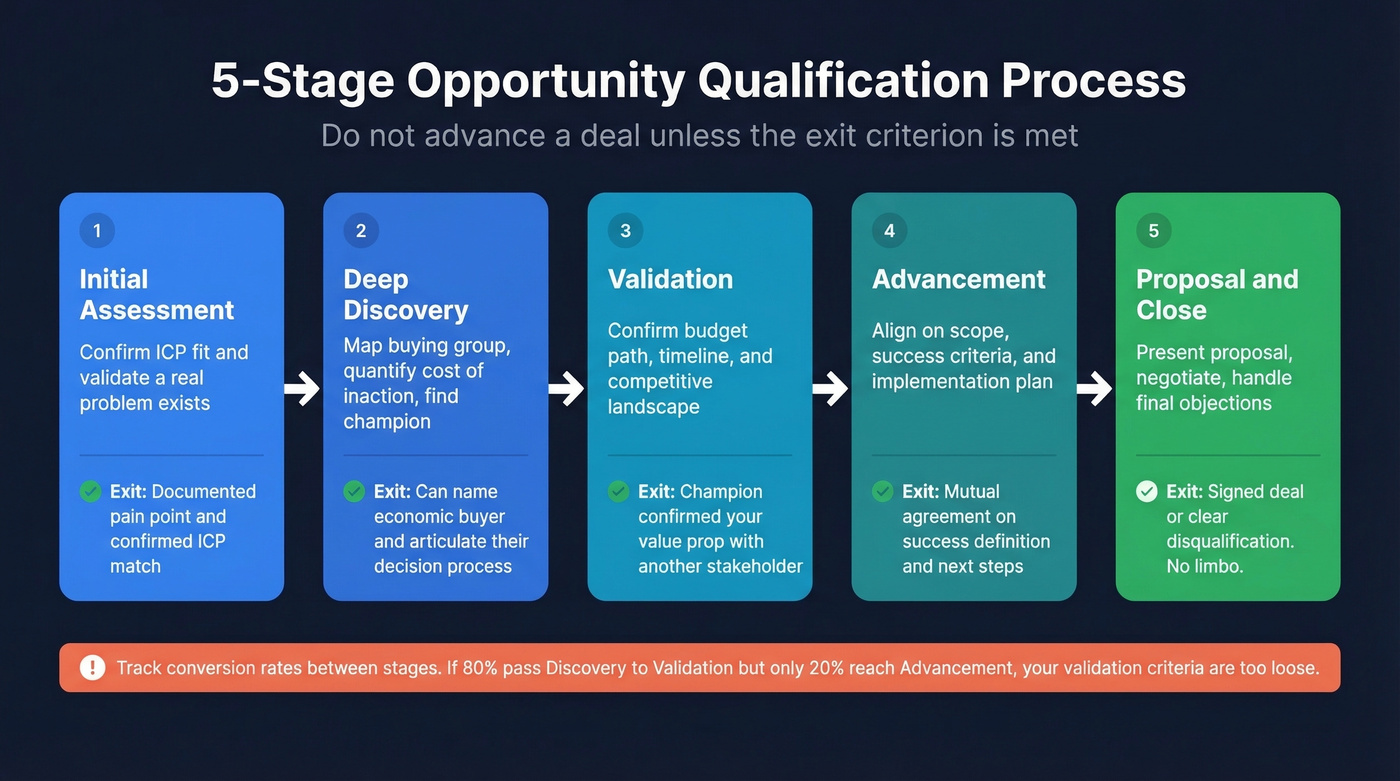
Initial Assessment. Confirm ICP fit, validate that a real problem exists, and identify at least one stakeholder with authority or influence. Exit criterion: documented pain point and confirmed ICP match. Don't advance on "they seemed interested."
Deep Discovery. Map the buying group, understand decision criteria, quantify the cost of inaction, and identify the champion. Exit criterion: you can articulate their decision process and name the economic buyer. If you can't, you're not done here.
Validation. Confirm budget path (allocated or allocatable), timeline, and competitive landscape. Get the champion to validate your understanding internally. Exit criterion: champion has confirmed your value proposition with at least one other stakeholder.
Advancement. Align on scope, success criteria, and implementation timeline. This is where you earn the right to propose. Exit criterion: mutual agreement on what "success" looks like and a defined next step toward a decision.
Proposal / Close. Present the proposal, negotiate terms, handle final objections. Exit criterion: signed deal or clear disqualification. No "we'll get back to you" limbo beyond an agreed date.
Track conversion rates between stages in your CRM. If 80% of deals pass from Discovery to Validation but only 20% make it from Validation to Advancement, your validation criteria are too loose.
Build a 100-Point Scorecard
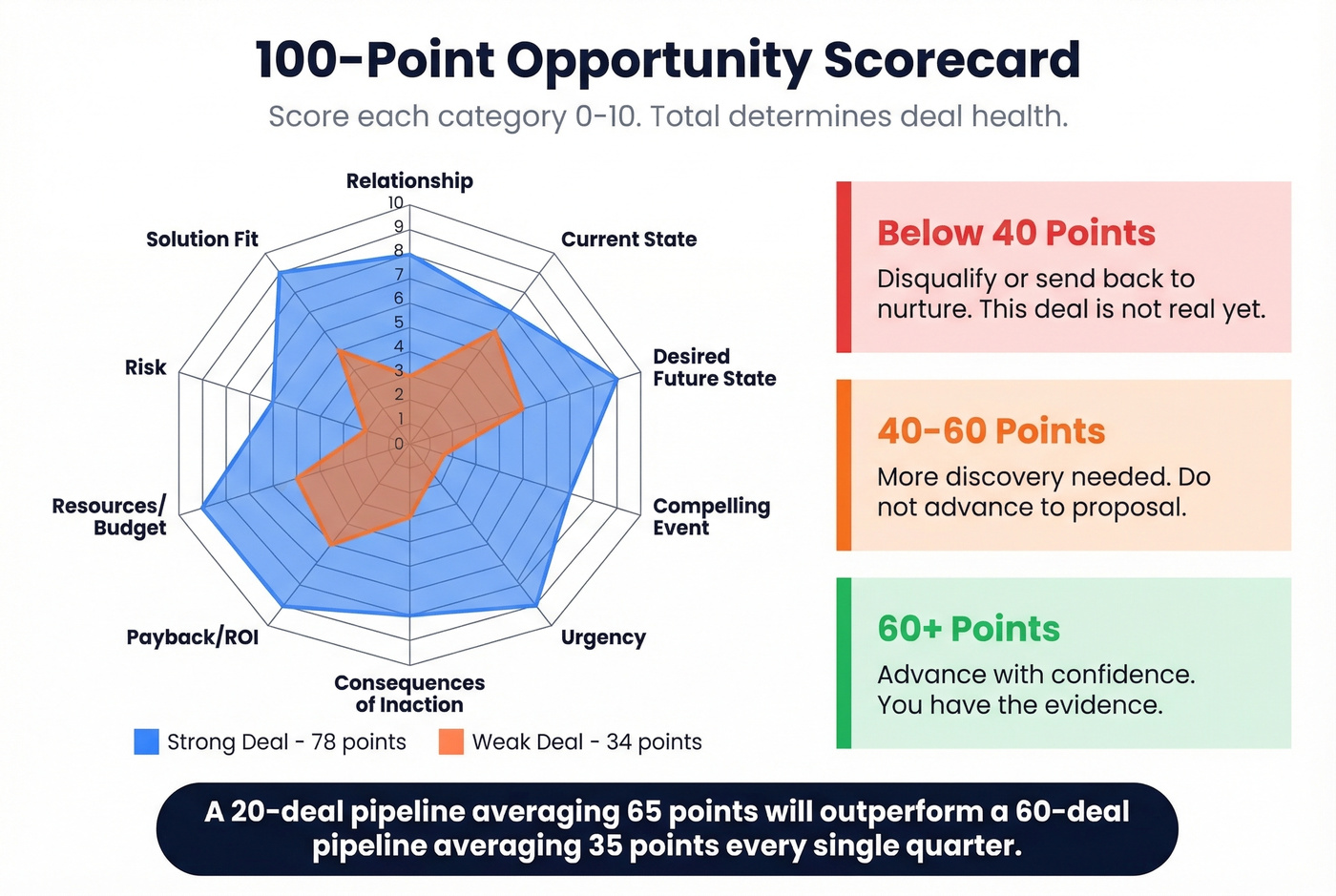
Frameworks tell you what to evaluate. A scorecard tells you how much evidence you have. Here's a 10-category model adapted from the Menemsha Group's approach, scored 0-10 per category for a 100-point total.
| Category | What You're Scoring | 0 (No Evidence) to 10 (Confirmed) |
|---|---|---|
| Relationship | Access to power | No contact to Champion engaged |
| Current State | Understanding of status quo | Unknown to Fully mapped |
| Desired Future State | Clarity on outcomes | Vague to Quantified |
| Compelling Event | External deadline/trigger | None to Hard deadline |
| Urgency | Commitment to act now | "Someday" to "This quarter" |
| Consequences of Inaction | Cost of doing nothing | Unclear to Quantified |
| Payback / ROI | Business case strength | No case to Board-approved |
| Resources / Budget | Funding path | Unknown to Allocated |
| Risk | Implementation concerns | Unaddressed to Mitigated |
| Solution Fit | Your ability to deliver | Poor fit to Perfect match |
Probability thresholds: Below 40 points = disqualify or send back to nurture. 40-60 = more discovery needed before advancing. 60+ = advance to proposal with confidence.
Make it operational. Create these 10 categories as custom number fields in Salesforce or HubSpot, then build a formula field that sums the total. Use radar charts in pipeline reviews - they instantly expose where a deal is strong and where it's weak. It's much harder to hide a poorly qualified deal behind a narrative when the chart has three categories sitting at zero.
Let's be honest about something: most teams would close more revenue by cutting their pipeline in half and scoring what's left. A 20-deal pipeline with average scores of 65 will outperform a 60-deal pipeline averaging 35 every single quarter. The math always wins.
Copy this scorecard into a Google Sheet or build it directly in your CRM. The format matters less than the discipline of scoring every deal, every week.
Qualification Doesn't End at Discovery
Most qualification happens once and then gets treated as permanent. A rep fills out the MEDDIC fields after the second call, marks the deal as qualified, and never revisits those answers. Meanwhile, the champion changes roles, a budget freeze hits, and a competitor enters the evaluation - but the CRM still says "Qualified."
Qualification is continuous. In complex B2B sales, circumstances change constantly, and your criteria should evolve with them. The right posture is to default to qualifying out unless positive evidence keeps emerging. Reaffirm your criteria before advancing stages. Any significant change - new stakeholder, budget reallocation, competitor locked in - should trigger a deal review.
Separate two questions: will this prospect do anything at all, and if they do, will we win? Most reps only ask the second question. A deal where you'd beat every competitor is worthless if the prospect decides to stick with the status quo. Score both dimensions independently.
Frameworks fail when reps fill them out after the call to justify a decision they already made. If your MEDDIC fields are being completed retroactively to support a "feeling" about a deal, you don't have a qualification process. You have a documentation process.
Mistakes That Kill Deals
Happy ears. Confusing interest with intent. The Director of Marketing said "this is really cool" on the demo. The AE marks it qualified. But the Director has no budget until Q3, no authority to sign, and was just doing competitive research. Interest isn't intent. Intent has a timeline and a budget path.
Single-threading. Talking to one contact and assuming they represent the buying group. In a world where deals involve 6-10+ stakeholders, single-threading is how you get blindsided by a VP you never met who kills the deal in the final review.
Skipping disqualification. If you aren't disqualifying 30%+ of your pipeline, you aren't qualifying. The 37% win-rate increase from structured frameworks comes from saying no more often, not from saying yes better. Fewer, better-qualified deals beat a bloated pipeline every time.
Not requalifying stale deals. That deal's been in "Negotiation" for 90 days. Has anyone confirmed the champion is still there? That the budget hasn't been reallocated? Stale deals are the #1 source of forecast misses.
Framework as box-checking. Filling out MEDDIC fields isn't qualification. Gathering evidence is. If your reps can't explain why they scored a category the way they did, the score is meaningless.
Ignoring data quality. Your qualification framework is only as good as the data feeding it. If your emails bounce and you can't find the economic buyer's direct line, discovery never happens. One of our customers, Snyk, saw bounce rates of 35-40% before switching to Prospeo - which meant their 50 AEs were trying to qualify ghosts. After the switch, bounces dropped under 5% and AE-sourced pipeline jumped 180%.
Framework paralysis. Skip this if you're agonizing over MEDDIC vs. SPICED vs. CHAMP. Pick one. Any structured approach beats no structure. You can always iterate after a quarter of data.
Contextual qualification - the layer most teams skip - requires real-time signals like job changes, hiring surges, and tech stack shifts. Prospeo tracks 15,000 intent topics and refreshes data every 7 days, so your reps know which prospects are ready to buy this quarter, not last quarter.
Score opportunities on live buying signals, not stale CRM data.
FAQ
What's the difference between lead qualification and opportunity qualification?
Lead qualification determines whether a contact fits your ICP at the top of the funnel. Opportunity qualification happens later on a live deal - verifying budget path, decision authority, timeline, and competitive position before committing resources to win.
Which framework is best for SaaS?
SPICED works best for most SaaS teams because it's customer-centric and adapts to varied deal sizes. For enterprise SaaS contracts above $50K, layer MEDDIC on top for rigor around economic buyers and paper processes.
How do I score a deal objectively?
Use a 10-factor scorecard rated 0-10 per category for a 100-point total. Below 40 = disqualify. Between 40-60 = more discovery needed. Above 60 = advance to proposal. Consistent scoring turns gut feelings into forecasts you can trust.
When should I disqualify a deal?
Disqualify when the score drops below your threshold, when key criteria can't be validated after two attempts, or when circumstances shift significantly - budget freeze, champion departure, or a competitor already locked in. Disqualifying early protects forecast accuracy.
How does contact data quality affect qualification?
Bad data means your discovery call never happens. If bounce rates sit at 35-40%, you're qualifying ghosts. Verified emails and direct dials to the economic buyer and champion are table stakes for any qualification process to work.