

How to Optimize Your Sales Process: The Operator's Playbook for 2026
You're sitting in the Q3 pipeline review and the numbers don't add up. 40% of "qualified" opportunities went dark after the first demo - no reply, no objection, just silence. The problem isn't your closers. As HBR's research on sales optimization frames it, outcomes are downstream of earlier choices about where you allocate time, money, and effort. If you want to optimize your sales process, you need to start at the other end of the funnel.
What You Need (Quick Version)
If you don't read anything else, nail these three things:
- Pick a qualification framework that matches your deal size. BANT for quick deals, MEDDIC for enterprise, SPICED for SaaS. Decision matrix below.
- Build one dashboard showing pipeline velocity by stage. Review it weekly. Not monthly. Weekly.
Here's the hot take most optimization guides miss: stop optimizing your close. Start optimizing your disqualification. The case study later in this piece shows a team that went from a 15% to a 40% close rate - not by getting better at closing, but by filtering out 60% of bad-fit leads before they ever reached a demo.
If your average deal closes under five figures, you probably don't need a 12-step sales process. You need cleaner data and faster disqualification.
Benchmark Your Funnel First
You can't improve what you haven't measured. Before touching a single workflow, map your current conversion rates against these benchmarks.
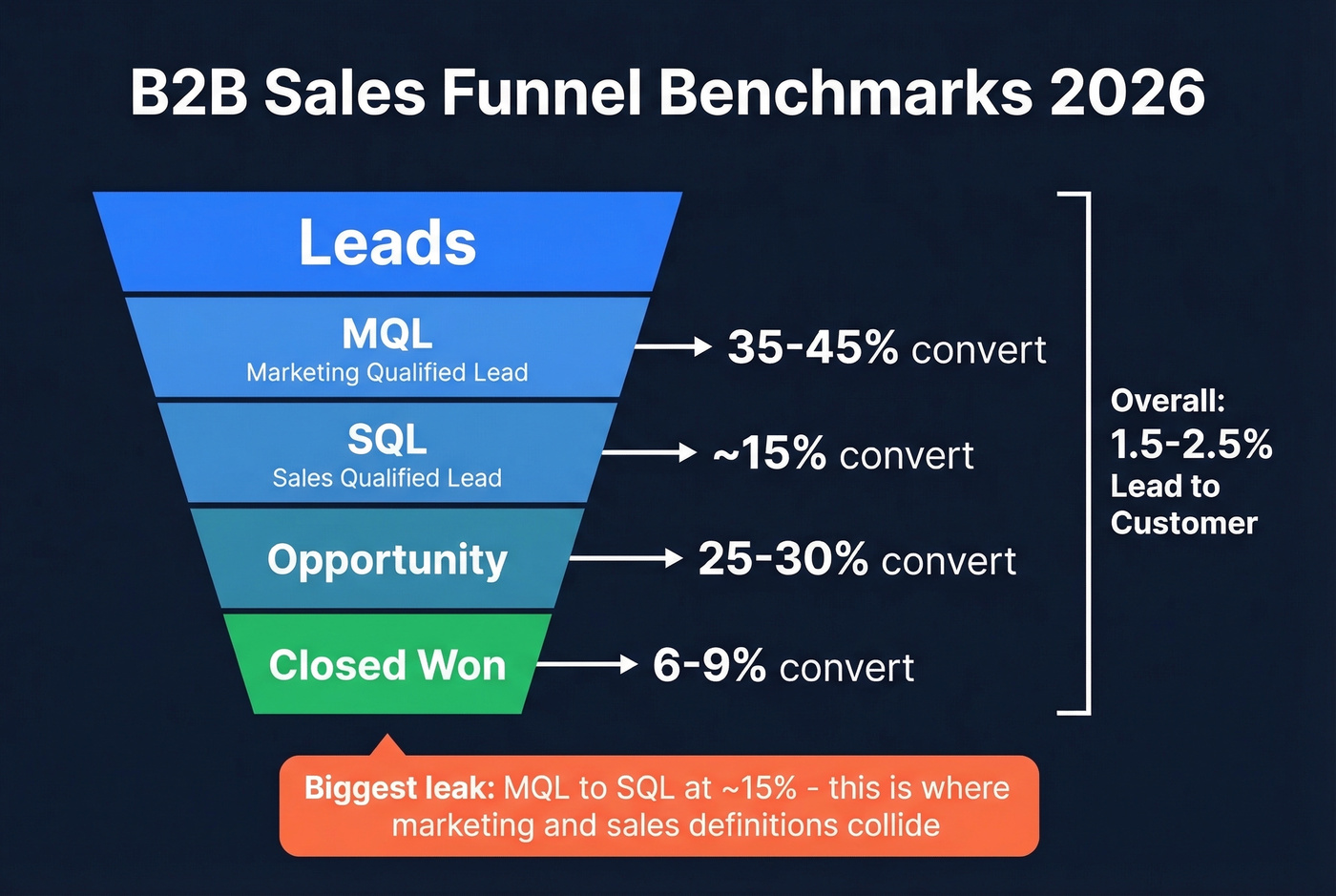
| Stage | Benchmark Range |
|---|---|
| Lead to MQL | 35-45% |
| MQL to SQL | ~15% |
| SQL to Opportunity | 25-30% |
| Opp to Closed Won | 6-9% |
| Overall Lead to Customer | 1.5-2.5% |
The median B2B conversion rate sits at 2.9%, but that number hides massive variation by industry. B2B SaaS teams typically see stronger stage-by-stage numbers - 39% Lead-to-MQL, 38% MQL-to-SQL, 42% SQL-to-Opportunity, 37% SQL-to-Closed - while legal services convert at 7.4% overall and B2B e-commerce limps along at 1.8%.
The biggest leak in almost every funnel? MQL-to-SQL at roughly 15%. That's where marketing's definition of "qualified" collides with sales reality. If your number is significantly below 15%, your lead scoring model is broken. If it's above 30%, you're probably under-generating top-of-funnel volume. Pull your own numbers for the last two quarters, compare them to the table above, and the stage where you're furthest below benchmark is where you start - not at the close.
The Proof It Works
A seed-stage B2B SaaS company was running a 15% close rate with a team processing 40 leads per month. Revenue sat at $50K/quarter. The core problem: 70% of deals were dying within 48 hours of the first demo because the wrong people were getting demos in the first place.
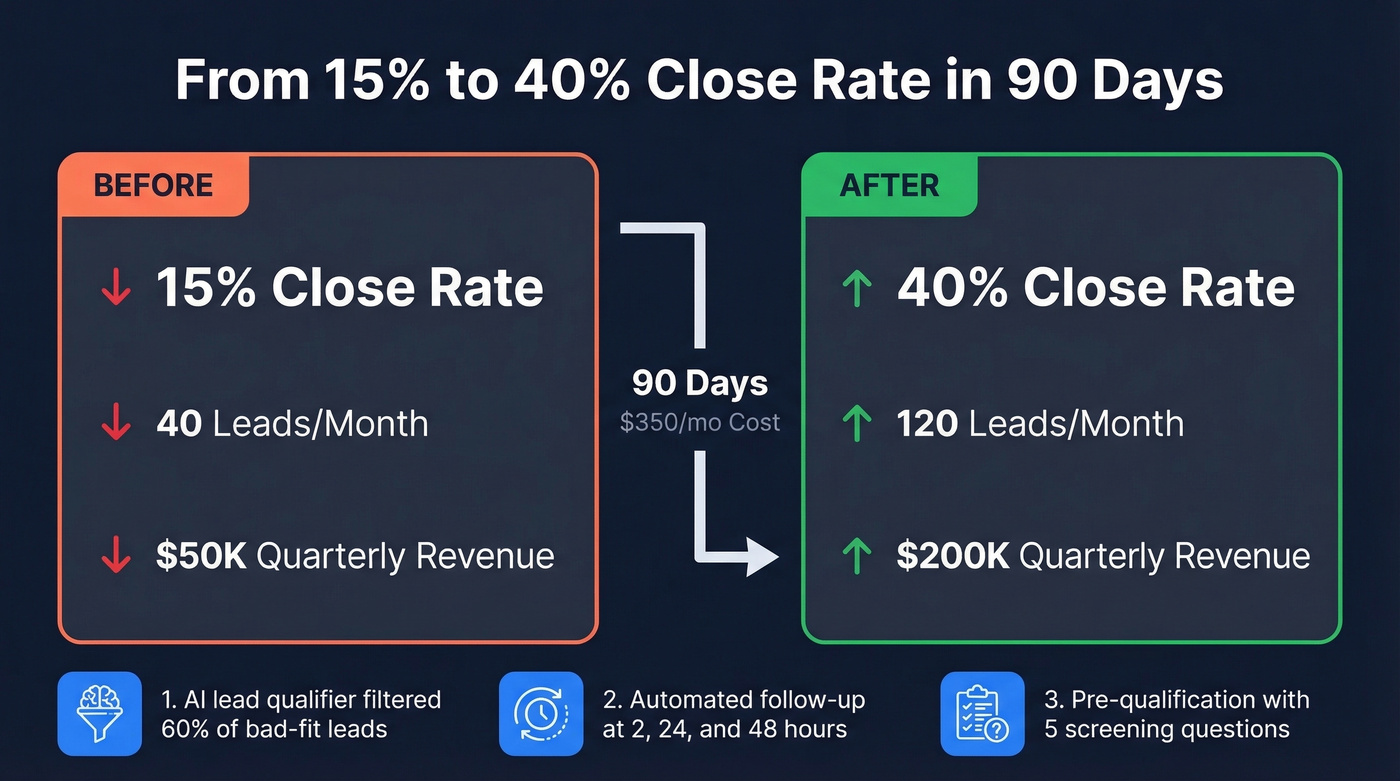
They implemented three changes over 90 days for $350/month total: an AI lead qualifier that filtered out 60% of bad-fit leads before they reached a rep, automated post-demo follow-up sequences at 2, 24, and 48 hours, and structured pre-qualification with five screening questions. Close rate jumped to 40%. Lead capacity tripled to 120/month. Quarterly revenue hit $200K. The lesson, as Impact+ documented: optimizing upstream - who gets into your pipeline - matters more than optimizing what happens once they're in it.

Stop paying for bounced emails. Prospeo verifies every contact with 98% accuracy, refreshed every 7 days.
Start free and only pay for verified contacts
7 Steps to Improve Your Sales Process
1. Map Your Current Process
Before you change anything, document what actually happens today. Not what your playbook says - what reps actually do. One important distinction upfront: your sales process is the stages and actions. Your sales methodology - SPIN, Challenger, Sandler - is how you execute within each stage. Refine the process first. Methodology is a layer on top.
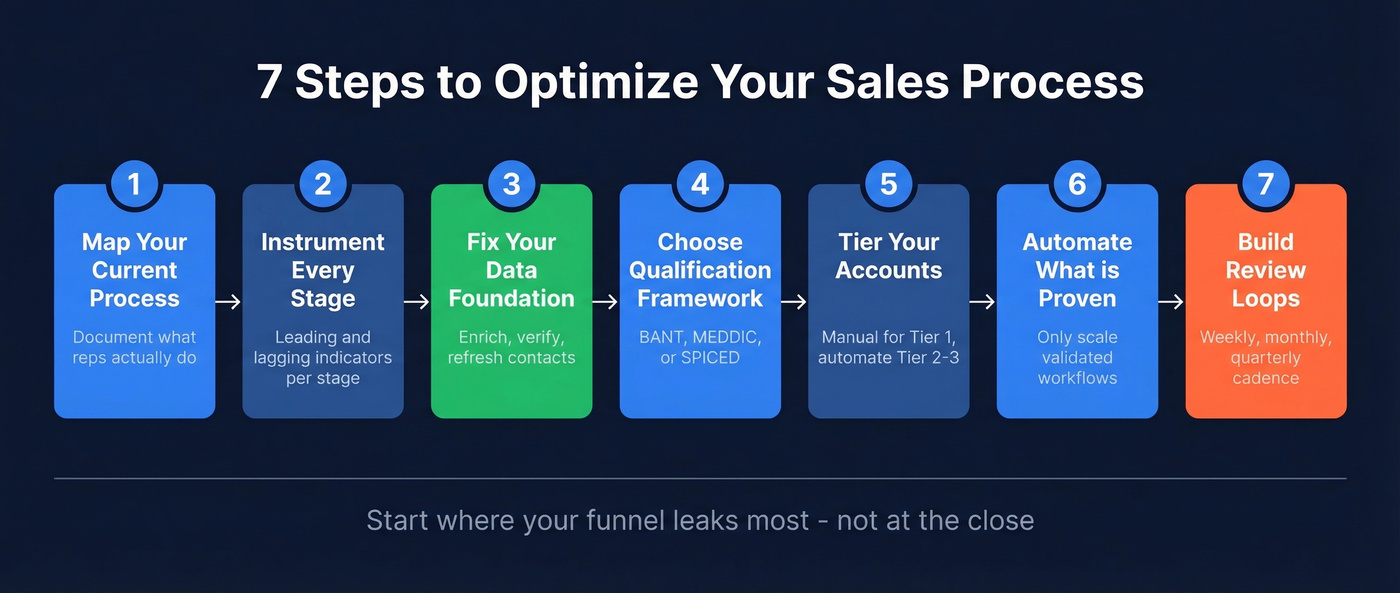
For every stage, identify three things: who owns it, what tools they use, and where the handoff happens. A SalesOps thread on Reddit nailed the biggest gap: there's plenty of tooling for opportunity-to-close, but "very little in the pre-opportunity phase." If you can't measure what happens before an opportunity is created, you're flying blind on the most important part of your funnel.
2. Instrument Every Stage
Once you've mapped the process, instrument it. Every stage needs at least one leading indicator and one lagging indicator tracked in your CRM.
Pre-opportunity metrics are the black hole for most teams. Track outbound activity - emails sent, calls made, meetings booked - along with response rates by channel and time-to-first-meeting by lead source. Add audit trails and timestamps for every handoff so you can spot where deals stall. These are the numbers that predict pipeline 60-90 days out, and teams with CRM dashboards see a 29% increase in sales](https://monday.com/blog/crm-and-sales/sales-dashboard-templates/) on average. Visibility isn't optional.
3. Fix Your Data Foundation
Here's a scenario we've watched play out dozens of times: an SDR sends 5,000 emails in a week. 1,800 bounce. The domain reputation tanks. Now every email from that domain - including the CEO's - lands in spam. Three months of outbound capacity, gone.
Bad data is the invisible tax on every downstream process. Your sequences, your qualification, your forecasting - all of it degrades when the underlying contact data is wrong. The three pillars are enrichment (filling in missing fields), verification (confirming emails and phones actually work), and refresh cycles (keeping data current as people change jobs).
Prospeo handles all three with real-time email and mobile verification, a 98% email accuracy rate, 125M+ verified mobile numbers, and a 7-day data refresh cycle compared to the 6-week industry average. The 83% enrichment match rate means the vast majority of leads come back with usable contact data. We've seen the difference firsthand: Meritt switched and saw their bounce rate drop from 35% to under 4%, with pipeline tripling from $100K to $300K per week. That's what clean data does to a funnel.
4. Choose the Right Qualification Framework
Most teams pick a framework because someone read about it, not because it matches their sales motion. Here's the decision matrix:
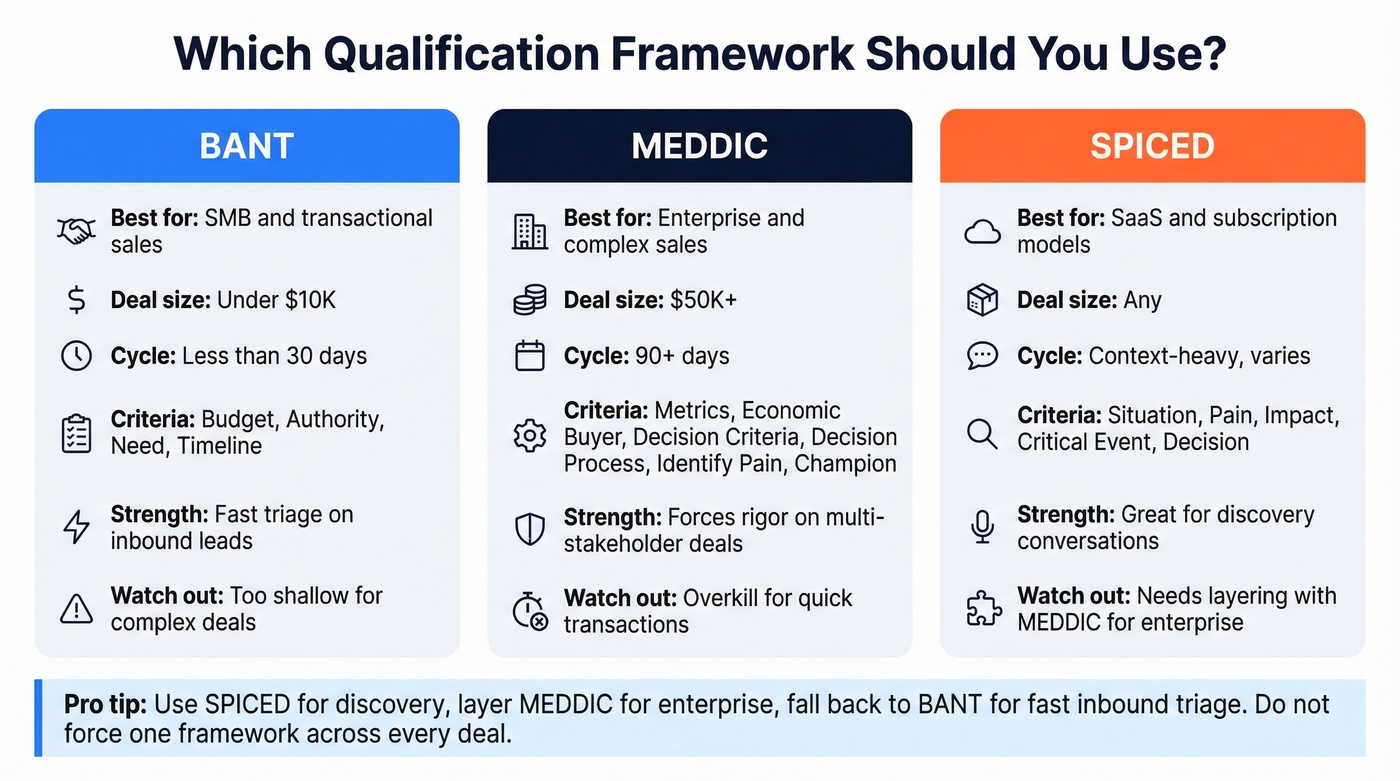
| Framework | Best For | Deal Size | Sales Cycle |
|---|---|---|---|
| BANT | SMB, transactional | Under $10K | Less than 30 days |
| MEDDIC | Enterprise, complex | $50K+ | 90+ days |
| SPICED | SaaS, subscription | Any | Context-heavy |
The hybrid approach works best for teams selling across segments: use SPICED for discovery conversations, layer MEDDIC criteria for enterprise deals with multiple stakeholders, and fall back to BANT for quick-triage on inbound leads that need a fast yes or no. Don't force one framework across every deal type - that's how you end up with reps gaming qualification criteria instead of actually qualifying.
5. Tier Your Accounts
A Reddit practitioner who drove $1.5M in sales shared a framework we've seen work repeatedly: Tier 1 accounts get manual, personalized outreach - never automate here. Tier 2 and Tier 3 get progressively more automation. Keep cold email campaigns under 200 contacts, ideally 50-100, to maintain relevance. Build your total prospecting lists in the 500-2,000 lead range to balance volume with targeting.
That same practitioner sent 7 messages to a Fortune 500 CEO before it got forwarded internally and turned into a deal. That kind of persistence only works when you're confident the account is worth the effort. Tiering forces that confidence.
"Do manual work first" isn't anti-technology advice. It's anti-premature-scaling advice. Once you've validated which tiers convert, layer automation on top of a proven workflow.
6. Automate What's Proven
Let's be honest: automating a broken process just breaks it faster. We've seen teams layer automation on top of workflows that had unnecessary approval steps, unclear handoffs, and no qualification criteria. The result? They burned through leads three times faster with the same bad outcomes.
AI adoption among revenue organizations hit 89% in 2025, and sales reps using AI spend 30% less time on admin tasks. But the teams getting value from AI refined the manual process first, then automated the proven version. Automate follow-up sequences after you've tested the messaging manually (or start from proven sales follow-up templates). Automate lead scoring after you've validated the criteria with closed-won analysis. The sequence matters - simplify before you scale.
7. Build Review Loops
Optimization isn't a project. It's a cadence.
Weekly: Dashboard review. Pipeline velocity by stage. Which deals moved? Which stalled? Why?
Monthly: Process audit. Where are reps deviating from the playbook? Is the deviation working or hurting?
Quarterly: Framework and ICP reassessment. Has your average deal size shifted? Have your firmographic, technographic, or behavioral ICP criteria changed? Update both.
Pipeline velocity by stage is the single most important metric because it captures both conversion and speed. With buying committees averaging 13 decision-makers per deal, your process has to evolve as deal complexity changes. Bake these review loops into your operating rhythm from day one - don't treat them as something you'll "get to eventually."
Tools for Sales Process Optimization
You don't need 15 tools. You need 3-4 that integrate well and cover the critical stages.
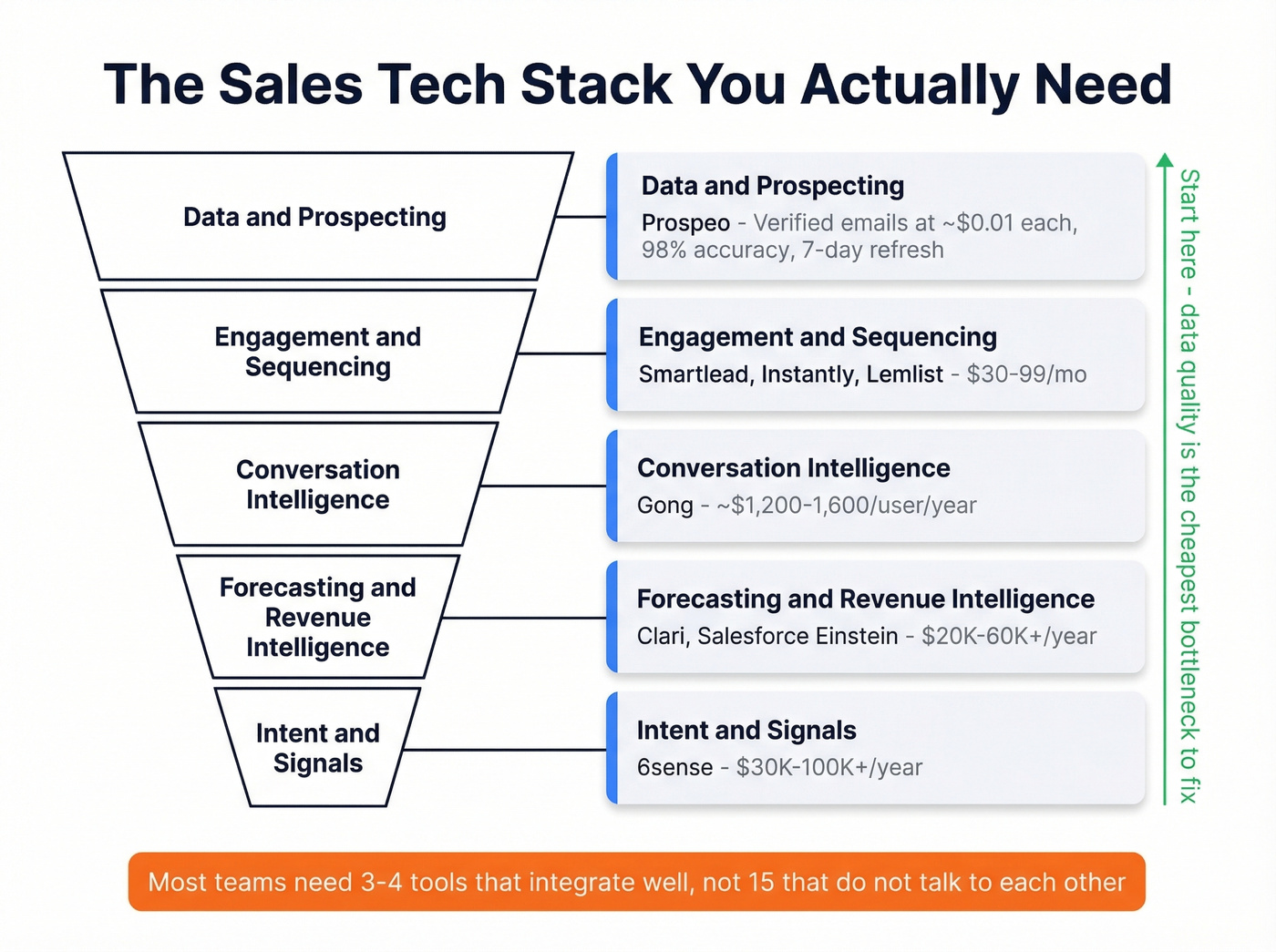
| Stage | Category | Tools | Pricing |
|---|---|---|---|
| Engagement | Sequencing | Smartlead, Instantly, Lemlist | $30-99/mo |
| Intelligence | Conversation Intelligence | Gong | ~$1,200-1,600/user/year |
| Forecasting | Rev Intelligence | Clari, Salesforce Einstein | Clari ~$20k-60k+/year. Einstein varies by Salesforce edition. |
| Intent | Intent & Signals | 6sense | ~$30k-100k+/year |
| Enablement | Content & Training | Seismic, Spekit | Seismic: enterprise contracts. Spekit: ~$30-50/user/mo. |
For most teams, data quality is the bottleneck - and it's the cheapest one to fix. Start with verified contacts and a sequencing tool that integrates with your CRM. Add conversation intelligence once your deal volume justifies the per-seat cost. Layer intent data and forecasting when you're selling into committees of 10+ and need signal prioritization.

Your outbound is only as good as your data. With 300M+ profiles and verified emails at ~$0.01 each, Prospeo keeps your pipeline full.
Try it free - no credit card required
5 Process Killers to Eliminate
Automating broken processes. Automation amplifies whatever it touches. If your process has a 15% qualification rate and you automate it, you now have a machine generating unqualified pipeline at scale. Fix the process, then automate.
Talking more than listening. Every study points the same direction: reps who dominate conversations close less. Flip the ratio.
Pitching the wrong stakeholder. With 80% of buyer interactions happening digitally, the real decision-maker may never be in the room. Multi-thread or lose.
Skipping qualification. If your reps are emailing unqualified leads, automation just burns your domain faster. Qualify before you sequence.
Ignoring frontline feedback. Reps know where the process breaks. Redesign workflows without their input and you'll get low adoption and miss the real bottlenecks. We learned this one the hard way - the best process improvements we've shipped started as complaints from SDRs, not ideas from leadership.
Build Your Sales Dashboard
Not every team needs the same dashboard. Pick the archetype that matches your biggest visibility gap:
| Dashboard | Key Metrics | Who Uses It |
|---|---|---|
| Pipeline | Total value, # opps, avg deal size, cycle length, win rate | Sales managers |
| Activity | Calls, emails, meetings, response rate | SDR leads |
| Forecasting | Forecasted revenue, probability, pipeline coverage ratio | RevOps |
| Executive | YTD revenue vs target, CAC, LTV, new customers | Leadership |
The pipeline dashboard is non-negotiable. That 29% sales lift from CRM dashboards happens because visibility changes behavior - reps who can see their own pipeline velocity start self-correcting before managers intervene. Start with pipeline velocity by stage as your north-star metric, add activity metrics once you have SDR capacity to manage (see more sales activities examples), and layer forecasting when deal volume makes probability-weighted projections meaningful.
Skip the executive dashboard until you're past $2M ARR. Before that, leadership should be looking at the pipeline dashboard directly.
FAQ
What's the biggest drop-off in a B2B sales funnel?
MQL-to-SQL, at roughly 15% conversion, is where most B2B funnels lose the most prospects. Fix your lead scoring model and qualification framework before investing in closing techniques - the upstream fix delivers a bigger revenue impact than any downstream coaching.
How long does sales process optimization take?
Teams that tackle the highest-leverage fix first - usually data quality or qualification - see measurable improvement within 60-90 days. The seed-stage case study above saw a 167% close rate increase in 90 days by fixing pre-demo qualification. Start with one change, measure it, then stack the next.
What tools do I need to get started?
Three things at minimum: a data platform for verified contacts (Prospeo's free tier covers 75 emails/month), a CRM with dashboard visibility, and a sequencing tool for outbound. Three or four well-integrated tools outperform a bloated stack every time. Add conversation intelligence and intent data as deal complexity grows.
How do I know which part of my process to fix first?
Pull your stage-by-stage conversion rates for the last two quarters and compare them to the benchmarks in this guide. The stage where you're furthest below benchmark is your starting point. Most teams discover the answer is upstream - lead quality or qualification - rather than downstream closing skills. That's where the fastest ROI lives.