

Outsourced Sales and Marketing: What It Actually Costs, How It Works, and When It Fails
Your CEO wants double the pipeline next quarter. You've got zero headcount budget, a hiring freeze that won't lift until Q3, and a board deck due in six weeks. This is the exact moment most B2B leaders start evaluating outsourced sales and marketing - and the exact moment they get buried in agency pitches with no real pricing attached.
Every outsourcing provider says "contact us for pricing." That's a sales tactic, not transparency. The global BPO market is on track to hit [$525 billion by 2030](https://www.prnewswire.com/news-releases/the-worldwide-business-process-outsourcing-industry-is-expected-to-reach-525-2-billion-by-2030 - 301609766.html), and over 70% of B2B companies are expanding outsourced SDR investment through 2026. The money is flowing. But most buyers walk in blind.
Here are the real numbers, the real failure modes, and a framework your CFO can actually use.
The Short Version
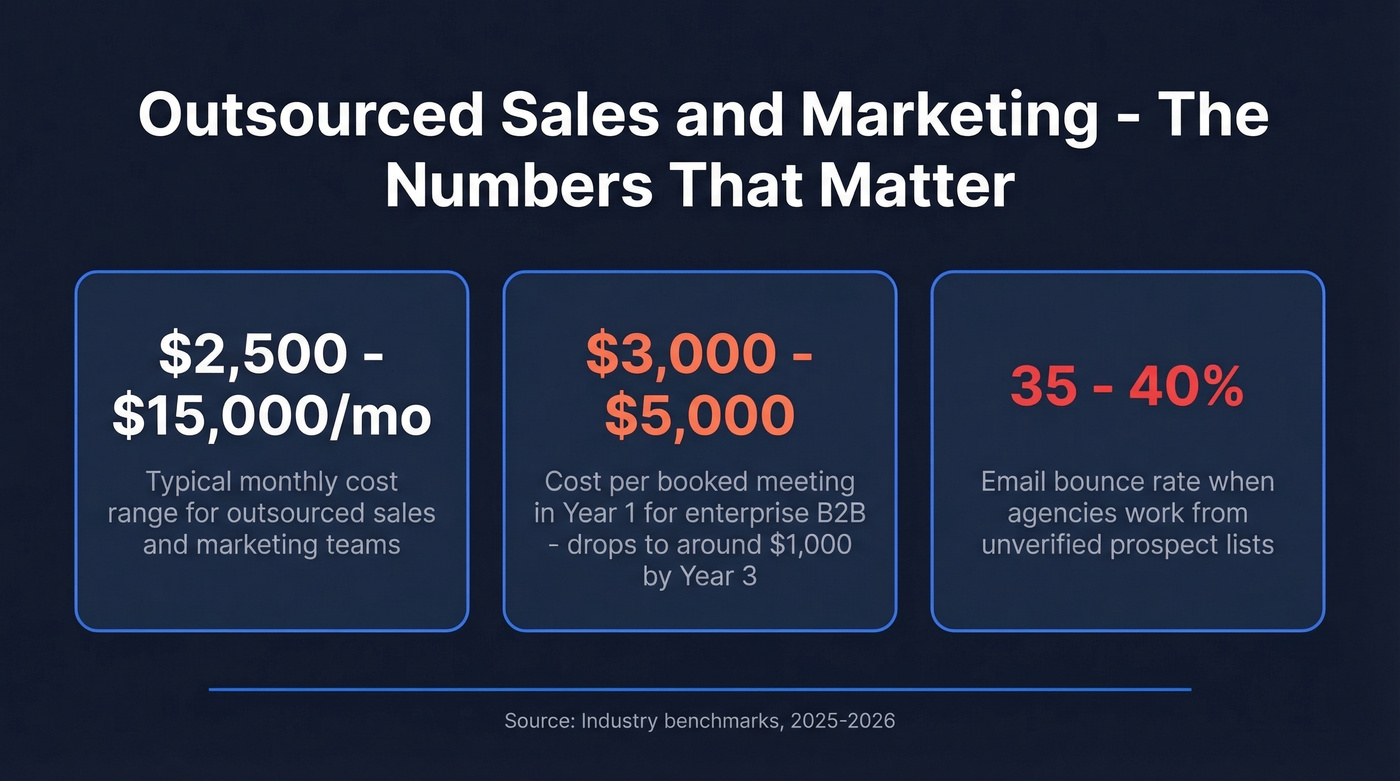
- Outsourced teams cost $2,500-$15,000/month depending on model, scope, and deal complexity. Full pricing breakdown below.
- Year 1 is expensive. Expect $3,000-$5,000 per booked meeting for enterprise B2B. By year 3, that drops to ~$1,000. Plan accordingly - this is an investment curve, not a failure signal.
- The #1 silent killer is bad prospect data. If your external team works from unverified lists, bounce rates start at 35-40% before a human even reads the email. Verify before you hand off.
What Does It Mean to Outsource Revenue Functions?
Outsourced sales and marketing means hiring an external team - an agency, a managed service, or individual contractors - to handle some or all of your revenue-generating activities. On the sales side, that can mean lead generation, appointment setting, full-cycle closing, or SDR-level prospecting. On the marketing side, it covers content production, ABM campaigns, email sequences, SEO, and paid media.
The line between the two disciplines has all but disappeared. Most modern engagements bundle lead gen with appointment setting and some form of content or email support. 37% of small businesses already outsource at least one business process, and for growth-stage B2B companies, sales development is often the first function to go external.
The key distinction isn't "sales vs. marketing." It's whether you're outsourcing activities (someone does tasks you define) or outcomes (someone delivers qualified meetings or pipeline). That distinction drives everything: pricing model, contract structure, and how quickly you'll see ROI.
Why Companies Outsource (and When They Shouldn't)
The Case for Going External
A fully loaded in-house SDR - salary, recruiting costs, benefits, tech stack, management overhead - runs $140,000-$150,000 per year. Three SDRs plus a manager? You're looking at $400,000-$460,000 annually before they book a single meeting.
An outsourced SDR engagement runs $30,000-$96,000 per year. That's a 35-75% cost reduction, and you skip the 3-6 month ramp time that in-house hires need. A good agency can start delivering qualified meetings in 2-4 weeks. Here's the line-item breakdown:
| Cost Component | In-House (3 SDRs + Manager) | Outsourced (Managed SDR Pod) |
|---|---|---|
| Base salary | $180,000-$210,000 | Included |
| Recruiting fees | $30,000-$45,000 | $0 |
| Benefits & payroll tax | $54,000-$63,000 | $0 |
| Tech stack (CRM, dialer, data) | $18,000-$30,000 | Included |
| Management overhead | $120,000-$140,000 | Included |
| Annual total | $400,000-$460,000 | $96,000/year+ |
Salesforce research shows sales pros spend 70% of their time on non-selling activities - admin, CRM updates, list building, internal meetings. Outsourced teams are structured to eliminate that overhead. Their entire job is outbound activity, not internal politics.
Beyond cost, outsourcing buys you scalability and speed-to-market. Need to test a new vertical? An external team can spin up a campaign in two weeks. Hiring internally for the same experiment takes three months minimum. And if the vertical doesn't pan out, you scale back without severance packages.
When to Keep It In-House
A common objection from founders and sales leaders: "No one can sell my product like I can." That's true - until it isn't. Once you've closed 20+ deals and documented the playbook, an outsourced team can replicate the motion. But if you haven't hit that threshold, keep it in-house.
Outsourcing also breaks down in these situations:
- Complex enterprise deals ($500K+ ACV). Multi-threaded, 9-month sales cycles with procurement involvement need internal relationship builders, not outsourced SDRs.
- Heavily regulated industries. Healthcare, financial services, and defense contracting have compliance requirements that most external teams aren't equipped to handle.
- Products requiring deep technical demos. If every discovery call needs an engineer on the line, outsourced appointment setting creates more friction than value.
Here's the thing: most companies outsource too late, not too early. By the time you're desperate enough to start evaluating agencies, you've already burned two quarters of pipeline. The best time to start a pilot is when you still have runway to let it ramp.
The 4 Pricing Models Compared
Picking the wrong pricing model is the second most common mistake we see (after bad data - more on that below). Every outsourcing engagement falls into one of four buckets:
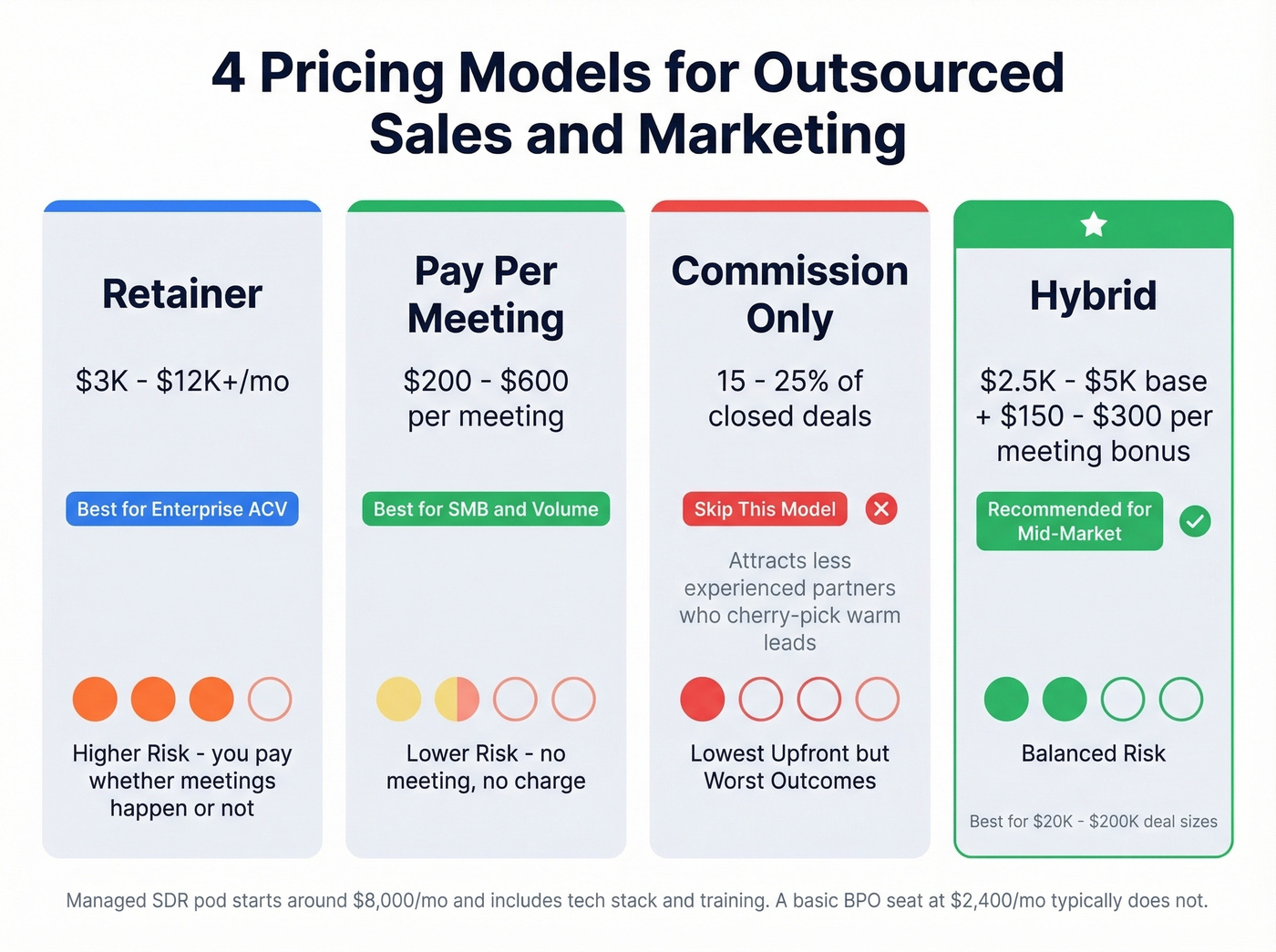
| Model | Monthly Cost | Best For | Risk Level |
|---|---|---|---|
| Retainer | $3K-$12K+ | Enterprise ACV | Higher (fixed) |
| Pay-per-meeting | $200-$600/mtg | SMB / volume | Lower |
| Commission | 15-25% of deals | Transactional | Lowest upfront |
| Hybrid | $2.5K-$5K + bonus | Mid-market | Balanced |
Retainer
You pay a fixed monthly fee - typically $3,000-$12,000+ - for a dedicated SDR or team. This includes prospecting, outreach, meeting booking, and usually some level of reporting. The higher end gets you a managed SDR pod starting around $8,000/month, often including a performance incentive. Best for companies with ACV above $50K where each meeting has real pipeline value. The risk is obvious: you pay whether meetings happen or not.
Pay-Per-Meeting
You pay $200-$600 per qualified meeting that actually gets booked. No meeting, no charge. Sounds ideal, but there's a catch - "qualified" is doing a lot of work in that sentence. Define your meeting acceptance criteria in writing before you sign anything. Best for teams selling lower-ticket products where volume matters more than deal complexity.
Commission-Only: Skip This
The agency takes 15-25% of closed revenue. Zero upfront cost. Good agencies won't take commission-only deals unless your product practically sells itself. You'll attract hungrier, less experienced partners - or ones who cherry-pick your warmest leads. We've never seen a commission-only engagement outperform a hybrid one for mid-market B2B. The consensus on r/sales backs this up: commission-only attracts the bottom of the barrel.
Hybrid (Our Recommendation)
A base retainer of $2,500-$5,000/month plus a per-meeting bonus ($150-$300) or a small commission (5-10%). This gives the agency enough stability to invest in your account while keeping them accountable to outcomes. For average deal sizes in the $20K-$200K range, start here.
One important distinction: a BPO seat costs roughly $2,439/month on average, but that's just the person. Tech stack, training, and QA are often extra. A managed SDR service starting around $8,000/month includes the infrastructure. Don't compare the two numbers without understanding what's included.

The article says it plainly: bad prospect data is the #1 silent killer of outsourced sales. Bounce rates of 35-40% torch your domain reputation before a single meeting gets booked. Prospeo's 5-step verification delivers 98% email accuracy and refreshes every 7 days - so the lists you hand your agency actually connect.
Stop paying agencies to send emails that bounce. Verify first.
The Cost-Per-Meeting Curve
Let's be honest about something most outsourcing buyers don't understand: year one is supposed to be expensive.
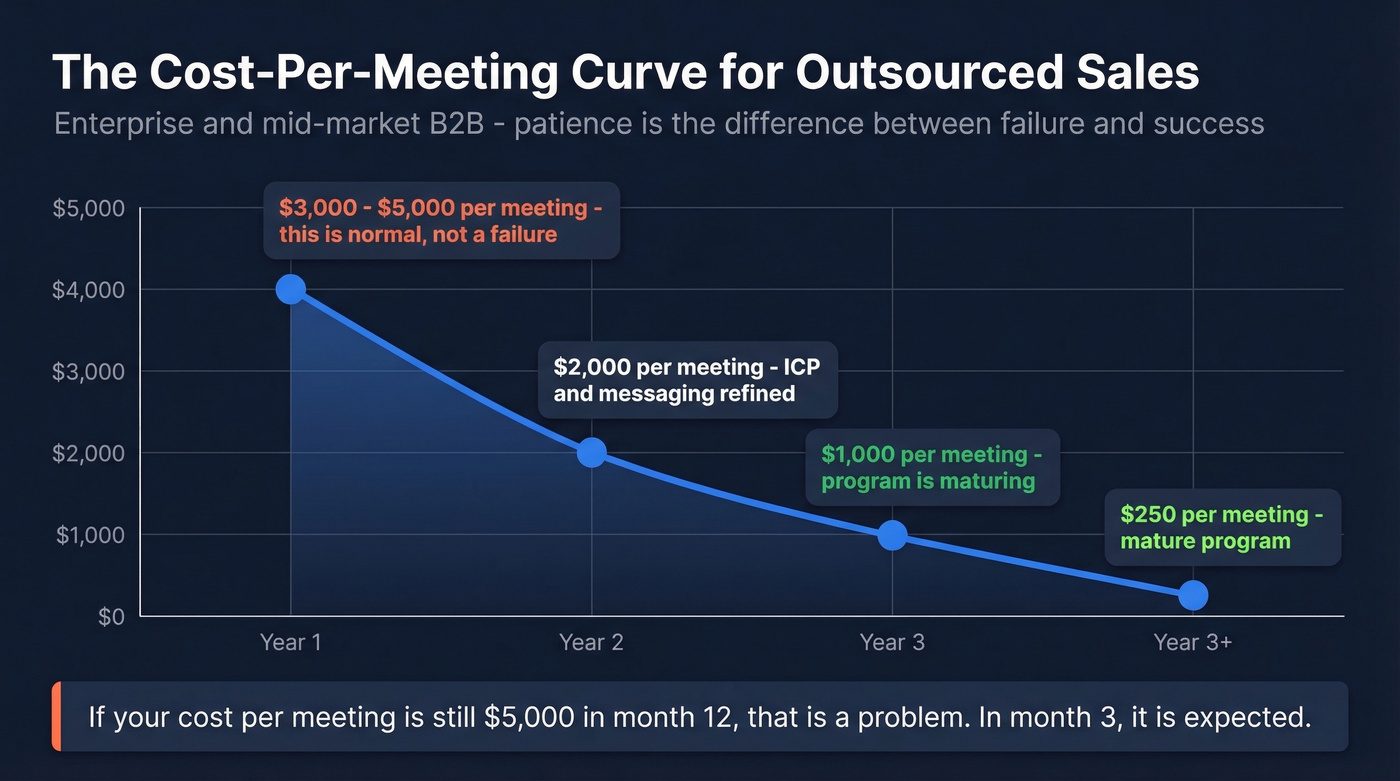
For enterprise and mid-market B2B, expect to pay $3,000-$5,000 per booked meeting in year one. That sounds brutal. It is. But it's the cost of building the targeting, messaging, and process from scratch. By year two, that drops to roughly $2,000 per meeting as the agency refines your ICP and messaging. Year three brings it down to ~$1,000. Mature programs running 3+ years can hit ~$250 per meeting.
If your outsourced team costs $5,000 per meeting in month three, that's normal. If it still costs $5,000 in month twelve, that's a problem. The difference between a failed program and a successful one is usually patience - and whether leadership understood the curve before signing the contract.
When Outsourced Programs Fail
We've watched enough engagements go sideways to identify the patterns. Five failure modes kill programs:
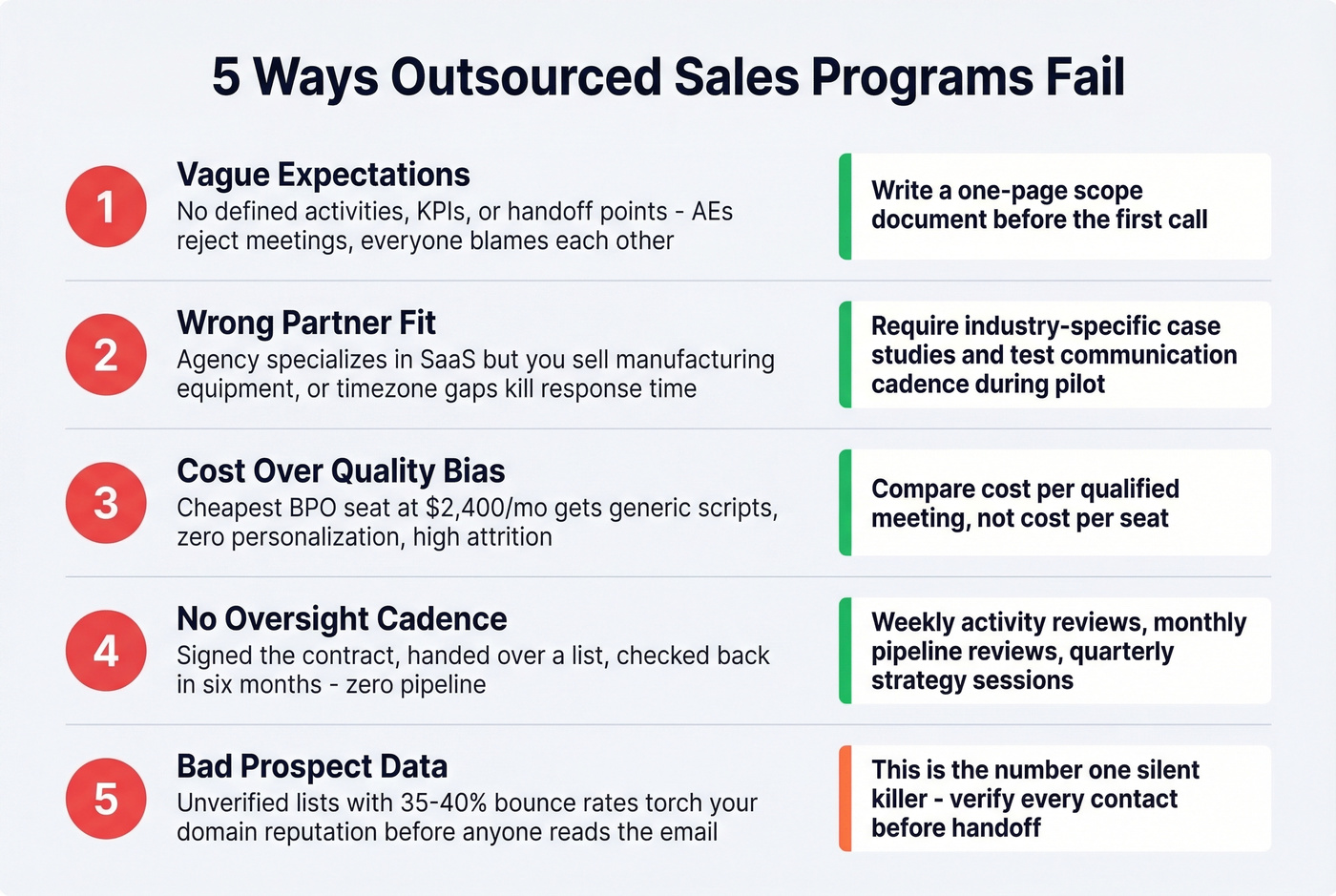
1. Vague expectations. You outsourced "sales" without defining which activities, which KPIs, which handoff points. The agency runs outbound. Your AEs reject the meetings. Everyone blames each other. Write a one-page scope document before the first call.
2. Wrong partner fit. The agency specializes in SaaS but you sell manufacturing equipment. Or they're in a timezone 10 hours away and your buyers expect same-day callbacks. Require industry-specific case studies and test communication cadence during the pilot.
3. Cost-over-quality bias. You picked the cheapest BPO seat at $2,400/month and got the cheapest results - generic scripts, zero personalization, high attrition. Compare cost per qualified meeting, not cost per seat.
4. No oversight cadence. You signed the contract, handed over a list, and checked back in six months. Surprise: zero pipeline. The set-and-forget anti-pattern kills more outsourcing programs than bad vendors do. Run weekly activity reviews, monthly pipeline reviews, and quarterly strategy sessions.
5. Bad prospect data. This one deserves its own section.
The Data Problem Nobody Talks About
Every outsourcing failure post-mortem focuses on the vendor, the messaging, or the market. Almost none of them look at the data. That's a mistake.
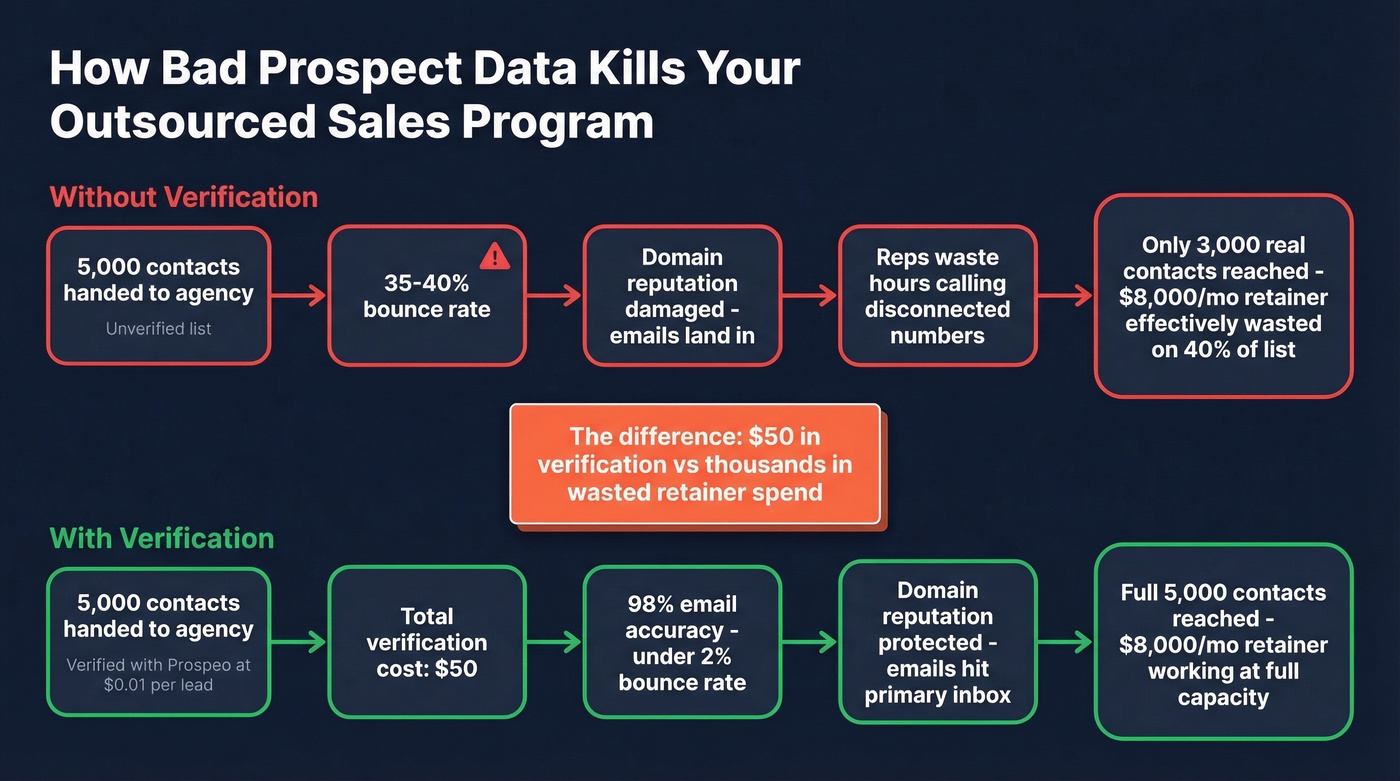
Here's what happens: you hand your outsourced team a list of 5,000 contacts. The list isn't verified. Bounce rates start at 35-40%. Your sending domain takes a deliverability hit. The agency's reps waste hours calling disconnected numbers. Your $8,000/month retainer is effectively buying you outreach to 3,000 real contacts - and even those are going stale.
The fix costs almost nothing relative to the retainer. Prospeo verifies emails in real time at $0.01 per lead with 98% accuracy. That's $50 to verify a 5,000-contact list, compared to the thousands you're spending on the team working that list. One company, Meritt, cut bounce rates from 35% to under 4% after switching to verified data and tripled pipeline from $100K to $300K per week. Snyk saw AE-sourced pipeline increase 180% after dropping bounce rates from 35-40% to under 5%.
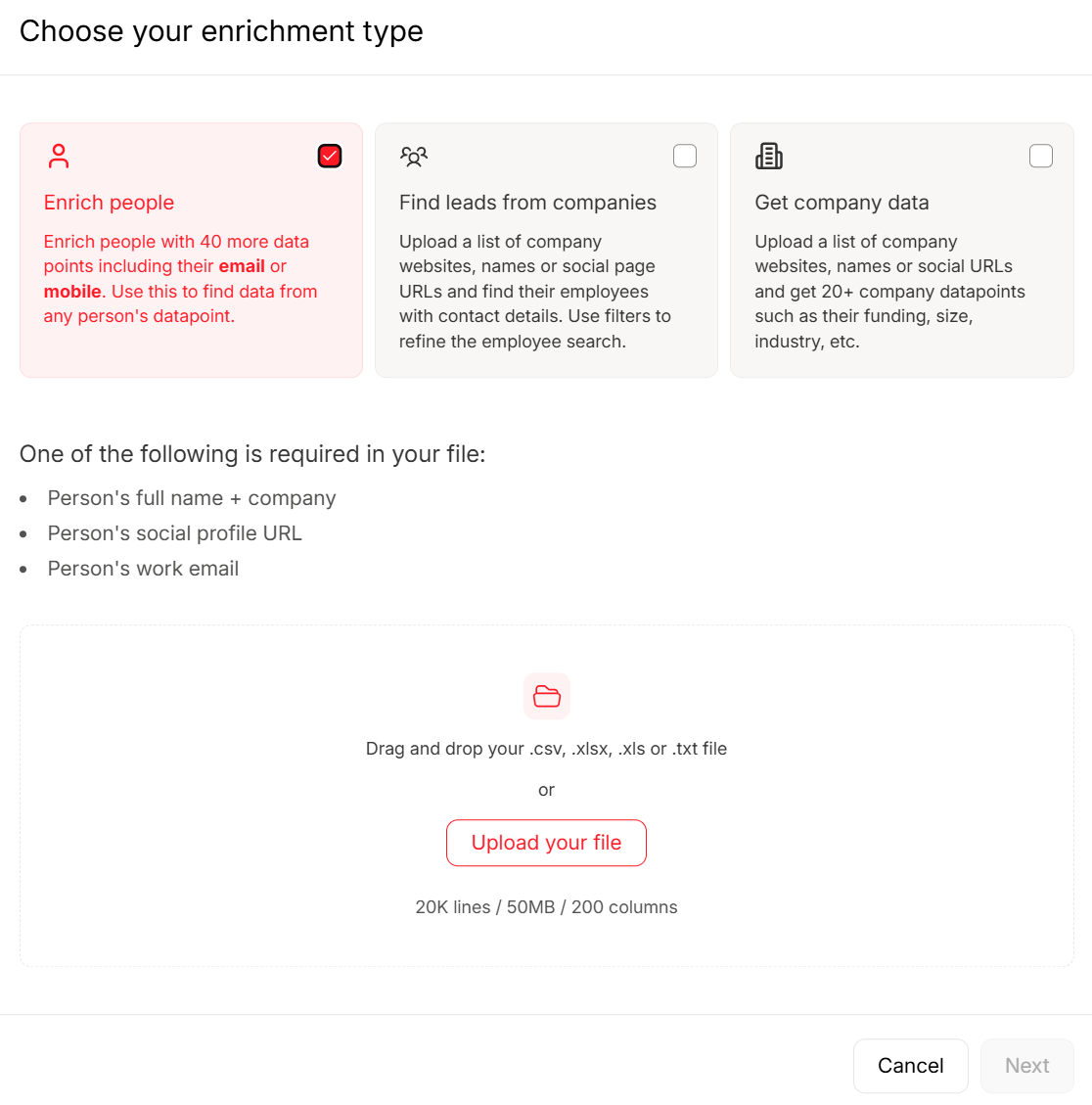
Before you spend $8,000/month on an outsourced SDR pod, spend $50 to make sure every email actually works. It's the highest-ROI step in the entire outsourcing process, and almost nobody does it.
An outsourced SDR pod costs $8,000+/month. The data they prospect with costs $0.01/email on Prospeo. One bad list wipes out a month of retainer spend in bounced emails and burned domains. With 300M+ profiles, 30+ filters, and 98% accuracy, Prospeo is the cheapest insurance policy your outsourcing investment will ever have.
Arm your external team with data that actually converts to meetings.
What to Put in Your Contract
Most outsourcing contracts are written by the vendor's legal team and designed to protect the vendor. Here's what you need to add - or negotiate - before signing:
- Meeting acceptance rate - the percentage of meetings your AEs accept as genuinely qualified. Target: 70%+. Below 50% means the agency's definition of "qualified" doesn't match yours.
- Show rate - percentage of booked meetings that actually happen. Industry benchmark: 60-75%.
- SQL conversion rate - percentage of meetings that become sales-qualified leads. This connects outsourced activity to pipeline.
- Pipeline value generated - total dollar value attributed to the external team. This is the number your CFO cares about.
- Bounce rate SLA - under 5%. Set this explicitly. If the agency pushes back on a bounce rate SLA, that tells you something about their data hygiene.
- IP and data ownership - who owns the prospect lists, messaging templates, and pipeline data if the engagement ends? Get this in writing. Agencies that built your outbound playbook shouldn't walk away with it.
- Reporting cadence - weekly activity reports, monthly pipeline reviews. Non-negotiable.
- Escalation procedures - who to call when metrics slip, and what happens next.
- Termination triggers - define the performance floor that allows contract exit without penalty.
- 90-day pilot period - if a vendor won't do a 90-day pilot before a 12-month commitment, walk away. Any agency confident in their results will agree to it.
Adapt the SLA framework from CIO's outsourcing guide to sales-specific metrics. The structure - service description, measurement methods, reporting cadence, remedies for misses - translates directly.
How to Shortlist Providers
Most outsourcing guides list eight vendors. That list is outdated in six months. Here's a framework for evaluating any vendor, anytime.
Clutch lists 5,171+ sales outsourcing providers with verified reviews. Start there for initial discovery, but don't stop at ratings. Evaluate on five criteria:
- Industry fit - do they have case studies in your vertical?
- Pricing model alignment - retainer vs. pay-per-meeting vs. hybrid
- Tech stack compatibility - do they use your CRM? Can they integrate with your existing Salesforce or HubSpot instance without a custom build?
- Pilot willingness - 90-day minimum
- Reference quality - talk to clients who churned, not just happy ones
Look for concrete metrics in case studies. Rudholm Group, a packaging supplier, reported 55-60% positive response rates from outsourced appointment setting campaigns targeting US and UK retailers. That's a real number from a real engagement. Demand that level of specificity from any vendor on your shortlist.
The vendor matters less than the process. A mediocre agency with great data, clear SLAs, and weekly oversight will outperform a premium agency running on stale lists with no accountability structure. Every time.
FAQ
How long before outsourced sales generates ROI?
Most programs need 3-6 months to optimize messaging, targeting, and handoff processes. Year 1 cost-per-meeting runs $3,000-$5,000 for enterprise B2B; by year 3, expect ~$1,000 per meeting. Plan for a 6-month investment period before judging results.
Can I outsource marketing and sales together?
Yes, and it's increasingly common. Many agencies bundle lead gen, appointment setting, and content or email campaigns into a single engagement. Hybrid packages typically run $5,000-$15,000/month depending on scope and channel count.
What's the biggest risk of outsourcing sales?
Unverified prospect data. Bounce rates of 35-40% burn your sending domain and waste your retainer spend. Verifying emails at ~$0.01/lead is a $50 fix that protects thousands in monthly agency fees.
Should I start with a pilot or a 12-month contract?
Always start with a 90-day pilot. Define success metrics upfront - meeting acceptance rate above 70%, show rate above 60%, SQL conversion - and evaluate at 60 and 90 days. Any vendor confident in their delivery will agree to a pilot period.
Is outsourced sales and marketing worth it for early-stage startups?
It can be, but only if you've already closed 20+ deals and documented a repeatable sales motion. Without that foundation, an external team has nothing to replicate. Once the playbook exists, outsourcing lets you scale pipeline without the overhead of full-time hires.