

The PACTT Framework: Question Bank and Scoring Rubric for 2026
You've sat through a 45-minute demo with someone who was never going to buy. They were polite, asked good questions, even said "this looks great." Then they ghosted. 67% of lost sales come from poor qualification - not bad selling, bad qualifying. And with up to 70% of reps missing quota, the problem isn't individual. It's structural. The PACTT framework fixes it.
PACTT stands for Pain, Authority, Consequence, Target Profile, and Timing. Below you'll find the full question bank, an original 0-15 scoring rubric, and a head-to-head comparison against BANT and MEDDIC.
What Is PACTT in Sales?
PACTT is a lead qualification framework organized around five dimensions: Pain, Authority, Consequence, Target Profile, and Timing. It's built for inside sales and SaaS motions where deals close in weeks, not quarters, and where the old BANT checklist feels too blunt.
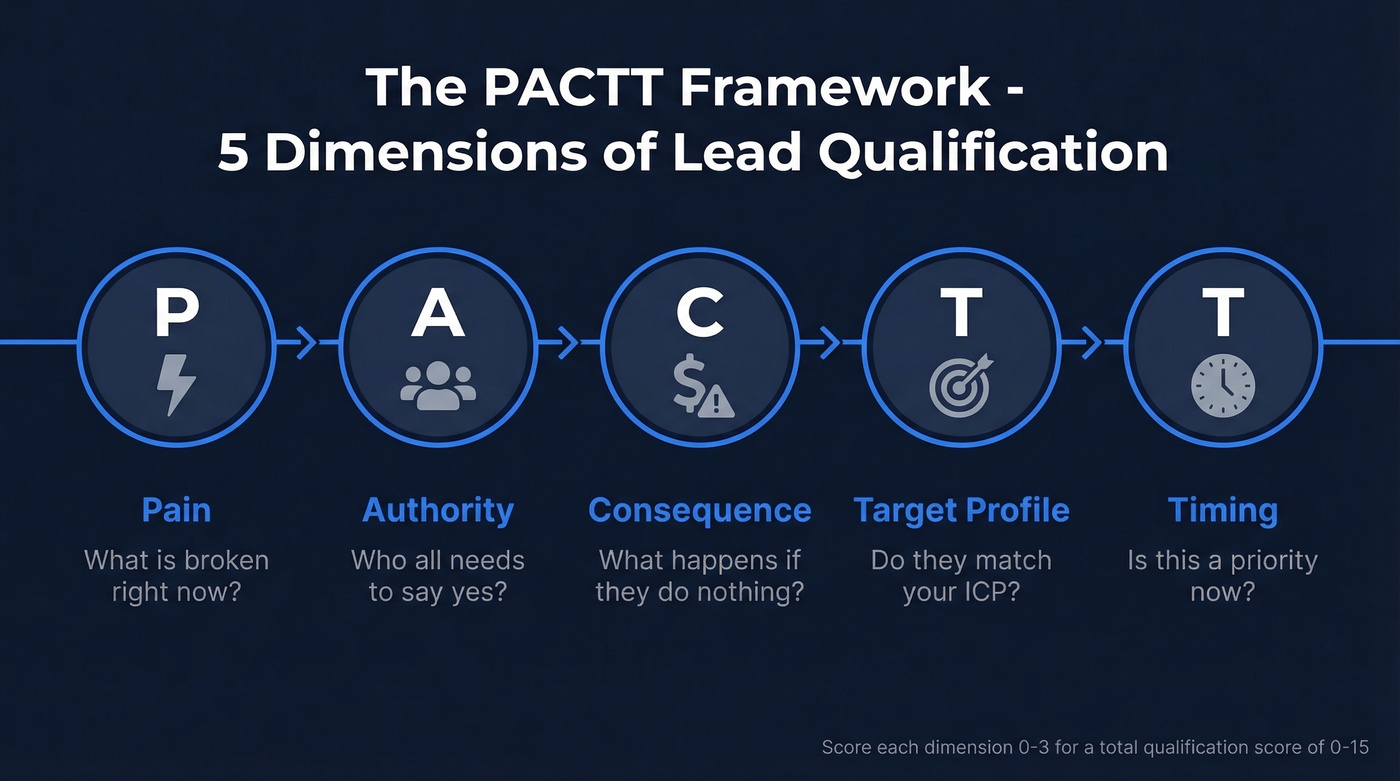
No single canonical creator is documented for PACTT. It's most commonly shared in practitioner content rather than tied to one inventor, sitting alongside other modern approaches as part of a broader shift away from legacy qualification models.
The Five Letters - With Discovery Questions
Pain
Pain is the entry point. No pain, no deal - just a curious browser. Your job isn't to pitch features; it's to understand what's broken in their world right now. This mirrors the thinking behind the Chet Holmes buyer pyramid, which reminds us that only about 3% of prospects are actively buying at any given time. The rest need their pain surfaced before they'll act.
- "Can you walk me through your current process for [task]?"
- "Where does that process break down most often?"
- "If you had to quantify the impact in time, money, or missed opportunities - what would that look like?"
- "What have you already tried to fix this?"
Authority
Authority isn't about finding "the decision-maker." That person rarely exists anymore. B2B deals involve 6-10 stakeholders on average, and enterprise deals can hit 15+. Authority means mapping the entire buyer cohort - the champion, the economic buyer, the technical evaluator, legal, procurement - and building relationships across all of them.
Closed-won deals have roughly 2x as many buyer contacts as lost deals, and for deals over $50k, multi-threading boosts win rates by 130%. You can't multi-thread if you don't have verified contact data for every stakeholder. That's where a tool like Prospeo becomes practical - 98% email accuracy across 300M+ professional profiles means you're not guessing at email formats or hoping someone forwards your message.
- "Who else needs to sign off before a decision gets made?"
- "How does your team typically evaluate solutions like this?"
- "Is there a technical review or security process we should plan for?"
- "Who would block this if they weren't involved early?"
Consequence
Imagine two prospects. Prospect A says "we lose about $40k a quarter in manual rework." Prospect B shrugs and says "it'd be nice to improve." One of those is a qualified opportunity. The other is a friendly conversation you'll never close.
Consequence is the letter that most clearly differentiates PACTT from older qualification checklists. It forces you to quantify the cost of doing nothing - and if you can't, you don't have a deal.
| Signal | What It Means |
|---|---|
| Prospect quantifies a dollar or time cost | Strong - build the business case around this number |
| Prospect describes downstream team impact | Moderate - dig deeper to attach a number |
| Prospect says "would be nice to fix" | Weak - likely not a real opportunity |
- "What happens if you don't solve this in the next 6 months?"
- "What's the cost of staying with the status quo - in revenue, time, or headcount?"
- "How does this problem affect other teams or departments?"
Target Profile
Target Profile is your ICP-fit checkpoint. Even if pain, authority, and consequence all check out, a bad-fit account will churn. Evaluate fit using firmographic data like industry and company size, technographic signals from their current tool stack, and behavioral indicators such as active solution research.
Skip this prospect if: they're outside your ICP on two or more dimensions, regardless of how enthusiastic they sound. Enthusiasm without fit is the most expensive kind of pipeline.
- "What's prompting you to explore solutions like ours now?"
- "What tools are you currently using for [related function]?"
- "How large is the team that would use this day-to-day?"
Timing
Timing isn't about budget - it's about priority. As one practitioner puts it, "Sales today is more about the priority than the budget." A prospect with budget but no urgency will stall forever. Average B2B sales cycles now run 6.5 months, up from 4.9 in 2019. Understanding timing early - including existing contract expirations and break clauses - saves you from nursing a deal that won't close this year.
- "What's your realistic timeline for implementing a solution?"
- "Are there existing contracts that need to expire first?"
- "Where does this rank against your other priorities this quarter?"

You can't score a 3 on Authority without verified contact data for every stakeholder. Prospeo gives you 98% accurate emails and 125M+ verified mobiles across 300M+ profiles - so you can multi-thread deals and hit that 130% win rate boost.
Stop single-threading deals with bad data. Map the full buying committee.
PACTT Scoring Rubric (0-15)
We couldn't find a widely published scoring template for PACTT, so we built one. Score each letter 0-3. Total range: 0-15.
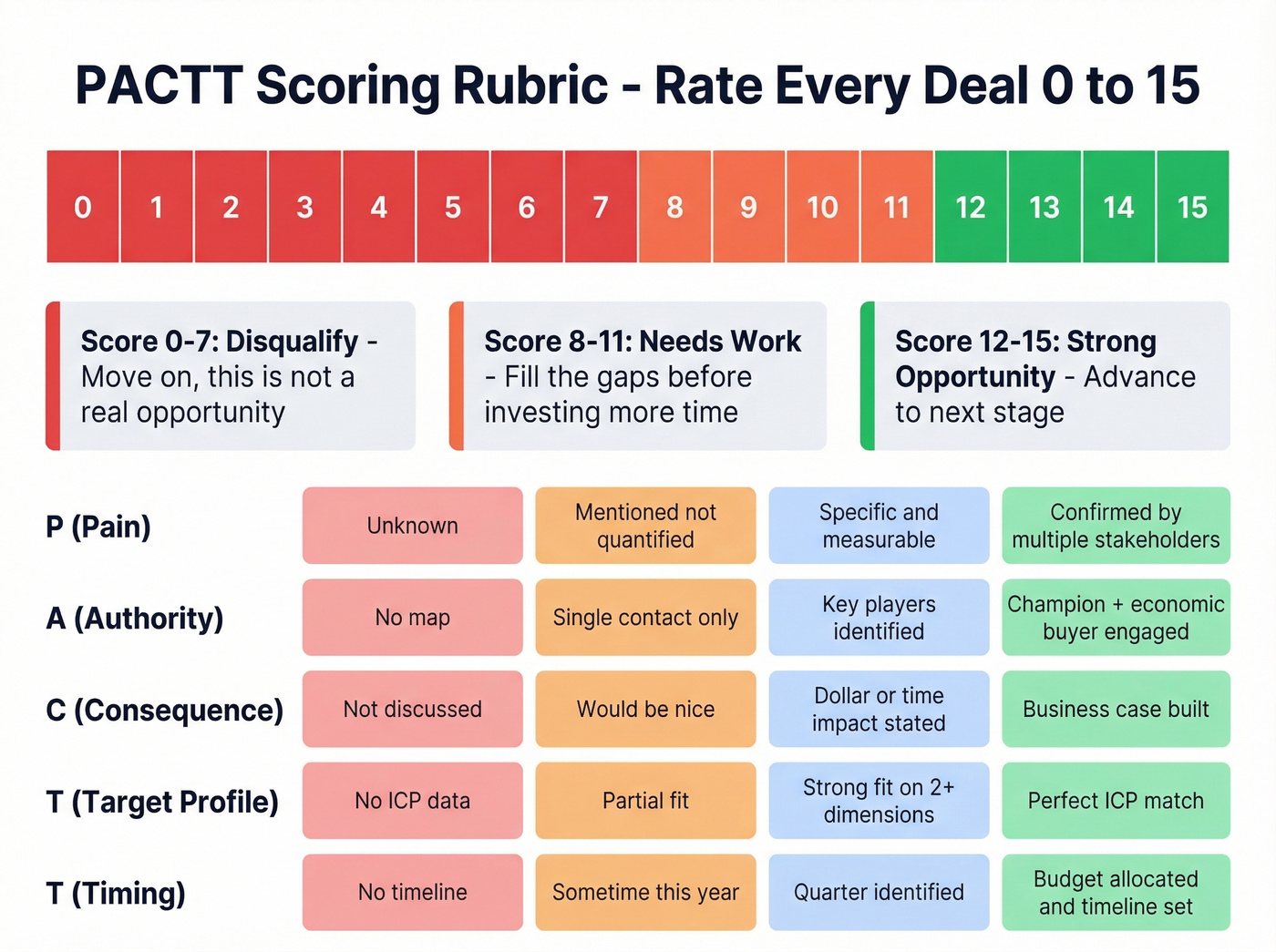
| Letter | 0 - No Info | 1 - Vague | 2 - Clear | 3 - Validated |
|---|---|---|---|---|
| Pain | Unknown | Mentioned, not quantified | Specific, measurable | Confirmed by multiple stakeholders |
| Authority | No map | Single contact only | Key players identified | Champion + economic buyer engaged |
| Consequence | Not discussed | "Would be nice" | Dollar/time impact stated | Business case built |
| Target Profile | No ICP data | Partial fit | Strong fit on 2+ dimensions | Perfect ICP match |
| Timing | No timeline | "Sometime this year" | Quarter identified | Budget allocated, timeline set |
12-15: Strong opportunity. Advance to next stage.
8-11: Needs work. Fill the gaps before investing more time.
0-7: Disqualify. Move on.
Here's the thing: don't treat this like a checklist you rush through on a single discovery call. PACTT is a structure for real conversation that unfolds across multiple touches. We've seen teams try to cram all five letters into one 30-minute call and end up with shallow answers that look qualified on paper but fall apart at the proposal stage.
PACTT vs BANT vs MEDDIC
| Framework | Best For | Key Strength | Limitation | Origin |
|---|---|---|---|---|
| BANT | High-velocity SMB | Fast disqualification | Ignores buying committees | IBM, 1950s |
| MEDDIC | Enterprise $100k+ | Deep deal understanding | Overkill for short cycles | Dick Dunkel, PTC, 1996 |
| CHAMP | Mid-market consultative | Pain-first approach | Can get too loose | Practitioner community |
| PACTT | Inside sales / SaaS | Consequence quantification | Less proven at enterprise scale | Practitioner community |
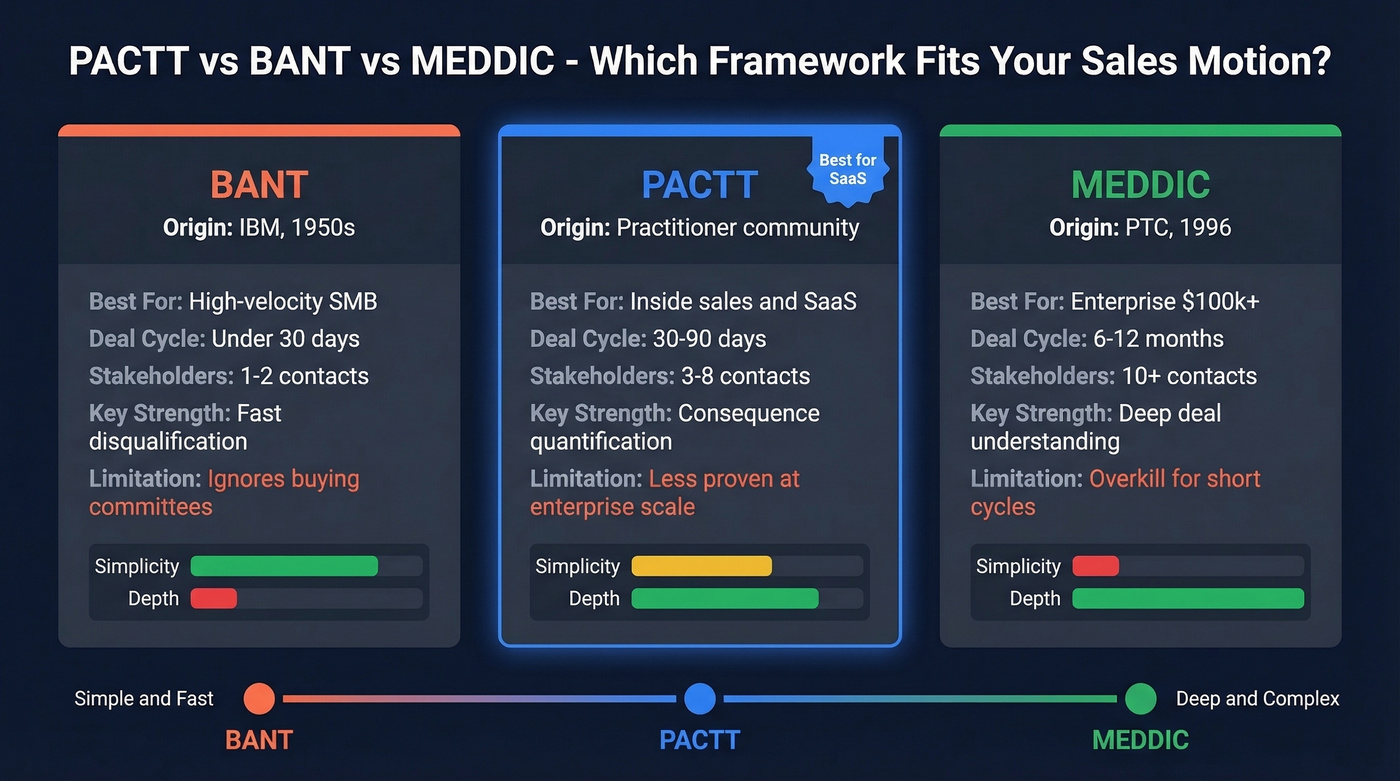
BANT was built for a world where one person held the budget. That world doesn't exist anymore. MEDDIC is the right call for complex enterprise deals - it helped PTC grow from $300M to $1B in four years, and one team cited a forecast-accuracy jump from 62% to 89% after switching from BANT to MEDDIC.
But MEDDIC is heavy machinery for a 45-day SaaS deal. PACTT gives you the rigor of MEDDIC's multi-stakeholder thinking and deal validation without the overhead of mapping metrics, economic buyers, and paper processes separately. If your average deal closes in under 90 days, MEDDIC will slow you down more than it helps you. PACTT is the right weight class for 30-90 day cycles with 3-8 stakeholders.
Making PACTT Stick
Qualify before demos, not during. If you're discovering pain on a demo call, you've already wasted 30 minutes of engineering or SE time. Let's be honest - most teams know this and still don't enforce it.
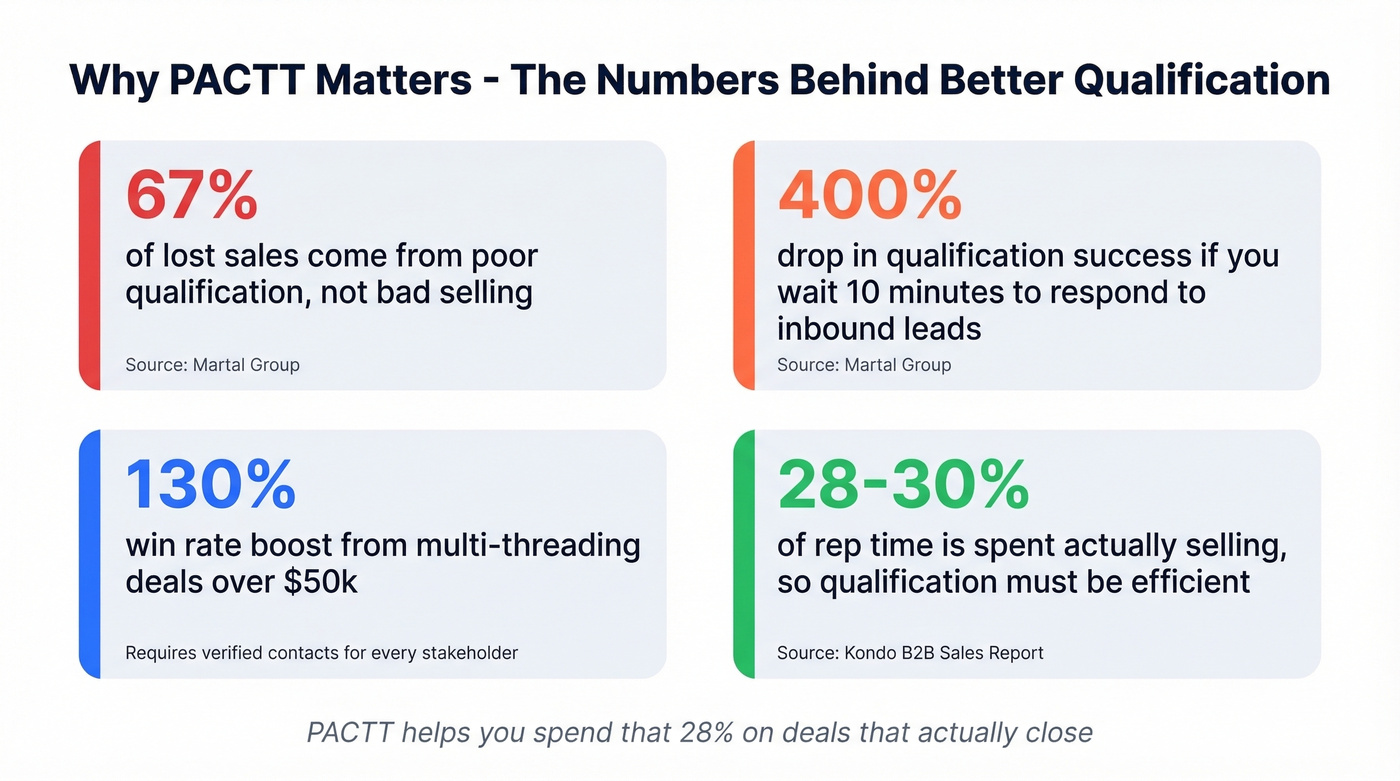
Respond fast. Responding to inbound leads within 5 minutes improves qualification success. Wait 10 minutes and success drops by 400%.
Measure before and after. Track stage conversion rate, forecast accuracy, and demo-to-close ratio. In our experience, teams that score every deal before advancing it see the biggest improvement in forecast accuracy - often within a single quarter. One team we worked with went from a 40% forecast miss rate to under 15% just by requiring a PACTT score of 8+ before any deal moved past Stage 2.
Keep it efficient. Reps spend only 28-30% of their time actually selling. Qualification can't be a 90-minute interrogation - it needs to happen in natural conversation across 2-3 touches.
Accept the disqualification. With average win rates sitting around 20%, most of your pipeline is unqualified. The framework's job is to surface that truth early, not to make every deal look good.
PACTT's Target Profile letter demands firmographic, technographic, and behavioral data to validate ICP fit. Prospeo's 30+ search filters - including technographics, buyer intent, and headcount growth - let you score Target Profile before the first call, not after.
Qualify ICP fit with real data, not gut feel. Start free today.
FAQ
Who created the PACTT framework?
No single canonical creator is documented. PACTT emerged from practitioner content for SaaS and inside sales teams, building on the limitations of BANT and the overhead of MEDDIC for mid-market deal cycles. It's community-driven rather than attributed to one author or consultancy.
When should I use PACTT instead of MEDDIC?
Use PACTT for inside sales and SaaS deals with 30-90 day cycles and 3-8 stakeholders. Switch to MEDDIC for enterprise deals above $100k with 6-12 month cycles and 10+ stakeholders where you need to map metrics, decision criteria, and paper processes separately.
How do I score a deal that's missing one PACTT dimension?
A missing dimension scores 0 in the rubric above. If your total lands below 8, the deal isn't qualified - park it in nurture and revisit when the gaps fill. Don't advance deals just because three out of five letters look strong.
What tools help with the Authority step?
Multi-threading requires verified contact data for every stakeholder. Any solid B2B data platform will work here - the key is accuracy and coverage across the full buying committee. Pair your data source with your CRM's relationship mapping to track engagement across all contacts on the deal.