

Parallel Dialers: What They Actually Do, What They Cost, and When They Backfire
400 dials. 6 conversations. Zero meetings. That's a real Tuesday for an SDR team running a parallel dialer on a stale list. The tool promises 5x more calls per hour, and it delivers - but more calls into bad numbers just means you burn through caller IDs faster. Orum's own data shows a 5.3% average pickup rate across their platform. Roughly 95 out of every 100 dials don't reach a live person.
The dialer isn't the problem. The problem is what happens before it fires.
What You Need (Quick Version)
- Large SDR teams (15+ reps) dialing high-volume SMB lists: Orum or Nooks. Expensive but purpose-built for this exact motion.
- Budget-conscious teams testing parallel dialing: CloudTalk. Transparent pricing, add-on model, monthly billing, low commitment.
- Teams where connect rates keep dropping: Stop buying dialers. Fix your data first. A power dialer fed with verified mobile numbers outperforms a multi-line dialer burning through stale contacts.
What Is a Parallel Dialer?
A parallel dialer places multiple outbound calls simultaneously for a single agent - typically 3 to 5 lines at once, though some tools push up to 10. The system dials five numbers at the same time, and the moment one person picks up, the remaining four calls drop and the agent connects to the live answer. "Auto-dialer" is the catch-all term that covers parallel, power, and predictive variants, but the mechanics differ in ways that matter.
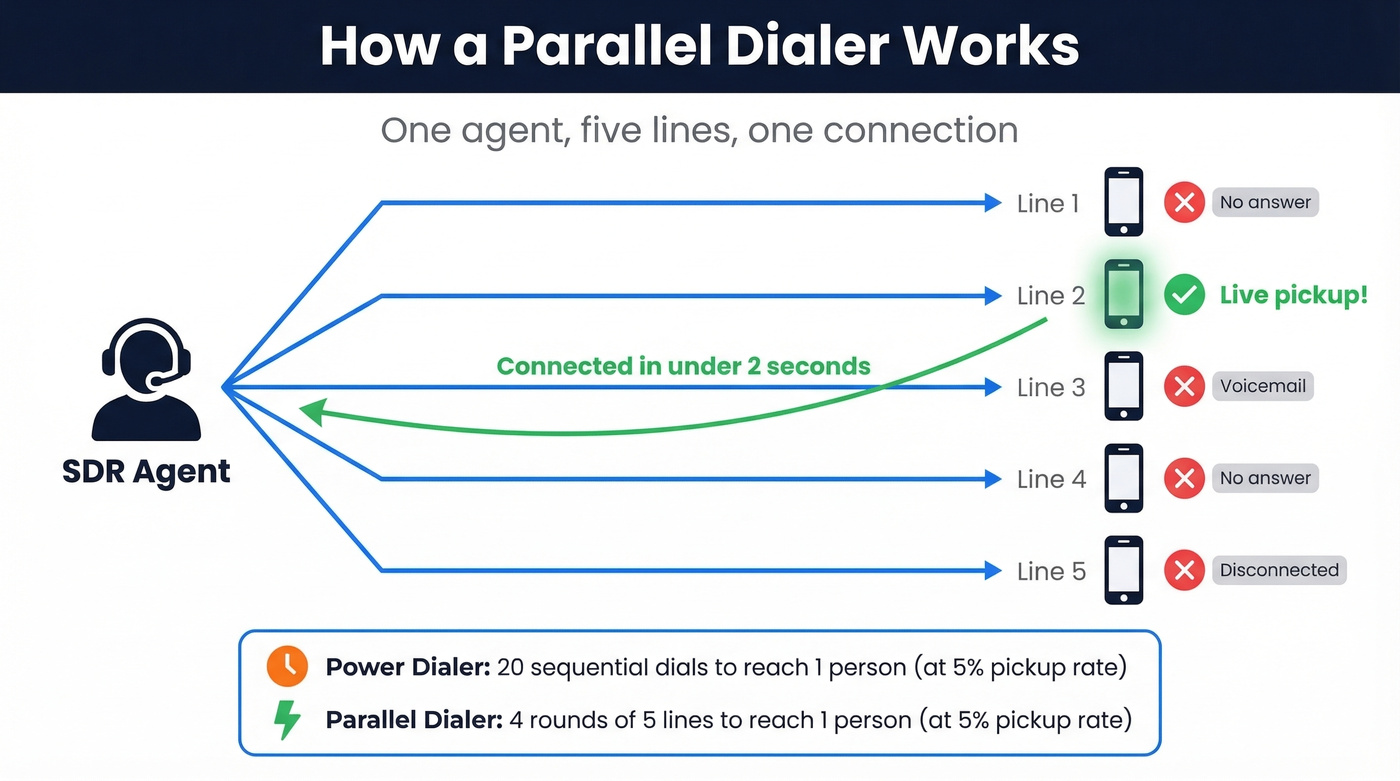
A power dialer dials one number at a time and auto-advances after each call ends. A predictive dialer uses algorithms to forecast agent availability and starts dialing before the current call wraps.
The appeal is pure math. If your pickup rate is 5%, a power dialer needs 20 sequential dials to get one conversation. A parallel dialer running 5 lines gets there in 4 attempts. That's a real productivity gain, and it explains why parallel dialing exists in a world where 80% of cold calls go to voicemail. But the caveat carries more weight than the feature page suggests. Parallel dialing assumes your list is large, your numbers are accurate, and you're comfortable with the compliance and reputation tradeoffs that come with it. If any of those assumptions break, the tool amplifies the damage instead of the output.
Parallel Dialer vs Power Dialer vs Predictive
| Type | Lines/Agent | Pacing Logic | Best For | Compliance Risk |
|---|---|---|---|---|
| Parallel | 3-10 | All fire at once | High-volume SMB | Higher |
| Power | 1 | Auto-advances | Mid-market, personalized | Lower |
| Predictive | 1-3 | Algorithm-paced | Call centers, support | Medium-high |
| Progressive | 1 | Agent-triggered | Regulated industries | Lowest |
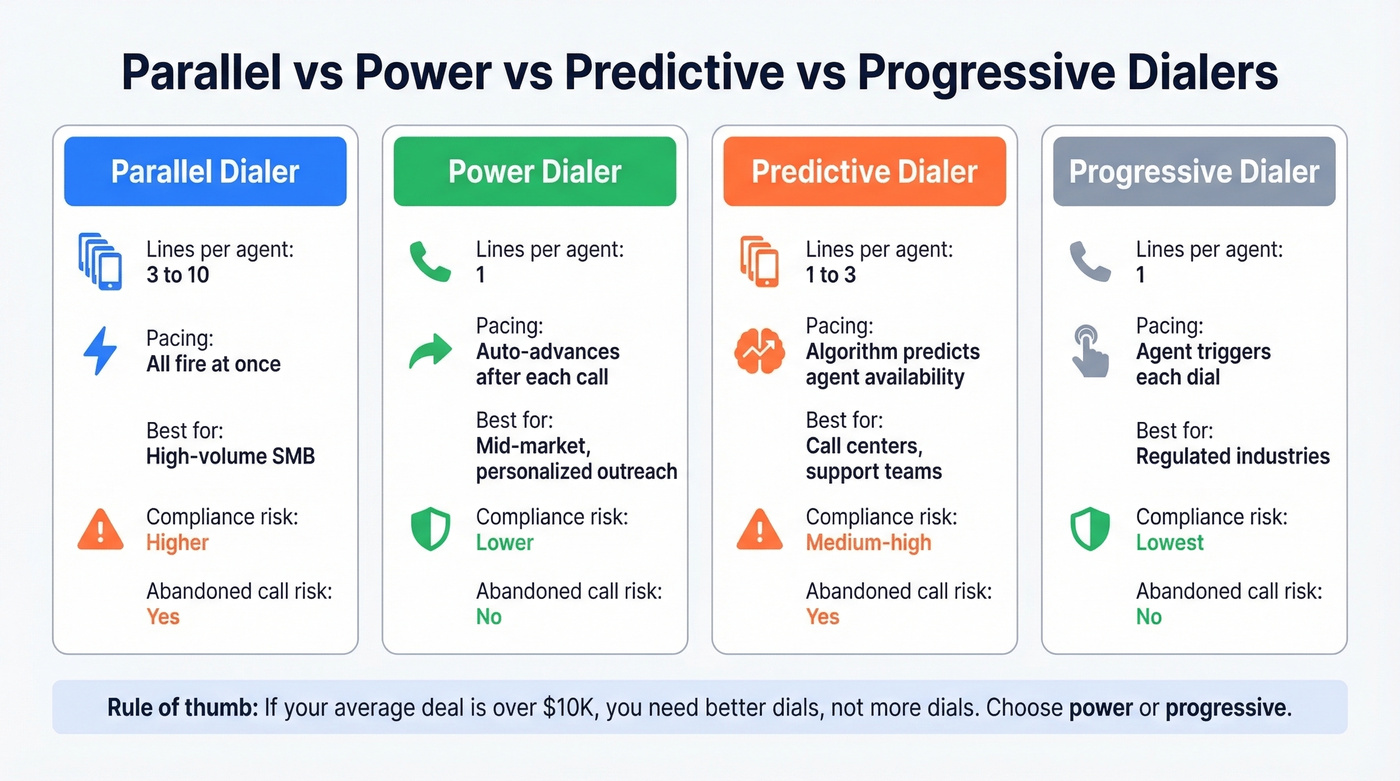
Parallel and predictive dialers both create abandoned-call risk because they dial before an agent is confirmed available. Power and progressive dialers wait for the agent, then dial. That difference matters for compliance and for caller ID reputation.
Here's the thing: for mid-market and enterprise prospecting where personalization drives conversion, a power dialer is almost always the smarter choice. If your average contract value is north of $10K, you don't need more dials - you need better dials. A parallel dialer earns its keep on large SMB lists where volume matters more than tailoring the first 10 seconds of the call.
When Parallel Dialing Backfires
The Reddit threads about parallel dialers aren't glowing reviews. They're war stories.
Spam Labels and Burned Numbers
This is the #1 operational risk: caller ID reputation collapse. 81% of businesses report losing revenue due to incorrect spam flagging, and 15% lost more than $100,000. When you're firing 5-10 simultaneous calls per agent, your outbound volume per number spikes fast. Carriers notice. And 80% of customers block calls from numbers they don't recognize.
One SDR leader on r/sales described it bluntly: "All of our numbers are spam." Connection rates plummeted, connected-call-to-meeting rates dropped, and the team was calling the same prospects multiple times per day without realizing it. That's not a dialer problem. That's an operational meltdown.
The Rep Experience Problem
Reps using multi-line dialers often don't know who answered. The system connects them to a live voice, and the first 3 seconds are fumbled - "Hi, uh, who is this?" That signals robocall and kills trust before the conversation starts. We've seen teams where reps actually preferred a Salesloft power dialer over Nooks because the call quality and context were better, even though volume was lower.
Contract Lock-In
Many vendors require annual contracts with 3-5 seat minimums. That same Reddit poster mentioned being stuck in a second-year Nooks contract with no exit. If connect rates drop and the tool isn't delivering, you're still paying $25K+ per year while your numbers get flagged.

Running 5 lines into stale numbers doesn't multiply productivity - it multiplies burned caller IDs. Prospeo's 125M+ verified mobile numbers refresh every 7 days, not every 6 weeks. Teams using verified direct dials see 30% pickup rates, turning any dialer into a meeting machine.
Fix the data before you fire the dialer.
Compliance Risks
Parallel dialing creates legal exposure, and the regulatory environment is getting stricter in 2026.
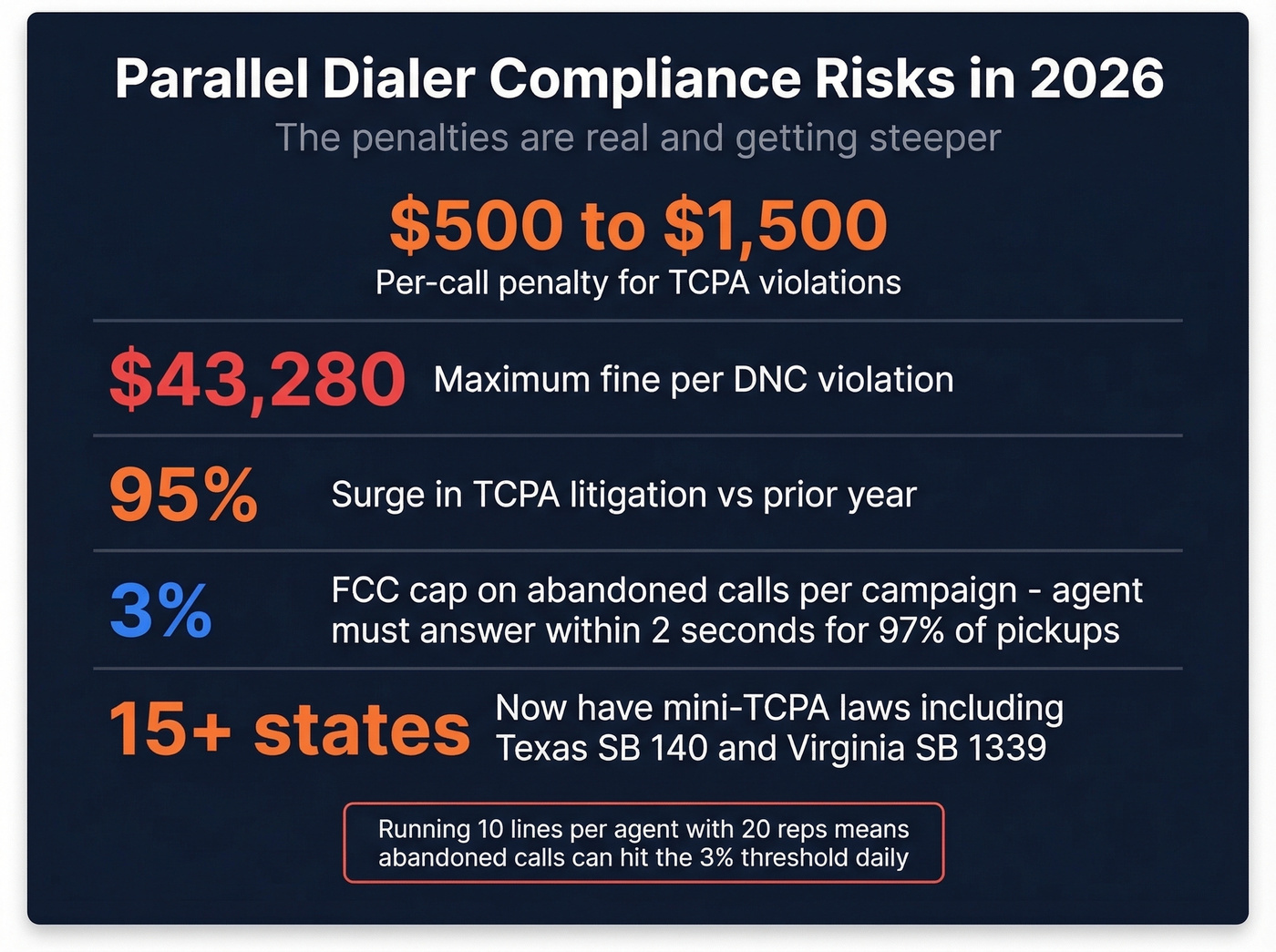
The FCC's abandonment rule caps abandoned calls at 3% per campaign. A live agent must be available for 97% of answered calls within 2 seconds. When you're running 10 lines per agent and two people pick up simultaneously, the other call is abandoned. Scale that across a 20-rep floor and you're flirting with the threshold daily.
Penalty snapshot: TCPA violations carry $500-$1,500 per call. DNC violations can hit $43,280 per violation. TCPA litigation surged nearly 95% versus the prior year.
The FCC now treats AI-generated voices as "artificial/prerecorded," requiring prior express written consent. Consent revocation rules let consumers revoke by any reasonable method, with cross-channel effects rolling in through April 2026. A Supreme Court ruling (McLaughlin v. McKesson) further complicated matters by holding that district courts aren't bound by FCC interpretations in civil TCPA cases.
Over 15 states now have mini-TCPA laws - Texas SB 140 and Virginia SB 1339 among them. If your team dials across state lines, you're navigating a patchwork of rules that multi-line dialing makes harder to comply with.
The Data Problem No Dialer Solves
Most parallel dialer failures aren't dialer failures. They're data failures.
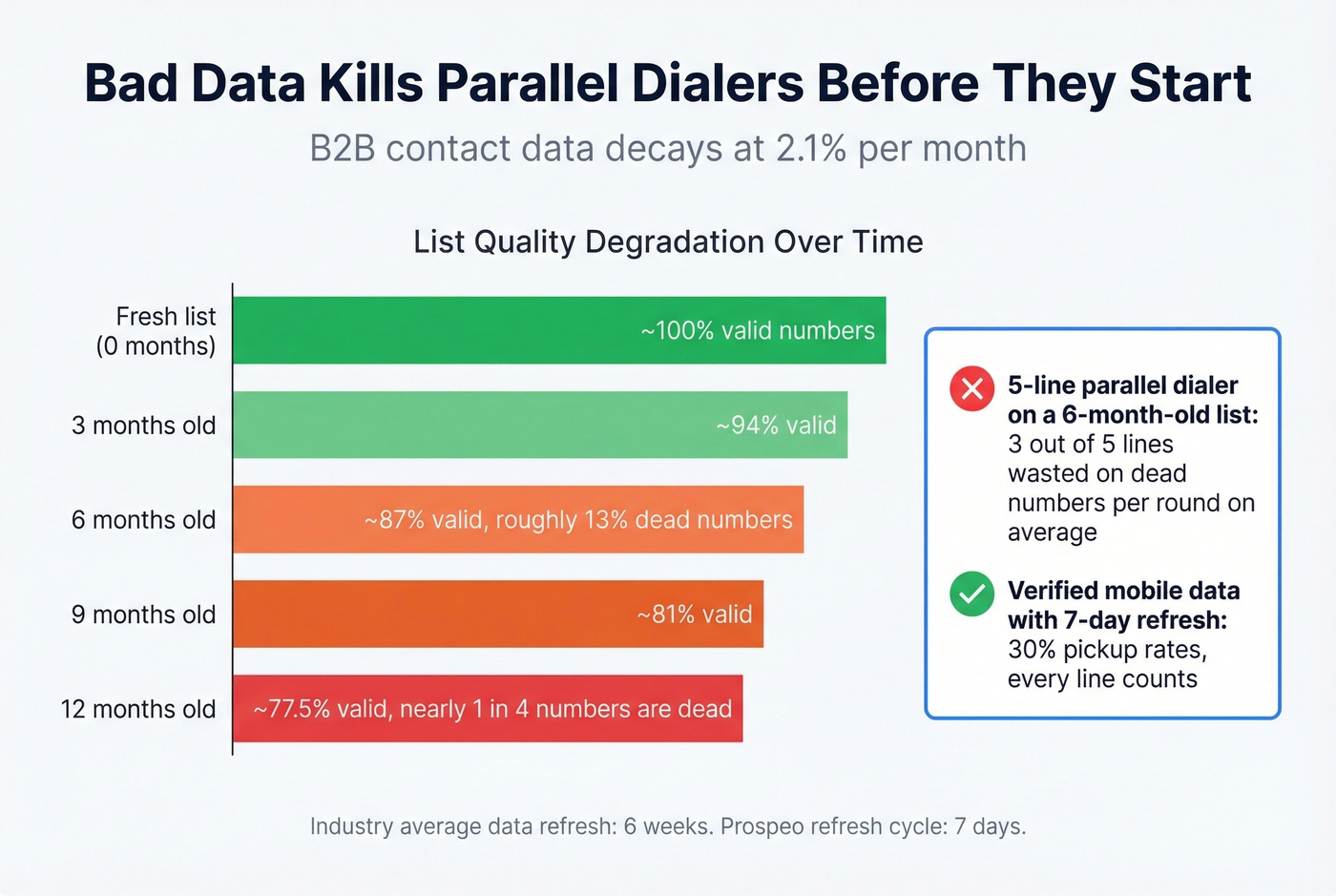
B2B contact data decays at roughly 2.1% per month - that's 22.5% annually. A six-month-old list has ~13% dead numbers. Running 5 lines on that list isn't multiplying productivity. It's multiplying wasted caller ID reputation on disconnected numbers, wrong numbers, and people who changed jobs three months ago.
Number rotation - the "fix" many vendors sell - actually makes things worse. Carriers penalize number swapping because it's a prime scammer tactic. Roughly 30% of phone numbers used daily on mobile networks have little or no call history, which means "fresh" rotated numbers start with zero trust. The industry consensus is to cap outbound volume at 100-150 calls per day per number.
The upstream fix is better data. Teams that verify numbers before loading them into any dialer get materially higher connect rates than teams that just upgrade their dialing software. Prospeo's Mobile Finder returns verified mobile numbers globally across 125M+ verified mobiles with a 30% pickup rate - that's the difference between burning 5 caller IDs on dead numbers and actually reaching the VP you're targeting. And with a 7-day data refresh cycle versus the 6-week industry average, the numbers you pull are far less likely to be stale by the time your reps start dialing.
If you're rebuilding your outbound stack, start with the sales engagement platform and data layer, not the dialer.
Top Parallel Dialing Software Compared
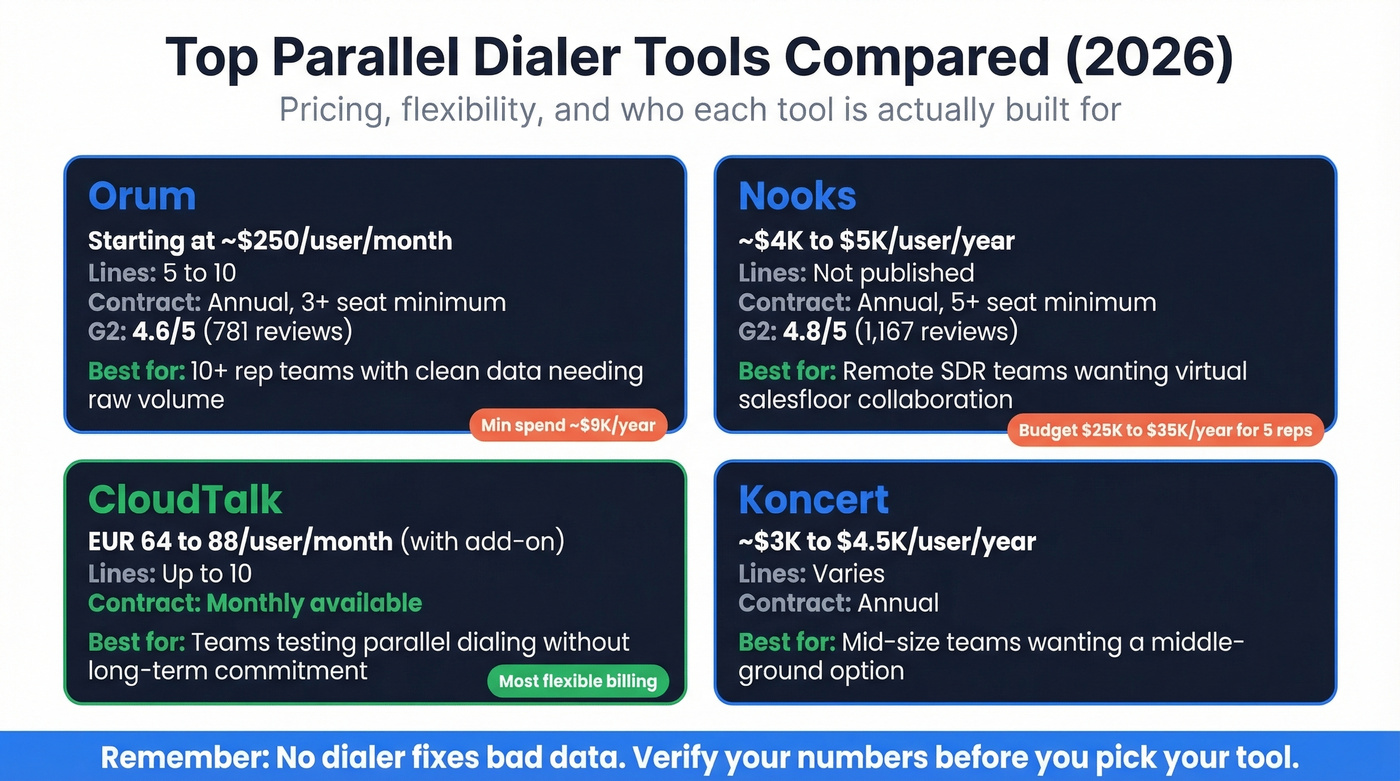
| Tool | Starting Price | Lines | Terms | G2 Rating |
|---|---|---|---|---|
| Orum | ~$250/user/mo | 5-10 | Annual, 3+ seats | 4.6/5 (781) |
| Nooks | ~$4K-$5K/user/yr | Not published | Annual, 5+ seats | 4.8/5 (1,167) |
| CloudTalk | EUR 64-88/user/mo | Up to 10 | Monthly available | - |
| Koncert | ~$3K-$4.5K/user/yr | Varies | Annual | - |
| PowerDialer.ai | ~$100-$200/user/mo (est.) | Up to 5 | - | - |
| Ringover | Free to start | Included on paid | Monthly | - |
Orum
Orum has handled 200M+ calls and publishes benchmarks that other vendors avoid sharing. Two plans: Launch gives you 5 parallel lines and 5 caller IDs per month; Ascend bumps that to 10 lines, 10 caller IDs, international calling across 160+ countries, and 200 enrichment credits monthly.

Pricing starts at roughly $250/user/month on an annual contract with a 3-seat minimum - $9,000/year for the smallest possible team on Launch. Ascend typically runs ~$300-$400/user/month. The product is genuinely well-built for high-volume outbound. We've recommended it to teams with 10+ reps and clean data who need raw dial volume. Skip Orum if you have fewer than 5 reps or your list quality is questionable - you'll burn through caller IDs before the tool pays for itself.
If you're evaluating the broader SDR stack (not just dialing), compare options in our guide to SDR tools.
Nooks: High Ratings, Real Complaints
Nooks holds the highest G2 rating in the category (4.8/5 across 1,167 reviews), but the Reddit backlash tells a different story. Teams report spam-labeled numbers, declining connect rates, and contracts they can't exit. The "salesfloor" concept - a virtual room where reps dial together - resonates with remote SDR teams, and the praise themes (time-saving, ease of use) are consistent. So are the complaints: call issues, dialer bugs, and connection problems show up repeatedly in G2 cons.

Pricing runs ~$4,000-$5,000/user/year with annual contracts and typically 5+ seat minimums. A 5-rep team should budget $25K-$35K/year with add-ons. This works for 10+ SDRs running high-volume SMB outbound who want the collaborative experience. Skip it if you need monthly billing flexibility or have fewer than 5 reps.
CloudTalk: The Transparent Option
CloudTalk publishes actual prices - a rarity in this category. Starter begins at EUR 25/user/month (annual), with Expert at EUR 49/user/month. The parallel dialing add-on costs EUR 39/user/month, supporting up to 10 simultaneous lines. All-in: EUR 64-88/user/month. Monthly billing is available at a premium, and there aren't massive seat minimums.
One edge worth noting: CloudTalk's voicemail detection runs at ~1.5 seconds, compared to 4-5 seconds on some competitors. That saves meaningful time across hundreds of daily dials. The tradeoff is that CloudTalk isn't purpose-built for SDR workflows the way Orum and Nooks are - it's a broader telephony platform with parallel dialing bolted on. That makes it the obvious choice for teams testing the approach without committing $25K+ annually.
If you're comparing CloudTalk in more detail, see our Aircall vs CloudTalk breakdown.
Koncert
Koncert's differentiator is a human-assisted model called Lightning: live agents screen calls before connecting your reps, so your SDRs never fumble the "who is this?" opening. The AI-powered dialer runs $3,000-$4,500/user/year; Lightning runs $6,000-$10,000/user/year. The full suite bundle hits $8,000-$12,000/user/year. Implementation takes 4-6 weeks and the learning curve is steep. This is enterprise-grade tooling for teams that have outgrown simpler options.
PowerDialer.ai & Ringover
PowerDialer.ai positions itself as a simpler, cheaper option - up to 5 simultaneous lines with an AI-assist layer. Pricing isn't public; expect ~$100-$200/user/month based on market positioning. Ringover lets you get started free, with paid plans on monthly terms. It's the lowest-commitment way to experiment with multi-line dialing before spending real budget, though feature depth is limited compared to Orum or Nooks.
If Ringover is on your shortlist, check Ringover alternatives before you commit.
How to Decide
Your team size, budget, and list quality should drive this decision - not the feature matrix.
For teams with fewer than 5 reps or under EUR 500/month to spend, stick with a power dialer or CloudTalk's add-on. Multi-line dialing at this scale burns caller IDs faster than you can rotate them. 5-15 reps with EUR 1K-3K/month should look at CloudTalk or Orum Launch - test the approach with manageable spend and see if connect rates actually improve. 15+ reps with dedicated SDR management and EUR 3K+ monthly budget are the sweet spot for Orum Ascend or Nooks, where the investment makes sense because you have the volume and the ops discipline to manage caller ID health.
Before loading any list into a dialer, run a pre-dial checklist: verify phone numbers are current, scrub against DNC lists, cap daily volume at 100-150 calls per number, and confirm your STIR/SHAKEN attestation is active.
If you need a repeatable outbound motion around calling, build a documented cold calling system so reps don’t improvise under pressure.
Let's be honest about this: if more than 20% of your list is stale - and if you haven't refreshed it in 90+ days, it probably is - no parallel dialer will save your connect rates. Fix the data before spending another dollar on dialing software. A $50/month power dialer on verified numbers will outperform a $5,000/year multi-line dialer on garbage data every single time.
If you're cleaning lists at scale, consider pairing dialing with data enrichment services so records stay usable longer.
B2B numbers decay 2.1% per month, and your parallel dialer amplifies every dead number into wasted reputation. Prospeo's 7-day refresh cycle and 5-step verification eliminate disconnected and wrong numbers before they hit your dialer. At $0.01 per verified contact, it costs less than a single burned caller ID.
Stop rotating numbers. Start verifying them.
FAQ
How many lines should I run?
Start at 3-4 lines per agent. Going above 5 increases abandoned calls and compliance risk significantly. Orum's data shows a 5.3% pickup rate across 2-10 lines, but higher line counts mean more dropped calls when multiple prospects answer simultaneously. Scale up only after your abandonment rate stays under 3%.
Is parallel dialing legal in 2026?
Yes, but heavily regulated. The FCC caps abandoned calls at 3% per campaign, requiring a live agent for 97% of answered calls within 2 seconds. Violations carry $500-$1,500 per call. Over 15 state mini-TCPAs add further restrictions, and TCPA litigation surged 95% in the past year. Legal? Yes. Risk-free? Not remotely.
Which is better - parallel or power dialer?
Use parallel for high-volume SMB lists where pickup rates are low and personalization matters less. Use power for mid-market and enterprise where the first 10 seconds determine whether you get a meeting. If your average deal size exceeds $15K, a power dialer with verified data outperforms a multi-line dialer with mediocre data every time.
Why are my numbers getting flagged as spam?
High call volume per number (over 100-150/day), aggressive number rotation, and low answer rates all trigger carrier spam algorithms. STIR/SHAKEN attestation alone doesn't prevent flagging - it verifies caller identity, not calling behavior. Reduce volume per number, stop rotating aggressively, and improve list quality so more calls actually connect.
How do I improve connect rates before investing in a dialer?
Verify your phone numbers first. B2B data decays 2.1% per month, meaning a six-month-old list has ~13% dead numbers. Clean data paired with a basic power dialer will outperform any multi-line dialer running on an unverified list - at a fraction of the cost. In our experience, teams that fix data quality before upgrading their dialer see connect rate improvements that dwarf anything a fancier tool delivers on its own.