

The PAS Formula: Write Copy That Actually Converts
You don't need ten copywriting formulas. You need one that works every time you sit down to write - whether it's a cold email, a landing page, or a 30-second video script. The PAS formula is that framework, and the gap between people who use it well and people who use it badly comes down to one word: specificity.
The framework in 30 seconds:
Problem - Name the exact pain your reader feels right now. Agitate - Make the cost of inaction concrete and emotional. Solution - Show the way out, clearly and credibly.
Skip to: Templates by Channel | Mistakes to Avoid | PAS vs. AIDA
What Is PAS?
PAS stands for Problem-Agitate-Solution. It's a three-step copywriting framework that works by showing the reader you understand what they're dealing with, then guiding them to a clear next step.
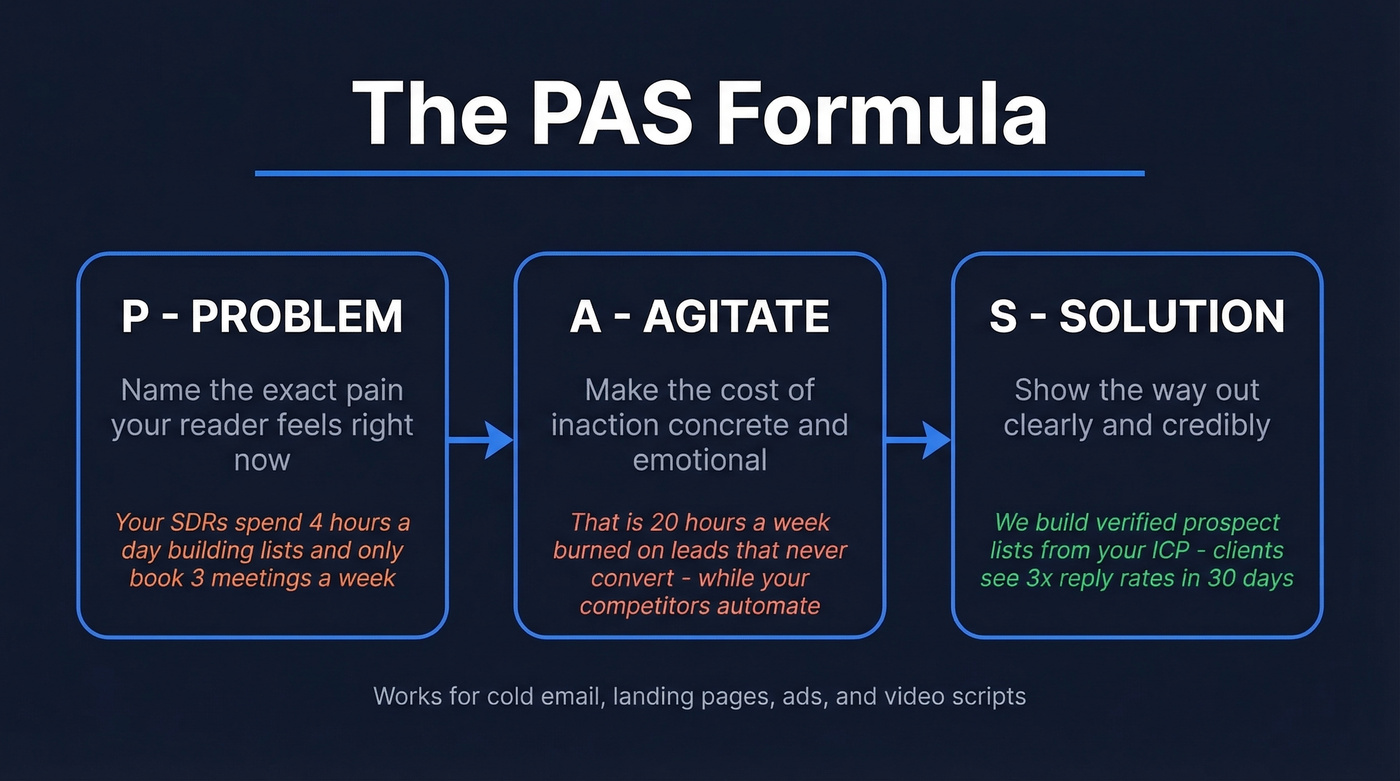
The structure comes from direct-response writing and has stayed relevant across formats - print, email, short-form video - because the underlying trigger never changes: people act when they feel understood and the path forward feels obvious. If you only learn one copywriting framework, this is the one. The problem-agitate-solution sequence works for a 47-word cold email and a 2,000-word sales page alike.
Why This Framework Works
Emotion drives action. Specificity drives emotion.
Claude Hopkins wrote in 1923 that "platitudes and generalities roll off the human understanding like water from a duck. They leave no impression whatever. But actual figures are not generally discounted. Specific facts, when stated, have their full weight and effect." That observation is a hundred years old and still the best copywriting advice anyone's ever given.
The widely cited figure is that 95% of purchasing decisions are emotional, with logic applied after the fact to justify them. Whether the exact number is 95% or 80%, the direction is clear - and PAS exploits that sequence perfectly. You name the problem so the reader recognizes it, agitate it so they feel it, then present the solution as relief.
Here's where most people get it wrong: they think the formula itself does the work. It doesn't. Tom Goodwin at Contentere ran A/B tests where "Pay £15" beat a generic "pay" message, and "B12" outperformed "blood biomarkers." The concrete version won every time. The framework is the skeleton. Specificity is the muscle.
Let's be honest about something: the PAS formula is probably the most powerful copywriting structure that exists. But 90% of the work happens before you write a word - in the research. If you don't know your reader's exact pain, exact language, and exact stakes, PAS gives you nothing but a pretty three-letter acronym. Research is the prerequisite. The formula just organizes what you already know.
How to Write PAS Copy (Step by Step)
Step 1: Name the Problem
Name the exact pain your reader experiences. Not a category of pain - the specific, felt version of it.
The questions that matter:
- What's the reader trying to do right now that isn't working?
- What words would they use to describe this problem to a colleague?
- Can you quantify it - hours wasted, dollars lost, deals missed?
"Struggling with lead generation" is a category. "Your SDRs are spending 4 hours a day building lists and still only booking 3 meetings a week" is a problem. The framework works outside B2B too: "You're brushing twice a day but your dentist still finds plaque buildup every visit" hits harder than "oral hygiene is important."
Step 2: Agitate
Make the cost of inaction feel real. This isn't about inventing fears - it's about articulating consequences the reader already suspects but hasn't fully confronted.
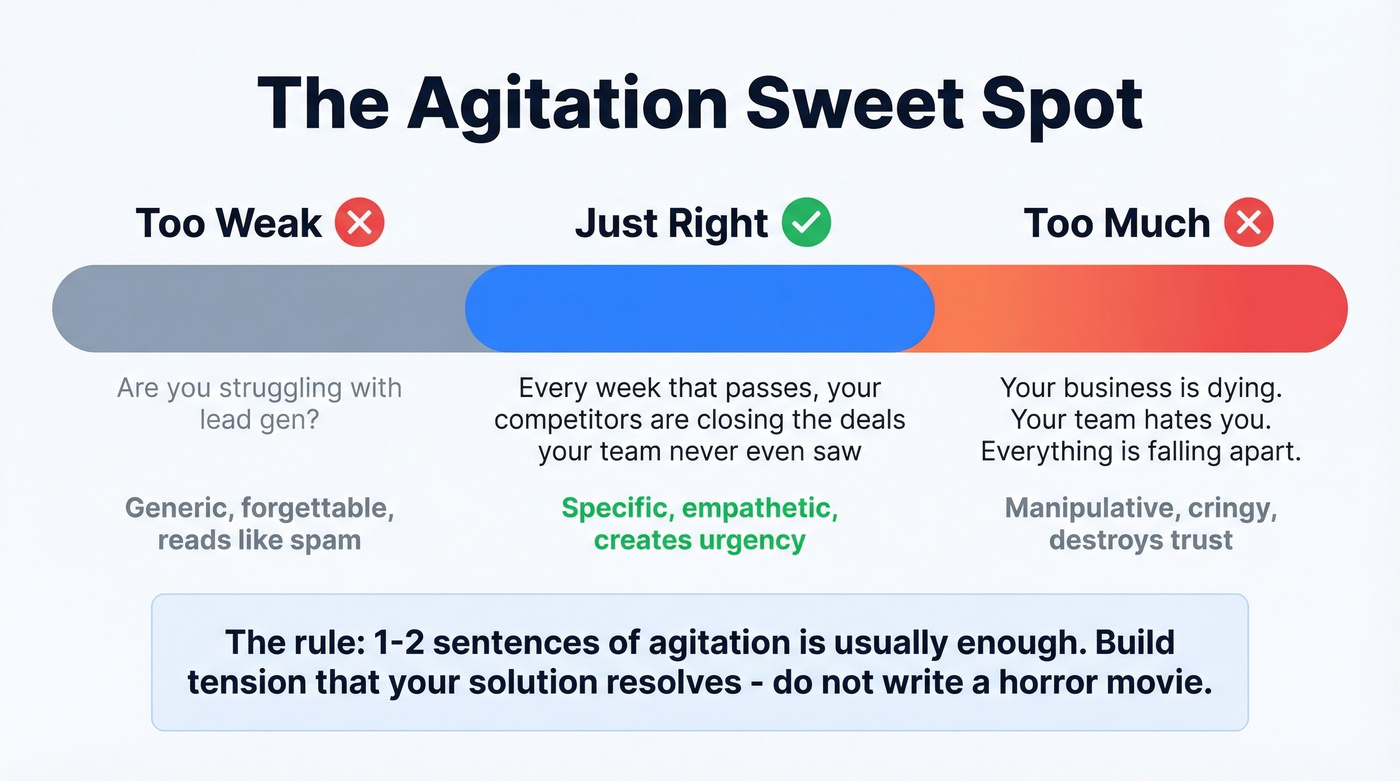
Think through what happens if the problem persists another month, another quarter. What's the compounding cost - financial, emotional, competitive? How does this make them look to their boss, their board, their team?
The guardrail here matters: don't let your reader wallow. Over-agitation makes copy feel cringy and unserious. One or two sentences is often enough. You're building tension that the next step resolves - not writing a horror movie trailer.
Step 3: Deliver the Solution
Show the way out. Be specific about what changes, how quickly, and what proof you have.
- What's the first tangible result they'll see?
- Can you show a before/after contrast?
- What makes your solution credible - data, testimonials, a demo?
The solution step is where most copy falls apart. Writers spend 80% of their energy on the problem and agitation, then phone in a vague "we can help." Your solution needs to be at least as detailed as your agitation - ideally more. That's what makes the sequence complete.

The best PAS copy in the world won't save you from a 35% bounce rate. Prospeo's 5-step email verification drops bounces under 4% - so your perfectly agitated cold emails actually land in inboxes, not spam folders.
Write the copy. Let Prospeo handle the data.
PAS Templates by Channel
Cold Email (50 Words or Less)
The r/copywriting heuristic for 2026: 40-60 words max. The offer does the heavy lifting. Soft CTA. Your framework needs to compress hard.
Fill-in-the-blank template:
P: Most [role]s at [company type] are [specific problem with a number]. A: That means [concrete consequence - dollars, time, or competitive risk]. S: We [specific mechanism] - [proof point]. Worth a quick look?
Before/After rewrite:
❌ Vague: "Are you struggling with outbound? It's hard to get replies these days. We can help you get more meetings."
✅ Specific: "Your site's pulling 99.7k visits/mo (per SimilarWeb), but your outbound team is emailing generic lists. That's pipeline left on the table. We build targeted lists from your ICP and verify every email - clients see 3x reply rates in 30 days. Worth a conversation?"
Step zero before any of this: verify your list. A 35% bounce rate tanks deliverability before anyone reads your copy. We've seen teams go from 35% bounce to under 4% just by running their list through Prospeo's verification before hitting send.
Landing Page Hero
Headline (P): [Audience] are losing [specific thing] because of [specific problem]. Subhead (A): Every [time period], that costs you [specific consequence]. CTA (S): [Action verb] + [specific outcome] + [timeframe]. [Button text.]
❌ "We help businesses grow with better marketing."
✅ "Most B2B landing pages leak conversions. Every month, that's ad spend driving visitors who leave without a trace. See exactly which companies visit your site - and reach the buyers inside them. Start free."
Social Ad Copy
Keep it tight and scannable. The scroll-stop is the problem statement - make it feel like you're reading the viewer's mind.
Line 1 (P): [Audience], you're spending [resource] on [activity] and getting [disappointing result]. Line 2 (A): Meanwhile, [competitor/alternative] is [winning because of X]. Line 3 (S): [Product] does [specific thing] so you [outcome]. [Soft CTA or link.]
Short-Form Video Script
PAS maps perfectly to a 30-60 second video:
Hook / first 3 seconds (P): "You know that feeling when [specific frustration]?" Build / seconds 4-20 (A): "Here's what's actually happening: [consequence with a number]. And it gets worse - [compounding effect]." Payoff / seconds 21-45 (S): "Here's what we did instead: [mechanism]. Result: [specific outcome]. Link in bio."
The hook has to earn the next 5 seconds. If your problem statement is generic ("tired of bad results?"), they're already scrolling.
PAS Variations: PASO, PASCA, PASTOR
PAS is the foundation. Several variants extend it for different contexts:
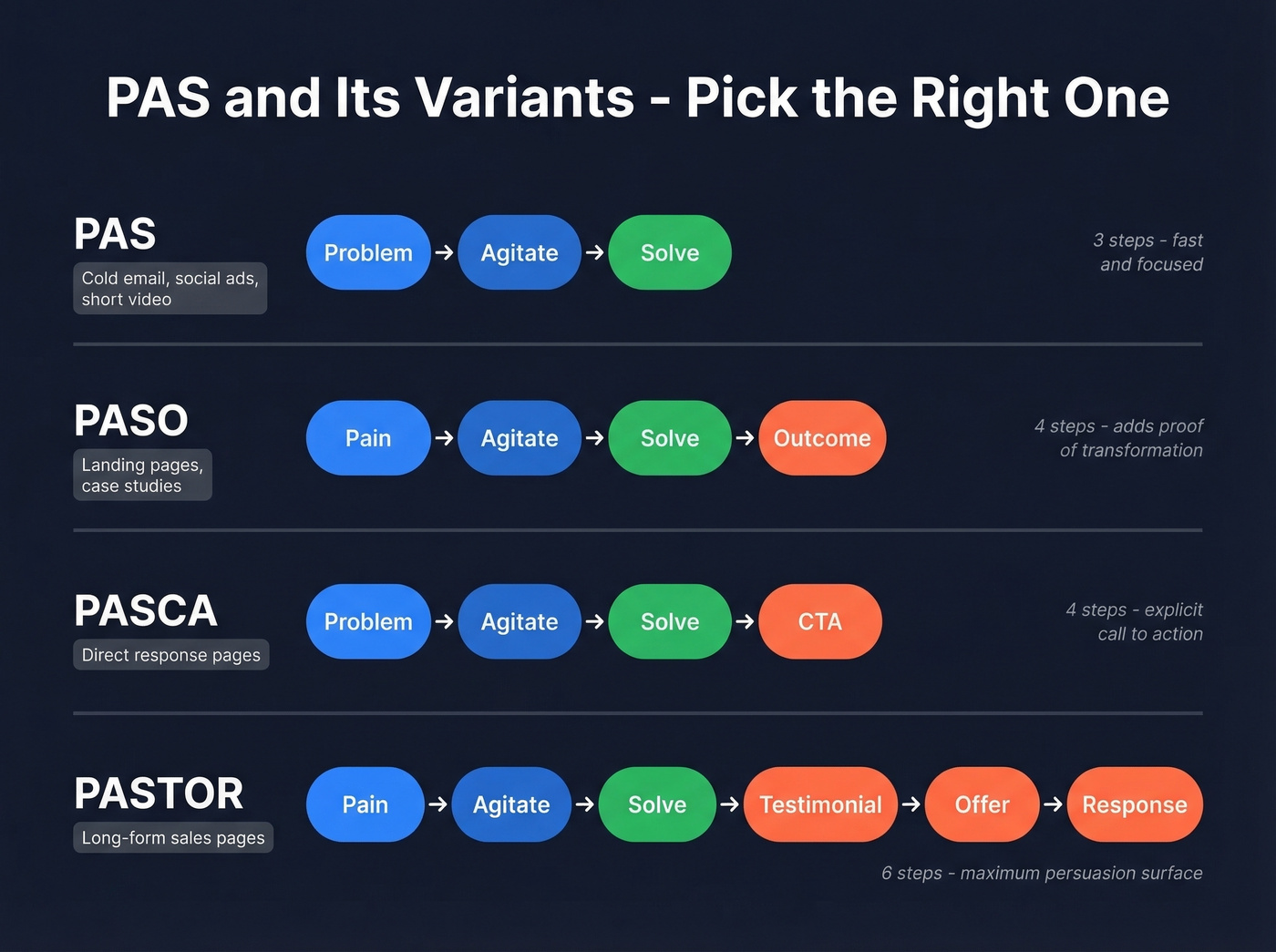
| Variant | Steps | Best For |
|---|---|---|
| PAS | Problem - Agitate - Solve | Email, landing pages, social ads, short-form video |
| PASO | Pain - Agitate - Solve - Outcome | Landing pages, case studies |
| PASCA | Problem - Agitate - Solve - CTA | Direct-response pages where you want an explicit CTA |
| PASTOR | Pain - Agitate - Solve - Testimonial - Offer - Response | Long-form sales pages |
PASO adds an explicit "Outcome" step that helps the reader picture themselves after the transformation. Pair it with proof - a testimonial, a stat, a screenshot. The outcome step without evidence is just a promise.
PASTOR is the heavy-duty version for long-form sales letters. The acronym's expansion varies across sources - some swap "Testimonial" for "Transformation." Don't get hung up on the naming. The principle is the same: more proof, more detail, more persuasion surface area.
One thing we've noticed in practice: PAS doesn't have to be linear. Test leading with the solution when your audience is already solution-aware. Agitation doesn't have to be negative either - framing an unmet goal or missed opportunity works just as well as pain. We've seen solution-first emails outperform the standard order for audiences deep in a buying cycle.
For cold email, stick with PAS. For landing pages, use PASO. For long-form sales pages, PASTOR gives you the most structure.
PAS vs. AIDA: When to Use Which
A common take on r/copywriting is that AIDA (Attention-Interest-Desire-Action) works as a general step-by-step structure, but "people no longer buy in such a linear way." That tracks with what we've seen.
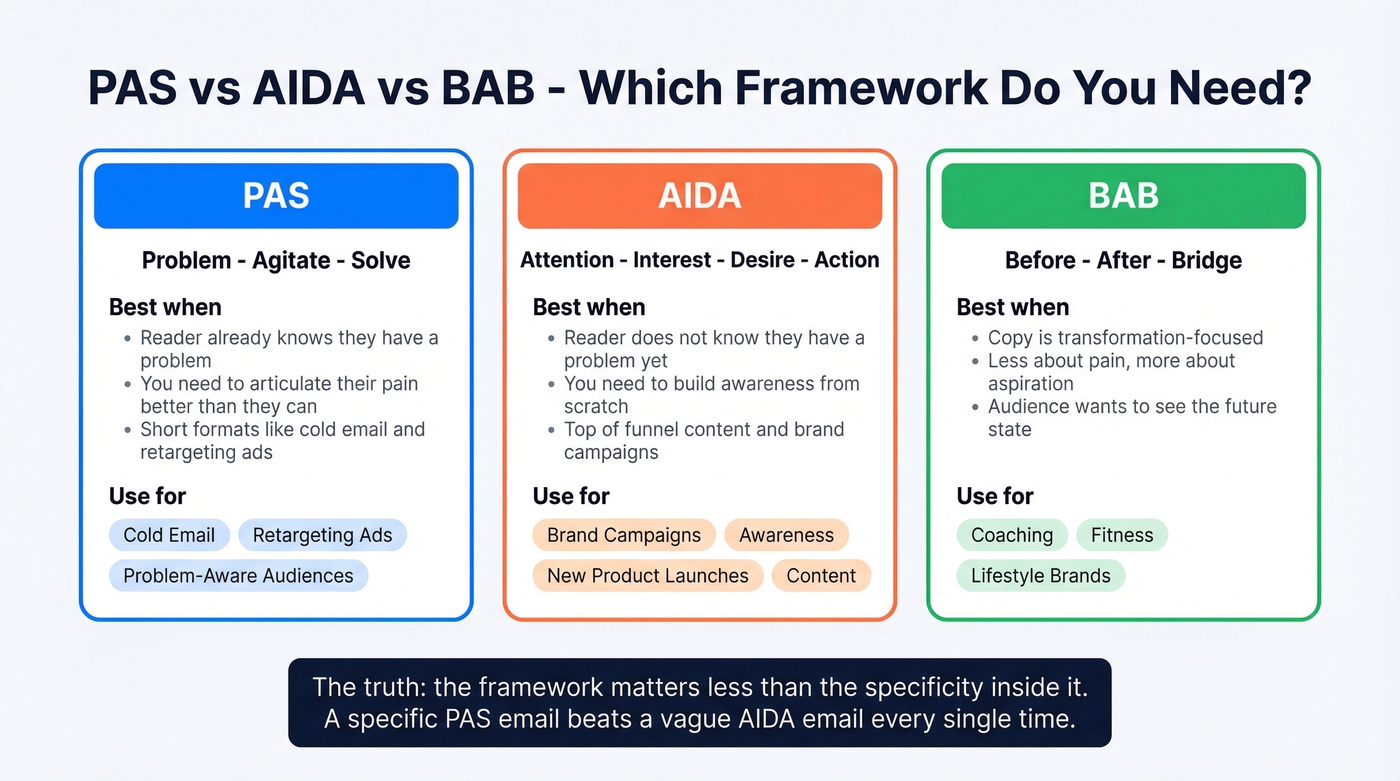
Use PAS when you're meeting the reader at a known pain point. They already know they have a problem - you just need to articulate it better than they can, then offer the fix. Cold emails, retargeting ads, problem-aware audiences.
Use AIDA when you need to build awareness first. The reader doesn't know they have a problem yet, or doesn't know your category exists. Top-of-funnel content, brand campaigns, new product launches.
Consider BAB (Before-After-Bridge) for transformation-focused copy - less about pain, more about aspiration. Fitness, coaching, lifestyle brands.
The framework matters less than the specificity inside it. A specific PAS email will outperform a vague AIDA email every time. Pick the structure that fits your audience's awareness level, then make every word concrete.
Five Mistakes That Kill Your Copy
1. Over-agitating. The Reddit advice is blunt: "don't overdo the drama." If your agitation reads like a horror movie trailer, you've lost the reader's trust. Empathy and urgency, not fear-mongering. One sentence of agitation is often enough.
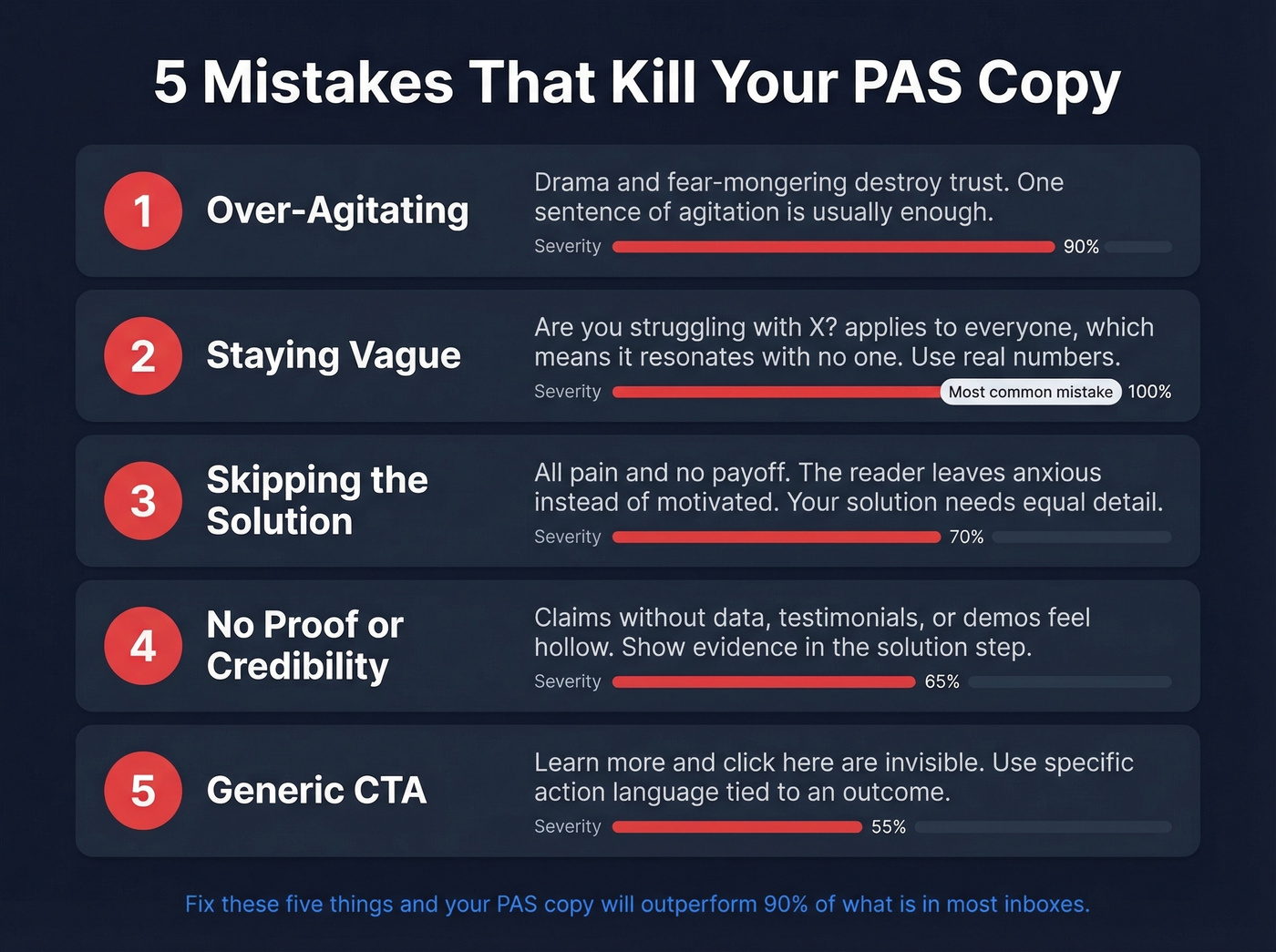
2. Staying vague. "Are you struggling with X?" is the hallmark of lazy copywriting. It reads like spam because it is spam - it applies to anyone, which means it resonates with no one. Use specific numbers, names, and consequences. We've reviewed hundreds of cold emails, and this is by far the most common failure mode.
3. Skipping the solution. All pain, no payoff. The reader leaves feeling anxious instead of motivated. Your solution step needs to be at least as detailed as your agitation - ideally more so.
4. Writing to the wrong audience. No framework saves copy aimed at people who don't have the problem. As Crazy Egg's framework guide puts it, audience targeting is a prerequisite, not an afterthought. If your list is wrong, your copy is irrelevant - no matter how sharp the writing.

5. Ignoring data quality. Here's the thing: the best cold email in the world fails if it hits a dead inbox. Half your list bouncing means your deliverability and domain reputation tank before anyone reads your brilliant agitation. Verify before you send. A 35% bounce rate is a self-inflicted wound, and it's the easiest one to prevent.
Step 3 of PAS says your solution needs proof. Here's ours: 98% email accuracy, 143M+ verified addresses, and teams booking 35% more meetings than Apollo users. Your cold email template deserves a list that converts.
Stop sending great copy to dead addresses.
FAQ
Is the PAS formula manipulative?
No - ethical PAS describes real problems your reader actually experiences. If your agitation reflects something that genuinely happens to them, that's empathy, not manipulation. The line is simple: are you describing reality or distorting it? Inventing fears to pressure a sale is an ethics problem, not a framework problem.
Can PAS work for long-form content?
Yes. PAS scales by adding depth to each step - more data in the problem, more specificity in the agitation, more proof in the solution. Variants like PASTOR explicitly add testimonials and offers for long-form sales pages. The framework doesn't limit word count; it organizes your argument.
What tools help send PAS cold emails?
Smartlead, Instantly, and Lemlist handle the sending. The bigger question is list quality - verify emails first so your copy actually reaches inboxes. Prospeo's 98% email accuracy and free tier of 75 credits/month make it easy to clean a list before you hit send.