

Persana AI Alternatives Worth Trying in 2026
Your enrichment table broke overnight. Again. The columns you built last week are returning blanks, a feature you relied on got quietly deprecated, and you've burned through credits trying to figure out what changed. If you're shopping for Persana AI alternatives because the platform feels unpredictable, you're not alone - we've heard the same story from dozens of teams this year.
We've tested most of these tools across real outbound campaigns. Here are seven options with real pricing, honest tradeoffs, and no filler.
Quick Picks
| Pick | Best For | Starting Price |
|---|---|---|
| Apollo.io | All-in-one prospecting + sequencing | Free, paid from $49/mo |
| Clay | GTM engineers building custom workflows | $185/mo (Launch) |
Your choice comes down to one question: is your problem data quality or workflow automation? Data quality - Prospeo. All-in-one - Apollo. Custom enrichment workflows - Clay.
Why Teams Switch
Persana AI carries a 4.6/5 on G2 across 40 reviews, and the praise for onboarding and support is genuine. But the switching triggers are consistent.
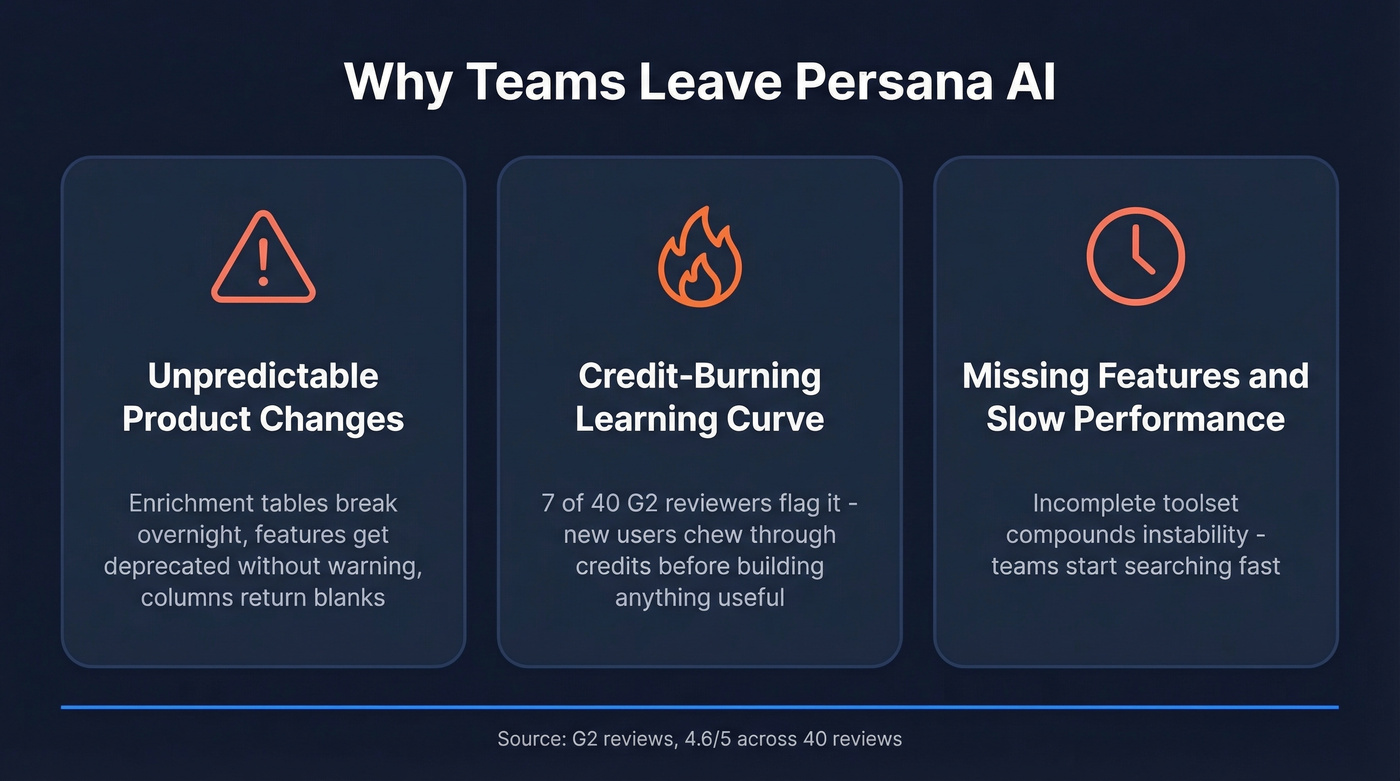
The biggest one: unpredictable product changes. One reviewer described enrichment lists feeling "like Excel with Smart Formulas" and noted that product changes sometimes aren't communicated cleanly - causing tables to stop working or features to be disabled without warning. That's not a minor annoyance when your pipeline depends on stable enrichment. Persana positions itself as a waterfall enrichment tool, but users don't always feel the execution matches the promise.
Second trigger: a credit-burning learning curve. Seven of 40 reviews flag it explicitly. New users chew through credits figuring out how the platform works before they've built anything useful.
Third is a cluster of missing features and slow performance that compounds the first two. When the tool is both unstable and incomplete, teams start searching fast.

Unpredictable enrichment and credit-burning learning curves shouldn't be the cost of doing outbound. Prospeo delivers 98% email accuracy, 30% mobile pickup rates, and a 7-day data refresh - at $0.01 per email with no contracts.
Stop debugging your enrichment tool and start booking meetings.
Pricing Comparison
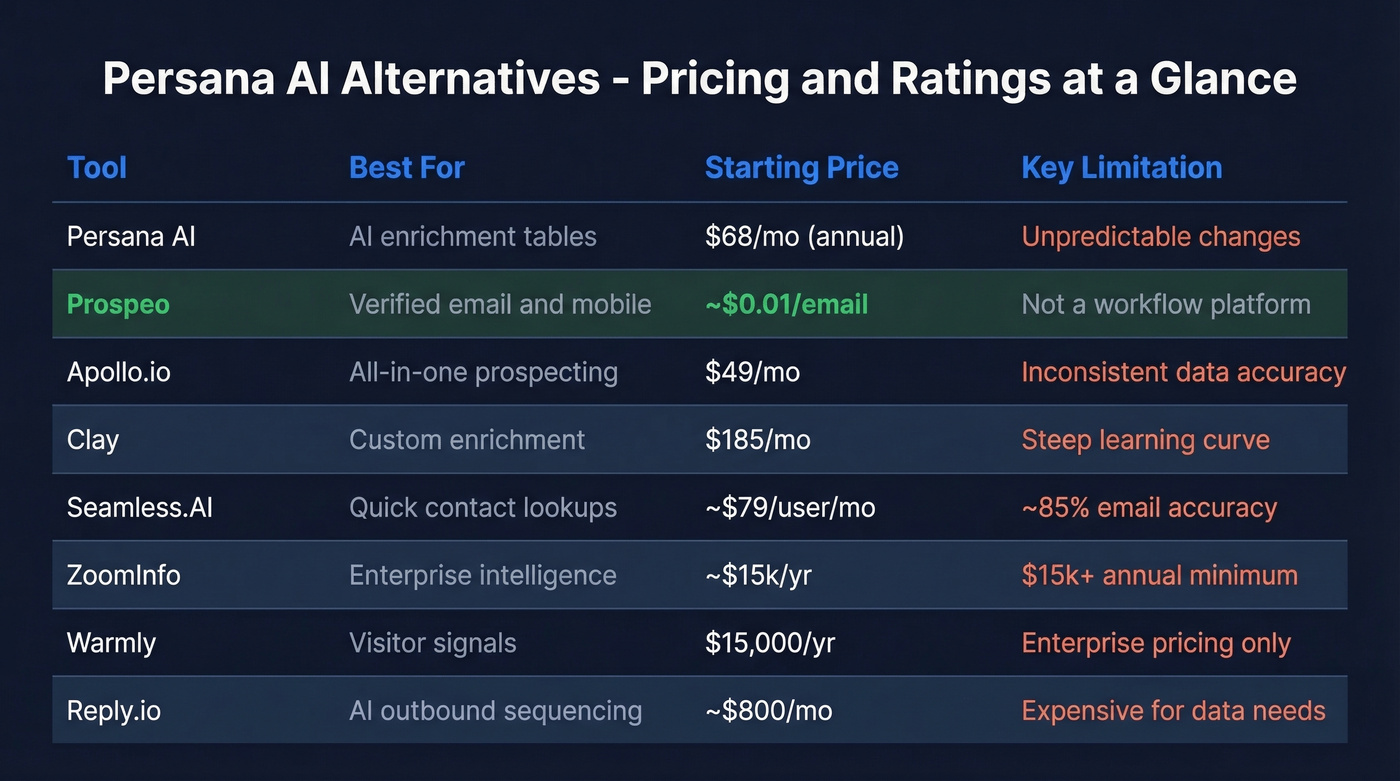
| Tool | Best For | Starting Price | G2 Rating | Key Limitation |
|---|---|---|---|---|
| Persana AI | AI enrichment tables | Free / $68/mo (annual) or $85/mo (monthly) | 4.6/5 (40) | Unpredictable changes |
| Prospeo | Verified email and mobile | Free / ~$0.01/email | - | Not a workflow platform |
| Apollo.io | All-in-one prospecting | Free / $49/mo | 4.7/5 (9,183) | Inconsistent data accuracy |
| Clay | Custom enrichment | $185/mo (Launch) | 4.7/5 (189) | Steep learning curve, credits burn fast |
| Seamless.AI | Quick contact lookups | Free / ~$79/user/mo | - | Opaque pricing, ~85% email accuracy |
| ZoomInfo | Enterprise intelligence | $0 (Lite) / ~$15k/yr | 4.5/5 (8,805) | $15k+ annual minimum |
| Warmly | Visitor signals | $15,000/yr | - | Enterprise pricing |
| Reply.io | AI outbound sequencing | ~$800/mo | - | Expensive for data needs |
Best Persana AI Alternatives
Prospeo
Prospeo is the cleanest pick when your real problem is deliverability: bounced emails, catch-all domains, and phone numbers that never connect. It's built around verified contact data and freshness, not "hope the enrichment sticks."
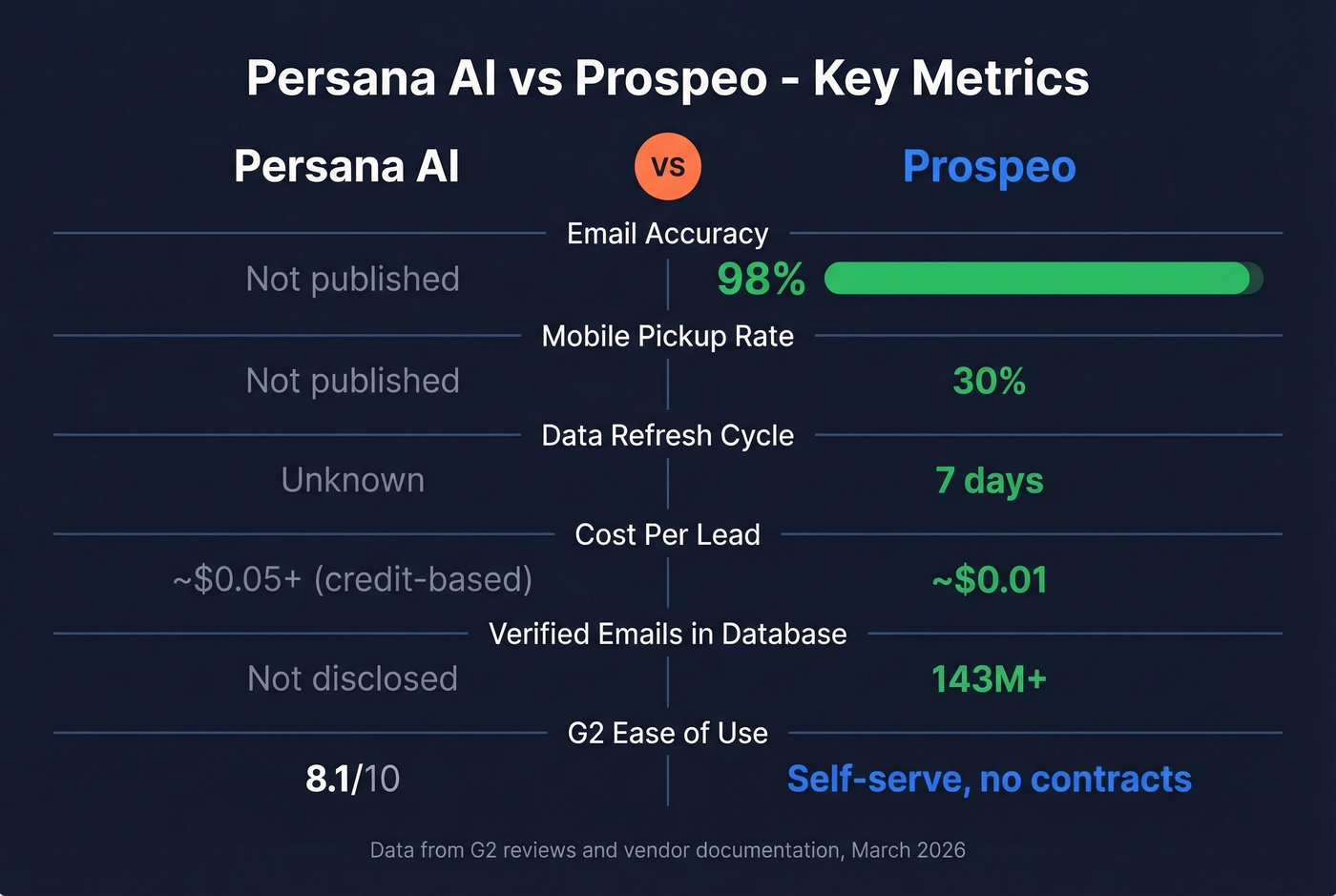
You get access to 300M+ professional profiles, 143M+ verified emails, and 125M+ verified mobile numbers - all refreshed on a 7-day cycle while most databases refresh every six weeks or so. On top of that: 30+ search filters including technographics, job changes, headcount growth, funding signals, and buyer intent across 15,000 topics powered by Bombora. The Chrome extension, used by 40,000+ people, pulls verified contacts from any website or CRM, and the enrichment API hits a 92% match rate while returning 50+ data points per contact.

If you're coming from a table-first workflow, the key difference is that Prospeo is optimized for accuracy and refresh cadence: 98% email accuracy, 30% mobile pickup rate, GDPR compliant, self-serve, no contracts. It's also 90% cheaper than ZoomInfo at roughly $0.01 per lead versus $1 per lead.
The results speak for themselves. Snyk rolled it out across 50 AEs and watched bounce rates drop from 35-40% to under 5%, generating 200+ new opportunities per month. Teams using Prospeo book 26% more meetings than those using ZoomInfo and 35% more than Apollo users.
Use it if: Your core problem is bounced emails and dead phone numbers, and you want self-serve pricing with weekly refreshes.
Skip it if: You need a full workflow automation platform with AI agents and native sequencing. Pair Prospeo with Clay or your existing sequencer instead.
Pricing: Free tier gives you 75 verified emails per month. Paid plans run ~$0.01 per email, 10 credits per mobile. Cancel anytime.
Apollo.io
Apollo is the obvious starting point for teams that want prospecting, sequencing, and a lightweight CRM in one platform. The free tier includes 50 AI credits and up to 2 sequences - enough to test whether the workflow fits before you spend anything.
Paid plans start at $49/mo (Basic, 1,000 email credits, 75 mobile credits), $79/mo (Professional), and $119/mo (Organization, minimum 3 seats). Credits don't roll over, so plan your usage carefully.
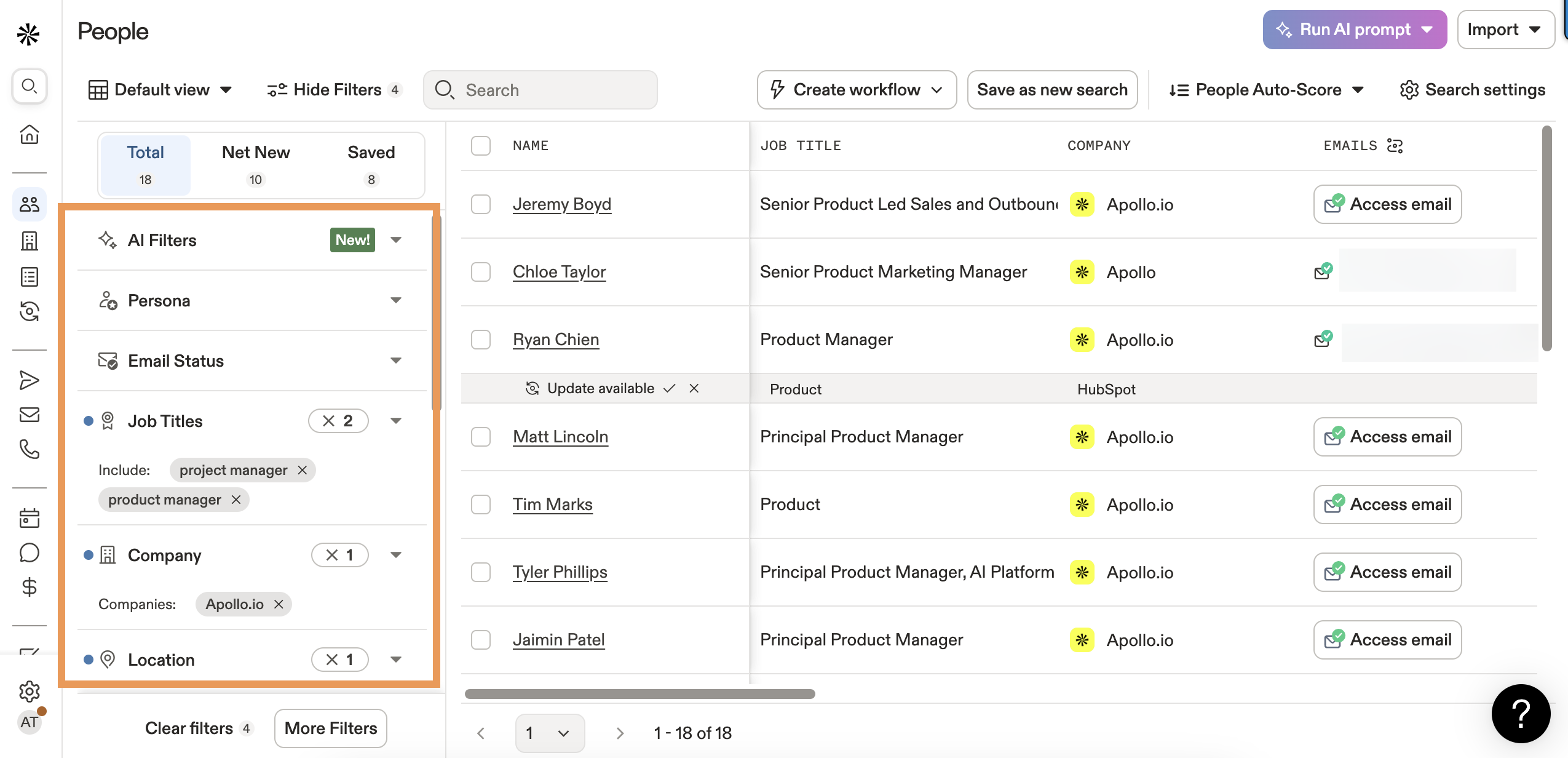
Here's the tradeoff: Apollo's data quality doesn't always match its feature breadth. One practitioner on r/coldemail reported getting roughly 200 usable leads per 1,000 scraped, with heavy duplicates. The "verified" label doesn't always mean what you'd expect. A 4.7/5 rating across 9,183 reviews isn't an accident - the platform genuinely does a lot - but if email accuracy is your top priority, run Apollo data through an external verification tool before you sequence it.
Use it if: You want an all-in-one platform with transparent pricing and a real free tier.
Skip it if: Deliverability is your number one concern. Apollo's breadth comes at the cost of depth on data quality.
Clay
Clay overhauled its pricing in March 2026, and the new structure is worth understanding. The Launch plan runs $185/mo with 2,500 Data Credits plus 15,000 Actions. Growth is $495/mo with 6,000 Data Credits plus 40,000 Actions - down from the old Pro plan at $800/mo.
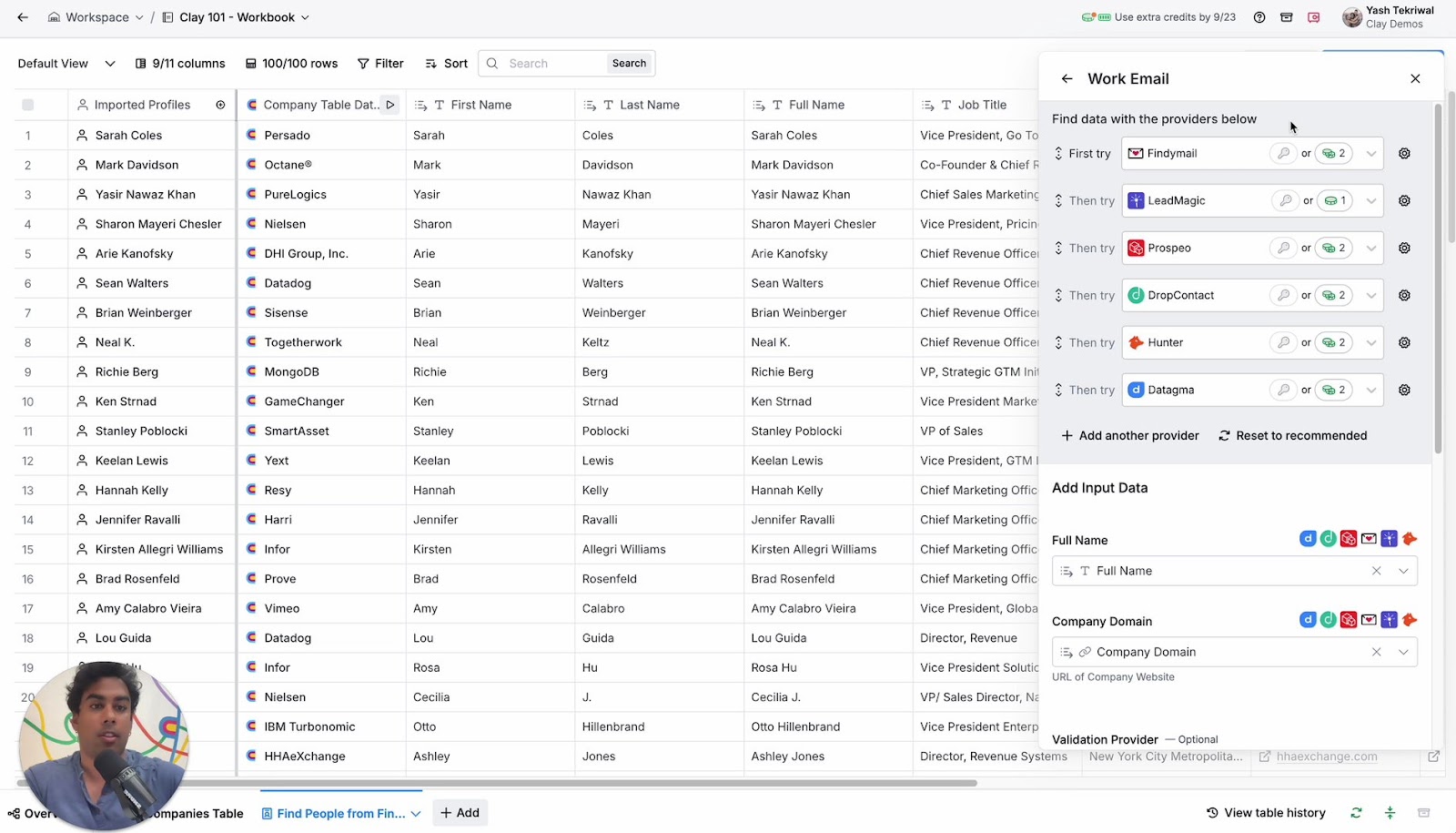
The dual-currency model splits usage into Data Credits for enrichment from 150+ providers and Actions for platform operations like AI calls, CRM pushes, and exports. If an enrichment returns no result, you aren't charged. That's a meaningful improvement over the old system.
But Clay's power comes with real cost risk. One user burned through $700 in two weeks on inaccurate enrichments. Persana actually scores higher on ease of use on G2 (8.1 vs 7.8), which tells you something about Clay's complexity ceiling. Let's be honest: if you're an SDR who just needs emails, Clay's flexibility is wasted on you. It's a power tool for GTM engineers who want maximum control across 150+ data sources with custom waterfall logic.
Use it if: You're building complex, multi-source enrichment workflows and you have the technical chops to manage them.
Skip it if: You just need contact data. The learning curve and credit risk aren't worth it for simple lookups.
Seamless.AI
Seamless has a large contact database and quick lookup speed, plus a free tier with 50 credits to test before committing. That's the good news.
The bad news: pricing isn't published. You have to talk to sales. Reddit users peg Pro at ~$79/user/mo for 1,000 credits, Enterprise at ~$149/user/mo with a 5-user minimum ($745/mo floor). Extra credits run $49 per 500. User-reported accuracy sits around 85% for email and 60% for phone. At those prices, that's a hard sell. Skip this one unless you've already tried the free tier and the data quality surprised you.
ZoomInfo
ZoomInfo still has the largest database in the space: 500M+ contacts, 200M+ verified emails, and 120M+ direct dials. The enterprise-grade intent data and workflow tools are unmatched by smaller players.
But annual contracts are the norm. Professional runs ~$15k-$18k/year, Advanced ~$22k-$28k/year, Elite ~$35k-$45k+/year. Renewals creep up 10-20%. The $0 ZoomInfo Lite plan exists with 10 credits per month, but it's a teaser, not a tool. Real usage means real budget.
Here's the thing: ZoomInfo is still the best all-in-one enterprise platform. But if your average deal size is closer to mid-market or your sales team is under ~50 reps, you're paying for modules you'll never activate. Most teams switching from Persana don't need ZoomInfo-level infrastructure - they need accurate data at a price that doesn't require CFO approval. ZoomInfo's pricing page confirms the Lite tier, but everything above it requires a sales conversation.
Warmly
Warmly is a website visitor de-anonymization and signal orchestration platform - not a contact database. Pricing starts at $15,000/year for TAM Orchestrate and $30,000/year for INBOUND Capture. It's enterprise-priced and solves a fundamentally different problem than Persana AI. Only relevant if your bottleneck is identifying anonymous website visitors, not sourcing contact data.
Reply.io
Reply.io's Jason AI SDR product starts around $800/mo and focuses on AI-powered outbound sequencing. It's a strong tool if your bottleneck is outreach execution rather than data sourcing. But at that price point for what's primarily a sequencer, most teams are better served by Apollo's built-in sequences or pairing a dedicated data tool with a sequencer like Instantly or Lemlist.
Snyk's 50 AEs dropped bounce rates from 35-40% to under 5% and generated 200+ new opportunities per month after switching. Teams on Prospeo book 35% more meetings than Apollo users - with data that actually connects.
Replace broken enrichment with 143M+ verified emails that land.
How to Choose
You don't need ten options. You need to answer one question: is your problem data quality, workflow automation, or signal intelligence?
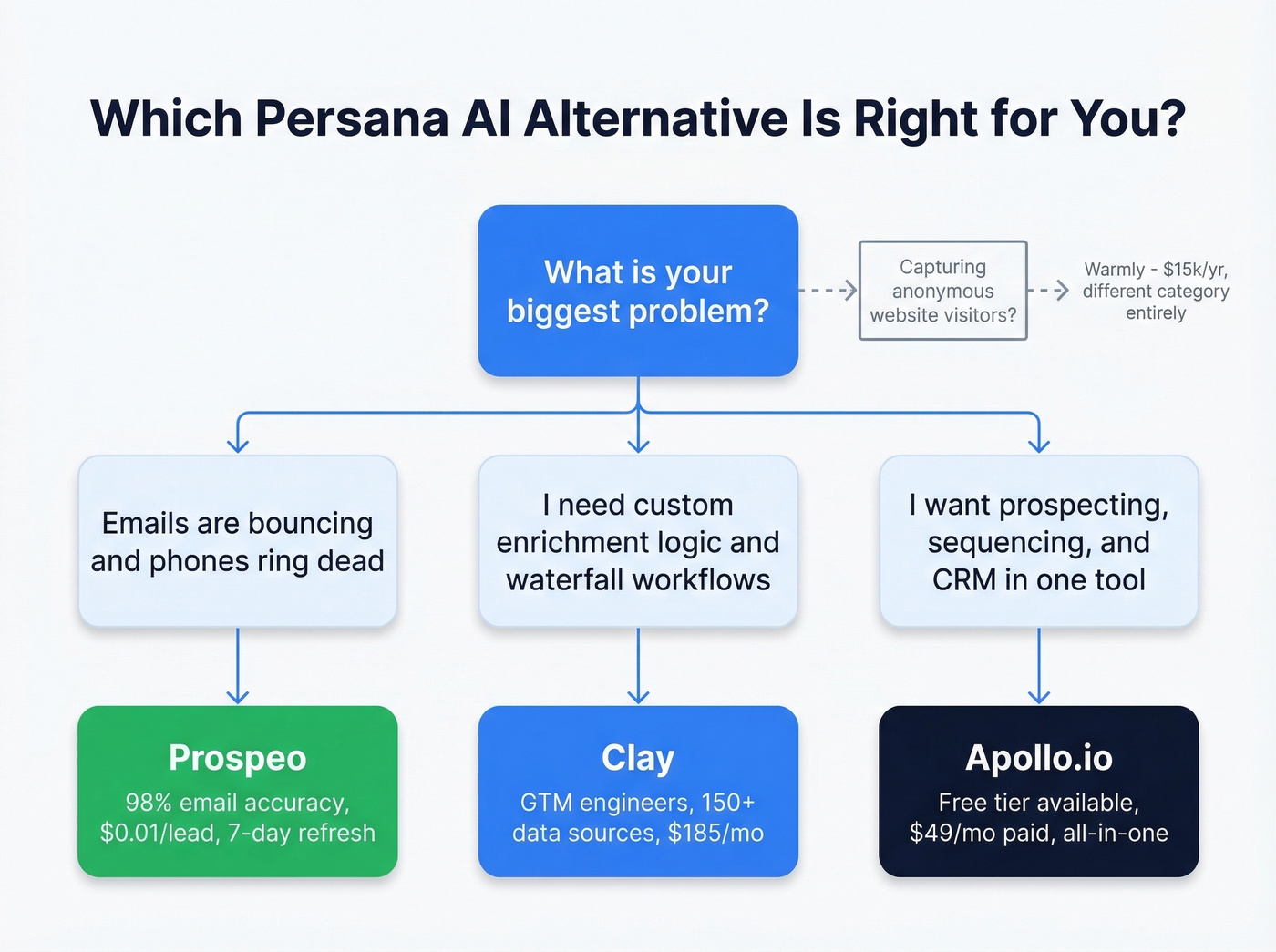
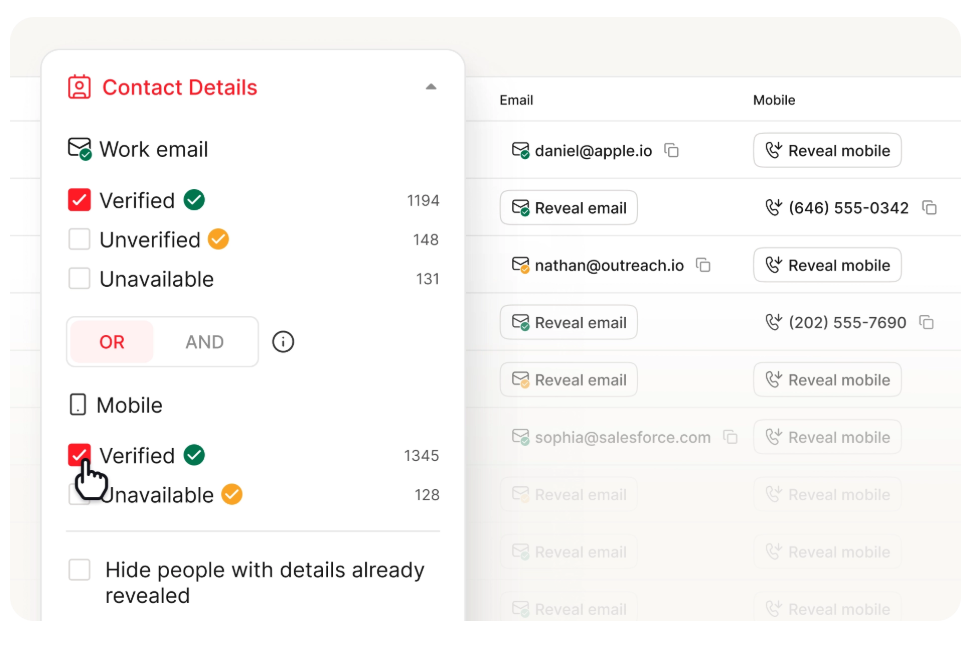
If emails are bouncing and phones are ringing dead, your problem is data quality. Prospeo solves that with the highest accuracy numbers in this list. Apollo bundles more features but trades off on data precision.
For teams that need custom enrichment logic, waterfall providers, and AI-driven workflows, the problem is automation - Clay lives there. And if you're trying to capture anonymous website traffic, that's signal intelligence, which is Warmly's territory and a completely different budget conversation.
In our experience, the best approach for most teams is a two-week test with one tool from each category you care about. That's enough time to see real deliverability numbers and decide what actually moves your pipeline. Don't overthink it - pick one, send 500 emails, and let the bounce rate tell you the answer.
FAQ
Is Persana AI worth it in 2026?
It can be - if you're actively using the agent and enrichment-table workflow and you can tolerate occasional product shifts. If you mainly need contact data, it's usually not the best value. Users rate it 4.6/5, but reviews repeatedly call out the learning curve and instability that can break day-to-day prospecting.
Can I use multiple tools together?
Absolutely - most teams get the best results with a simple two-step stack. Build lists in Clay or Apollo, then verify and enrich contacts through a dedicated accuracy tool before sending. This protects your domain reputation. As a rule of thumb, if your bounce rate is above ~5%, add a verification step immediately and re-check your list criteria.
Summary
If you're evaluating Persana AI alternatives because tables feel fragile or credits disappear during setup, start by deciding what you're really buying: accurate contact data, workflow automation, or signal intelligence. For accuracy and freshness, Prospeo is the fastest win. For bundled prospecting and sequencing, Apollo is the default. For custom workflows, Clay is the power tool.