


Piper AI Pricing, Reviews, Pros & Cons (2026)
Several different products share the name "Piper," and most have nothing to do with sales automation. This article covers the conversation intelligence and revenue automation platform - what it costs, what users think, and whether it's worth your time before you commit.
Quick verdict: Piper AI looks promising for mid-market teams wanting Gong-level call intelligence at a lower price. But with only 3 G2 reviews, zero Capterra reviews, and no public pricing, you're buying on faith. Request a pilot, talk to references, and don't sign a multi-year deal.
Which Piper Are We Talking About?
| Product | What It Does | Starting Price |
|---|---|---|
| Piper AI | Conversation intelligence + CRM automation | ~$1,200-$3,000/user/yr (est.) |
| Qualified's "Piper" | AI SDR agent for inbound website chat | ~$42K-$68K/yr |
| Chili Piper | Scheduling + lead routing | $30/user/mo + platform fee |
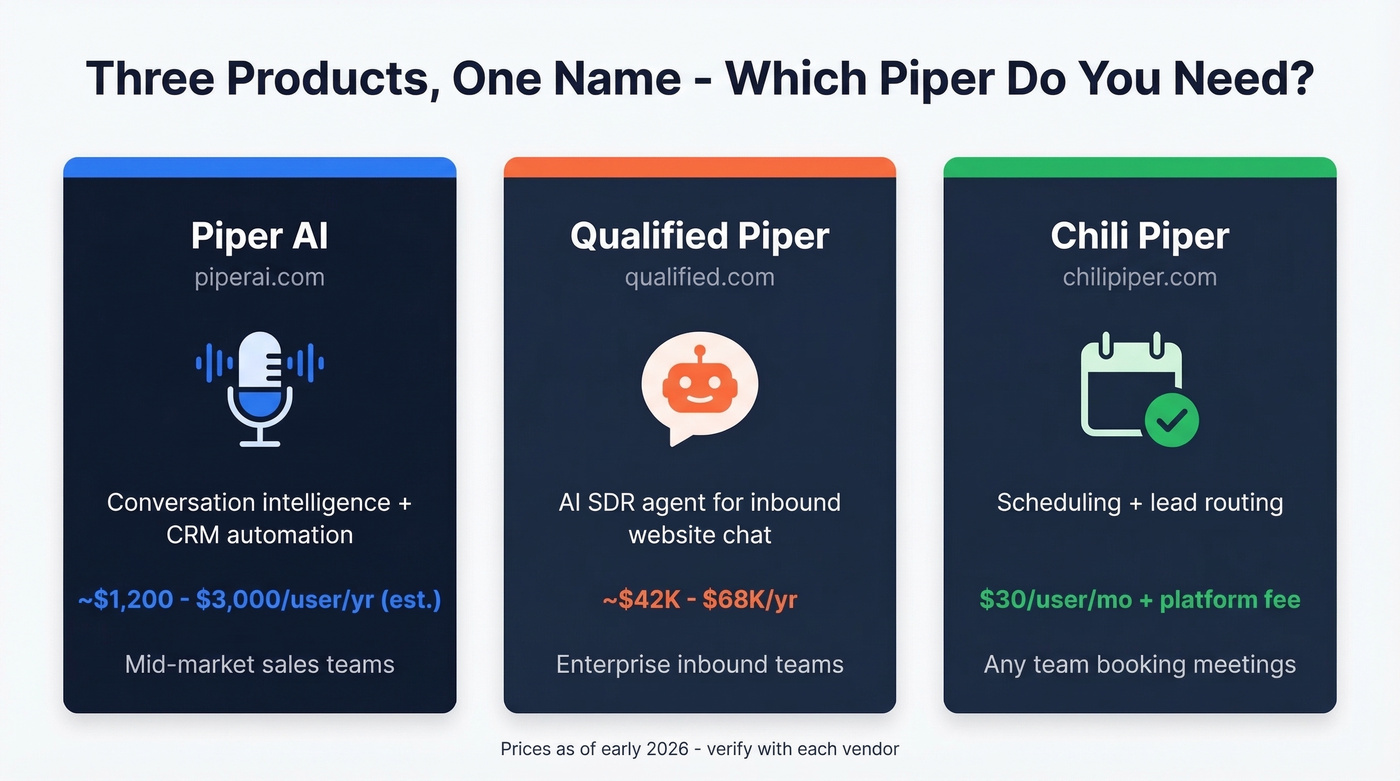
JoinPiper (telehealth) and Piper Aircraft have nothing to do with any of these. If you're here for the revenue intelligence tool, keep reading.
What Is Piper AI?
Piper AI is an omnichannel sales automation platform that captures interactions across calls, emails, and chat, then syncs everything to your CRM in real time. Think of it as a lighter-weight Gong alternative built to kill rep admin work.
Here's what it actually does:
- Automated call recording and transcription
- Real-time CRM updates - notes, stages, custom fields, tasks
- AI-generated summaries and follow-up drafts
- Deal scoring against MEDDIC and BANT frameworks
- Pre-meeting briefings pulled from historical interactions
The platform carries ISO 27001, SOC 2 Type II, and GDPR compliance, which is a strong posture for European teams especially. Setup is positioned as plug-and-play in under an hour, with integrations for HubSpot, Zoom, Microsoft Teams, Slack, and Zapier.
Piper AI Pricing in 2026
Piper AI doesn't publish pricing. No free trial either. You'll need to book a demo and negotiate.
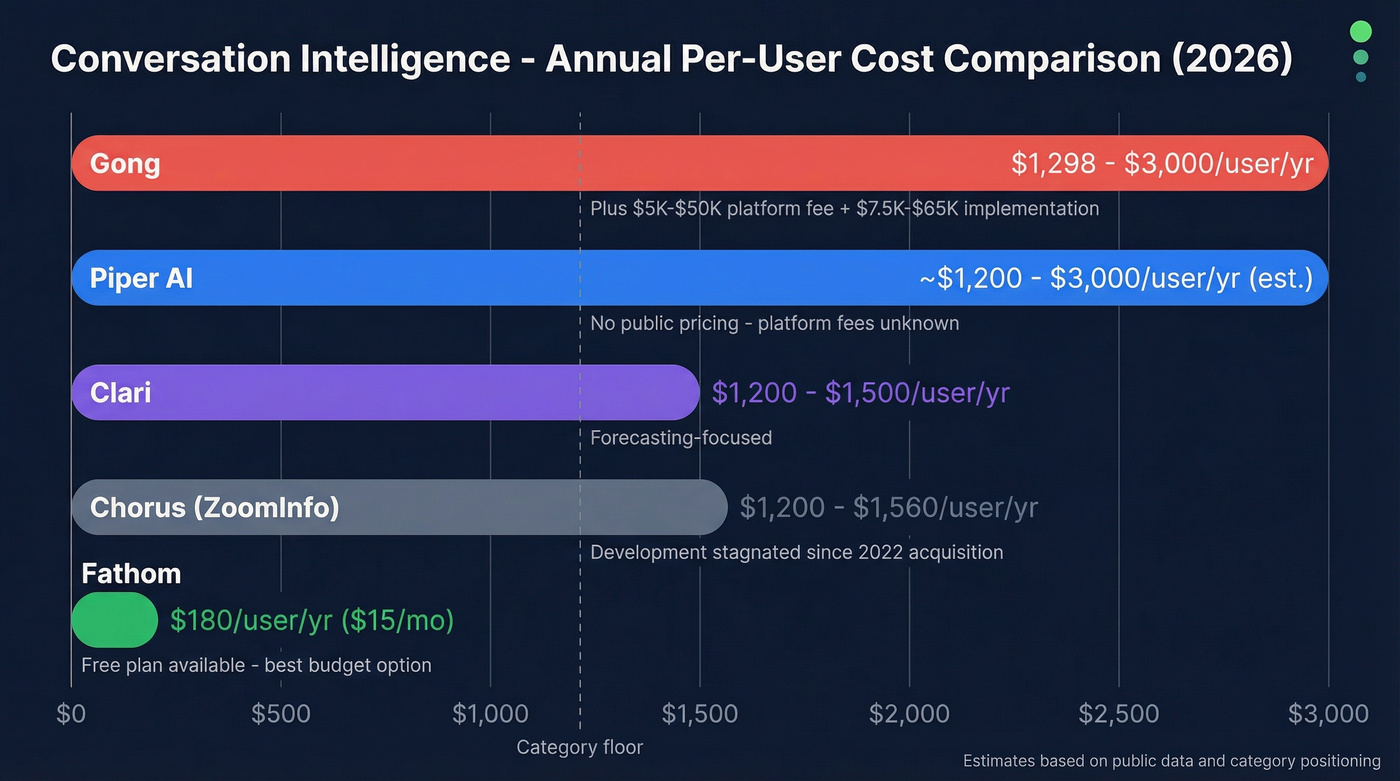
Based on category positioning, expect $1,200-$3,000/user/year. For a 20-person team, that's roughly $24K-$60K/year - a wide range, but that's what happens when vendors hide the number. We've seen this pattern across dozens of conversation intelligence tools, and it almost always means pricing flexes based on team size and contract length.
| Tool | Per-User Cost | Platform/Other Fees | Notes |
|---|---|---|---|
| Piper AI | ~$1,200-$3,000/yr (est.) | Unknown | No public pricing |
| Gong | $1,298-$3,000/yr | $5K-$50K platform + $7.5K-$65K implementation | 50-user Y1: $105K-$180K |
| Chorus (ZoomInfo) | $1,200-$1,560/yr | Not public | Development has stagnated since ZoomInfo's 2022 acquisition |
| Clari | $1,200-$1,500/yr | Not public | Forecasting-focused |
| Fathom | $15/user/mo ($180/yr) | None | Free plan available |
If budget is the primary driver and you don't need deal scoring or MEDDIC analysis, Fathom at $15/user/month is the obvious pick. But if you want the full revenue intelligence stack without Gong's first-year sticker shock, Piper AI is worth a demo.
One thing to watch: Reddit results for "Piper" are dominated by Chili Piper scheduling threads or generic AI SDR discussions, so make sure you're evaluating the right product. A scheduling-tool thread includes a concrete spend complaint - a user said they pay >$7,000/year for a routing/scheduling tool that "barely works."

Piper AI can't analyze conversations that never happen. Before investing $1,200-$3,000/user/year in call intelligence, make sure reps are actually reaching the right people. Prospeo delivers 98% email accuracy and 125M+ verified mobiles on a 7-day refresh cycle - so every call your AI records is a real conversation with a real buyer.
Fix the data upstream. Start free with 75 verified emails/month.
Pros and Cons
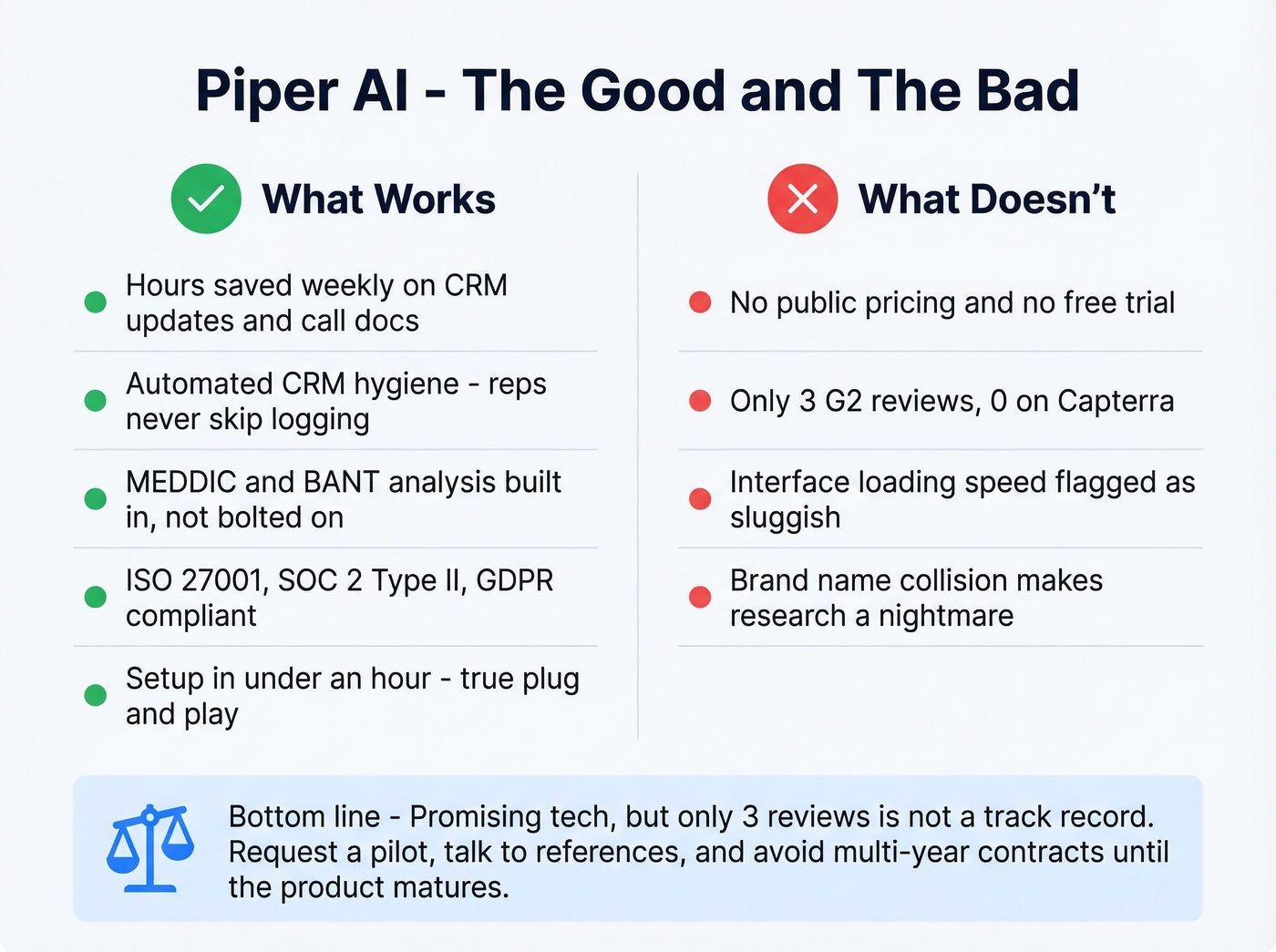
Pros:
- G2 reviewers report hours saved weekly on CRM updates and call documentation
- Automated CRM hygiene eliminates the "reps don't log activities" problem
- MEDDIC/BANT call analysis baked in, not bolted on
- Strong compliance posture (ISO 27001, SOC 2 Type II, GDPR)
- Fast implementation - under an hour for setup
Cons:
- No public pricing and no free trial, so you can't test without a sales conversation
- Only 3 G2 reviews and 0 on Capterra - not enough social proof for a confident buying decision
- Interface loading speed flagged as sluggish by reviewers
- Brand name collision makes finding real information nearly impossible
What Users Actually Say
Piper AI holds a 4.8/5 on G2, but that's based on exactly three reviews. All from Europe-based companies, mostly mid-market teams.
The praise is consistent: automated call capture and CRM updates that "save hours every week," with summaries described as "remarkably accurate." The only recurring complaint? The interface "could load slightly faster." Minor on its own, but it stands out when it appears in a three-review sample.
Capterra has zero reviews. We couldn't find any high-signal Reddit discussion specifically about Piper AI's conversation intelligence product either - the brand name collision buries everything under Chili Piper threads and generic "AI SDR" posts.
Is Piper AI Worth It?
The AI sales tools market hit $3B in 2025 and is growing at roughly 13% annually, so this category will only get more crowded. Sellers who effectively partner with AI are 3.7x more likely to meet quota, and with reps spending only 28-30% of their time actually selling, any tool that automates CRM busywork pays for itself quickly.
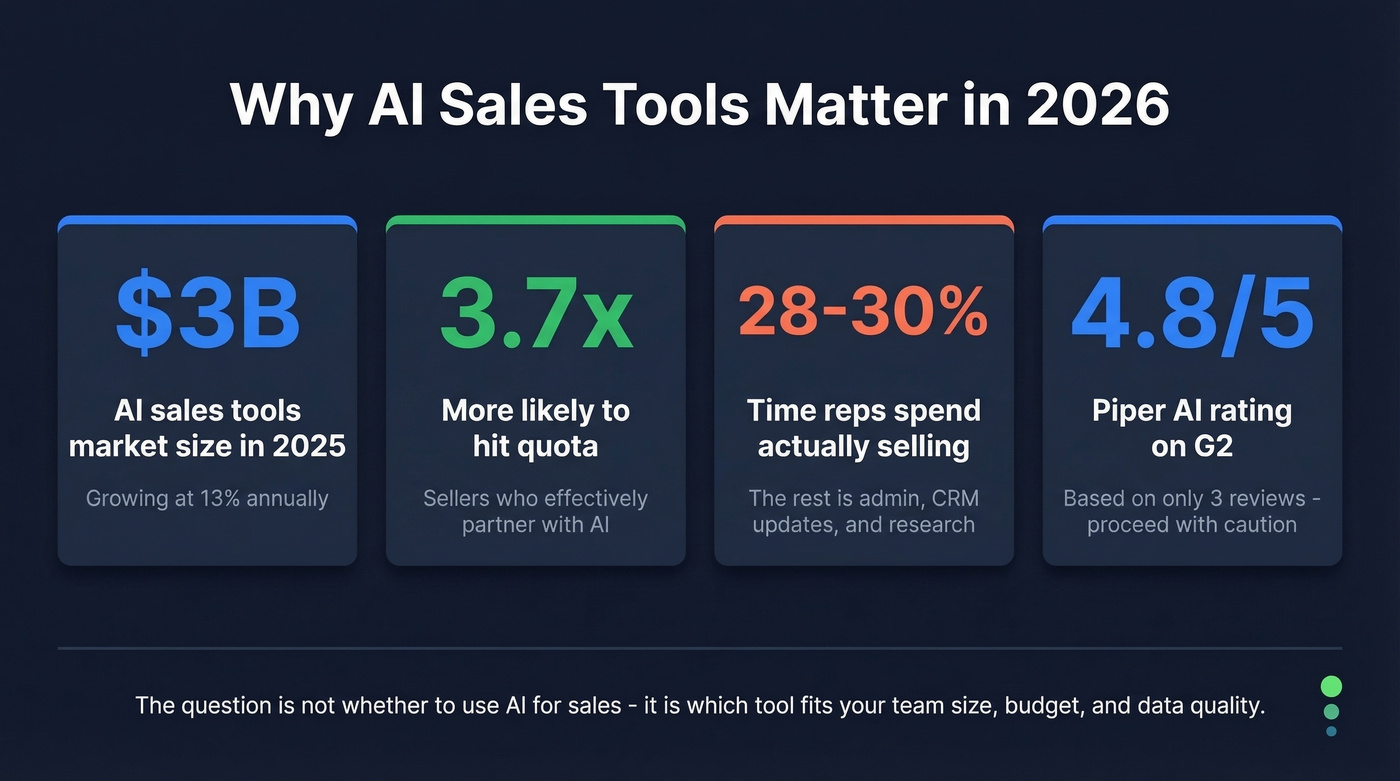
Here's the thing: Piper AI fits best for mid-market European teams that want Gong-level intelligence without Gong-level pricing. But three reviews isn't a track record - it's a starting point. If you need proven scale or transparent pricing, skip this for now and check back in six months.
For teams that don't need the full conversation intelligence stack but are drowning in bad CRM data, the problem is usually upstream. Reps call stale numbers, email dead addresses, and even the best AI summaries can't save a deal that never connects. We've seen this pattern repeatedly in our own outbound work - the intelligence layer only matters if the contact data feeding it is accurate and fresh.
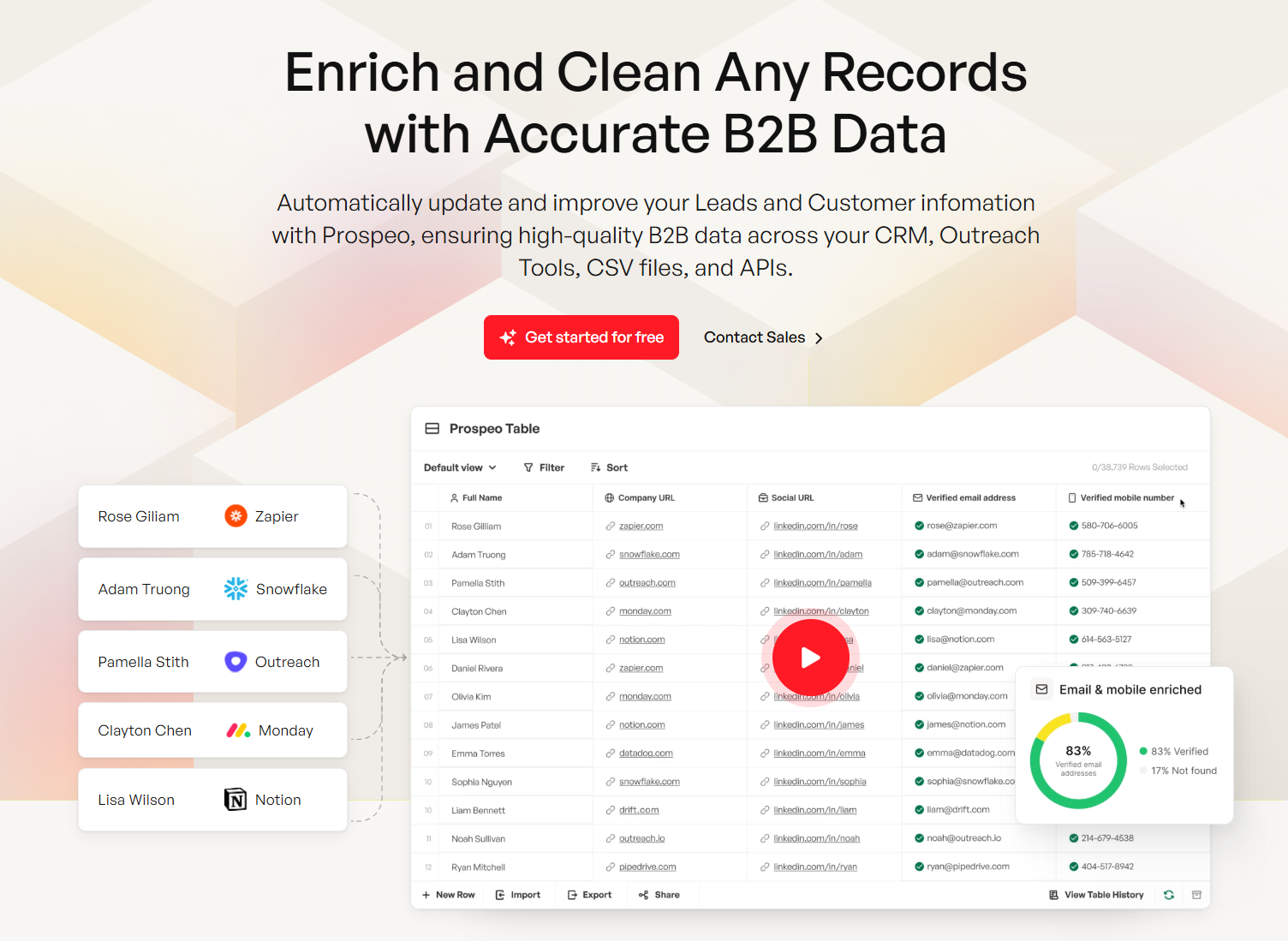
That's where a tool like Prospeo fits in. With 98% email accuracy, 125M+ verified mobiles, and a 7-day data refresh cycle, it keeps the upstream data clean so your conversation intelligence tools have real conversations to analyze. If you're also evaluating upstream options, compare data enrichment services and sales prospecting databases before you commit.
You're evaluating tools to eliminate rep busywork. Piper handles CRM logging - but what about the hours wasted dialing dead numbers and emailing invalid addresses? Prospeo's 300M+ profiles with 30% mobile pickup rate mean reps spend less time chasing ghosts and more time in the conversations your AI tools need to analyze.
Clean contact data at $0.01/email. No contracts, no sales calls required.
FAQ
Does Piper AI offer a free trial?
No. You'll need to book a demo and speak with sales to get access. That's standard for conversation intelligence tools in the $1K+/user range, though lighter alternatives like Fathom offer free plans for basic transcription and summaries.
Is Piper AI the same as Chili Piper?
Completely different products. Piper AI records calls, generates summaries, and syncs data to your CRM. Chili Piper is a scheduling and lead-routing tool at $30/user/month. They share a name and nothing else.
How does Piper AI compare to Gong on price?
Gong's first-year cost for a 50-person team runs $105K-$180K including platform fees and implementation. Piper AI's estimated range is $1,200-$3,000/user/year without disclosed platform fees - likely significantly cheaper at scale. Fathom at $15/user/month is the budget option if you only need transcription.
What's the best way to improve data quality alongside Piper AI?
Pair conversation intelligence with a verified data source so reps aren't wasting AI-analyzed calls on wrong numbers. Prospeo offers 98% email accuracy and 125M+ verified mobiles on a 7-day refresh cycle - starting free at 75 credits/month - while tools like ZoomInfo and Apollo provide broader but less frequently refreshed datasets.