


Ploomes CRM: Pricing, Reviews, Pros and Cons for 2026
You're evaluating a CRM that 3,000+ companies use - almost all of them in Brazil. That context matters more than any feature list. Ploomes is genuinely strong for Brazilian B2B sales teams with complex deal cycles and ERP dependencies, but it's not trying to be HubSpot or Salesforce for the rest of the world.
30-Second Verdict: Ploomes earns its 4.9 rating on Capterra across 418 reviews, but that user base is overwhelmingly Brazilian. Pricing is quote-based - expect $22-$50/user/month depending on modules. It's excellent for B2B companies needing TOTVS/Sankhya/Omie integration and automated proposal generation. Skip it if you're an international team, need deep analytics, or want a broad integration ecosystem outside Brazil.
Ploomes Pricing Breakdown
Nobody agrees on the number, including Ploomes themselves.
| Source | Plan Name | Listed Price | Notes |
|---|---|---|---|
| Capterra | Ploomes Lite | $22/user/mo | Single plan listed |
| GetApp | Starting price | $22/user/mo | Updated Mar 2026 |
| G2 | Ploomes Starter | R$225/mo (3 users) | ~$40/mo total |
| SelectHub | Starting price | $50/user/mo | Analyst estimate |
| Official site | Quote-based | Varies | Pay for what you need |
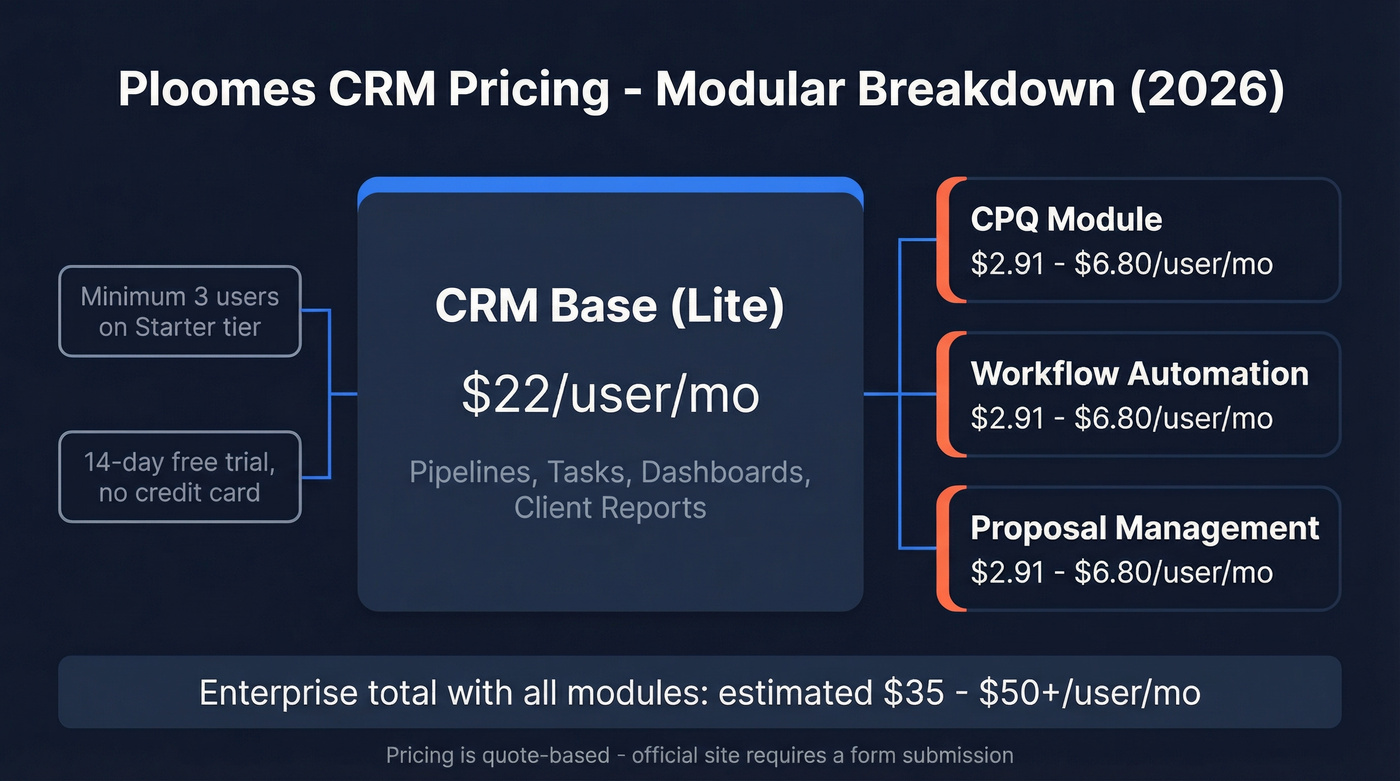
The $22/user/month figure from Capterra and GetApp reflects the base Lite tier - multiple sales funnels, task management, dashboards, client reports, and analytics. The $50 figure from SelectHub likely includes one or more add-on modules.
Ploomes is modular by design. You start with the CRM base and bolt on CPQ, Workflow Automation, or Proposal Management as needed. Additional modules run $2.91 to $6.80 per user per month based on Tekpon data, though enterprise configurations with multiple modules push total costs well above the base price. The official site doesn't publish a price list - you'll fill out a form and get a custom quote based on user count and selected modules.
Here's the thing: a CRM that won't tell you what it costs before a sales call is already losing trust with buyers who just want to compare options. Expect typical contract structures with monthly or annual billing and a 3-user minimum on the Starter tier.
One quick note on trials: SoftwareAdvice's comparison snippet claims Ploomes doesn't offer a free trial. Capterra and GetApp both confirm the 14-day trial exists, no credit card required. That's enough time to test the pipeline builder and see if the ERP integrations actually work for your stack.
Ratings and User Reviews
| Platform | Rating | Reviews | Notes |
|---|---|---|---|
| Capterra | 4.9/5 | 418 | Portuguese-dominant |
| G2 | 3.3/5 | 3 | Tiny sample size |
| SelectHub | 98% satisfaction | 366 | Blended sources |
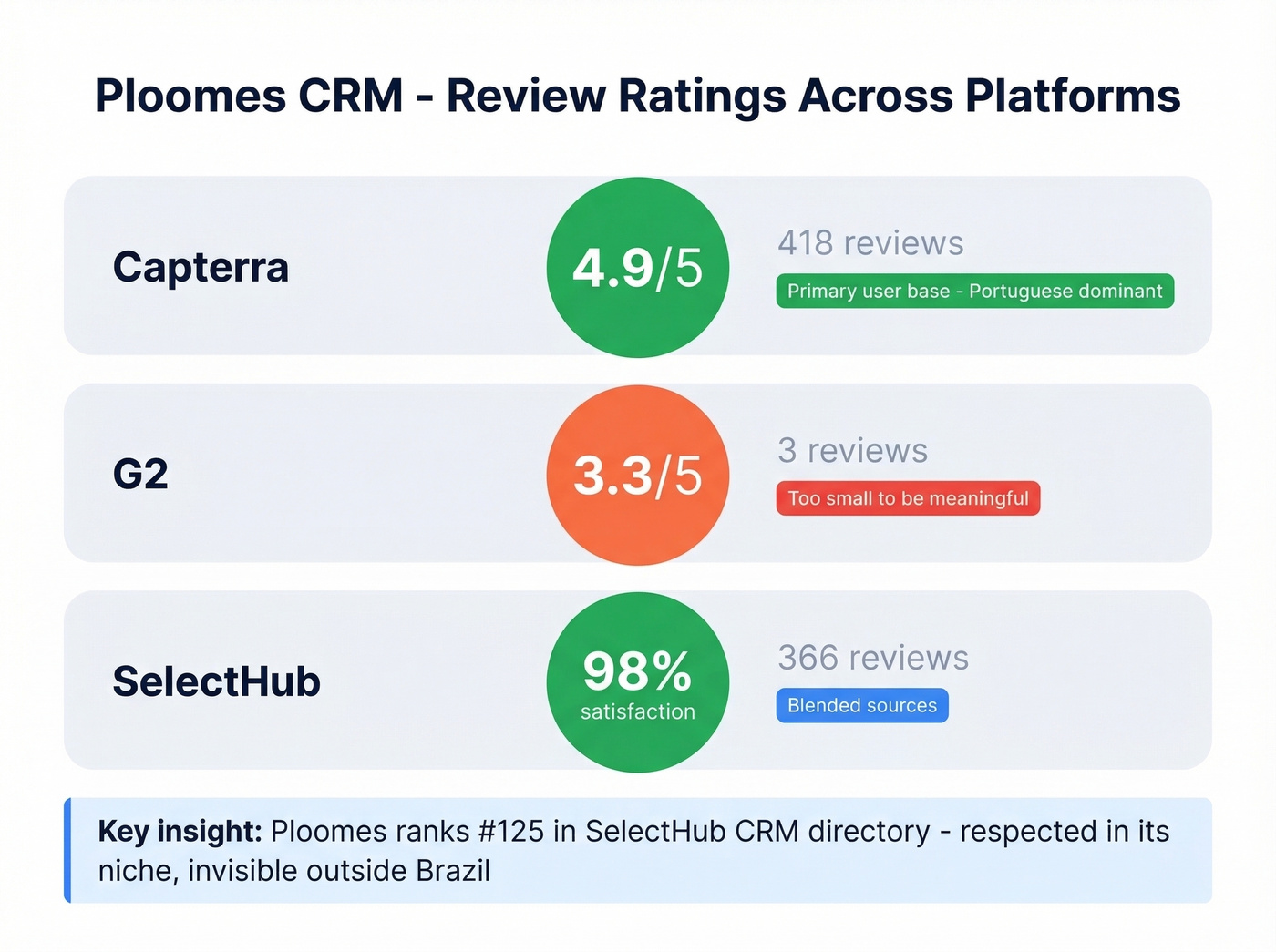
Don't read too much into G2's 3.3 rating. Three reviews isn't a sample - it's a rounding error. Ploomes' user base lives on Capterra's Portuguese-language platform, not G2's English-first ecosystem, and the 4.9 across 418 reviews is the meaningful signal. SelectHub ranks Ploomes #125 in their CRM directory, which gives you a sense of its niche positioning: respected within its market, invisible outside it.
Founded in 2013, Ploomes has had over a decade to refine its product for the Brazilian B2B vertical. We couldn't find much English-language community discussion, which lines up with where its user base actually lives.
What Users Love
In our analysis of 400+ Capterra reviews and the handful of G2 write-ups, a clear pattern emerges: reps actually use this CRM daily. That alone puts it ahead of half the CRM market. Both G2 reviewers and SelectHub's aggregated feedback highlight ease of use as the top strength.
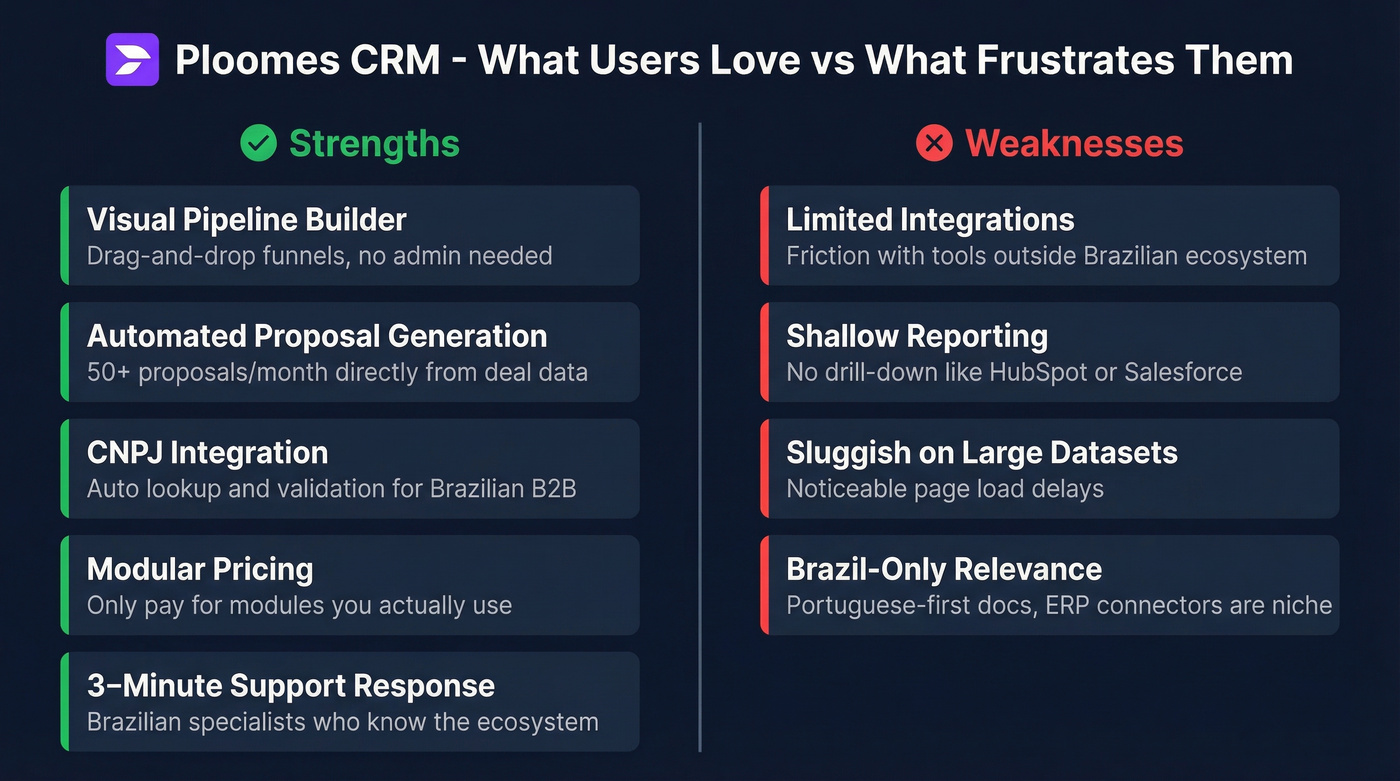
The visual pipeline builder stands out. One G2 enterprise reviewer called out "easy construction of flows and funnels" - drag-and-drop funnel management that doesn't require admin hand-holding. For teams sending 50+ proposals a month, the automated proposal generation alone justifies the subscription. You build proposals, orders, and contracts directly from deal data without toggling between tools.
Two Brazil-specific features deserve attention. First, CNPJ integration - automatic CNPJ lookup and validation is a massive time-saver for B2B sales in Brazil, and a G2 mid-market reviewer flagged this as a differentiator no international CRM matches. Second, the recently added AI assistant gives reps in-context suggestions without leaving the pipeline view.
The modular pricing structure means you're not paying for CPQ if you don't need CPQ. Support response times are genuinely fast - Ploomes reports a 3-minute average, staffed entirely by Brazilian specialists who understand the local ecosystem.

Ploomes handles your pipeline - but who fills it with verified contacts? Prospeo delivers 300M+ profiles with 98% email accuracy and 125M+ verified mobiles, refreshed every 7 days. It plugs into any CRM, so your reps spend time selling, not hunting for data.
Feed your CRM contacts that actually convert - starting at $0.01 per email.
What Users Complain About
Integration difficulties top the list. One G2 enterprise reviewer wrote about "difficulty of integration and very limited support" for non-standard connectors. If your stack is built around tools outside the Brazilian ecosystem, expect friction.
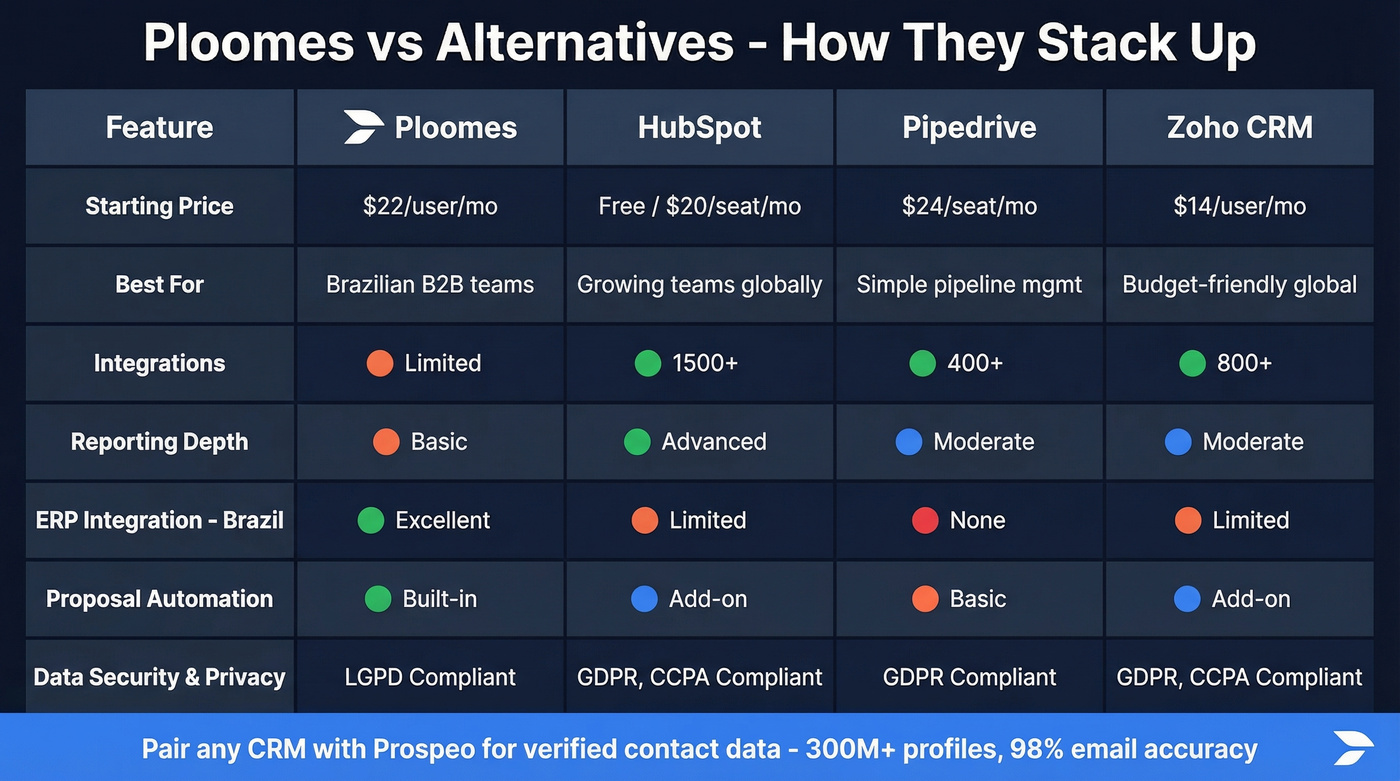
Reporting depth is the other recurring frustration. You can see pipeline metrics, but don't expect the drill-down capability of HubSpot or Salesforce reporting. Multiple sources flag shallow analytics and limited custom dashboards. For teams that live in reports, this is a dealbreaker - especially if you're benchmarking against Salesforce reporting expectations.
G2 reviews also mention sluggish page loads with larger datasets - not catastrophic, but noticeable. And the Brazil-centric ecosystem is simultaneously Ploomes' greatest strength and its hard boundary. ERP connectors for TOTVS, Sankhya, and Omie, Portuguese-first documentation, and CNPJ features are exactly what Brazilian teams need - and exactly what makes this tool irrelevant for everyone else.
Who Should Use Ploomes
This CRM fits a specific profile: Brazilian B2B companies running complex, multi-stage sales cycles with TOTVS, Sankhya, or Omie in their stack. If you're generating high volumes of proposals and need document automation baked into your CRM, Ploomes delivers. Your reps will adopt it without heavy training - especially if you already have a clear lead status process and defined sales activities.
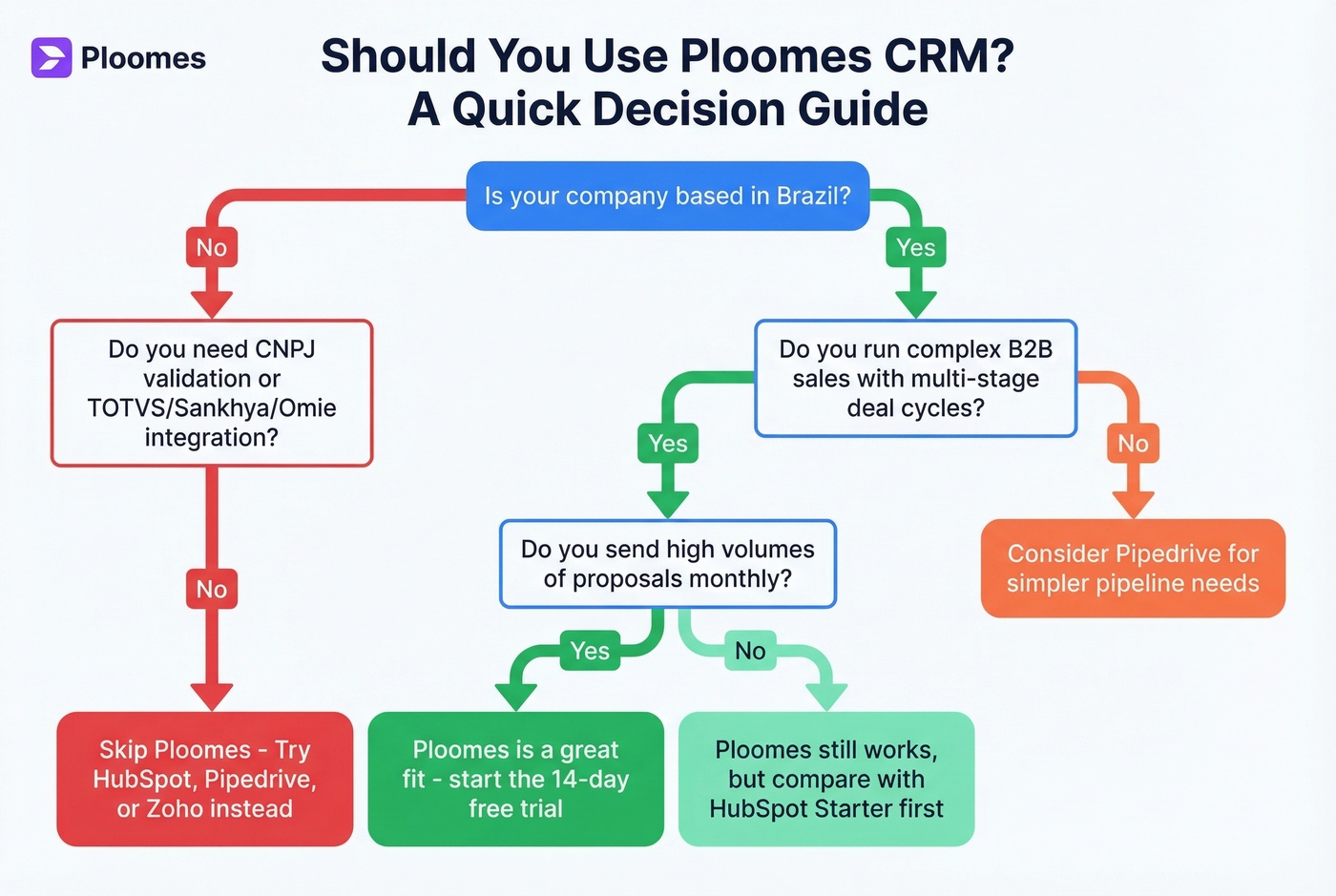
Let's be honest - if your company sells B2B in Brazil with deal sizes above R$10,000 and you're currently wrestling with Salesforce's complexity or HubSpot's localization gaps, Ploomes is the better choice. Full stop. But the moment your sales motion crosses borders, you'll outgrow it.
Skip Ploomes if you're an international team needing English-first documentation, deep reporting, or a tech stack built around Outreach, Salesloft, or other US/EU-centric platforms. English is listed as supported, but this is a Brazil-first product through and through.
Alternatives Worth Considering
| Tool | Starting Price | Best For |
|---|---|---|
| Prospeo | Free / ~$39/mo | Verified contact data for any CRM |
| HubSpot | Free / $20/seat/mo | All-around CRM for growing teams |
| Pipedrive | $24/seat/mo | Simple pipeline management |
| Zoho CRM | $14/user/mo | Budget-friendly, global reach |
Prospeo isn't a CRM - it's the data layer that makes any CRM actually work. With 300M+ professional profiles, 98% email accuracy, and 125M+ verified mobile numbers refreshed every 7 days, it solves the stale-data problem that plagues every pipeline. The Chrome extension lets reps verify contacts from any website before pushing them into Ploomes, HubSpot, or whatever CRM you choose. Native integrations with Salesforce, HubSpot, Instantly, and Lemlist mean enrichment runs on autopilot. If you're comparing vendors, start with a quick scan of the broader data enrichment services landscape. The free tier includes 75 email credits per month - enough to test the accuracy claims yourself.
HubSpot is the obvious CRM comparison. The free tier gets small teams started, and the $20/seat/month Starter plan covers most basics. HubSpot pulls ahead on reporting depth and integration breadth with 1,500+ apps, but it gets expensive fast once you add Marketing Hub or Sales Hub Pro. A SoftwareAdvice comparison shows HubSpot at 4.5/5 across 4,447 reviews versus Ploomes' 4.9 across 418 - both strong, different audiences entirely.
Pipedrive keeps things dead simple at $24/seat/month with a clean pipeline view and minimal setup time. Zoho CRM starts at $14/user/month and covers global markets with multi-language support and a massive integration library. For teams outside Brazil, either of these will give you more flexibility than Ploomes at a comparable price point - especially if you're still deciding between different examples of a CRM and what "good" looks like for your sales motion.

Shallow integrations and limited global reach are Ploomes' hard boundaries. Prospeo works everywhere - 30+ search filters, intent data across 15,000 topics, and native integrations with HubSpot, Salesforce, and every major outreach tool. No sales calls, no contracts.
Stop letting your CRM's data gaps kill deals. Start with 75 free emails.
FAQ
Does Ploomes offer a free plan?
No free plan exists. Ploomes offers a 14-day free trial with no credit card required. Paid plans start at $22/user/month for the Lite tier, with modular add-ons for CPQ, workflow automation, and advanced analytics increasing the total cost.
Is Ploomes worth it for non-Brazilian companies?
For most international teams, no. The ERP connectors for TOTVS, Sankhya, and Omie, CNPJ validation, and Portuguese-first support are its core differentiators. Without those needs, HubSpot or Pipedrive will serve you better at comparable prices with broader integrations.
How accurate is the data going into Ploomes?
Your CRM is only as good as the contacts inside it. We've seen teams cut bounce rates from 35% to under 4% by running contacts through Prospeo's verification before importing them into their CRM. Pairing a verification layer with any CRM - including Ploomes - eliminates bounces before they damage your sender reputation.
What are Ploomes' biggest drawbacks?
Limited reporting depth, sluggish performance on large datasets, and a narrow integration ecosystem outside Brazil. The lack of transparent public pricing also frustrates buyers who want to compare costs without scheduling a sales call.