

Power Almanac vs Apollo.io: Which One Do You Need in 2026?
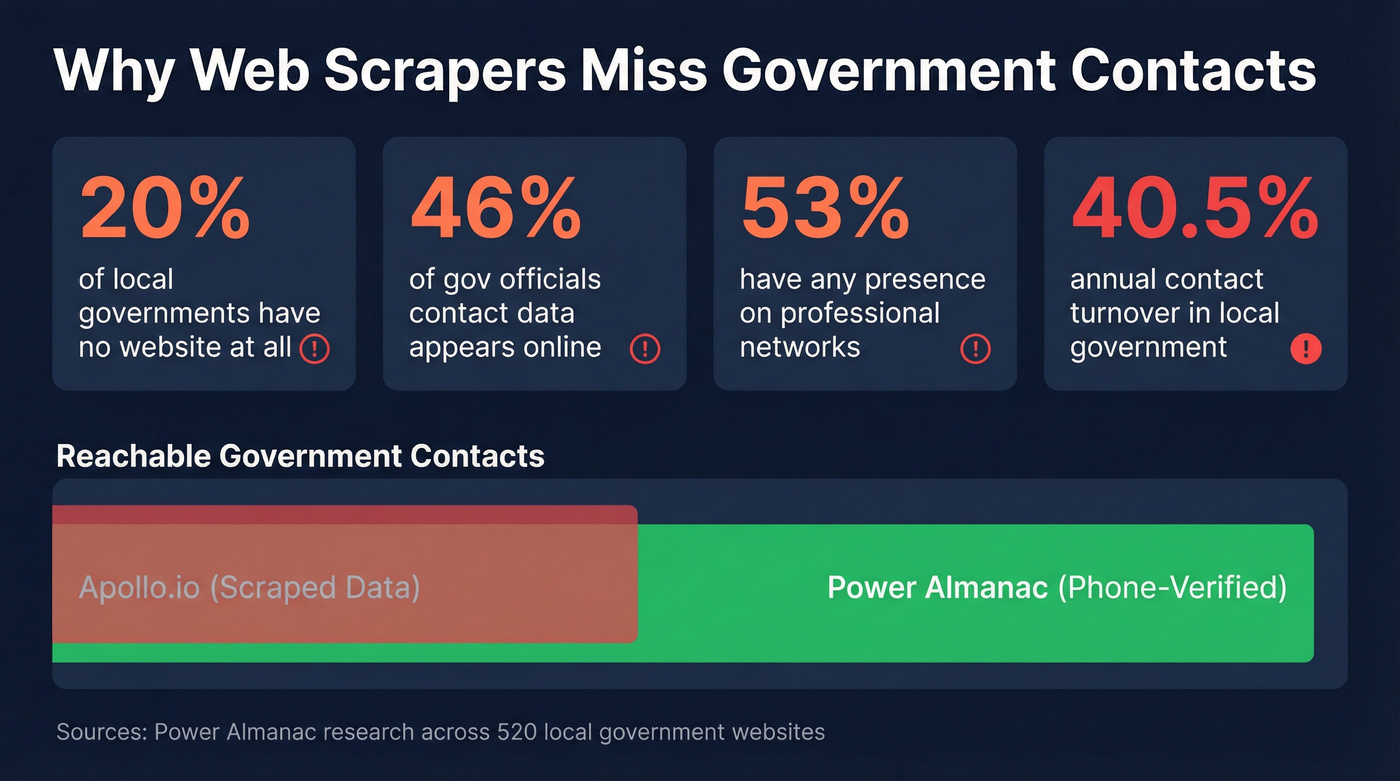
Power Almanac and Apollo.io get compared like they're rivals. They're not. This matchup only makes sense if you're selling into municipal buyers and wondering whether a general database can handle that job. One is a scalpel built for a single market - U.S. local government - and the other is a Swiss Army knife for broad B2B outreach. Here's the thing: the general database can't handle it. 20% of local governments don't even have a website, which means scrapers and crowdsourced data are structurally blind to a huge chunk of the market.
30-Second Verdict
Power Almanac wins if you sell to local government and need phone-verified municipal contacts with 97%+ accuracy.
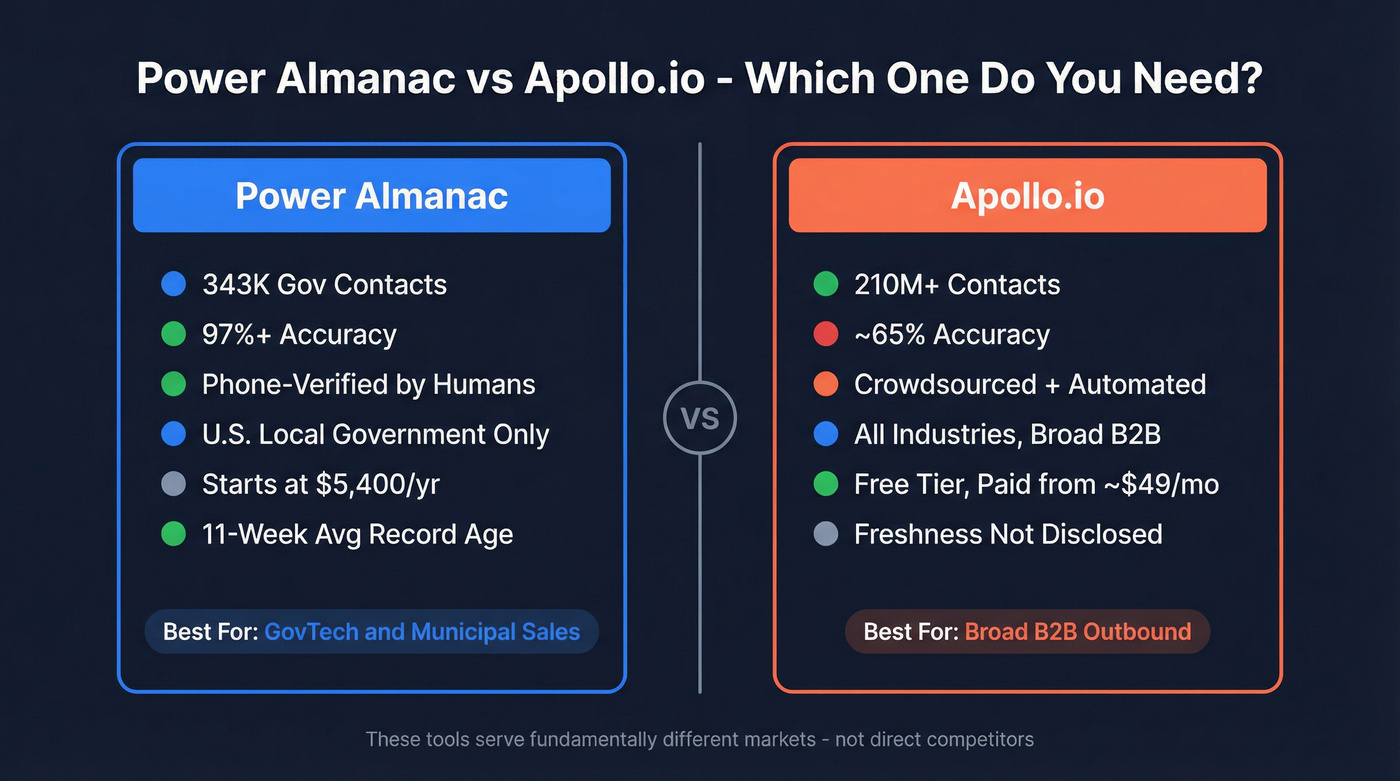
Apollo.io wins if you run broad B2B outreach across industries and want a built-in sequencer with a massive contact database.
What Is Power Almanac?
Power Almanac is a contact database laser-focused on U.S. local government decision-makers. It covers 22,000 local governments and roughly 343,000 records, organized by 22 decision-maker roles rather than job titles. That distinction matters because municipal titles are wildly inconsistent across jurisdictions - a "Director of Public Works" in one city is a "Superintendent of Infrastructure" in the next.
The real differentiator is verification. A 16-person research team calls all 22,000 governments every 90 days, keeping the average record age at just 11 weeks. Emails get revalidated every two weeks using ZeroBounce and Email Checker. The result is 97%+ accuracy, which is remarkable for a sector where contact data goes stale fast. GovExec acquired Power Almanac in 2022, adding it to a platform reaching 3.3 million government influencers monthly. On G2, it holds a 4.7/5 rating from 10 reviews - small sample, but the scores are consistently high.

Use it if you sell GovTech, municipal services, or anything where your buyer is a city manager, finance director, or public works lead.
Skip it if you prospect commercial B2B accounts. Power Almanac doesn't cover the private sector at all.
What Is Apollo.io?
Apollo is the default starting point for SMB and mid-market sales teams running outbound. Its database spans 210M+ contacts, and the built-in sequencer means you can find, enrich, and email prospects without leaving the platform. Teams often consolidate from multiple tools - one Apollo customer reported cutting costs from $35,000 (Outreach + ZoomInfo) to $12,000. On G2, Apollo carries a 4.7/5 rating from over 9,000 reviews.
The tradeoff is data quality. Apollo's data is crowdsourced and automated, not phone-verified. Third-party reviews put its accuracy around 65%. That means roughly one in three emails you pull will bounce or lead nowhere, which tanks your sender reputation over time.
There's also a credit structure that frustrates teams at scale: email exports are capped at 2,000/month and direct dial reveals top out at 125/month on plans described as "unlimited data." Credits don't roll over.
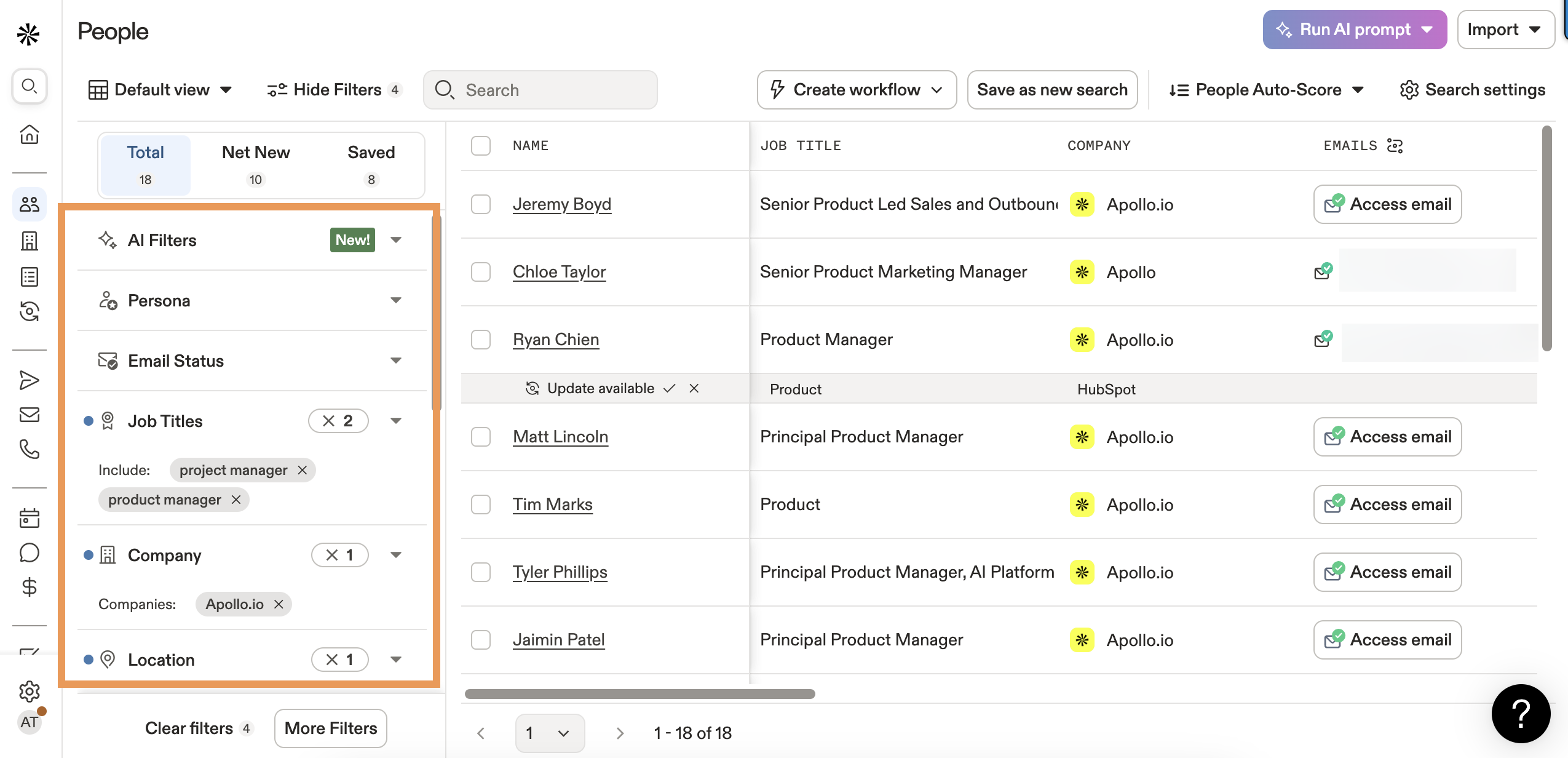
Use it if you need a broad B2B prospecting engine with sequencing built in and you're comfortable with data quality tradeoffs.
Skip it if your target market is niche, regulated, or government - Apollo's crowdsourced model underperforms in sectors where contacts aren't well-represented online.

Power Almanac handles government. But for commercial B2B, you need data that won't tank your sender reputation. Prospeo delivers 98% email accuracy - 33 points higher than Apollo's ~65% - with a 7-day refresh cycle and 300M+ profiles across 30+ filters.
Stop burning credits on contacts that bounce. Start with data that connects.
Head-to-Head Comparison
| Factor | Power Almanac | Apollo.io | Winner |
|---|---|---|---|
| Database size | 343K gov contacts | 210M+ contacts | Apollo (scale) |
| Niche focus | U.S. local government only | Broad B2B, all industries | Depends on market |
| Data accuracy | 97%+ (phone-verified) | ~65% (third-party estimate) | Power Almanac |
| Verification | 16-person team, 90-day calls | Crowdsourced + automated | Power Almanac |
| Data freshness | 11-week avg; bi-weekly email validation | Not publicly disclosed | Power Almanac |
| Pricing (entry) | $5,400/yr | Free tier; paid from ~$49-$59/mo per user | Apollo (accessibility) |
| G2 rating | 4.7/5 (10 reviews) | 4.7/5 (9,015 reviews) | Tie on score; Apollo on sample size |
| Best for | GovTech, municipal sales | Broad B2B prospecting | - |
The mismatch is structural. Power Almanac's ~343,000 records are phone-verified by humans who call every government every 90 days. Apollo's 210M+ records are scraped, crowdsourced, and algorithmically validated. For broad B2B, Apollo's scale wins. For local government, that scale is meaningless if the data's wrong.
Why General Databases Fail for Government
Local government is structurally invisible to web scrapers. Only 46% of local government officials' contact data appears online, and just 53% have a presence on professional networks. When Power Almanac's team analyzed 520 local government websites, more than half the time the website-derived contact data was inaccurate or incomplete. Add 4.1% monthly contact turnover - that's 40.5% annually - and Apollo's database simply can't keep up.
We've seen teams waste entire quarters trying to force Apollo into government prospecting before accepting the structural gap. No amount of AI data enrichment closes it. You need humans making phone calls.
Let's be honest: if your average government deal exceeds $5,000, the $5,400/year Power Almanac subscription pays for itself with a single closed deal. Trying to save money with Apollo's free tier will cost you more in wasted outreach and missed contacts than the subscription ever would.
Pricing Breakdown
| Plan | Power Almanac | Apollo.io |
|---|---|---|
| Entry / Free | 100 free records | Free tier (limited) |
| Tier 1 | $5,400/yr (15K credits, $0.36/record) | ~$49-$59/mo per user |
| Tier 2 | $12,000/yr (75K credits, $0.16/record) | ~$79/mo per user |
| Tier 3 | $16,900/yr (unlimited, ~$0.05/record) | ~$119/mo per user (min 3 seats, annual only) |
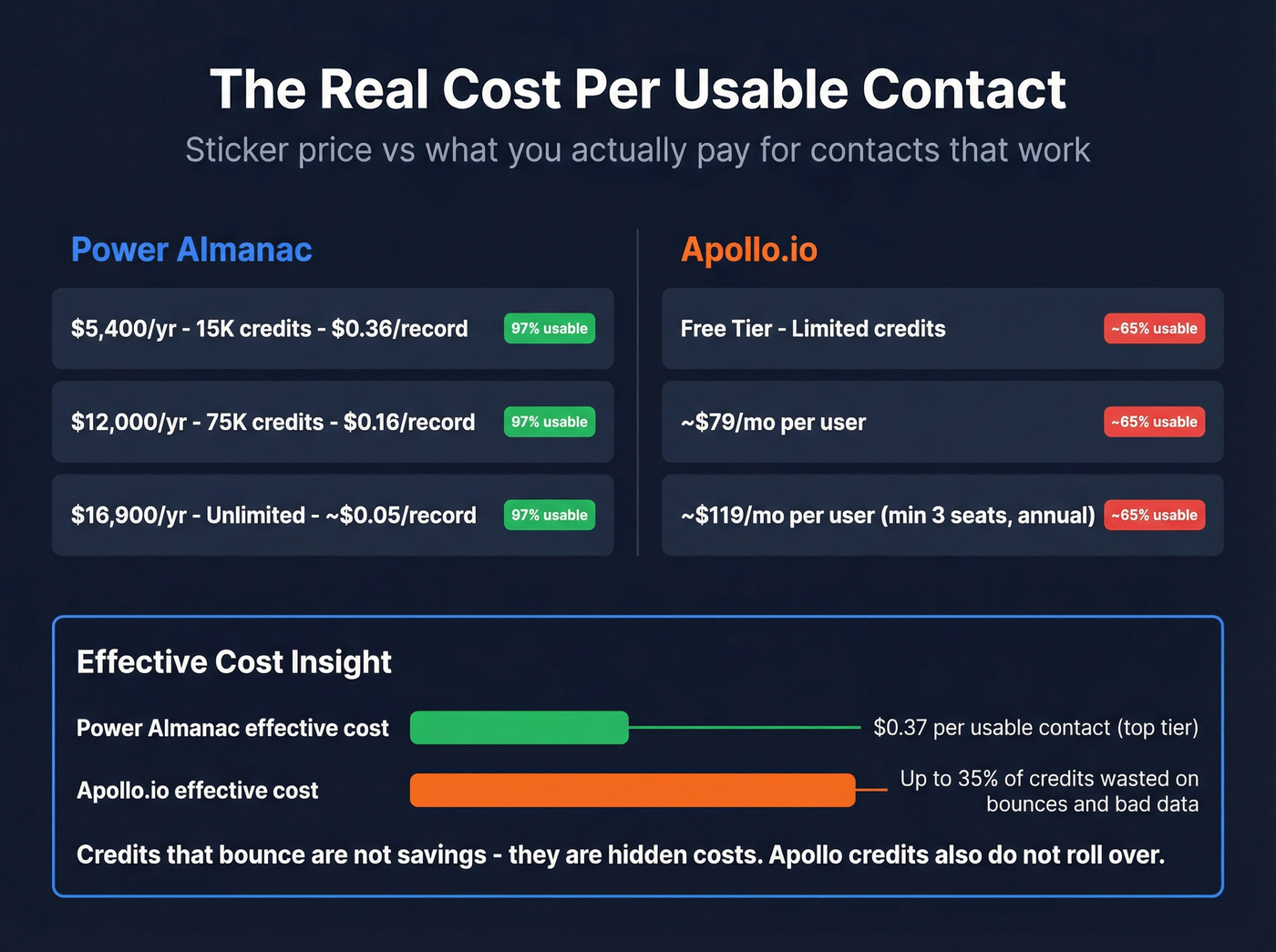
Power Almanac looks expensive until you factor in usable data. At 97%+ accuracy, nearly every credit returns a real contact. Apollo looks cheaper on paper, but at ~65% accuracy roughly a third of your credits produce contacts that bounce or don't connect. That's not a discount - it's hidden cost.
Apollo credits don't roll over either, so unused credits at month-end vanish.
What If You Need Both Markets?
Plenty of companies sell into both local government and commercial B2B. In our experience, the smart play is a two-tool stack: Power Almanac for municipal contacts, and a dedicated B2B data platform for everything else. Prospeo fits that second slot well - 98% email accuracy (33 percentage points higher than Apollo's estimated 65%), a 7-day data refresh cycle, and unit economics at ~$0.01 per email that are hard to argue with. You also get 125M+ verified mobile numbers with a 30% pickup rate, 30+ search filters including buyer intent and technographics, and native integrations with Salesforce, HubSpot, Instantly, and Lemlist. The free tier gives you 75 verified emails per month with no credit card required, so you can test it alongside Power Almanac without any commitment.
If you’re building a broader outbound stack, it’s also worth comparing sales prospecting databases and free lead generation tools before you commit.
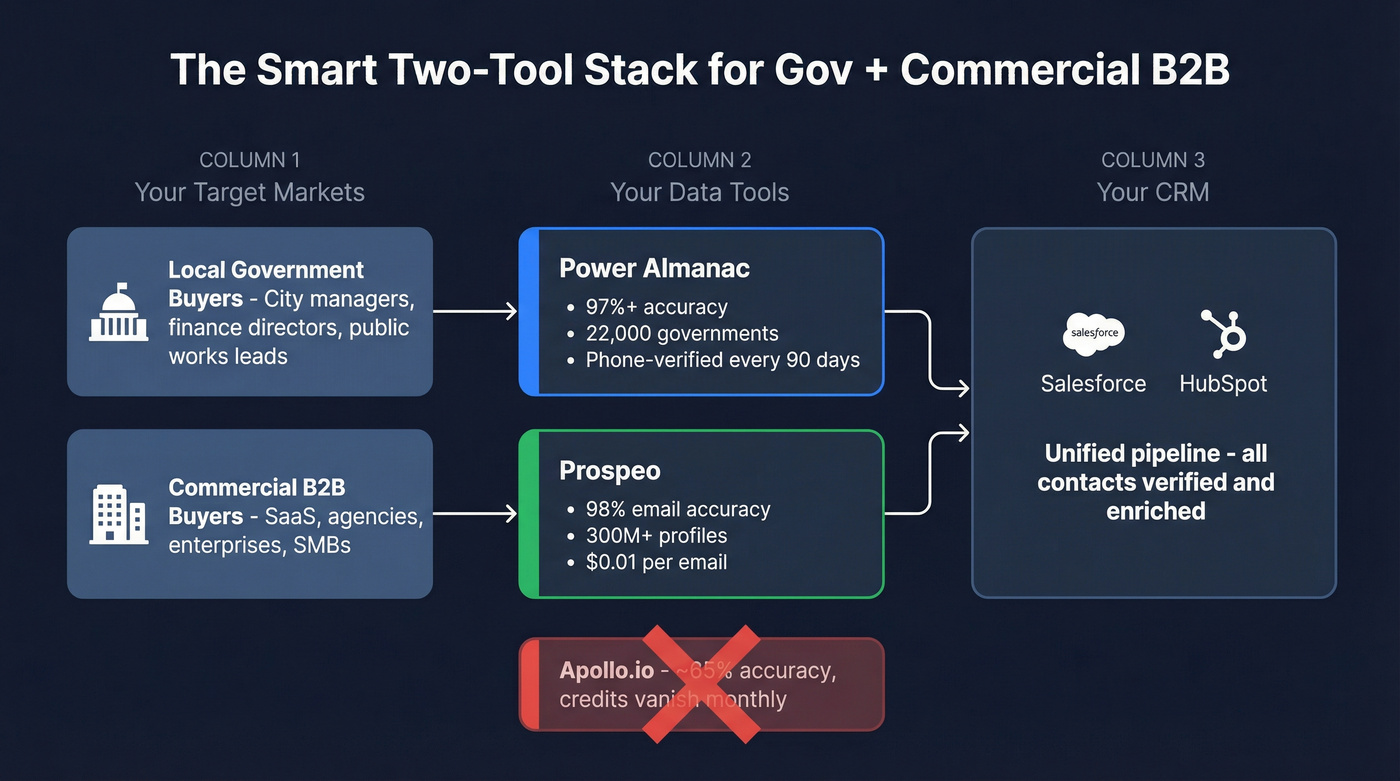
Running a two-tool stack? Pair Power Almanac's government data with Prospeo for everything else. At $0.01 per email, 125M+ verified mobiles, and 92% API match rates, you cover both markets without Apollo's accuracy tradeoffs or vanishing credits.
Replace Apollo in your stack - same scale, 98% accuracy, no contracts.
FAQ
Can Apollo.io find local government contacts?
Apollo's database includes some government contacts, but only 46% of local government officials' data appears online - exactly what Apollo scrapes. Expect significant gaps in coverage and accuracy for municipal buyers. For dependable gov contacts with 97%+ verification, Power Almanac is the right tool.
Does Power Almanac work for non-government prospecting?
No. It covers U.S. local government exclusively - 343,000 records across 22,000 jurisdictions. If you also prospect commercial B2B accounts, pair it with a dedicated data platform for verified emails and direct dials outside government.
Which tool is cheaper for small teams?
Apollo offers a free tier and paid plans starting around $49-$59/mo per user, making it more accessible upfront. Power Almanac starts at $5,400/year - steep unless local government is your primary market. For general B2B on a budget, Prospeo's free tier (75 emails/month, no credit card) is the lowest-risk starting point at ~$0.01 per email on paid plans.
Is Power Almanac worth $5,400/year?
For teams selling GovTech or municipal services, absolutely. A single closed deal above $5,400 recoups the annual cost, and 97%+ data accuracy means nearly zero wasted outreach. If local government isn't your primary market, the investment doesn't make sense - use a broad B2B database instead.