

Predictive Sales AI: The Complete Guide for B2B Sales Teams
More than 55% of sales leaders say inaccurate forecasting costs them revenue targets every single quarter. That's not a data problem. It's a prediction problem. And in a market that's hit $3B and growing at 13% annually, predictive sales AI is finally mature enough to trust.
The Short Version
- Machine learning on CRM and engagement data scores deals, forecasts revenue, and flags churn. It's 20-50% more accurate than manual methods when the underlying data is clean.
- Best tools by budget: Zoho Zia ($14-40/user/mo) for SMB, HubSpot Sales Hub ($45-150/user/mo) for mid-market, Clari (custom enterprise pricing; $100-120/user/mo base range) for enterprise.
- None of it works without clean data. Verify your CRM contacts first - or your predictions are built on sand.
What Is Predictive Sales AI?
Think of it as a three-stage pipeline. Stage one: inputs - CRM activity history, buyer behavior, email and call engagement signals, product usage data, and external triggers like intent signals and firmographic changes. Stage two: the model, where machine learning algorithms weight these inputs against historical outcomes to find patterns humans miss. Stage three: outputs - deal scoring with win probability, churn prediction, upsell targeting, and quota forecasting, all delivered in real time rather than at the end of the quarter.
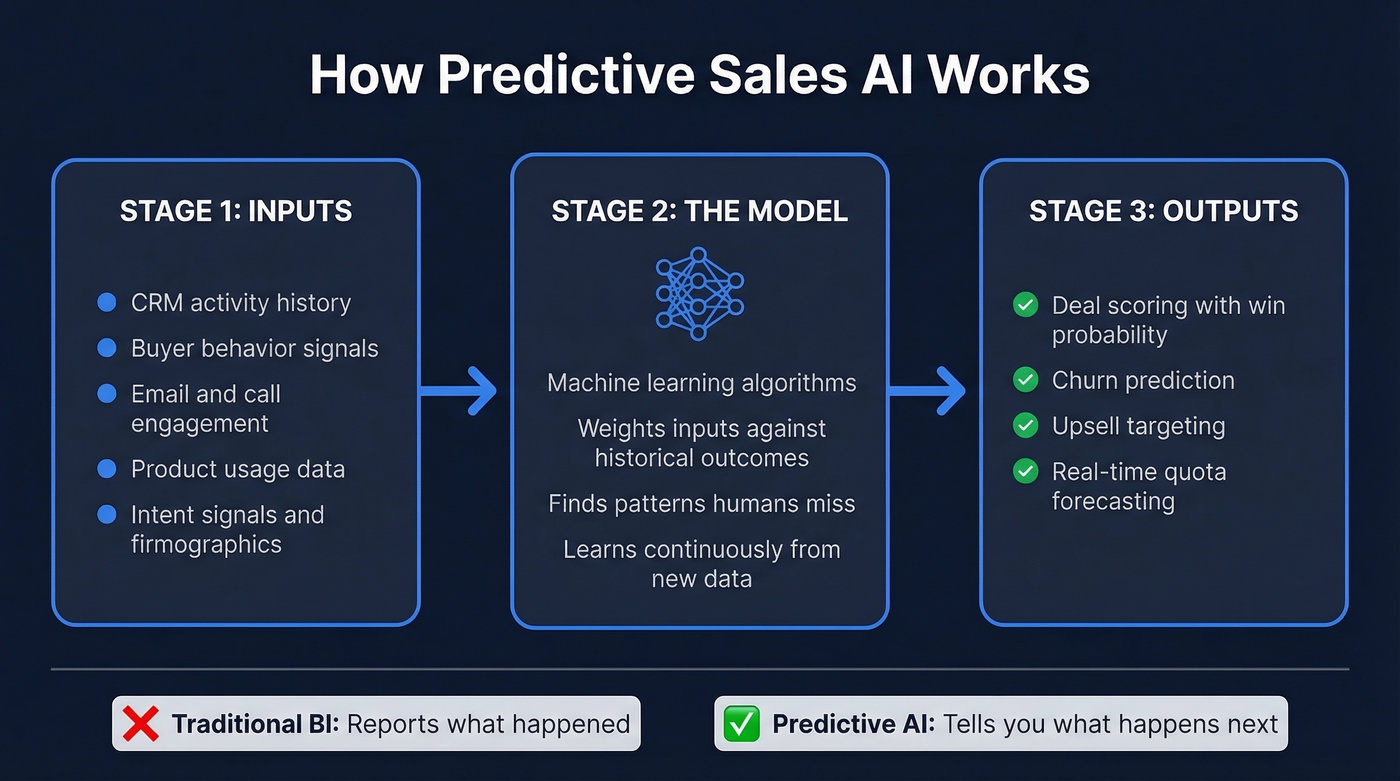
The key distinction from traditional BI dashboards? Predictive AI doesn't just report what happened. It tells you what's likely to happen next and, critically, which deals need intervention right now.
Quick disambiguation: If you've landed on predictivesalesai.com, that's a different product entirely. PSAI is a niche home-services platform for roofing, HVAC, and solar companies - it uses weather-triggered lead gen and pricing runs $295-$1,095/mo. This guide covers the broader category of predictive AI for B2B sales teams.
Why It Matters Now
AI adoption among sales reps jumped from 24% in 2023 to 43% in 2024, and 2026 data shows over half of sales professionals now use AI daily. Daily users are twice as likely to exceed targets. The gap between AI-equipped teams and everyone else isn't narrowing - it's accelerating.
The impact data backs it up. Bain found early AI deployments boosted win rates by 30% or more. Gartner's research is even more striking: sellers who effectively partner with AI are 3.7x more likely to meet quota. Meanwhile, 61% of B2B buyers now prefer a rep-free buying experience, which means the signals that predict a deal's trajectory are increasingly digital - exactly what these tools are built to analyze.
How It Actually Works
Traditional stage-based forecasting - the kind where a rep marks a deal as "60% likely" because it's in the proposal stage - hits 60-75% accuracy at best. AI-native platforms reach 90-98% precision by analyzing contextual deal health rather than relying on a rep's gut feel.
The market split matters here. Pre-2018 tools mostly tracked activity keywords and simple triggers. Post-2020 AI-native platforms use LLMs to analyze email sentiment, call transcripts, and multi-threaded engagement patterns to assess whether a deal is actually progressing or just sitting in the pipeline collecting dust. Reps spend only 28% of their time selling - the rest goes to admin and reporting. Automating the analysis layer lets reps focus on conversations that move deals forward instead of updating spreadsheets nobody trusts anyway.

Every predictive model in this article depends on one thing: clean CRM data. Prospeo's 5-step verification delivers 98% email accuracy with a 7-day refresh cycle - so your forecasting engine isn't learning from bounced emails and outdated contacts. 83% of enriched leads come back with verified contact data.
Fix the data layer before you buy the prediction layer.
Best Tools for 2026
| Tool | Best For | Price | Implementation | Accuracy Claim |
|---|---|---|---|---|
| Zoho Zia | Budget / SMB | $14-40/user/mo | 2-4 weeks | 60-70% |
| HubSpot Sales Hub | Mid-market | $45-150/user/mo | 4-6 weeks | 65-72% |
| Clari | Enterprise forecasting | $100-120/user/mo base | 8-12 weeks | 70-85% |
| Gong Forecast | Conversation-driven | ~$250/user/mo | 12-16 weeks | 72-78% |
| Salesforce Einstein | Salesforce shops | $50-220/user/mo | 16-24 weeks | 68-75% |
| People.ai | Activity capture | $50-75/user/mo | 6-10 weeks | Not public |
| 6sense | ABM + intent | $60K-100K+/yr | 12-20 weeks | Not public |
| Aviso | Enterprise AI-native | Enterprise pricing | 10-14 weeks | 98%+ |
Under $50/User/Month
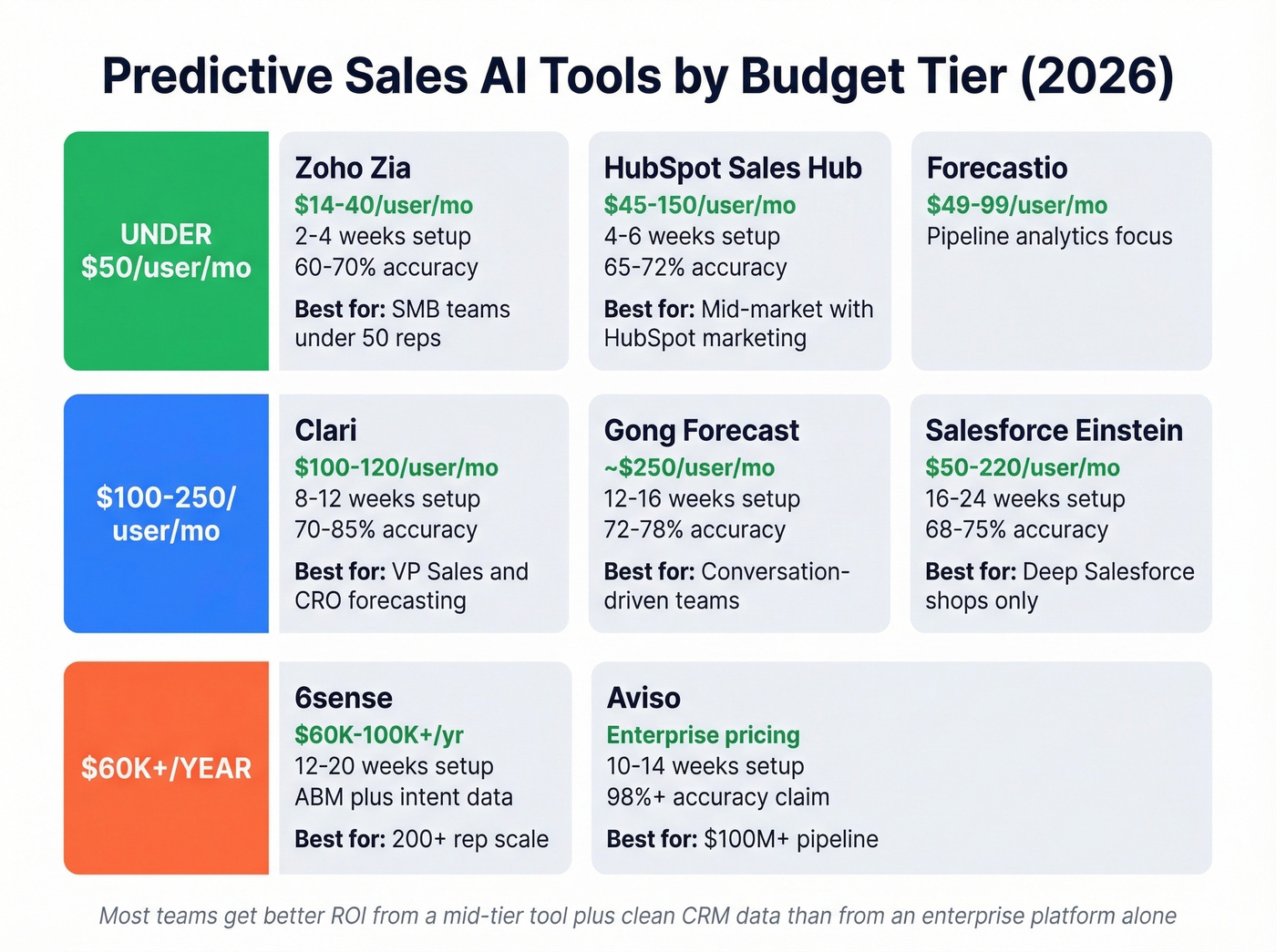
Zoho Zia and HubSpot Sales Hub deliver roughly 80% of the value at 10% of the cost of enterprise tools. Zoho deploys in two weeks and works well for teams under 50 reps who need deal scoring and basic forecasting baked into their existing CRM. HubSpot's advantage is its native marketing-to-sales data loop - if your marketing team already runs HubSpot, the forecasting engine has richer engagement signals out of the box. Other mid-range options worth evaluating: Forecastio ($49-99/user/mo) for pipeline analytics and BoostUp.ai for deal risk detection.
Skip this tier if you have fewer than 12 months of closed-deal data. The models won't have enough signal to learn from, and you'll end up blaming the tool for a data problem.
$100-250/User/Month
Clari is the default choice for VP Sales and CRO-level forecasting - purpose-built for revenue inspection and pipeline risk detection. Gong Forecast takes a different angle, building predictions from actual conversation data rather than CRM fields, which makes it powerful for teams where call quality drives outcomes.
Salesforce Einstein makes sense only if you're already deep in the Salesforce ecosystem. The 16-24 week implementation timeline makes it a poor fit otherwise. People.ai sits slightly lower on price and focuses on automated activity capture - useful for teams whose CRM hygiene is terrible, since it removes the rep-entry dependency entirely.
$60K+/Year
6sense and Aviso are full revenue intelligence platforms. 6sense combines ABM orchestration with intent data and predictive scoring - powerful but takes 12-20 weeks to implement and only makes financial sense at 200+ rep scale. Aviso reports 98%+ forecast accuracy, the highest in the category. We haven't tested it deeply enough to give a full endorsement yet, but it's on our radar for teams doing $100M+ in pipeline.
Here's the thing: most teams buying $60K+/year forecasting platforms would get better ROI spending $15K on a mid-tier tool and $5K on cleaning their CRM data. The prediction engine is only as smart as the data feeding it - and that's where most implementations actually fail.
The Data Foundation Problem
You can buy the best forecasting tool on the market and still get garbage predictions. The model is only as good as the data feeding it, and Gartner estimates poor data quality costs organizations $12.9M annually.
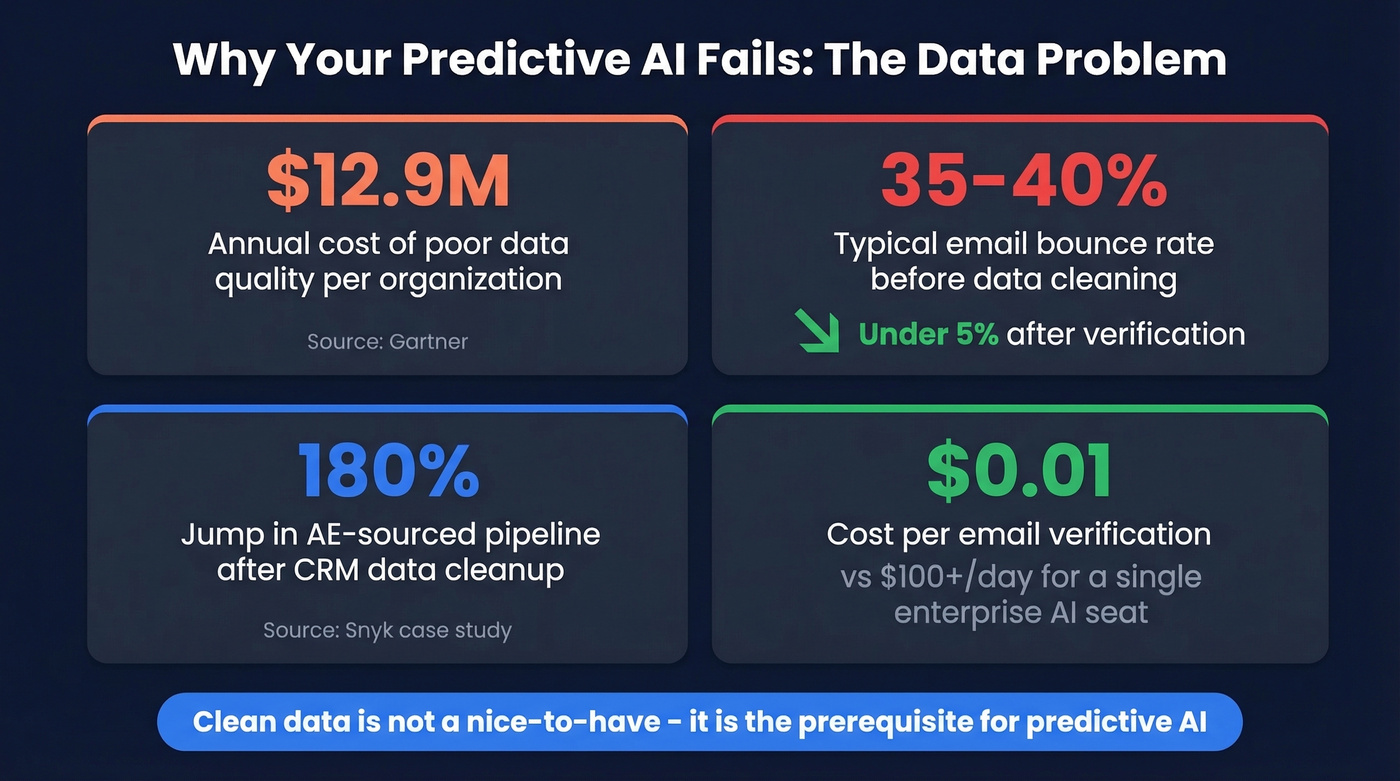
We've seen this pattern over and over in forecasting rollouts: teams buy prediction tools before fixing CRM hygiene, then blame the AI when forecasts miss. They invest $50K+ in forecasting software and skip the data verification layer underneath it. Your reps are calling numbers that don't connect, sending emails that bounce, and working accounts where the decision-maker left three months ago. No matter how advanced the model is, the prediction engine can't tell the difference between a valid contact and a dead one.
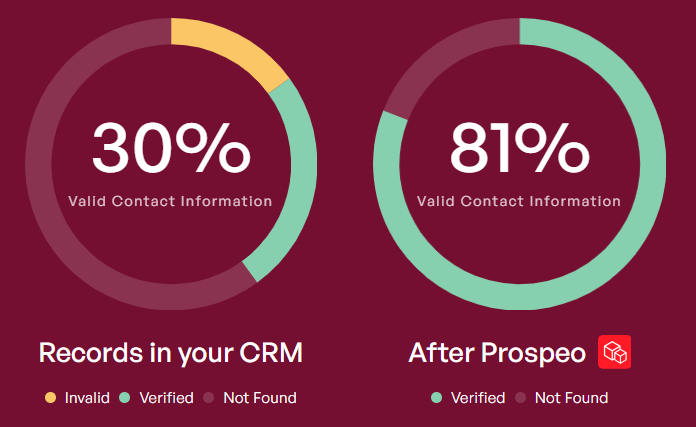
Snyk is a good counter-example. They took bounce rates from 35-40% down to under 5% using Prospeo and saw AE-sourced pipeline jump 180% after cleaning their data foundation. For a typical team verifying 1,000 contacts monthly, that costs roughly $10/mo with 98% email accuracy and a 7-day data refresh cycle. Less than a single Clari seat costs per day. Clean data isn't a nice-to-have when you're running predictive AI - it's the prerequisite.
Implementation Pitfalls
Five mistakes that sink predictive AI projects before they deliver ROI:
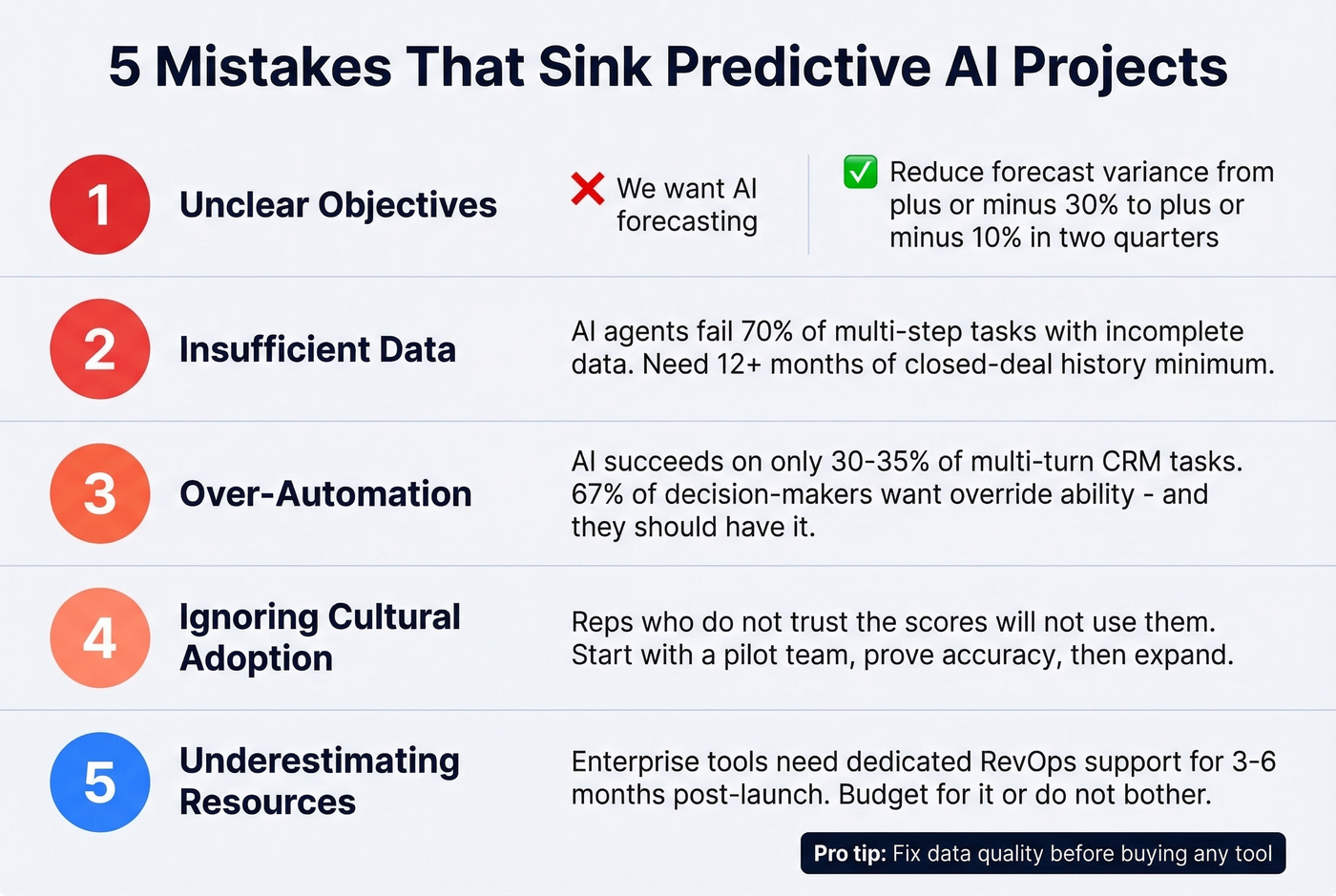
Unclear objectives. "We want AI forecasting" isn't a goal. "Reduce forecast variance from ±30% to ±10% within two quarters" is. Define the metric before you buy the tool.
Insufficient data. A Carnegie Mellon study found AI agents fail 70% of multi-step tasks when data is incomplete. If your CRM has six months of history and spotty activity logging, no model can save you.
Over-automation. AI agents succeed on only 30-35% of multi-turn CRM tasks. Keep humans in the loop - 67% of decision-makers want the ability to override AI recommendations, and honestly, they should have it.
Ignoring cultural adoption. Reps who don't trust the scores won't use them. Period. Roll out with a pilot team, prove accuracy against their gut calls, then expand. The consensus on r/sales is that forced rollouts without buy-in create more resentment than value.
Underestimating resources. Enterprise tools like Gong and Salesforce Einstein need dedicated RevOps support for 3-6 months post-launch. Budget for it or don't bother.
How to Choose
For teams with an annual budget under $50K, go with Zoho Zia or HubSpot Sales Hub and pair it with a data verification layer like Prospeo. That combination - roughly $50/user/mo for predictions plus verified contact data - gives a 20-person team production-quality forecasting at a fraction of enterprise cost.
For mid-market teams in the $50-150K range, Clari or Gong Forecast is the move, depending on whether you're more pipeline-inspection or conversation-intelligence oriented. Whatever tool you choose, run enrichment before you flip on AI scoring. The $500/mo you spend on clean data will save you from a $100K prediction engine running on garbage.
Let's be honest about the enterprise tier: if you're spending $60K+ on 6sense or Aviso, you already have RevOps headcount. Make sure they're spending their first month on data quality, not dashboard customization.
You read it above: poor data quality costs organizations $12.9M per year. Before spending $60K+ on a forecasting platform, verify what's already in your pipeline. Prospeo enriches CRM records with 50+ data points at $0.01/email - 90% cheaper than ZoomInfo - with a 92% API match rate.
Stop feeding your predictive AI garbage data.
FAQ
How accurate is predictive sales AI?
AI-native platforms reach 90-98% forecast accuracy, compared to 60-75% for manual stage-based methods. Real-world results depend heavily on CRM data quality. Expect a 20-50% improvement over spreadsheet forecasting if your CRM has at least 12 months of closed-deal history and verified contact records.
Can small teams use AI for sales prediction?
Yes - tools like Zoho Zia start at $14/user/mo and deliver meaningful deal scoring for teams as small as five reps. The key constraint isn't team size, it's data volume: you need at least 12 months of closed-won and closed-lost deals for the model to find reliable patterns.
How long does implementation take?
Budget tools like Zoho Zia and HubSpot deploy in 2-6 weeks. Enterprise platforms - Clari, Gong, Salesforce Einstein - take 8-24 weeks including data integration, model training, and change management. Plan for the longer end of every estimate.
What's the best way to prepare CRM data for AI forecasting?
Start by verifying all contact records - stale emails and disconnected numbers produce stale predictions regardless of model sophistication. Then ensure 12+ months of deal history with consistent stage definitions and activity logging before turning on any scoring model. We've found that teams who spend even one week on data cleanup before launch see dramatically better first-quarter results from their prediction tools.