

Product Champion: Definition, Frameworks, and How to Find One
"Product champion" means three completely different things depending on who's saying it. A product manager means cross-functional accountability. A sales leader means the internal advocate selling your deal when you're not in the room. A PLG team means the power user pulling colleagues onto the platform.
Every glossary page treats these as one concept. They're not, and conflating them leads to bad strategy. Let's untangle all three.
What Is a Product Champion?
- Product management: The person accountable for a product's success - a conduit between strategy and delivery, regardless of title.
- Enterprise sales (MEDDPICC): An internal advocate at the target company who actively promotes your solution and navigates the buying committee on your behalf.
- Product-led growth: A power user who drives organic adoption, generates social proof through reviews, and expands usage across their organization.
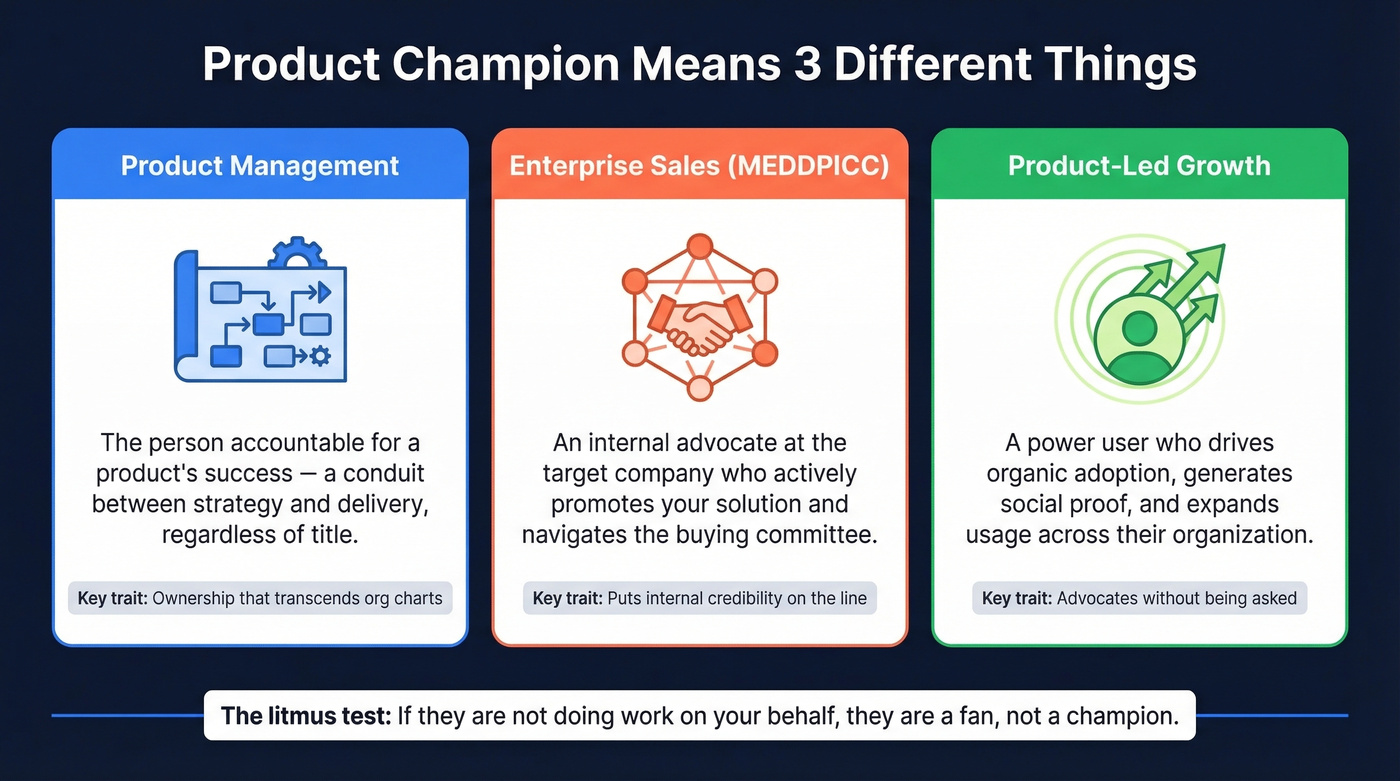
The litmus test across all three: if they're not doing work on your behalf, they're a fan, not a champion. Fans are nice. Champions close deals, ship products, and drive expansion.
Champion vs. Product Owner vs. Product Manager
These three roles get tangled constantly. Here's how they separate:
| Product Manager | Product Owner | Product Champion | |
|---|---|---|---|
| Focus | Long-term strategy | Sprint execution | Advocacy & delivery |
| Orientation | Market & external | Dev team & internal | Cross-functional |
| Core work | Roadmap, research | Backlog, user stories | Stakeholder alignment |
| Origin | Business discipline | Scrum (with extensions in DAD and other Agile frameworks) | Org-agnostic role |
| Hire first when... | You need market positioning | You're running Scrum sprints | You need someone to bridge strategy and execution |
The PM owns strategy - vision, market research, positioning, roadmap. The PO translates that strategy into actionable work for delivery teams, managing backlogs and sprint priorities. Frameworks like Disciplined Agile Delivery further define how PM and PO responsibilities split as organizations scale.
The champion sits differently. Sparkbox's framing is simple: if accountability for a digital product rests on your shoulders, you're the champion - the conduit between strategy and delivery. That could be an engineer, a marketing director, or a UX lead.
Don Frey's 1991 HBR article "My Life as a Product Champion" draws on 40 years of experience "making new products happen." That's the champion's defining trait: ownership that transcends org charts.
In small orgs, one person often covers all three roles. That works until it doesn't - each is effectively a full-time job, and the moment your product hits real complexity, the seams show fast.
The Enterprise Sales Champion (MEDDPICC)
This is where the term carries the most operational weight, and where getting it wrong costs you quarters.
What a Sales Champion Actually Does
An internal champion is someone inside the target company who believes in your solution and actively promotes it. The key word is actively. Per UserGems' framework, champions typically have prior success with your tool or category and are motivated to replicate that win. Here's what they deliver:
They shorten sales cycles because they navigate internal politics you can't see. They give you access to hidden stakeholders - the VP who controls budget, the procurement lead who fast-tracks approvals. They make warm introductions that skip the cold outreach grind entirely. And they provide early warning when deals stall, because they hear objections before you do.
The 7-Test Validation Checklist
Here's the thing: most "champions" aren't. They're friendly contacts who like your product but won't stick their neck out when it matters. The MEDDPICC champion validation framework from SalesHood gives you seven concrete tests:
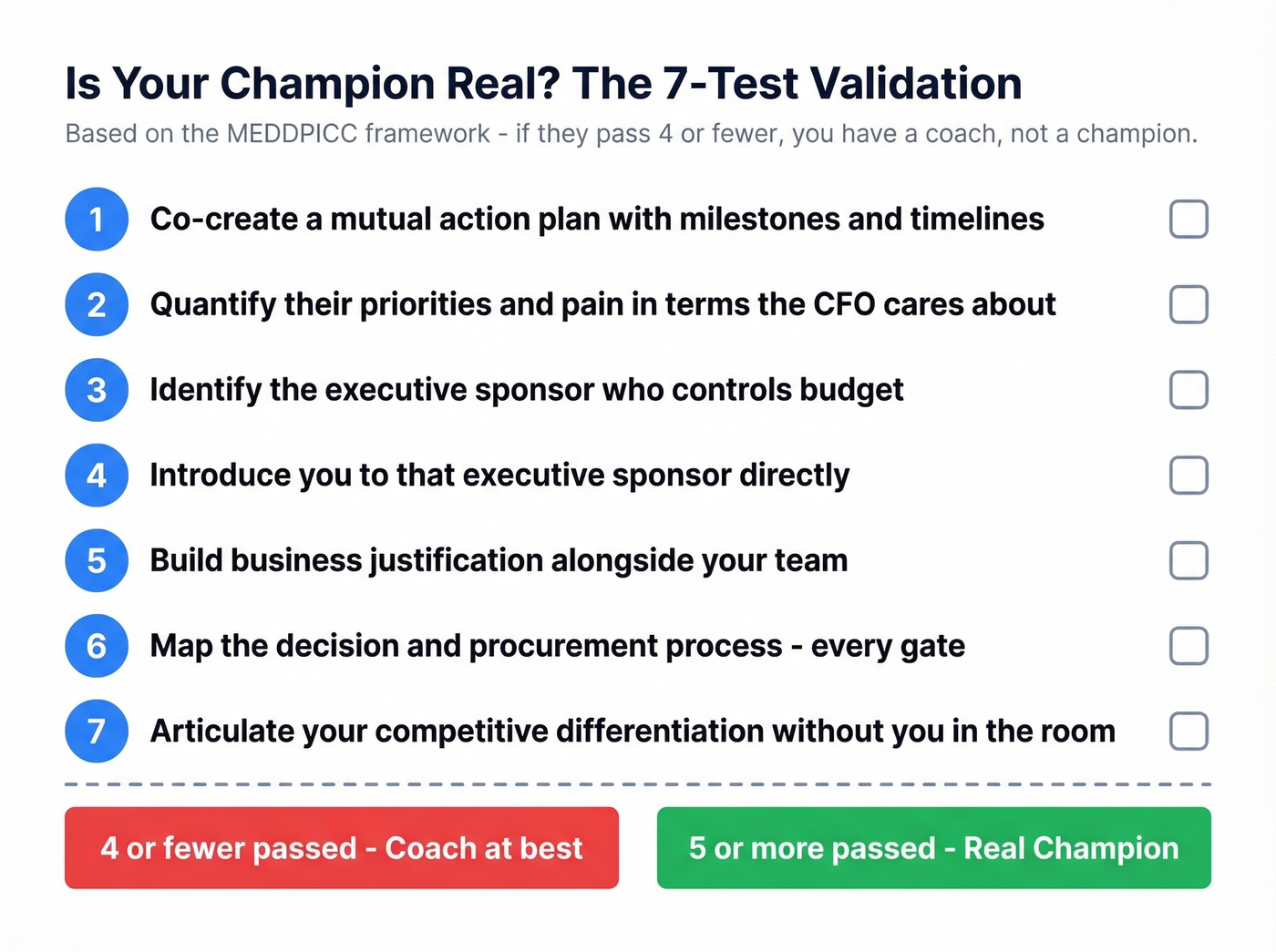
- Co-create a mutual action plan with defined milestones and timelines
- Quantify their priorities and pain in terms the CFO cares about
- Identify the executive sponsor who controls budget
- Introduce you to that executive sponsor directly
- Build business justification alongside your team
- Map the decision and procurement process so you know every gate
- Articulate your competitive differentiation to internal stakeholders without you in the room
If they pass four or fewer, you've got a coach at best. Real champions put their internal credibility on the line for your deal.
The Champion Bottleneck Problem
We see this pattern constantly in complex B2B sales. You've got an engineering lead who completed technical due diligence, loves the product, and is ready to advocate internally. The problem? They sit in a technical org with zero line of sight to commercial decision-makers.
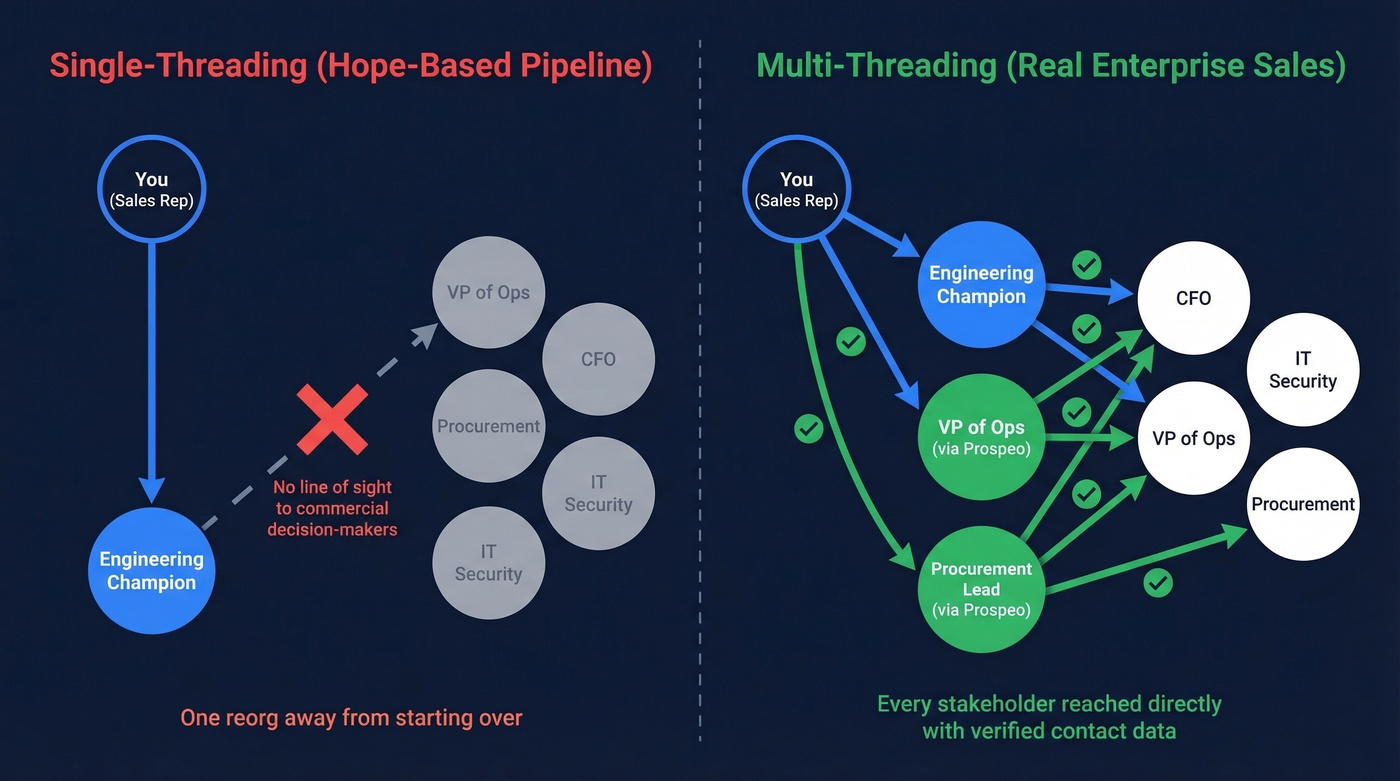
This is especially brutal in long-cycle enterprise deals. One r/sales thread describes a 20-26 month cycle where the champion is an engineering lead who completed technical due diligence but can't reach commercial stakeholders. In companies with 10,000+ employees, the gap between advocacy and purchasing authority can be enormous.
The fix is multi-threading. Don't rely on a single champion to navigate the entire buying committee alone. Once your champion maps the stakeholders, you need verified contact data for every person on that list - reaching every decision-maker directly rather than waiting for warm intros that never come.
If your average deal cycle exceeds 12 months and you're single-threading through one internal advocate, you're not running enterprise sales. You're running a hope-based pipeline. Multi-thread or lose.

Multi-threading kills single-champion risk - but only if you can actually reach every stakeholder. Prospeo gives you 98% accurate emails and 125M+ verified mobile numbers for the entire buying committee, so you stop waiting on warm intros that never come.
Stop hoping your champion makes the intro. Reach every decision-maker directly.
Turning Customers into Champions with PLG
PLG champions look nothing like enterprise sales champions. They're users first, advocates second - and the playbook for activating them is completely different.
Use this framework if you have a self-serve product with measurable user engagement, NPS data, and a path from free to paid. Skip this if your product requires top-down enterprise sales with no self-serve motion.
The simplest segmentation comes from Appcues' PLG playbook: champions are NPS promoters who gave their score within the past six months. Older promoters may have churned emotionally even if they haven't cancelled. Recency matters more than score.
Once you've identified them, activation looks like requesting G2 or Capterra reviews that compound as social proof, offering beta access to new features that deepens the relationship at low cost, and inviting them into feedback loops that make them feel like insiders. The goal is turning customers into advocates who expand usage organically across their organization - and the best ones don't even realize they're doing your job for you.
For expansion specifically, Pocus outlines trigger signals worth monitoring: high account upside with low product penetration, account growth rate exceeding benchmarks, free users outnumbering paid users, and enterprise features like SSO getting enabled. Each trigger pairs with an action - human touch for high-value accounts, automated nudges for the long tail. The champion is the person you reach out to when the trigger fires.
How to Identify Product Champions
Finding champions isn't guesswork if you build the right system. Here's a process adapted from UserGems' identification framework:
1. Define your ideal champion profile. What title, seniority, and department does your typical advocate hold? For most B2B tools, it's a director-level user in the department that feels the pain most acutely.
2. Map the target company. Understand the org structure, reporting lines, and where budget authority sits relative to product usage. This step alone saves weeks of wasted outreach.
3. Mine your CRM for patterns. Look at closed-won deals - who was the internal advocate? What title did they hold? These patterns predict future champions with surprising reliability, and we've found that even a sample of 20-30 closed-won deals reveals clear persona clusters.
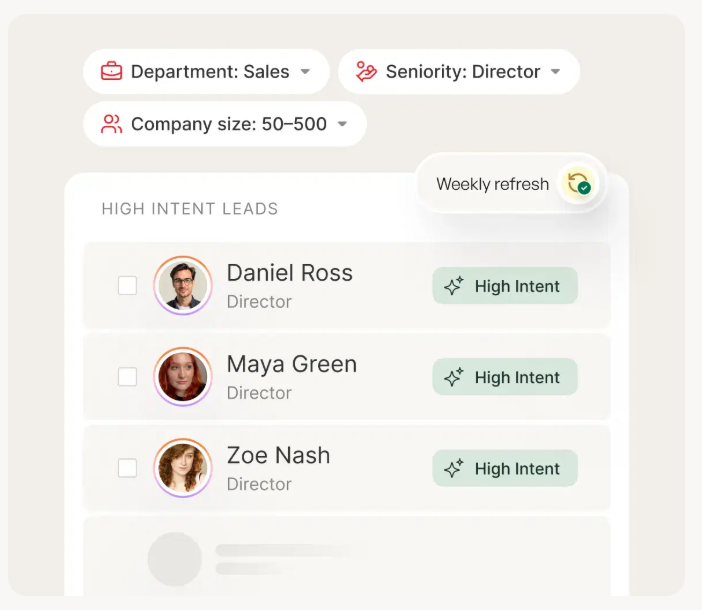
4. Layer in data signals. CRM patterns reveal past champions. Intent data and product analytics reveal emerging ones. Prospeo tracks 15,000 intent topics powered by Bombora and refreshes contact data every 7 days, so you can spot accounts showing buying signals and reach the right contacts with current information before they self-identify.
5. Connect peer-to-peer. Champions respond better to peers than to sales reps. Have your customer success team or existing advocates make introductions whenever possible.
6. Build the relationship, then ask for help. Don't lead with "Can you introduce me to your CFO?" Earn the right by delivering value first - competitive intel, ROI frameworks, internal presentation decks they can use without modification.
Key Traits of Effective Champions
Not every enthusiastic user becomes a great advocate.
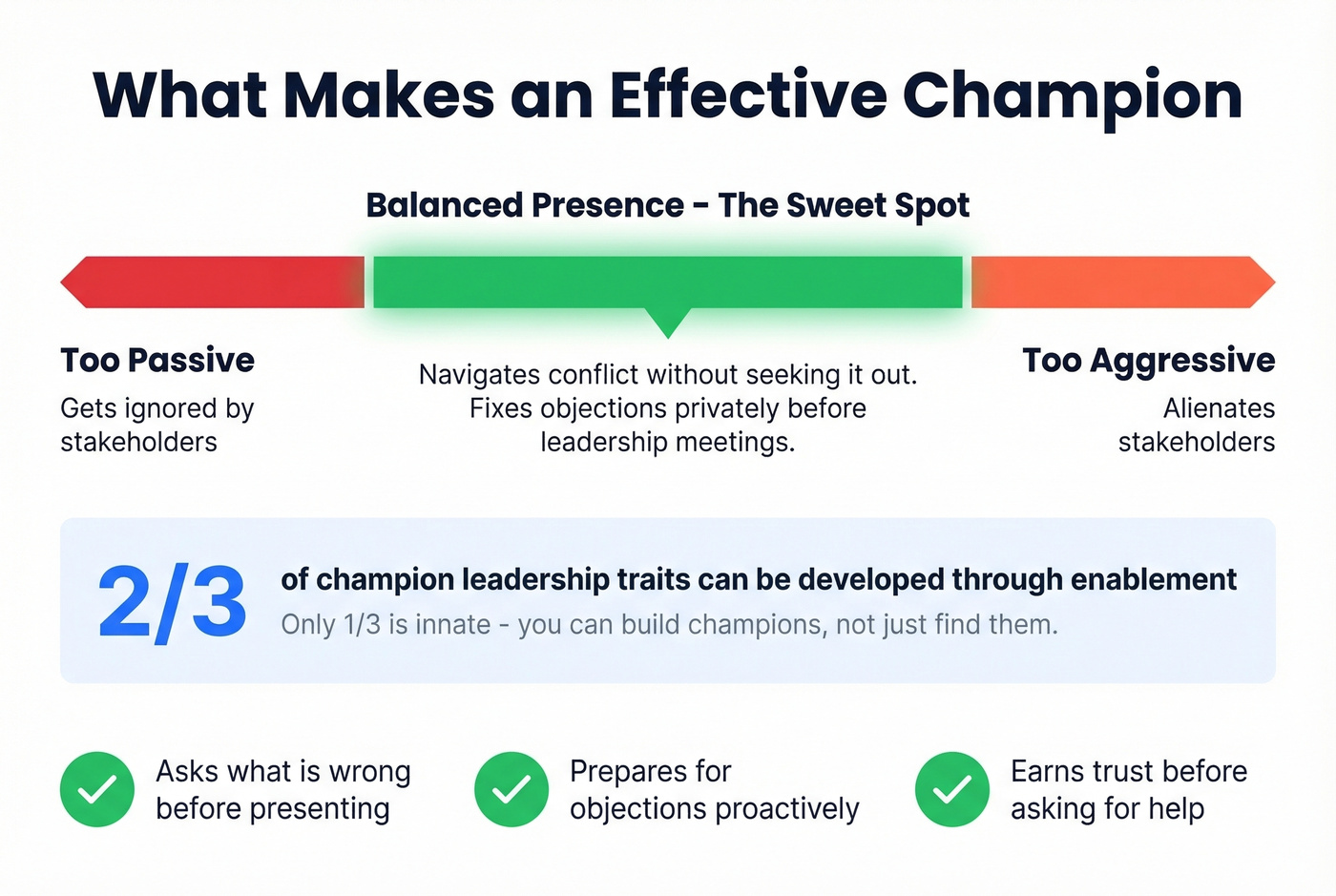
Sparkbox's research on champion leadership highlights balanced presence as the defining characteristic. Champions who are too aggressive alienate stakeholders. Too passive and they get ignored. The sweet spot is someone who navigates conflict without seeking it out - they don't avoid hard conversations, but they don't manufacture unnecessary ones either.
In our experience, the best champions aren't the loudest voices in the room. They're the ones who ask "What's wrong with this approach?" before presenting it to leadership, because they'd rather fix objections privately than get blindsided in a steering committee. The encouraging finding from Sparkbox's research: leadership is roughly one-third born and two-thirds made. You can develop champions through enablement, not just discover them through luck.
Common Pitfalls
Single-threading through one champion. If your entire deal depends on one person, you're one reorg away from starting over. Multi-thread into at least three stakeholders across two departments.
Confusing fans with champions. A fan says "I love your product" in a demo. A champion says "I scheduled time with our VP of Ops to walk through the business case." Run the 7-test checklist. No exceptions.
Champion stuck in a technical silo. Your advocate is an engineering lead with zero access to commercial decision-makers. Help them build a business case that translates technical value into revenue impact - give them the language and the deck.
Not enabling champions with ammunition. Champions can't sell internally with enthusiasm alone. Build a champion enablement kit with three essentials: an ROI calculator pre-loaded with their company's numbers, a competitive comparison one-pager they can forward to their boss, and an executive summary slide deck under five pages. Update it quarterly - stale enablement materials are almost worse than none at all.
If you're building the rest of your outbound motion, start with sales prospecting techniques and a repeatable lead generation workflow.
Your champion identified the VP who controls budget and the procurement lead who fast-tracks deals. Now you need their direct contact data - not a generic info@ address. Prospeo's 30+ search filters let you pinpoint exact titles, departments, and seniority levels across 300M+ verified profiles.
Find every hidden stakeholder your champion just mapped - for $0.01 per email.
FAQ
What is a product champion in simple terms?
A product champion is someone who takes personal ownership of a product's success - whether that means shepherding it through development, advocating inside a buying committee, or driving organic adoption across an organization. The common thread is active work on the product's behalf, not passive enthusiasm.
What's the difference between a champion and an evangelist?
Champions work internally to drive purchasing decisions and cross-functional alignment. Evangelists promote externally through talks, posts, and social advocacy. Different audiences, different skill sets - though one person can fill both roles over time.
How do you test if your champion is real?
Use the MEDDPICC 7-test checklist. The two most revealing tests: will they co-create a mutual action plan with dates, and will they introduce you to the economic buyer? If they dodge both, you have a coach, not a champion.
What tools help identify product champions?
CRM data reveals patterns from past closed-won deals. NPS surveys surface recent promoters. Intent data platforms track buying-signal topics and refresh contact data regularly, giving you a head start on reaching emerging advocates before competitors do.
Where did the term originate?
Don Frey's 1991 HBR article "My Life as a Product Champion" formalized the concept for a broad business audience, drawing on 40 years of shepherding innovations from idea to market. The term has since expanded to cover sales, PLG, and product management contexts.