

100+ Professional Email Subject Line Examples That Get Opened
You spent 45 minutes writing the perfect email. Polished the ask, nailed the tone, attached the right file. Then you typed "Update" in the subject line and hit send. Open rate: 11%. That email might as well not exist.
47% of recipients decide whether to open an email based on the subject line alone. Another 69% use it to decide whether to report you as spam. The body of your email doesn't matter if nobody reads past the inbox preview.
The Topic + Purpose Framework
Chris Fenning's framework is the simplest way to fix a bad subject line: state the topic, then state the purpose. Most business email subject lines fail because they skip one or both.
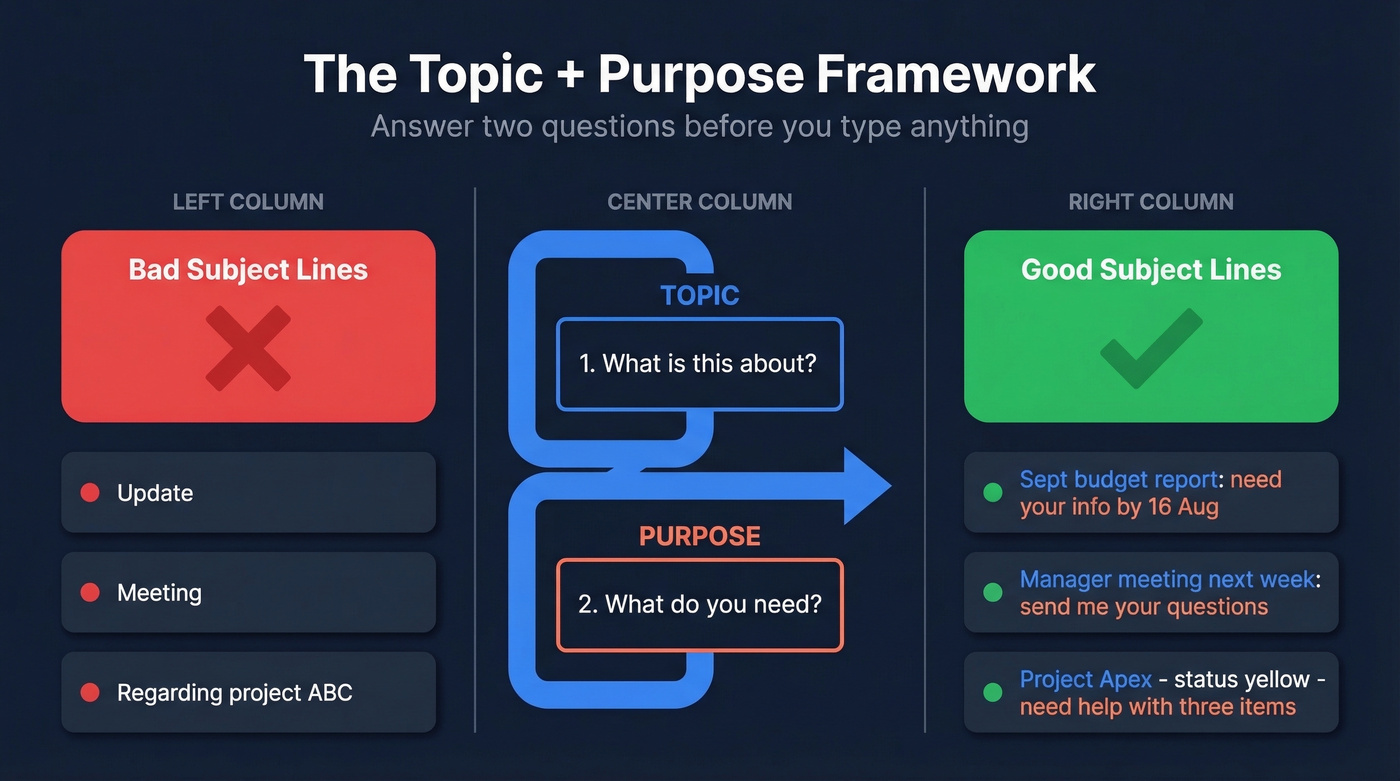
Bad vs. Good:
- "Update" → "Sept budget report: need your info by 16 Aug"
- "Meeting" → "Manager meeting next week: send me your questions"
- "Regarding project ABC" → "Project Apex - status yellow - need help with three items"
The bad versions aren't wrong. They're just useless. "Update" tells a recipient nothing when they're scanning 40 unread messages. We've watched someone type "Update" as the subject line for an email going to 12 stakeholders across three departments - nobody opened it the same day.
The fix isn't clever copywriting. It's answering those two questions before you type anything else. What's this about? What do you need? Front-load both.
Ideal Length - What the Data Says
Generic advice says "keep it under 60 characters." Too generous. EmailToolTester tested actual devices and found the real truncation limits are much tighter:
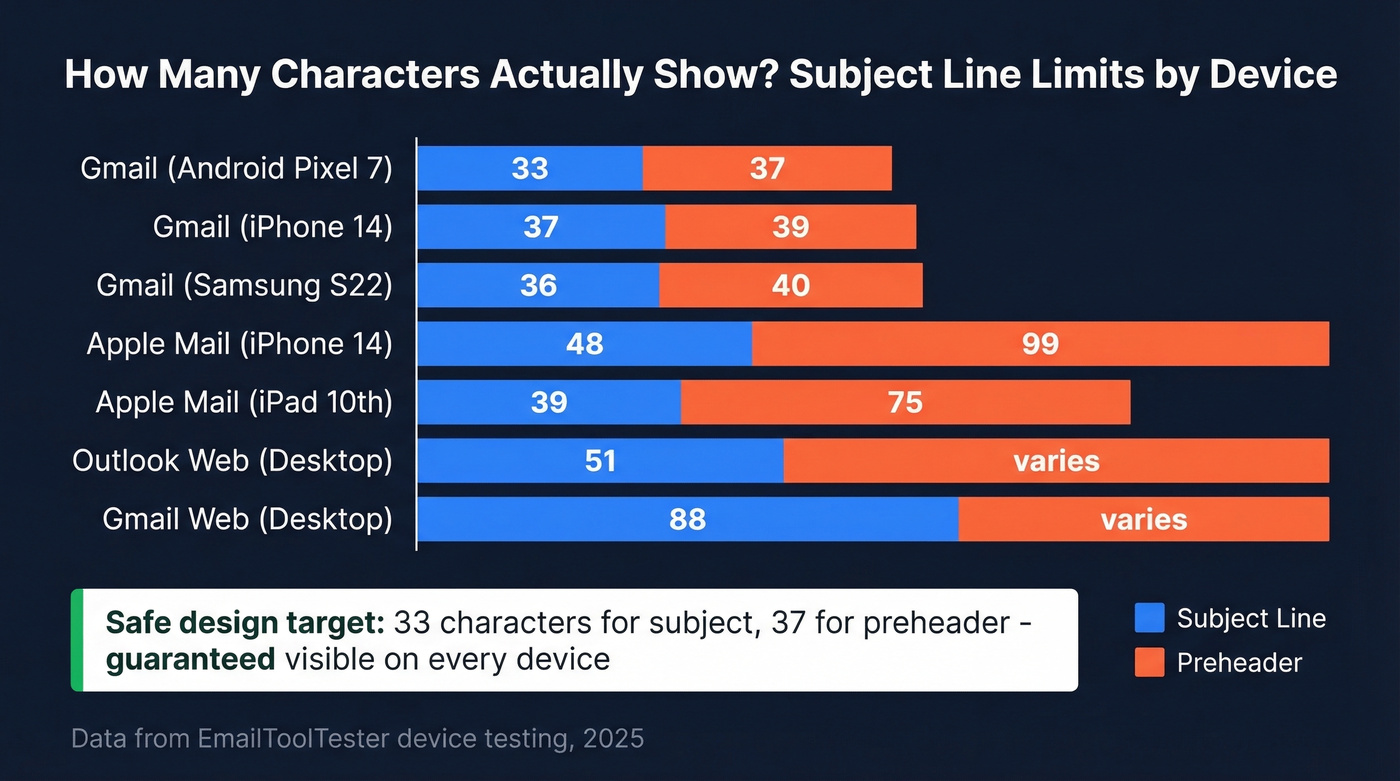
| Device / Client | Subject Visible | Preheader Visible |
|---|---|---|
| Gmail (Android Pixel 7) | 33 chars | 37 chars |
| Gmail (iPhone 14) | 37 chars | 39 chars |
| Gmail (Samsung S22) | 36 chars | 40 chars |
| Apple Mail (iPhone 14) | 48 chars | 99 chars |
| Apple Mail (iPad 10th) | 39 chars | 75 chars |
| Outlook web (desktop) | ~51 chars | varies |
| Gmail web (desktop) | ~88 chars | varies |
The safe number across every tested device is 33 characters for the subject and 37 characters for the preheader. That's your design target.
Think of the subject line and preheader as a combined system. You get roughly 33 + 37 = 70 characters of guaranteed visibility on the worst-case device. Put the core message in the subject. Put the supporting context in the preheader. If you can't fit your message in 33 characters, keep it under 50 - but front-load the most important words so they survive truncation on mobile.
Don't waste the preheader on default text like "View this email in your browser." Write it deliberately. A subject line of "Q3 launch timeline" paired with a preheader of "Two milestones at risk - need your input" gives the reader the full picture before they ever tap.
Most people read email on their phones first. Design for 33 characters, and everything else is a bonus.
2026 Benchmarks - What "Good" Looks Like
Before you obsess over crafting the perfect subject line, you need to know what "good" actually means for your industry. MailerLite analyzed over 3.6 million campaigns from 181,000 accounts covering December 2024 through November 2025:
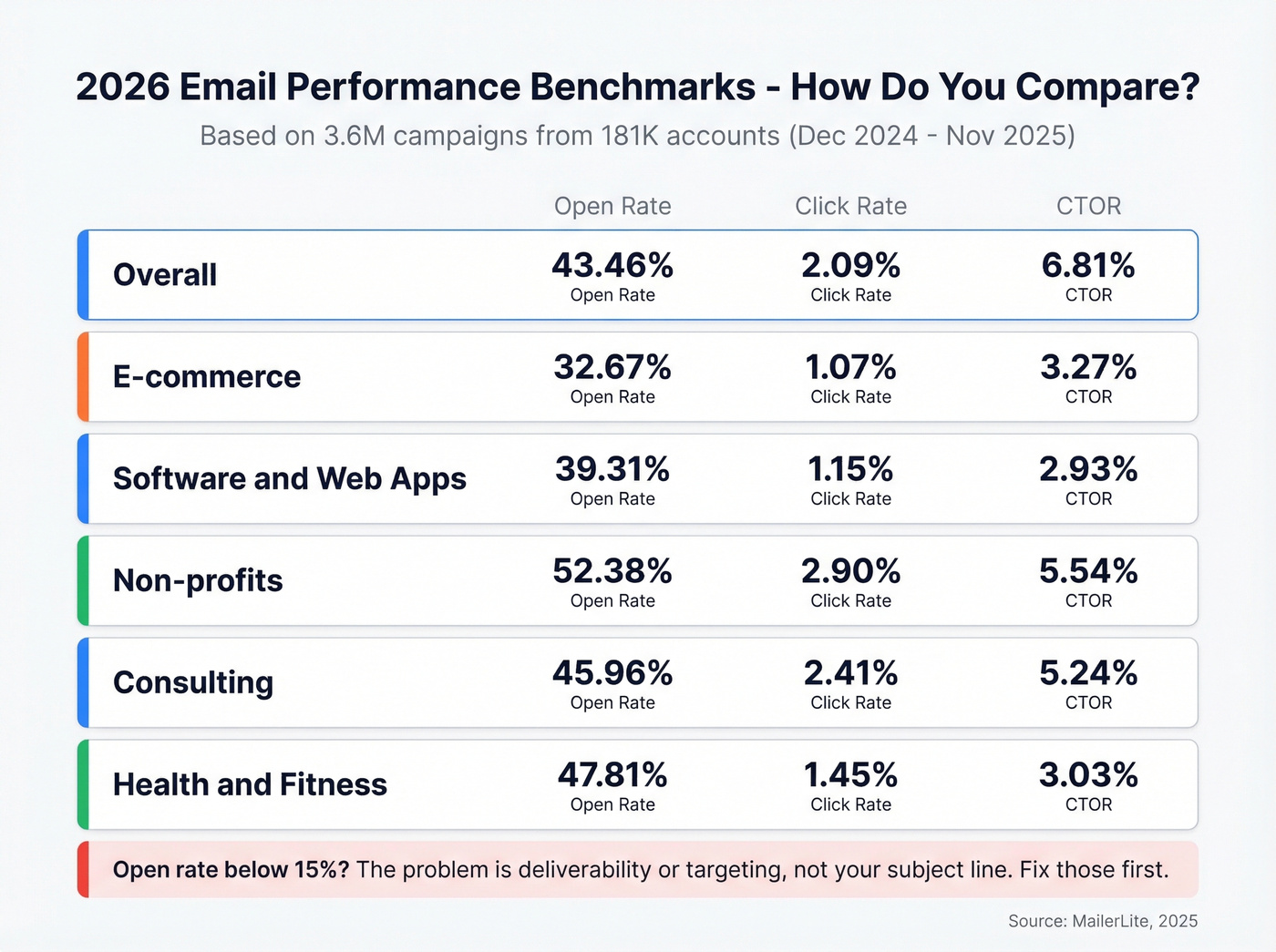
| Industry | Open Rate | Click Rate | CTOR |
|---|---|---|---|
| Overall (all industries) | 43.46% | 2.09% | 6.81% |
| E-commerce | 32.67% | 1.07% | 3.27% |
| Software & Web Apps | 39.31% | 1.15% | 2.93% |
| Non-profits | 52.38% | 2.90% | 5.54% |
| Consulting | 45.96% | 2.41% | 5.24% |
| Health & Fitness | 47.81% | 1.45% | 3.03% |
Apple Mail Privacy Protection inflates open rates by pre-loading tracking pixels. Everyone's affected equally, so the numbers are still useful for relative comparison - just don't treat a 43% open rate as meaning 43% of humans actually read your email.
The unsubscribe rate jumped from 0.08% to 0.22% year-over-year, largely driven by Gmail's one-click unsubscribe button. That's not a subject line problem - it's a platform change. But it means your subject line has to earn the open faster than ever, because opting out has never been easier.
A diagnostic worth memorizing: if your open rates are below 15%, the problem is typically email deliverability or targeting, not your subject line. Fix those first.

If your open rates are below 15%, the problem isn't your subject line - it's bad data. Prospeo's 5-step verification catches spam traps, honeypots, and invalid addresses before they tank your deliverability. 143M+ emails verified at 98% accuracy.
Fix your list before you fix your subject lines.
100+ Subject Line Examples by Category
Internal & Workplace Emails
These follow the topic + purpose framework. Every one tells the recipient what it's about and what they need to do.
Meeting requests:
- Manager meeting next week: send me your questions
- Quarterly review Thursday 2pm: confirm attendance
- Rescheduled: design sync moved to Wednesday 10am
- Skip-level 1:1 request: 20 min this week?
Project updates:
- Project Apex - status yellow - need help with three items
- Q3 launch timeline: two milestones at risk
- Website redesign: final review due Friday
- Migration complete: verify your access by EOD
Approvals & action items:
- Action required: approval of Tim's expense report
- Sept budget report: need your info by 16 Aug
- Sign-off needed: vendor contract by Thursday
- PTO request: Dec 18-22, coverage plan attached
Announcements & FYIs:
- New parental leave policy: effective March 1
- Confirmation: travel arrangements for Florida trip
- Office closed Dec 24-Jan 1: emergency contacts inside
- Org update: Sarah promoted to VP Engineering
Sales Outreach & Cold Email
Cold email subject lines play by different rules. You're interrupting someone who didn't ask to hear from you. Specificity and brevity are everything - keep it under 7 words when possible.
Cold opens:
- [Company] + [relevant trend]
- Quick question about your [recent announcement]
- [Their competitor] just did this...
- Thought you'd find this interesting
- Idea for [specific business challenge]
- 5-minute favour?
Trigger-based (popular patterns on r/coldemail):
- Congrats on the [funding round]
- Following up on [industry event]
- Saw your [recent company news]
- Your [job posting] caught my eye
- Re: [conference name] last week
- [Industry report] - thought of your team
Follow-ups:
- Following up: [specific topic from last email]
- Still relevant? [One-line value prop]
- [First name], circling back on this
- Any thoughts on [specific deliverable]?
Meeting requests:
- 15 min this week? Re: [specific topic]
- Coffee at [event name]?
- Worth a conversation?
- [Mutual connection] suggested we connect
Here's the thing: the best subject line in the world is worthless if the email bounces. Before you launch any cold sequence, verify your list. Prospeo catches invalid addresses, spam traps, and honeypots with 98% email accuracy across 143M+ verified addresses - so your carefully crafted subject line actually reaches an inbox.

Job Applications & Career
Job application subject lines aren't the place for creativity. Kickresume's research is clear: if the posting specifies a format, follow it exactly. Recruiters processing 200 applications don't want to hunt for your details.
Standard format (when no format is specified):
- Job application - Office Manager, Job ID #1553 - Ian Lumberjack
- Application: Senior Analyst - Marketing Team - Jane Park
- Referred by [Name]: Application for [Position]
Follow-ups:
- Following up: [Position] application submitted [date]
- Thank you: [Position] interview on [date]
- Additional materials: [Position] application - [Your name]
What recruiters delete immediately:
- "Resume" / "Job Search" / "Hi"
- "Hard Worker!" / "I NEED A JOB!!!!!"
- "Please consider me" / "Eager applicant"
Customer Success & Support
Customer-facing subject lines need to be clear and reassuring. Nobody wants to guess whether an email from their vendor is good news or bad news.
- Your onboarding checklist: 3 steps left
- Renewal reminder: contract expires March 15
- New feature: [feature name] is live in your account
- Issue resolved: [ticket #] - here's what we fixed
- Your quarterly review: key metrics + recommendations
- Billing update: invoice #4521 attached
- Check-in: how's [specific feature] working for you?
- Action needed: update your payment method by [date]
- [Product] maintenance window: Saturday 2-4am EST
- Welcome aboard: your first 7 days with [Product]
- Your usage report: January highlights
- We heard you: [requested feature] ships next month
Networking & Introductions
Networking emails live or die on specificity. "Great to meet you" is forgettable - a reference to the actual conversation sticks. The best networking subject lines name the event, the topic, or the mutual connection in the first few words so the recipient can place you instantly, even if they met 30 people that day.
- Great chatting at [event]: the [topic] idea
- [Mutual connection] suggested I reach out
- Fellow [industry/role] - quick intro
- Loved your talk on [topic] at [event]
- Following up from [event]: [specific topic]
- Informational interview request: 20 min on [topic]?
- Your [article/podcast] on [topic] - one question
- Introduction: [Your name] / [Their name] via [Connector]
- Met at [event]: the [resource] I mentioned
Vendor & Partner Communication
Vendor emails need to be scannable. The person on the other end is managing dozens of vendor relationships, so clarity beats cleverness every time. "Proposal" forces them to open the email to understand what it's about. "Proposal: Q2 content strategy for Acme Corp" lets them triage it immediately.
- Proposal: [Service] for [Their Company] - Q2 scope
- Contract renewal: [Agreement name] expires [date]
- Partnership inquiry: [Your Company] + [Their Company]
- Invoice #7823: payment due [date]
- NDA attached: please review and countersign
- Pricing update: [Product/Service] effective [date]
- RFP response: [Project name] - [Your Company]
- Quarterly business review: [date] agenda attached
- Scope change request: [Project name] - details inside
Subject Lines That Stopped Working
Some subject lines that crushed it three years ago now get you ignored - or worse, flagged.
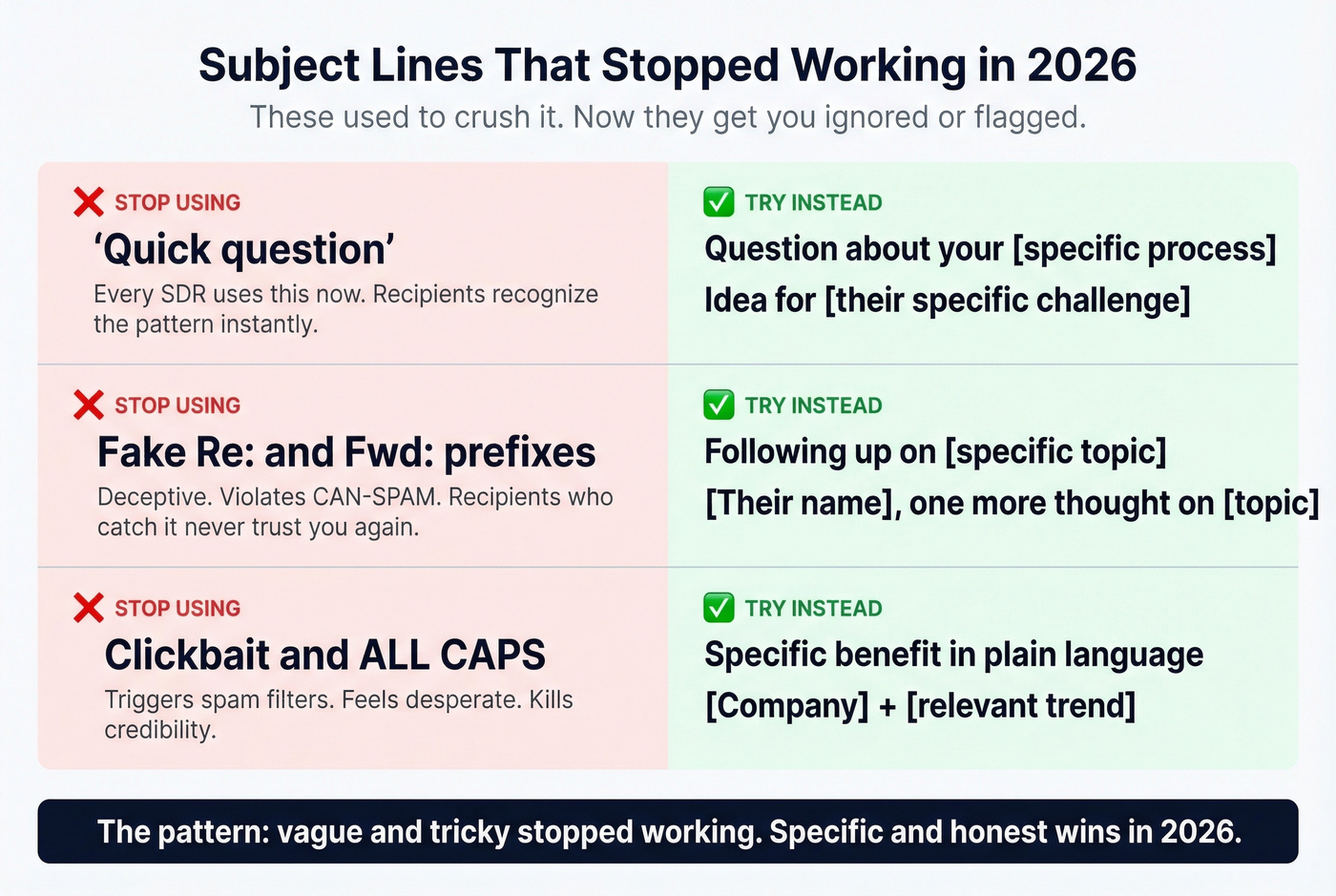
"Quick question" - The consensus on r/coldemail is that this one's burned out. It was effective because it felt casual and low-commitment. Now every SDR uses it, and recipients recognize the pattern instantly. In 2026, it's the subject line equivalent of "To Whom It May Concern."
Fake Re: and Fwd: prefixes - Adding "Re:" to a first-touch email to make it look like an ongoing conversation is deceptive. CAN-SPAM prohibits deceptive subject headings, and ESPs are getting better at detecting this pattern. Recipients who catch it will never trust you again.
"Marketing firm needed" - A subtler form of deception: framing your cold outreach to look like inbound demand. The recipient opens it thinking someone's looking for their services, only to find a pitch. It works once. Then you're permanently flagged.
"Hey {first name}" - Recognized immediately as a cold email template. It signals "I'm using a mail merge tool and didn't bother writing a real subject line."
Bait-and-switch subject lines - "Extra vacation day this year" as the subject for an unrelated HR policy update. It gets opens, sure. It also destroys trust. The next time that sender's name appears, the recipient assumes it's clickbait and skips it. Short-term open rate, long-term credibility damage.
Generic value props - "Increase your revenue by 30%" or "Save 10 hours a week" get deleted on sight. They're seller-centric and unverifiable. Replace them with something specific to the recipient's company or situation.
What works instead? Specificity. A reference to their recent funding round, a mutual connection, or a relevant industry trend. The bar for cold email subject lines keeps rising because everyone's inbox is more crowded than it was last year.
Spam Trigger Words to Avoid
Email filters have gotten smarter, but certain words still raise red flags - especially in combination:
Free - Guarantee - Act now - Limited time - Winner - Congratulations - Urgent - Click here - No obligation - Risk-free
One or two of these in a well-established sender relationship won't kill you. But stack them in a cold email - "Free guarantee, act now!" - and you're going straight to spam. If your subject line sounds like a late-night infomercial, rewrite it.
Subject Lines and Deliverability
Most subject line guides skip this part, and it's the part that matters most for anyone doing outreach at scale.
ESPs like Gmail and Outlook track engagement signals - opens, deletes-without-reading, spam complaints - and use them to route your future emails. A pattern of low engagement from bad subject lines trains spam filters to deprioritize everything you send. It's not just about one email. It's about your domain reputation over time.
Deceptive subject lines carry legal risk too. CAN-SPAM explicitly prohibits misleading subject headings. GDPR's Article 5 requires "lawful, fair, and transparent" processing - and misleading framing is the opposite of transparent.
But let's be honest: the biggest deliverability killer isn't your subject line. It's bad data. Every bounced email chips away at your sender reputation, and enough bounces will land you in spam regardless of how good your copy is. We've seen teams go from 35% bounce rates to under 4% just by running their lists through proper email verification before hitting send.
Our take: if your deals are typically under five figures, don't obsess over subject line A/B tests. Obsess over whether your emails are reaching real inboxes in the first place. Fix deliverability first, then optimize copy.
How to A/B Test Subject Lines
Don't guess. Test. CodeCrew's A/B testing data shows the typical lift ranges:
- Emojis: up to 10% open rate lift (works for promotional, not formal)
- Personalization (first name, company): 1-5% lift
- Length (short vs. long): up to 5% swing either direction
- Send time optimization: up to 10% more opens
- Removing brand name from subject: 1-4% lift
Test one variable at a time. If you change the length and add an emoji and switch the send time, you won't know what moved the needle. Start with subject line length - it's the easiest variable to isolate and typically produces the clearest results.
Words that consistently boost opens fall into three categories: curiosity ("surprising," "secret," "behind the scenes"), urgency ("deadline," "expires," "last chance"), and exclusivity ("invitation," "selected," "early access"). Use them honestly - pair urgency words with genuine deadlines, not manufactured scarcity.
In one case study, systematic A/B testing drove a 114% open rate increase and a 306% revenue-per-recipient bump for a single brand. That's not a typo. Small, tested improvements compound fast.
Skip A/B testing entirely if your list is under 1,000 contacts - the sample size won't produce statistically meaningful results, and you're better off spending that time writing more specific, relevant subject lines for each segment. For more ideas, pull from these email subject line examples and then validate with a subject line tester.
You just bookmarked 100+ subject line templates. None of them matter if your emails bounce. Prospeo verifies every address in real time - 98% accuracy, 7-day data refresh, and catch-all domain handling included. Start at $0.01 per email.
Send your best subject lines to real inboxes, not dead addresses.
FAQ
How long should a professional email subject line be?
Aim for 33 characters to guarantee full visibility on every device. If you can't fit the message in 33, keep it under 50 and front-load the most important words so they survive mobile truncation. Gmail on Android shows the least - just 33 characters.
Should I use emojis in professional emails?
In marketing and sales emails, emojis can lift open rates up to 10%. In internal workplace or executive communication, skip them - they undermine credibility in formal contexts and render inconsistently across email clients.
How do I write a cold email subject line that avoids spam?
Reference something specific - a recent company announcement, a mutual connection, or a relevant industry trend. Generic value claims like "Boost revenue by 30%" get deleted. Specificity signals relevance and separates you from template-driven outreach.
What makes professional email subject line examples effective?
The best examples follow the topic + purpose framework: they tell the reader what the email is about and what action is needed. They stay under 50 characters, front-load the key words, and avoid spam trigger language. Low engagement from weak subject lines trains filters to deprioritize your future sends, so getting this right protects long-term deliverability too.