

Prospect CRM: The Independent Buyer's Guide for B2B Product Businesses
Two Products, One Confusing Name
"Prospect CRM" refers to two completely different products from two different companies. Let's sort this out before you waste 20 minutes on the wrong website.
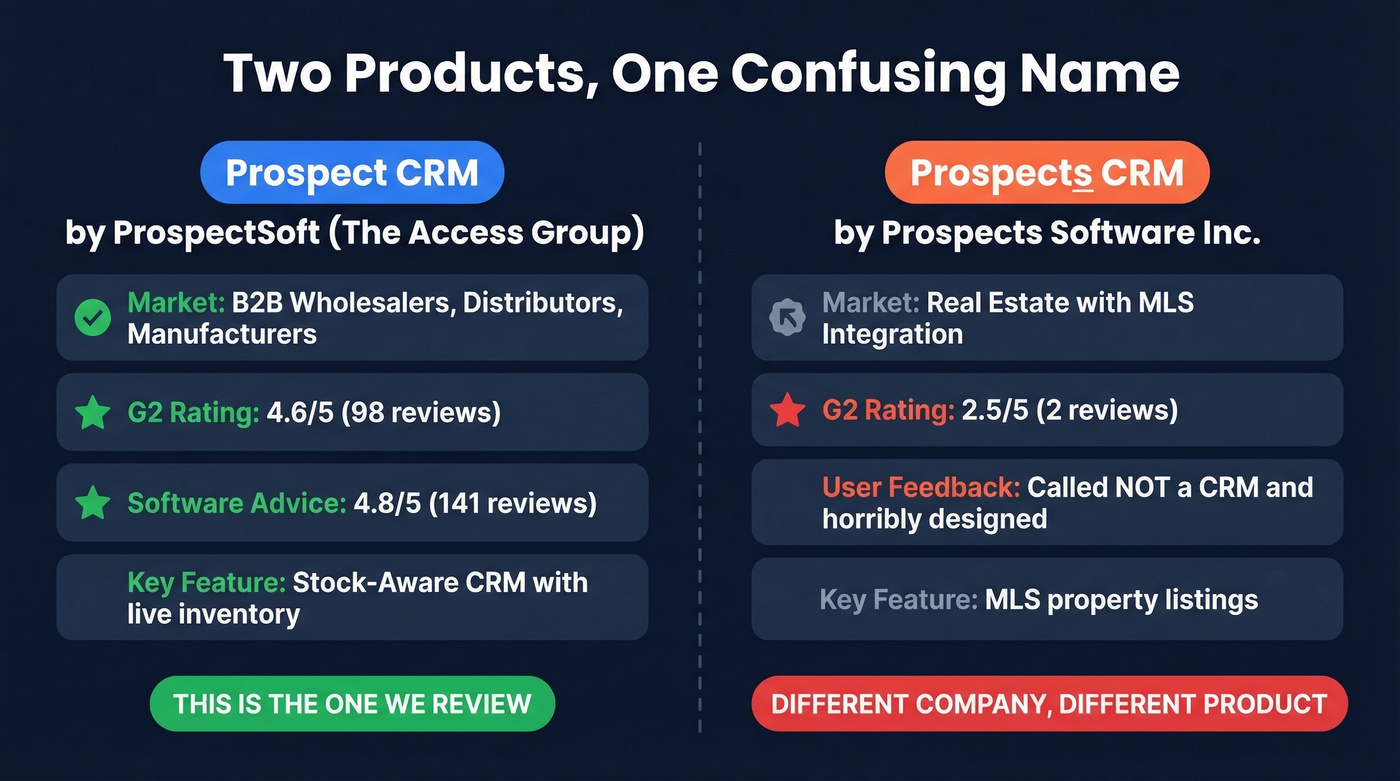
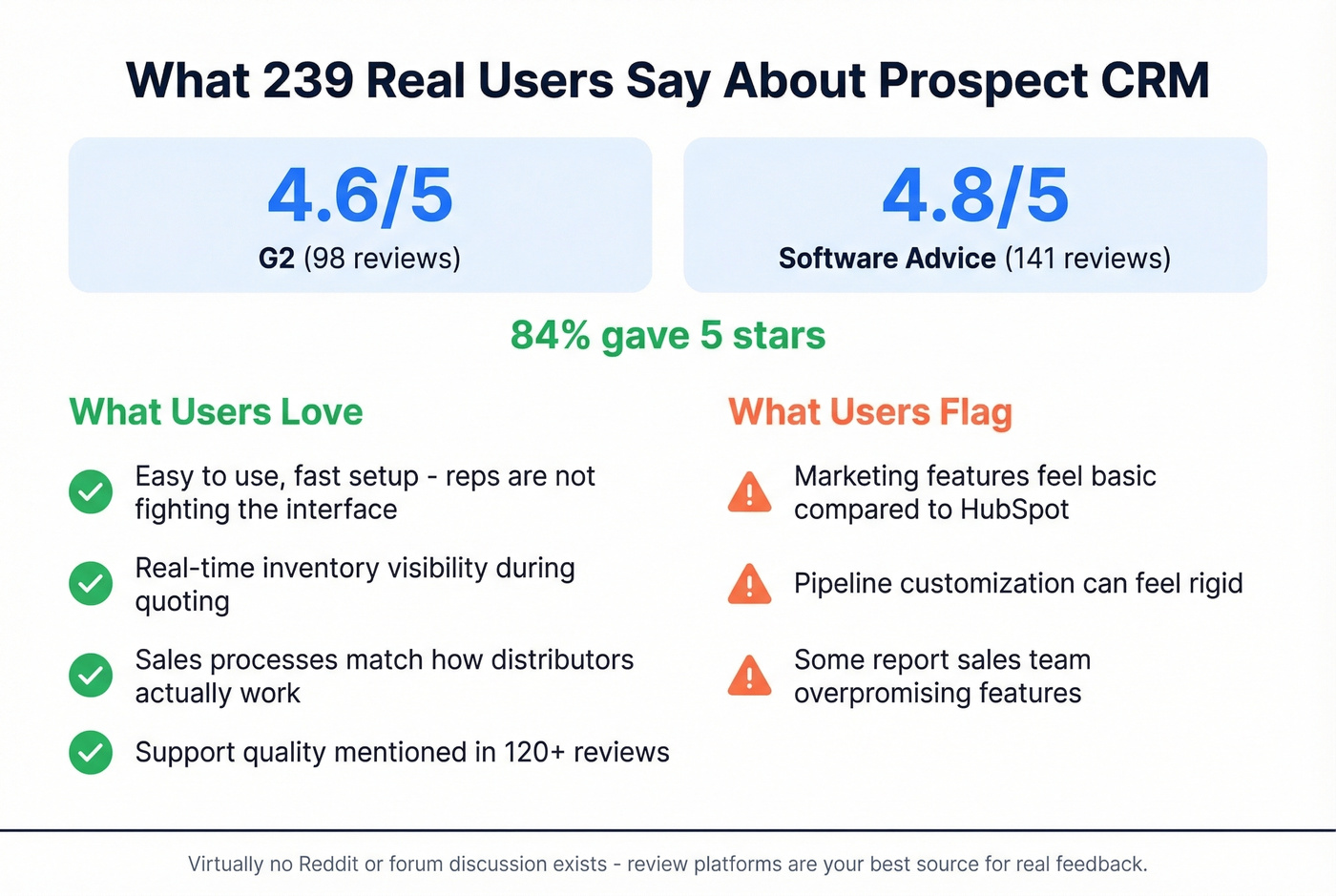
Prospect CRM by ProspectSoft (now part of The Access Group) is a stock-aware CRM built for B2B wholesalers, distributors, and manufacturers. It carries a 4.6/5 on G2 from 98 reviews and a 4.8/5 on Software Advice from 141 reviews. That's the product this guide covers.
Prospects CRM (note the "s") by Prospects Software Inc. is a real estate CRM with MLS integration - completely different company, different market. It holds a 2.5/5 on G2 from just 2 reviews, with users calling it "NOT a CRM" and "horribly designed." If you're in real estate, that's your product. If you sell physical products B2B, keep reading.
30-Second Verdict
Use Prospect CRM if: you sell physical products B2B, your reps quote without knowing what's in stock, and you want a CRM that pulls real-time inventory into the quoting workflow. Starts at $243/mo for 4 users on an annual contract paid monthly, with a 90-day cancellation notice before renewal. Ratings are strong - 4.6/5 and 4.8/5 across 239 reviews.
Skip it if: you need marketing automation (go HubSpot), maximum pipeline customization (go Pipedrive), or you don't sell physical products. It's a niche tool that does its niche extremely well.
What "Stock-Aware CRM" Actually Means
Prospect CRM calls itself a "stock-aware CRM," and that's the most useful two-word description you'll find.
Picture a sales rep on the phone with a distributor. The customer wants 500 units of a specific SKU. In a normal CRM - Salesforce, HubSpot, Pipedrive - the rep creates a quote, sends it, and then someone in the warehouse emails back saying they've only got 120 units with the rest on backorder for three weeks. The customer's annoyed, the rep looks unprofessional, and the deal stalls.
Prospect CRM solves this by pulling real-time inventory data directly into the CRM. When that rep builds a quote, they see live stock levels. If inventory's low, the system triggers a back-to-back purchase order during the quoting process itself. No warehouse emails. No guessing.
ProspectSoft built this specifically for B2B product businesses - wholesalers, distributors, and manufacturers who sell from stock. It's now owned by The Access Group (the same company behind Unleashed inventory management), which matters because the Unleashed integration is native and two-way. ProspectSoft markets a "7-part CRM Growth Engine" framework that structures their onboarding tiers (FlightPath A/B/C). The framework is more marketing than product feature, but it signals how opinionated the product is about how distributors should run their sales operations.
Pricing Breakdown
Here are the three tiers. ProspectSoft lists pricing in USD on its pricing page, and Software Advice lists GBP pricing for the UK market.
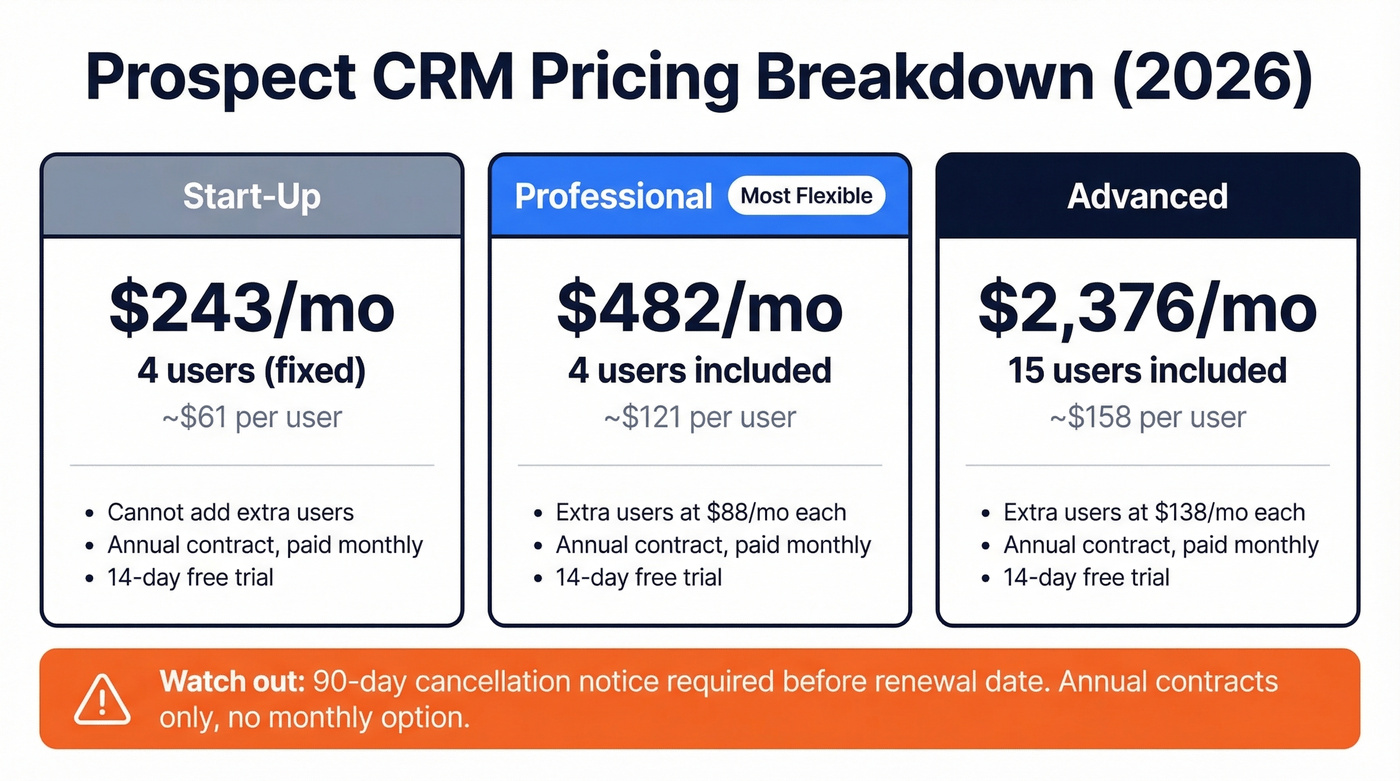
| Start-Up | Professional | Advanced | |
|---|---|---|---|
| USD/mo | $243 | $482 | $2,376 |
| GBP/mo | £177 | £351 | £1,933 |
| Users included | 4 (fixed) | 4 | 15 |
| Extra users | N/A | $88/mo each | $138/mo each |
| Per-user cost | ~$61/user | ~$121/user | ~$158/user |
The contract structure deserves attention. Prospect CRM runs on annual contracts paid monthly, with a 90-day cancellation notice before your renewal date. That's aggressive for an SMB-focused tool. If you're a 6-person distribution company testing your first real CRM, committing to a year with a 90-day exit window feels heavy - especially when HubSpot and Pipedrive let you cancel monthly.
The Start-Up plan is fixed at exactly 4 users. You can't buy it for 2 people or scale to 5. Got a 3-person sales team? You're paying for a seat you don't need. Got 5 reps? You're jumping to Professional at nearly double the price.
There's a 14-day free trial with no credit card required. Onboarding comes in three tiers: FlightPath A (self-service setup), B (guided onboarding), and C (extended consulting and training). Pricing for those packages isn't published, but based on typical SMB CRM onboarding costs, expect $1,000-5,000 depending on complexity and integration count.

A stock-aware CRM tells reps what's in the warehouse. But who fills the pipeline with verified contacts? Prospeo enriches your CRM with 98% accurate emails and 125M+ verified mobiles - 50+ data points per contact, synced directly to HubSpot or Salesforce.
Feed your CRM contacts that actually convert - starting at $0.01 per email.
Features Worth Knowing
Stock-Aware Capabilities
The feature set revolves around one idea: your CRM should know what's in your warehouse.
RFM segmentation (Recency, Frequency, Monetary) scores customers based on buying behavior, not just pipeline stage. For distributors managing hundreds of accounts, this surfaces which customers are slipping away before you lose them entirely. Missing order alerts flag accounts that haven't reordered on their usual schedule - if a customer typically orders every 6 weeks and they're at week 8, your rep gets a nudge. This is retention-focused CRM thinking, and it's where this platform separates from lead-centric tools like Salesforce or HubSpot.
The Magic Matrix is their cross-sell engine. It analyzes what similar customers buy and suggests products your current customer hasn't ordered yet. Think "customers who bought X also bought Y," but built into the CRM workflow rather than bolted on.
Quoting with real-time inventory visibility is the headline feature. Reps see stock levels while building quotes, and the system generates back-to-back purchase orders when stock runs low. Built-in reporting covers sales performance, order trends, and customer health metrics.
Integrations
The integration story is narrow but deep. The Unleashed integration is the crown jewel - both products sit under The Access Group umbrella, so the sync is native and two-way. Real-time inventory, order history, and product data flow between systems without middleware.
Beyond Unleashed, it connects to DEAR (Cin7) and Katana for inventory management, plus the usual accounting suspects: Xero, QuickBooks, and Sage. There's also a Microsoft Word add-in for merging CRM data into quotation templates - useful for teams that still send formal Word-based quotes.
The gaps are revealing. HubSpot isn't listed among core integrations. This isn't a CRM that's built to sit inside a broad marketing automation stack - it's designed to run the sales workflow for product businesses, tightly connected to inventory and order data.
Why Distribution-Specific CRMs Win
Here's the thing: Prospect CRM's real competition isn't Salesforce. It's the spreadsheet your ops manager built in 2019 and the clunky CRM module bolted onto your ERP.
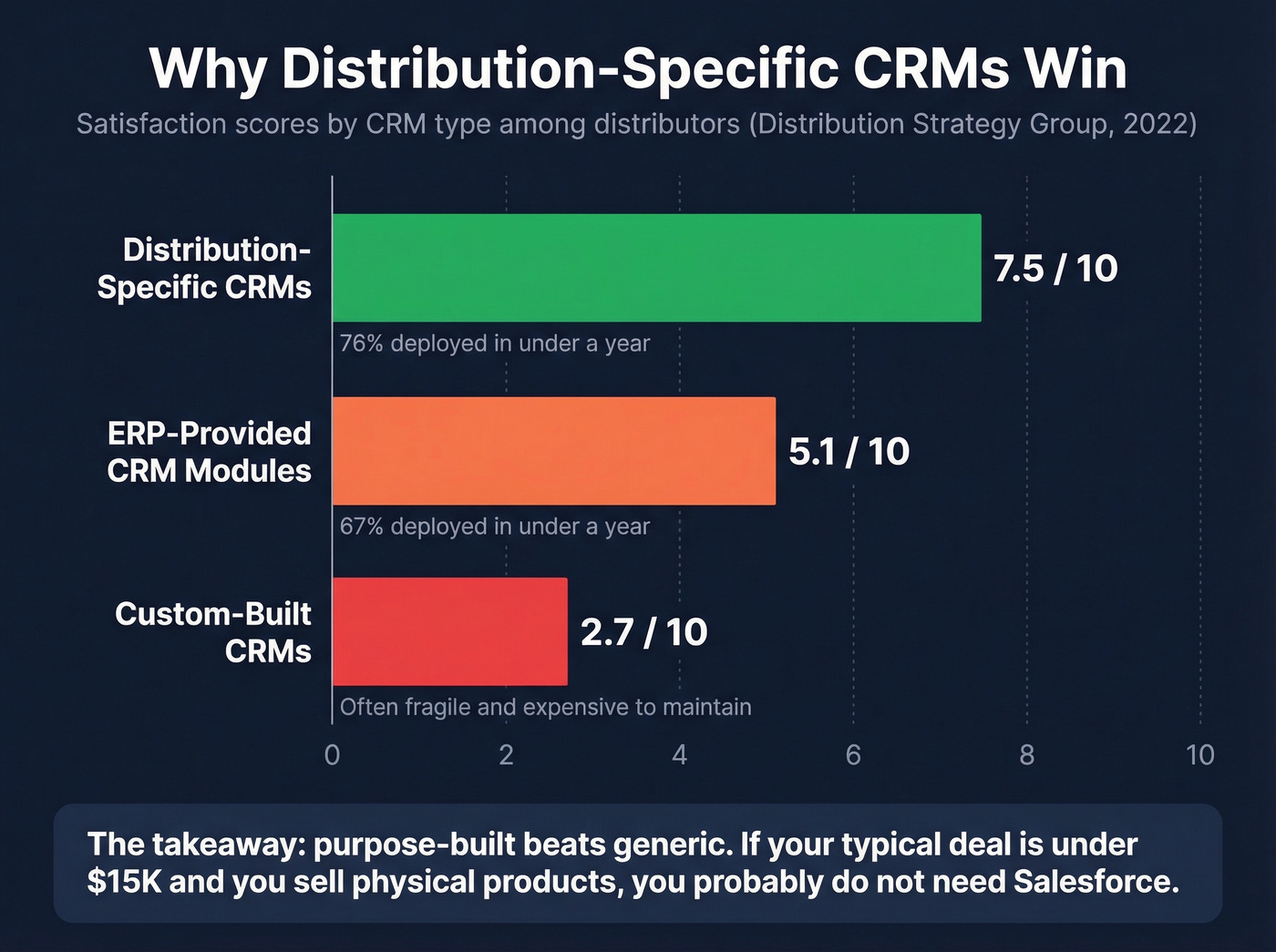
The data backs this up. Per a 2022 Distribution Strategy Group study, CRM adoption among distributors grew from 55% in 2017 to 72% in 2022. But satisfaction varies wildly by CRM type. Distribution-specific CRMs score 7.5/10 on satisfaction. ERP-provided CRM modules? 5.1/10. Custom-built CRMs? A dismal 2.7/10.
Deployment speed matters too. 76% of distributors get distribution-specific CRMs live in under a year, compared to 67% for all-purpose tools. That gap widens dramatically at the enterprise end - we've seen Salesforce implementations for mid-market distributors run $50-150K in year-one total cost (licenses, implementation, integration work, training), and still take 6-12 months before the rollout is truly complete.
The fundamental problem with generic CRMs for product businesses is architectural. Salesforce and HubSpot are built around leads and opportunities. Distributors need to manage existing accounts, track reorder patterns, handle massive product catalogs, and tie everything back to inventory. Forcing that workflow into a lead-centric CRM means endless customization - and customization means cost, complexity, and fragility. If your typical deal size sits below $15K and you're selling physical products, you almost certainly don't need a Salesforce-level platform. A purpose-built tool will get you live faster and cost less in year one.
What Real Users Say
Across 98 G2 reviews and 141 Software Advice reviews, the sentiment is overwhelmingly positive - 84% of reviewers gave it 5 stars. But the negative themes are consistent enough to matter.
What users love:
- Ease of use and fast setup - reps aren't fighting the interface
- Real-time inventory visibility during quoting eliminates warehouse back-and-forth
- Sales processes that match how distributors actually work
- Support quality stands out - it's mentioned in 120+ Software Advice reviews, which is an unusually high ratio for any CRM
What users flag:
- Marketing functions aren't competitive with dedicated tools - email campaigns feel basic compared to HubSpot or ActiveCampaign
- Pipeline customization can feel rigid if your sales process doesn't match the default workflow
- A few reviewers mention sales overpromising features during the buying process versus what's actually delivered
In our experience, the marketing automation gap is the dealbreaker for about half the teams that evaluate this platform. If your team runs sophisticated nurture sequences, segmented email campaigns, or lead scoring workflows, you'll need to pair it with a dedicated marketing tool. And since HubSpot isn't listed among the core integrations, that can create a data silo.
One thing worth noting - there's virtually no Reddit or forum discussion about Prospect CRM. It's a niche product serving a niche market, so the community feedback loop that exists for tools like Salesforce or HubSpot simply doesn't exist here. Review platforms are your best source for real user sentiment.
Who Should Skip This CRM
Not every B2B team belongs here.
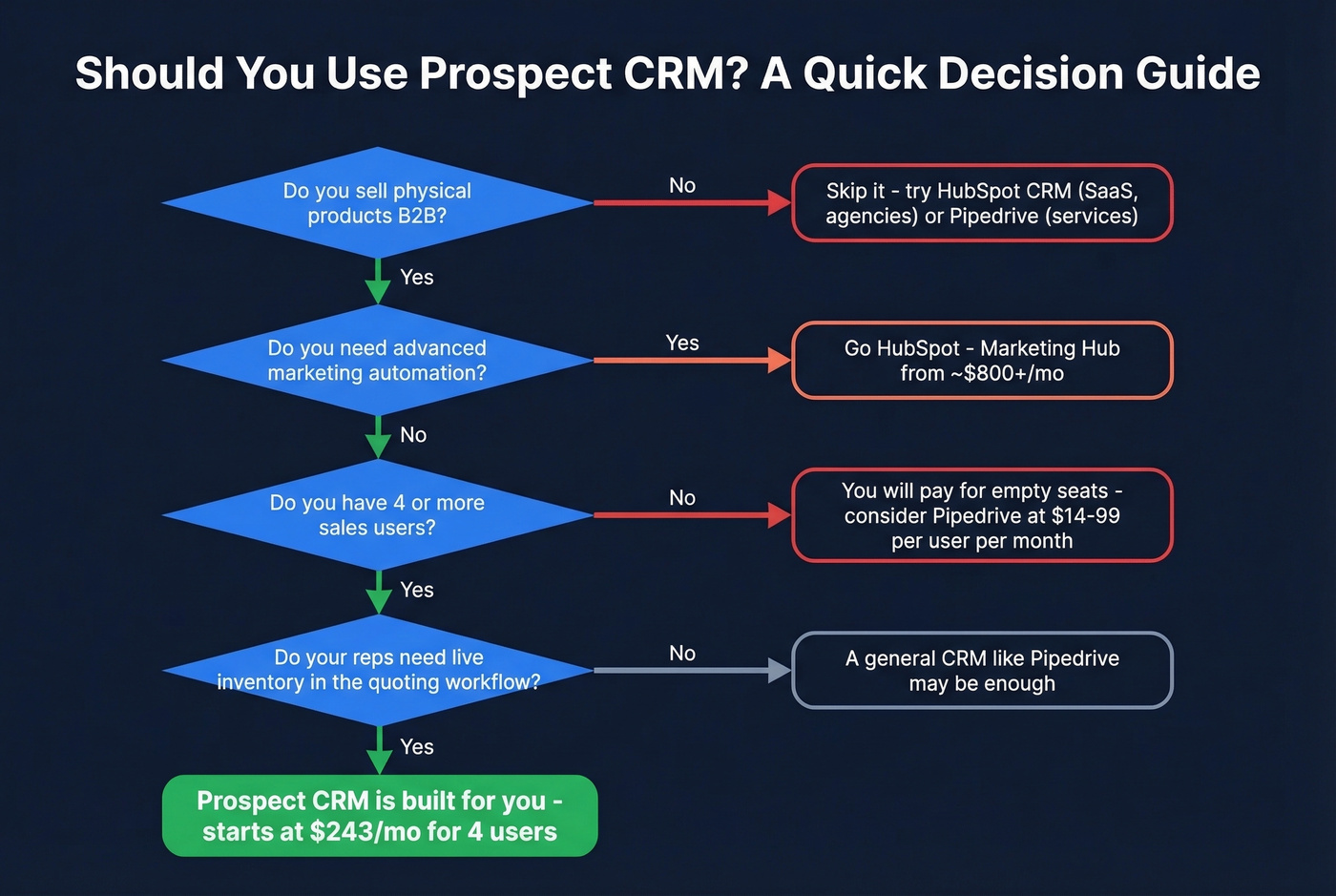
Marketing-first teams should look at HubSpot's CRM (free tier + Marketing Hub from ~$800+/mo) for the automation, lead scoring, and campaign tools this platform lacks.
Teams needing maximum pipeline customization will be happier with Pipedrive (~$14-99/user/mo), which lets you bend the pipeline to match any sales process.
Enterprise-scale organizations still end up on Salesforce - just budget $50-150K for year-one total cost and 6-12 months of implementation.
Teams with fewer than 4 users are paying for empty chairs. The Start-Up plan is fixed at 4 seats with no smaller option.
Companies that don't sell physical products - SaaS, agencies, consultancies - won't get value here. The entire product revolves around inventory, product catalogs, and reorder patterns. No warehouse, no need for a stock-aware CRM.
Filling Your CRM With Quality Data
A CRM is only as good as the contacts inside it. Most distributors fill their pipeline through trade shows, referrals, and inbound inquiries - which works, but it's slow.
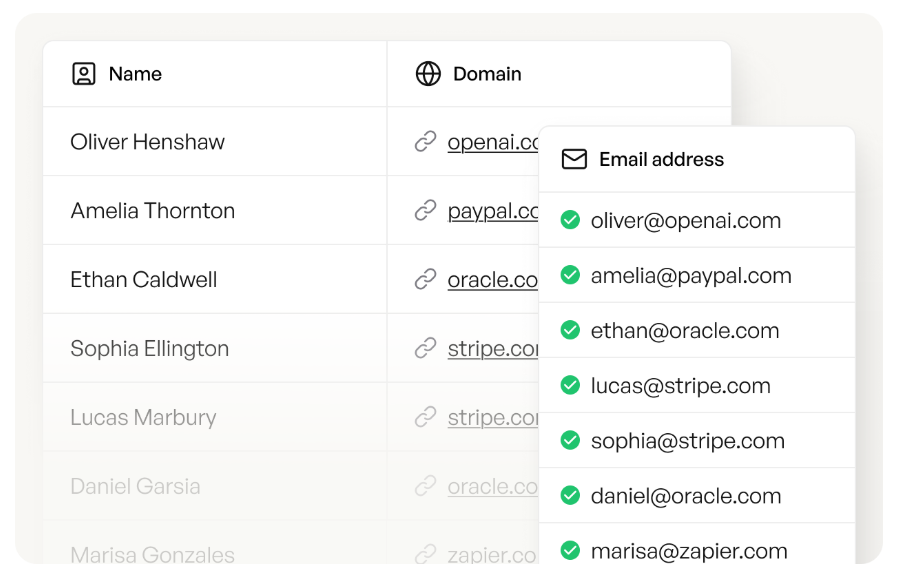
Adding outbound prospecting accelerates the process dramatically. Build a verified contact list using a tool like Prospeo - filter by industry, job title, company size, and buyer intent signals across 300M+ professional profiles, then export a clean CSV and import directly into your CRM. With 98% email accuracy and a 7-day data refresh cycle, you're importing contacts that won't bounce and wreck your sender reputation. From there, the stock-aware features handle quoting, reorder tracking, and retention.
If you want to compare options, start with data enrichment services and a dedicated sales prospecting database before you commit.
Prospect CRM nails inventory-aware quoting for distributors. But before reps can quote, they need real buyer contacts. Prospeo's 30+ search filters - including buyer intent, headcount growth, and technographics - help you build targeted prospect lists with an 83% enrichment match rate.
Stop prospecting blind. Layer intent data on 300M+ verified profiles.
FAQ
Does Prospect CRM offer a free plan?
No permanent free plan exists. There's a 14-day free trial with no credit card required. Paid plans start at $243/mo for 4 users on an annual contract paid monthly - you're committing for a year from day one.
Can I cancel anytime?
No. It's an annual contract requiring 90 days' notice before your renewal date. Miss that window and you're locked in for another year. Mark your calendar 100 days before renewal to give yourself a buffer.
Is "Prospects CRM" the same as "Prospect CRM"?
Completely different products from different companies. Prospect CRM (ProspectSoft/The Access Group) serves B2B wholesale and distribution. Prospects CRM (Prospects Software Inc.) is a real estate CRM with MLS integration. Zero overlap despite the confusingly similar names.
How do I get quality contact data into Prospect CRM?
This platform doesn't include a built-in prospecting database. Use an external B2B data tool to build verified contact lists, export as CSV, and import directly. Outbound prospecting with verified data fills the pipeline faster than trade shows alone.