

Quarter Close: The Practitioner's Guide to Closing Faster
You shouldn't need to work 60-70 hours in a single week to produce financial statements. But that's the reality for a lot of accounting teams during quarter close - 16-hour days, late-night tie-outs, weekends consumed by reconciliations and ad hoc requests. 81% of accounting professionals say the monthly close disrupts their personal lives. The quarterly cycle is worse by every measure.
A quarter-end close is everything month-end close is - journal entries, reconciliations, accruals, depreciation - plus quarterly disclosures, deeper variance analysis, intercompany eliminations, 10-Q prep for public companies, and audit support. Same sprint, more laps.
What You Need (Quick Version)
Three things that actually move the needle:
- Quarter close = month-end close + quarterly disclosures, variance analysis, 10-Q prep, and audit support. If you don't separate the quarter-specific work from the routine close, everything bleeds together and takes longer.
- 50% of teams take 6+ business days to close. A structured checklist with named owners and hard deadlines is the single fastest fix - no software required.
- If you're still running close in spreadsheets, that's the bottleneck. 94% of finance teams use Excel in close, and half blame it for the slowdown. Jump to Quarter-Close Software if you're ready to fix that.
How Long Should Quarter Close Take?
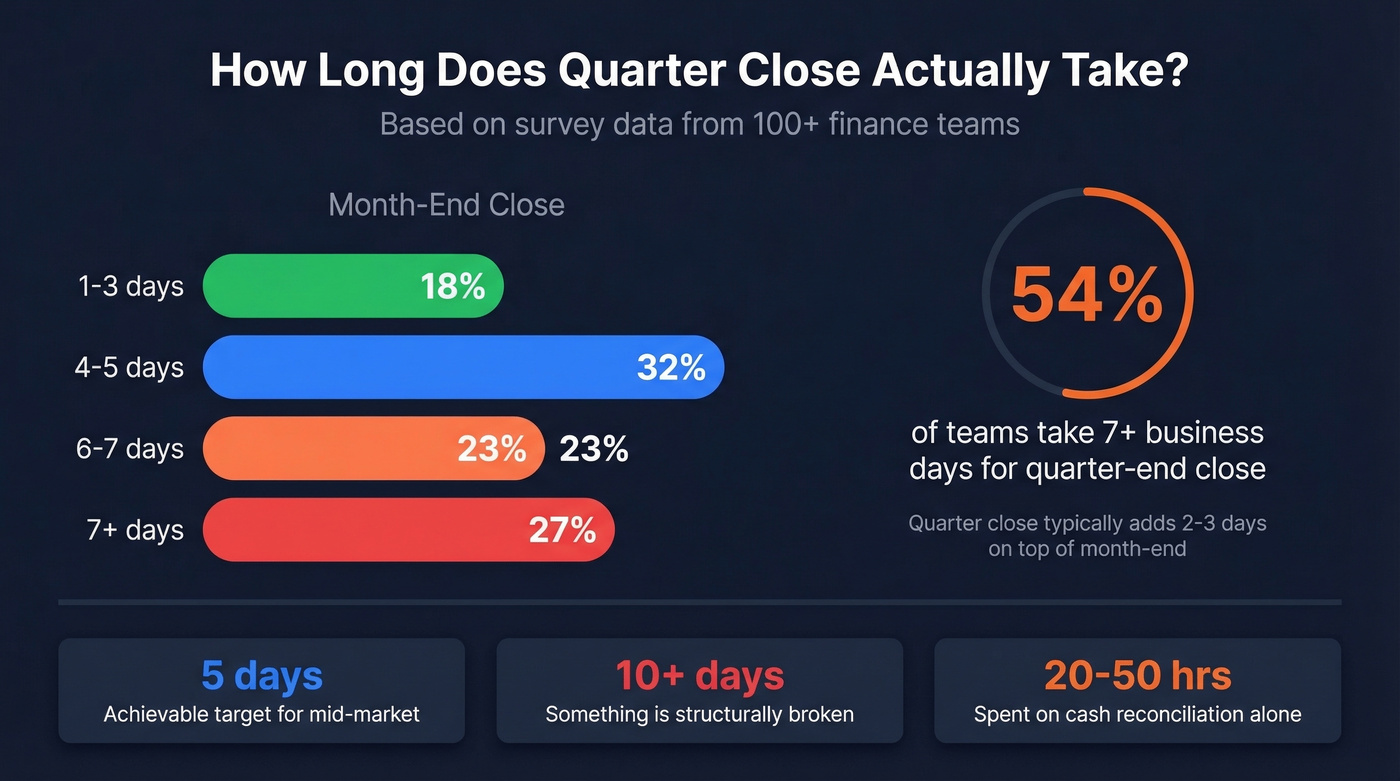
Let's start with where most teams actually land. A survey of 100 finance professionals across SaaS, healthcare, and manufacturing found this distribution for month-end close:
| Days to Close | % of Teams |
|---|---|
| 1-3 | 18% |
| 4-5 | 32% |
| 6-7 | 23% |
| 7+ | 27% |
The quarterly cycle often adds 2-3 days of incremental work on top of that. Numeric's research puts it bluntly: 54% of teams delivered a quarter-end close in 7+ business days. APQC tracks the cycle time from quarterly close completion to earnings release as a key KPI, and for most public filers, earnings releases typically land about 2-4 weeks after quarter-end.
One r/Accounting post asked whether a 10-business-day close is normal. Another described quarter-end getting worse after an acquisition - two weekends in a row, including Sundays.
Here's the thing: a 5-day close is achievable for most mid-market companies. If you're consistently at 10+, something is structurally broken, and it's probably not your team's effort level.
Most teams don't have a close speed problem. They have a close start problem. The work that should happen in pre-close gets punted to Day 1, and everything cascades from there. Fix pre-close, and the rest compresses on its own.
| Dimension | Traditional Close | Modern Close |
|---|---|---|
| Cycle time | 7-10+ days, overtime | 3-5 days or faster |
| Tools | Spreadsheets, siloed | Automated, integrated |
| Controls | Reactive, end-of-period | Embedded, real-time |
| Team impact | Burnout, weekend work | Sustainable workload |
Step-by-Step Checklist
Most quarter-close guides hand you a checklist and call it a day. That's not your problem. Your problem is that nobody owns the checklist. Every task needs a name next to it, a deadline, and a dependency - otherwise it's just a wish list.
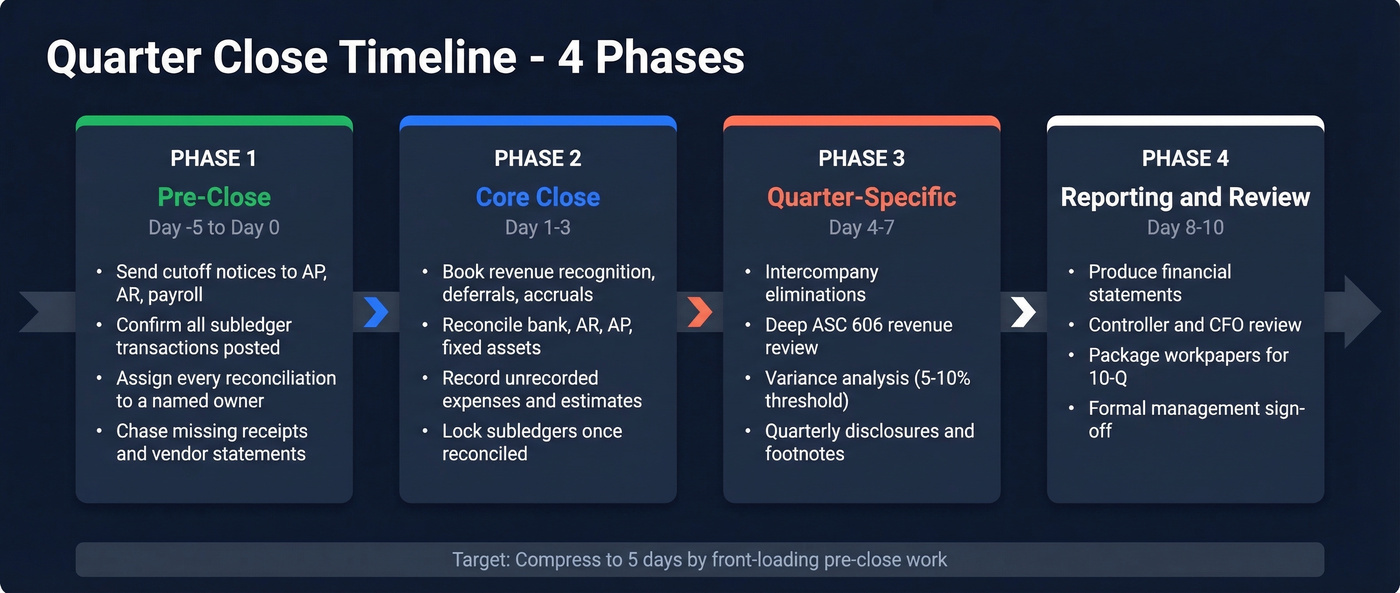
This checklist acts as a detective control: managers can monitor execution and catch missed steps before they cascade into reporting errors.
Pre-Close (Day -5 to Day 0)
Start before the quarter ends. This is where most teams lose time they don't realize they're losing.
Send cutoff notices to AP, AR, payroll, and purchasing at least five days before quarter-end. Every late invoice that arrives on Day 3 adds a day to your close - we've watched this happen at multiple companies, and it's always the same story. Confirm all subledger transactions are posted: payroll, expense reports, card charges, AR invoices. Clear drafts and fix failed recurring transactions. Assign every reconciliation - bank, credit card, intercompany, inventory - to a specific person with a specific due date. Chase missing receipts, vendor statements, and contract amendments now, not during close week.
Core Close (Day 1-3)
This is the standard month-end close engine. Speed here comes from preparation, not heroics.
- Journal entries: Book revenue recognition (review ASC 606 and ASC 944 compliance), deferrals, accruals, reversals, depreciation, and amortization. Aim for 90% of entries posted by end of Day 2.
- Account reconciliations: Bank, AR, AP, fixed assets, prepaid expenses. Cash reconciliation alone eats 20-50 hours per month across 3-5 systems - start it first.
- Accruals and estimates: Record unrecorded expenses, update reserves, and true up estimates from prior periods.
- Subledger close: Lock subledgers once reconciled. No more changes without controller approval.
Quarter-Specific Work (Day 4-7)
This is what separates a quarterly close from month-end. These tasks don't exist in a typical monthly cycle.
Intercompany eliminations deserve the most attention here. Reconcile and eliminate intercompany transactions across entities. For multi-entity orgs, this is often the single biggest time sink - and the one most likely to produce audit findings if done sloppily.
Revenue recognition review goes deeper than the monthly check. You're doing full ASC 606 analysis: contract modifications, variable consideration, performance obligations. If your sales team closed a bunch of complex deals in the final weeks of the quarter, expect this to take longer than you'd like.
Variance analysis compares actuals to budget and prior quarter. Flag anything over 5-10% variance for management discussion. For public companies, this feeds the 10-Q narrative directly. Quarterly disclosures include footnotes, segment reporting, and any new disclosure requirements. Inventory valuation means confirming FIFO/LIFO/weighted average calculations and booking write-downs if applicable.
Reporting & Review (Day 8-10)
Produce the income statement, balance sheet, cash flow statement, and trial balance - tie everything back to the GL. The controller and CFO review comes next, and this is where prior-period adjustments surface. Catch them now, not during audit.
For public companies, package workpapers, reconciliations, and supporting documentation that feeds directly into the 10-Q filing process. Formal management sign-off with documented approvals closes it out - this isn't bureaucracy, it's your audit trail.
FloQast offers a free monthly closing Excel template that works as a starting framework. Adapt it for the quarter-specific layers above.
SEC Filing Deadlines
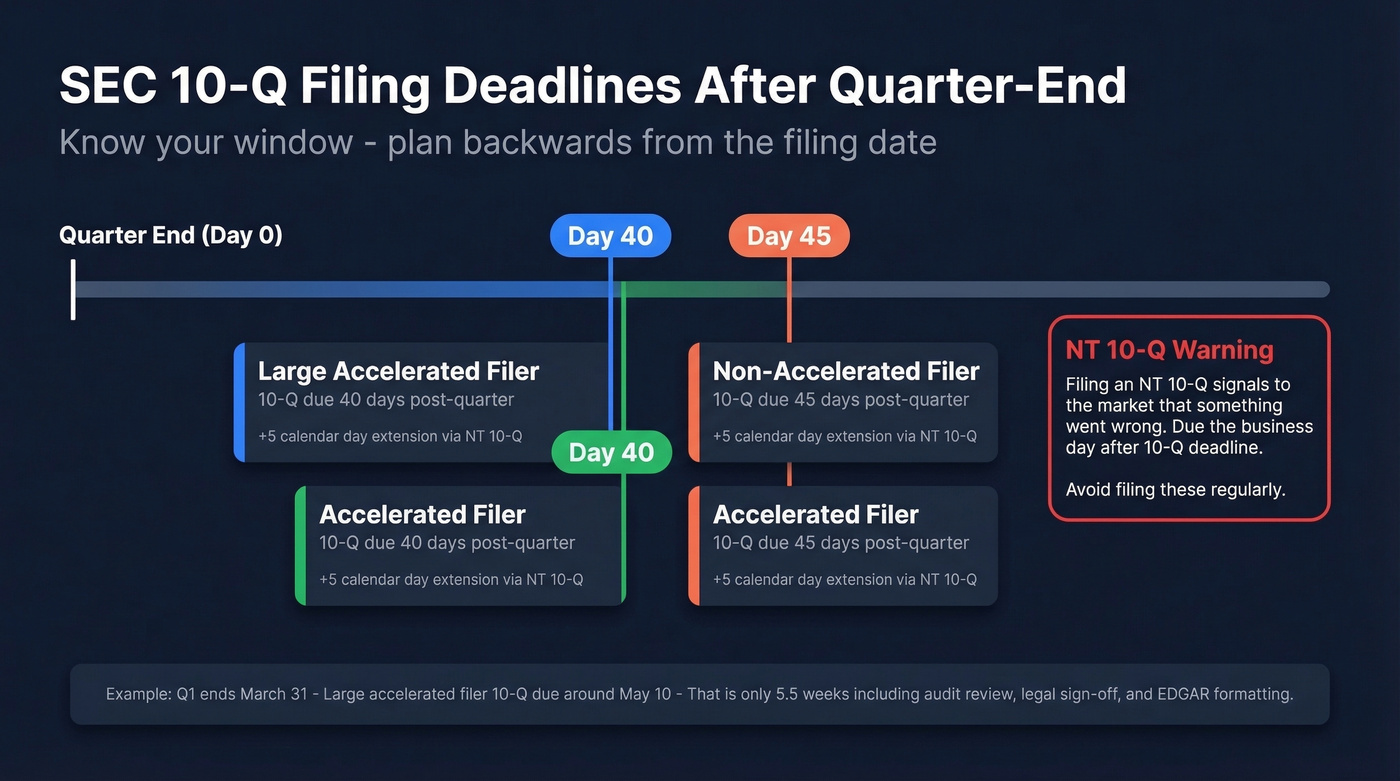
If you're at a public company, the quarter close isn't done when the books are closed - it's done when the 10-Q is filed.
| Filer Type | 10-Q Deadline | NT 10-Q Extension |
|---|---|---|
| Large Accelerated | 40 days post-quarter | +5 calendar days |
| Accelerated | 40 days post-quarter | +5 calendar days |
| Non-Accelerated | 45 days post-quarter | +5 calendar days |
The NT 10-Q form is due the business day after the 10-Q due date. Filing it buys you 5 calendar days, but it's a signal to the market that something went wrong. You don't want to be filing NT 10-Qs regularly.
For a large accelerated filer closing Q1 on March 31, the 10-Q is due around May 10 (next business day if the date falls on a weekend or holiday). That gives your team roughly 5.5 weeks from quarter-end to filing - which sounds generous until you factor in audit review, legal sign-off, and EDGAR formatting.

Quarter close drags when pipeline data is unreliable - reps chase bad contacts, deals slip, and revenue recognition turns into guesswork. Prospeo's 98% email accuracy and 7-day data refresh mean your CRM reflects reality, not stale records from six weeks ago.
Clean pipeline data means fewer last-minute deal surprises at quarter-end.
Why Quarter Close Breaks
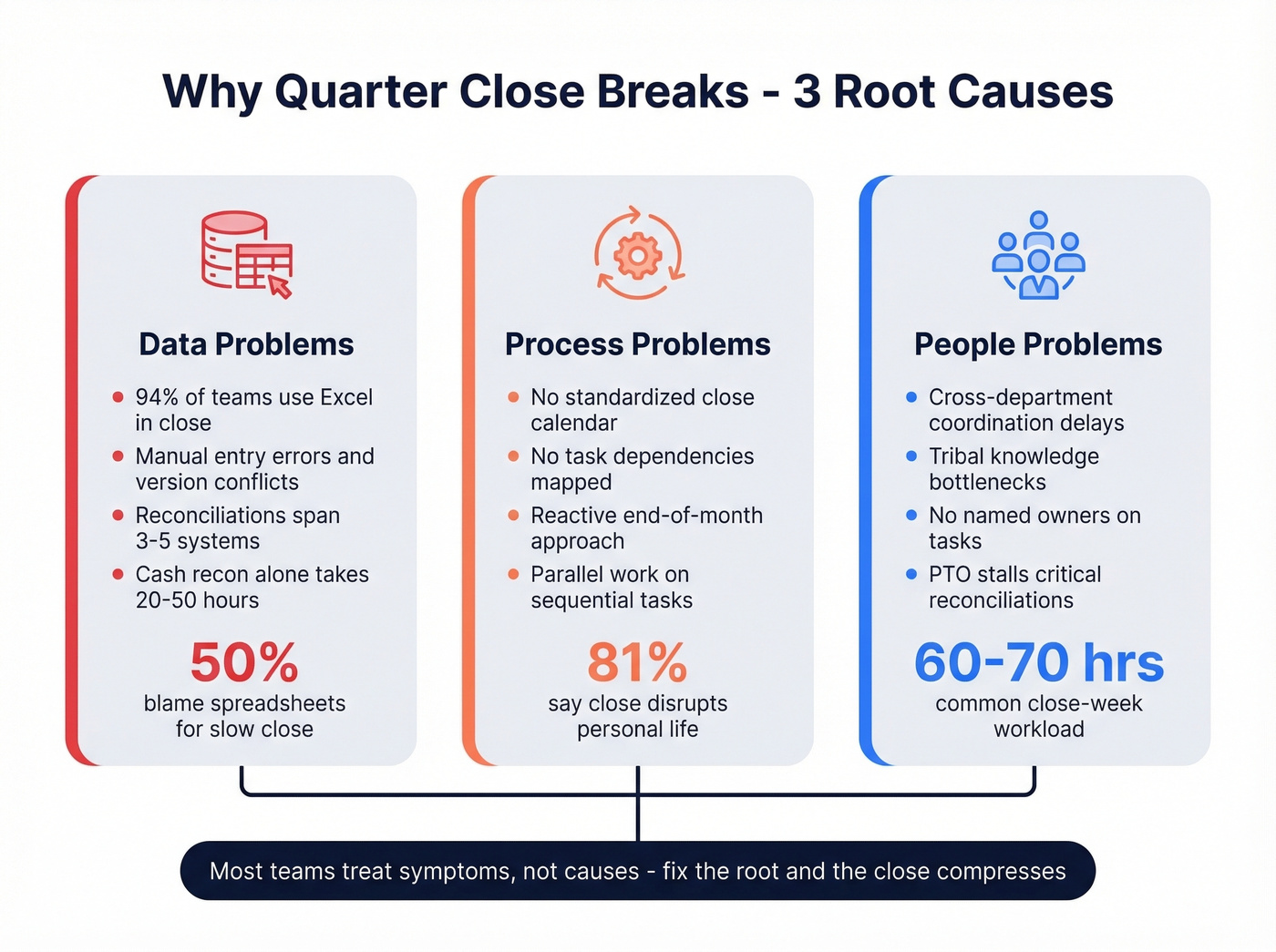
We've seen the same three root causes across dozens of close processes. They're not surprising, but they're worth naming explicitly because most teams treat symptoms instead of causes.
Data Problems
94% of finance teams use Excel in their close process. Half say it's a key reason the close is slow. Manual entry errors, inconsistent data across systems, version control nightmares, and reconciliations spanning 3-5 systems create a fragile foundation. When your cash reconciliation alone takes 20-50 hours because you're pulling from multiple bank feeds, credit card platforms, and ERP modules, the problem isn't your team. It's the tooling.
Process Problems
No standardization, no visibility, no accountability. The "wait until end of month" reactive approach means everything piles up in the same 5-day window. Without a documented close calendar with dependencies, teams work in parallel on tasks that should be sequential - or wait on tasks that could've been done in pre-close.
People Problems
The r/Accounting subreddit is full of posts about close-week chaos: coordinating with sales for AR reconciliation, chasing purchasing for missing references, waiting on warehouse for inventory verification. One poster described their team's close taking 4 business days with late nights every single one - and the bottleneck was always cross-department coordination. Another described quarter-end getting worse after an acquisition: two full weekends, including Sundays.
Tribal knowledge compounds all of this. When one person owns a critical reconciliation and they're on PTO, the whole close stalls.
Common Mistakes to Avoid
Skipped reconciliations are the most dangerous. Bank, AR, AP, and intercompany reconciliations get deferred "because we're behind," which distorts cash reporting and creates audit findings. Reconcile everything, every quarter. If you're short on time, prioritize cash and intercompany, but never skip them entirely.
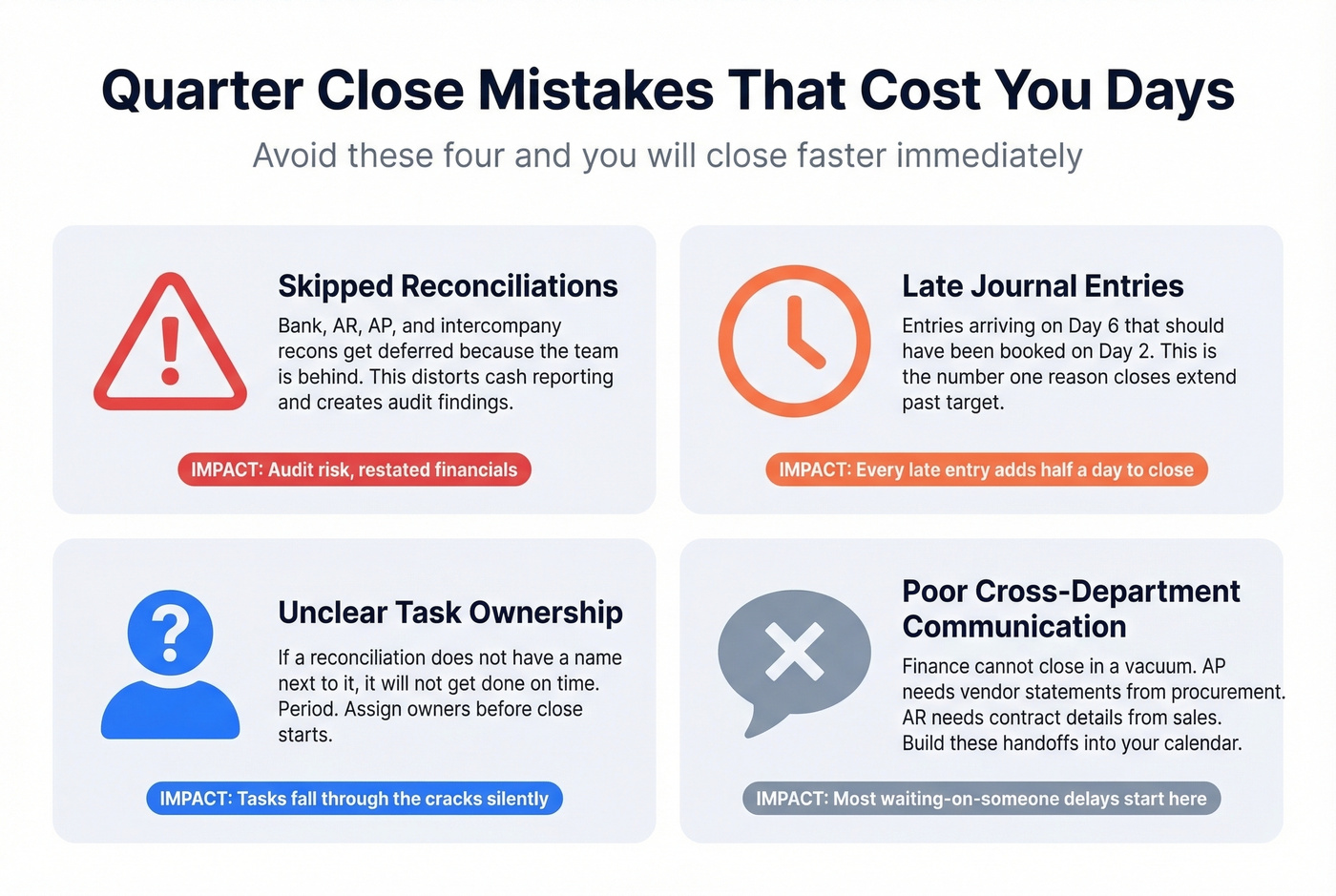
Late journal entries are the #1 reason closes extend past their target. Entries that arrive on Day 6 should've been booked on Day 2. Set hard cutoffs and enforce them - anything booked after the cutoff requires controller approval and a documented reason.
Unclear task ownership kills timelines quietly. If a reconciliation doesn't have a name next to it, it won't get done on time. Period.
Poor interdepartmental communication is the root cause behind most "waiting on someone" delays. Finance can't close in a vacuum. AP needs vendor statements from procurement. AR needs contract details from sales. Build these handoffs into your pre-close process with specific deadlines for each department.
Inadequate internal controls save time in the short term and create restatement risk in the long term. Segregation of duties, approval workflows, and review steps aren't optional. Run a quarterly controls self-assessment - 30 minutes with your team reviewing who approves what and whether the process matches the documentation.
Ignoring prior-period adjustments means you're building on a shaky foundation. Small errors from last quarter compound. Add a "prior-period review" task to Day 1 of every close checklist - 45 minutes of review prevents hours of rework later.
No post-close review guarantees you'll repeat the same mistakes next quarter. Without a retrospective - what took too long, what broke, what can be automated - nothing improves. We've seen teams shave two full days off their close just by running retrospectives for three consecutive quarters. Fifteen minutes of debrief saves hours next cycle.
Quarter-Close Software
Your ERP isn't a close management tool. SAP, Oracle, NetSuite - they're systems of record. They weren't designed to orchestrate close workflows with task dependencies, real-time status tracking, and cross-functional visibility. That's why 58% of CFOs plan to increase their automation investment over the next 12 months.
Close management software sits on top of your ERP and handles what it can't: reconciliation management, journal entry tracking, task sequencing with dependencies, variance analytics, and integrations across your accounting stack.
| Tool | Best For | Starting Price | Our Pick For |
|---|---|---|---|
| BlackLine | Enterprise reconciliation (SAP/Oracle) | ~$50K-150K+/yr | $100M+ revenue with SAP |
| FloQast | Mid-market close management | ~$20K-80K+/yr | $20M-500M revenue teams |
| Numeric | Growing teams, transparent pricing | $30/mo per user | Teams of 3-10 outgrowing Excel |
| Trintech/Adra | Multi-entity intercompany | ~$30K-100K+/yr | Heavy intercompany workflows |
| Workiva | SEC reporting/compliance | ~$25K-100K+/yr | Filing bottleneck, not accounting |
Numeric is the only vendor in this list with published self-serve pricing. Ranges for other tools are industry estimates and vary by entity count, modules, and implementation scope.
Skip BlackLine Under $100M
BlackLine is the enterprise standard for a reason. It handles high-volume reconciliations, journal entry management, and intercompany accounting across complex org structures with deep SAP and Oracle integrations. The tradeoff: implementation takes months, not weeks, and you're looking at $50K-150K+ per year. For companies above $100M in revenue with complex multi-entity structures, it's the right call. Below that threshold, you're paying for capability you won't use.
FloQast: Built by Accountants
We've watched mid-market teams cut 2-3 days off their close within the first quarter of implementing FloQast. The UX maps directly to how close actually works - checklist-driven, with tie-outs and review workflows that feel natural to anyone who's lived through a close cycle. It's the sweet spot for companies in the $20M-500M revenue range that need structure without enterprise complexity. Pricing typically runs $20K-80K+ per year depending on team size.
Numeric: Transparent Pricing
Here's what makes Numeric different: you can see the price before talking to sales. Starter plans begin at $30/month per user. It covers task management, flux analysis, and ERP integrations. If you're a 3-10 person accounting team outgrowing spreadsheets but can't justify a six-figure contract, start here.
Trintech and Workiva
Trintech/Adra is purpose-built for multi-entity organizations with heavy intercompany elimination workflows, typically $30K-100K+ per year. If intercompany is your biggest close bottleneck, it deserves a look.
Workiva focuses on SEC reporting and compliance - 10-Q/10-K preparation, XBRL tagging, and collaborative disclosure drafting, also in the $25K-100K+ range. If your bottleneck is the filing process rather than the accounting, Workiva is where to start.
Shifting to Continuous Close
The traditional close is a sprint: everything piles up at period-end, the team works overtime, and the books get closed in a compressed window. Continuous close flips this model. Instead of batch reconciliation at month-end, you're running rolling daily validations, posting entries throughout the period, and keeping the books near-audit-ready at all times.
The benefits are real: reduced crunch periods, real-time error detection, and financial statements that are always close to final. But you don't get there overnight.
Three quick wins to start moving in that direction:
Standardize your checklist with owners and deadlines. This costs nothing and typically saves 1-2 days per close. Automate bank reconciliation. Cash recon is the #1 time sink - even basic automation cuts 20-50 hours per month. Close subledgers daily. Don't wait for month-end to lock AP, AR, and payroll subledgers. Close them as transactions complete.
Moving to continuous close usually means evaluating new tools, and that means reaching the right people at vendors like BlackLine, FloQast, or Numeric without waiting weeks on procurement. Prospeo finds verified emails for any B2B contact with 98% accuracy, so you can reach the right decision-maker directly instead of filling out a "request a demo" form and waiting.
Your close timeline compresses when sales delivers clean, verified deals - not phantom pipeline built on outdated contacts. Prospeo enriches your CRM with 50+ data points per contact at a 92% match rate, so forecasts hold and quarter close stays on schedule.
Stop reconciling pipeline fiction. Start closing quarters with data you trust.
FAQ
What's the difference between quarter close and month-end close?
Quarter close includes everything in a month-end close - journal entries, reconciliations, accruals, financial statements - plus quarter-specific work like deeper variance analysis, intercompany eliminations, quarterly disclosures, and 10-Q preparation for public companies. It typically adds 2-3 business days beyond a standard monthly cycle.
How many business days should a quarterly close take?
A well-run mid-market team should target 5-7 business days. Benchmark data shows 54% of teams take 7+ days, but structured checklists and automation can bring that down to 3-5 days. If you're consistently above 10 days, your process needs structural changes - not just more effort.
What is a 10-Q filing?
A 10-Q is a quarterly financial report required by the SEC for all public companies. It includes unaudited financial statements, management discussion and analysis, and disclosure updates. Large accelerated and accelerated filers must file within 40 days of quarter-end; non-accelerated filers get 45 days.