

The Close Process Is Broken - Here's How to Fix It
It's day 7 of the close. AP still hasn't posted three vendor invoices, the intercompany entries don't tie, and the controller is manually reconciling cash in a spreadsheet that's been copy-pasted since 2019. Sound familiar?
The close process takes 50% of teams 6+ business days to complete. The problem isn't your people. It's your process.
What Is the Close Process?
The close process - also called the financial close or month-end close - is the sequence of steps a finance team follows to finalize all transactions, reconcile accounts, and produce accurate financial statements for a given period. It's how you go from "the month ended" to "here are the numbers we trust."
You'll also hear this term in two other contexts. In project management, it's the formal wrap-up of a project under PMBOK's Closing Process Group. In sales, it's the final stage of converting a prospect into a customer - sometimes called the close plan sales teams rely on to move deals across the finish line. This guide goes deepest on the financial close, but we'll cover all three before we're done.
What You Need (Quick Version)
- If your close takes 6+ days, the problem is process, not people. Start with the five root causes below.
- Fix three things before buying software: standardize your checklist, lock your periods, and set departmental cutoff dates.
- If you're evaluating tools: FloQast for mid-market, Numeric for transparent pricing, BlackLine for complex enterprise.
2026 Close Benchmarks
Here's where the industry actually stands. A survey of 100 finance professionals gives us the clearest recent distribution:
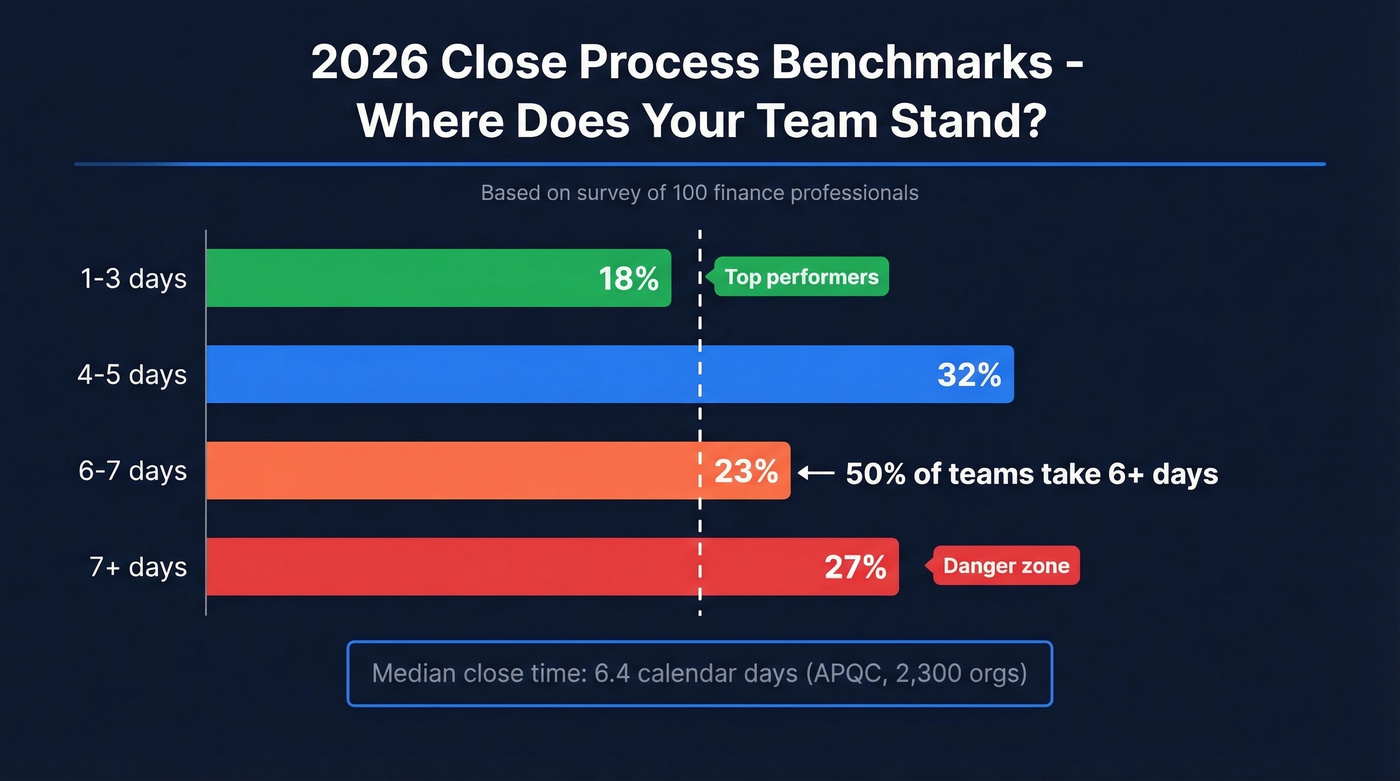
| Close Time (Business Days) | % of Teams |
|---|---|
| 1-3 days | 18% |
| 4-5 days | 32% |
| 6-7 days | 23% |
| >7 days | 27% |
Half of finance teams close in under six days. Half don't.
For historical context, APQC's benchmark across 2,300 organizations pegged the median at 6.4 calendar days. Ventana Research data shows the share of companies closing within four days rose from 29% to 46% - but that sample was just 48 companies, 70% of which were enterprises with $500M+ revenue. Not exactly representative.
Here's the uncomfortable truth: progress has stalled. Despite a decade of automation tools entering the market, the median close hasn't meaningfully shortened for most mid-market teams. The tools exist. The adoption doesn't.
Financial Close, Step by Step
A well-run close follows a predictable calendar. Here's how it breaks into three phases across roughly 9 business days - from five days before period end through four days after.
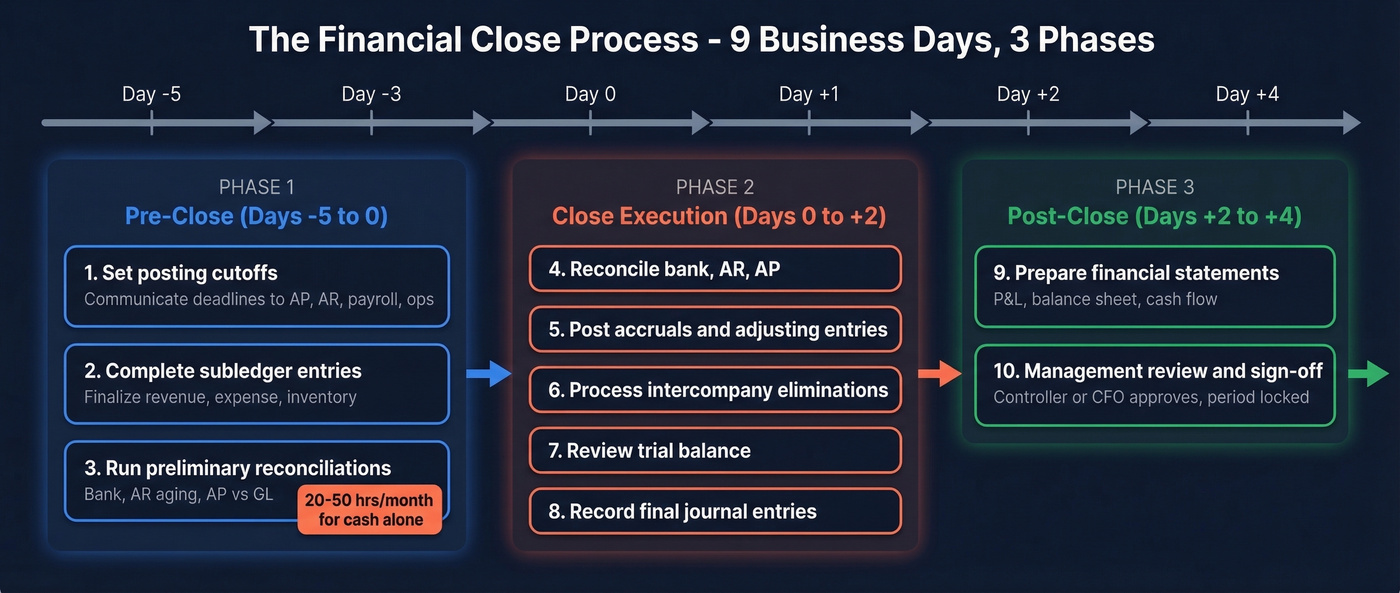
Pre-Close (Days -5 to 0)
- Set posting cutoffs. Communicate deadlines to AP, AR, payroll, and operations. Every department needs to know when their last transactions must be posted.
- Complete subledger entries. All revenue, expense, and inventory transactions should be finalized before the period flips.
- Run preliminary reconciliations. Start matching bank statements, AR aging, and AP balances against the GL. Cash reconciliation alone eats 20-50 hours per month for most teams using 3-5 systems.
Close Execution (Days 0 to +2)
- Reconcile bank, AR, and AP accounts. This is where the most time goes. Unreconciled items distort cash balances and inflate reported expenses.
- Post accruals and adjusting entries. Late accruals are the single most common reason periods get reopened.
- Process intercompany eliminations. Multi-entity orgs spend disproportionate time here, especially without automated matching.
- Review the trial balance. Flag variances, investigate anomalies, and clear suspense accounts.
- Record final journal entries. Depreciation, amortization, prepaid allocations, and any reclassifications.
Post-Close (Days +2 to +4)
- Prepare financial statements. Income statement, balance sheet, cash flow - consolidated if multi-entity.
- Management review and sign-off. Controller or CFO reviews, approves, and the period gets locked.
Every step should have a clear owner. We've seen teams materially shorten their close just by assigning RACI ownership to each task - no new software required.
Month-End vs. Quarter-End vs. Year-End
Not all closes are created equal.
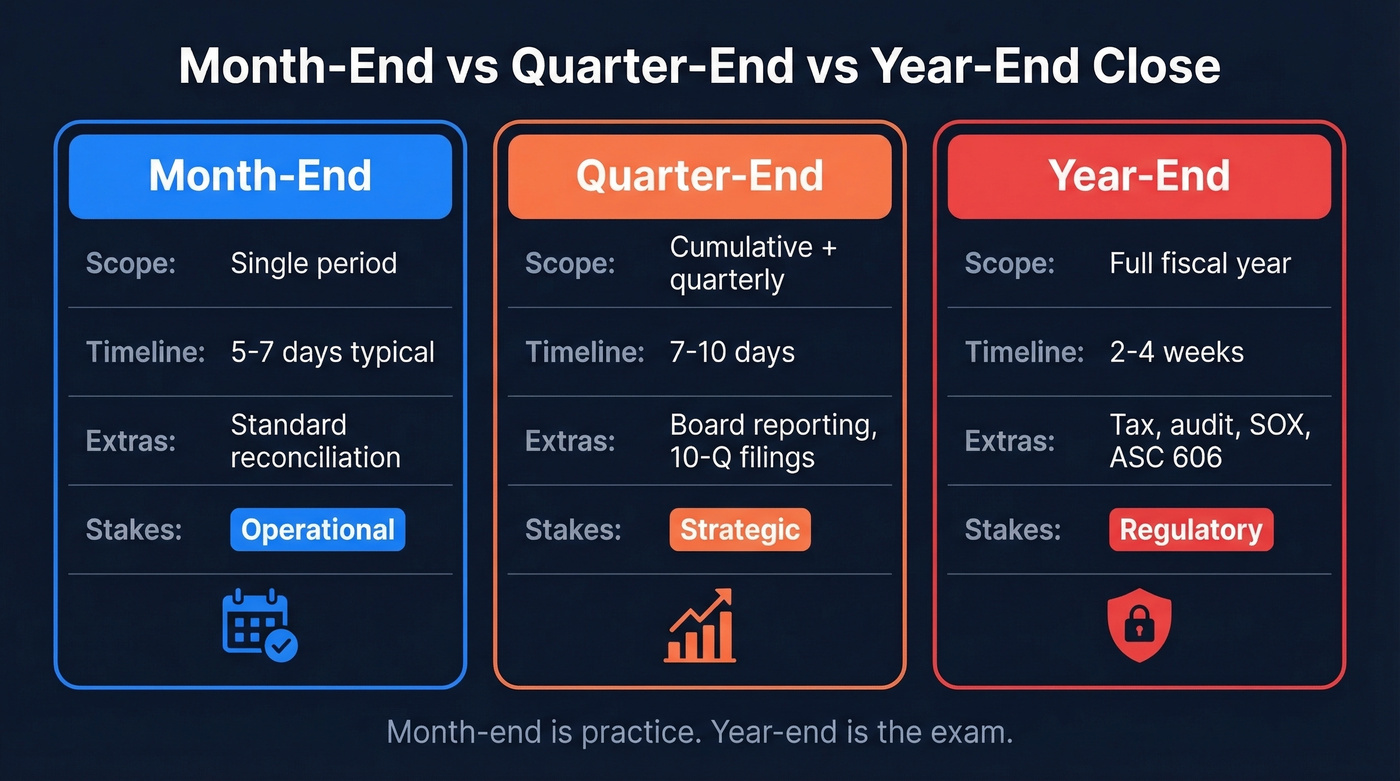
| Month-End | Quarter-End | Year-End | |
|---|---|---|---|
| Scope | Single period | Cumulative + quarterly | Full fiscal year |
| Timeline | 5-7 days typical | 7-10 days | 2-4 weeks |
| Extras | - | Board reporting, quarterly filings (10-Q for U.S. public companies) | Tax, audit, SOX |
| Stakes | Operational | Strategic | Regulatory |
Year-end is where things get serious. You're dealing with tax obligation calculations, audit preparation, revenue recognition adjustments under ASC 606%20SECTION%20A%E2%80%94SUMMARY%20AND%20AMENDMENTS%20THAT%20CREATE%20REVENUE%20FROM%20CONTRACTS%20WITH%20CUSTOMERS%20(TOPIC%20606)%20AND%20OTHER%20ASSETS%20AND%20DEFERRED%20COSTS%E2%80%94CONTRACTS%20WITH%20CUSTOMERS%20(SUBTOPIC%20340-40), and internal control reviews. Randstad's analysis of common year-end mistakes highlights tax obligations and internal controls as the two most frequent failure points that create downstream problems. Month-end is practice. Year-end is the exam.

A broken close process doesn't just slow finance - it stalls sales. When your pipeline data is outdated, deals slip past quarter-end. Prospeo refreshes 300M+ profiles every 7 days with 98% email accuracy, so your revenue numbers don't get held up by bad contact data.
Stop closing the books on deals that were dead from bad data.
Why Your Close Is Slow
Here's a stat that doesn't get enough attention: 81% of finance professionals say the close disrupts their personal lives. That's not just an efficiency problem - it's a retention problem. And it traces back to five root causes that account for the vast majority of delays.
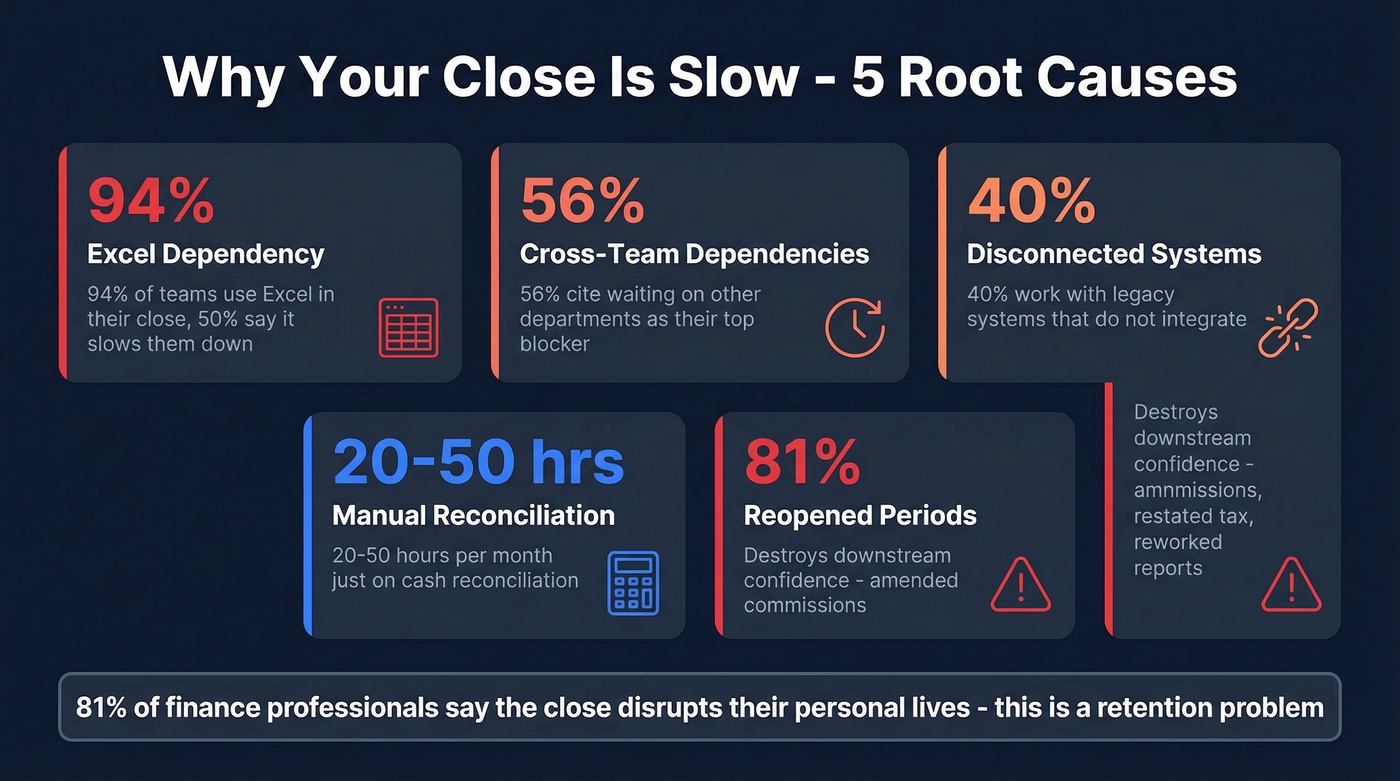
Ask any accountant online about month-end and you'll hear the same three complaints: late accruals from ops, Excel version control nightmares, and intercompany entries that never tie on the first pass. In our experience, those complaints map neatly to these five systemic failures.
Excel dependency is the biggest one. 94% of finance teams use Excel in their close, and 50% say it's a key reason things run slow. This isn't a technology problem - it's an inertia problem. Nobody owns the migration, so nobody starts it.
Cross-team dependencies come next. 56% of finance professionals cite waiting on other departments or regions as their top blocker. When AP posts on a different cadence than revenue, you get rework. When payroll misses a cutoff, the entire timeline shifts right.
Disconnected systems compound the problem. 40% of teams work with legacy systems that don't integrate. Hours get burned reconciling data that should match automatically between your ERP, banking platform, and billing system. We've reviewed dozens of close workflows, and the pattern is always the same: three systems that each think they're the source of truth, and a human in the middle trying to reconcile them in a spreadsheet.
Manual reconciliation is the time sink everyone knows about but nobody fixes. Cash reconciliation alone runs 20-50 hours per month. Line-by-line matching of bank data against spreadsheets is the kind of work that should've been automated five years ago.
Reopening closed periods is the most insidious cause. Every time someone reopens a locked period to post a late entry, it destroys downstream confidence - amended commissions, restated sales tax, reworked reports. Require management approval to reopen. Period.
9 Close Mistakes to Avoid
No checklist or priorities. Without a standardized task list, critical steps get skipped or done out of order. The most common casualty is reconciliation - it gets pushed to the end and then rushed.
Waiting until the last minute. Pre-close work should start 3-5 days before period end, not after. Teams that batch everything into the first two days after close consistently take 2-3 days longer than those who start early.
Skipping reconciliation. Unreconciled bank accounts distort cash balances. Unreconciled AR risks revenue loss. Unreconciled AP inflates expenses. If you're only going to fix one thing on this list, make it this one.
Manual entry errors. Transposed numbers and formula mistakes compound across periods. One wrong decimal in a depreciation schedule can cascade through three months of reporting before anyone catches it.
Missing documents. Invoices, receipts, and contracts that aren't collected before close create bottlenecks. The fix is simple: set a hard document cutoff 48 hours before the close starts and enforce it.
Improper revenue recognition. Especially dangerous at year-end - ASC 606 compliance isn't optional. Getting this wrong doesn't just mean restatements; it means audit findings and potential SEC scrutiny for public companies.
Poor cross-department communication. If payroll, ops, and finance aren't aligned on cutoff dates, someone's posting late. A shared calendar with hard deadlines, communicated two weeks in advance, eliminates most of these delays.
Inadequate internal controls. No segregation of duties, no approval workflows, no audit trail - these create both errors and fraud risk. Year-end auditors will flag every one of them.
Overlooking tax obligations. Miscalculated or missed tax entries at year-end can trigger penalties and restatements. This is the mistake that costs real money, not just time.
How to Speed Up Your Close
Before you buy a single tool, fix these three things:
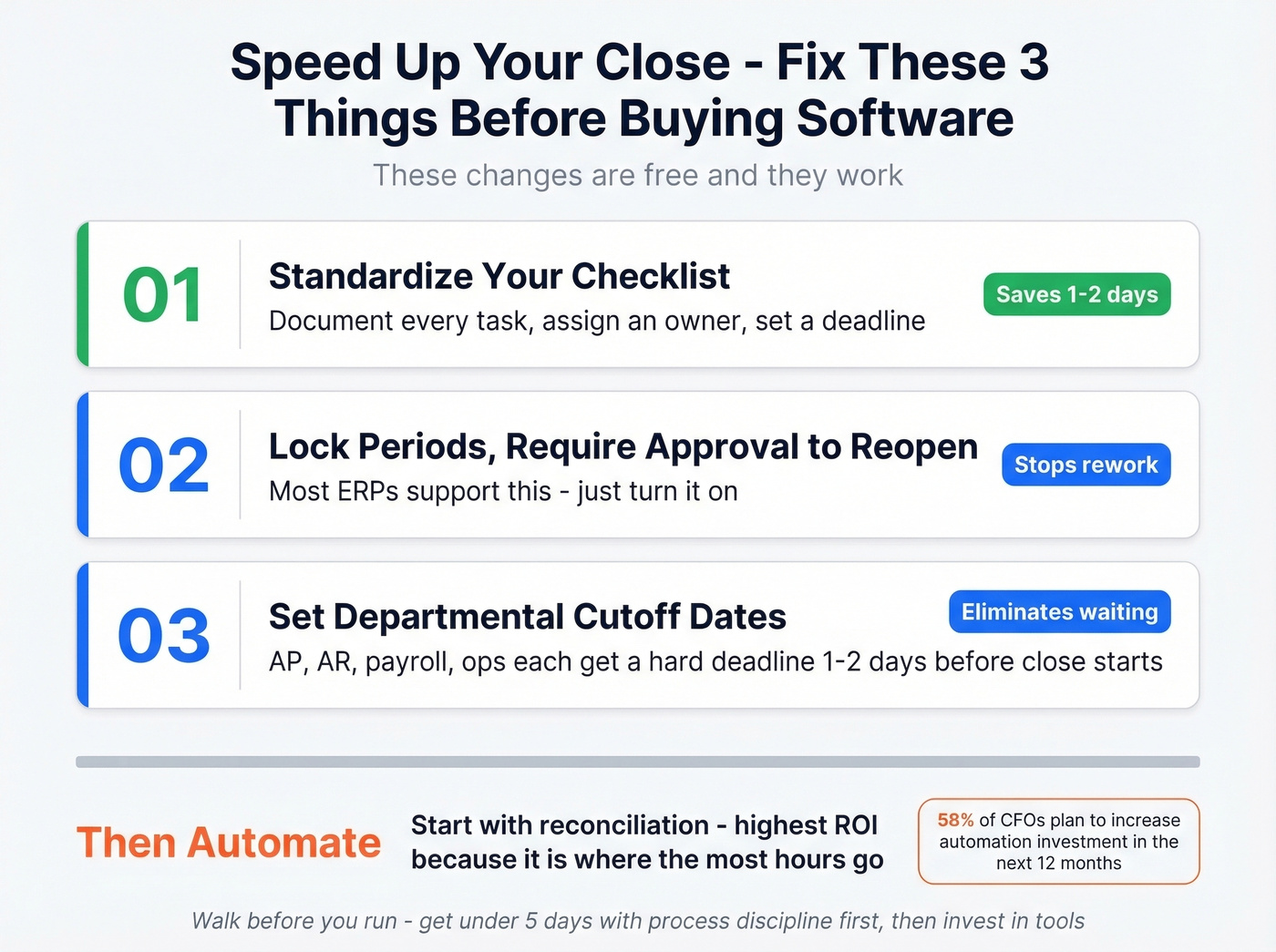
- Standardize your checklist. Document every task, assign an owner, set a deadline. This alone can cut 1-2 days.
- Lock periods and require approval to reopen. Most ERPs support this. Use it.
- Set departmental cutoff dates. AP, AR, payroll, and ops each need a hard deadline that's 1-2 days before the close starts.
Those three changes are free and they work. Once the process is clean, automate reconciliation first - it's the highest-ROI investment because it's where the most hours go. 58% of CFOs plan to increase automation investment over the next 12 months, and reconciliation is the obvious starting point.
Let's be honest about the "continuous close" pitch: most teams aren't ready for it, and buying software that promises it won't fix a process that isn't standardized yet. Walk before you run. Get your close under five days with process discipline, then invest in automation.
Continuous Close and AI
A continuous close replaces the traditional month-end batch with rolling daily validation. The GL stays current, subledgers sync in real time, and the books are audit-ready on day one of the new period - not day seven.
KPMG's Intelligent Close framework maps the maturity journey in three stages: digitally enabled (manual tasks, disjointed systems), AI-embedded (standardized workflows, partial automation), and GenAI-ready (high automation, continuous close capabilities). Their four pillars - trusted transactions, autonomous accounting, real-time reporting, and a modern workforce - paint a picture where accountants shift from reconciliation to insight.
Most teams aren't there yet. But the gap between "close in 7 days" and "close in 1 day" is narrowing, and the teams that standardize now will be the ones who can actually adopt AI-driven tools when they mature.
Close Management Software Costs
Pricing in this category is famously opaque - vendors want you on a sales call. With 58% of CFOs increasing automation budgets, these tools are seeing record demand, and pricing reflects it.
| Tool | Typical Cost | Best For |
|---|---|---|
| Numeric | $30/user/mo (Starter) | Mid-market, transparent |
| QuickBooks | $30-$200/mo | Small business |
| NetSuite | ~$999/mo + $99/user | Growing mid-market |
| FloQast | ~$1,500-$5,000/mo | Mid-market close mgmt |
| Vena | ~$15k-$60k/yr | Planning + close hybrid |
| Sage Intacct | ~$15k-$50k/yr | Multi-entity mid-market |
| BlackLine | ~$30k-$150k+/yr | Complex enterprise |
| Trintech | ~$20k-$100k+/yr | Enterprise recon |
| Workiva | ~$25k-$100k+/yr | SEC reporting + close |
For a 20-person finance team at a mid-market company, FloQast and Numeric are the two names that come up most. Numeric's starter plan at $30/user/month is one of the few transparent price points in the category. BlackLine and Trintech are built for enterprise complexity - multi-entity consolidation, high transaction volumes, SOX compliance. Skip them if you won't need those capabilities for three years.
Beyond Finance: Project and Sales Close
Project Close (PMBOK)
The PMI's Closing Process Group formally concludes all project activities, confirms deliverables, and transitions the work to operations. Key activities include confirming all work is complete, obtaining sponsor approval, capturing lessons learned, disbanding resources, and transitioning deliverables with training and support.
Skipping project close isn't just sloppy - PMI warns it puts organizations at considerable risk, prevents realizing anticipated benefits, and causes significant losses. It also undermines the project team's credibility for future work.
Sales Close - Deal Management That Feeds Finance
The sales close is the final stage of converting a prospect to a customer. But here's what most guides miss: dirty CRM data doesn't just hurt sales - it pollutes the financial close downstream. Stale contacts lead to wrong revenue attribution, which leads to commission errors, which leads to finance spending extra hours reconciling numbers that should've been right from the start. When deal management is sloppy, the mess flows straight into the books.
Clean CRM data isn't just a sales problem - it's a close problem. Tools like Prospeo catch bad emails before they hit the CRM, with 98% email verification accuracy, 83% of leads enriched with full contact data, and records refreshed every 7 days instead of the typical 6-week cycle. That means fewer reclassifications, fewer commission disputes, and less rework during the close.
If you're tightening up the sales side too, start with contact data quality and data enrichment so finance isn't reconciling garbage downstream.
You just read how 56% of teams blame cross-department delays for slow closes. On the sales side, the fix is upstream: reach the right decision-makers the first time. Prospeo's 30+ filters - including buyer intent, job changes, and funding signals - connect your reps to real buyers at $0.01 per email.
Close faster when every contact in your pipeline is verified and current.
FAQ
How long should the month-end close take?
Most non-public companies should aim for 5-7 calendar days; top performers finish in 1-3 business days. A 2026 survey found 50% of teams still take 6+ business days, so if you're in that range, process standardization - not new software - is the fastest path to improvement.
What's the difference between month-end and year-end close?
Month-end reconciles accounts and produces financial statements for a single period. Year-end adds tax calculations, audit preparation, ASC 606 revenue recognition adjustments, and internal control reviews - typically taking 2-4x longer with regulatory consequences for errors.
Can you close the books without close management software?
Yes. Standardize your checklist, set departmental cutoff dates, and lock periods first - many teams cut 1-2 days with these changes alone. Software helps most when you've outgrown Excel and need multi-entity consolidation or automated reconciliation at scale.
How does CRM data quality affect the financial close?
Stale or duplicate CRM records mean revenue can't be properly attributed, commissions calculate incorrectly, and finance spends extra hours reconciling. Keeping contact data verified on a 7-day refresh cycle at 98% email accuracy reduces rework and gives finance cleaner numbers to close against.