

SaaS Sales: The 2026 Playbook (With Benchmarks Most Guides Won't Give You)
A market projected to hit $375 billion this year, growing at 18.7% CAGR, and most guides about selling into it are still recycling 2022 advice about "building rapport" and "asking open-ended questions." SaaS sales in 2026 looks nothing like it did even two years ago - signal-based prospecting has replaced spray-and-pray, AI assistants are table stakes, and the teams winning deals obsess over data quality, not email volume. Here's what actually works right now, backed by real benchmarks.
The State of SaaS in 2026
The global SaaS market hit $315.68 billion in 2025 and is projected to reach $375.57 billion this year, on its way to $1.48 trillion by 2034. North America still commands 46.9% of that spend. Those numbers suggest smooth sailing, but the January 29, 2026 stock selloff told a different story - SAP dropped 16%, ServiceNow fell 11%, and the S&P 500 Software & Services Index slid 8.7% to a nine-month low.
The selloff wasn't about software subscriptions dying. It was about the market repricing what these companies are worth when AI can automate chunks of what they do. For sales teams, this means buyers are more skeptical, procurement cycles are tighter, and the "we've always used X" inertia that protected incumbents is weakening.
Selling software subscriptions in 2026 requires sharper targeting, better data, and a real understanding of where your buyer is in their journey. Volume alone won't save you.
What's actually working: Signal-based prospecting - targeting accounts showing buying intent through funding events, leadership hires, and tech stack changes. Not blasting 1,000 cold emails a day and hoping. (If you want a broader menu of plays, start with sales prospecting techniques.)
What benchmarks to expect: Sales cycles range from 25 days for sub-$1k ACV to 270 days for $500k+. Funnel conversion from lead to MQL sits around 39%. These numbers are your planning baseline. (For more context, compare against the average B2B lead conversion rate.)
What stack to build: A CRM, a verified data platform, and an outbound sequencer. Everything else is optimization. (If you're evaluating options, see examples of a CRM.)
What Is SaaS Sales?
SaaS sales is the process of selling cloud-delivered software on a subscription basis. Unlike traditional software - where you'd sell a perpetual license, ship a download link, and maybe collect a maintenance fee - SaaS revenue is recurring. Monthly or annual contracts. Ongoing relationships. Continuous value delivery.
This changes the sales dynamic fundamentally. You're not closing a one-time transaction; you're starting a relationship that needs to survive renewal cycles, usage reviews, and competitive displacement attempts. The initial sale might be the easy part. Keeping the customer and expanding the account is where the real revenue lives.
That's why teams care so much about net revenue retention and customer lifetime value. A churned customer doesn't just cost you one deal - it costs you every future renewal and expansion that account would've generated. Understanding customer success, the proactive discipline of ensuring buyers achieve their desired outcomes with your product, is essential because it directly protects that recurring revenue stream. (If you're diagnosing retention issues, use a structured churn analysis.)
The land-and-expand motion - start small, prove value, grow the contract - is the defining playbook of modern subscription selling.
SaaS Sales Models
Not every product gets sold the same way. The model you choose determines your team structure, tech stack, and unit economics.
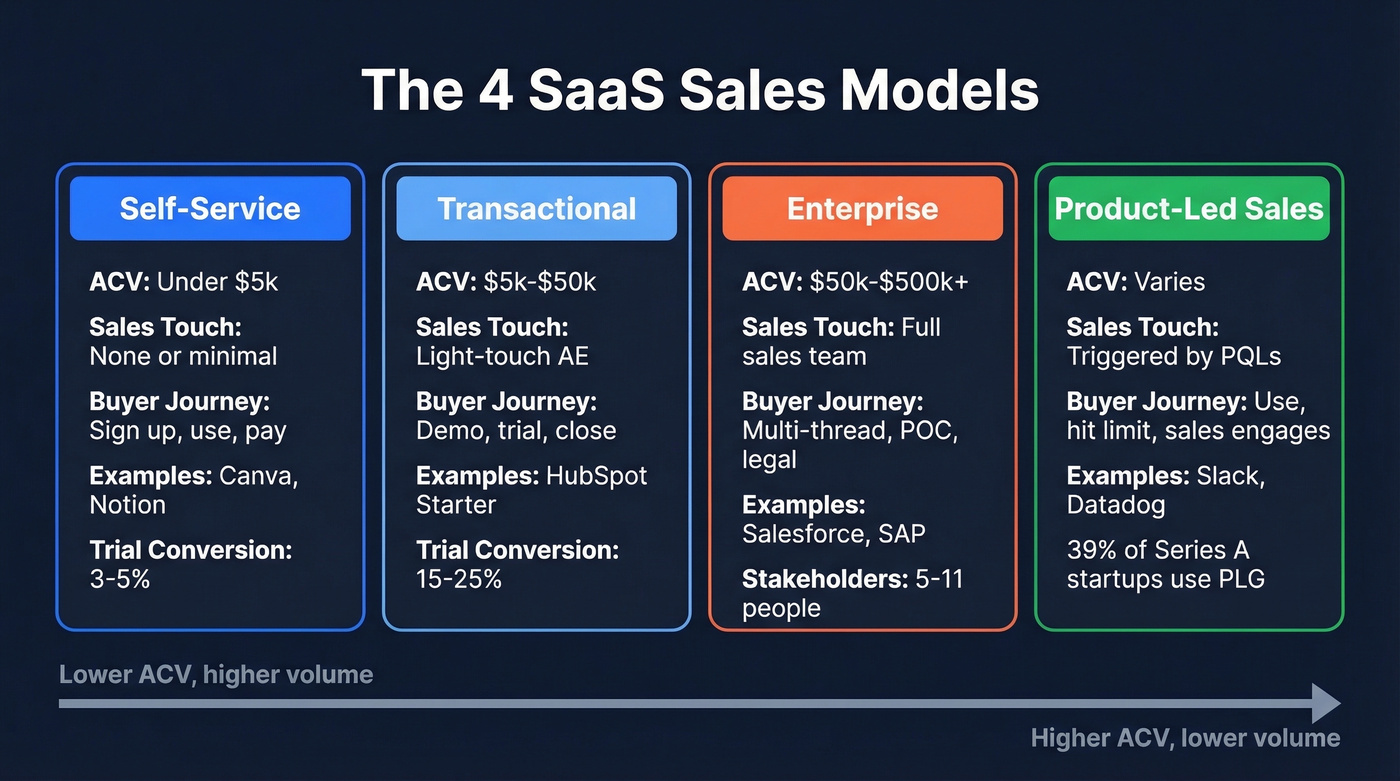
| Model | ACV Range | Sales Involvement | Buyer Journey | Example |
|---|---|---|---|---|
| Self-Service | <$5k | None/minimal | Sign up, use, pay | Canva, Notion |
| Transactional | $5k-$50k | Light-touch AE | Demo, trial, close | HubSpot Starter |
| Enterprise | $50k-$500k+ | Full sales team | Multi-thread, POC, legal | Salesforce, SAP |
| Product-Led Sales | Varies | Triggered by PQLs | Use, hit limit, sales | Slack, Datadog |
Self-Service & Transactional
Self-service is exactly what it sounds like: the buyer finds your product, signs up, enters a credit card, and starts using it. No sales rep involved. Transactional adds a light-touch sales layer - maybe a 20-minute demo, a short trial, and an AE who helps close. Both models depend on low friction and fast time-to-value.
Trial-to-paid conversion rates vary widely: self-serve typically lands in the 3-5% range from free trial to paid, while sales-assisted trials push closer to 15-25%.
Enterprise
Enterprise selling is a different animal entirely. Deals involve 5-11 stakeholders across multiple business functions, legal reviews, security questionnaires, and procurement cycles that can stretch past 6 months. The ACV justifies the complexity, but the cost of sale is high. Miss one stakeholder and the deal stalls in committee - we've watched it happen more times than we'd like to admit. (If you're building for this motion, see enterprise B2B sales.)
Product-Led Sales
39% of Series A startups now enable PLG or self-serve, across a dataset of 474 companies. In DevTools specifically, that number hits 50%. With the average organization running 23 tools in their GTM tech stack, buyers are drawn to products that prove value before requiring a sales conversation.
The key concept is the PQL - product-qualified lead. Instead of qualifying based on form fills or firmographics, you're qualifying based on actual product usage. A user who's hit their free tier limit, invited three teammates, and used the product daily for two weeks is a fundamentally different lead than someone who downloaded a whitepaper. That distinction matters more than any scoring model you'll build. (If you're formalizing this, start with lead scoring.)
PLG doesn't mean free. Many PLG companies charge from day one. The "product-led" part is about using the product as the primary acquisition and qualification engine. Readiness signals include median time-to-value under 30 minutes and support tickets shifting from "how do I?" to "can it also?" Gartner reports that 75% of B2B buyers now prefer a rep-free experience - that pressure isn't going away.
The SaaS Sales Process
Every deal, regardless of model, moves through five stages:
- Prospecting - Identifying accounts and contacts that match your ICP. This is where data quality matters most. Bad emails and outdated titles waste cycles before you even start. (To operationalize this, use an ideal customer profile.)
- Qualification - Determining whether the prospect has the budget, authority, need, and timeline. Most teams rush through this stage and pay for it later.
- Demo/Evaluation - Showing the product in context of the buyer's specific pain. Generic demos kill deals. Tailored demos that reference the prospect's tech stack, team size, and stated challenges close them. (Use a product demo checklist to standardize quality.)
- Negotiation - Pricing, terms, legal review, security questionnaires. Enterprise deals can spend 30+ days here. Transactional deals might skip this entirely.
- Close - Contract signed, handoff to customer success, onboarding begins. The sale isn't really "closed" until the customer renews.
BANT vs. MEDDIC
The qualification framework you choose should match your deal complexity. Using the wrong one creates real problems.
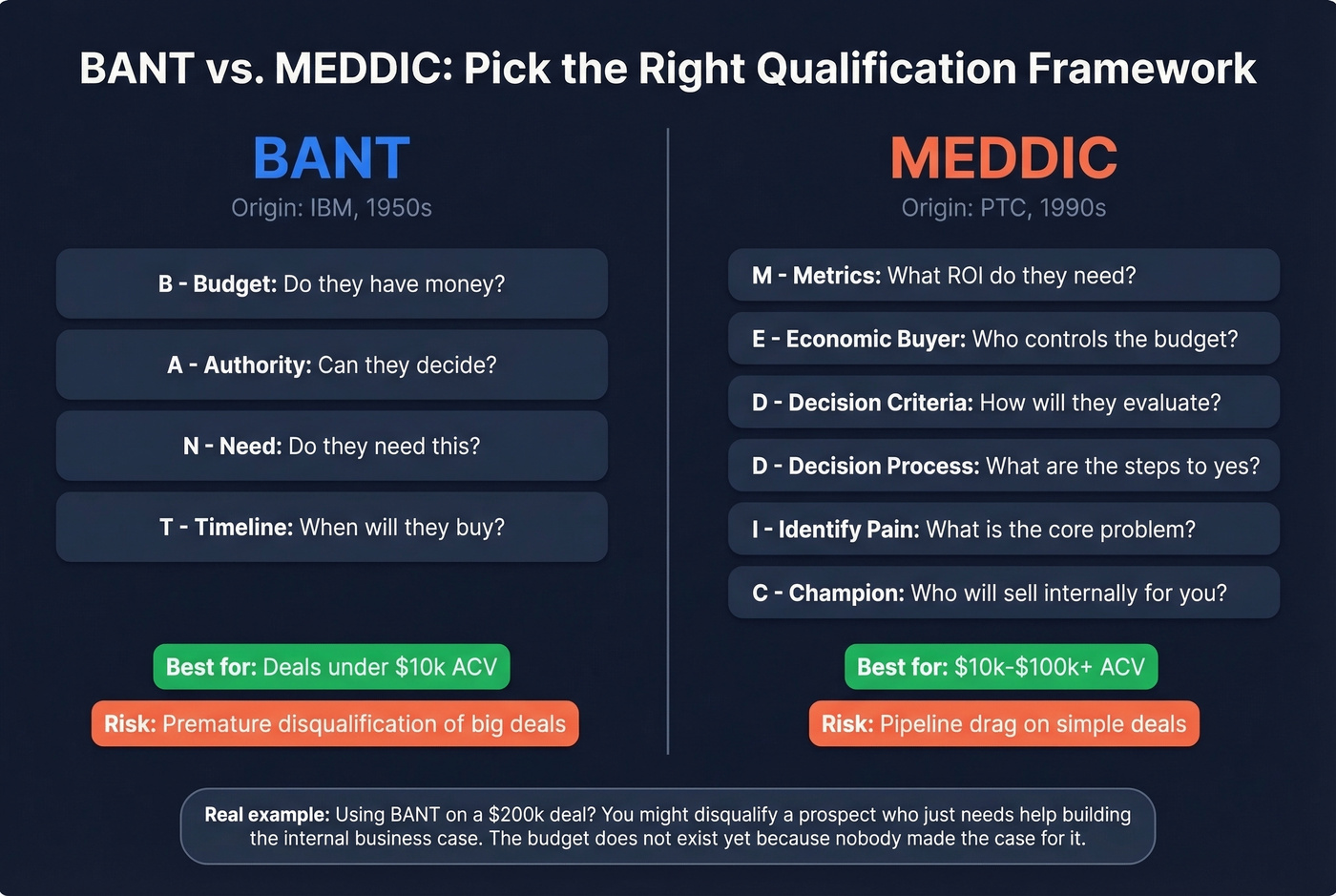
| BANT | MEDDIC | |
|---|---|---|
| Origin | IBM, 1950s | PTC, 1990s |
| Best for | Deals under $10k ACV | $10k-$100k+ ACV |
| Risk if misapplied | Premature disqualification | Pipeline drag |
BANT (Budget, Authority, Need, Timeline) was built for high-volume, transactional sales. It's a fast filter. Does the prospect have money? Can they make the decision? Do they need this? When? If any answer is no, move on.
MEDDIC (Metrics, Economic Buyer, Decision Criteria, Decision Process, Identify Pain, Champion) is built for complex deals where understanding the buying process matters more than speed. PTC used it to grow from $300M to $1B in four years.
Here's a scenario we see constantly: a team uses BANT on a $200k enterprise deal and disqualifies a prospect because "they don't have budget." In reality, the champion just needs help building the internal business case. The budget doesn't exist yet because nobody's made the case for it. Wrong framework, lost deal.
Sales Cycle Benchmarks
Knowing how long your deals should take is critical for forecasting, hiring, and not panicking when a $200k deal isn't closed in 45 days.
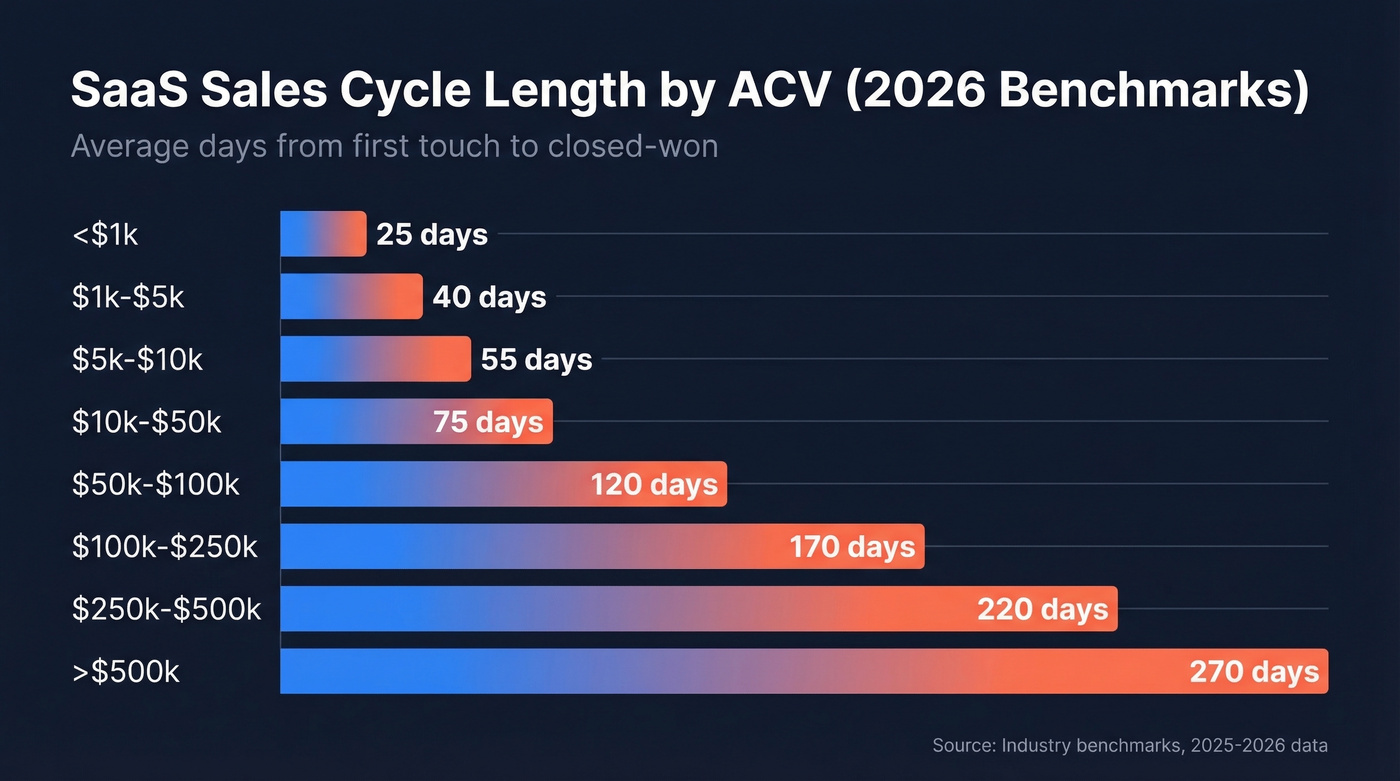
Sales Cycle Length by ACV
| ACV | Avg Cycle (Days) |
|---|---|
| <$1k | 25 |
| $1k-$5k | 40 |
| $5k-$10k | 55 |
| $10k-$50k | 75 |
| $50k-$100k | 120 |
| $100k-$250k | 170 |
| $250k-$500k | 220 |
| >$500k | 270 |
Sales Cycle Length by Prospect Company Size
| Employees | Avg Cycle (Days) |
|---|---|
| 1-10 | 38 |
| 11-50 | 57 |
| 51-200 | 77 |
| 201-500 | 95 |
| 501-1,000 | 115 |
| 1,001-5,000 | 135 |
| 5,001-10,000 | 158 |
| 10,001+ | 185 |
Channel matters too. Inbound leads from SEO convert in 28-75 days depending on deal complexity. Cold calling runs 60-110 days. The software industry average across all channels and deal sizes is about 90 days - Cognism reports an 84-day average across their customer base, which tracks.
The practical takeaway: if you're selling $50k+ deals into companies with 1,000+ employees, plan for 4-5 month cycles minimum. Staff accordingly. Build pipeline accordingly. And stop telling your board the deal will close "next month" when the math says otherwise. (If you're pressure-testing coverage, use sales pipeline benchmarks.)
Funnel Conversion Benchmarks
This is the data point most guides skip entirely. Based on FirstPageSage's 2017-2025 dataset, here are the stage-to-stage conversion rates for B2B SaaS:
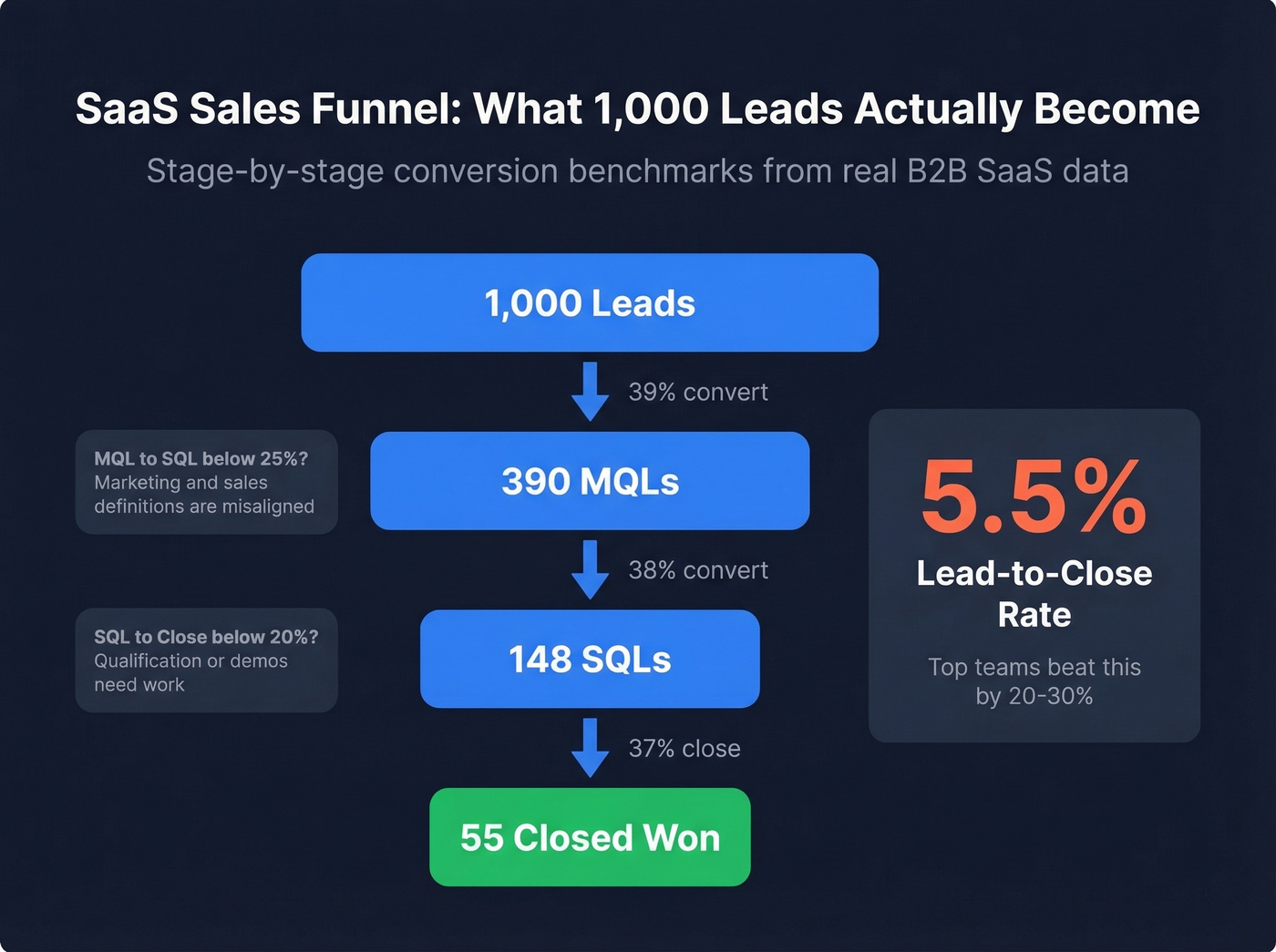
| Stage | Conversion Rate |
|---|---|
| Lead to MQL | 39% |
| MQL to SQL | 38% |
| SQL to Opportunity | 42% |
| SQL to Closed Won | 37% |
Here's what this means in practice. Start with 1,000 leads: roughly 390 become MQLs, 148 become SQLs, and about 55 of those SQLs close at the 37% SQL-to-close rate. That's a 5.5% lead-to-close rate. Top-performing teams beat these benchmarks by 20-30%, but these are the numbers you should plan against.
If your funnel is dramatically underperforming at any stage, that's your diagnostic. MQL-to-SQL conversion below 25%? Your marketing and sales definitions are misaligned. SQL-to-close below 20%? Your qualification framework needs work, or your demos aren't connecting product to pain.

Bad emails and outdated titles waste sales cycles before they even start. Prospeo's 300M+ profiles refresh every 7 days - not 6 weeks - with 98% verified email accuracy. Layer in buyer intent from 15,000 Bombora topics and 30+ filters to find SaaS buyers actually in-market right now.
Stop blasting 1,000 cold emails a day. Start with data that connects.
Strategies That Work in 2026
Signal-Based Prospecting
The consensus on r/SaaS is clear: spray-and-pray outbound is dead. Only 3-5% of your market is actively buying at any given time, with another ~7% open to a conversation. Signal-based prospecting helps you find that ~10% instead of annoying the other 90%.
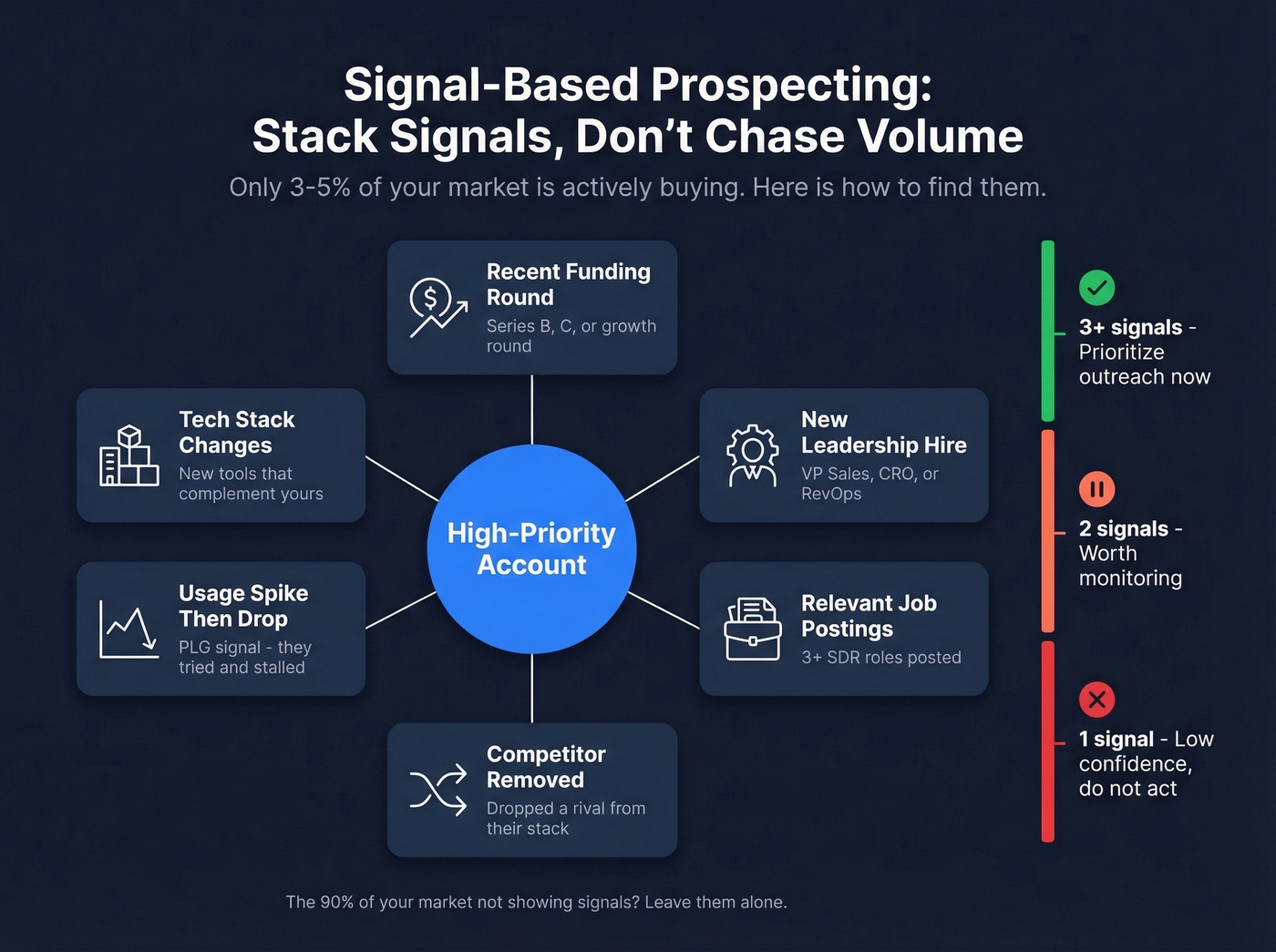
The signals that matter: recent funding rounds, a new VP of Sales hire, job postings that indicate the pain you solve, a competitor removed from their tech stack, or a usage spike followed by a drop for PLG companies. The key is stacking signals - don't act on one alone. A company that just raised a Series B and posted three SDR roles and removed a competitor from their stack is a fundamentally different prospect than one that just raised money. One founder reported hitting $500k ARR in 8 months using a combination of these signal-stacking tactics. (To systematize this, see how to track sales triggers.)
The Modern Outbound Stack
The practitioner playbook in 2026: Clay (from around $149/mo) for signal aggregation and enrichment workflows, Instantly (~$30/mo) or Lemlist (~$59/mo) for sequencing with domain rotation, and Prospeo underneath it all for verified contact data - 98% email accuracy and a 7-day refresh cycle that keeps your sequences hitting real inboxes instead of dead addresses.
Some teams layer in community-led demand - consistent posting on Reddit and five LinkedIn posts per week - as a compounding channel that feeds inbound while outbound does the heavy lifting. WhatsApp follow-ups are gaining traction too, with practitioners seeing 80%+ open rates. And the reverse job posting tactic, finding companies hiring for roles that signal the problem you solve, is one of the highest-signal prospecting methods available right now.
Data Quality: The Hidden Multiplier
Here's the thing: this is where most outbound strategies quietly fail. You can build the perfect signal-based workflow, write compelling copy, and nail your ICP - and still get destroyed by bad data. We've seen teams running bounce rates of 35-40% on their cold email campaigns, which doesn't just waste rep time. It tanks your domain reputation, which tanks deliverability on every subsequent send. It's a compounding problem that gets worse the longer you ignore it. (If you're troubleshooting, start with email bounce rate.)
If your deal sizes sit below $10k, you probably don't need a $30k/year sales intelligence platform. But you absolutely need verified data. The difference between a 35% bounce rate and a sub-5% bounce rate is the difference between a working outbound motion and an expensive one that generates spam complaints. When Snyk's 50 AEs switched to verified data, their bounce rate dropped from 35-40% to under 5%, and AE-sourced pipeline jumped 180%.
Skip the premium intelligence tools until you're running enterprise deals. Don't skip data verification at any deal size. (If you're comparing vendors, see data enrichment services.)
AI's Impact on Selling SaaS
The January 29 selloff wasn't just market noise - it was the market recalibrating what software companies are worth when AI agents can handle tasks that previously required dedicated tools. The thesis: SaaS is tested, not displaced. Enterprises can't rip-and-replace deeply integrated platforms overnight. Data integrity, security requirements, and migration complexity create massive friction.
But agents as the primary enterprise interface, rather than applications, is the direction of travel.
For sales teams specifically, AI assistants are becoming non-negotiable, like CRM was a decade ago. The r/sales community predicts deal rooms expanding into SMB and midmarket segments, contact-level website tracking replacing third-party intent data, and increasing outsourcing of deliverability and data ops as the technical bar for outbound keeps rising.
If you're not using AI for call transcription, email drafting, and pipeline analysis by now, you're already behind. The question isn't whether to adopt - it's how fast you can integrate these tools without breaking your existing workflows.
Mistakes That Kill Deals
These aren't generic tips. Each one has a SaaS-specific consequence that compounds over time.
- Over-emphasizing price over value. The moment you lead with "we're cheaper than X," you've commoditized yourself. Cheaper products churn faster because the buyer never internalized the value. Sell the outcome, not the line item.
- Failing to qualify early. A bloated pipeline of unqualified deals feels productive until quarter-end, when 60% of your "pipeline" slips. Qualification isn't gatekeeping - it's resource allocation.
- Talking too much in discovery. Poor discovery leads to generic demos, which lead to "we'll get back to you," which leads to ghosting. The best discovery calls have the prospect talking 60-70% of the time.
- Selling to the wrong stakeholders. In enterprise deals, buying groups run 5-11 people across five business functions. If you're only talking to your champion, you're one procurement objection away from a stalled deal.
- Ignoring data quality. Burned domains, bounced sequences, wasted rep hours. Bad data doesn't just fail silently - it actively damages your ability to reach future prospects. I've watched a team burn through three sending domains in a single quarter because they wouldn't invest in verified emails.
- Using the wrong qualification framework. BANT on a $200k enterprise deal disqualifies champions who haven't secured budget yet. MEDDIC on a $3k self-serve deal creates pipeline drag that kills velocity.
Metrics That Actually Matter
Track five metrics. Not fifteen. Everything else is a derivative.
| Metric | Formula | Why It Matters |
|---|---|---|
| MRR/ARR | Sum of monthly recurring revenue | Revenue baseline |
| CAC | Sales + marketing cost / new customers | Acquisition efficiency |
| LTV | ARPU x gross margin x avg lifespan | Long-term unit economics |
| Churn | Lost customers / starting customers | Retention health |
| Sales Velocity | (Opps x win rate x ACV) / cycle days | Pipeline throughput |
The hidden predictor most teams ignore is net revenue retention (NRR). If your NRR is below 100%, you're filling a leaky bucket - every new customer you acquire is partially offset by contraction and churn in your existing base. The best companies run NRR above 120%, meaning their existing customers grow faster than they churn.
Win rate and quota attainment are your operational health checks. Industry-average win rates hover around 20-25%. If you're significantly below that, the problem is usually qualification or demo quality. Quota attainment across the industry runs roughly 55-65% of reps hitting target - when your team is well below that, it's a systemic issue, not an individual performance problem.
Careers and Compensation
SaaS sales remains one of the highest-paying career paths that doesn't require a specific degree. Here's what the 2026 compensation data looks like:
| Role | Base Salary | OTE | Notes |
|---|---|---|---|
| SDR | $55k-$75k | $70k-$95k | Comp tied to meetings/pipeline |
| Mid-Market AE | $75k-$100k | $140k-$180k | 50/50 base/variable typical |
| Enterprise AE | $100k-$140k | $180k-$250k+ | Longer cycles, bigger deals |
| Sales Manager | $110k-$140k | $160k-$200k+ | Team performance comp |
| Sales Director | $140k-$180k | $200k-$250k+ | Strategic + operational |
| VP Sales | $180k-$220k | $250k-$350k+ | Equity often included |
The standard comp structure is a 50/50 base-to-variable split, with commissions typically running 10-15% of closed deal value. The cost of getting this wrong is real: an AE carrying a $1.2M quota who leaves creates a 60-day vacancy that translates to roughly $200k in missed revenue. Hiring and retaining good sellers isn't just an HR problem - it's a revenue problem. (If you need to standardize targets, see OTE in sales.)
The 2026 Tech Stack
Start with three things. Add tools only when you've maxed out what those three can do.
CRM: HubSpot's free tier is genuinely usable for small teams. Salesforce runs around $25-$330/user/month and is the default once you need serious customization. Skip a paid CRM until you have 3+ reps or need pipeline reporting your spreadsheet can't handle.
Sales Intelligence / Data: Prospeo gives you 300M+ professional profiles with 98% email accuracy and a 7-day data refresh cycle. Free tier starts at 75 verified emails per month, no contracts or sales calls required. It integrates natively with Salesforce, HubSpot, Instantly, Clay, and Lemlist.

Outbound Sequencer: Instantly from ~$30/mo or Lemlist from ~$59/mo for multi-channel sequences with domain rotation and warm-up.
Revenue Intelligence: Gong typically costs $100-$200/user/month for call recording and deal intelligence. Skip it until you're running 20+ calls per week - otherwise you're paying for insights you don't have enough data to generate.
Automation: Clay from ~$149/mo for enrichment workflows and signal aggregation. Skip it until you've defined your ICP well enough to build workflows around it.
Let's be honest - most teams buy too many tools too early. Our experience is that three core tools, used well, outperform a bloated stack of eight that nobody fully adopts.
Signal-based prospecting only works if your signals sit on top of accurate contact data. Prospeo combines funding events, tech stack changes, and headcount growth filters with 143M+ verified emails and 125M+ direct dials - at $0.01 per email. Teams using Prospeo book 26% more meetings than ZoomInfo users.
Enterprise-grade SaaS sales data without the enterprise contract.
FAQ
Is SaaS sales a good career in 2026?
Yes - OTE ranges from $70k for SDRs to $350k+ for VP-level roles, and the market is growing at 18.7% CAGR. The field increasingly rewards sellers who use signals and data over pure volume. Reps who can't adapt to AI-assisted workflows and signal-based prospecting will struggle, but those who can are earning more than ever.
How long is a typical sales cycle?
Cycle length scales directly with deal size. Deals under $1k close in about 25 days, $10k-$50k deals average 75 days, and anything above $500k stretches to 270 days or more. The software industry average across all deal sizes is roughly 90 days.
What's the difference between SaaS and traditional software sales?
SaaS is subscription-based with recurring revenue, lower upfront cost, cloud delivery, and an ongoing customer success relationship. Traditional software involves perpetual licenses, on-premise deployment, and maintenance fees. Subscription sellers need to think beyond the initial close - retention and expansion drive long-term revenue.
What conversion rates should I expect?
B2B SaaS benchmarks show Lead-to-MQL at 39%, MQL-to-SQL at 38%, SQL-to-Opportunity at 42%, and SQL-to-Closed Won at 37%. That works out to roughly a 5.5% lead-to-close rate. Top-performing teams beat these by 20-30%, so if you're significantly below at any stage, that's your diagnostic.
What tools do I need to start?
Three essentials: a CRM (HubSpot's free tier works), a verified data platform like Prospeo for accurate emails and direct dials, and an outbound sequencer like Instantly or Lemlist. Add revenue intelligence tools like Gong and automation platforms like Clay once you have enough volume to justify the spend.