

Mid-Market Definition: What It Means in 2026 (+ Data)
Your VP of Sales wants a "mid-market target list" by Friday. Marketing thinks mid-market means 200-500 employees. Finance says it's $100M+ in revenue. Your CRM has a picklist that says "Commercial." Nobody agrees, and the list isn't getting built.
This confusion isn't unique to your org - it's baked into the segment itself.
The Quick Version
So what is mid-market, exactly? Here's the consensus range most teams can align around:
- Revenue: $10M-$1B annually
- Employees: 100-2,000
- No universal standard exists. Finance, SaaS, PE, and government agencies all draw the lines differently.
The table below breaks down who defines the segment how - and why those differences matter for your targeting.
Why There's No Single Answer
The term shifts depending on who's using it. Private equity firms define "middle market" by enterprise value because they're sizing acquisition targets. SaaS sales teams segment by employee count because headcount correlates with seat-based pricing. Economists at the National Center for the Middle Market (NCMM) use annual revenue as the primary yardstick.
There's also a terminology split. "Middle market" is the preferred phrase in finance, investment banking, and M&A. "Mid-market" dominates in B2B sales, SaaS, and marketing. Google treats them interchangeably, and so should you.
Here's the thing: mid-market is really a behavioral segment, not just a size bracket. These companies have real budgets but aren't drowning in procurement bureaucracy. They move faster than enterprise but need more stakeholder alignment than SMBs. That behavioral middle ground is what makes them attractive - and what makes a single numerical definition impossible.
On r/sales and similar communities, this debate is perennial. Some teams draw the line at 200 employees, others at 1,000. We've seen teams waste weeks arguing over employee-size thresholds when the real question is buying behavior.
Definitions by Source
| Source | Revenue | Employees | EV Range | Context |
|---|---|---|---|---|
| NCMM | $10M-$1B | - | - | Economic research |
| Gartner | $50M-$1B or 100-1,000 | - | - | Analyst benchmark |
| Capstone/PE | - | 100-2,000 | $10M-$1B | M&A / PE deals |
| ZoomInfo | - | 500-2,000 | - | Sales operations |
| EU (medium-sized enterprise) | ≤EUR50M turnover or ≤EUR43M balance sheet | 50-249 | - | Regulatory |
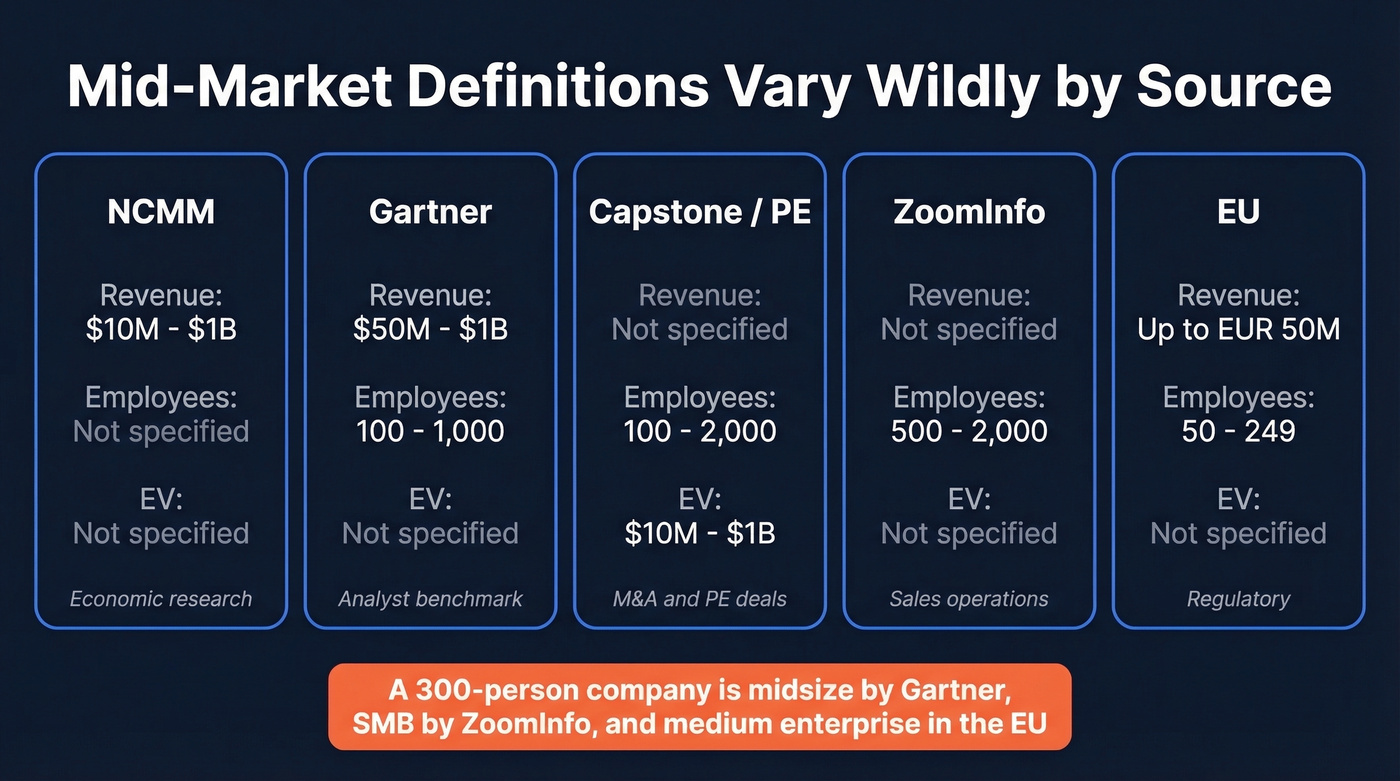
Notice how ZoomInfo's employee floor (500) is 10x the EU's (50). A 300-person company is "midsize" by Gartner's employee band, "SMB" by ZoomInfo's segmentation, and "medium-sized enterprise" in the EU. This is why internal alignment matters more than picking the "right" external definition.
Sub-Segments in Finance and M&A
Not all middle-market companies are the same. In M&A, Capstone Partners breaks the segment into enterprise-value tiers:
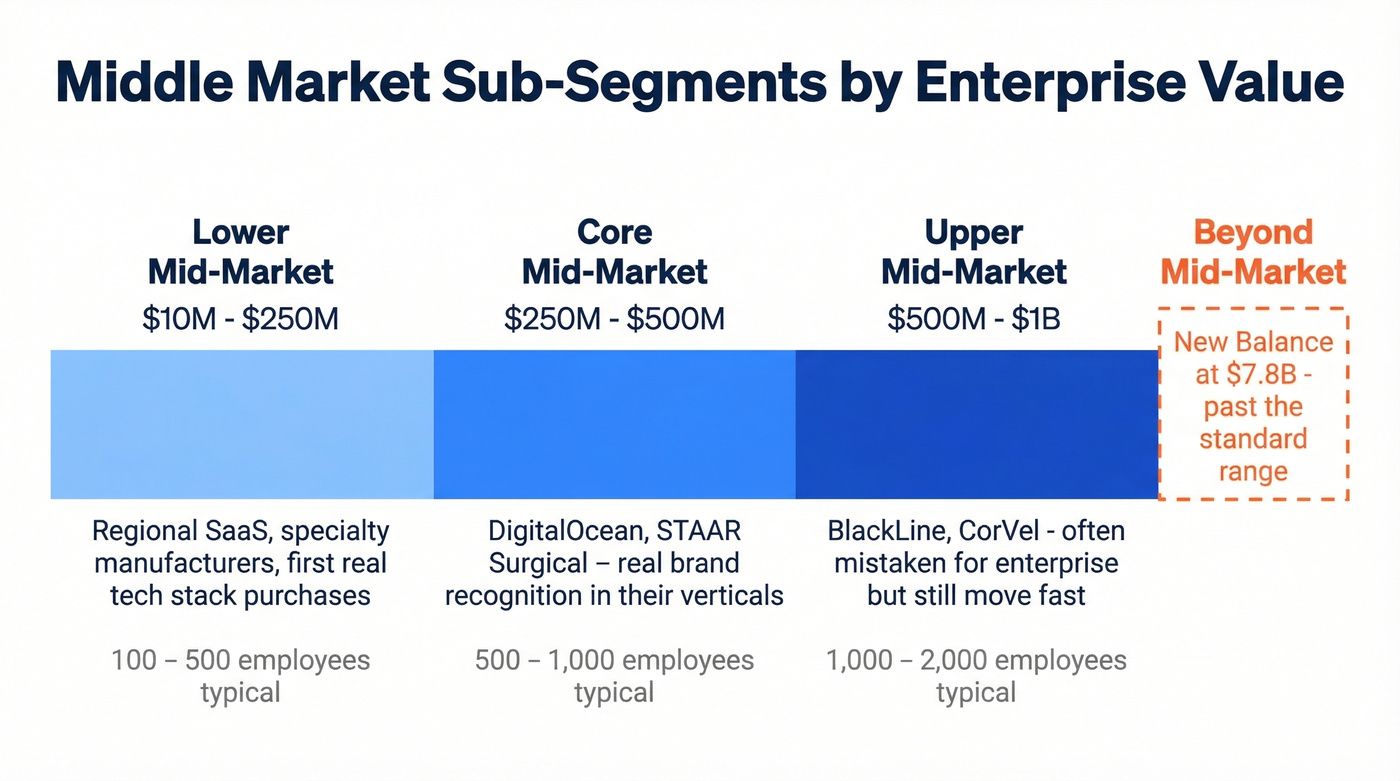
| Sub-Segment | Enterprise Value |
|---|---|
| Lower | $10M-$250M |
| Middle | $250M-$500M |
| Upper | $500M-$1B |
These sub-segments matter most in deals, where complexity and valuation dynamics shift dramatically between a $30M company and a $700M one.
For sales targeting, the lower-to-upper distinction is useful too. A 150-person company buying its first "real" tech stack behaves very differently than a 1,500-person company with multiple departments and a mature RevOps function.

Your team finally agreed on a mid-market definition - now you need a list. Prospeo's 30+ filters let you set exact revenue floors ($50M-$500M), headcount ranges, buyer intent signals, and technographic data to build a mid-market prospect list with 98% verified email accuracy.
Stop debating the definition and start building the list.
Mid-Market vs. SMB vs. Enterprise
Here's a practical way to think about it for go-to-market:
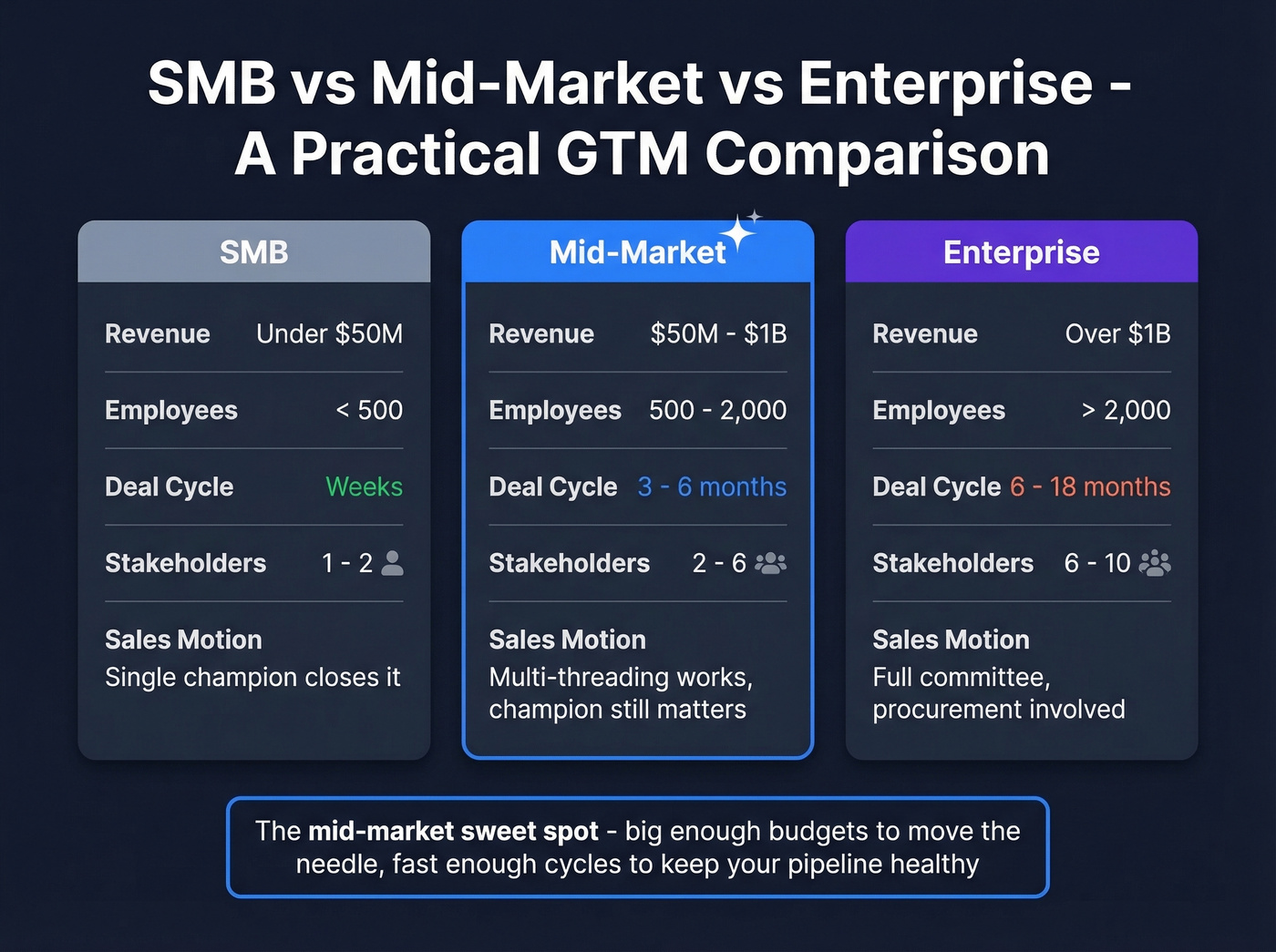
| Segment | Revenue | Employees | Deal Cycle | Stakeholders |
|---|---|---|---|---|
| SMB | <$50M | <500 | Weeks | 1-2 |
| Mid-Market | $50M-$1B | 500-2,000 | 3-6 months | 2-6 |
| Enterprise | >$1B | >2,000 | 6-18 months | 6-10 |
The deal cycle column is where this gets practical. Mid-market sales cycles average 3-6 months, with 2-6 stakeholders involved - long enough to require multi-threading but short enough that a single champion can still push a deal through. Enterprise deals can stretch to 18 months with 6-10 decision-makers and deal sizes typically north of $50,000, which is a fundamentally different motion.
Let's be honest: if your average contract value sits below $15k, you probably don't need an enterprise sales motion at all. The mid-market is where most B2B companies should focus. Big enough budgets to move the needle, fast enough cycles to keep your pipeline healthy.
Why This Segment Matters
About 200,000 U.S. firms sit in the middle market. Together, they employ 48 million people and generate $10 trillion in revenue - roughly one-third of private-sector GDP. If the U.S. middle market were its own country, that $10 trillion output would rank third globally, behind only the U.S. and China as a whole. Over 90% of these firms are privately held, and the average mid-sized company has been around for 34 years, per Doug Farren, Managing Director at the NCMM.
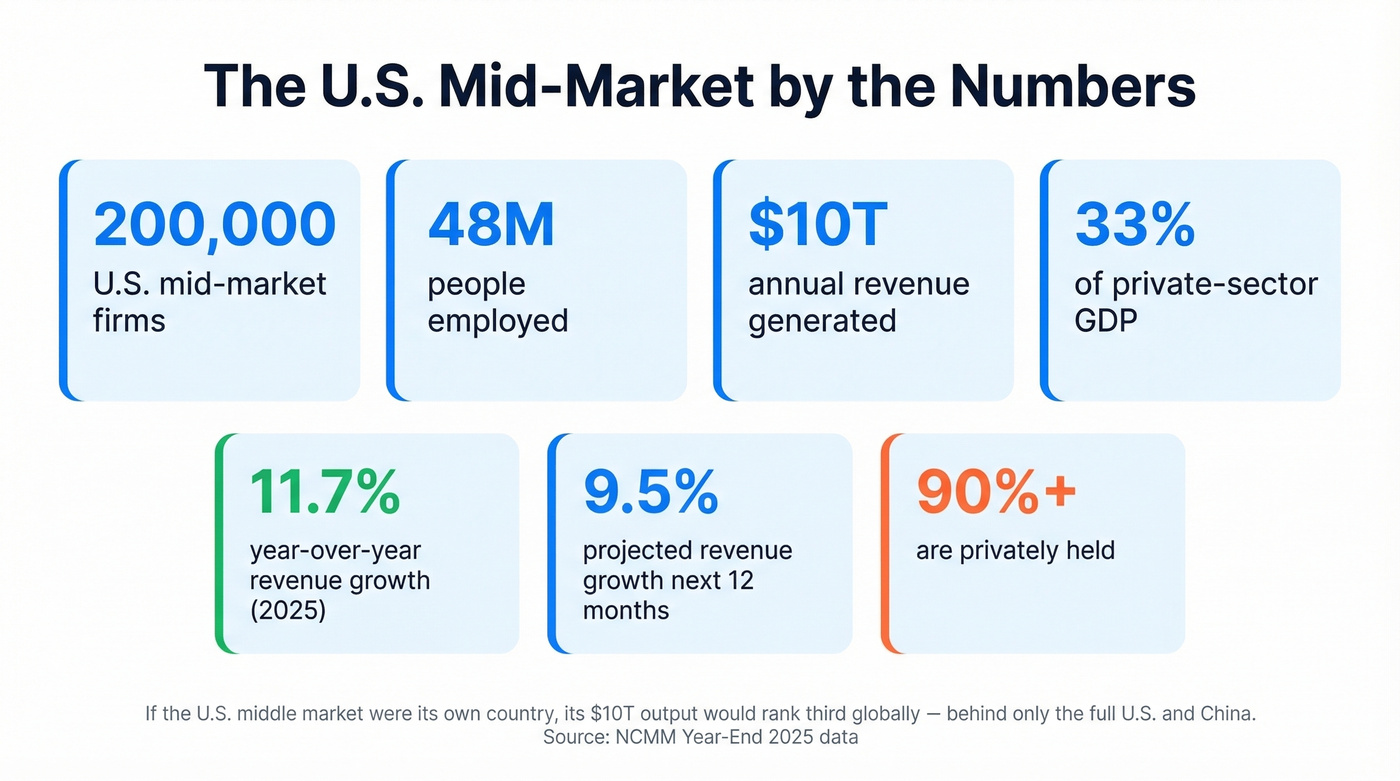
The latest NCMM Year-End 2025 data - based on a survey of 1,005 firms - shows the segment accelerating: 11.7% year-over-year revenue growth, driven largely by core and upper middle-market firms. Employment growth stayed flat, which signals a productivity-over-headcount mindset. The NCMM projects 9.5% revenue growth and 9.2% workforce growth over the next 12 months, with AI as the leading investment priority for mid-market leaders.
In our experience, this is a segment that's growing revenue without adding headcount. For sellers, that means these companies are spending on technology and efficiency - and they're actively buying.
Real Company Examples
Anchoring the mid-market definition to actual companies makes it concrete.
Lower mid-market ($10M-$50M): Regional SaaS firms, specialty manufacturers, and professional services companies. You won't recognize most of these names - that's the point. They're the backbone of the segment.
Core mid-market ($50M-$500M): DigitalOcean ($576M revenue, 2023) and STAAR Surgical ($312M, 2023) are publicly traded companies with real brand recognition in their verticals. They buy like mid-market companies even when their revenue pushes toward the upper boundary.
Upper mid-market ($500M-$1B): BlackLine ($523M, 2023) and CorVel ($678M, 2023) sit here. These companies often get mistaken for enterprise but still operate with mid-market speed and decision-making structures.
Upper edge / large midsize: New Balance ($7.8B, 2024) made TIME/Statista's "Best Midsize Companies" list, but that list uses a broader $100M-$10B definition. By the common $10M-$1B middle-market standard, New Balance is well past mid-market. Worth noting the definitional gap - skip this bracket entirely if you're building a prospect list around the standard revenue range.
How to Find Mid-Market Companies
Once your team aligns on a definition - say, $50M-$500M revenue, 100-1,000 employees - the next step is building a prospect list filtered by those exact criteria. You need a database that lets you set revenue floors and ceilings, filter by headcount, and layer on signals like buyer intent and technographic data.
We've found Prospeo's B2B database works well for this. You can filter across 30+ criteria including revenue range, employee count, headcount growth, technographics, and buyer intent across 15,000 topics. The database covers 300M+ profiles with 98% email accuracy and a 7-day data refresh cycle, so you're not emailing contacts who changed jobs two months ago. There's a free tier with no contracts - useful if you want to test the filters before committing.
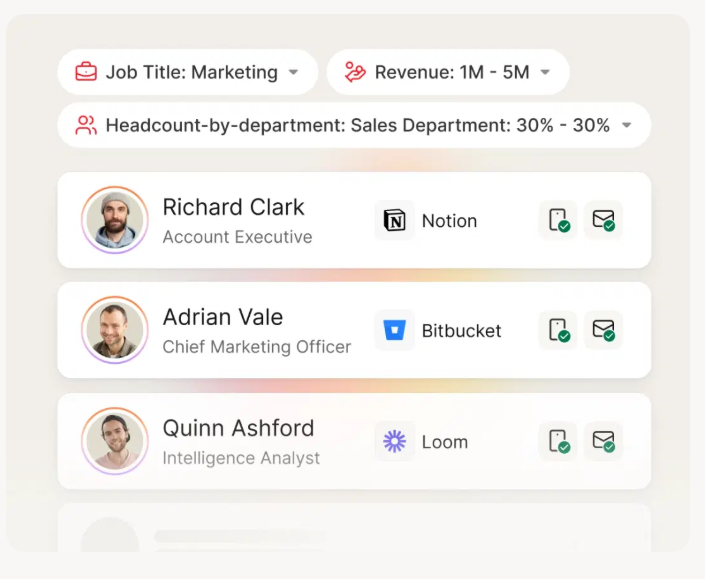
Mid-market deals involve 2-6 stakeholders. You need every direct contact - verified emails and mobile numbers - to multi-thread effectively. Prospeo gives you 300M+ profiles with 125M+ verified mobiles at $0.01/email, so you reach the full buying committee without burning your domain.
Reach every mid-market stakeholder with data that actually connects.
FAQ
What does mid-market mean?
Most sources use $10M-$1B in annual revenue to define the segment. Gartner narrows this to $50M-$1B. The exact threshold depends on context - PE firms use enterprise value, while sales teams often rely on employee count (100-2,000) as a proxy.
How many mid-market companies are in the U.S.?
About 200,000 firms. They employ 48 million people and generate $10 trillion in revenue - roughly one-third of private-sector GDP. Over 90% are privately held.
What's the difference between mid-market and middle market?
Same segment, different audiences. "Middle market" is standard in finance and PE. "Mid-market" dominates in SaaS and B2B sales. Google treats them interchangeably, so the definition you use internally matters more than which label you pick.
How do I build a mid-market prospect list?
Use a B2B database that filters by revenue range, employee count, and firmographic criteria. Set exact revenue floors and ceilings, layer in intent data to catch companies actively buying, and export verified contacts. Most platforms offer free tiers so you can test before committing.
Is mid-market the same as SMB?
No. SMBs typically have under $50M in revenue and shorter sales cycles with one or two decision-makers. Mid-market companies are larger, with more complex buying committees and 3-6 month deal cycles that require multi-threading across 2-6 stakeholders.