

Quarter End: The Complete Guide for Finance and Sales Teams in 2026
You just got the Slack message from your controller: "Q2 close starts Monday. Please have your accruals in by Wednesday." Suddenly half the finance team is scrambling to reconcile three months of deferred work in five days. Meanwhile, the sales floor is trying to jam deals through before the number resets. Quarter end hits everyone - and most teams handle it worse than they should.
Quick Reference
2026 quarter-end dates (calendar year):
| Quarter | Ends |
|---|---|
| Q1 | March 31, 2026 |
| Q2 | June 30, 2026 |
| Q3 | September 30, 2026 |
| Q4 | December 31, 2026 |
Three things that make or break your close:
- A published close calendar with task owners and deadlines - not a last-minute email chain
- Monthly reconciliations that prevent the final week from becoming a forensic exercise
- Automation that cuts your close from 10-15 days to 3-5
78% of finance teams still run the close on spreadsheets and email, per AFP research. That's why most closes feel chaotic.
For sales teams: the last two weeks of every fiscal quarter are your highest-intent prospecting window. Buyers are flushing budgets, renewing vendors, and making decisions. But only if your contact data is fresh enough to reach them in time.
What Is a Fiscal Quarter?
A fiscal quarter is a three-month reporting period that divides a company's financial year into four segments. Quarter end is the final day of that period - the moment when the books need to close, financial statements need to be prepared, and performance gets measured against plan.
Roughly 70% of public companies use a calendar fiscal year ending December 31, which means their quarters align with March, June, September, and December. But a fiscal year can start in any month, and the distinction matters more than people realize. When someone says "end of quarter," they might mean their company's fiscal quarter, not the calendar quarter. Apple's fiscal year ends in September. Many retailers use a January 31 fiscal year-end to capture the full holiday season before closing the books. If you're selling into these companies or analyzing their financials, knowing their fiscal calendar is table stakes.
For public companies in the U.S., the close of each quarter kicks off a series of regulatory and operational deadlines. The SEC requires quarterly financial reports (Form 10-Q) for the first three quarters and an annual 10-K at year-end. Internally, it's when leadership evaluates performance, adjusts forecasts, and decides where to allocate resources for the next 90 days.
2026 Dates by Quarter
For calendar-year companies, the dates are straightforward:
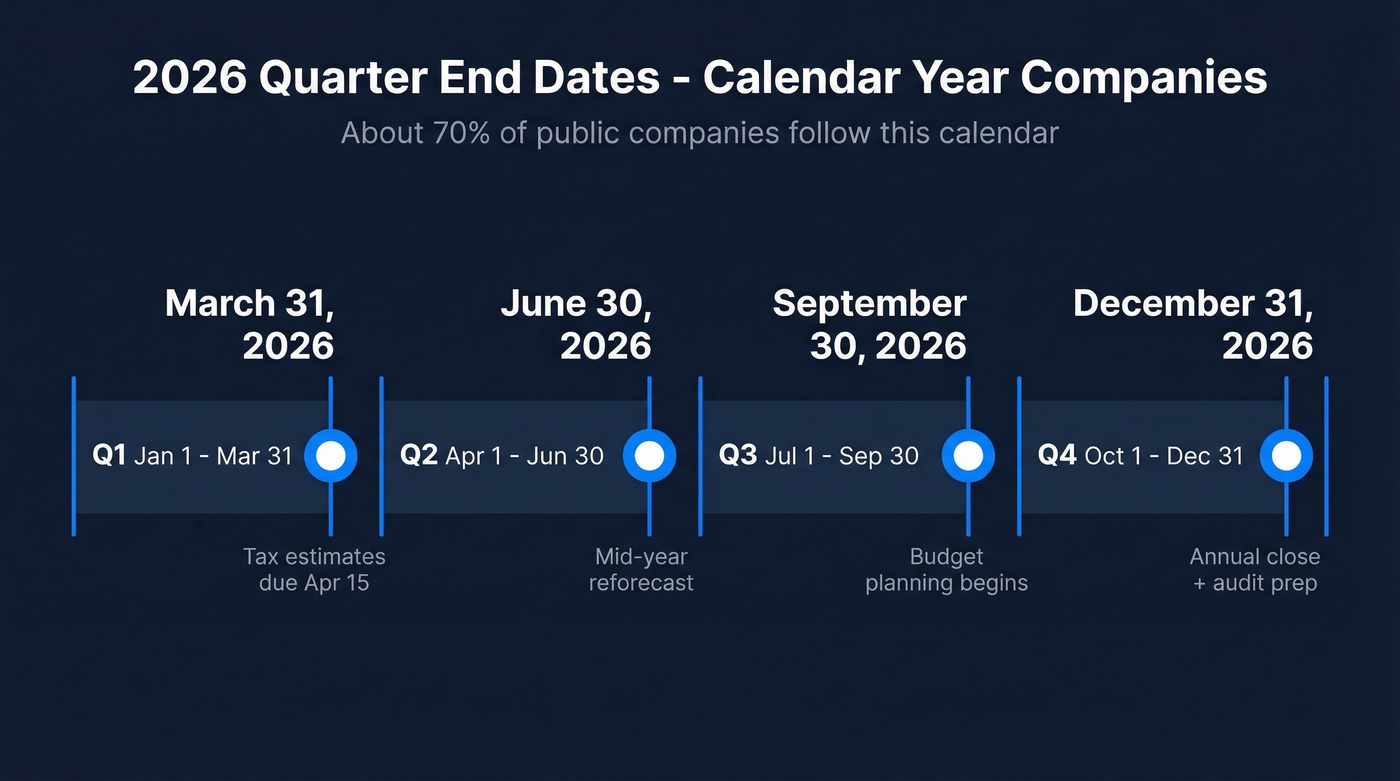
| Quarter | Period | Ends |
|---|---|---|
| Q1 | Jan 1 - Mar 31 | March 31 |
| Q2 | Apr 1 - Jun 30 | June 30 |
| Q3 | Jul 1 - Sep 30 | September 30 |
| Q4 | Oct 1 - Dec 31 | December 31 |
Not every company follows the calendar, though. Here are the most common non-calendar fiscal year-ends and why they exist:
| Company / Sector | FY Ends | Rationale |
|---|---|---|
| Apple | September | Captures iPhone launch cycle |
| Costco | Sunday nearest Aug 31 | Closes after summer peak |
| Many retailers | January 31 | Captures full holiday season |
| U.S. Government | September 30 | Federal fiscal year |
| Defense contractors | September 30 | Aligns to federal budgets |
| Financial services | March 31 | Regulatory alignment |
If you're in finance, pin your company's fiscal calendar somewhere visible. If you're in sales, know your prospect's fiscal calendar - it tells you when they're making buying decisions.
Why Quarter End Matters
This isn't just an accounting exercise. It's the moment when several critical business functions converge, and where short-term thinking can quietly take over.
SEC reporting. Public companies must file Form 10-Q for Q1, Q2, and Q3. Filing deadlines depend on filer status: large accelerated and accelerated filers typically get 40 days, non-accelerated filers get 45. Miss the deadline and you risk SEC scrutiny.
Performance evaluation. Quarterly results drive comp decisions, promotion conversations, and headcount planning. Sales teams live and die by the quarterly number. If you're trying to make the number more predictable, tighten your sales operations metrics and review them weekly.
Budget reassessment. Finance teams use quarterly actuals to reforecast the year. If Q1 came in 15% under plan, Q2 budgets get adjusted - sometimes painfully.
Earnings and investor relations. Earnings calls happen within weeks of the close, and the numbers your finance team produces flow directly into what the CEO tells Wall Street.
Vendor and contract decisions. Procurement teams often align contract renewals and new vendor evaluations to quarterly cycles, which is why sales teams see a spike in inbound activity during the last two weeks of every quarter.
Window dressing. Portfolio managers frequently adjust holdings right before the close to make their reports look better. It's a well-known market behavior that can distort short-term signals.
Estimated tax payments. The close of each quarter also triggers estimated tax deadlines for individuals and pass-through entities (Form 1040-ES), which is easy to forget until the penalty notice arrives.
Here's what most finance leaders won't say out loud: quarterly reporting incentivizes short-term decision-making. Teams optimize for the 90-day number at the expense of longer-term bets. If you want a more honest view of business performance, trailing-twelve-month (TTM) analysis strips out the quarterly noise and shows the actual trend. Use quarterly reporting for compliance and communication - but make strategic decisions on TTM data.

The last two weeks of every quarter are your highest-intent window - but stale data means bounced emails and missed deals. Prospeo refreshes every record on a 7-day cycle, so your contact data is live when buyers are making end-of-quarter decisions. 98% email accuracy. $0.01 per lead.
Stop losing EOQ deals to bad data. Start reaching real buyers.
The Close Process in Five Phases
This is where the real work happens. A well-run close follows five phases, each with clear owners and deadlines. The goal is to move from raw transactions to approved financial statements in a predictable, repeatable cycle.
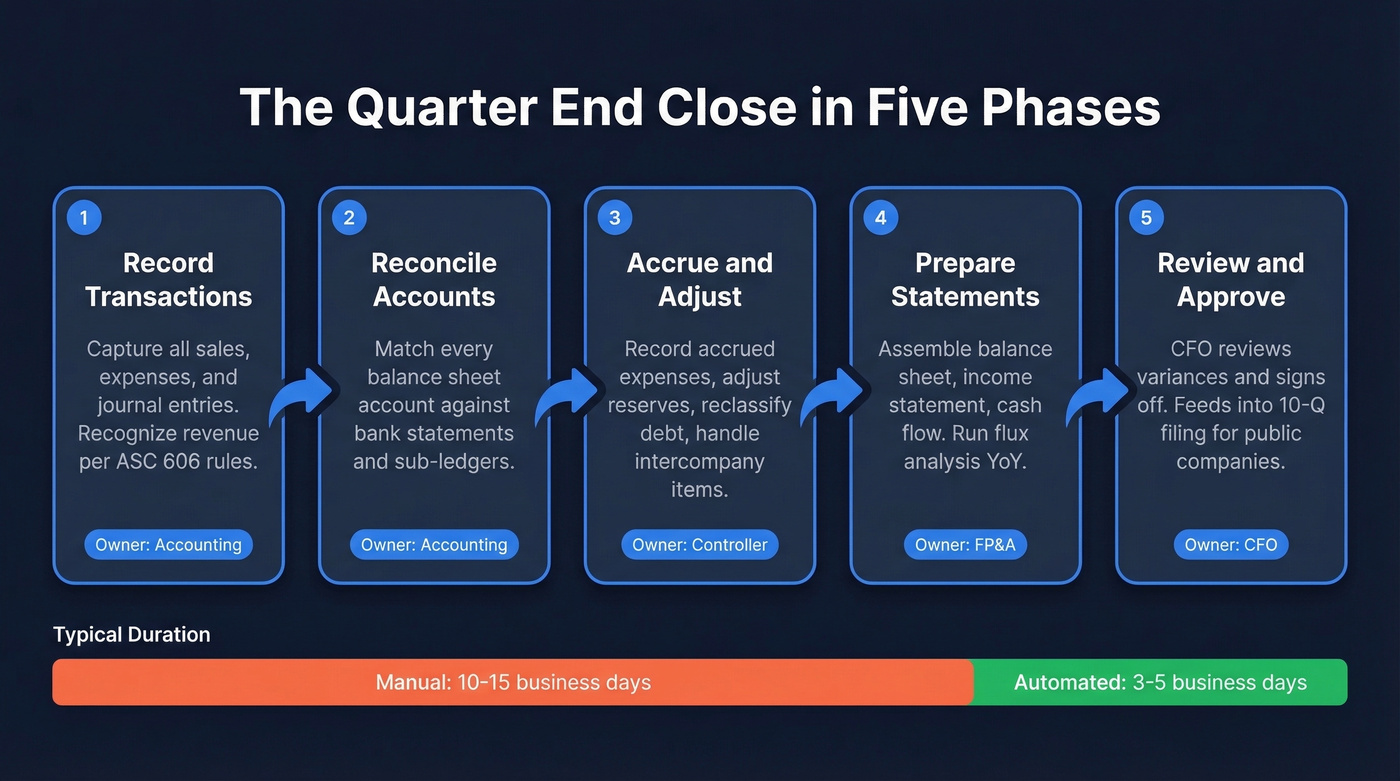
Phase 1: Record all transactions. Every sale, expense, and journal entry for the quarter needs to be captured. This means confirming that revenue is recognized correctly under ASC 606 - matching revenue to performance obligations, not just booking it when cash hits the account. The accounting team owns this, and it should be substantially complete before the period even ends if you're running monthly closes properly.
Phase 2: Reconcile accounts. Bank accounts, credit cards, AR, AP, inventory - every significant balance sheet account gets reconciled against external statements and sub-ledgers. This is where skipping monthly reconciliations comes back to haunt you. If you haven't reconciled since last quarter, you're doing three months of detective work in a few days.
Phase 3: Accrue and adjust. Record accrued expenses that haven't been invoiced yet, adjust reserves, reclassify short-term vs. long-term debt, and handle any intercompany eliminations. The quarterly close requires more diligence on reserves and adjustments than a standard monthly close.
Phase 4: Prepare financial statements. Balance sheet, income statement, and cash flow statement get assembled. Flux analysis compares current quarter to prior quarter and same quarter last year. Quarter-to-quarter comparisons can mislead due to seasonality, so year-over-year is the standard benchmark.
Phase 5: Review and approve. The controller or CFO reviews the statements, investigates variances, and signs off. For public companies, this feeds directly into the 10-Q filing.
The whole cycle commonly runs 10-15 business days for teams doing it manually. A published close schedule - with every task assigned to a specific person and a specific deadline - is the single biggest lever for keeping it on track. We've seen teams cut days off their close just by making the calendar visible to everyone involved.
Month-End vs. Quarter vs. Year-End
Not all closes are created equal. A "soft close" means internal-only reporting with minimal adjustments; a "hard close" means full reconciliation and external reporting.
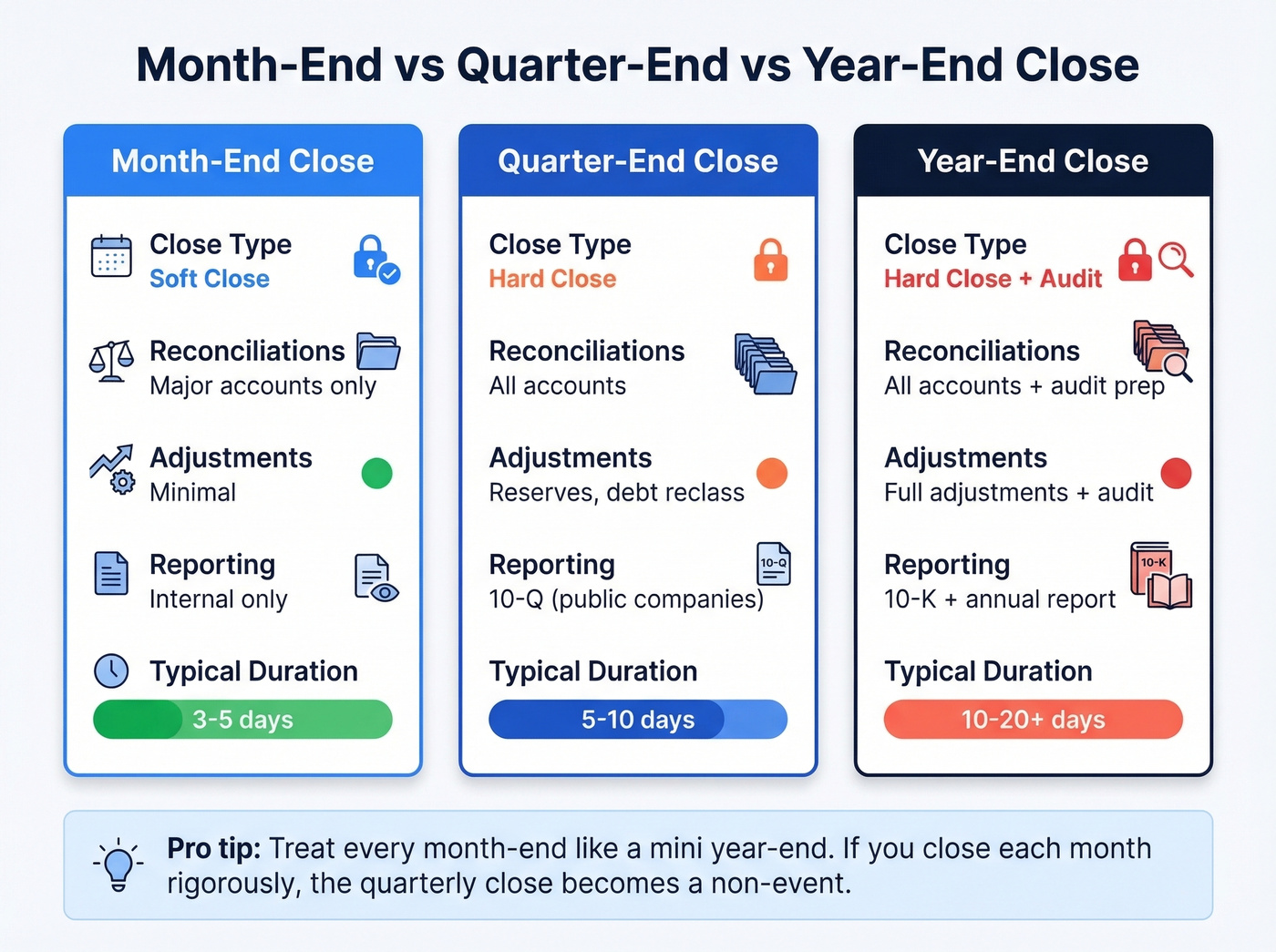
| Month-End | Quarter-End | Year-End | |
|---|---|---|---|
| Type | Soft close | Hard close | Hard close + audit |
| Reconciliations | Major accounts | All accounts | All accounts + audit prep |
| Adjustments | Minimal | Reserves, debt reclass | Full adjustments + audit |
| Reporting | Internal only | 10-Q (public cos) | 10-K + annual report |
| Typical duration | 3-5 days | 5-10 days | 10-20+ days |
The smartest finance teams treat every month-end like a mini year-end. The philosophy is simple: if you close each month rigorously, the quarterly close becomes a non-event - just a monthly close with a few extra steps.
In our experience, the teams that struggle most treat this as a quarterly event instead of a monthly discipline. They defer reconciling marketing invoices, adjusting long-term liabilities, and updating reserves until the deadline forces them to. That works in theory, as long as you're not deferring so much that the close becomes a backlog clearance exercise.
Year-end adds the audit layer - external auditors reviewing everything, the annual report getting assembled, and the board deck getting finalized. If your quarterly closes are clean, year-end is manageable. If they're not, expect late nights in January.
Five Mistakes That Slow Your Close
1. No close schedule. Without a published calendar assigning tasks, owners, and deadlines, the close devolves into a series of Slack messages asking "is this done yet?" A shared project board or even a spreadsheet with dates beats nothing.
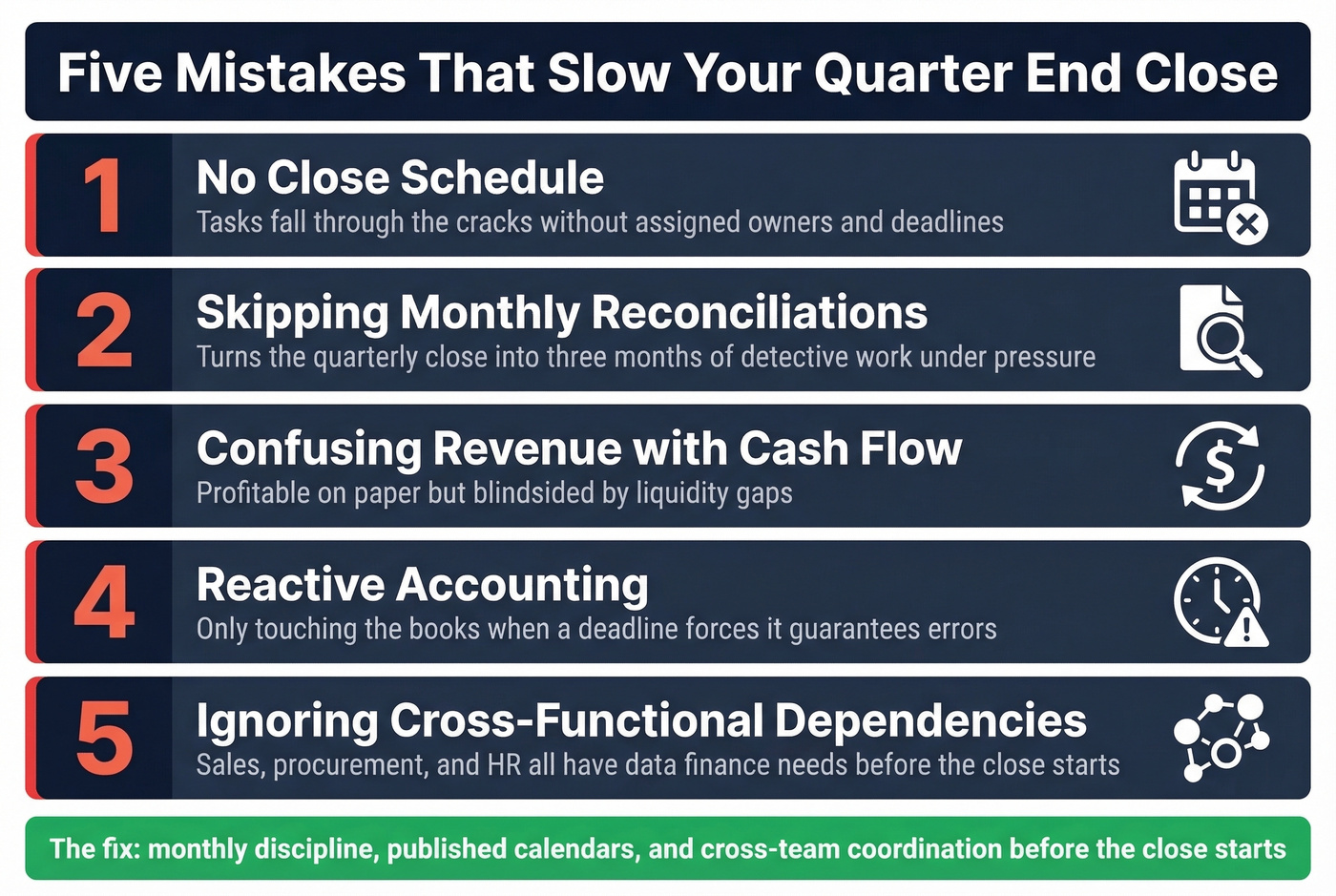
2. Skipping monthly reconciliations. This is the most common and most painful mistake. When you don't reconcile monthly, the quarterly close becomes a forensic exercise - hunting down three months of discrepancies under deadline pressure. Reconcile significant balance sheet accounts monthly. Full stop.
3. Confusing revenue with cash flow. A profitable quarter on paper means nothing if cash collections are lagging. Teams that don't monitor cash flow separately from revenue recognition get blindsided by liquidity gaps right when they're reporting strong numbers.
4. Reactive accounting. Some teams only touch the books when a deadline forces them to - payroll, tax filing, the close. This catch-up approach guarantees errors and late closes. Consistent, proactive bookkeeping throughout the quarter is the fix.
5. Ignoring cross-functional dependencies. The close doesn't happen in a finance vacuum. Sales needs to confirm deal terms for revenue recognition. Procurement needs to submit invoices. HR needs to finalize headcount for compensation accruals. If you're not coordinating across departments before the close starts, you'll be chasing people during it.
Tools to Automate Your Close
The financial close software market has grown to $5.8B at a 12% CAGR, and for good reason - organizations deploying close automation typically reduce cycle time by 30-50% in the first year, bringing a 10-15 day manual close down to 3-5 business days.
| Tool | Best For | Pricing | Deploy Time |
|---|---|---|---|
| FloQast | Mid-market teams | ~$30K-$120K/yr | 4-8 weeks |
| Numeric | Smaller teams | $30/user/mo | Days to weeks |
| BlackLine | Enterprise (4,300+ cos) | ~$150K-$500K+/yr | 3-6 months |
| OneStream | Multi-entity CPM | ~$200K+/yr | Months |
| Workiva | SEC filing (75%+ of F500) | ~$100K-$300K/yr | 6-10 weeks |
FloQast is the mid-market sweet spot. It's purpose-built for the close and deploys in weeks instead of months. If you're a 50-500 person company running QuickBooks or NetSuite, FloQast is your first call.
Skip Numeric if you need enterprise-grade consolidation. But for smaller teams that want task management, reconciliation tracking, and flux analysis without a five-figure annual commitment, it's the best entry point at $30/user/month.
BlackLine is the enterprise standard with 4,300+ customers and a full suite covering reconciliations, journal entries, intercompany, and variance analysis. The price tag and implementation timeline reflect that scope. If you're a public company with complex multi-entity accounting, BlackLine earns its cost. For a 200-person SaaS company, it's overkill.
OneStream and Workiva serve different enterprise needs. OneStream is a full CPM suite for multi-entity consolidation. Workiva dominates SEC filing workflows - 75%+ of the Fortune 500 use it for regulatory reporting.
EOQ Sales Playbook and Forecasting
Now for the other side of quarter end - the one that doesn't involve reconciliations.
There's a post on r/sales that captures the EOQ dynamic perfectly. A seller describes how executive interference and internal pressure to close deals before the number resets actually killed a deal - because the buyer didn't care about the seller's Q1 deadline. The buyer had their own budget process, their own timeline, and pushing an artificial deadline just eroded trust.
Let's be honest: artificial urgency at the close of a quarter backfires more often than it works. Buyers can smell desperation. Discounting to pull a deal forward trains your market to wait for EOQ to get a better price. It's a losing cycle.
The smarter approach is to invest in forecasting early - building a realistic view of which deals will actually close by the deadline and which ones are wishful thinking. Reliable EOQ deal forecasts separate high-performing sales orgs from the ones that scramble every 90 days. And that forecasting discipline protects your full-year outlook too: when your Q1 through Q3 numbers are built on honest pipeline assessments rather than inflated commit numbers, the annual forecast stays credible with leadership and the board.
But the final weeks of a fiscal quarter are genuinely the highest-intent prospecting window of the cycle. Companies are flushing remaining budget, evaluating vendor renewals, and making purchase decisions before the next period's priorities take over. If you're reaching out to the right people at the right time, this is when doors open.
If you're trying to maximize the last two weeks, tighten your sales prospecting motion and keep your personalized outreach consistent across channels.
You know your prospect's fiscal calendar. You know budgets expire at quarter end. But none of that matters if you're dialing dead numbers. Prospeo gives you 125M+ verified mobile numbers with a 30% pickup rate - so your reps connect with decision-makers while the budget window is still open.
Get direct dials that actually pick up during the EOQ sprint.
FAQ
What are the quarter-end dates for 2026?
For calendar-year companies: March 31 (Q1), June 30 (Q2), September 30 (Q3), and December 31 (Q4). Companies with non-calendar fiscal years - like Apple (September) or most retailers (January 31) - have different dates entirely.
How long does a typical close take?
Manual closes run 10-15 business days. With close automation software like FloQast or BlackLine, teams typically compress that to 3-5 days - a 30-50% reduction in the first year of deployment.
What is a 10-Q filing?
A 10-Q is an unaudited quarterly financial report that U.S. public companies file with the SEC for Q1, Q2, and Q3. Large accelerated filers have 40 days after the period ends; non-accelerated filers get 45. The annual 10-K, filed after Q4, is audited.
How can EOQ forecasting improve pipeline accuracy?
Disciplined EOQ forecasting forces sales managers to pressure-test each opportunity against objective criteria - confirmed budget, identified decision-maker, and a timeline matching the buyer's process. Teams running this consistently see fewer "surprise slips" in the final week and more credible full-year projections.
How do I find contacts for end-of-quarter outreach?
Use a B2B data platform with weekly-refreshed contacts. Prospeo refreshes 300M+ profiles every 7 days with 98% email accuracy and 125M+ verified mobiles - critical when a two-week budget window means bounced emails equal missed deals. You can start free with 75 verified emails per month.